

Church Embracing Refugees
 |
Description
Book Introduction
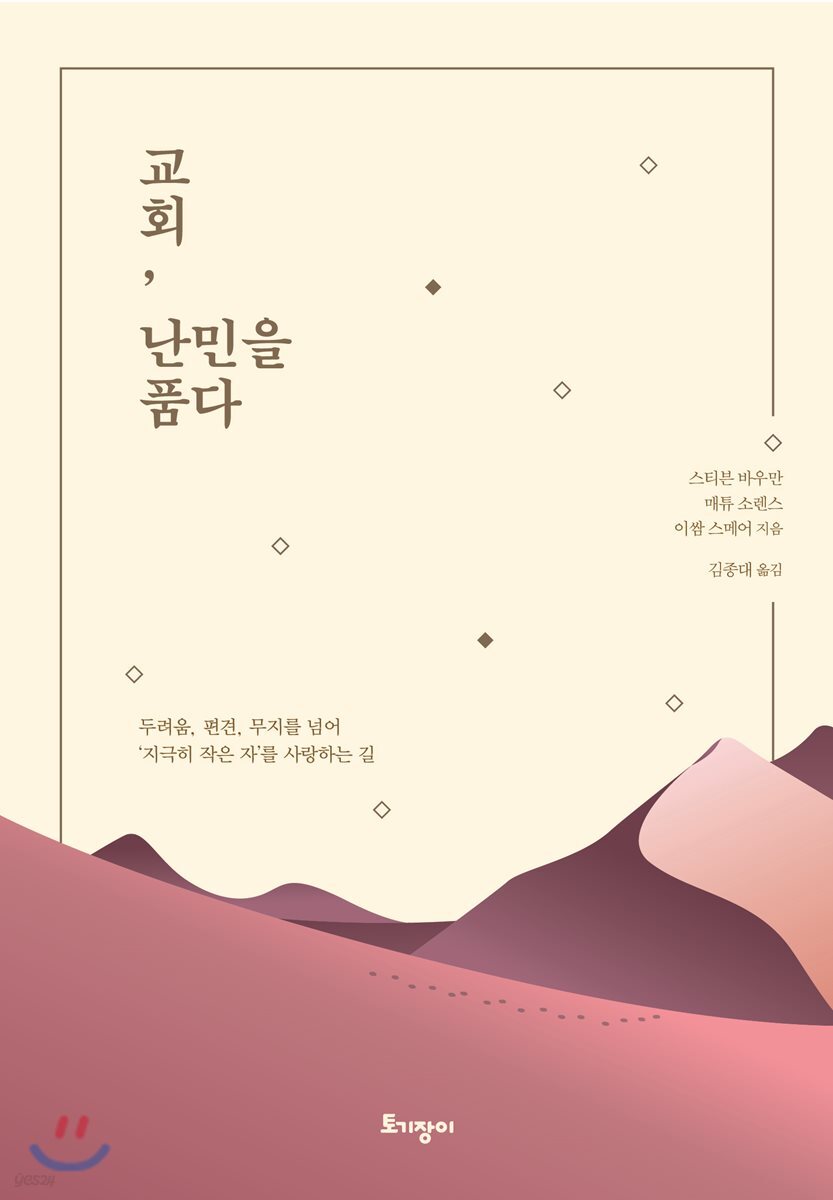
“What would you do?” How should the church and Christians respond to the refugee crisis that has permeated our lives? The three authors, who served as CEO, director, and clinical consultant at World Relief, wrote this book while working on a joint project with World Relief. The authors argue persuasively that the church must now be at the center of solving the refugee crisis, as “welcome the stranger” is the most frequently repeated commandment in the Old Testament, aside from the command to serve God alone. |
- You can preview some of the book's contents.
Preview
index
Recommendation
1.
“What would you do?”
2.
Jesus was also a refugee
3.
There are people there too
4.
Why We Are Not Afraid
5.
The Refugee Resettlement Process: From Strangers to Family
6.
Other categories of displaced persons
7.
Now is the time for the church to step up.
8.
The best healing experiences come through relationships.
9.
Addressing the larger context in which refugees arise
10.
What we can do
11.
A chance to shine in the world
supplement
Acknowledgements
main
Translator's Note
1.
“What would you do?”
2.
Jesus was also a refugee
3.
There are people there too
4.
Why We Are Not Afraid
5.
The Refugee Resettlement Process: From Strangers to Family
6.
Other categories of displaced persons
7.
Now is the time for the church to step up.
8.
The best healing experiences come through relationships.
9.
Addressing the larger context in which refugees arise
10.
What we can do
11.
A chance to shine in the world
supplement
Acknowledgements
main
Translator's Note
Into the book
The debate over refugees and their domestic settlement has also divided the church.
Many Christians have been torn between their instinctive duty to protect themselves and their families and their responsibility to serve the vulnerable with compassion.
How Christ's disciples respond to this conflict will determine whether they can provide the next generation with an answer to the question, "What is the church?"
_1.
“What would you do?”
As has always been the case throughout history, God is working through the movement of refugees and migrants.
If you wish to join in this calling, you must first recognize that there is much to be harvested, and you must look at this issue from a biblical perspective, transcending political and economic understandings of the refugee situation.
_2.
Jesus was also a refugee
Only when we respond to Muslims with love and respect can we seize the incredible opportunity to lead them to Jesus.
Conversely, when we demonize or avoid them, we not only risk committing the sin of slander, but we also deprive them of the opportunity to consider following Jesus and play into the ploy of extremists who hope to turn marginalized Muslims against Christians.
When it comes to addressing the refugee issue, it's legitimate to express concern and to expect our government to act thoughtfully.
But I believe there is actually little reason to be afraid.
Many of the economic, legal, religious and security concerns are either misunderstood or exaggerated.
Even if it is not actually safe to welcome refugees, God's commandment still holds true.
He says not to “fear” because there is nothing to fear, but to “fear not” because “I am with you,” because “God is our refuge and strength, a very present help in trouble.”
_3.
Why We Are Not Afraid
The government must classify, but the church can love its neighbors without discrimination.
Because each of us is created in the image of God, is a person for whom Christ died, and is a neighbor we are called to love.
_6.
Other categories of displaced persons
We hope that the church will shine through the refugee crisis.
By the same resurrection power that raised Jesus from the dead, I pray that all God's people will rise up and welcome strangers with unprecedented hospitality, doing what God has called us to do.
_11.
A chance to shine in the world
Many Christians have been torn between their instinctive duty to protect themselves and their families and their responsibility to serve the vulnerable with compassion.
How Christ's disciples respond to this conflict will determine whether they can provide the next generation with an answer to the question, "What is the church?"
_1.
“What would you do?”
As has always been the case throughout history, God is working through the movement of refugees and migrants.
If you wish to join in this calling, you must first recognize that there is much to be harvested, and you must look at this issue from a biblical perspective, transcending political and economic understandings of the refugee situation.
_2.
Jesus was also a refugee
Only when we respond to Muslims with love and respect can we seize the incredible opportunity to lead them to Jesus.
Conversely, when we demonize or avoid them, we not only risk committing the sin of slander, but we also deprive them of the opportunity to consider following Jesus and play into the ploy of extremists who hope to turn marginalized Muslims against Christians.
When it comes to addressing the refugee issue, it's legitimate to express concern and to expect our government to act thoughtfully.
But I believe there is actually little reason to be afraid.
Many of the economic, legal, religious and security concerns are either misunderstood or exaggerated.
Even if it is not actually safe to welcome refugees, God's commandment still holds true.
He says not to “fear” because there is nothing to fear, but to “fear not” because “I am with you,” because “God is our refuge and strength, a very present help in trouble.”
_3.
Why We Are Not Afraid
The government must classify, but the church can love its neighbors without discrimination.
Because each of us is created in the image of God, is a person for whom Christ died, and is a neighbor we are called to love.
_6.
Other categories of displaced persons
We hope that the church will shine through the refugee crisis.
By the same resurrection power that raised Jesus from the dead, I pray that all God's people will rise up and welcome strangers with unprecedented hospitality, doing what God has called us to do.
_11.
A chance to shine in the world
--- From the text
Publisher's Review
Armed with biblical, missional, and factual information, this book explores from a missionary perspective why the church must wisely and courageously welcome refugees.
The authors emphasize that the solution to the refugee problem must be thoroughly sought from the Bible.
So, he says he wrote this book to tell what the Bible says about refugees, to provide accurate information about the current situation of refugees, and to believe that the local church is the hope of the world.
They consistently emphasize that the Church, the body of Jesus Christ, must stand at the center of the global refugee crisis.
In other words, it is time for Western churches and Christians to seriously consider and respond to the refugee issue, and to welcome and serve the refugees who have infiltrated our midst.
This book comes at a crucial time, as the world grapples with the largest refugee crisis in history.
Since our country is no longer an exception to this refugee issue, this book will also deliver an important message to the Korean church.
This is because the government and the church have shown that they are completely unprepared for the refugee issue by deciding to accept the number of Yemeni refugees who recently arrived on Jeju Island.
In a situation where refugees have literally reached the church doors, God seems to be asking the churches in a quiet voice:
“What would you do?” How we view and respond to the refugee crisis ultimately depends on whether we respond to the calling as disciples.
In order to live as good Samaritans of this age, looking to Jesus, a stranger who accompanied the long line of forced migration, and so that the commandment to welcome strangers no longer becomes a forgotten commandment, the church and Christians must remain awake.
[For readers]
- A believer who is interested in the refugee issue
- A believer who is dedicated to serving the marginalized
- A pastor who ponders biblical solutions to the refugee problem.
The authors emphasize that the solution to the refugee problem must be thoroughly sought from the Bible.
So, he says he wrote this book to tell what the Bible says about refugees, to provide accurate information about the current situation of refugees, and to believe that the local church is the hope of the world.
They consistently emphasize that the Church, the body of Jesus Christ, must stand at the center of the global refugee crisis.
In other words, it is time for Western churches and Christians to seriously consider and respond to the refugee issue, and to welcome and serve the refugees who have infiltrated our midst.
This book comes at a crucial time, as the world grapples with the largest refugee crisis in history.
Since our country is no longer an exception to this refugee issue, this book will also deliver an important message to the Korean church.
This is because the government and the church have shown that they are completely unprepared for the refugee issue by deciding to accept the number of Yemeni refugees who recently arrived on Jeju Island.
In a situation where refugees have literally reached the church doors, God seems to be asking the churches in a quiet voice:
“What would you do?” How we view and respond to the refugee crisis ultimately depends on whether we respond to the calling as disciples.
In order to live as good Samaritans of this age, looking to Jesus, a stranger who accompanied the long line of forced migration, and so that the commandment to welcome strangers no longer becomes a forgotten commandment, the church and Christians must remain awake.
[For readers]
- A believer who is interested in the refugee issue
- A believer who is dedicated to serving the marginalized
- A pastor who ponders biblical solutions to the refugee problem.
GOODS SPECIFICS
- Date of issue: February 25, 2019
- Page count, weight, size: 268 pages | 348g | 140*200*20mm
- ISBN13: 9788977824119
- ISBN10: 8977824117
You may also like
카테고리
korean


korean

![GQ KOREA Mark (Monthly): December [2025]](http://librairie.coreenne.fr/cdn/shop/files/8ef265dbbfbf186523ed75ba7319009d.jpg?v=1765340328&width=3840)


