

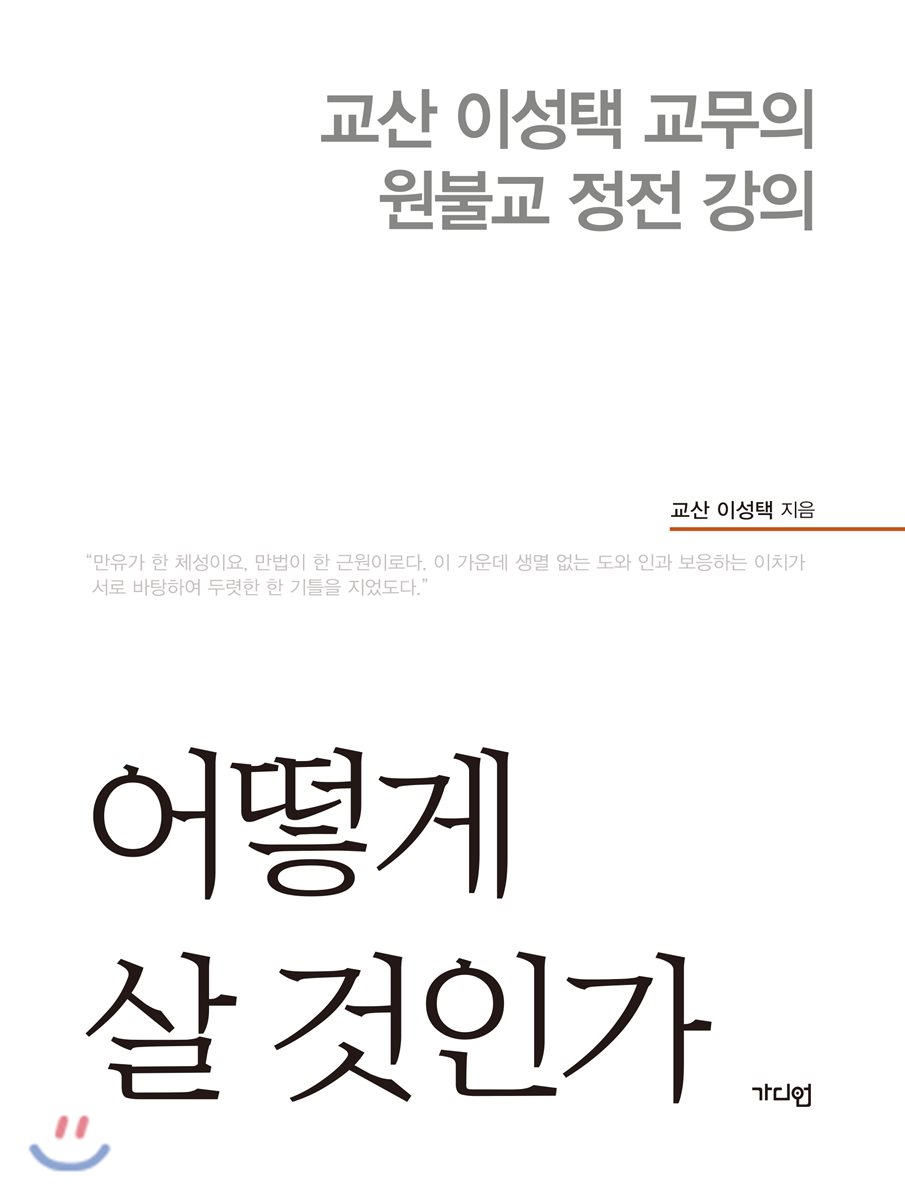
How to live
 |
Description
Book Introduction
How should we live now?
Former head of the correctional facility, Lee Seong-taek, presents a life direction through a lecture!
Pastor Lee Seong-taek of Kyo-san spared no effort in establishing the spirit of this era through lectures on the doctrines of Won Buddhism by Daejongsa on the WBS original broadcast.
This newly published book was written based on the lectures given during this lecture on the Jeongjeon section, the core of the Won Buddhism scriptures.
"How to Live" is a massive 580-page book that contains all the methods and teachings of how he governed and practiced his body and mind while living his life as a monk in the Won Buddhism sect.
Rather than discussing the afterlife or the next life, this book explains the reason and purpose of our existence in this life, the present, and offers a profound insight into the future humanity will face, even suggesting countermeasures.
Although it is based on the doctrine of Won Buddhism, the entire content constantly asks the question, “How should we live our lives?”
It is enough to serve as a solid guide for our lives, which are exhausted by the speed of material civilization.
According to Pastor Lee Seong-taek, 'living well' means living while accumulating blessings, and accumulating blessings means giving to others.
His idea is that to build up fortune, you must use your body, mind, and money, and to do so, you must always practice your mind.
Therefore, giving to others is not only for the sake of others.
If you accumulate blessings, eventually all of those blessings will return to you.
That is the core of the law of cause and effect that Won Buddhism speaks of, and it is the wisdom and principle of living together.
Former head of the correctional facility, Lee Seong-taek, presents a life direction through a lecture!
Pastor Lee Seong-taek of Kyo-san spared no effort in establishing the spirit of this era through lectures on the doctrines of Won Buddhism by Daejongsa on the WBS original broadcast.
This newly published book was written based on the lectures given during this lecture on the Jeongjeon section, the core of the Won Buddhism scriptures.
"How to Live" is a massive 580-page book that contains all the methods and teachings of how he governed and practiced his body and mind while living his life as a monk in the Won Buddhism sect.
Rather than discussing the afterlife or the next life, this book explains the reason and purpose of our existence in this life, the present, and offers a profound insight into the future humanity will face, even suggesting countermeasures.
Although it is based on the doctrine of Won Buddhism, the entire content constantly asks the question, “How should we live our lives?”
It is enough to serve as a solid guide for our lives, which are exhausted by the speed of material civilization.
According to Pastor Lee Seong-taek, 'living well' means living while accumulating blessings, and accumulating blessings means giving to others.
His idea is that to build up fortune, you must use your body, mind, and money, and to do so, you must always practice your mind.
Therefore, giving to others is not only for the sake of others.
If you accumulate blessings, eventually all of those blessings will return to you.
That is the core of the law of cause and effect that Won Buddhism speaks of, and it is the wisdom and principle of living together.
- You can preview some of the book's contents.
Preview
index
How to live as we enter
How was the blackout created?
Part 1: On the Blackout - General Book
Chapter 1: Why Study the Mind? - The Motivation for Opening a School
Chapter 2: Where Are We Going? - A General Introduction to the Doctrine
Part 2: The Great Currents of the Open Era - Doctrine
Chapter 1: What the Circle Means - Ilwonsang
The Truth of Ilwonsang | The Faith of Ilwonsang | The Practice of Ilwonsang | The Vow of Ilwonsang | The Dharma Speech of Ilwonsang | Song
Chapter 2: How to Be Kind to Others - Gratitude
Cheon Ji-eun | Parents | Dongpo | Law
Chapter 3: On the Four Kinds of Unrighteousness - Sayo
Self-reliance ㅣ Self-centeredness ㅣ Education of children of others ㅣ Worship of the public servant
Chapter 4: Three Study Methods of Practice - Samhak
Mental cultivation | Study of the truth | Cooking
Chapter 5: Eight Ways of Mind Learning - Paljo
Progress Group 4 | Story Group 4
Chapter 6: Illuminating the Path of Life and Studying the Mind - The Key to Life and the Key to Studying
Chapter 7: Four Ways to Know the Truth - The Four Great Tenets
Part 3: Practical Methods in the Open Era - Practice
Chapter 1: How to Practice in Life - Therapeutics for Daily Practice
Chapter 2: How to Train: Regular and Continuous Training
Regular Training Method | Continuous Training Method | The Relationship Between Regular Training Method and Continuous Training Method
Chapter 3: Gathering Ten Thousand Boundaries into a Single Thought - The Recitation of the Buddha's Name
Chapter 4: Letting Wandering Thoughts Rest - Sitting Meditation
Chapter 5: List of Questions to Ask - Topics
Chapter 6: Evaluating the Overall Training - Diary Method
Chapter 7: Meditation Anywhere, Anytime - The Method of Ishi Zen
Chapter 8: Reflecting on Past Mistakes - A Letter of Confession
Chapter 9: How to Practice the Faith of the One Person - Simgo and Prayer
Chapter 10: Paying Attention to the Buddha - The Method of Paying Attention to the Buddha
Chapter 11: The Thirty Precepts to Be Observed - The Precepts
Chapter 12: How to Govern Your Character - Theory of Solseong
Chapter 13: The First Sermon after the Great Awakening - The First Dharma Talk
Chapter 14: Escape from Pain and Pleasure - A Dharma Talk on Pleasure and Satisfaction
Chapter 15: How Can a Sick World Be Healed? - A Sick Society and Its Treatment
Chapter 16: Learning Mind and Body Together - The Dual Law of Spirit and Body
Chapter 17: Step-by-Step Goals of Mind Learning - Dharma Levels
And about the trends of this era
How was the blackout created?
Part 1: On the Blackout - General Book
Chapter 1: Why Study the Mind? - The Motivation for Opening a School
Chapter 2: Where Are We Going? - A General Introduction to the Doctrine
Part 2: The Great Currents of the Open Era - Doctrine
Chapter 1: What the Circle Means - Ilwonsang
The Truth of Ilwonsang | The Faith of Ilwonsang | The Practice of Ilwonsang | The Vow of Ilwonsang | The Dharma Speech of Ilwonsang | Song
Chapter 2: How to Be Kind to Others - Gratitude
Cheon Ji-eun | Parents | Dongpo | Law
Chapter 3: On the Four Kinds of Unrighteousness - Sayo
Self-reliance ㅣ Self-centeredness ㅣ Education of children of others ㅣ Worship of the public servant
Chapter 4: Three Study Methods of Practice - Samhak
Mental cultivation | Study of the truth | Cooking
Chapter 5: Eight Ways of Mind Learning - Paljo
Progress Group 4 | Story Group 4
Chapter 6: Illuminating the Path of Life and Studying the Mind - The Key to Life and the Key to Studying
Chapter 7: Four Ways to Know the Truth - The Four Great Tenets
Part 3: Practical Methods in the Open Era - Practice
Chapter 1: How to Practice in Life - Therapeutics for Daily Practice
Chapter 2: How to Train: Regular and Continuous Training
Regular Training Method | Continuous Training Method | The Relationship Between Regular Training Method and Continuous Training Method
Chapter 3: Gathering Ten Thousand Boundaries into a Single Thought - The Recitation of the Buddha's Name
Chapter 4: Letting Wandering Thoughts Rest - Sitting Meditation
Chapter 5: List of Questions to Ask - Topics
Chapter 6: Evaluating the Overall Training - Diary Method
Chapter 7: Meditation Anywhere, Anytime - The Method of Ishi Zen
Chapter 8: Reflecting on Past Mistakes - A Letter of Confession
Chapter 9: How to Practice the Faith of the One Person - Simgo and Prayer
Chapter 10: Paying Attention to the Buddha - The Method of Paying Attention to the Buddha
Chapter 11: The Thirty Precepts to Be Observed - The Precepts
Chapter 12: How to Govern Your Character - Theory of Solseong
Chapter 13: The First Sermon after the Great Awakening - The First Dharma Talk
Chapter 14: Escape from Pain and Pleasure - A Dharma Talk on Pleasure and Satisfaction
Chapter 15: How Can a Sick World Be Healed? - A Sick Society and Its Treatment
Chapter 16: Learning Mind and Body Together - The Dual Law of Spirit and Body
Chapter 17: Step-by-Step Goals of Mind Learning - Dharma Levels
And about the trends of this era
Into the book
About living well in this era
The era we live in is called the era of the Fourth Industrial Revolution.
And as we all sense in our daily lives, the Fourth Industrial Revolution is bringing about profound changes to human life.
Not only is life changing, but the pace of change is so fast that it can be dizzying.
Now, no one on Earth can live independently of this change and its pace.
I receive over 10 text messages every morning.
The texts are diverse, including columns and daily common sense, and I'm now used to starting my day by reading them.
But sometimes, I get confused because new words and terms I've never heard of appear in this text.
For example, I come across words like AI, blockchain, connected cars, and the Internet of Things through text, and every time I do, I realize that this era is changing at an incredible pace, regardless of my actions.
The Fourth Industrial Revolution, like previous industrial revolutions, is a material civilization achieved through human technology.
Of course, it is providing convenience to humanity at a speed incomparable to that of the industrial revolution of the past.
But the convenience also has its downsides.
The shelf life of knowledge acquired by people is becoming incredibly short, and we are constantly struggling to keep up with the flow.
There is also a risk that our entire daily lives will be paralyzed by an unexpected event, like the recent KT base station fire.
Even in this age of advanced material civilization, basic problems related to livelihood, such as youth unemployment, remain unresolved.
So, I think that in times like these, people need to ask themselves, "How should we live?"
Human problems that cannot be solved by the development of material civilization cannot avoid asking such questions.
In fact, this question has been raised in various forms since ancient times.
If we look for a closer example, we can look at the ideology raised by the common people during the late Joseon Dynasty.
At a time when the nation's fortunes were declining and the world powers were forcefully demanding the opening of its doors, the common people created an ideology in hopes of the nation's revival.
That ideology is a reflection of the cultural soil that was only possible in Joseon.
That ideology is the idea of Gaebyeok.
Ten openings, ten walls to open.
The first person to bring out this yearning that lies deep within the subconscious of the people was the great monk Suun, who founded Cheondoism.
After his awakening, the great master gave the message to the people, "People are like heaven, so treat people like heaven."
These words of the great priest received explosive cheers from the numerous people who were not treated as human beings at the time.
A great number of people gathered at Gyeongju Yongdam and confirmed that they were in heaven.
For those who are fed up with the caste system, this may not be a huge thought.
Those in power saw it as a religion that would shake up the system in which they held vested interests.
So, the great priest who first advocated the ideological movement was executed by the government officials.
Less than four years after his death, he was executed in Daegu, where the Gyeongsang Provincial Office was located.
The person who followed in the footsteps of the great monk and advocated a new history of enlightenment was the angel Kang Jeungsan who founded the Jeungsan religion.
He attained enlightenment at Daewonsa Temple on Mt. Moak, called himself Sangje, and gathered people through numerous miracles.
Of course, he advocated a new era of the creation of the world.
The Angel of Zengshan has attained great enlightenment and has clarified the ways of heaven and earth. He defines the pre-heavenly era as the era of conflict and the post-heavenly era as the era of mutual creation.
He saw that the innate world was a time of conflict, so they were divided, fought, and split.
They are entangled in conflict with each other, fighting a war, and their resentment is building up in the realm of the gods.
That is, the resentment from the fights in the pre-heavenly era is fully dissolved in the yin realm.
Because the ethereal world and the real world are interconnected and interact with each other, it is impossible for the real world to become a world of mutual prosperity until this grudge is resolved.
So, the Angel of Increase performs a work of heaven and earth to resolve the grudges of the people of the new world.
Through this grand project, all the resentment from the prehistoric era will be completely resolved.
But will the era of the virtuous creation of the post-heavenly world arrive immediately? Not yet.
The division of the pre-heavenly era is fundamentally caused by the division of the divine order.
Division and war arose because each household, each region, each country, each nation, and each religion worshipped different gods.
So, the angel Kang Jeung-san is working to unify all of these divided shrines into one shrine.
This is the Unification Shrine construction.
The unification of the new world is the foundation for uniting the real world.
During this series of construction projects for the creation of the heavens and the earth, nine years after the Great Awakening, a sudden disaster occurred.
The last person to advocate the idea of the creation of a new heaven was Daejongsa Park Jung-bin of Sotaesan, who was enlightened in 1916.
After the diagonal, 'All things are one body, and all dharmas are one source.
He expressed his thoughts by saying, 'In the midst of this, the Tao without birth or death and the principle of cause and effect are based on each other and form a clear framework.'
The ideology and thought pursued by the Gaebyeok thought are contained within this diagonal line.
‘One is one’ This is the saying that summarizes the idea of Gaebyuk.
And then we steadily work on concretizing this idea of opening the world and establishing a theoretical system.
In fact, the task of expressing the content of each sensation in words is not that simple.
The two prophets who appeared before us did not have time to do this work.
After attaining enlightenment, Venerable Park Jung-bin of Sotaesan Mountain must have had many tasks to accomplish in the process of founding the Won Buddhism religious order, but it is clear that he knew that putting the ideologies of Gaebyeok into writing and organizing the methods for doing so was his most important task.
So, through various processes, we publish small booklets and carry out a continuous process of compiling scriptures.
It is unprecedented in all religions for a founder of a religion to transcribe what he has realized into scripture.
The scriptures written by the founder himself are the canon of Won Buddhism.
The content of the book, which was completed by Master Sotaesan before he entered nirvana in 1943, is contained in its entirety in the Jeongjeon.
The Won Buddhism Canon is thus a guidebook for the creation of the post-heavenly world, a blueprint for the world of creation, and an ideological book and definitive edition of the idea of creation that was conceived and born among the people of the late Joseon Dynasty.
How should we live? This question has transcended time and is a topic of conversation for all people.
However, in this age where the phenomenon of material enlightenment is approaching like a tidal wave, the question of what kind of spirit we should have in our lives is more important than ever.
And the answer can be found in the Won Buddhism scriptures.
I gave a lecture on this contemporary response through broadcast.
While keeping in mind the founding motto of Won Buddhism, “As matter is being transformed, let us transform our spirits,” I dream of the era of the 5th Industrial Revolution, the era of the Mind Industry, which will follow the 4th Industrial Revolution.
It is not only material things that humans must fight against.
Ultimately, humans must fight against themselves.
The mind is awakened in a fierce battle with itself.
When we awaken our spirit, establish our independence, and use that independence to utilize the millions of materials created by humans, a new world of enlightenment will come to us.
I hope this book will serve as a guide for those who are lost in these times.
- From the introduction
How should we live? This question has transcended time and is a topic of conversation for all people.
However, in this age where the phenomenon of material enlightenment is approaching like a tidal wave, the question of what kind of spirit we should have in our lives is more important than ever.
And the answer can be found right in the Won Buddhism scriptures.
- Page 8, from 'How to Live'
Our Jeongjeon is a sutra that examines the aspect of reminiscence with its origins in Buddhism.
In the process of formation, it was derived from Buddhism, and its first name was Buddhist Jeongjeon.
You should not say, ‘Won Buddhism is not Buddhism.’
Because the Great Master originated from Buddhism and the title of the first sutra is Buddhist Canon.
The identity of Won Buddhism's canon is clearly revealed.
- Page 29, from 'How was the power outage created?'
In the past, Western society was often referred to as a material civilization, and Eastern society was often referred to as a spiritual civilization.
The foundation of the humanities is history.
Perhaps this is why Danjae Shin Chae-ho said, “A nation and people that forget their history have no future.”
But now, in Korea and around the world, those words have become meaningless.
- Page 39, from 'Why Learn the Mind?'
In the General Commentary, the Great Master pointed out all the problems of the world, the problems of religion, the problems of the times, and the problems within religion, and even suggested methods for resolving them.
The direction that the Won Buddhism sect must take is the boundless world of paradise.
If you look at the general teachings of Won Buddhism, the main focus is on the truth of the One Ilwon Sang, the doctrines of the three studies, faith, and practice, and it speaks of the direction that Won Buddhism should take, that is, to become a perfect believer through this.
I think it would be helpful to keep this in mind.
- Page 63, from 'What Are We Heading For?'
If you do well in studying, you will live well in life, and if you do well in life, you will also do well in studying.
The key to life is to show us the way to live as a human being.
The essential path of study is to illuminate the essential path of mental study.
- Page 295, from 'Illuminating the Path of Life and Mind Study'
The essence of sitting meditation can be summarized in two points. The first point is to 'keep away from the boundary where your mind can be taken away.'
It is a cliche to tell us to stay away from the boundaries that will take our minds off things.
Stay away from the outside world.
The second is, ‘Don’t create problems.’
This is the inner diameter.
It's a boundary inside.
Doing so is what it means to live a good life.
- Page 388, from 'Let Your Wandering Mind Rest'
So, the most fundamental treatment for a sick society is ‘gratitude.’
It means 'detonate the nucleus of grace'.
The Great Master is the ‘Saint of Grace.’
What He came to this earth as the saint of grace and taught us, what He taught to cure the world's ills, is 'gratitude.'
He has cured the world's ills through the prescription of 'gratitude.'
- Page 549, from 'How can a sick world be healed?'
The Great Master pointed out the evil phenomenon of having to dedicate one's entire life to food, clothing, and shelter in the dual battle of spirit and flesh.
In doing so, you emphasized that the 'new religion of the new world' you are pursuing must be a religion where the capital and life are not separate.'
That is, it must be a mountain religion, and monasticism and life are not separate.
He saw it as a living religion, not a dual religion, and as a perfect religion.
- Page 556, from ‘Learning Mind and Body Together’
The era we live in is called the era of the Fourth Industrial Revolution.
And as we all sense in our daily lives, the Fourth Industrial Revolution is bringing about profound changes to human life.
Not only is life changing, but the pace of change is so fast that it can be dizzying.
Now, no one on Earth can live independently of this change and its pace.
I receive over 10 text messages every morning.
The texts are diverse, including columns and daily common sense, and I'm now used to starting my day by reading them.
But sometimes, I get confused because new words and terms I've never heard of appear in this text.
For example, I come across words like AI, blockchain, connected cars, and the Internet of Things through text, and every time I do, I realize that this era is changing at an incredible pace, regardless of my actions.
The Fourth Industrial Revolution, like previous industrial revolutions, is a material civilization achieved through human technology.
Of course, it is providing convenience to humanity at a speed incomparable to that of the industrial revolution of the past.
But the convenience also has its downsides.
The shelf life of knowledge acquired by people is becoming incredibly short, and we are constantly struggling to keep up with the flow.
There is also a risk that our entire daily lives will be paralyzed by an unexpected event, like the recent KT base station fire.
Even in this age of advanced material civilization, basic problems related to livelihood, such as youth unemployment, remain unresolved.
So, I think that in times like these, people need to ask themselves, "How should we live?"
Human problems that cannot be solved by the development of material civilization cannot avoid asking such questions.
In fact, this question has been raised in various forms since ancient times.
If we look for a closer example, we can look at the ideology raised by the common people during the late Joseon Dynasty.
At a time when the nation's fortunes were declining and the world powers were forcefully demanding the opening of its doors, the common people created an ideology in hopes of the nation's revival.
That ideology is a reflection of the cultural soil that was only possible in Joseon.
That ideology is the idea of Gaebyeok.
Ten openings, ten walls to open.
The first person to bring out this yearning that lies deep within the subconscious of the people was the great monk Suun, who founded Cheondoism.
After his awakening, the great master gave the message to the people, "People are like heaven, so treat people like heaven."
These words of the great priest received explosive cheers from the numerous people who were not treated as human beings at the time.
A great number of people gathered at Gyeongju Yongdam and confirmed that they were in heaven.
For those who are fed up with the caste system, this may not be a huge thought.
Those in power saw it as a religion that would shake up the system in which they held vested interests.
So, the great priest who first advocated the ideological movement was executed by the government officials.
Less than four years after his death, he was executed in Daegu, where the Gyeongsang Provincial Office was located.
The person who followed in the footsteps of the great monk and advocated a new history of enlightenment was the angel Kang Jeungsan who founded the Jeungsan religion.
He attained enlightenment at Daewonsa Temple on Mt. Moak, called himself Sangje, and gathered people through numerous miracles.
Of course, he advocated a new era of the creation of the world.
The Angel of Zengshan has attained great enlightenment and has clarified the ways of heaven and earth. He defines the pre-heavenly era as the era of conflict and the post-heavenly era as the era of mutual creation.
He saw that the innate world was a time of conflict, so they were divided, fought, and split.
They are entangled in conflict with each other, fighting a war, and their resentment is building up in the realm of the gods.
That is, the resentment from the fights in the pre-heavenly era is fully dissolved in the yin realm.
Because the ethereal world and the real world are interconnected and interact with each other, it is impossible for the real world to become a world of mutual prosperity until this grudge is resolved.
So, the Angel of Increase performs a work of heaven and earth to resolve the grudges of the people of the new world.
Through this grand project, all the resentment from the prehistoric era will be completely resolved.
But will the era of the virtuous creation of the post-heavenly world arrive immediately? Not yet.
The division of the pre-heavenly era is fundamentally caused by the division of the divine order.
Division and war arose because each household, each region, each country, each nation, and each religion worshipped different gods.
So, the angel Kang Jeung-san is working to unify all of these divided shrines into one shrine.
This is the Unification Shrine construction.
The unification of the new world is the foundation for uniting the real world.
During this series of construction projects for the creation of the heavens and the earth, nine years after the Great Awakening, a sudden disaster occurred.
The last person to advocate the idea of the creation of a new heaven was Daejongsa Park Jung-bin of Sotaesan, who was enlightened in 1916.
After the diagonal, 'All things are one body, and all dharmas are one source.
He expressed his thoughts by saying, 'In the midst of this, the Tao without birth or death and the principle of cause and effect are based on each other and form a clear framework.'
The ideology and thought pursued by the Gaebyeok thought are contained within this diagonal line.
‘One is one’ This is the saying that summarizes the idea of Gaebyuk.
And then we steadily work on concretizing this idea of opening the world and establishing a theoretical system.
In fact, the task of expressing the content of each sensation in words is not that simple.
The two prophets who appeared before us did not have time to do this work.
After attaining enlightenment, Venerable Park Jung-bin of Sotaesan Mountain must have had many tasks to accomplish in the process of founding the Won Buddhism religious order, but it is clear that he knew that putting the ideologies of Gaebyeok into writing and organizing the methods for doing so was his most important task.
So, through various processes, we publish small booklets and carry out a continuous process of compiling scriptures.
It is unprecedented in all religions for a founder of a religion to transcribe what he has realized into scripture.
The scriptures written by the founder himself are the canon of Won Buddhism.
The content of the book, which was completed by Master Sotaesan before he entered nirvana in 1943, is contained in its entirety in the Jeongjeon.
The Won Buddhism Canon is thus a guidebook for the creation of the post-heavenly world, a blueprint for the world of creation, and an ideological book and definitive edition of the idea of creation that was conceived and born among the people of the late Joseon Dynasty.
How should we live? This question has transcended time and is a topic of conversation for all people.
However, in this age where the phenomenon of material enlightenment is approaching like a tidal wave, the question of what kind of spirit we should have in our lives is more important than ever.
And the answer can be found in the Won Buddhism scriptures.
I gave a lecture on this contemporary response through broadcast.
While keeping in mind the founding motto of Won Buddhism, “As matter is being transformed, let us transform our spirits,” I dream of the era of the 5th Industrial Revolution, the era of the Mind Industry, which will follow the 4th Industrial Revolution.
It is not only material things that humans must fight against.
Ultimately, humans must fight against themselves.
The mind is awakened in a fierce battle with itself.
When we awaken our spirit, establish our independence, and use that independence to utilize the millions of materials created by humans, a new world of enlightenment will come to us.
I hope this book will serve as a guide for those who are lost in these times.
- From the introduction
How should we live? This question has transcended time and is a topic of conversation for all people.
However, in this age where the phenomenon of material enlightenment is approaching like a tidal wave, the question of what kind of spirit we should have in our lives is more important than ever.
And the answer can be found right in the Won Buddhism scriptures.
- Page 8, from 'How to Live'
Our Jeongjeon is a sutra that examines the aspect of reminiscence with its origins in Buddhism.
In the process of formation, it was derived from Buddhism, and its first name was Buddhist Jeongjeon.
You should not say, ‘Won Buddhism is not Buddhism.’
Because the Great Master originated from Buddhism and the title of the first sutra is Buddhist Canon.
The identity of Won Buddhism's canon is clearly revealed.
- Page 29, from 'How was the power outage created?'
In the past, Western society was often referred to as a material civilization, and Eastern society was often referred to as a spiritual civilization.
The foundation of the humanities is history.
Perhaps this is why Danjae Shin Chae-ho said, “A nation and people that forget their history have no future.”
But now, in Korea and around the world, those words have become meaningless.
- Page 39, from 'Why Learn the Mind?'
In the General Commentary, the Great Master pointed out all the problems of the world, the problems of religion, the problems of the times, and the problems within religion, and even suggested methods for resolving them.
The direction that the Won Buddhism sect must take is the boundless world of paradise.
If you look at the general teachings of Won Buddhism, the main focus is on the truth of the One Ilwon Sang, the doctrines of the three studies, faith, and practice, and it speaks of the direction that Won Buddhism should take, that is, to become a perfect believer through this.
I think it would be helpful to keep this in mind.
- Page 63, from 'What Are We Heading For?'
If you do well in studying, you will live well in life, and if you do well in life, you will also do well in studying.
The key to life is to show us the way to live as a human being.
The essential path of study is to illuminate the essential path of mental study.
- Page 295, from 'Illuminating the Path of Life and Mind Study'
The essence of sitting meditation can be summarized in two points. The first point is to 'keep away from the boundary where your mind can be taken away.'
It is a cliche to tell us to stay away from the boundaries that will take our minds off things.
Stay away from the outside world.
The second is, ‘Don’t create problems.’
This is the inner diameter.
It's a boundary inside.
Doing so is what it means to live a good life.
- Page 388, from 'Let Your Wandering Mind Rest'
So, the most fundamental treatment for a sick society is ‘gratitude.’
It means 'detonate the nucleus of grace'.
The Great Master is the ‘Saint of Grace.’
What He came to this earth as the saint of grace and taught us, what He taught to cure the world's ills, is 'gratitude.'
He has cured the world's ills through the prescription of 'gratitude.'
- Page 549, from 'How can a sick world be healed?'
The Great Master pointed out the evil phenomenon of having to dedicate one's entire life to food, clothing, and shelter in the dual battle of spirit and flesh.
In doing so, you emphasized that the 'new religion of the new world' you are pursuing must be a religion where the capital and life are not separate.'
That is, it must be a mountain religion, and monasticism and life are not separate.
He saw it as a living religion, not a dual religion, and as a perfect religion.
- Page 556, from ‘Learning Mind and Body Together’
--- From the text
Publisher's Review
“Now that matter has been transformed, let us transform our spirit.”
Dreaming of a Mind Industry Era
In Won Buddhism, the focus is on the ‘present’ and ‘society.’
As can be seen from the fact that the first word of the motive for opening the school is 'present', the realization of the life I am living now takes priority over the next life or the world after death.
It is not a life that pursues only immediate pleasure or immediate goals.
It means that if you focus on this moment and purify your body and mind, that much more good fortune will come to you.
One of the unique features of this book is that it suggests the direction we must pursue without losing our focus in the era of the Fourth Industrial Revolution, which has brought about great changes in human life.
Scientific civilization, which has developed for the convenience of life, does not enable us to live truly well.
Rather, it is causing greater confusion and competition.
Fundamental problems that cannot be solved by scientific and technological advancements still remain, and in an increasingly serious form.
Therefore, we must constantly study and learn our minds.
The author believes that the era of the Fourth Industrial Revolution will be followed by an era of mind industry based on the value of human beings.
He says that rather than living a life of fierce competition with others, it will be a life of competing with myself.
This book is quite 'trendy' enough to defy the preconception that doctrine is rigid and difficult, and at the same time, it is a guide that helps us find the answer to the question 'How should we live?', although it does not directly answer it.
Dreaming of a Mind Industry Era
In Won Buddhism, the focus is on the ‘present’ and ‘society.’
As can be seen from the fact that the first word of the motive for opening the school is 'present', the realization of the life I am living now takes priority over the next life or the world after death.
It is not a life that pursues only immediate pleasure or immediate goals.
It means that if you focus on this moment and purify your body and mind, that much more good fortune will come to you.
One of the unique features of this book is that it suggests the direction we must pursue without losing our focus in the era of the Fourth Industrial Revolution, which has brought about great changes in human life.
Scientific civilization, which has developed for the convenience of life, does not enable us to live truly well.
Rather, it is causing greater confusion and competition.
Fundamental problems that cannot be solved by scientific and technological advancements still remain, and in an increasingly serious form.
Therefore, we must constantly study and learn our minds.
The author believes that the era of the Fourth Industrial Revolution will be followed by an era of mind industry based on the value of human beings.
He says that rather than living a life of fierce competition with others, it will be a life of competing with myself.
This book is quite 'trendy' enough to defy the preconception that doctrine is rigid and difficult, and at the same time, it is a guide that helps us find the answer to the question 'How should we live?', although it does not directly answer it.
GOODS SPECIFICS
- Date of issue: January 21, 2019
- Page count, weight, size: 584 pages | 1,110g | 170*225*35mm
- ISBN13: 9791189159160
- ISBN10: 1189159163
You may also like
카테고리
korean


korean

![GQ KOREA Mark (Monthly): December [2025]](http://librairie.coreenne.fr/cdn/shop/files/8ef265dbbfbf186523ed75ba7319009d.jpg?v=1765340328&width=3840)


