

Seonhwa Merchant Lotus Sutra Lecture Set
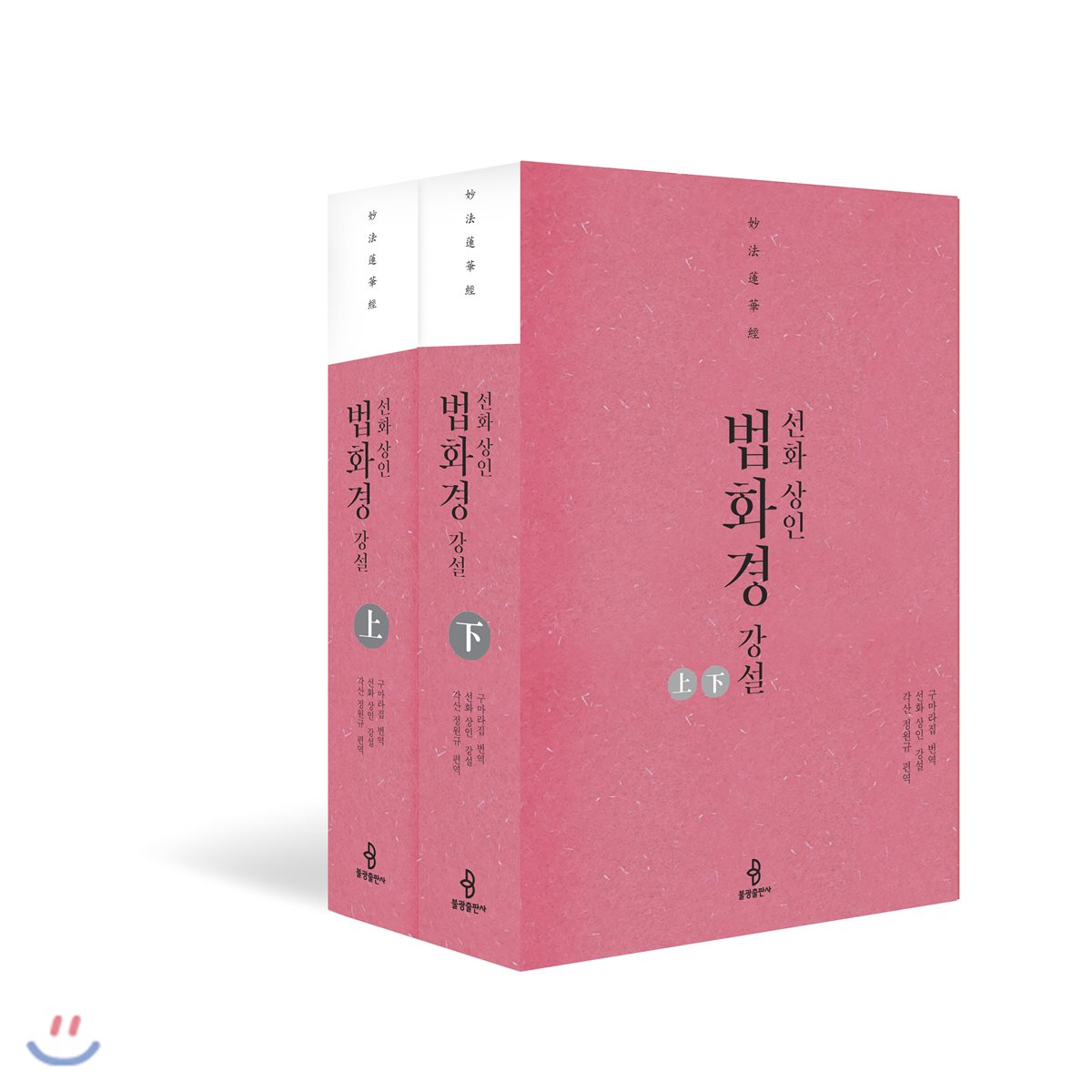 |
Description
Book Introduction
From the great meaning of Mahayana to the explanation of words,
A complete commentary on the 28 chapters of the Lotus Sutra
The Lotus Sutra, translated into Chinese by Kumarajiva, is a vast sutra containing 69,384 Chinese characters (1,742 of which appear more than once).
Even putting aside its vastness, it is a scripture filled with all kinds of metaphors, so it is not easy to properly read the hidden meaning between each line.
On the contrary, for this reason, the Lotus Sutra has been distributed in Korea mainly in the form of a collection of scriptures or recitations that only have the original Chinese characters or a Korean translation.
Occasionally, there were books titled “Lectures on the Lotus Sutra” or “Exposition of the Lotus Sutra,” but contrary to the titles, they only explained some of the 28 chapters of the Lotus Sutra (especially the “Avalokitesvara Bodhisattva’s Universal Gate Chapter,” which was popular among believers).
This book is a lecture on all chapters of the Lotus Sutra, from the first chapter, “Introduction” to the twenty-eighth chapter, “Exhortation of Universally Wise Bodhisattva.”
The lectures have the advantage of allowing us to see both the forest and the trees of Mahayana Buddhism at the same time, as they include explanations of the meaning and essence as well as the words included in the parables.
A complete commentary on the 28 chapters of the Lotus Sutra
The Lotus Sutra, translated into Chinese by Kumarajiva, is a vast sutra containing 69,384 Chinese characters (1,742 of which appear more than once).
Even putting aside its vastness, it is a scripture filled with all kinds of metaphors, so it is not easy to properly read the hidden meaning between each line.
On the contrary, for this reason, the Lotus Sutra has been distributed in Korea mainly in the form of a collection of scriptures or recitations that only have the original Chinese characters or a Korean translation.
Occasionally, there were books titled “Lectures on the Lotus Sutra” or “Exposition of the Lotus Sutra,” but contrary to the titles, they only explained some of the 28 chapters of the Lotus Sutra (especially the “Avalokitesvara Bodhisattva’s Universal Gate Chapter,” which was popular among believers).
This book is a lecture on all chapters of the Lotus Sutra, from the first chapter, “Introduction” to the twenty-eighth chapter, “Exhortation of Universally Wise Bodhisattva.”
The lectures have the advantage of allowing us to see both the forest and the trees of Mahayana Buddhism at the same time, as they include explanations of the meaning and essence as well as the words included in the parables.
- You can preview some of the book's contents.
Preview
index
Volume 1
introduction
Hanging talk
Volume 1
1. Preface
2 Expedient means
Kwon Jae (No. 2)
3 Parables
4. Sinhaepum (信解品)
Volume 3
5 Herbal relics
6. Gifts
7. Martian relics
Volume 2
Volume 4
8. The Record of the Five Hundred Disciples
9. The Record of a Person Who Has No Education
10. Chapter of the Dharma Master
11. Chapter on Seeing the Treasure Pagoda
12 Devadal Dapum
13. The Book of Encouragement
Volume 5
14 Comfortable products
15. Products from the Land of Dance
Chapter 16: The Lifespan of the Tathagata
17. Discrimination of Merit Chapter
Volume 6
18. Chapter on Merit and Virtue
Chapter 19: The Merits of the Dharma Master
Chapter 20: The Always Unlightened Bodhisattva
Chapter 21: The Divine Powers of the Tathagata
22 Cholupum (囑累品)
Chapter 23: The Medicine King Bodhisattva's Original Affairs
Volume 7
Chapter 24: The Wonderful Sound Bodhisattva
Chapter 25: The Universal Gate of Avalokitesvara Bodhisattva
Chapter 26: Dharani
27. Chapter on the Origin of the Wonderful and Strict King
28 Chapter on the Advancement of Samantabhadra Bodhisattva
After completing the translation: The Path to Buddhahood
introduction
Hanging talk
Volume 1
1. Preface
2 Expedient means
Kwon Jae (No. 2)
3 Parables
4. Sinhaepum (信解品)
Volume 3
5 Herbal relics
6. Gifts
7. Martian relics
Volume 2
Volume 4
8. The Record of the Five Hundred Disciples
9. The Record of a Person Who Has No Education
10. Chapter of the Dharma Master
11. Chapter on Seeing the Treasure Pagoda
12 Devadal Dapum
13. The Book of Encouragement
Volume 5
14 Comfortable products
15. Products from the Land of Dance
Chapter 16: The Lifespan of the Tathagata
17. Discrimination of Merit Chapter
Volume 6
18. Chapter on Merit and Virtue
Chapter 19: The Merits of the Dharma Master
Chapter 20: The Always Unlightened Bodhisattva
Chapter 21: The Divine Powers of the Tathagata
22 Cholupum (囑累品)
Chapter 23: The Medicine King Bodhisattva's Original Affairs
Volume 7
Chapter 24: The Wonderful Sound Bodhisattva
Chapter 25: The Universal Gate of Avalokitesvara Bodhisattva
Chapter 26: Dharani
27. Chapter on the Origin of the Wonderful and Strict King
28 Chapter on the Advancement of Samantabhadra Bodhisattva
After completing the translation: The Path to Buddhahood
Publisher's Review
The 9th Patriarch of the Weiyang Sect, Shanhua, China
A lecture on the Lotus Sutra for American Buddhist disciples
This book is a compilation of lectures on the Lotus Sutra given by Xuanhua Sangin, the ninth ordained dharma master of the Chinese Weiyang sect by Zen Master Heoun, to five (at first two) disciples who had converted to Buddhism, at a Buddhist lecture hall in San Francisco, USA. (It appears that the general public also occasionally attended the lectures.)
I started the “Avalokitesvara Bodhisattva’s Universal Gate” on October 16, 1968, and finished it on November 9 of the same year.
The lectures on the entire Lotus Sutra began again the day after the lecture on the "Avalokitesvara Bodhisattva's Universal Gate" ended (November 10).
Exactly two years later, on November 10, 1970, all lectures were completed. (This book follows the table of contents of the Lotus Sutra, not the order of the lectures.)
Since this lecture is aimed at American students, it explains not only the essence of Mahayana Buddhism, but also the meaning of each line and word.
The reason why this had to be done was not only because the American disciples were not yet familiar with the Buddhist law, but also because the Lotus Sutra itself is a sutra full of parables.
In order to properly understand the meaning contained in this parable, we must start with 'understanding Buddhism' and climb up the ladder step by step to 'the system of Buddhist doctrine', 'the emergence and manifestation of Mahayana', and 'the essence of Lotus Sutra thought'.
Thanks to this, it is of great help to both Buddhists who are new to the Lotus Sutra and Confucian scholars who want to revisit its meaning.
The lecture given by Shanhua Merchant, who had already achieved fame in China through Zen and Pure Land practice, to his disciples in the United States, a barren land of Buddhism, therefore resonates deeply with us who study the Lotus Sutra in the 21st century.
snowfall
Merchant Seonhwa (宣化 上人, 1918-1995)
His Buddhist name is Anja (安慈), and his courtesy name is Doryeon (度輪).
He was the 9th patriarch of the Weiyang sect in China, and his given title was Xuanhua.
In 1947, when he was 29 years old, he received the full precepts at Mount Puta.
In 1949, he went to Hong Kong and promoted the five sects of Zen Buddhism, Gyo Buddhism, Yul Buddhism, Esoteric Buddhism, and Pure Land Buddhism, and overthrew the literary faction. He also built the Seonakwon Temple, Buddhist Lecture Hall, and Jaheung Seonsa Temple.
In 1956, Zen Master Heo-un appointed him as the 46th successor to the Dharma transmitted by Shakyamuni Buddha and the 9th successor to the Weiyang Sect of China at Ungeosan Mountain and bestowed upon him the title of 'Seonhwa'.
In 1962, he went to the United States and established a Buddhist school in San Francisco to spread Buddhism.
In 1973, he established the International Institute of Transformation to cultivate talents in the field of transformation. In 1974, he built the Ten Thousand Buddhas Holy City in Ukiah, California, and then established 27 temples in various parts of the world, including the United States.
Translation
Gaksan Jeong Won-gyu
Born in Jinju, Gyeongsangnam-do, he graduated from the Department of Chinese Language and Literature at Kyungpook National University.
While working at the Gyeongnam Provincial Office, I was impressed by the Chinese Buddhist texts and Buddhist teachings of great Chinese monks that I encountered while studying and working in China, and I am introducing them to Korea.
Since entering Buddhism, he has been diligently striving to enlighten his mind and attain enlightenment through practices such as studying sutras, chanting the Buddha's name, reciting the Neng-Yeom-Joo, and Zen meditation.
The translated books include 『The Story of Causality by Master Odaesan Nosun』, 『The Power to Accomplish Everything』, 『The Sermon of the Nung-eom Shinju by Seonhwa Sangin』, 『Lectures on the Nung-eom Sutra by Seonhwa Sangin』 (Part 1 and Part 2), 『Breaking Through the Void to Illuminate the Mind』, 『Anyone Who Calls My Name Will Cross Over』, 『Doing as the Buddha Says』, 『Become the Master of the Root of Life and Death』, and 『The Buddha Speaks of the Mahayana Infinite Life Adorned Equal-minded Awakening Sutra』.
A lecture on the Lotus Sutra for American Buddhist disciples
This book is a compilation of lectures on the Lotus Sutra given by Xuanhua Sangin, the ninth ordained dharma master of the Chinese Weiyang sect by Zen Master Heoun, to five (at first two) disciples who had converted to Buddhism, at a Buddhist lecture hall in San Francisco, USA. (It appears that the general public also occasionally attended the lectures.)
I started the “Avalokitesvara Bodhisattva’s Universal Gate” on October 16, 1968, and finished it on November 9 of the same year.
The lectures on the entire Lotus Sutra began again the day after the lecture on the "Avalokitesvara Bodhisattva's Universal Gate" ended (November 10).
Exactly two years later, on November 10, 1970, all lectures were completed. (This book follows the table of contents of the Lotus Sutra, not the order of the lectures.)
Since this lecture is aimed at American students, it explains not only the essence of Mahayana Buddhism, but also the meaning of each line and word.
The reason why this had to be done was not only because the American disciples were not yet familiar with the Buddhist law, but also because the Lotus Sutra itself is a sutra full of parables.
In order to properly understand the meaning contained in this parable, we must start with 'understanding Buddhism' and climb up the ladder step by step to 'the system of Buddhist doctrine', 'the emergence and manifestation of Mahayana', and 'the essence of Lotus Sutra thought'.
Thanks to this, it is of great help to both Buddhists who are new to the Lotus Sutra and Confucian scholars who want to revisit its meaning.
The lecture given by Shanhua Merchant, who had already achieved fame in China through Zen and Pure Land practice, to his disciples in the United States, a barren land of Buddhism, therefore resonates deeply with us who study the Lotus Sutra in the 21st century.
snowfall
Merchant Seonhwa (宣化 上人, 1918-1995)
His Buddhist name is Anja (安慈), and his courtesy name is Doryeon (度輪).
He was the 9th patriarch of the Weiyang sect in China, and his given title was Xuanhua.
In 1947, when he was 29 years old, he received the full precepts at Mount Puta.
In 1949, he went to Hong Kong and promoted the five sects of Zen Buddhism, Gyo Buddhism, Yul Buddhism, Esoteric Buddhism, and Pure Land Buddhism, and overthrew the literary faction. He also built the Seonakwon Temple, Buddhist Lecture Hall, and Jaheung Seonsa Temple.
In 1956, Zen Master Heo-un appointed him as the 46th successor to the Dharma transmitted by Shakyamuni Buddha and the 9th successor to the Weiyang Sect of China at Ungeosan Mountain and bestowed upon him the title of 'Seonhwa'.
In 1962, he went to the United States and established a Buddhist school in San Francisco to spread Buddhism.
In 1973, he established the International Institute of Transformation to cultivate talents in the field of transformation. In 1974, he built the Ten Thousand Buddhas Holy City in Ukiah, California, and then established 27 temples in various parts of the world, including the United States.
Translation
Gaksan Jeong Won-gyu
Born in Jinju, Gyeongsangnam-do, he graduated from the Department of Chinese Language and Literature at Kyungpook National University.
While working at the Gyeongnam Provincial Office, I was impressed by the Chinese Buddhist texts and Buddhist teachings of great Chinese monks that I encountered while studying and working in China, and I am introducing them to Korea.
Since entering Buddhism, he has been diligently striving to enlighten his mind and attain enlightenment through practices such as studying sutras, chanting the Buddha's name, reciting the Neng-Yeom-Joo, and Zen meditation.
The translated books include 『The Story of Causality by Master Odaesan Nosun』, 『The Power to Accomplish Everything』, 『The Sermon of the Nung-eom Shinju by Seonhwa Sangin』, 『Lectures on the Nung-eom Sutra by Seonhwa Sangin』 (Part 1 and Part 2), 『Breaking Through the Void to Illuminate the Mind』, 『Anyone Who Calls My Name Will Cross Over』, 『Doing as the Buddha Says』, 『Become the Master of the Root of Life and Death』, and 『The Buddha Speaks of the Mahayana Infinite Life Adorned Equal-minded Awakening Sutra』.
GOODS SPECIFICS
- Publication date: November 19, 2018
- Page count, weight, size: 1,328 pages | 1,992g | 152*225*80mm
- ISBN13: 9788974794781
- ISBN10: 8974794780
You may also like
카테고리
korean


korean

![GQ KOREA Mark (Monthly): December [2025]](http://librairie.coreenne.fr/cdn/shop/files/8ef265dbbfbf186523ed75ba7319009d.jpg?v=1765340328&width=3840)


