

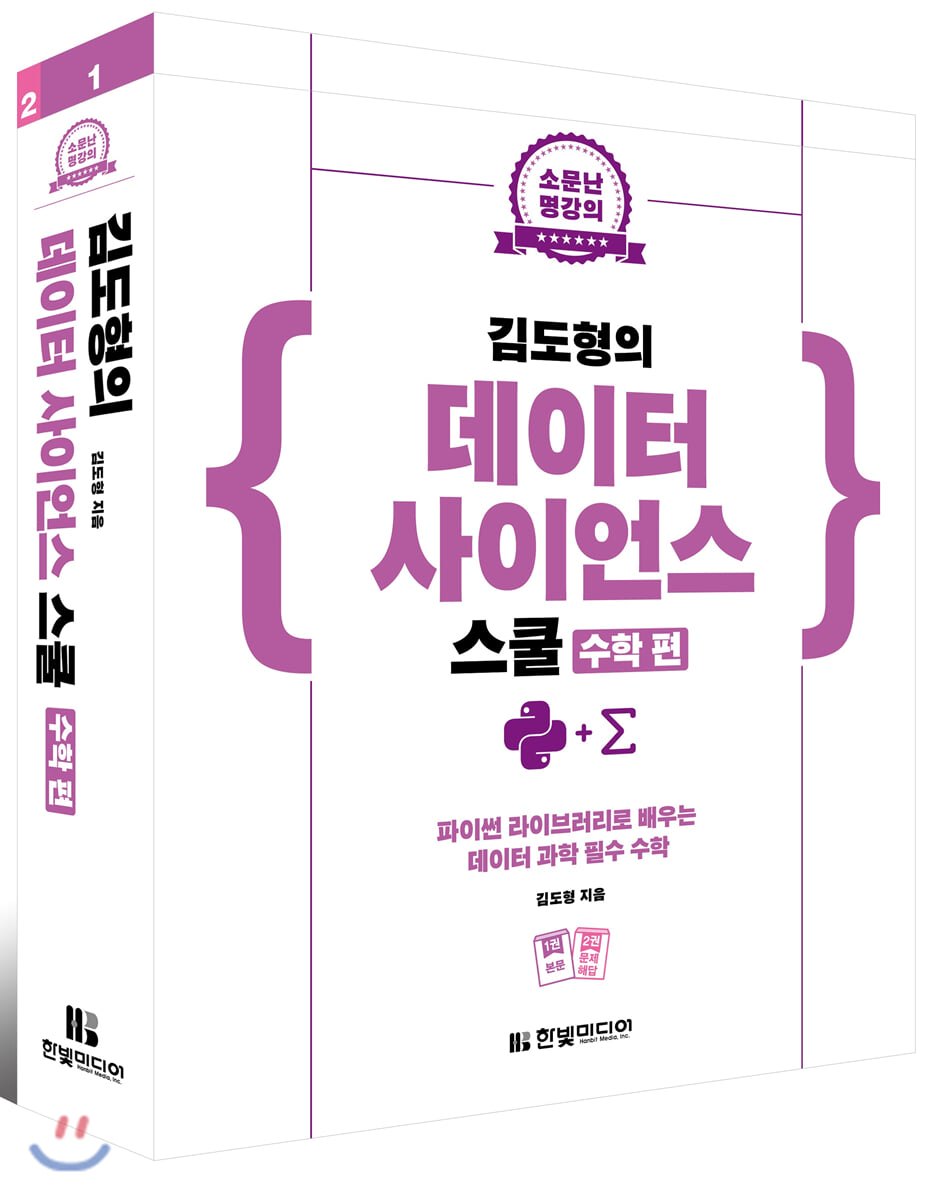
Kim Do-hyung's Data Science School Math Edition
 |
Description
Book Introduction
“Kim Do-hyung, a renowned lecturer in data science
A math book that's a gift for beginners
“All the mathematics you need for machine learning and deep learning—linear algebra, calculus, optimization, probability theory, and even Bayesian estimation—all in one book!”
This book teaches core mathematics to beginners in artificial intelligence development and working professionals who did not major in mathematics in college.
Anyone can learn math step by step, starting with the Greek alphabet and high school math symbols that are often used in formulas.
It starts from the basics but covers all the essential math needed for data analysis and machine learning, and all formulas are presented in code using Python packages.
A Python Jupyter Notebook practice environment using startup files was also provided.
(Note: This assumes that the reader has basic knowledge of the Python language.)
A math book that's a gift for beginners
“All the mathematics you need for machine learning and deep learning—linear algebra, calculus, optimization, probability theory, and even Bayesian estimation—all in one book!”
This book teaches core mathematics to beginners in artificial intelligence development and working professionals who did not major in mathematics in college.
Anyone can learn math step by step, starting with the Greek alphabet and high school math symbols that are often used in formulas.
It starts from the basics but covers all the essential math needed for data analysis and machine learning, and all formulas are presented in code using Python packages.
A Python Jupyter Notebook practice environment using startup files was also provided.
(Note: This assumes that the reader has basic knowledge of the Python language.)
index
Chapter 0: Python Installation and Usage
__0.1 command line interface
__0.2 Installing Python
__0.3 Using Python for the First Time
Installing the __0.4 Python package
__0.5 Introducing Python Packages for Data Analysis
__0.6 IPython and Jupyter Setup
__0.7 How to Use Google Colab
__0.8 In conclusion
Chapter 1 Mathematical Symbols
__1.1 Greek letters
__1.2 Sum and product of sequences and sets
__1.3 In conclusion
Chapter 2: Linear Algebra with Numpy
__2.1 Data and Matrices
__2.2 Operations on vectors and matrices
__2.3 Properties of matrices
__2.4 Linear Systems of Equations and Inverse Matrices
__2.5 In conclusion
Chapter 3 Advanced Linear Algebra
__3.1 Foundations of Linear Algebra and Analytical Geometry
__3.2 Coordinates and Transformations
__3.3 Eigenvalue decomposition
__3.4 Singular value decomposition
__3.5 PCA
__3.6 In conclusion
Chapter 4: Studying Calculus with SymPy
__4.1 Function
__4.2 Differentiating functions using SymPy
__4.3 Integration
__4.4 Differentiation of matrices
__4.5 Variational calculus
__4.6 In conclusion
Chapter 5: Studying Optimization with SciPy
__5.1 Optimization Basics
__5.2 Optimization problems with constraints
__5.3 Linear programming problems and quadratic programming problems
__5.4 In conclusion
Chapter 6: Studying Probability with pgmpy
__6.1 Set
__6.2 Mathematical definition and meaning of probability
__6.3 Properties of Probability
__6.4 Probability distribution function
__6.5 Joint probability and joint probability
__6.6 Bayes' theorem
__6.7 In conclusion
Chapter 7: Random Variables and Correlation
__7.1 Probabilistic Data and Random Variables
__7.2 Transformation of Expected Values and Random Variables
__7.3 Variance and standard deviation
__7.4 Multivariate random variables
__7.5 Covariance and Correlation Coefficient
__7.6 Expected value and prediction problem
__7.7 In conclusion
Chapter 8: Studying Probability Distributions with SciPy
__8.1 Probability Distribution Analysis Using SciPy
__8.2 Bernoulli distribution and binomial distribution
__8.3 Categorical distribution and multinomial distribution
__8.4 Normal Distribution and Central Limit Theorem
__8.5 Student's t-distribution, chi-square distribution, and F-distribution
__8.6 Multivariate normal distribution
__8.7 Beta distribution, gamma distribution, Dirichlet distribution
__8.8 In conclusion
Chapter 9: Estimation and Testing
__9.1 Estimation of probability distributions
__9.2 Maximum likelihood estimation
__9.3 Bayesian estimation
__9.4 Test and significance level
__9.5 Black using SciFi
__9.6 In conclusion
Chapter 10 Entropy
__10.1 Entropy
__10.2 Conditional entropy
__10.3 Cross-entropy and Kullback-Leibler divergence
__10.4 Mutual information
__10.5 In conclusion
__0.1 command line interface
__0.2 Installing Python
__0.3 Using Python for the First Time
Installing the __0.4 Python package
__0.5 Introducing Python Packages for Data Analysis
__0.6 IPython and Jupyter Setup
__0.7 How to Use Google Colab
__0.8 In conclusion
Chapter 1 Mathematical Symbols
__1.1 Greek letters
__1.2 Sum and product of sequences and sets
__1.3 In conclusion
Chapter 2: Linear Algebra with Numpy
__2.1 Data and Matrices
__2.2 Operations on vectors and matrices
__2.3 Properties of matrices
__2.4 Linear Systems of Equations and Inverse Matrices
__2.5 In conclusion
Chapter 3 Advanced Linear Algebra
__3.1 Foundations of Linear Algebra and Analytical Geometry
__3.2 Coordinates and Transformations
__3.3 Eigenvalue decomposition
__3.4 Singular value decomposition
__3.5 PCA
__3.6 In conclusion
Chapter 4: Studying Calculus with SymPy
__4.1 Function
__4.2 Differentiating functions using SymPy
__4.3 Integration
__4.4 Differentiation of matrices
__4.5 Variational calculus
__4.6 In conclusion
Chapter 5: Studying Optimization with SciPy
__5.1 Optimization Basics
__5.2 Optimization problems with constraints
__5.3 Linear programming problems and quadratic programming problems
__5.4 In conclusion
Chapter 6: Studying Probability with pgmpy
__6.1 Set
__6.2 Mathematical definition and meaning of probability
__6.3 Properties of Probability
__6.4 Probability distribution function
__6.5 Joint probability and joint probability
__6.6 Bayes' theorem
__6.7 In conclusion
Chapter 7: Random Variables and Correlation
__7.1 Probabilistic Data and Random Variables
__7.2 Transformation of Expected Values and Random Variables
__7.3 Variance and standard deviation
__7.4 Multivariate random variables
__7.5 Covariance and Correlation Coefficient
__7.6 Expected value and prediction problem
__7.7 In conclusion
Chapter 8: Studying Probability Distributions with SciPy
__8.1 Probability Distribution Analysis Using SciPy
__8.2 Bernoulli distribution and binomial distribution
__8.3 Categorical distribution and multinomial distribution
__8.4 Normal Distribution and Central Limit Theorem
__8.5 Student's t-distribution, chi-square distribution, and F-distribution
__8.6 Multivariate normal distribution
__8.7 Beta distribution, gamma distribution, Dirichlet distribution
__8.8 In conclusion
Chapter 9: Estimation and Testing
__9.1 Estimation of probability distributions
__9.2 Maximum likelihood estimation
__9.3 Bayesian estimation
__9.4 Test and significance level
__9.5 Black using SciFi
__9.6 In conclusion
Chapter 10 Entropy
__10.1 Entropy
__10.2 Conditional entropy
__10.3 Cross-entropy and Kullback-Leibler divergence
__10.4 Mutual information
__10.5 In conclusion
Detailed image

Publisher's Review
[Starting from the basics for beginners and non-majors]
We teach core mathematics to beginners in AI development and working professionals who did not major in mathematics in college.
Anyone can learn math step by step, starting with the Greek alphabet and high school math symbols that are often used in formulas.
It starts from the basics but covers all the essential mathematics needed for data analysis and machine learning, and all formulas are presented as code using Python packages.
[Selected only the key content necessary to understand machine learning]
It covers a wide range of mathematical fields, including linear algebra, functional theory, calculus, and optimization, but it has been curated to only the bare minimum required for data analysis and machine learning.
Since this book only covers the core content, thoroughly studying the content will help you study data analysis and machine learning theory effectively and in depth.
Please study any parts you do not understand repeatedly.
[Understanding and Application through Python Implementation]
Data analysis and machine learning implement algorithms in code, so understanding them through mathematical formulas alone is insufficient.
Therefore, all the formulas and algorithms in this book are implemented in Python code.
Considering the perspective of developers who want to use mathematics as code, rather than implementing the algorithms themselves, the goal is to enable them to understand and freely use the functions of packages such as NumPy, SymPy, SciPy, and pgmpy in which the algorithms are implemented.
[300 practice questions]
There are over 300 practice problems to help you make sure you understand the material covered in the book.
All practice problems are pre-existing problems that solve some of the formulas that appear when explaining the theory of machine learning.
If you can solve the practice problems, you will find it easier to understand the complex formulas that come up later.
Python Packages Covered in This Book We used Python 3.7 and the following packages to implement the code in this book:
_ IPython
_ Scikit-Learn
_ matplotlib
_ NumPy
_ seaborn
_ SciPy
_ pgmpy
Structure of this book
[Chapter 0: Python Installation and Usage]
_ Learn how to install and use Python and Python packages.
_ Introducing Python packages required for data analysis.
_ How to customize iPython and Jupyter.
[Chapter 1 Mathematical Symbols]
_ Learn to read and write the Greek alphabet, which is often used in formulas.
_ Learn the meaning of mathematical symbols frequently used in machine learning textbooks and papers.
Chapter 2: Linear Algebra with Numpy
_ Learn the meaning and symbols of scalars, vectors, matrices, and tensors, and how to use the NumPy package.
_ Covers matrix operations, properties, and simultaneous equations.
[Chapter 3 Advanced Linear Algebra]
_ Learn how linear algebra is used in geometry.
_ We study eigenvalue decomposition and singular value decomposition and find out what problems they can be applied to.
[Chapter 4: Calculus with SymPy]
_ Learn about frequently used functions and their characteristics in machine learning.
_ Learn the differentiation and integration formulas and learn how to do calculus using the SymPy package, which allows symbolic operations.
_ Study the matrix calculus formulas frequently used in machine learning.
_ Introduces the concept of variational calculus.
Chapter 5: Optimization with SciPy
_ Learn how to solve optimization problems using the maximum gradient method.
_ Learn how to solve real-world optimization problems using the SciPy package.
_ We study the Lagrange multiplier method for solving optimization problems with equality or inequality constraints.
_ In addition to machine learning, we introduce LP and QP problems that are widely used in various fields.
[Chapter 6: Studying Probability with pgmpy]
_ We study the mathematical definition of probability and its meaning from frequentist and Bayesian perspectives.
_ We introduce the process through which probability distribution functions are defined.
_ Learn conditional probability and Bayes' theorem, important concepts used in machine learning.
_ Learn how to implement probability distributions and perform Bayesian estimation using the PGMpy package.
[Chapter 7: Random Variables and Correlation]
_ Learn the concept of data modeling using random variables.
_ We study the meaning of expected value and variance of sample data and the characteristics of expected value of variance.
_ Learn about the definitions and characteristics of discrete distributions such as Bernoulli distribution, binomial distribution, categorical distribution, and multinomial distribution, and continuous distributions such as Gaussian normal distribution, Student's t distribution, chi-square distribution, and F distribution, and how these distributions are used in data analysis.
_ Introduces the beta distribution, Dirichlet distribution, and gamma distribution used in probability parameter models.
[Chapter 8: Studying Probability Distributions with SciPy]
_ We introduce how to define the correlation between multiple random variables.
_ Learn about the multivariate normal distribution model, the most widely used correlation model.
_ We introduce the concept of conditional expectation and study how it is used in prediction, one of the biggest applications of machine learning.
[Chapter 9 Estimation and Testing]
_ We study how to make decisions based on data when given data.
_ Learn the concept of testing, the most basic data-driven decision-making, and testing methods using SciPy.
_ Learn how to estimate the parameters of a probability distribution using the concept of likelihood and maximum likelihood estimation.
_ We study uncertainty in parameter estimation and introduce Bayesian parameter estimation methods based on Bayes' theorem.
[Chapter 10 Entropy]
_ We introduce the concept of entropy and learn how entropy is related to the amount of information contained in a random variable.
_ We study how to compare the similarity of probability distributions using cross entropy and Kullback-Leibler divergence.
We teach core mathematics to beginners in AI development and working professionals who did not major in mathematics in college.
Anyone can learn math step by step, starting with the Greek alphabet and high school math symbols that are often used in formulas.
It starts from the basics but covers all the essential mathematics needed for data analysis and machine learning, and all formulas are presented as code using Python packages.
[Selected only the key content necessary to understand machine learning]
It covers a wide range of mathematical fields, including linear algebra, functional theory, calculus, and optimization, but it has been curated to only the bare minimum required for data analysis and machine learning.
Since this book only covers the core content, thoroughly studying the content will help you study data analysis and machine learning theory effectively and in depth.
Please study any parts you do not understand repeatedly.
[Understanding and Application through Python Implementation]
Data analysis and machine learning implement algorithms in code, so understanding them through mathematical formulas alone is insufficient.
Therefore, all the formulas and algorithms in this book are implemented in Python code.
Considering the perspective of developers who want to use mathematics as code, rather than implementing the algorithms themselves, the goal is to enable them to understand and freely use the functions of packages such as NumPy, SymPy, SciPy, and pgmpy in which the algorithms are implemented.
[300 practice questions]
There are over 300 practice problems to help you make sure you understand the material covered in the book.
All practice problems are pre-existing problems that solve some of the formulas that appear when explaining the theory of machine learning.
If you can solve the practice problems, you will find it easier to understand the complex formulas that come up later.
Python Packages Covered in This Book We used Python 3.7 and the following packages to implement the code in this book:
_ IPython
_ Scikit-Learn
_ matplotlib
_ NumPy
_ seaborn
_ SciPy
_ pgmpy
Structure of this book
[Chapter 0: Python Installation and Usage]
_ Learn how to install and use Python and Python packages.
_ Introducing Python packages required for data analysis.
_ How to customize iPython and Jupyter.
[Chapter 1 Mathematical Symbols]
_ Learn to read and write the Greek alphabet, which is often used in formulas.
_ Learn the meaning of mathematical symbols frequently used in machine learning textbooks and papers.
Chapter 2: Linear Algebra with Numpy
_ Learn the meaning and symbols of scalars, vectors, matrices, and tensors, and how to use the NumPy package.
_ Covers matrix operations, properties, and simultaneous equations.
[Chapter 3 Advanced Linear Algebra]
_ Learn how linear algebra is used in geometry.
_ We study eigenvalue decomposition and singular value decomposition and find out what problems they can be applied to.
[Chapter 4: Calculus with SymPy]
_ Learn about frequently used functions and their characteristics in machine learning.
_ Learn the differentiation and integration formulas and learn how to do calculus using the SymPy package, which allows symbolic operations.
_ Study the matrix calculus formulas frequently used in machine learning.
_ Introduces the concept of variational calculus.
Chapter 5: Optimization with SciPy
_ Learn how to solve optimization problems using the maximum gradient method.
_ Learn how to solve real-world optimization problems using the SciPy package.
_ We study the Lagrange multiplier method for solving optimization problems with equality or inequality constraints.
_ In addition to machine learning, we introduce LP and QP problems that are widely used in various fields.
[Chapter 6: Studying Probability with pgmpy]
_ We study the mathematical definition of probability and its meaning from frequentist and Bayesian perspectives.
_ We introduce the process through which probability distribution functions are defined.
_ Learn conditional probability and Bayes' theorem, important concepts used in machine learning.
_ Learn how to implement probability distributions and perform Bayesian estimation using the PGMpy package.
[Chapter 7: Random Variables and Correlation]
_ Learn the concept of data modeling using random variables.
_ We study the meaning of expected value and variance of sample data and the characteristics of expected value of variance.
_ Learn about the definitions and characteristics of discrete distributions such as Bernoulli distribution, binomial distribution, categorical distribution, and multinomial distribution, and continuous distributions such as Gaussian normal distribution, Student's t distribution, chi-square distribution, and F distribution, and how these distributions are used in data analysis.
_ Introduces the beta distribution, Dirichlet distribution, and gamma distribution used in probability parameter models.
[Chapter 8: Studying Probability Distributions with SciPy]
_ We introduce how to define the correlation between multiple random variables.
_ Learn about the multivariate normal distribution model, the most widely used correlation model.
_ We introduce the concept of conditional expectation and study how it is used in prediction, one of the biggest applications of machine learning.
[Chapter 9 Estimation and Testing]
_ We study how to make decisions based on data when given data.
_ Learn the concept of testing, the most basic data-driven decision-making, and testing methods using SciPy.
_ Learn how to estimate the parameters of a probability distribution using the concept of likelihood and maximum likelihood estimation.
_ We study uncertainty in parameter estimation and introduce Bayesian parameter estimation methods based on Bayes' theorem.
[Chapter 10 Entropy]
_ We introduce the concept of entropy and learn how entropy is related to the amount of information contained in a random variable.
_ We study how to compare the similarity of probability distributions using cross entropy and Kullback-Leibler divergence.
GOODS SPECIFICS
- Publication date: November 20, 2019
- Page count, weight, size: 880 pages | 1,680g | 183*235*40mm
- ISBN13: 9791162242414
- ISBN10: 1162242418
You may also like
카테고리
korean


korean

![GQ KOREA Mark (Monthly): December [2025]](http://librairie.coreenne.fr/cdn/shop/files/8ef265dbbfbf186523ed75ba7319009d.jpg?v=1765340328&width=3840)


