

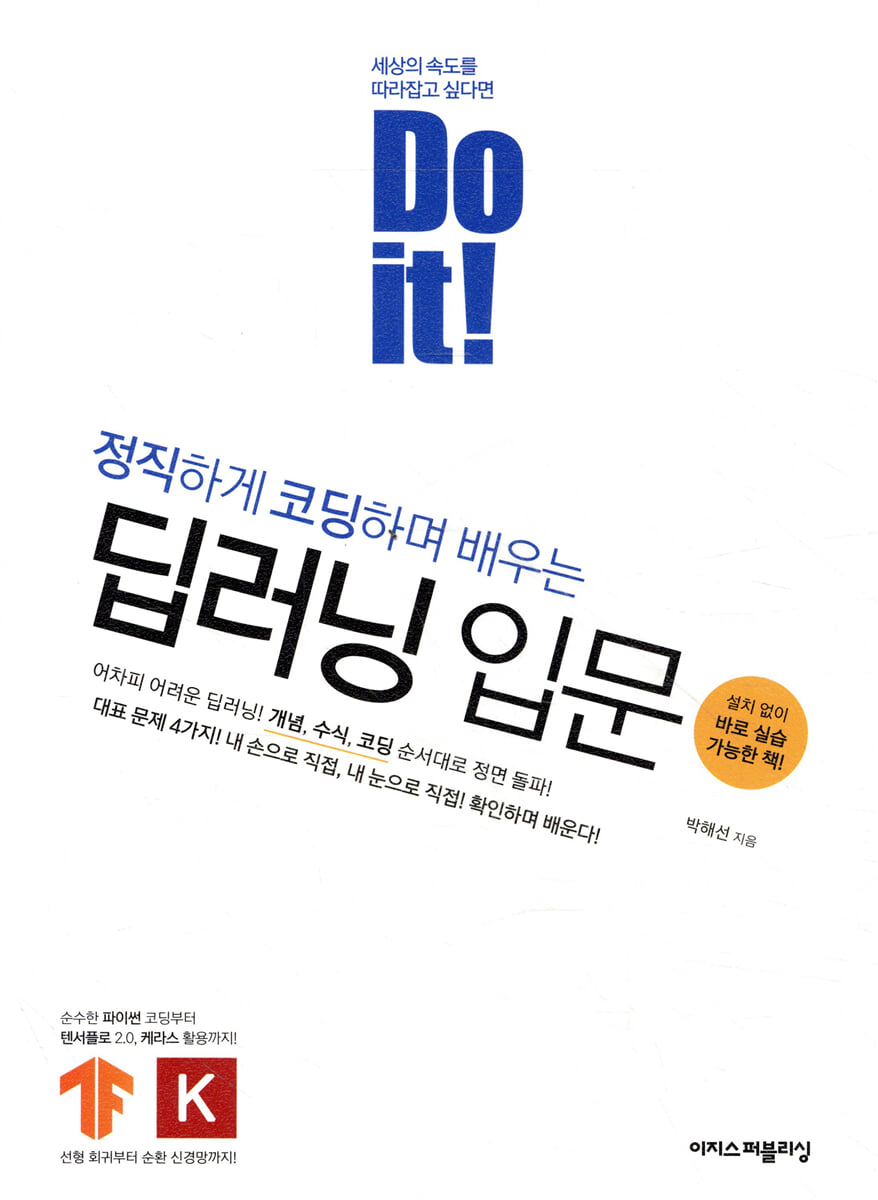
Do it! Introduction to Deep Learning
 |
Description
Book Introduction
Coding honestly
Let's quickly tackle deep learning head-on!
This book does not contain any clumsy shortcuts.
Studying is not enough if you don't learn something! You need to understand and apply it effectively in the real world! Professor Park Hae-seon, one of only six Google-certified machine learning experts (ML GDE; Machine Learning Google Developer Experts) in Korea and the author of the most translated books on artificial intelligence, has now written an introductory book on deep learning.
This book is one step at a time, from concepts to formulas and coding.
It guides readers through deep learning with the most appropriate stride and straight direction.
Additionally, there are over 100 graphs, illustrations, and diagrams, allowing you to easily and quickly understand abstract concepts.
Another unique feature of this book is that you can start practicing right away by simply accessing the web browser without installing any programs.
After comfortably understanding the theory and then coding, you can master four representative deep learning problems with your own eyes, making it a perfect textbook for deep learning.
To enhance learning effectiveness, concepts and terms that must be covered are reviewed twice in the "Wait a minute! To move on to the next section" section in the middle of the text and in the "Memory Card" section at the end of each chapter.
Let's quickly tackle deep learning head-on with "Do it! Introduction to Deep Learning."
Let's quickly tackle deep learning head-on!
This book does not contain any clumsy shortcuts.
Studying is not enough if you don't learn something! You need to understand and apply it effectively in the real world! Professor Park Hae-seon, one of only six Google-certified machine learning experts (ML GDE; Machine Learning Google Developer Experts) in Korea and the author of the most translated books on artificial intelligence, has now written an introductory book on deep learning.
This book is one step at a time, from concepts to formulas and coding.
It guides readers through deep learning with the most appropriate stride and straight direction.
Additionally, there are over 100 graphs, illustrations, and diagrams, allowing you to easily and quickly understand abstract concepts.
Another unique feature of this book is that you can start practicing right away by simply accessing the web browser without installing any programs.
After comfortably understanding the theory and then coding, you can master four representative deep learning problems with your own eyes, making it a perfect textbook for deep learning.
To enhance learning effectiveness, concepts and terms that must be covered are reviewed twice in the "Wait a minute! To move on to the next section" section in the middle of the text and in the "Memory Card" section at the end of each chapter.
Let's quickly tackle deep learning head-on with "Do it! Introduction to Deep Learning."
- You can preview some of the book's contents.
Preview
index
01 Introducing Deep Learning
__01-1 Introducing Artificial Intelligence
__01-2 Introducing Machine Learning
__01-3 Introducing Deep Learning
Things to Remember in Chapter 1
02 Start deep learning with minimal tools.
__02-1 Introducing Google Colab
__02-2 Learn about tools for deep learning
Things to remember in Chapter 2
03 Laying the Foundations of Machine Learning - Numerical Prediction
__03-1 Learn about linear regression and prepare your data
__03-2 Learn how to learn with gradient descent
__03-3 Learn about the relationship between loss functions and gradient descent.
__03-4 Create a neuron for linear regression
Things to remember in Chapter 3
04 Create a classification neuron - binary classification
__04-1 Learn about early artificial intelligence algorithms and logistic regression.
__04-2 Create probabilities using the sigmoid function
__04-3 Applying the logistic loss function to gradient descent
__04-4 Prepare the dataset for classification
__04-5 Create a neuron for logistic regression
__04-6 Create a single-layer neural network with logistic regression neurons
__04-7 Performing logistic regression with scikit-learn
Things to remember in Chapter 4
05 Learn training know-how
__05-1 Split the validation set and learn the preprocessing process.
__05-2 Learn about overfitting and underfitting
__05-3 Learn regularization methods and apply them to single-layer neural networks.
__05-4 Let's learn about cross-validation and implement it with scikit-learn.
Things to remember in Chapter 5
06 Connecting two layers - multilayer neural network
__06-1 Vectorize the neural network algorithm to use all samples at once
__06-2 Implement a neural network with two layers
__06-3 Train the model using mini-batches
Things to remember in Chapter 6
07 Classify multiple items - Multi-classification
__07-1 Create a multilayer neural network to classify multiple images.
__07-2 Creating a Neural Network Using TensorFlow and Keras
Things to remember in Chapter 7
08 Classifying images - Convolutional Neural Networks
__08-1 Learn about convolution operations
__08-2 Learn about pooling operations
__08-3 Let's learn about the structure of a convolutional neural network.
__08-4 Create and train a convolutional neural network
__08-5 Creating a Convolutional Neural Network with Keras
Things to remember in Chapter 8
09 Classifying Text - Recurrent Neural Networks
__09-1 Learn sequential data and recurrent neural networks
__09-2 Create a recurrent neural network and classify text
__09-3 Creating a recurrent neural network with TensorFlow
__09-4 Create an LSTM recurrent neural network and classify text.
Things to remember in Chapter 9
__01-1 Introducing Artificial Intelligence
__01-2 Introducing Machine Learning
__01-3 Introducing Deep Learning
Things to Remember in Chapter 1
02 Start deep learning with minimal tools.
__02-1 Introducing Google Colab
__02-2 Learn about tools for deep learning
Things to remember in Chapter 2
03 Laying the Foundations of Machine Learning - Numerical Prediction
__03-1 Learn about linear regression and prepare your data
__03-2 Learn how to learn with gradient descent
__03-3 Learn about the relationship between loss functions and gradient descent.
__03-4 Create a neuron for linear regression
Things to remember in Chapter 3
04 Create a classification neuron - binary classification
__04-1 Learn about early artificial intelligence algorithms and logistic regression.
__04-2 Create probabilities using the sigmoid function
__04-3 Applying the logistic loss function to gradient descent
__04-4 Prepare the dataset for classification
__04-5 Create a neuron for logistic regression
__04-6 Create a single-layer neural network with logistic regression neurons
__04-7 Performing logistic regression with scikit-learn
Things to remember in Chapter 4
05 Learn training know-how
__05-1 Split the validation set and learn the preprocessing process.
__05-2 Learn about overfitting and underfitting
__05-3 Learn regularization methods and apply them to single-layer neural networks.
__05-4 Let's learn about cross-validation and implement it with scikit-learn.
Things to remember in Chapter 5
06 Connecting two layers - multilayer neural network
__06-1 Vectorize the neural network algorithm to use all samples at once
__06-2 Implement a neural network with two layers
__06-3 Train the model using mini-batches
Things to remember in Chapter 6
07 Classify multiple items - Multi-classification
__07-1 Create a multilayer neural network to classify multiple images.
__07-2 Creating a Neural Network Using TensorFlow and Keras
Things to remember in Chapter 7
08 Classifying images - Convolutional Neural Networks
__08-1 Learn about convolution operations
__08-2 Learn about pooling operations
__08-3 Let's learn about the structure of a convolutional neural network.
__08-4 Create and train a convolutional neural network
__08-5 Creating a Convolutional Neural Network with Keras
Things to remember in Chapter 8
09 Classifying Text - Recurrent Neural Networks
__09-1 Learn sequential data and recurrent neural networks
__09-2 Create a recurrent neural network and classify text
__09-3 Creating a recurrent neural network with TensorFlow
__09-4 Create an LSTM recurrent neural network and classify text.
Things to remember in Chapter 9
Detailed image

Publisher's Review
What you need to know to understand deep learning
Conquer the four representative problems through practice!
Deep learning is a technology for solving real-world problems in complex data.
So, you must experience the process of solving a real problem.
This book solves numerical prediction, binary classification, multi-class classification, and text classification problems using data from diabetic patients, Wisconsin breast cancer, MNIST fashion images, and movie reviews.
Most deep learning problems extend the concepts of these problems, so if you know just the four representative problems covered in this book, you will be able to solve problems you will encounter in practice.
Deep learning starts in just 1 minute!
Don't waste time preparing your practice environment; let's get started right away!
Deep learning requires a lot of preparation for practice, from setting up a computer to installing software and Python packages.
However, 『Do it! Introduction to Deep Learning』 has a simple practical preparation process.
Google Colab provides hands-on training so you can start studying deep learning in just one minute.
Colab is Google's Jupyter notebook that can be run in a web browser. It is a great Python editor that comes with all the packages necessary for deep learning training installed.
All the hands-on code you write in Colab runs on Google's cloud computers and is automatically saved to Google Drive.
No need to bother with preparing various things, just access your web browser and start deep learning in just one minute.
There's no royal road to deep learning, but there are degrees!
An introductory book to deep learning that teaches you how to study honestly without avoiding the difficult part!
Deep learning is an inherently difficult technology that requires a mastery of concepts, formulas, and even coding.
In particular, formulas are the biggest stumbling block for beginners.
Not many people get out of this swamp.
So, some books choose to introduce formulas briefly or omit them altogether, out of consideration for the reader.
But the author of this book put a lot of effort into this part.
The reason is that formulas are the foundation of deep learning code, so you can't build a house on sand.
Yes, that's right.
There is no royal road to deep learning, but there is a right way.
The right way to study deep learning is like climbing a tall mountain.
Just take one honest step at a time.
But you can't just take a step carelessly.
As you take each step toward the top, make sure to focus on the three elements: concepts, formulas, and practice.
I recommend this book as the first deep learning textbook for beginner AI developers.
It's easy to understand with the kind explanation~
Make it easier with over 100 graphs, illustrations, and diagrams!
Mathematical concepts like linear regression, overfitting, and underfitting are presented graphically! Abstract concepts like image classification, text classification, convolution, and dropout are presented with illustrations and diagrams! The text is easy to read, with helpful explanations and a variety of visual aids.
I personally sketched the graphs and diagrams with the hope that 'those new to deep learning can study more easily' (the illustrations in the book are the author's sketches edited by a professional artist).
Let's get started with deep learning more easily by feeling the sincerity in this book for readers.
As an artificial intelligence blogger, translator, and presenter
The first book by a Google-certified machine learning expert who constantly shares his knowledge!
This book was written by one of only six Google Certified Machine Learning Experts (ML GDE; Machine Learning Google Developer Experts) in Korea.
The author is the operator of the TensorFlow Blog, which has 2.4 million visitors and is a must-visit for anyone searching for information on artificial intelligence. As a translator, he has translated six books on artificial intelligence.
I also hosted a deep learning study group and met beginners through knowledge-sharing activities.
He is the best author to write an introductory book on deep learning.
Recently, he has been participating as a presenter at various artificial intelligence-related conferences and is continuing various knowledge-sharing activities.
All the exercises in the book are available for free on the Aegis Publishing website and GitHub.
The correct answer code for all exercises in the book is provided in the author's GitHub and the data room of the Aegis Publishing website.
You can increase your learning effectiveness by practicing the book's examples and comparing them with the code written by the author himself.
Additionally, by accessing the notebook viewer link, you can easily view the author's code without downloading the file.
Download the practice file
- Author's GitHub https://github.com/rickiepark
- Easy Publishing Data Room: https://easyspub.co.kr > [Data Room] (Membership required)
Easily review practice files with Jupyter Notebooks
- Jupyter Notebook Viewer https://nbviewer.jupyter.org/github/rickiepark/do-it-dl
Doit Study Room, where we learn, share, and grow together!
The Doit series, created with beta testers! Self-study or textbook-based, OK!
If you plan and study alone, you will quickly become tired.
Why not meet readers who are struggling with similar issues and share your challenges? Helping others with what you've diligently studied can bring you even greater satisfaction.
At the Doit Study Room Cafe, where you can learn, share, and grow together, you can meet colleagues who want to grow through books.
Additionally, this book was created by selecting three readers as beta testers (beta testers are recruited irregularly through open recruitment on the Easy Publishing Facebook page or Doit Study Room).
Additionally, the book includes a 14-day progress chart for self-study and a 16-week progress chart for textbook use, which is helpful for both studying and lectures.
- Doit Study Room Cafe: cafe.naver.com/doitstudyroom
- Easys Publishing Facebook: https://www.facebook.com/easyspub/
Conquer the four representative problems through practice!
Deep learning is a technology for solving real-world problems in complex data.
So, you must experience the process of solving a real problem.
This book solves numerical prediction, binary classification, multi-class classification, and text classification problems using data from diabetic patients, Wisconsin breast cancer, MNIST fashion images, and movie reviews.
Most deep learning problems extend the concepts of these problems, so if you know just the four representative problems covered in this book, you will be able to solve problems you will encounter in practice.
Deep learning starts in just 1 minute!
Don't waste time preparing your practice environment; let's get started right away!
Deep learning requires a lot of preparation for practice, from setting up a computer to installing software and Python packages.
However, 『Do it! Introduction to Deep Learning』 has a simple practical preparation process.
Google Colab provides hands-on training so you can start studying deep learning in just one minute.
Colab is Google's Jupyter notebook that can be run in a web browser. It is a great Python editor that comes with all the packages necessary for deep learning training installed.
All the hands-on code you write in Colab runs on Google's cloud computers and is automatically saved to Google Drive.
No need to bother with preparing various things, just access your web browser and start deep learning in just one minute.
There's no royal road to deep learning, but there are degrees!
An introductory book to deep learning that teaches you how to study honestly without avoiding the difficult part!
Deep learning is an inherently difficult technology that requires a mastery of concepts, formulas, and even coding.
In particular, formulas are the biggest stumbling block for beginners.
Not many people get out of this swamp.
So, some books choose to introduce formulas briefly or omit them altogether, out of consideration for the reader.
But the author of this book put a lot of effort into this part.
The reason is that formulas are the foundation of deep learning code, so you can't build a house on sand.
Yes, that's right.
There is no royal road to deep learning, but there is a right way.
The right way to study deep learning is like climbing a tall mountain.
Just take one honest step at a time.
But you can't just take a step carelessly.
As you take each step toward the top, make sure to focus on the three elements: concepts, formulas, and practice.
I recommend this book as the first deep learning textbook for beginner AI developers.
It's easy to understand with the kind explanation~
Make it easier with over 100 graphs, illustrations, and diagrams!
Mathematical concepts like linear regression, overfitting, and underfitting are presented graphically! Abstract concepts like image classification, text classification, convolution, and dropout are presented with illustrations and diagrams! The text is easy to read, with helpful explanations and a variety of visual aids.
I personally sketched the graphs and diagrams with the hope that 'those new to deep learning can study more easily' (the illustrations in the book are the author's sketches edited by a professional artist).
Let's get started with deep learning more easily by feeling the sincerity in this book for readers.
As an artificial intelligence blogger, translator, and presenter
The first book by a Google-certified machine learning expert who constantly shares his knowledge!
This book was written by one of only six Google Certified Machine Learning Experts (ML GDE; Machine Learning Google Developer Experts) in Korea.
The author is the operator of the TensorFlow Blog, which has 2.4 million visitors and is a must-visit for anyone searching for information on artificial intelligence. As a translator, he has translated six books on artificial intelligence.
I also hosted a deep learning study group and met beginners through knowledge-sharing activities.
He is the best author to write an introductory book on deep learning.
Recently, he has been participating as a presenter at various artificial intelligence-related conferences and is continuing various knowledge-sharing activities.
All the exercises in the book are available for free on the Aegis Publishing website and GitHub.
The correct answer code for all exercises in the book is provided in the author's GitHub and the data room of the Aegis Publishing website.
You can increase your learning effectiveness by practicing the book's examples and comparing them with the code written by the author himself.
Additionally, by accessing the notebook viewer link, you can easily view the author's code without downloading the file.
Download the practice file
- Author's GitHub https://github.com/rickiepark
- Easy Publishing Data Room: https://easyspub.co.kr > [Data Room] (Membership required)
Easily review practice files with Jupyter Notebooks
- Jupyter Notebook Viewer https://nbviewer.jupyter.org/github/rickiepark/do-it-dl
Doit Study Room, where we learn, share, and grow together!
The Doit series, created with beta testers! Self-study or textbook-based, OK!
If you plan and study alone, you will quickly become tired.
Why not meet readers who are struggling with similar issues and share your challenges? Helping others with what you've diligently studied can bring you even greater satisfaction.
At the Doit Study Room Cafe, where you can learn, share, and grow together, you can meet colleagues who want to grow through books.
Additionally, this book was created by selecting three readers as beta testers (beta testers are recruited irregularly through open recruitment on the Easy Publishing Facebook page or Doit Study Room).
Additionally, the book includes a 14-day progress chart for self-study and a 16-week progress chart for textbook use, which is helpful for both studying and lectures.
- Doit Study Room Cafe: cafe.naver.com/doitstudyroom
- Easys Publishing Facebook: https://www.facebook.com/easyspub/
GOODS SPECIFICS
- Date of issue: September 20, 2019
- Page count, weight, size: 328 pages | 625g | 188*257*30mm
- ISBN13: 9791163031093
- ISBN10: 1163031097
You may also like
카테고리
korean


korean

![GQ KOREA Mark (Monthly): December [2025]](http://librairie.coreenne.fr/cdn/shop/files/8ef265dbbfbf186523ed75ba7319009d.jpg?v=1765340328&width=3840)


