

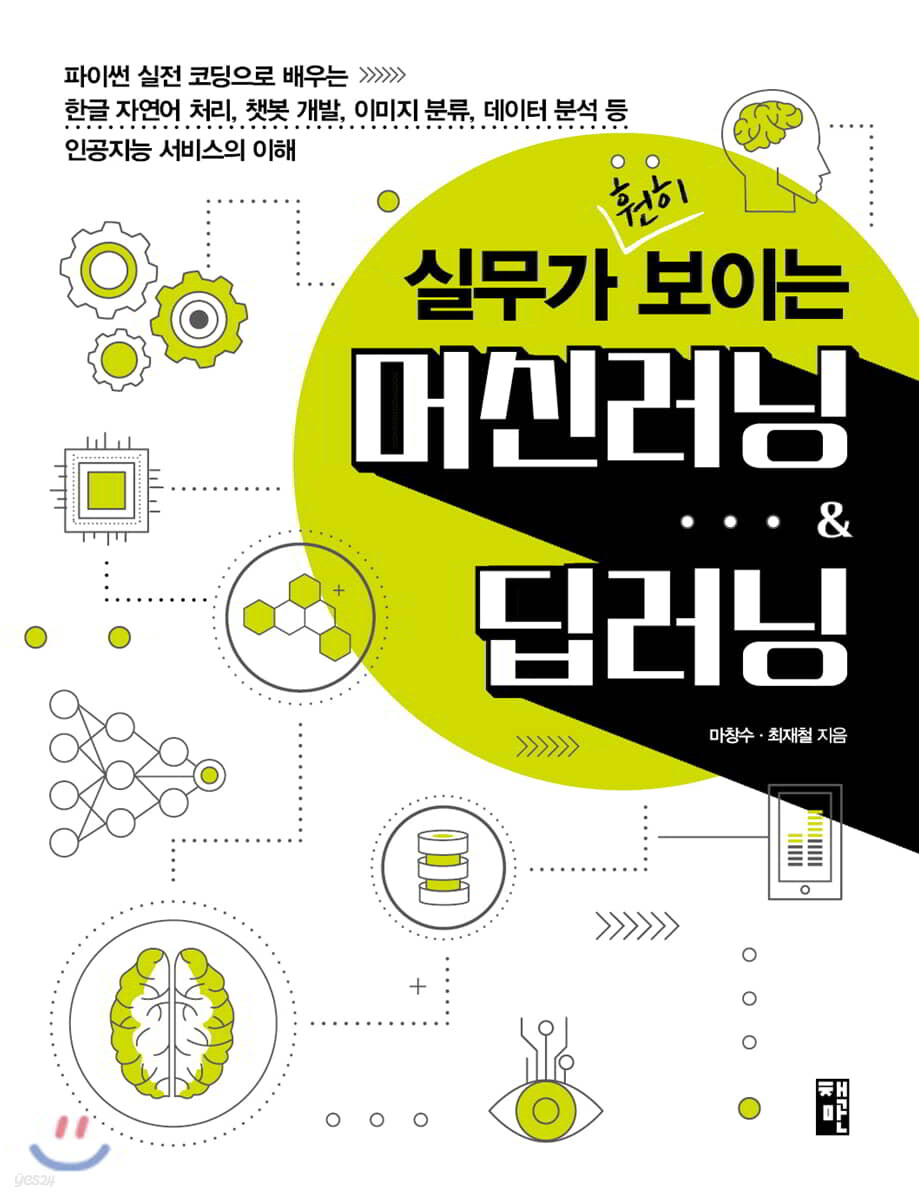
Machine Learning & Deep Learning with Visible Practical Applications
 |
Description
Book Introduction
To design and apply practical artificial intelligence technologies and services to practice, and to directly implement machine learning and deep learning development.
A comprehensive introduction for planners, developers, and managers who need to understand diverse perspectives.
"Machine Learning & Deep Learning with Visible Practice" is a book filled with friendly algorithm theory learning and abundant practical coding examples, including Korean natural language processing, image classification, conversation service chatbot development, and text sentiment analysis, utilizing various Python-based artificial intelligence frameworks and services.
Through this book, you can learn about various fields of artificial intelligence services, practice practical examples, learn the key algorithmic theories of machine learning and deep learning, and create simple services yourself.
A comprehensive introduction for planners, developers, and managers who need to understand diverse perspectives.
"Machine Learning & Deep Learning with Visible Practice" is a book filled with friendly algorithm theory learning and abundant practical coding examples, including Korean natural language processing, image classification, conversation service chatbot development, and text sentiment analysis, utilizing various Python-based artificial intelligence frameworks and services.
Through this book, you can learn about various fields of artificial intelligence services, practice practical examples, learn the key algorithmic theories of machine learning and deep learning, and create simple services yourself.
- You can preview some of the book's contents.
Preview
index
[Part 1] Understanding AI Services and Technologies
[Chapter 1] What is Artificial Intelligence?
1.1 The Origin and Development of Artificial Intelligence Technology
1.2 Key Business Cases Using Artificial Intelligence
1.3 Summary
[Chapter 2] Methods for Applying Artificial Intelligence
2.1 Classification of AI Application Technologies
2.2 Distributed Platform Environment for Artificial Intelligence Development
2.3 Tools to support artificial intelligence development
2.4 Deep Learning and Machine Learning Dedicated Frameworks
2.5 Programming Languages for Artificial Intelligence Development
2.6 Format for effective data handling
2.7 Cloud-based AI services that are easy to access and use
2.8 Summary
[Part 2] Machine Learning and Deep Learning
[Chapter 3] Understanding Machine Learning and Classification Using Supervised Learning
3.1 Types of Machine Learning
3.2 Decision Tree
3.3 Support Vector Machine Algorithm
3.4 Summary
[Chapter 4] Clustering Using Unsupervised Learning
4.1 Understanding Clustering Concepts with the K-Means Algorithm
4.2 Implementing K-Means Directly
4.3 Practicing Clustering with Iris Data
4.4 Practicing Clustering with Wine Data
4.5 Summary
[Chapter 5] Image Classification Using Deep Learning
5.1 Understanding Deep Learning Technology
5.2 What is CNN?
5.3 Handwriting Image Recognition
5.4 Food Image Recognition
5.5 Summary
[Chapter 6] Image Object Extraction Using TensorFlow
6.1 Object Extraction Overview
6.2 Trying Object Recognition
6.3 Applying Object Recognition
6.4 Image Labeling Tools for Object Recognition
6.5 Summary
[Part 3] Understanding Natural Language Processing Technology
[Chapter 7] Korean Natural Language Processing
7.1 Overview of Natural Language Processing
7.2 Text Data Preprocessing
7.3 Vectorization of text data
7.4 Korean Natural Language Processing Process
7.5 Understanding the Korean Morphological Analyzer
7.6 Using the Korean Morphological Analyzer
7.7 Topic Modeling
7.8 Summary
[Chapter 8] Natural Language Processing Using Word2Vec
8.1 Understanding Word Embeddings: The Art of Natural Language Processing
8.2 Trying out word2vec
8.3 Analyzing Movie Reviews Using Word2Vec
8.4 Summary
[Chapter 9] Analyzing Text Sentiment
9.1 What is Text Sentiment Analysis?
9.2 Sentiment Analysis with Keras
9.3 Sentiment Analysis Using Support Vector Machines
9.4 Summary
[Part 4] Understanding Chatbot Services and Implementation Technologies
[Chapter 10] Introduction to Chatbot Service Technology
10.1 What is a Chatbot?
10.2 Main Service Types of Chatbots
10.3 Technologies that make up chatbots
10.4 Summary
[Chapter 11] Chatbot Development Using Cloud Services
11.1 Developing Conversation Scenarios Using Watson
11.2 Adding a Slack Bot
11.3 Running the Chatbot Program
11.4 Summary
[Chapter 12] Developing a Conversational Service Using RNNs
12.1 Preparing a Deep Learning-Based Development Environment
12.2 Building a Conversation Engine with RNNs
12.3 Developing a Laundry Chatbot Service
12.4 Developing a Home IoT Control Chatbot
12.5 Summary
[Appendix A] Installing Python 3
A.1 Installing on Ubuntu
A.2 Installing on Mac OS X
A.3 Installing on Windows
[Appendix B] Installing NumPy and SciPy on Windows
B.1 Installing NumPy Modules
B.2 Installing the SiFi Module
[Appendix C] Installing Keras
C.1 Creating a Virtual Development Environment
C.2 Installing Additional Packages
C.3 Installing Jupyter Notebook
[Chapter 1] What is Artificial Intelligence?
1.1 The Origin and Development of Artificial Intelligence Technology
1.2 Key Business Cases Using Artificial Intelligence
1.3 Summary
[Chapter 2] Methods for Applying Artificial Intelligence
2.1 Classification of AI Application Technologies
2.2 Distributed Platform Environment for Artificial Intelligence Development
2.3 Tools to support artificial intelligence development
2.4 Deep Learning and Machine Learning Dedicated Frameworks
2.5 Programming Languages for Artificial Intelligence Development
2.6 Format for effective data handling
2.7 Cloud-based AI services that are easy to access and use
2.8 Summary
[Part 2] Machine Learning and Deep Learning
[Chapter 3] Understanding Machine Learning and Classification Using Supervised Learning
3.1 Types of Machine Learning
3.2 Decision Tree
3.3 Support Vector Machine Algorithm
3.4 Summary
[Chapter 4] Clustering Using Unsupervised Learning
4.1 Understanding Clustering Concepts with the K-Means Algorithm
4.2 Implementing K-Means Directly
4.3 Practicing Clustering with Iris Data
4.4 Practicing Clustering with Wine Data
4.5 Summary
[Chapter 5] Image Classification Using Deep Learning
5.1 Understanding Deep Learning Technology
5.2 What is CNN?
5.3 Handwriting Image Recognition
5.4 Food Image Recognition
5.5 Summary
[Chapter 6] Image Object Extraction Using TensorFlow
6.1 Object Extraction Overview
6.2 Trying Object Recognition
6.3 Applying Object Recognition
6.4 Image Labeling Tools for Object Recognition
6.5 Summary
[Part 3] Understanding Natural Language Processing Technology
[Chapter 7] Korean Natural Language Processing
7.1 Overview of Natural Language Processing
7.2 Text Data Preprocessing
7.3 Vectorization of text data
7.4 Korean Natural Language Processing Process
7.5 Understanding the Korean Morphological Analyzer
7.6 Using the Korean Morphological Analyzer
7.7 Topic Modeling
7.8 Summary
[Chapter 8] Natural Language Processing Using Word2Vec
8.1 Understanding Word Embeddings: The Art of Natural Language Processing
8.2 Trying out word2vec
8.3 Analyzing Movie Reviews Using Word2Vec
8.4 Summary
[Chapter 9] Analyzing Text Sentiment
9.1 What is Text Sentiment Analysis?
9.2 Sentiment Analysis with Keras
9.3 Sentiment Analysis Using Support Vector Machines
9.4 Summary
[Part 4] Understanding Chatbot Services and Implementation Technologies
[Chapter 10] Introduction to Chatbot Service Technology
10.1 What is a Chatbot?
10.2 Main Service Types of Chatbots
10.3 Technologies that make up chatbots
10.4 Summary
[Chapter 11] Chatbot Development Using Cloud Services
11.1 Developing Conversation Scenarios Using Watson
11.2 Adding a Slack Bot
11.3 Running the Chatbot Program
11.4 Summary
[Chapter 12] Developing a Conversational Service Using RNNs
12.1 Preparing a Deep Learning-Based Development Environment
12.2 Building a Conversation Engine with RNNs
12.3 Developing a Laundry Chatbot Service
12.4 Developing a Home IoT Control Chatbot
12.5 Summary
[Appendix A] Installing Python 3
A.1 Installing on Ubuntu
A.2 Installing on Mac OS X
A.3 Installing on Windows
[Appendix B] Installing NumPy and SciPy on Windows
B.1 Installing NumPy Modules
B.2 Installing the SiFi Module
[Appendix C] Installing Keras
C.1 Creating a Virtual Development Environment
C.2 Installing Additional Packages
C.3 Installing Jupyter Notebook
Detailed image
.jpg)
Publisher's Review
Structure of this book
Part 1, "Understanding Artificial Intelligence Services and Technologies," examines the background and definition of artificial intelligence, the concepts of machine learning and deep learning, and various tools and technological elements for introducing artificial intelligence services.
Chapter 1, "What is Artificial Intelligence?" introduces key concepts and background knowledge about artificial intelligence, machine learning, and deep learning.
Additionally, we introduce various services that utilize artificial intelligence.
Chapter 2, "Methods for Applying Artificial Intelligence," explores various tools and technical elements for introducing artificial intelligence technology into services.
In Part 2, "Machine Learning and Deep Learning," we examine the characteristics and differences between types of machine learning technology and explore representative algorithms for supervised and unsupervised learning.
Chapter 3, 'Understanding Machine Learning and Classification Using Supervised Learning' is the starting point for building machine learning in earnest. By implementing decision trees and support vector machine algorithms, you will learn the basic concepts necessary for machine learning.
Chapter 4, "Clustering Using Unsupervised Learning," provides an overview of unsupervised learning and explores how to solve unsupervised learning problems using the K-means algorithm.
In Chapter 5, 'Image Classification Using Deep Learning', you will learn how to process images using deep learning, and through hands-on practice of recognizing food images, you will be able to understand the deep learning training process.
In Chapter 6, 'Image Object Extraction Using TensorFlow', you will learn how to extract image objects using deep learning.
You can learn how to use TensorFlow, a deep learning framework.
In Part 3, "Understanding Natural Language Processing Technology," we'll get an overview of what natural language processing is, examine the purpose of learning natural language processing, and then learn how to analyze sentiment in text using real-world examples.
In Chapter 7, 'Korean Natural Language Processing', we will learn about the definition and basic knowledge of natural language processing and examine morphological analysis for Korean processing.
Chapter 8, 'Natural Language Processing Using Word-to-Vec' introduces a natural language processing method using deep learning, which has recently been used in addition to the existing natural language processing method.
In particular, we will take a closer look at a technology called Word2Vec.
In Chapter 9, Analyzing Text Sentiment, you will learn techniques for assessing sentiment through Korean movie reviews.
Learn how to implement it using recurrent neural networks (RNNs) and support vector machines.
Part 4, 'Understanding Chatbot Services and Implementation Technologies' covers the basic concepts of chatbots, how to create them using cloud services, and how to create simple conversational services using deep learning technology.
Chapter 10, "Introduction to Chatbot Service Technology," explores the understanding, types, and various examples of chatbot services, which are attracting attention recently.
We also look at the technology that makes up chatbots.
In Chapter 11, 'Developing Chatbots Using Cloud Services,' we'll create our own chatbot using cloud-based Watson.
In Chapter 12, 'Developing a Conversational Service Using RNN', we will build a conversational service using deep learning technology rather than a provided cloud service.
Finally, the appendix explains how to install Python, NumPy, SciPy, and Keras, the main execution environments for running the examples in this book.
Other environmental installation and configuration methods are also explained in detail in the text.
Key features of this book
- With this one book, you can learn about various fields of artificial intelligence services and practice practical examples.
- Learn the key algorithmic theories of machine learning and deep learning and create a simple service yourself.
- You can acquire the basic skills for service planning by understanding the types, cases, and application technologies of artificial intelligence.
- You can directly experience and choose from the perspective of expanding and applying artificial intelligence technology.
- You can experience various artificial intelligence technologies such as voice recognition, natural language processing, conversation systems, and image processing.
- We use Python-based packages for artificial intelligence, such as PyTorch, Gensim, TensorFlow, Keras, and NLTK.
Target audience for this book
- Service/solution planners who are considering new IT services utilizing artificial intelligence and are thirsty for technical understanding.
- IT professionals seeking to expand their expertise in the areas of machine learning and deep learning.
- High school students, college students, and the general public who have experience with computer programming and want to experience development using artificial intelligence
Part 1, "Understanding Artificial Intelligence Services and Technologies," examines the background and definition of artificial intelligence, the concepts of machine learning and deep learning, and various tools and technological elements for introducing artificial intelligence services.
Chapter 1, "What is Artificial Intelligence?" introduces key concepts and background knowledge about artificial intelligence, machine learning, and deep learning.
Additionally, we introduce various services that utilize artificial intelligence.
Chapter 2, "Methods for Applying Artificial Intelligence," explores various tools and technical elements for introducing artificial intelligence technology into services.
In Part 2, "Machine Learning and Deep Learning," we examine the characteristics and differences between types of machine learning technology and explore representative algorithms for supervised and unsupervised learning.
Chapter 3, 'Understanding Machine Learning and Classification Using Supervised Learning' is the starting point for building machine learning in earnest. By implementing decision trees and support vector machine algorithms, you will learn the basic concepts necessary for machine learning.
Chapter 4, "Clustering Using Unsupervised Learning," provides an overview of unsupervised learning and explores how to solve unsupervised learning problems using the K-means algorithm.
In Chapter 5, 'Image Classification Using Deep Learning', you will learn how to process images using deep learning, and through hands-on practice of recognizing food images, you will be able to understand the deep learning training process.
In Chapter 6, 'Image Object Extraction Using TensorFlow', you will learn how to extract image objects using deep learning.
You can learn how to use TensorFlow, a deep learning framework.
In Part 3, "Understanding Natural Language Processing Technology," we'll get an overview of what natural language processing is, examine the purpose of learning natural language processing, and then learn how to analyze sentiment in text using real-world examples.
In Chapter 7, 'Korean Natural Language Processing', we will learn about the definition and basic knowledge of natural language processing and examine morphological analysis for Korean processing.
Chapter 8, 'Natural Language Processing Using Word-to-Vec' introduces a natural language processing method using deep learning, which has recently been used in addition to the existing natural language processing method.
In particular, we will take a closer look at a technology called Word2Vec.
In Chapter 9, Analyzing Text Sentiment, you will learn techniques for assessing sentiment through Korean movie reviews.
Learn how to implement it using recurrent neural networks (RNNs) and support vector machines.
Part 4, 'Understanding Chatbot Services and Implementation Technologies' covers the basic concepts of chatbots, how to create them using cloud services, and how to create simple conversational services using deep learning technology.
Chapter 10, "Introduction to Chatbot Service Technology," explores the understanding, types, and various examples of chatbot services, which are attracting attention recently.
We also look at the technology that makes up chatbots.
In Chapter 11, 'Developing Chatbots Using Cloud Services,' we'll create our own chatbot using cloud-based Watson.
In Chapter 12, 'Developing a Conversational Service Using RNN', we will build a conversational service using deep learning technology rather than a provided cloud service.
Finally, the appendix explains how to install Python, NumPy, SciPy, and Keras, the main execution environments for running the examples in this book.
Other environmental installation and configuration methods are also explained in detail in the text.
Key features of this book
- With this one book, you can learn about various fields of artificial intelligence services and practice practical examples.
- Learn the key algorithmic theories of machine learning and deep learning and create a simple service yourself.
- You can acquire the basic skills for service planning by understanding the types, cases, and application technologies of artificial intelligence.
- You can directly experience and choose from the perspective of expanding and applying artificial intelligence technology.
- You can experience various artificial intelligence technologies such as voice recognition, natural language processing, conversation systems, and image processing.
- We use Python-based packages for artificial intelligence, such as PyTorch, Gensim, TensorFlow, Keras, and NLTK.
Target audience for this book
- Service/solution planners who are considering new IT services utilizing artificial intelligence and are thirsty for technical understanding.
- IT professionals seeking to expand their expertise in the areas of machine learning and deep learning.
- High school students, college students, and the general public who have experience with computer programming and want to experience development using artificial intelligence
GOODS SPECIFICS
- Date of issue: July 31, 2019
- Page count, weight, size: 316 pages | 180*235*16mm
- ISBN13: 9791189909031
- ISBN10: 1189909030
You may also like
카테고리
korean


korean

![GQ KOREA Mark (Monthly): December [2025]](http://librairie.coreenne.fr/cdn/shop/files/8ef265dbbfbf186523ed75ba7319009d.jpg?v=1765340328&width=3840)


