

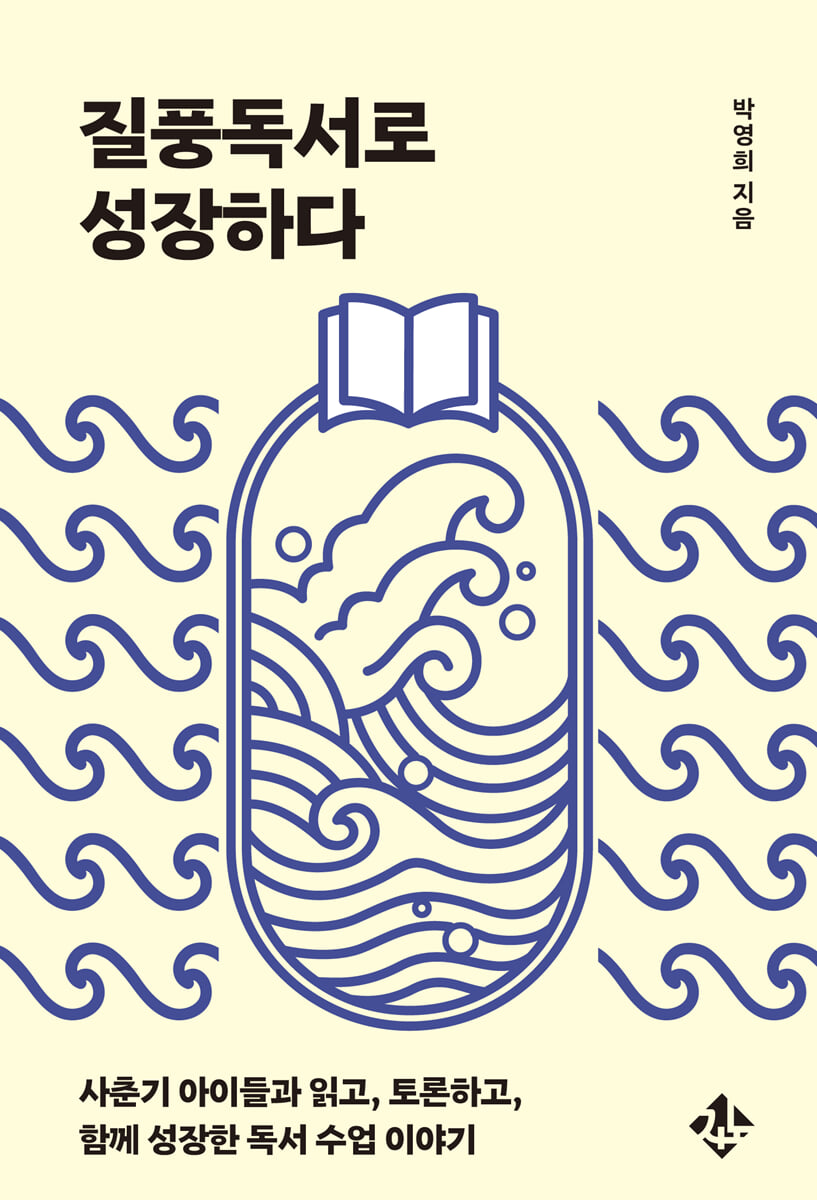
Growing up through reading like a whirlwind
 |
Description
Book Introduction
In stormy times, when books are my ally
A story about reading during adolescence from teacher Park Young-hee
Time to read, shake, and become stronger!
In the middle of a classroom for adolescents, Korean language teacher Park Young-hee began to connect with the children through 'reading'.
Children who had previously rejected books began to slowly turn the pages, ask questions, and listen to each other's stories.
This book, "Growing Through a Storm of Reading," is a practical account of reading classes conducted over 13 years in middle school, where students read, asked questions, and discussed books together. It is also a record of the journey of growth that the teacher and the children going through the stormy period of adolescence have shared together.
Reading is not just a learning tool.
It is a process in which children develop the ability to think for themselves, to sway, and to express themselves.
However, in the real world of adolescent classrooms, the place for reading is increasingly limited by tests and grades.
This book shows how reading can enrich children's inner selves and serve as a guide through the stormy times.
The author realized this by reading and discussing the book with children.
That rather than solving one more problem, we need more experience looking into our own hearts.
Through the stories in the book, children sometimes cried and laughed, and sometimes told their own stories, strengthening themselves.
It was a small miracle and growth in the classroom to see students who had previously refused to read gradually open their bookshelves, ask questions, and listen to each other's lives.
And through that journey, teachers also had the experience of learning and growing stronger together with the children.
A story about reading during adolescence from teacher Park Young-hee
Time to read, shake, and become stronger!
In the middle of a classroom for adolescents, Korean language teacher Park Young-hee began to connect with the children through 'reading'.
Children who had previously rejected books began to slowly turn the pages, ask questions, and listen to each other's stories.
This book, "Growing Through a Storm of Reading," is a practical account of reading classes conducted over 13 years in middle school, where students read, asked questions, and discussed books together. It is also a record of the journey of growth that the teacher and the children going through the stormy period of adolescence have shared together.
Reading is not just a learning tool.
It is a process in which children develop the ability to think for themselves, to sway, and to express themselves.
However, in the real world of adolescent classrooms, the place for reading is increasingly limited by tests and grades.
This book shows how reading can enrich children's inner selves and serve as a guide through the stormy times.
The author realized this by reading and discussing the book with children.
That rather than solving one more problem, we need more experience looking into our own hearts.
Through the stories in the book, children sometimes cried and laughed, and sometimes told their own stories, strengthening themselves.
It was a small miracle and growth in the classroom to see students who had previously refused to read gradually open their bookshelves, ask questions, and listen to each other's lives.
And through that journey, teachers also had the experience of learning and growing stronger together with the children.
index
Introduction _ Time to read together
Chapter 1 | The Beginning of Reading, Taking the First Step
01.
Reading time begins
02.
Time to get acquainted with books
03.
Class library, our class's small library
04.
A library that nurtures dreams
05.
The birth of a reading club
06.
Reading classes possible because we're together
07.
The Power of Storytelling, the Beginning of Growth
08.
Four Ways to Become Friends with Books
Chapter 2 | Reading, Reading Deeper
09.
Reading books together online
10.
A reading journey through short stories
11.
A living reading class
12.
Reading that leads to questions
13.
Fall in love with the charm of reading poetry
14.
Reading to record, emotions to remember
Chapter 3 | Moments When Books Change Us
15.
There's a book between us
16.
The easiest way to open your heart
17.
The moment you discover me
18.
Beyond hate and discrimination
19.
A Poetry Prescription to Heal the Heart
20.
A child buying a wedding
21.
Why we read novels
22.
A reading journey of learning and growing
Chapter 4 | The Joy of Reading and Growing Together
23.
The Flower of Reading, Reading Discussion
24.
An unforgettable meeting with an author
25.
Welcome, is this your first time at the reading club?
26.
Dreaming of a student-wide reading club
27.
Neighborhood Bookstores: Connecting Books and People
28.
Reading Challenges in the Text Heap Era
Chapter 5 | Teachers' Reading Life and Practice
29.
Becoming a Teacher and YouTuber
30.
Teachers' Reading Group
31.
Teachers working together, learning together
32.
Reading is also a tool for redemption, the power of tools
33.
My own way of choosing books
34.
Book Reviews: How to Record Your Reading
35.
From reader to writer
Concluding remarks _ We grow with books
supplement
1.
Creating a small library for our class to become familiar with books
2.
3 foolproof ways to choose a book
3.
Tools to Make Reading Discussions Fun
Chapter 1 | The Beginning of Reading, Taking the First Step
01.
Reading time begins
02.
Time to get acquainted with books
03.
Class library, our class's small library
04.
A library that nurtures dreams
05.
The birth of a reading club
06.
Reading classes possible because we're together
07.
The Power of Storytelling, the Beginning of Growth
08.
Four Ways to Become Friends with Books
Chapter 2 | Reading, Reading Deeper
09.
Reading books together online
10.
A reading journey through short stories
11.
A living reading class
12.
Reading that leads to questions
13.
Fall in love with the charm of reading poetry
14.
Reading to record, emotions to remember
Chapter 3 | Moments When Books Change Us
15.
There's a book between us
16.
The easiest way to open your heart
17.
The moment you discover me
18.
Beyond hate and discrimination
19.
A Poetry Prescription to Heal the Heart
20.
A child buying a wedding
21.
Why we read novels
22.
A reading journey of learning and growing
Chapter 4 | The Joy of Reading and Growing Together
23.
The Flower of Reading, Reading Discussion
24.
An unforgettable meeting with an author
25.
Welcome, is this your first time at the reading club?
26.
Dreaming of a student-wide reading club
27.
Neighborhood Bookstores: Connecting Books and People
28.
Reading Challenges in the Text Heap Era
Chapter 5 | Teachers' Reading Life and Practice
29.
Becoming a Teacher and YouTuber
30.
Teachers' Reading Group
31.
Teachers working together, learning together
32.
Reading is also a tool for redemption, the power of tools
33.
My own way of choosing books
34.
Book Reviews: How to Record Your Reading
35.
From reader to writer
Concluding remarks _ We grow with books
supplement
1.
Creating a small library for our class to become familiar with books
2.
3 foolproof ways to choose a book
3.
Tools to Make Reading Discussions Fun
Into the book
-“Reading is not just a learning tool.
It is a process that develops the ability to think and express oneself.
But the reality is different.
Parents who emphasized reading until their children were in elementary school say, "I don't have time to read books because I don't have enough time to study."
Reading is increasingly falling down the rankings.
It's the same at school.
It is difficult to find reading and writing academies for middle and high school students, and even when reading education is provided, it is mostly for preparing for entrance exam essays.
Ultimately, it is not an exaggeration to say that practical reading ends in elementary school.
… … As a middle school teacher, I look back on the 13 years I spent reading, thinking, and growing with children.
The most important thing I considered in the classroom was to develop the ability to think for oneself and express what one thinks.
As we read the book together, I realized that children need the experience of looking into their own hearts more than just getting one more question right.
Through this book, I want to convey that reading is not just a means of learning, but can also be a strength in living life.
I hope that the stories created by the books and children will resonate warmly.”
-“The next day, I was so motivated that I took all the kids to the library and told them to pick out a book they wanted to read.
I wanted to give people the freedom to choose.
But something unexpected happened.
Some children kept taking out their books and stopping them, while others just stood there blankly.
There were many children who were wandering around the bookshelf for 30 minutes without being able to choose a book.
Even the book I had chosen a long time ago turned out to be too difficult, so I went back to change it.
I was taken aback by that sight.
'What's wrong?' I never thought children would have such a hard time choosing books.
I always had a ton of books I wanted to read, and I had trouble deciding which one to read first.
However, children who lack reading experience hit a wall from the very beginning when choosing books.
Only then did I realize.
“The fact that children have never learned ‘how to read a book,’ let alone ‘how to choose a book.’”
-“While reading a story, we begin to imagine.
We imagine the situation the character is in, recall their feelings, empathize with them, and understand them.
I also ask myself, 'What would I have done?'
By following the choices and conflicts of the characters in the story, I reflect on the reality I face and gain the strength to move forward from the lessons I learn.
In this way, through stories, we understand our own lives, the lives of others, and connect more deeply with the world.
In fact, there are studies that show that the parts of the brain used when reading a novel are largely the same as the parts of the brain used when dealing with human relationships.”
-“When we think of reading classes, we usually only think of activities that are done after reading a book.
When I look back on my school days, all I did after reading a book was write a book report or share my thoughts with friends.
Organizing what I read and felt was a meaningful activity, but the process was not easy.
There have been more than a few times when I couldn't remember the content well or felt lost because I didn't know what part to talk about.
But as I became a teacher and taught children, I realized that reading classes weren't just about 'reading books and sharing our thoughts.'
I realized that reading is only complete when all processes—before, during, and after reading—are organically connected.”
-“With the advancement of artificial intelligence, there is now little meaning in humans memorizing answers.
Because we can never beat artificial intelligence by knowing more.
So what should children learn now? Not the right answers, but "how to ask questions."
The answers you get depend on the questions you ask, and you need to know how to ask the right questions to get the answers you need.
However, students in our country are famous for not asking questions.
It's not just a problem for students.
A video of former U.S. President Obama giving Korean reporters a chance to ask questions, but no one did, became a hot topic.
This video went viral, and there were loud voices of criticism from both the media and the education community, saying, “This is the result of spoon-fed education.”
It is a process that develops the ability to think and express oneself.
But the reality is different.
Parents who emphasized reading until their children were in elementary school say, "I don't have time to read books because I don't have enough time to study."
Reading is increasingly falling down the rankings.
It's the same at school.
It is difficult to find reading and writing academies for middle and high school students, and even when reading education is provided, it is mostly for preparing for entrance exam essays.
Ultimately, it is not an exaggeration to say that practical reading ends in elementary school.
… … As a middle school teacher, I look back on the 13 years I spent reading, thinking, and growing with children.
The most important thing I considered in the classroom was to develop the ability to think for oneself and express what one thinks.
As we read the book together, I realized that children need the experience of looking into their own hearts more than just getting one more question right.
Through this book, I want to convey that reading is not just a means of learning, but can also be a strength in living life.
I hope that the stories created by the books and children will resonate warmly.”
-“The next day, I was so motivated that I took all the kids to the library and told them to pick out a book they wanted to read.
I wanted to give people the freedom to choose.
But something unexpected happened.
Some children kept taking out their books and stopping them, while others just stood there blankly.
There were many children who were wandering around the bookshelf for 30 minutes without being able to choose a book.
Even the book I had chosen a long time ago turned out to be too difficult, so I went back to change it.
I was taken aback by that sight.
'What's wrong?' I never thought children would have such a hard time choosing books.
I always had a ton of books I wanted to read, and I had trouble deciding which one to read first.
However, children who lack reading experience hit a wall from the very beginning when choosing books.
Only then did I realize.
“The fact that children have never learned ‘how to read a book,’ let alone ‘how to choose a book.’”
-“While reading a story, we begin to imagine.
We imagine the situation the character is in, recall their feelings, empathize with them, and understand them.
I also ask myself, 'What would I have done?'
By following the choices and conflicts of the characters in the story, I reflect on the reality I face and gain the strength to move forward from the lessons I learn.
In this way, through stories, we understand our own lives, the lives of others, and connect more deeply with the world.
In fact, there are studies that show that the parts of the brain used when reading a novel are largely the same as the parts of the brain used when dealing with human relationships.”
-“When we think of reading classes, we usually only think of activities that are done after reading a book.
When I look back on my school days, all I did after reading a book was write a book report or share my thoughts with friends.
Organizing what I read and felt was a meaningful activity, but the process was not easy.
There have been more than a few times when I couldn't remember the content well or felt lost because I didn't know what part to talk about.
But as I became a teacher and taught children, I realized that reading classes weren't just about 'reading books and sharing our thoughts.'
I realized that reading is only complete when all processes—before, during, and after reading—are organically connected.”
-“With the advancement of artificial intelligence, there is now little meaning in humans memorizing answers.
Because we can never beat artificial intelligence by knowing more.
So what should children learn now? Not the right answers, but "how to ask questions."
The answers you get depend on the questions you ask, and you need to know how to ask the right questions to get the answers you need.
However, students in our country are famous for not asking questions.
It's not just a problem for students.
A video of former U.S. President Obama giving Korean reporters a chance to ask questions, but no one did, became a hot topic.
This video went viral, and there were loud voices of criticism from both the media and the education community, saying, “This is the result of spoon-fed education.”
--- From the text
Publisher's Review
Grow through 'Whirlwind Reading'!
Reading, discussing, and discussing with adolescent children
A story about a reading class that grew together
The title of the book, 'Whirlwind Reading,' contains the belief that reading can be a light for adolescent children going through a period full of ups and downs.
The author said, “In stormy times, books serve as a light.
“The intense experiences children have through books can bring about great changes in children,” he says.
I am confident that the diverse experiences encountered in the book will ultimately establish a strong foundation in the children's hearts.
The text, consisting of 35 chapters in total, contains detailed reading class methods, changes in students, and the teacher's concerns and trials and errors.
Among them, the 'Poetry Prescription Writing' class, where children read poetry and write poems to address their friends' concerns, left a deep impression.
The sight of children who seemed prickly on the outside expressing their inner feelings and understanding each other through poetry is a moment that shows the power of books to open children's hearts.
The author confesses that although he tried to teach his children through reading, he ended up learning and growing more himself.
I personally felt that education is not a one-way transmission, but an experience in which both teachers and students change together.
So, this book is more than just a record of classes; it is also a story of the teacher's own growth.
This book is open to teachers and parents who are concerned about reading education, and all readers who want to learn about reading classes or grow through reading.
Parents who navigate their children's adolescence together will gain a new perspective on how to interpret their children's changes, and teachers will discover another way to engage with children in the classroom.
Above all, since it is based on field experience, it contains practical concerns and trial and error rather than abstract theories, making it a useful book that can be immediately applied to educational settings.
Reading, discussing, and discussing with adolescent children
A story about a reading class that grew together
The title of the book, 'Whirlwind Reading,' contains the belief that reading can be a light for adolescent children going through a period full of ups and downs.
The author said, “In stormy times, books serve as a light.
“The intense experiences children have through books can bring about great changes in children,” he says.
I am confident that the diverse experiences encountered in the book will ultimately establish a strong foundation in the children's hearts.
The text, consisting of 35 chapters in total, contains detailed reading class methods, changes in students, and the teacher's concerns and trials and errors.
Among them, the 'Poetry Prescription Writing' class, where children read poetry and write poems to address their friends' concerns, left a deep impression.
The sight of children who seemed prickly on the outside expressing their inner feelings and understanding each other through poetry is a moment that shows the power of books to open children's hearts.
The author confesses that although he tried to teach his children through reading, he ended up learning and growing more himself.
I personally felt that education is not a one-way transmission, but an experience in which both teachers and students change together.
So, this book is more than just a record of classes; it is also a story of the teacher's own growth.
This book is open to teachers and parents who are concerned about reading education, and all readers who want to learn about reading classes or grow through reading.
Parents who navigate their children's adolescence together will gain a new perspective on how to interpret their children's changes, and teachers will discover another way to engage with children in the classroom.
Above all, since it is based on field experience, it contains practical concerns and trial and error rather than abstract theories, making it a useful book that can be immediately applied to educational settings.
GOODS SPECIFICS
- Date of issue: August 30, 2025
- Page count, weight, size: 236 pages | 300g | 128*188*16mm
- ISBN13: 9791193878279
- ISBN10: 1193878276
You may also like
카테고리
korean


korean

![ELLE 엘르 스페셜 에디션 A형 : 12월 [2025]](http://librairie.coreenne.fr/cdn/shop/files/b8e27a3de6c9538896439686c6b0e8fb.jpg?v=1766436872&width=3840)


