

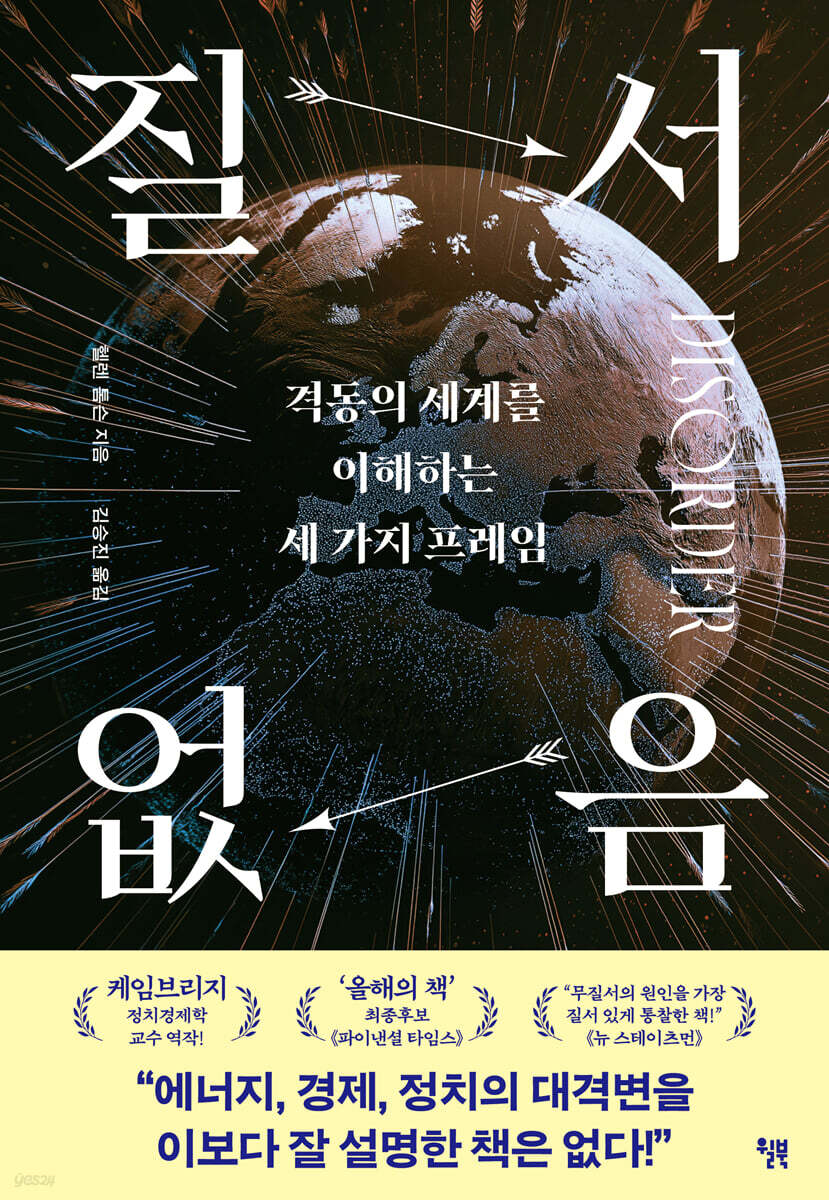
No order
 |
Description
Book Introduction
- A word from MD
-
To understand the chaotic worldThe price of gold has skyrocketed.
It is evidence that the world is unstable.
The order is collapsing, with war, trade conflicts, and right-wing extremism.
Only by knowing why can we imagine a better world.
The origins of disorder analyzed in three ways: energy, economy, and democracy.
October 17, 2025. Min-gyu Son, Social and Political PD
Endless wars, unpredictable tariff bombs, and global inflation... What are the roots of this chaos that defies common sense? Professor Helen Thompson of Cambridge University, a world-renowned scholar, has unraveled the origins of the "disorder" we face today.
"No Order" proves that the seemingly fragmentary geopolitical, economic, and political shocks—the Russo-Japanese War, the US-China hegemony competition, the Middle East conflicts, and the crisis of democracy—were in fact inevitable results of the complex intertwining of three great historical currents: energy, finance, and democracy.
This book traces the roots of the forces that drive today's world, spanning decades of history, from the oil shocks of the 1970s to the shale revolution and green transition of the 21st century, and the current crisis of the Ukraine War in 2022.
This book, which clearly unravels the complex flow of modern history, received enthusiastic praise from academia and the media immediately after its publication, and its value was proven when it was shortlisted for the Financial Times' Book of the Year award.
"No Order" proves that the seemingly fragmentary geopolitical, economic, and political shocks—the Russo-Japanese War, the US-China hegemony competition, the Middle East conflicts, and the crisis of democracy—were in fact inevitable results of the complex intertwining of three great historical currents: energy, finance, and democracy.
This book traces the roots of the forces that drive today's world, spanning decades of history, from the oil shocks of the 1970s to the shale revolution and green transition of the 21st century, and the current crisis of the Ukraine War in 2022.
This book, which clearly unravels the complex flow of modern history, received enthusiastic praise from academia and the media immediately after its publication, and its value was proven when it was shortlisted for the Financial Times' Book of the Year award.
- You can preview some of the book's contents.
Preview
index
Author's Preface to the Paperback Edition
Introduction: The Great Disturbance
| Part 1 | Geopolitics
Chapter 1: The Beginning of the Oil Age
Chapter 2: Oil cannot be guaranteed
Chapter 3: Eurasia, Reconstructed
| Part 2 | Economy
Chapter 4 Our Currency, Your Problem
Chapter 5: "Made in China" Needs Dollars
Chapter 6: There's No Going Back
| Part 3 | Democratic Politics
Chapter 7: 'Time' in Democracy
Chapter 8: The Rise and Fall of Democratic Taxation States
Chapter 9: Where is Reform Headed?
Outgoing Post: More to Come
Review: The War of 2022
Acknowledgements
main
Introduction: The Great Disturbance
| Part 1 | Geopolitics
Chapter 1: The Beginning of the Oil Age
Chapter 2: Oil cannot be guaranteed
Chapter 3: Eurasia, Reconstructed
| Part 2 | Economy
Chapter 4 Our Currency, Your Problem
Chapter 5: "Made in China" Needs Dollars
Chapter 6: There's No Going Back
| Part 3 | Democratic Politics
Chapter 7: 'Time' in Democracy
Chapter 8: The Rise and Fall of Democratic Taxation States
Chapter 9: Where is Reform Headed?
Outgoing Post: More to Come
Review: The War of 2022
Acknowledgements
main
Detailed image
.jpg)
Into the book
In the democratic United States, the 'loser's consent' [acceptance of victory by the losing side] has now disappeared from elections, and no democracy can function without the consent of the loser.
There have been numerous articles and commentaries on the disturbances of the past decade.
Many analyses have discussed it within the framework of populist nationalism, in connection with the economic collapse of 2007–2008, or in the context of the collapse of the so-called “liberal international order.”
However, there was much that was left unexplained regarding what the structural factors at the system level were.
Energy is today's geopolitical.
One reason may be that it has been overlooked as a crucial factor in shaking up economic fault lines.
Geopolitical upheaval inevitably affects domestic politics because it upsets the balance of power in domestic politics.
In Europe, this dynamic takes on a unique form, as the question of where the political authority to respond to and implement geopolitical change remains a subject of fierce political struggle. The EU is a union of democratic nation-states.
However, they find their legitimacy in relying on external powers for security and appealing to the fact that the concept of the nation-state is to some extent an outdated one.
This external dependence and internal potential for change dramatically exposes both the EU itself and its member states to the disruptions brought about by geopolitical changes.
However, the geopolitical and economic changes that occurred in the 1970s began to shake up the functioning of this type of democratic political body.
Governments around the world have become more reliant on international capital markets and less reliant on their own citizens for their finances.
Moreover, open international financial flows and new trade agreements have made it easier for manufacturing companies in North America and Europe to shift jobs overseas where labor costs are lower, and highly globalized finance has deepened wealth concentration.
Since the 1990s, politics in democratic countries everywhere have become increasingly unresponsive to popular democratic demands for economic reforms that would give workers a greater share of the wealth they earn.
--- From "Introduction: The Great Disturbance"
Since the 1970s, Soviet-German gas cooperation has been a key feature of the European geopolitical landscape and has created structural divisions within NATO, intertwined with the fact that the United States does not have as much of a stake in Soviet energy as European countries.
--- From "Chapter 2: Oil Cannot Be Guaranteed"
In 2004, the EU finally admitted eight new member states, including Poland.
But the EU's expansion into Eastern Europe remains fraught with security concerns.
France had been concerned that the EU would retreat from its security alliance, and the second Iraq war seemed to prove that these fears were not unfounded.
Just weeks before the war began, when Eastern European countries supported the US invasion of Iraq, Chirac condemned them as “infantile” and said they were “missing the opportunity to keep their mouths shut.”
These tensions were almost inevitable.
For Eastern European countries, the old logic of making NATO the 'EU's security agent' was still a self-evident national interest.
--- From "Chapter 3: Eurasia, Reconstructed"
In structural terms, this skepticism about what monetary policy can achieve echoes the judgment of his predecessor, Mervyn King, when he spoke of the “death of NICE” 14 years ago.
At the time, King was referring to the oil issue, not the dollar issue [the issue of rising oil prices due to China's increasing demand for oil], which was both wrong and right.
He was wrong in missing the fact that monetary policy could increase oil supplies.
And since that oil was coming from the United States, Jean-Claude Trichet's view that oil was shifting power from Western to non-Western countries was also wrong.
Since 2008, America's energy and financial power have grown in tandem.
The problem was that both oil and the dollar would create new economic problems in addition to the geopolitical disruption they were causing.
Including the question of monetary policy tools, which US policymakers had bet everything on in late 2008.
--- From "Chapter 5: 'Made in China' Needs Dollars"
Ten years after the eurozone crisis, the EU was in the same state as before the crisis.
In other words, it was a 'single economy with multiple currencies', and the institutions that make up the EU were stronger than those that make up the eurozone.
The reason for this outcome could be explained in one word: “Because there was no realistically feasible political solution.”
The decision was made to just leave it as it was, as it was much less difficult than trying to fix it.
--- From "Chapter 6: There's No Going Back"
Since the 1970s, the combined influences of a more globalized and financialized economy have brought an end to economic national communitarianism.
The concept of a 'national polity that shares an economic destiny and for which the national government is responsible' collapsed as the external environment that supported it disappeared.
The interests among the people were so fiercely and obviously divided.
Inflation sharply deepened divisions among consumers, between generations, and between non-union workers and unionized workers who, at least initially, had been able to protect their wages through strikes and industry-wide bargaining.
--- From "Chapter 8: The Rise and Fall of Democratic Taxation States"
Predictably, debt played a decisive role in the collapse of economic national communitarianism.
As governments reverted to borrowing from international capital markets to finance their spending, the mechanism that had previously provided citizens as savers and taxpayers with funds and controlled the risks of creditor-debtor conflicts disappeared.
Democracies relied more on international financial markets to finance government spending and less on the savings and taxes of their own citizens.
But then the interest burden of maintaining the fiscal deficit fell on the citizens in the form of taxes.
In reality, these citizens receive no benefit from saving.
--- Chapter 8: The Rise and Fall of Democratic Taxation States, p. 313
In Europe, the world created by the end of the Cold War, German reunification, and the Maastricht and subsequent EU treaties began to shake.
It was in 2005 that Dutch and French voters held referendums rejecting the EU's constitutional treaty.
If we consider what would have happened if the French referendum in 2005 had been a narrow yes, or if the British referendum Tony Blair had promised had actually been held and resulted in a no, we can see that Cameron's decision was not the anomalous starting point of an unexpected new phase, but the end of a long story of erosion of public consensus on the EU in British domestic politics.
There have been numerous articles and commentaries on the disturbances of the past decade.
Many analyses have discussed it within the framework of populist nationalism, in connection with the economic collapse of 2007–2008, or in the context of the collapse of the so-called “liberal international order.”
However, there was much that was left unexplained regarding what the structural factors at the system level were.
Energy is today's geopolitical.
One reason may be that it has been overlooked as a crucial factor in shaking up economic fault lines.
Geopolitical upheaval inevitably affects domestic politics because it upsets the balance of power in domestic politics.
In Europe, this dynamic takes on a unique form, as the question of where the political authority to respond to and implement geopolitical change remains a subject of fierce political struggle. The EU is a union of democratic nation-states.
However, they find their legitimacy in relying on external powers for security and appealing to the fact that the concept of the nation-state is to some extent an outdated one.
This external dependence and internal potential for change dramatically exposes both the EU itself and its member states to the disruptions brought about by geopolitical changes.
However, the geopolitical and economic changes that occurred in the 1970s began to shake up the functioning of this type of democratic political body.
Governments around the world have become more reliant on international capital markets and less reliant on their own citizens for their finances.
Moreover, open international financial flows and new trade agreements have made it easier for manufacturing companies in North America and Europe to shift jobs overseas where labor costs are lower, and highly globalized finance has deepened wealth concentration.
Since the 1990s, politics in democratic countries everywhere have become increasingly unresponsive to popular democratic demands for economic reforms that would give workers a greater share of the wealth they earn.
--- From "Introduction: The Great Disturbance"
Since the 1970s, Soviet-German gas cooperation has been a key feature of the European geopolitical landscape and has created structural divisions within NATO, intertwined with the fact that the United States does not have as much of a stake in Soviet energy as European countries.
--- From "Chapter 2: Oil Cannot Be Guaranteed"
In 2004, the EU finally admitted eight new member states, including Poland.
But the EU's expansion into Eastern Europe remains fraught with security concerns.
France had been concerned that the EU would retreat from its security alliance, and the second Iraq war seemed to prove that these fears were not unfounded.
Just weeks before the war began, when Eastern European countries supported the US invasion of Iraq, Chirac condemned them as “infantile” and said they were “missing the opportunity to keep their mouths shut.”
These tensions were almost inevitable.
For Eastern European countries, the old logic of making NATO the 'EU's security agent' was still a self-evident national interest.
--- From "Chapter 3: Eurasia, Reconstructed"
In structural terms, this skepticism about what monetary policy can achieve echoes the judgment of his predecessor, Mervyn King, when he spoke of the “death of NICE” 14 years ago.
At the time, King was referring to the oil issue, not the dollar issue [the issue of rising oil prices due to China's increasing demand for oil], which was both wrong and right.
He was wrong in missing the fact that monetary policy could increase oil supplies.
And since that oil was coming from the United States, Jean-Claude Trichet's view that oil was shifting power from Western to non-Western countries was also wrong.
Since 2008, America's energy and financial power have grown in tandem.
The problem was that both oil and the dollar would create new economic problems in addition to the geopolitical disruption they were causing.
Including the question of monetary policy tools, which US policymakers had bet everything on in late 2008.
--- From "Chapter 5: 'Made in China' Needs Dollars"
Ten years after the eurozone crisis, the EU was in the same state as before the crisis.
In other words, it was a 'single economy with multiple currencies', and the institutions that make up the EU were stronger than those that make up the eurozone.
The reason for this outcome could be explained in one word: “Because there was no realistically feasible political solution.”
The decision was made to just leave it as it was, as it was much less difficult than trying to fix it.
--- From "Chapter 6: There's No Going Back"
Since the 1970s, the combined influences of a more globalized and financialized economy have brought an end to economic national communitarianism.
The concept of a 'national polity that shares an economic destiny and for which the national government is responsible' collapsed as the external environment that supported it disappeared.
The interests among the people were so fiercely and obviously divided.
Inflation sharply deepened divisions among consumers, between generations, and between non-union workers and unionized workers who, at least initially, had been able to protect their wages through strikes and industry-wide bargaining.
--- From "Chapter 8: The Rise and Fall of Democratic Taxation States"
Predictably, debt played a decisive role in the collapse of economic national communitarianism.
As governments reverted to borrowing from international capital markets to finance their spending, the mechanism that had previously provided citizens as savers and taxpayers with funds and controlled the risks of creditor-debtor conflicts disappeared.
Democracies relied more on international financial markets to finance government spending and less on the savings and taxes of their own citizens.
But then the interest burden of maintaining the fiscal deficit fell on the citizens in the form of taxes.
In reality, these citizens receive no benefit from saving.
--- Chapter 8: The Rise and Fall of Democratic Taxation States, p. 313
In Europe, the world created by the end of the Cold War, German reunification, and the Maastricht and subsequent EU treaties began to shake.
It was in 2005 that Dutch and French voters held referendums rejecting the EU's constitutional treaty.
If we consider what would have happened if the French referendum in 2005 had been a narrow yes, or if the British referendum Tony Blair had promised had actually been held and resulted in a no, we can see that Cameron's decision was not the anomalous starting point of an unexpected new phase, but the end of a long story of erosion of public consensus on the EU in British domestic politics.
--- From "Outgoing Writing: More to Come"
Publisher's Review
How Energy, Finance, and Democracy Are Driving Humanity into Chaos
A Cambridge professor of political economy sharply points out the contradictions of the 21st century.
Russia's invasion of Ukraine in 2022 shocked the world.
The war, which shows no signs of ending, is causing soaring energy prices and inflation, threatening our wallets right now.
Meanwhile, the US-China hegemony competition is creating a trend of "deglobalization," shaking up the global supply chain, and the world is entering an era of "disorder" where it is impossible to see even an inch ahead, with political polarization deepening in each country and the foundations of democracy being shaken.
Can we possibly understand all this turmoil unfolding everywhere at once? Helen Thompson, a leading scholar of 21st-century political economy, asserts in this book that these phenomena are not entirely disconnected.
By weaving together three strands of history—geopolitics (energy), the global economy (finance), and democracy (democratic politics)—the author clearly demonstrates how the political turmoil that predated the pandemic and the current crisis connect into a single, grand narrative.
The author's analysis that the energy, financial, and democratic systems invented by mankind have brought us prosperity, but paradoxically, have brought about chaos rather than abundance, is worth noting.
From the two world wars to the oil shock and the Russo-Japanese War,
Powerful and profound insights that penetrate the patterns of 120 years of modern history.
"No Order" traces the history of the three key axes that drive the modern world over three parts, structurally analyzing how they influence each other to create the current "disorder."
Part 1, "Geopolitics," traces how the shift from coal to oil as the primary energy source led to the rise of the United States as a hegemonic power, while conversely, resource-poor European powers transformed the Middle East into a battleground.
The author argues that Germany's dependence on Soviet (Russian) energy after the Suez Crisis created a "fault line" that structurally divided NATO, and that this long-standing rift has now exploded into the Russo-Ukrainian war.
Part 2, 'Economy', shows the ripple effects of the collapse of the Bretton Woods system and the oil shock in the 1970s.
This incident gave birth to an unstable financial system centered on the dollar, and in response to this dollar instability, the European monetary community, the 'Euro', was created.
This new system also facilitated borderless capital movement and ushered in the era of "Made in China," but its inherent contradictions ultimately led to the 2008 financial crisis.
The author further explains that the current US-China tariff war was caused by the interplay between China's economic strategy change and US restraint following this crisis.
The final part, Part 3, "Democratic Politics," explores how the very upheaval in energy and finance weakened the state's ability to tax and led to the collapse of "economic national communitarianism."
As discontent grew that the state was no longer protecting citizens' economic well-being, anger at elites exploded, leading to the rise of populism and extremism, such as Brexit and the Trump phenomenon.
The author borrows from the ancient historian Polybius's theory of anacyclosis and points out that just as political systems cycle through repeated growth and decline, today's international situation is also amplified by the formation of a kind of "feedback loop" of geopolitics (energy hegemony), finance (currency hegemony), and democracy (international political hegemony).
History doesn't repeat itself, but its rhythm certainly does.
In an age where everything is connected, this book offers insight into the grand order beyond fragmented knowledge.
We can easily get lost in the international news that pours in every day.
"No Order" is a unique geopolitical solution that clearly unravels the complexly intertwined threads of modern history through three core frameworks: energy, finance, and democracy.
It provides the most powerful and profound historical insight, demonstrating that today's turmoil is not a sudden occurrence, but the inevitable result of decades of structural choices.
We can't accurately predict the future, but we can anticipate the patterns of upcoming crises and prepare wisely.
"What next upheaval will sweep our society?" Another war? An economic crisis? Political division? Readers who keep up with global news and economic podcasts, eager to stay abreast of the world's trends, and especially those who have felt an intellectual thirst for understanding the underlying causes behind current phenomena, will find clear answers in this book.
A Cambridge professor of political economy sharply points out the contradictions of the 21st century.
Russia's invasion of Ukraine in 2022 shocked the world.
The war, which shows no signs of ending, is causing soaring energy prices and inflation, threatening our wallets right now.
Meanwhile, the US-China hegemony competition is creating a trend of "deglobalization," shaking up the global supply chain, and the world is entering an era of "disorder" where it is impossible to see even an inch ahead, with political polarization deepening in each country and the foundations of democracy being shaken.
Can we possibly understand all this turmoil unfolding everywhere at once? Helen Thompson, a leading scholar of 21st-century political economy, asserts in this book that these phenomena are not entirely disconnected.
By weaving together three strands of history—geopolitics (energy), the global economy (finance), and democracy (democratic politics)—the author clearly demonstrates how the political turmoil that predated the pandemic and the current crisis connect into a single, grand narrative.
The author's analysis that the energy, financial, and democratic systems invented by mankind have brought us prosperity, but paradoxically, have brought about chaos rather than abundance, is worth noting.
From the two world wars to the oil shock and the Russo-Japanese War,
Powerful and profound insights that penetrate the patterns of 120 years of modern history.
"No Order" traces the history of the three key axes that drive the modern world over three parts, structurally analyzing how they influence each other to create the current "disorder."
Part 1, "Geopolitics," traces how the shift from coal to oil as the primary energy source led to the rise of the United States as a hegemonic power, while conversely, resource-poor European powers transformed the Middle East into a battleground.
The author argues that Germany's dependence on Soviet (Russian) energy after the Suez Crisis created a "fault line" that structurally divided NATO, and that this long-standing rift has now exploded into the Russo-Ukrainian war.
Part 2, 'Economy', shows the ripple effects of the collapse of the Bretton Woods system and the oil shock in the 1970s.
This incident gave birth to an unstable financial system centered on the dollar, and in response to this dollar instability, the European monetary community, the 'Euro', was created.
This new system also facilitated borderless capital movement and ushered in the era of "Made in China," but its inherent contradictions ultimately led to the 2008 financial crisis.
The author further explains that the current US-China tariff war was caused by the interplay between China's economic strategy change and US restraint following this crisis.
The final part, Part 3, "Democratic Politics," explores how the very upheaval in energy and finance weakened the state's ability to tax and led to the collapse of "economic national communitarianism."
As discontent grew that the state was no longer protecting citizens' economic well-being, anger at elites exploded, leading to the rise of populism and extremism, such as Brexit and the Trump phenomenon.
The author borrows from the ancient historian Polybius's theory of anacyclosis and points out that just as political systems cycle through repeated growth and decline, today's international situation is also amplified by the formation of a kind of "feedback loop" of geopolitics (energy hegemony), finance (currency hegemony), and democracy (international political hegemony).
History doesn't repeat itself, but its rhythm certainly does.
In an age where everything is connected, this book offers insight into the grand order beyond fragmented knowledge.
We can easily get lost in the international news that pours in every day.
"No Order" is a unique geopolitical solution that clearly unravels the complexly intertwined threads of modern history through three core frameworks: energy, finance, and democracy.
It provides the most powerful and profound historical insight, demonstrating that today's turmoil is not a sudden occurrence, but the inevitable result of decades of structural choices.
We can't accurately predict the future, but we can anticipate the patterns of upcoming crises and prepare wisely.
"What next upheaval will sweep our society?" Another war? An economic crisis? Political division? Readers who keep up with global news and economic podcasts, eager to stay abreast of the world's trends, and especially those who have felt an intellectual thirst for understanding the underlying causes behind current phenomena, will find clear answers in this book.
GOODS SPECIFICS
- Date of issue: October 20, 2025
- Page count, weight, size: 480 pages | 704g | 153*220*30mm
- ISBN13: 9791155818497
- ISBN10: 1155818490
You may also like
카테고리
korean


korean

![GQ KOREA Mark (Monthly): December [2025]](http://librairie.coreenne.fr/cdn/shop/files/8ef265dbbfbf186523ed75ba7319009d.jpg?v=1765340328&width=3840)


