

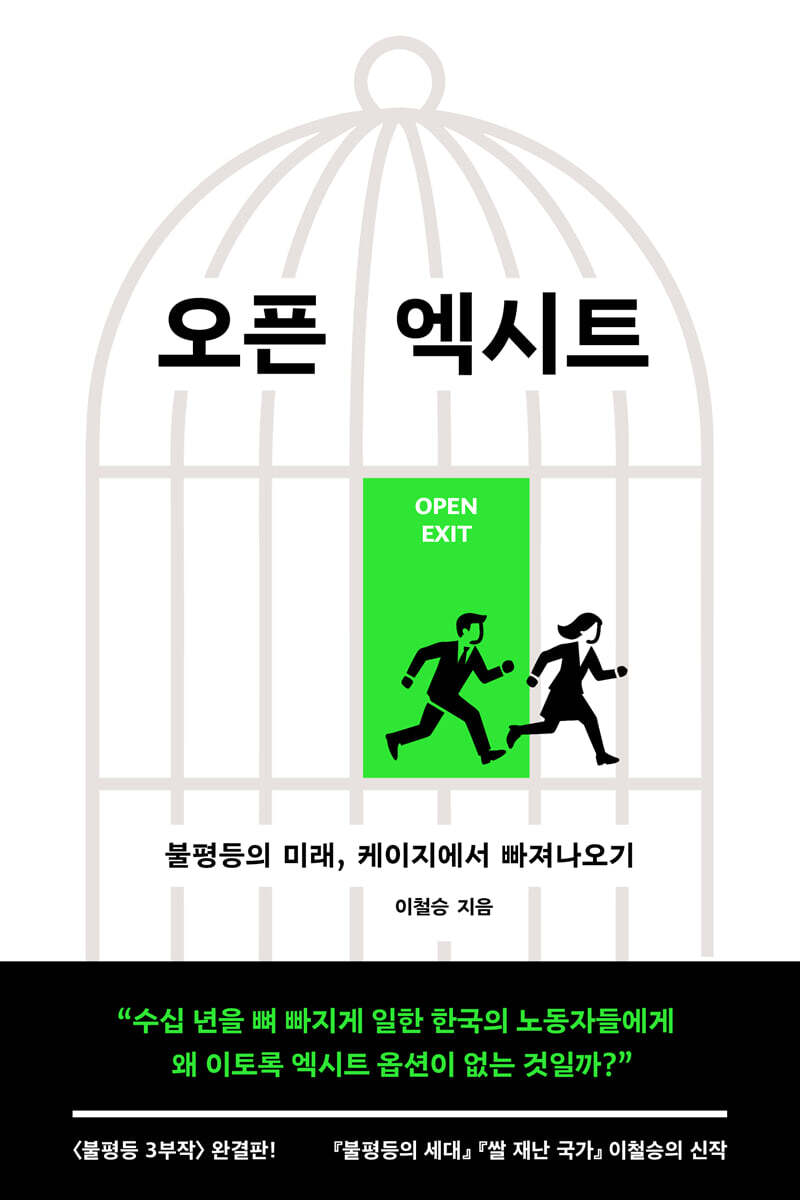
Open Exit
 |
Description
Book Introduction
Can we escape the cage of inequality?
Let's break away from this zero-sum game of all-in
Exploring individual free exit options
Open Exit, a project to reform the structure of Korean society
The final installment of the "Inequality Trilogy"! New works by Lee Cheol-seung, including "Generation of Inequality" and "Rice Disaster Nation."
A new book by sociologist Lee Cheol-seung (Department of Sociology, Sogang University), which has been praised for presenting a new perspective on inequality and generational theory in Korean society and has garnered enthusiastic responses from the media, academia, political circles, and the general public, has been published by Munhak-kwa-Jiseongsa.
The final work in the “Inequality Trilogy” following “Generation of Inequality” and “Rice Disaster Nation” is “Open Exit: The Future of Inequality, Breaking Out of the Cage.”
In his previous work, "Generation of Inequality," author Lee Cheol-seung analyzed the generational network established by the 386 generation to uncover the structure of inequality between and within contemporary generations. In his subsequent work, "Rice Disaster Nation," he traced the origins of this inequality structure through the lens of the "rice farming system" that developed in East Asia's rice-growing cultural sphere.
This book, the final installment of the “Inequality Trilogy,” identifies artificial intelligence, low birth rates/aging populations, and immigration as emerging axes of inequality. It analyzes the new structure of inequality created as these three structural changes and their forces collide with the existing institutions and structures of East Asia’s “social cage,” and presents the concept of an “exit option” as an individual or collective alternative.
The existing cage rules and conventions will not be able to respond to these three structural changes.
Amid the shocks and restructuring brought about by these three changes in the near future, what adaptation strategies should individuals and businesses devise, and what policy responses should the government adopt? How can civil society defend society and communities? Will Korean politics be equipped to identify and address these issues? Can we discover new opportunities in this future of inequality? Based on these concerns, author Lee Cheol-seung discusses the issue of structural reform, which has been largely undiscussed in Korean society for the past several years, from the perspective of "individual exit options," using "businesses" as the unit of analysis.
The reason for analyzing the social cage of the corporation is “because of the long-held belief that working humans are the essence of human society,” and the reason for lowering the issue of structural reform to the individual level is “because the individual is the ultimate agent of exit options.” However, exit options at the individual level are also a structural issue.
The author diagnoses that “the reason Korean society is so caught up in a fight to push each other out, with people grabbing each other by the hair and holding each other back, is because structurally, there are few options for exit.”
Therefore, the author argues that in order for Korean society, which is all-in on the zero-sum game, to escape this desperate struggle, it must move toward a society in which individuals can easily exit, especially one that expands the exit options for the lower and middle classes.
This book, "Open Exit," is a project that is absolutely necessary for our society today, preparing for structural reform of the labor market and Korean society in the face of a future of inequality that has already begun to sprout.
As we approach another unexpected election, this book will offer special insights to readers who dream of a better world.
Let's break away from this zero-sum game of all-in
Exploring individual free exit options
Open Exit, a project to reform the structure of Korean society
The final installment of the "Inequality Trilogy"! New works by Lee Cheol-seung, including "Generation of Inequality" and "Rice Disaster Nation."
A new book by sociologist Lee Cheol-seung (Department of Sociology, Sogang University), which has been praised for presenting a new perspective on inequality and generational theory in Korean society and has garnered enthusiastic responses from the media, academia, political circles, and the general public, has been published by Munhak-kwa-Jiseongsa.
The final work in the “Inequality Trilogy” following “Generation of Inequality” and “Rice Disaster Nation” is “Open Exit: The Future of Inequality, Breaking Out of the Cage.”
In his previous work, "Generation of Inequality," author Lee Cheol-seung analyzed the generational network established by the 386 generation to uncover the structure of inequality between and within contemporary generations. In his subsequent work, "Rice Disaster Nation," he traced the origins of this inequality structure through the lens of the "rice farming system" that developed in East Asia's rice-growing cultural sphere.
This book, the final installment of the “Inequality Trilogy,” identifies artificial intelligence, low birth rates/aging populations, and immigration as emerging axes of inequality. It analyzes the new structure of inequality created as these three structural changes and their forces collide with the existing institutions and structures of East Asia’s “social cage,” and presents the concept of an “exit option” as an individual or collective alternative.
The existing cage rules and conventions will not be able to respond to these three structural changes.
Amid the shocks and restructuring brought about by these three changes in the near future, what adaptation strategies should individuals and businesses devise, and what policy responses should the government adopt? How can civil society defend society and communities? Will Korean politics be equipped to identify and address these issues? Can we discover new opportunities in this future of inequality? Based on these concerns, author Lee Cheol-seung discusses the issue of structural reform, which has been largely undiscussed in Korean society for the past several years, from the perspective of "individual exit options," using "businesses" as the unit of analysis.
The reason for analyzing the social cage of the corporation is “because of the long-held belief that working humans are the essence of human society,” and the reason for lowering the issue of structural reform to the individual level is “because the individual is the ultimate agent of exit options.” However, exit options at the individual level are also a structural issue.
The author diagnoses that “the reason Korean society is so caught up in a fight to push each other out, with people grabbing each other by the hair and holding each other back, is because structurally, there are few options for exit.”
Therefore, the author argues that in order for Korean society, which is all-in on the zero-sum game, to escape this desperate struggle, it must move toward a society in which individuals can easily exit, especially one that expands the exit options for the lower and middle classes.
This book, "Open Exit," is a project that is absolutely necessary for our society today, preparing for structural reform of the labor market and Korean society in the face of a future of inequality that has already begun to sprout.
As we approach another unexpected election, this book will offer special insights to readers who dream of a better world.
- You can preview some of the book's contents.
Preview
index
prolog
The structure of this book - social cages and escape options
Why We Talk About the Social Cage | Emerging Cracks and Structures of Inequality | The Three Axes of Inequality and the Social Cage | The Conflict Between AI/Automation and the Social Cage | The Conflict Between Low Birth Rates and the Social Cage | The Conflict Between Immigration and the Social Cage
Chapter 1: Exiting the Cage - Expanding Exit Options
Parallel Universes | Life Cycles and Exit Options | Small Size and the Tragedy of the Lonely | Growing the Cage | Social Cage and Relational Mobility | Exit Options in East Asian Labor Markets | The Intertwining of Academic Background, Internal Labor Markets, and Seniority | Reputational Networks | Increased Mobility | Individual Survival and Collective Survival | Collaborative Organizations in a Society Where Exit Options Are the New Normal | Exit Options vs.
Internal labor markets | The dismantling of the ancien régime | Labor market integration | The costs and benefits of exit options | Company selection | Corporate casing strategies | Societies with few and many exit options | Caging strategies in societies with many exit options | Exit options and inequality | Social cages and freedom of choice in the rice-farming system
Chapter 2: Cage Update - Collaborating with AI
The World Is That Way | A Leading World | Automation Risk Index and Distribution | What Will Artificial Intelligence Change? | What Impact Will Artificial Intelligence Have on the Social Cage of the Rice Farming System? 1 | What Impact Will Artificial Intelligence Have on the Social Cage of the Rice Farming System? 2 | The Emergence of AI-Based Collaborative Systems | The Clash Between the Rice Farming System and AI-Based Collaborative Systems | Regulation and Control of AI | Inequality and Innovation in the Age of AI | Collaboration and Education in the Age of AI
Chapter 3: Cage Reproduction - Rice Farming Systems and Low Birth Rates
Two Divergent Trends Behind Low Birth Rates | Low Birth Rates in East Asian Societies | Why Women Opt for Work Instead of Having Children | Rapid Population Decline in East Asian Countries | The Development of Capitalism and the Retarded Women's Rights | Competition for Marriage and Non-Marriage to Compete | The Stratification of Marriage and Childbirth | Causes of Low Birth Rates | The Conflict Between the Rice Farming System and Parental Leave | Long-Hour Work Hours in Rice-Farming Regions | Negative Conformity Pressures Among Coworkers | Universal Sabbath/Parental Leave | Social Insurance for Sabbath/Parental Leave | Resistance to and Reconstruction of the Social Cage
Chapter 4: Opening the Cage - Immigration and Inequality
Reasons for Migration | Why We Are Not (Yet) a Nation of Migrants | Exit Options for Migrants | How Is Korea Becoming a Nation of Migrants? | Are Skilled Migrant Workers Citizens or Not? | The Migrant Labor Force Is Already Here | How Migrants Change the Demographics and Political Landscape of Cities | Labor Unions and Migrant Workers | Political Parties and Migrants | The Political Benefits of Minority Attacks | Minority Politics of Progressives and Conservatives | Who Hates Immigrants and Why? | Competition or Collaboration | East Asian Social Cage in the Age of Immigration and Multiculturalism
Conclusion - Creating New Cage Rules
The Crisis of the Social Cage | The Challenge of Artificial Intelligence | The Reproductive Crisis | Social Barriers | The Organizational Crisis Due to Aging | Social Liberalism 2 - The "Open Exit" Project | Exit Options from Extreme Politics
Epilogue
References
The structure of this book - social cages and escape options
Why We Talk About the Social Cage | Emerging Cracks and Structures of Inequality | The Three Axes of Inequality and the Social Cage | The Conflict Between AI/Automation and the Social Cage | The Conflict Between Low Birth Rates and the Social Cage | The Conflict Between Immigration and the Social Cage
Chapter 1: Exiting the Cage - Expanding Exit Options
Parallel Universes | Life Cycles and Exit Options | Small Size and the Tragedy of the Lonely | Growing the Cage | Social Cage and Relational Mobility | Exit Options in East Asian Labor Markets | The Intertwining of Academic Background, Internal Labor Markets, and Seniority | Reputational Networks | Increased Mobility | Individual Survival and Collective Survival | Collaborative Organizations in a Society Where Exit Options Are the New Normal | Exit Options vs.
Internal labor markets | The dismantling of the ancien régime | Labor market integration | The costs and benefits of exit options | Company selection | Corporate casing strategies | Societies with few and many exit options | Caging strategies in societies with many exit options | Exit options and inequality | Social cages and freedom of choice in the rice-farming system
Chapter 2: Cage Update - Collaborating with AI
The World Is That Way | A Leading World | Automation Risk Index and Distribution | What Will Artificial Intelligence Change? | What Impact Will Artificial Intelligence Have on the Social Cage of the Rice Farming System? 1 | What Impact Will Artificial Intelligence Have on the Social Cage of the Rice Farming System? 2 | The Emergence of AI-Based Collaborative Systems | The Clash Between the Rice Farming System and AI-Based Collaborative Systems | Regulation and Control of AI | Inequality and Innovation in the Age of AI | Collaboration and Education in the Age of AI
Chapter 3: Cage Reproduction - Rice Farming Systems and Low Birth Rates
Two Divergent Trends Behind Low Birth Rates | Low Birth Rates in East Asian Societies | Why Women Opt for Work Instead of Having Children | Rapid Population Decline in East Asian Countries | The Development of Capitalism and the Retarded Women's Rights | Competition for Marriage and Non-Marriage to Compete | The Stratification of Marriage and Childbirth | Causes of Low Birth Rates | The Conflict Between the Rice Farming System and Parental Leave | Long-Hour Work Hours in Rice-Farming Regions | Negative Conformity Pressures Among Coworkers | Universal Sabbath/Parental Leave | Social Insurance for Sabbath/Parental Leave | Resistance to and Reconstruction of the Social Cage
Chapter 4: Opening the Cage - Immigration and Inequality
Reasons for Migration | Why We Are Not (Yet) a Nation of Migrants | Exit Options for Migrants | How Is Korea Becoming a Nation of Migrants? | Are Skilled Migrant Workers Citizens or Not? | The Migrant Labor Force Is Already Here | How Migrants Change the Demographics and Political Landscape of Cities | Labor Unions and Migrant Workers | Political Parties and Migrants | The Political Benefits of Minority Attacks | Minority Politics of Progressives and Conservatives | Who Hates Immigrants and Why? | Competition or Collaboration | East Asian Social Cage in the Age of Immigration and Multiculturalism
Conclusion - Creating New Cage Rules
The Crisis of the Social Cage | The Challenge of Artificial Intelligence | The Reproductive Crisis | Social Barriers | The Organizational Crisis Due to Aging | Social Liberalism 2 - The "Open Exit" Project | Exit Options from Extreme Politics
Epilogue
References
Into the book
Have you ever dreamed of escaping? Then this book isn't for you.
You are likely either a winner of this system or an operator of this system.
(Like my father,) have you dreamed of escaping but lacked the courage to do so? Have you tried but failed? Do you believe you will one day attempt it? If so, you are now ready to discuss escape and adaptation.
I won't tell you how to escape successfully (I don't know either).
Instead, I will talk about why we dream of escape, why we stay in this system while dreaming, and what are the causes and consequences of this contradiction and discord.
--- p.15 From the "Prologue"
This book talks about 'escape,' but at the same time, it talks about the mechanisms that frustrate that escape, that is, the mechanisms that cause 'loyalty' and 'conformity.'
As important as the escape option is, the option to thwart the escape is also important.
Only by understanding how this option works can we discuss why escape is possible and why it is not.
The social cage, or social caging, that I define in this book is a 'mechanism that discourages escape.'
A social cage is a 'psychological-institutional-environmental barrier' that frustrates or discourages a person from escaping a specific social relationship, group, or organization.
In other words, the social cage is the totality of ecological, social, economic, political, and cultural incentive mechanisms and institutions that keep me in this place without exiting my current social relationships and structures.
--- pp.23-24 From “The Structure of This Book”
The seniority-based pay system is a wage system in East Asia that supports a "hierarchy" based on "age and length of service" for companies seeking to accumulate specialized corporate skills based on a specialized corporate culture.
Any organization that constantly compares, monitors, coordinates, and competes needs some level of hierarchy.
Someone must take on the role of dividing up work, coordinating with each other to eliminate risk factors, and focusing the organization's goals in one direction.
In East Asia, especially Northeast Asia (represented by Korea and Japan), the hierarchy is built on seniority, as those who have stayed in an organization for a long time have the most embodied skills and tacit knowledge.
Receiving the same salary for the same number of years of service helps to build unity in the organization.
By aligning the hierarchy of salary and seniority within the organization, a bond of horizontal unity and vertical obedience is formed.
--- p.69 From "Chapter 1: Leaving the Cage"
The mechanisms and structures that maximize the desire to settle down are the frame of the world we have lived in so far.
They can be summarized as the lifetime employment system and the internal labor market mechanism.
'Lifetime employment' is supported by employment protection laws and labor unions that make it difficult to fire workers.
The 'internal labor market mechanism' consists of a finely divided promotion ladder, seniority-based pay that increases over time, and various welfare systems.
For these two to work, you need entrance exam scores or academic background that can be evaluated without an evaluation system.
Ultimately, Korea's upper-class labor market is, to put it roughly, a system that has been maintained through labor unions, seniority-based pay, and academic background.
If you decide on your academic background in your late teens or early twenties and then get a job with a seniority-based system, the game of acquiring permanent residency is more or less over.
There will probably be a labor union in that workplace (large corporation or public enterprise) that will fight for wages when the time comes, lobby for an extension of the retirement age, and oppose the introduction of an evaluation system.
In my previous work, I argued that the seniority system, which serves as the backbone of these systems, is a legacy of the rice farming system.
This does not mean that it was created within the rice farming system, but rather that it is a wage system that has a strong affinity (selective affinity) with the seniority/hierarchy culture of the rice farming system.
--- pp.116-117 From "Chapter 1: Leaving the Cage"
In 2024, young Koreans will face a rate of irregular employment that is more than 10 percent higher than that of older generations, and highly skilled workers will be migrating to the United States at the highest rates and scale.
By August 2024, 3.39 million people will be in their 20s. The reversal in knowledge holdings between the middle-aged and older generations, who possess organizational resources and assets, and the younger generations, who do not, will lead to a crisis in the Korean hierarchical structure (already in progress).
In this new era of AI-based collaborative systems, the understanding of the AI-based knowledge economy between the top and bottom levels of organizations will shift, further exacerbating internal risks.
It is an inevitable result of the Korean hierarchical structure, in which the age-based seniority structure of society as a whole has been projected onto the company for a long time.
In an era of rapid technological and knowledge updates, leadership that fails to update its technology or lags behind, dominates the upper echelons of the network hierarchy. This lack of understanding of the market's current state and structure, coupled with a lack of critical assessment and analysis of the organization's capabilities and direction, can lead to decisions driven by trends.
In the worst case scenario, they are unable to even read the trends and end up neglecting the achievements that would have made their outstanding subordinates responsible for the future.
--- p.181 From "Chapter 2 Cage Update"
Finally, machine-based collaborative organizations (including AI) will be organizations that closely and quickly share machine-related, machine-acquired, and machine-operating know-how and technology, while also monitoring machine malfunctions and errors and communicating/monitoring and coordinating with the humans monitoring the machines.
The machine-based collaborative organization of the rice farming system, due to its human-to-human cooperation and monitoring system, will cooperate better with machines than collaborative organizations in any other region or culture.
The social cage of the rice farming system will make even the machines watch out.
We will train machines that don't know how to work to become machines that know how to work.
In this collaborative organization, both humans who do not know how to use machines and machines that do not know how to adapt to human collaboration will be eliminated.
--- p.191 From "Chapter 2 Cage Update"
For women as individuals, the crisis of the community, the declining birth rate, is—sorry, but—someone else's problem, or at least a neighbor's problem.
Regardless of whether the birth rate declines or not, we must find a way to support ourselves in the jungle called capitalism.
Marriage and childbirth are luxuries.
Securing essentials comes first.
These necessities will provide me with the financial foundation I need to protect my dignity from my (potential) husband and in-laws.
Even if you live alone without a husband, you still need a job to avoid relying on the patriarchal family structure (father).
Lastly, even if you choose to have children without a husband, you still need a job.
I cannot preserve my dignity without directly participating in the market economy.
For young women today, a job is a necessity and family is a luxury.
--- p.205 From “Chapter 3: Cage Reproduction”
On the other hand, young women react very differently to the same socioeconomic conditions and phenomena than young men.
To win this competition, we must recognize that we must shed the burden placed on women by the institution of marriage (and subsequent childbirth).
With more than half of women declaring themselves single, and more than two-thirds of those women (69.1 percent) responding that marriage would hinder their career achievements, it can be seen that nearly four out of ten women prioritize their careers over marriage/childbirth.
In conclusion, young men compete for marriage, but young women do not marry to compete (so they meet in the 'competitive arena' but not in the 'marriage arena').
--- p.215 From “Chapter 3: Cage Reproduction”
The more irregular one's employment, the more rented one's place, and the more remote one lives, the more difficult it is to find a romantic or marriage partner. Is this reality simply the cold and cruel fate of capitalism? Where is this "eugenics" phenomenon of marriage and childbirth, bringing about a "society of birth inequality," leading us?
Low birth rates are a problem, but the stratification of childbirth is a social problem of equal magnitude.
While the upper class and regular workers refrain from having children in order to concentrate their educational capital and assets on a smaller number of children, the middle and lower classes and irregular workers refrain from having children because they lack the economic ability to raise children.
This trend is a serious problem in that economic inequality has deepened to the point where it cannot satisfy the ultimate goal of economic activity: the biological reproduction of individuals and households.
Moreover, a society in which marriage and childbirth are the exclusive domain of the upper class and regular workers is bound to be eliminated in the long run.
The force that forces that elimination will come from outside, not from within.
--- pp.221-222 From "Chapter 3: Cage Reproduction"
Trump's politics, which unites lower-middle-class whites with the slogan MAGA (Make America Great Again), also grew by feeding off this cultural right wing.
Therefore, the immigration issue creates divisions not only within the left-wing parties, but also within the right-wing parties.
This rift is also the structural background for the decline of the traditional right wing, which promoted internationalism and globalization in the United States and Europe, and the emergence of a new extreme right wing, which has come to dominate right-wing parties.
In the West, the dominance of parliaments and executive branches by far-right parties since the 2000s is not limited to one or two countries; its ultimate causes are globalization and immigration.
You are likely either a winner of this system or an operator of this system.
(Like my father,) have you dreamed of escaping but lacked the courage to do so? Have you tried but failed? Do you believe you will one day attempt it? If so, you are now ready to discuss escape and adaptation.
I won't tell you how to escape successfully (I don't know either).
Instead, I will talk about why we dream of escape, why we stay in this system while dreaming, and what are the causes and consequences of this contradiction and discord.
--- p.15 From the "Prologue"
This book talks about 'escape,' but at the same time, it talks about the mechanisms that frustrate that escape, that is, the mechanisms that cause 'loyalty' and 'conformity.'
As important as the escape option is, the option to thwart the escape is also important.
Only by understanding how this option works can we discuss why escape is possible and why it is not.
The social cage, or social caging, that I define in this book is a 'mechanism that discourages escape.'
A social cage is a 'psychological-institutional-environmental barrier' that frustrates or discourages a person from escaping a specific social relationship, group, or organization.
In other words, the social cage is the totality of ecological, social, economic, political, and cultural incentive mechanisms and institutions that keep me in this place without exiting my current social relationships and structures.
--- pp.23-24 From “The Structure of This Book”
The seniority-based pay system is a wage system in East Asia that supports a "hierarchy" based on "age and length of service" for companies seeking to accumulate specialized corporate skills based on a specialized corporate culture.
Any organization that constantly compares, monitors, coordinates, and competes needs some level of hierarchy.
Someone must take on the role of dividing up work, coordinating with each other to eliminate risk factors, and focusing the organization's goals in one direction.
In East Asia, especially Northeast Asia (represented by Korea and Japan), the hierarchy is built on seniority, as those who have stayed in an organization for a long time have the most embodied skills and tacit knowledge.
Receiving the same salary for the same number of years of service helps to build unity in the organization.
By aligning the hierarchy of salary and seniority within the organization, a bond of horizontal unity and vertical obedience is formed.
--- p.69 From "Chapter 1: Leaving the Cage"
The mechanisms and structures that maximize the desire to settle down are the frame of the world we have lived in so far.
They can be summarized as the lifetime employment system and the internal labor market mechanism.
'Lifetime employment' is supported by employment protection laws and labor unions that make it difficult to fire workers.
The 'internal labor market mechanism' consists of a finely divided promotion ladder, seniority-based pay that increases over time, and various welfare systems.
For these two to work, you need entrance exam scores or academic background that can be evaluated without an evaluation system.
Ultimately, Korea's upper-class labor market is, to put it roughly, a system that has been maintained through labor unions, seniority-based pay, and academic background.
If you decide on your academic background in your late teens or early twenties and then get a job with a seniority-based system, the game of acquiring permanent residency is more or less over.
There will probably be a labor union in that workplace (large corporation or public enterprise) that will fight for wages when the time comes, lobby for an extension of the retirement age, and oppose the introduction of an evaluation system.
In my previous work, I argued that the seniority system, which serves as the backbone of these systems, is a legacy of the rice farming system.
This does not mean that it was created within the rice farming system, but rather that it is a wage system that has a strong affinity (selective affinity) with the seniority/hierarchy culture of the rice farming system.
--- pp.116-117 From "Chapter 1: Leaving the Cage"
In 2024, young Koreans will face a rate of irregular employment that is more than 10 percent higher than that of older generations, and highly skilled workers will be migrating to the United States at the highest rates and scale.
By August 2024, 3.39 million people will be in their 20s. The reversal in knowledge holdings between the middle-aged and older generations, who possess organizational resources and assets, and the younger generations, who do not, will lead to a crisis in the Korean hierarchical structure (already in progress).
In this new era of AI-based collaborative systems, the understanding of the AI-based knowledge economy between the top and bottom levels of organizations will shift, further exacerbating internal risks.
It is an inevitable result of the Korean hierarchical structure, in which the age-based seniority structure of society as a whole has been projected onto the company for a long time.
In an era of rapid technological and knowledge updates, leadership that fails to update its technology or lags behind, dominates the upper echelons of the network hierarchy. This lack of understanding of the market's current state and structure, coupled with a lack of critical assessment and analysis of the organization's capabilities and direction, can lead to decisions driven by trends.
In the worst case scenario, they are unable to even read the trends and end up neglecting the achievements that would have made their outstanding subordinates responsible for the future.
--- p.181 From "Chapter 2 Cage Update"
Finally, machine-based collaborative organizations (including AI) will be organizations that closely and quickly share machine-related, machine-acquired, and machine-operating know-how and technology, while also monitoring machine malfunctions and errors and communicating/monitoring and coordinating with the humans monitoring the machines.
The machine-based collaborative organization of the rice farming system, due to its human-to-human cooperation and monitoring system, will cooperate better with machines than collaborative organizations in any other region or culture.
The social cage of the rice farming system will make even the machines watch out.
We will train machines that don't know how to work to become machines that know how to work.
In this collaborative organization, both humans who do not know how to use machines and machines that do not know how to adapt to human collaboration will be eliminated.
--- p.191 From "Chapter 2 Cage Update"
For women as individuals, the crisis of the community, the declining birth rate, is—sorry, but—someone else's problem, or at least a neighbor's problem.
Regardless of whether the birth rate declines or not, we must find a way to support ourselves in the jungle called capitalism.
Marriage and childbirth are luxuries.
Securing essentials comes first.
These necessities will provide me with the financial foundation I need to protect my dignity from my (potential) husband and in-laws.
Even if you live alone without a husband, you still need a job to avoid relying on the patriarchal family structure (father).
Lastly, even if you choose to have children without a husband, you still need a job.
I cannot preserve my dignity without directly participating in the market economy.
For young women today, a job is a necessity and family is a luxury.
--- p.205 From “Chapter 3: Cage Reproduction”
On the other hand, young women react very differently to the same socioeconomic conditions and phenomena than young men.
To win this competition, we must recognize that we must shed the burden placed on women by the institution of marriage (and subsequent childbirth).
With more than half of women declaring themselves single, and more than two-thirds of those women (69.1 percent) responding that marriage would hinder their career achievements, it can be seen that nearly four out of ten women prioritize their careers over marriage/childbirth.
In conclusion, young men compete for marriage, but young women do not marry to compete (so they meet in the 'competitive arena' but not in the 'marriage arena').
--- p.215 From “Chapter 3: Cage Reproduction”
The more irregular one's employment, the more rented one's place, and the more remote one lives, the more difficult it is to find a romantic or marriage partner. Is this reality simply the cold and cruel fate of capitalism? Where is this "eugenics" phenomenon of marriage and childbirth, bringing about a "society of birth inequality," leading us?
Low birth rates are a problem, but the stratification of childbirth is a social problem of equal magnitude.
While the upper class and regular workers refrain from having children in order to concentrate their educational capital and assets on a smaller number of children, the middle and lower classes and irregular workers refrain from having children because they lack the economic ability to raise children.
This trend is a serious problem in that economic inequality has deepened to the point where it cannot satisfy the ultimate goal of economic activity: the biological reproduction of individuals and households.
Moreover, a society in which marriage and childbirth are the exclusive domain of the upper class and regular workers is bound to be eliminated in the long run.
The force that forces that elimination will come from outside, not from within.
--- pp.221-222 From "Chapter 3: Cage Reproduction"
Trump's politics, which unites lower-middle-class whites with the slogan MAGA (Make America Great Again), also grew by feeding off this cultural right wing.
Therefore, the immigration issue creates divisions not only within the left-wing parties, but also within the right-wing parties.
This rift is also the structural background for the decline of the traditional right wing, which promoted internationalism and globalization in the United States and Europe, and the emergence of a new extreme right wing, which has come to dominate right-wing parties.
In the West, the dominance of parliaments and executive branches by far-right parties since the 2000s is not limited to one or two countries; its ultimate causes are globalization and immigration.
--- pp.221-222 From "Chapter 4: Cage Reproduction"
Publisher's Review
“To the Korean workers who have worked tirelessly for decades,
“Why are there so few exit options?”
This book, "Open Exit," is a narrative that utilizes social methodology regarding "departure or escape" and "settlement or bondage," as the title suggests.
The social cage is a legacy of cultural structures passed down in each society. It encompasses everything from the family to the village, workplace, and nation, and is the sum total of ecological, social, economic, political, and cultural incentive mechanisms and institutions that ensure individuals remain in their current communities rather than exiting them.
In particular, in this book, author Lee Cheol-seung analyzes the corporate systems that evolved from the East Asian rice farming system and developed into the social cage of today's Korean capitalism (entangled with academic background, internal labor market, and seniority system), and focuses on the problems that arise when these systems face the huge waves of change such as artificial intelligence, low birth rate/aging population, and immigration.
For example, the characteristics of East Asian social cages are that they are social networks and cooperative labor organizations based on collaboration, hierarchy, and competition, with strong internal discipline and mutual monitoring mechanisms, making them difficult to enter and difficult to exit.
Once inside this social cage, long-term employment is guaranteed within the organization, but it is a structure in which all members must work closely together while fiercely competing for power and wealth, which lead to higher positions and rewards.
This collectivist and hierarchical collaborative system played a crucial role in rapidly catching up with Western industrial capitalism by rapidly spreading the standardization and leveling of technology and tools through inter- and intra-generational networks, thereby creating the Miracle on the Han River.
So, does the social cage we've adapted and nurtured still function well today? Author Lee Cheol-seung argues otherwise.
This book is a study on how to restructure the social cage of East Asia, which is facing such a crisis.
Creating new cage rules
- Open Exit Project
This book, "Open Exit," analyzes the new structure of inequality that is being created as the social cage of East Asia, which has evolved over thousands of years, collides with the massive structural changes that are coming. It unfolds this in a fascinating way through the mechanisms of "departure or escape" and "settlement or bondage."
First, AI-based automation will replace many parts of the manufacturing sector that have traditionally been dominated by East Asian production systems.
So where is East Asia's social cage headed? If artificial intelligence is a challenge to update our social cage due to the external shock, the low birth rate stems from women's resistance to the rules within the social cage.
By refusing to form a family, or even if one does form a family, refusing or postponing childbirth and childcare, one is attempting to break away from the patriarchal ideology of the good wife and wise mother and preserve one's career and leisure time.
In this case, choosing not to have children is an exit from the feudal family system at the individual level, but it appears as a low birth rate phenomenon for society as a whole.
How can we resolve this situation, where society, unable to adapt its rules to the new values and movements of its members, is driving itself to reproductive failure (extinction), and where this failure is accelerating even further at the lower levels of society? Ultimately, immigration stems from the human desire to migrate, to escape the cage of another society and enter our own.
However, foreign workers, who number over 2 million and are approaching 3 million, are unable to enter the collaborative cage of Koreans and are instead flowing into industries that Koreans shun, creating their own regional and industrial ghettos.
What will Korean society look like in the future if these invisible barriers of exclusion and separation deepen?
As AI-driven automation reshapes the labor market, demographic shifts threaten the very fabric of our nation and society, and immigrants become a fundamental part of our lives, this book, "Open Exit," explores how individuals, businesses, the state, and civil society should respond. Drawing on the author's unique perspective and diverse data analysis, it offers practical insights.
Author Lee Cheol-seung goes beyond simply pointing out problems and criticizing the current situation. He presents a solution called "expanding exit options" using various examples.
It is a very personal strategy, but in a developed capitalist society it may be the most powerful and lethal solution.
In the "Epilogue," the author writes that he wrote this book because he believes that the responsibility of a sociologist, which will be helpful to many people, is to discuss the issues of finding jobs, building skills, freely transferring or converting those skills to create new income, and at the same time receiving appropriate compensation.
This book explores individual, free exit options, breaking away from this closed world where everyone is tied to the same organization, shackled to each other's legs, and all-in on the zero-sum game. It is an interesting reflection on the structural reform of Korean society, suggesting the direction of the future we must design together.
“Why are there so few exit options?”
This book, "Open Exit," is a narrative that utilizes social methodology regarding "departure or escape" and "settlement or bondage," as the title suggests.
The social cage is a legacy of cultural structures passed down in each society. It encompasses everything from the family to the village, workplace, and nation, and is the sum total of ecological, social, economic, political, and cultural incentive mechanisms and institutions that ensure individuals remain in their current communities rather than exiting them.
In particular, in this book, author Lee Cheol-seung analyzes the corporate systems that evolved from the East Asian rice farming system and developed into the social cage of today's Korean capitalism (entangled with academic background, internal labor market, and seniority system), and focuses on the problems that arise when these systems face the huge waves of change such as artificial intelligence, low birth rate/aging population, and immigration.
For example, the characteristics of East Asian social cages are that they are social networks and cooperative labor organizations based on collaboration, hierarchy, and competition, with strong internal discipline and mutual monitoring mechanisms, making them difficult to enter and difficult to exit.
Once inside this social cage, long-term employment is guaranteed within the organization, but it is a structure in which all members must work closely together while fiercely competing for power and wealth, which lead to higher positions and rewards.
This collectivist and hierarchical collaborative system played a crucial role in rapidly catching up with Western industrial capitalism by rapidly spreading the standardization and leveling of technology and tools through inter- and intra-generational networks, thereby creating the Miracle on the Han River.
So, does the social cage we've adapted and nurtured still function well today? Author Lee Cheol-seung argues otherwise.
This book is a study on how to restructure the social cage of East Asia, which is facing such a crisis.
Creating new cage rules
- Open Exit Project
This book, "Open Exit," analyzes the new structure of inequality that is being created as the social cage of East Asia, which has evolved over thousands of years, collides with the massive structural changes that are coming. It unfolds this in a fascinating way through the mechanisms of "departure or escape" and "settlement or bondage."
First, AI-based automation will replace many parts of the manufacturing sector that have traditionally been dominated by East Asian production systems.
So where is East Asia's social cage headed? If artificial intelligence is a challenge to update our social cage due to the external shock, the low birth rate stems from women's resistance to the rules within the social cage.
By refusing to form a family, or even if one does form a family, refusing or postponing childbirth and childcare, one is attempting to break away from the patriarchal ideology of the good wife and wise mother and preserve one's career and leisure time.
In this case, choosing not to have children is an exit from the feudal family system at the individual level, but it appears as a low birth rate phenomenon for society as a whole.
How can we resolve this situation, where society, unable to adapt its rules to the new values and movements of its members, is driving itself to reproductive failure (extinction), and where this failure is accelerating even further at the lower levels of society? Ultimately, immigration stems from the human desire to migrate, to escape the cage of another society and enter our own.
However, foreign workers, who number over 2 million and are approaching 3 million, are unable to enter the collaborative cage of Koreans and are instead flowing into industries that Koreans shun, creating their own regional and industrial ghettos.
What will Korean society look like in the future if these invisible barriers of exclusion and separation deepen?
As AI-driven automation reshapes the labor market, demographic shifts threaten the very fabric of our nation and society, and immigrants become a fundamental part of our lives, this book, "Open Exit," explores how individuals, businesses, the state, and civil society should respond. Drawing on the author's unique perspective and diverse data analysis, it offers practical insights.
Author Lee Cheol-seung goes beyond simply pointing out problems and criticizing the current situation. He presents a solution called "expanding exit options" using various examples.
It is a very personal strategy, but in a developed capitalist society it may be the most powerful and lethal solution.
In the "Epilogue," the author writes that he wrote this book because he believes that the responsibility of a sociologist, which will be helpful to many people, is to discuss the issues of finding jobs, building skills, freely transferring or converting those skills to create new income, and at the same time receiving appropriate compensation.
This book explores individual, free exit options, breaking away from this closed world where everyone is tied to the same organization, shackled to each other's legs, and all-in on the zero-sum game. It is an interesting reflection on the structural reform of Korean society, suggesting the direction of the future we must design together.
GOODS SPECIFICS
- Date of issue: May 16, 2025
- Page count, weight, size: 376 pages | 490g | 140*210*20mm
- ISBN13: 9788932044002
- ISBN10: 8932044007
You may also like
카테고리
korean


korean

![GQ KOREA Mark (Monthly): December [2025]](http://librairie.coreenne.fr/cdn/shop/files/8ef265dbbfbf186523ed75ba7319009d.jpg?v=1765340328&width=3840)


