

To the anxious mothers today too
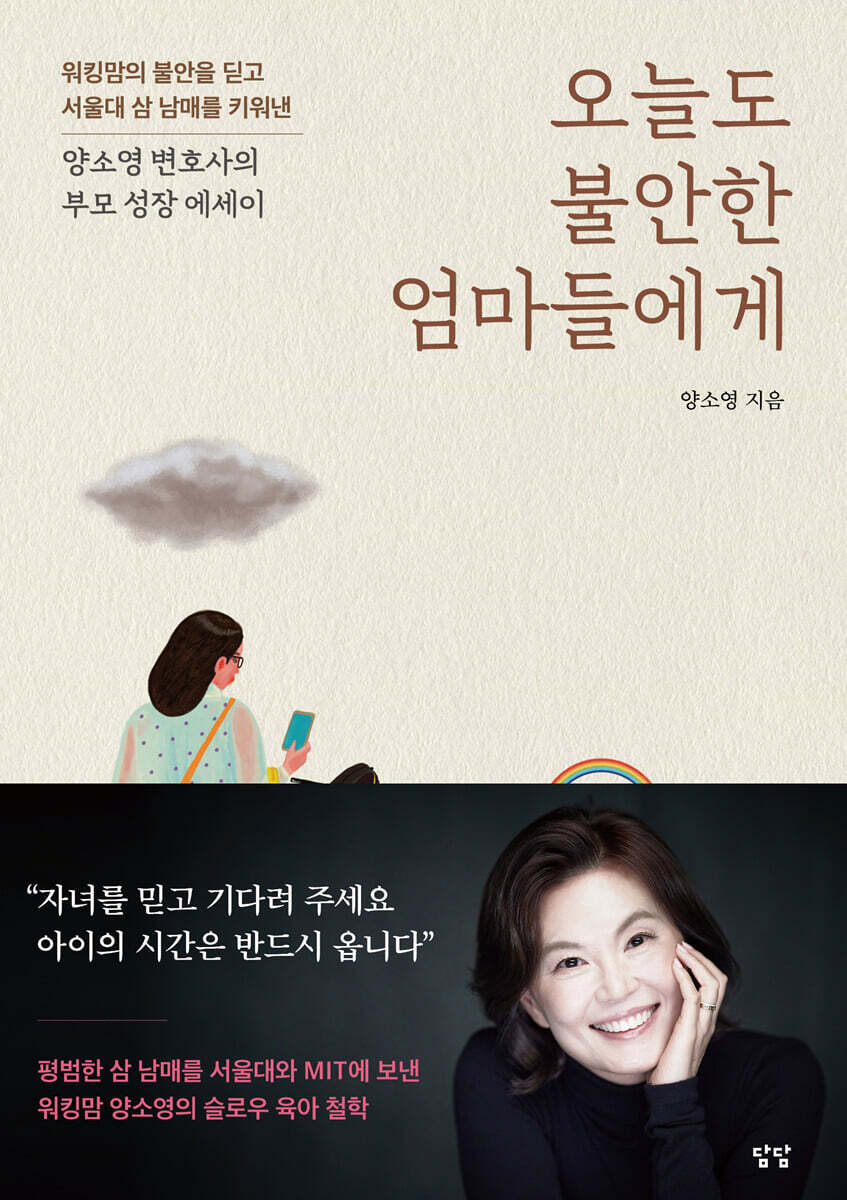 |
Description
Book Introduction
A record of a mother who was difficult but happy,
The most realistic and successful parenting book, 'proven by results'
To the anxious mothers today too
“A mother who was consumed by anxiety and yelled at her children,
"Let go of anxiety and kill three birds with one stone: academic performance, character, and future capabilities."
In the midst of fierce college entrance exam competition, is nurturing a child's character and future potential an impossible dream? Yang So-young, a divorce attorney with 25 years of experience and the mother of three children, one from Seoul National University and one from MIT, firmly asserts a "no" in her new book, "To Anxious Mothers Today, Too."
He proves through his results that letting go of his mother's "anxiety" is the most powerful "realistic strategy" that not only fosters top grades but also the right character and creative problem-solving skills needed in the AI era.
This book is not a success story about enduring a painful process.
This is the most realistic message of hope for all parents in this era, showing that although there were times when mistakes were made and frustrations were made, all those moments were 'happy processes' and led to 'shining results.'
The most realistic and successful parenting book, 'proven by results'
To the anxious mothers today too
“A mother who was consumed by anxiety and yelled at her children,
"Let go of anxiety and kill three birds with one stone: academic performance, character, and future capabilities."
In the midst of fierce college entrance exam competition, is nurturing a child's character and future potential an impossible dream? Yang So-young, a divorce attorney with 25 years of experience and the mother of three children, one from Seoul National University and one from MIT, firmly asserts a "no" in her new book, "To Anxious Mothers Today, Too."
He proves through his results that letting go of his mother's "anxiety" is the most powerful "realistic strategy" that not only fosters top grades but also the right character and creative problem-solving skills needed in the AI era.
This book is not a success story about enduring a painful process.
This is the most realistic message of hope for all parents in this era, showing that although there were times when mistakes were made and frustrations were made, all those moments were 'happy processes' and led to 'shining results.'
- You can preview some of the book's contents.
Preview
index
Prologue: The first principle of raising three Seoul National University siblings: quelling my inner anxiety.
PART 1: No child is good from the start.
Chapter 1: The Mother Who Waited for the Slow Bamboo for Five Years
· The three siblings were not smart children.
Like bamboo that doesn't grow for 5 years
· Only 30% of the strength, but steadily
· Give the opportunity to make mistakes in freedom
· To the child who slammed the door and went in
Chapter 2: When a child is shaking, what is more important than comfort?
· Don't go to work, Mom!
A tree that does not shake is a dead tree
· To make your child listen to his mother's words
Chapter 3: 'This' That Made Three Children Study on Their Own
· Extremely realistic study goals
· Don't expect your parents to pay for college tuition.
· What is the secret to having three children go to Seoul National University?
PART 2 My child is not okay? What have I tried?
Chapter 4 If you don't want to raise a child without perseverance
· I don't have the patience, so it won't work.
· What six failures taught me
· Lack is not a deficiency, but a space of opportunity.
Chapter 5: The Story of How the Top Student in the School Became an Outcast
· A father who whipped a running horse
· Top student in the entire school, but a loner
· My first rebellion was more thrilling than studying.
Chapter 6: Why do we do the gifted test? There's something more important.
· Youngjae needs to rest on weekends too.
· Not on the report card, but really important
· Before teaching, we must first examine brain development.
· If we take one step at a time together
Chapter 7: Concentration: Parents Can Develop It Too
There is no such thing as elegant parenting.
· Becoming a mother means growing together with your child.
· The beginning of all learning, emotional connection
· It's evening, time to turn off the lights and go to sleep.
PART 3: A Real-Life Experience of a Mother of Three
Chapter 8: Mother is an actress who plays happiness
· How do you develop study habits?
· The dangerous words 'for you'
· The reason for postponing happiness
· A virtuous cycle created by mothers' practice
· Mom's emotional practice is an anxiety diary
· A collection of happiness in my heart
Chapter 9: What Raised Me from My Fall
· Can I raise three children well?
· Comfort given to me by Harvard graduates
· Instead of taking away suffering, I decided to give love.
· A bicycle gift from my father
Chapter 10: A Mother is a Fishbowl for Her Child
· What kind of fishbowl am I to my child?
· Your mom is behind you
· What the child wanted was connection
· A single word to clear the fish tank water, “Have you eaten?”
Chapter 11: How to Face the Dragon in Your Child's Heart
· A question posed by a picture book
· Facing the dragon within me
· A dragon called narcolepsy
· Meaning of looking at a child
PART 4 Basic physical strength is important for studying too
Chapter 12: Forest Study: Seeing the Forest, Not the Trees
· A mother who robs her child of the ability to study
· Things you can only see when you come out of the forest
· The real study secret of the top student in the school
Chapter 13: The Three Siblings' Study Method for Overcoming the Illusion of Knowing
· The pitfalls of studying that I realized while imitating New Jeans
· I know this is a question, but I got it wrong. Is it true?
· Fake to Real, the Three Siblings' Study Method
Chapter 14: The Best Habits for Boosting Your Learning Efficiency
· The one thing that scary mom emphasized
· Just doing your homework is enough
· Let's create a V-shaped victory record.
· Homework, why do I have to do it?
· A Mom's Technique for Kids Who Hate Homework
Chapter 15: A Study Method That Will Restore Your Confidence
· Mom, math is so hard for me.
· The courage to return to basics: 'follow-up learning'
· A proportional graph called confidence
PART 5 Sometimes Waiting Is the Answer
Chapter 16: The Ability to Delay Gratification Makes a Studying Child
· Chocolate and three-year-old's choice
· How to make waiting fun
· Training in delayed gratification called studying
Ben, a special family made possible through hard work
· Someone who can teach waiting
Chapter 17: Have you heard of failures like English kindergartens and specialized high schools?
Tears burst out in front of an English kindergarten
· Real English teachers are YouTubers
· English study method that improves second and third level skills
· Failing to get into a specialized high school: "My life is ruined!"
Chapter 18: The War on Control with Smartphones: Break It or Not?
· Mom and Dad use smartphones, and the child uses math problems.
· Seniors, your kids didn't use smartphones much, did they?
· Smartphone Prison Escape Operation
· Self-regulation of smartphones was possible because I didn't know about it
· A mother and daughter with no secrets, but their grades are a secret
· Report cards? Mom's getting even more anxious.
Chapter 19: You shouldn't let your strength go in advance
· Because I played a lot in elementary school
· When will the real spurt begin?
PART 6: Why You Should Read Books Even If You Don't Want to
Chapter 20: Is it better to become independent in reading as quickly as possible?
· Perseverance discovered through copying
· The impact of the addition sign
· An inevitable choice, reading independence
· What matters is not the timing, but the empathy we build together.
· A family of five's bedtime talk
· Goethe's Pillow Story
Chapter 21: Let's Play with Books
· Best outing spot, bookstore
· Reading Golden Bell, a gift of success
· Is reading a book as playful as possible?
· Principles of reading play
Chapter 22: If My Child Won't Read
· It wasn't the book that changed my daughter, but her mother's gaze.
· How to Feed the Good Wolf: Developing a Reading Habit
Chapter 23: Children who accumulate books and memories go further.
· It's more fun to read books together
· Books are the compass of a child's life.
· The greatest harvest is the communication built through books.
PART 7 The principles of studying well do not change.
Chapter 24: Basal Metabolic Rate for Studying, Sleep, and Exercise
The Science of Sleep: Recharging Your Brain
· Sleep is a strategy, not a luxury!
The power of 'exercise' to awaken the brain
· Legal coupons
Chapter 25: The Kid Who Built Legos All Night
· National Physics Olympiad representative who started last
· Mom, please put a piece of paper next to the bed.
· The talent of sincerity is more important than IQ
Chapter 26: The Math Reversal Brought About by Three Months of Immersion
· Metacognition is an invisible force
· The betrayal of fake studies
· Metacognition realized through tears
· From Grade 3 to Grade 1, the miracle of the wrong answer notebook
· The Secret of the Wrong Answer Notebook: The 4-Step Study Method
Chapter 27: When I quit a famous academy, my child's potential exploded.
· Do better at what you do well
· The pros and cons of famous academies
· The miracle of a small academy that's just right for my child
PART 8 How to Survive as a Strong Mom
Chapter 28: Where should I send my child to school?
· A gathering of mothers who only fostered impatience
· The solution lies in the child's sparkle
· The best academy is the one chosen by the child.
Chapter 29: The True Courage Parents Must Have
· Parents' courage to deal with their children's lies
· The only reason I recommend divorce
· Even couples fighting need after-sales service.
Chapter 30: Our House Rules We Follow Even When We Fight
· They say that three is an asset, but the reality is war.
· Article 4 of our constitution, all power belongs to the first
· The politician of our family, the second
· Arts and physical education activities that are helpful to sibling families
Chapter 31: School, the Greatest Fence for Learning About the World
· A place that discovered my child's potential
· A place to learn about different minds
Our school is okay because it's not perfect
PART 8 How to Survive as a Strong Mom
Chapter 32: Don't Doubt Your Child's Dream
· Discover your child's sparkling moments
· Not every child's dream is to go to medical school.
· When we dream together, we achieve more.
· How to talk with your child to find their true dream
Chapter 33: Stop Saying "My Child Can't"
· What I learned from completing a marathon in my fifties
· The fixed mindset of parents who confine their children
· It's okay, it's just not done yet!
Chapter 34: What Would I Do If My Children Hadn't Learned?
· If the children did not study
· Even if my child becomes a 'zombie daughter'
· The greatest courage a parent can show
Epilogue The courage of parents who allow failure,
With the wings of a child flying again
Appendix: Mother's Time as Seen by the Three Siblings
PART 1: No child is good from the start.
Chapter 1: The Mother Who Waited for the Slow Bamboo for Five Years
· The three siblings were not smart children.
Like bamboo that doesn't grow for 5 years
· Only 30% of the strength, but steadily
· Give the opportunity to make mistakes in freedom
· To the child who slammed the door and went in
Chapter 2: When a child is shaking, what is more important than comfort?
· Don't go to work, Mom!
A tree that does not shake is a dead tree
· To make your child listen to his mother's words
Chapter 3: 'This' That Made Three Children Study on Their Own
· Extremely realistic study goals
· Don't expect your parents to pay for college tuition.
· What is the secret to having three children go to Seoul National University?
PART 2 My child is not okay? What have I tried?
Chapter 4 If you don't want to raise a child without perseverance
· I don't have the patience, so it won't work.
· What six failures taught me
· Lack is not a deficiency, but a space of opportunity.
Chapter 5: The Story of How the Top Student in the School Became an Outcast
· A father who whipped a running horse
· Top student in the entire school, but a loner
· My first rebellion was more thrilling than studying.
Chapter 6: Why do we do the gifted test? There's something more important.
· Youngjae needs to rest on weekends too.
· Not on the report card, but really important
· Before teaching, we must first examine brain development.
· If we take one step at a time together
Chapter 7: Concentration: Parents Can Develop It Too
There is no such thing as elegant parenting.
· Becoming a mother means growing together with your child.
· The beginning of all learning, emotional connection
· It's evening, time to turn off the lights and go to sleep.
PART 3: A Real-Life Experience of a Mother of Three
Chapter 8: Mother is an actress who plays happiness
· How do you develop study habits?
· The dangerous words 'for you'
· The reason for postponing happiness
· A virtuous cycle created by mothers' practice
· Mom's emotional practice is an anxiety diary
· A collection of happiness in my heart
Chapter 9: What Raised Me from My Fall
· Can I raise three children well?
· Comfort given to me by Harvard graduates
· Instead of taking away suffering, I decided to give love.
· A bicycle gift from my father
Chapter 10: A Mother is a Fishbowl for Her Child
· What kind of fishbowl am I to my child?
· Your mom is behind you
· What the child wanted was connection
· A single word to clear the fish tank water, “Have you eaten?”
Chapter 11: How to Face the Dragon in Your Child's Heart
· A question posed by a picture book
· Facing the dragon within me
· A dragon called narcolepsy
· Meaning of looking at a child
PART 4 Basic physical strength is important for studying too
Chapter 12: Forest Study: Seeing the Forest, Not the Trees
· A mother who robs her child of the ability to study
· Things you can only see when you come out of the forest
· The real study secret of the top student in the school
Chapter 13: The Three Siblings' Study Method for Overcoming the Illusion of Knowing
· The pitfalls of studying that I realized while imitating New Jeans
· I know this is a question, but I got it wrong. Is it true?
· Fake to Real, the Three Siblings' Study Method
Chapter 14: The Best Habits for Boosting Your Learning Efficiency
· The one thing that scary mom emphasized
· Just doing your homework is enough
· Let's create a V-shaped victory record.
· Homework, why do I have to do it?
· A Mom's Technique for Kids Who Hate Homework
Chapter 15: A Study Method That Will Restore Your Confidence
· Mom, math is so hard for me.
· The courage to return to basics: 'follow-up learning'
· A proportional graph called confidence
PART 5 Sometimes Waiting Is the Answer
Chapter 16: The Ability to Delay Gratification Makes a Studying Child
· Chocolate and three-year-old's choice
· How to make waiting fun
· Training in delayed gratification called studying
Ben, a special family made possible through hard work
· Someone who can teach waiting
Chapter 17: Have you heard of failures like English kindergartens and specialized high schools?
Tears burst out in front of an English kindergarten
· Real English teachers are YouTubers
· English study method that improves second and third level skills
· Failing to get into a specialized high school: "My life is ruined!"
Chapter 18: The War on Control with Smartphones: Break It or Not?
· Mom and Dad use smartphones, and the child uses math problems.
· Seniors, your kids didn't use smartphones much, did they?
· Smartphone Prison Escape Operation
· Self-regulation of smartphones was possible because I didn't know about it
· A mother and daughter with no secrets, but their grades are a secret
· Report cards? Mom's getting even more anxious.
Chapter 19: You shouldn't let your strength go in advance
· Because I played a lot in elementary school
· When will the real spurt begin?
PART 6: Why You Should Read Books Even If You Don't Want to
Chapter 20: Is it better to become independent in reading as quickly as possible?
· Perseverance discovered through copying
· The impact of the addition sign
· An inevitable choice, reading independence
· What matters is not the timing, but the empathy we build together.
· A family of five's bedtime talk
· Goethe's Pillow Story
Chapter 21: Let's Play with Books
· Best outing spot, bookstore
· Reading Golden Bell, a gift of success
· Is reading a book as playful as possible?
· Principles of reading play
Chapter 22: If My Child Won't Read
· It wasn't the book that changed my daughter, but her mother's gaze.
· How to Feed the Good Wolf: Developing a Reading Habit
Chapter 23: Children who accumulate books and memories go further.
· It's more fun to read books together
· Books are the compass of a child's life.
· The greatest harvest is the communication built through books.
PART 7 The principles of studying well do not change.
Chapter 24: Basal Metabolic Rate for Studying, Sleep, and Exercise
The Science of Sleep: Recharging Your Brain
· Sleep is a strategy, not a luxury!
The power of 'exercise' to awaken the brain
· Legal coupons
Chapter 25: The Kid Who Built Legos All Night
· National Physics Olympiad representative who started last
· Mom, please put a piece of paper next to the bed.
· The talent of sincerity is more important than IQ
Chapter 26: The Math Reversal Brought About by Three Months of Immersion
· Metacognition is an invisible force
· The betrayal of fake studies
· Metacognition realized through tears
· From Grade 3 to Grade 1, the miracle of the wrong answer notebook
· The Secret of the Wrong Answer Notebook: The 4-Step Study Method
Chapter 27: When I quit a famous academy, my child's potential exploded.
· Do better at what you do well
· The pros and cons of famous academies
· The miracle of a small academy that's just right for my child
PART 8 How to Survive as a Strong Mom
Chapter 28: Where should I send my child to school?
· A gathering of mothers who only fostered impatience
· The solution lies in the child's sparkle
· The best academy is the one chosen by the child.
Chapter 29: The True Courage Parents Must Have
· Parents' courage to deal with their children's lies
· The only reason I recommend divorce
· Even couples fighting need after-sales service.
Chapter 30: Our House Rules We Follow Even When We Fight
· They say that three is an asset, but the reality is war.
· Article 4 of our constitution, all power belongs to the first
· The politician of our family, the second
· Arts and physical education activities that are helpful to sibling families
Chapter 31: School, the Greatest Fence for Learning About the World
· A place that discovered my child's potential
· A place to learn about different minds
Our school is okay because it's not perfect
PART 8 How to Survive as a Strong Mom
Chapter 32: Don't Doubt Your Child's Dream
· Discover your child's sparkling moments
· Not every child's dream is to go to medical school.
· When we dream together, we achieve more.
· How to talk with your child to find their true dream
Chapter 33: Stop Saying "My Child Can't"
· What I learned from completing a marathon in my fifties
· The fixed mindset of parents who confine their children
· It's okay, it's just not done yet!
Chapter 34: What Would I Do If My Children Hadn't Learned?
· If the children did not study
· Even if my child becomes a 'zombie daughter'
· The greatest courage a parent can show
Epilogue The courage of parents who allow failure,
With the wings of a child flying again
Appendix: Mother's Time as Seen by the Three Siblings
Into the book
One day, I dropped my kids off at school and sat in the driver's seat, asking myself:
'Why did I send my kids to school screaming like a crazy bitch?
Actually, it's nothing special.
All I had to do was get scolded by the teacher once and then start taking better care of myself from now on. What's the big deal? Am I really going crazy?
--- p.13
This book is not a manual for getting into Seoul National University.
I hope you don't view the studying I'm talking about here as just studying, but as learning an attitude toward life.
We all know that a child who is good at studying does not necessarily succeed in life.
--- p.15
So I asked the kids one time.
“What do you think is the best thing your mother has ever done for you?” the three siblings answered in unison.
“Patience.” At that moment, I knew.
Rather than striving to be perfect, I think my efforts to wait until the end were the greatest strength for the children.
--- p.33
Parents must wait by their child's side without giving up on them.
The key to this waiting is consistency.
In order to watch over them consistently, parents must first not get tired.
So I always say:
Roughly, but steadily.
--- p.40
The job of parents is simple.
It is about being a quiet embrace where the child can return and rest even after being shaken to his or her heart's content.
At such times, the child begins to speak little by little and realizes that he is growing and wavering.
When a child is shaken, parents should be the roots, not the wind.
--- p.48
The answer I came to was, of course, ‘independence.’
Children need to draw their own big picture toward independence.
And there must be a process of examining one by one what conditions are necessary for that independence.
There is an important premise here.
In order for a child to develop his or her own thoughts in a healthy way, the parents must first have a healthy attitude toward life.
When parents live their lives faithfully and show a positive attitude, their children can also dream of independence.
--- p.53
I respected the children's pace, and although it was a bit slow at first and there were some setbacks along the way, they eventually overcame them and all three siblings successfully walked their own paths.
A line from teacher Kim Joo-young (played by Kim Seo-hyung) in the drama “SKY Castle” comes to mind.
“Mother, you have to believe me!”
--- p.70
Studying is for the child's life, not a tool for parents' reward.
If a child wants to become the master of his or her own life, he or she must study for his or her own sake, not for the sake of his or her parents.
What's really important is helping children discover their own purpose and meaning.
--- p.82
I have established some communication principles to ensure that my questions reach the child's heart.
When asking questions to your child, be specific.
Rather than a vague question like, “Was it hard?”, ask something like, “I heard you had trouble sleeping last night. Did you fall asleep at school?”
It also focuses on feelings rather than outcomes.
Instead of asking, “Did you do well on the test?” ask, “How did you feel when you solved a difficult problem?”
--- p.106
Confidence and goals draw a surprisingly accurate proportional graph.
It is the parent's role to find opportunities to instill that confidence in the child and to draw that graph.
--- p.142
The ability to delay gratification is the ability to self-regulate.
It is the power to postpone present desires for a moment for greater value.
It has a positive impact on not only learning, but also friendships, economic sense, and social skills.
And the only ones who can help develop this ability are parents.
This is something parents must do.
--- p.153
There is something I always emphasize.
'Direction is more important than speed.' At work and at home, I always talk about direction first.
If you run and come across a cliff, you must stop.
But if the speed is fast, it is difficult to stop because of inertia.
If you run fast without looking in the right direction, you are likely to stumble or collapse in the face of a crisis.
--- p.170
Ultimately, the point is one.
Giving a little food to the good wolf every day.
A child's small effort, a parent's waiting and encouragement.
That repetition creates habits, and habits create the child's path.
--- p.203
An academy should not just be a place to solve problems, but a training center where students can experience personal growth.
Parents should not only view achievements in terms of grades. They should also capture and verbalize the small, meaningful accomplishments their children accumulate at the academy. They should also pay attention and respond to their children so that they can gradually build a sense of accomplishment in their hearts.
--- p.247
Accepting that the world isn't perfect may be the beginning of true education.
School is the first stage to learn about the imperfect world.
It's not just a place to study, it's a space to practice life.
I hoped that school would teach us how to live with imperfect people, how to navigate uncomfortable situations, and how to maintain respect even in disappointment.
--- p.265
What I've noticed more and more while raising children is that these two mindsets are held more strongly by parents than by children.
“My child is not good at math.” “He’s too shy to give presentations.” “He just can’t do it no matter how hard he tries.”
On the surface, it sounds like it's for the child's benefit, but in reality, it's a sentence that makes the parents give up hope first.
When we change our language and adopt a growth mindset, new paths open up for our children.
'Why did I send my kids to school screaming like a crazy bitch?
Actually, it's nothing special.
All I had to do was get scolded by the teacher once and then start taking better care of myself from now on. What's the big deal? Am I really going crazy?
--- p.13
This book is not a manual for getting into Seoul National University.
I hope you don't view the studying I'm talking about here as just studying, but as learning an attitude toward life.
We all know that a child who is good at studying does not necessarily succeed in life.
--- p.15
So I asked the kids one time.
“What do you think is the best thing your mother has ever done for you?” the three siblings answered in unison.
“Patience.” At that moment, I knew.
Rather than striving to be perfect, I think my efforts to wait until the end were the greatest strength for the children.
--- p.33
Parents must wait by their child's side without giving up on them.
The key to this waiting is consistency.
In order to watch over them consistently, parents must first not get tired.
So I always say:
Roughly, but steadily.
--- p.40
The job of parents is simple.
It is about being a quiet embrace where the child can return and rest even after being shaken to his or her heart's content.
At such times, the child begins to speak little by little and realizes that he is growing and wavering.
When a child is shaken, parents should be the roots, not the wind.
--- p.48
The answer I came to was, of course, ‘independence.’
Children need to draw their own big picture toward independence.
And there must be a process of examining one by one what conditions are necessary for that independence.
There is an important premise here.
In order for a child to develop his or her own thoughts in a healthy way, the parents must first have a healthy attitude toward life.
When parents live their lives faithfully and show a positive attitude, their children can also dream of independence.
--- p.53
I respected the children's pace, and although it was a bit slow at first and there were some setbacks along the way, they eventually overcame them and all three siblings successfully walked their own paths.
A line from teacher Kim Joo-young (played by Kim Seo-hyung) in the drama “SKY Castle” comes to mind.
“Mother, you have to believe me!”
--- p.70
Studying is for the child's life, not a tool for parents' reward.
If a child wants to become the master of his or her own life, he or she must study for his or her own sake, not for the sake of his or her parents.
What's really important is helping children discover their own purpose and meaning.
--- p.82
I have established some communication principles to ensure that my questions reach the child's heart.
When asking questions to your child, be specific.
Rather than a vague question like, “Was it hard?”, ask something like, “I heard you had trouble sleeping last night. Did you fall asleep at school?”
It also focuses on feelings rather than outcomes.
Instead of asking, “Did you do well on the test?” ask, “How did you feel when you solved a difficult problem?”
--- p.106
Confidence and goals draw a surprisingly accurate proportional graph.
It is the parent's role to find opportunities to instill that confidence in the child and to draw that graph.
--- p.142
The ability to delay gratification is the ability to self-regulate.
It is the power to postpone present desires for a moment for greater value.
It has a positive impact on not only learning, but also friendships, economic sense, and social skills.
And the only ones who can help develop this ability are parents.
This is something parents must do.
--- p.153
There is something I always emphasize.
'Direction is more important than speed.' At work and at home, I always talk about direction first.
If you run and come across a cliff, you must stop.
But if the speed is fast, it is difficult to stop because of inertia.
If you run fast without looking in the right direction, you are likely to stumble or collapse in the face of a crisis.
--- p.170
Ultimately, the point is one.
Giving a little food to the good wolf every day.
A child's small effort, a parent's waiting and encouragement.
That repetition creates habits, and habits create the child's path.
--- p.203
An academy should not just be a place to solve problems, but a training center where students can experience personal growth.
Parents should not only view achievements in terms of grades. They should also capture and verbalize the small, meaningful accomplishments their children accumulate at the academy. They should also pay attention and respond to their children so that they can gradually build a sense of accomplishment in their hearts.
--- p.247
Accepting that the world isn't perfect may be the beginning of true education.
School is the first stage to learn about the imperfect world.
It's not just a place to study, it's a space to practice life.
I hoped that school would teach us how to live with imperfect people, how to navigate uncomfortable situations, and how to maintain respect even in disappointment.
--- p.265
What I've noticed more and more while raising children is that these two mindsets are held more strongly by parents than by children.
“My child is not good at math.” “He’s too shy to give presentations.” “He just can’t do it no matter how hard he tries.”
On the surface, it sounds like it's for the child's benefit, but in reality, it's a sentence that makes the parents give up hope first.
When we change our language and adopt a growth mindset, new paths open up for our children.
--- p.275
Publisher's Review
“Psychologists’ advice is different from reality?”…
"Result-Proven" Practical Parenting for Parents Tired of Idealism
“The greater the love, the greater the anxiety.” Author Yang So-young confesses that she, too, “only ended up feeling more guilty” after following trendy teaching methods like “Mom’s English” and “Daechi-dong Explanation Session.”
He makes it clear that this book is not a vague "Seoul National University Sending Manual," and focuses on parents who are lost between the idealism presented in numerous parenting books and the reality of college entrance exams.
Surprisingly, the solution was not in the child, but in the mother's inner self.
The author reveals specific mental management methods, such as 'part-time anxiety' and 'anxiety diary', that he has learned to avoid being consumed by anxiety.
This is a survival strategy and a technique that delivers results, discovered through direct experience in the intense life of a working mom, and is powerfully persuasive to parents who are tired of the theoretical advice of psychologists.
Emotional stability and academic achievement
Counterintuitive strategies to kill two birds with one stone!
The author has perfectly proven, through 25 years of parenting, the common belief that "emotional stability" is the foundation for "academic achievement."
Let's put aside our mother's anxiety and trust our children. Children go beyond grades and develop their own character and future capabilities.
Confidence instead of anxious leading | To restore the confidence of her daughter who had lost her confidence by saying, “Mom, math is so hard for me,” she boldly chose ‘retroactive learning’, which led to the myth of the ‘V-shaped report card of victory’ where students turn a drop in grades into an opportunity for growth.
Trust, Not Control | Insights from a divorce lawyer who has seen countless families break apart, comparing parents to a sturdy "fishbowl" that a child can lean on.
When parents provide an unwavering environment, children find their own way without supervision.
The art of 'rest' instead of unconditional effort | By creating 'days to skip school' coupons for children exhausted by their tight school schedules, the book helped them control the pace of their studies and build resilience. All of the reverse parenting methods presented in this book prioritize the emotional stability of children.
However, it ultimately shows that it is the most realistic and effective strategy to naturally lead to the 'second rabbit' of autonomous learning attitude and high academic achievement.
"Result-Proven" Practical Parenting for Parents Tired of Idealism
“The greater the love, the greater the anxiety.” Author Yang So-young confesses that she, too, “only ended up feeling more guilty” after following trendy teaching methods like “Mom’s English” and “Daechi-dong Explanation Session.”
He makes it clear that this book is not a vague "Seoul National University Sending Manual," and focuses on parents who are lost between the idealism presented in numerous parenting books and the reality of college entrance exams.
Surprisingly, the solution was not in the child, but in the mother's inner self.
The author reveals specific mental management methods, such as 'part-time anxiety' and 'anxiety diary', that he has learned to avoid being consumed by anxiety.
This is a survival strategy and a technique that delivers results, discovered through direct experience in the intense life of a working mom, and is powerfully persuasive to parents who are tired of the theoretical advice of psychologists.
Emotional stability and academic achievement
Counterintuitive strategies to kill two birds with one stone!
The author has perfectly proven, through 25 years of parenting, the common belief that "emotional stability" is the foundation for "academic achievement."
Let's put aside our mother's anxiety and trust our children. Children go beyond grades and develop their own character and future capabilities.
Confidence instead of anxious leading | To restore the confidence of her daughter who had lost her confidence by saying, “Mom, math is so hard for me,” she boldly chose ‘retroactive learning’, which led to the myth of the ‘V-shaped report card of victory’ where students turn a drop in grades into an opportunity for growth.
Trust, Not Control | Insights from a divorce lawyer who has seen countless families break apart, comparing parents to a sturdy "fishbowl" that a child can lean on.
When parents provide an unwavering environment, children find their own way without supervision.
The art of 'rest' instead of unconditional effort | By creating 'days to skip school' coupons for children exhausted by their tight school schedules, the book helped them control the pace of their studies and build resilience. All of the reverse parenting methods presented in this book prioritize the emotional stability of children.
However, it ultimately shows that it is the most realistic and effective strategy to naturally lead to the 'second rabbit' of autonomous learning attitude and high academic achievement.
GOODS SPECIFICS
- Date of issue: September 22, 2025
- Page count, weight, size: 300 pages | 422g | 148*210*17mm
- ISBN13: 9791197120060
You may also like
카테고리
korean


korean

![GQ KOREA Mark (Monthly): December [2025]](http://librairie.coreenne.fr/cdn/shop/files/8ef265dbbfbf186523ed75ba7319009d.jpg?v=1765340328&width=3840)


