

Trend Korea 2026
 |
Description
Book Introduction
- A word from MD
-
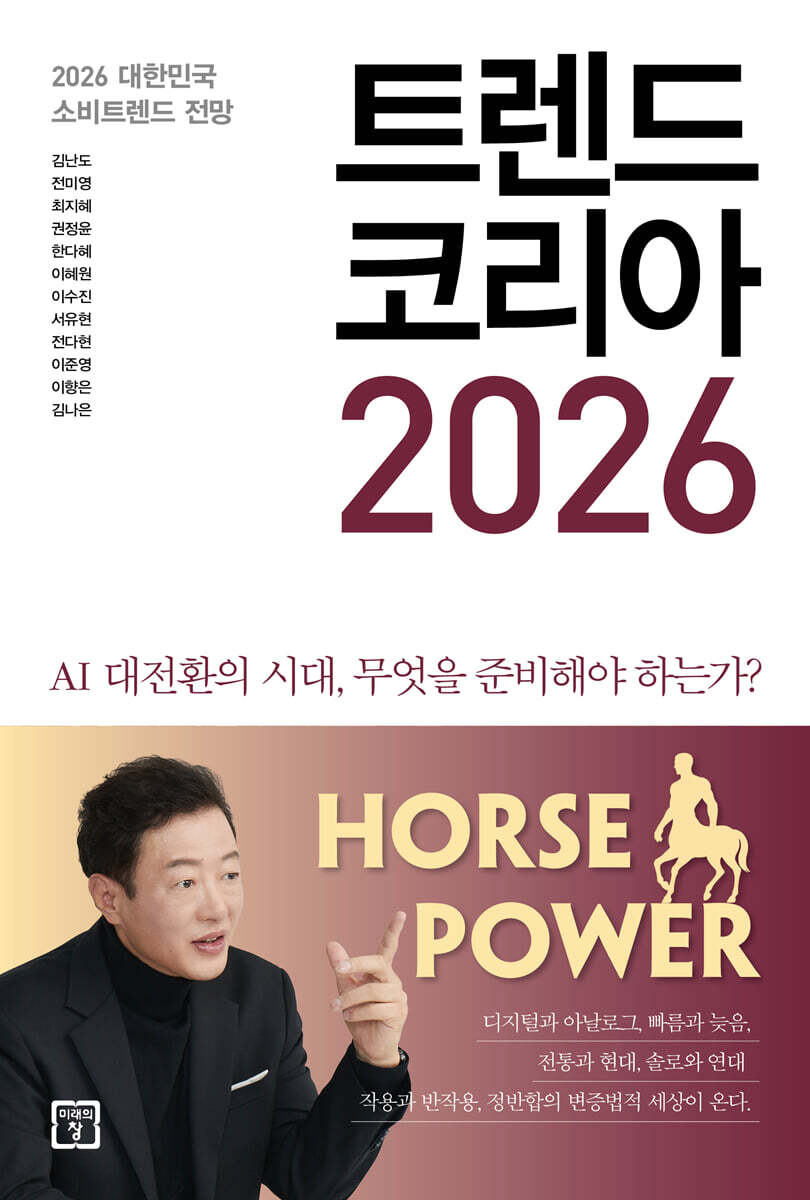
HORSE POWER: The Era of AI TransformationKorea's leading trend forecaster, Trend Korea, is back.
We look back at the major trends and products that dominated South Korea throughout 2025 and present 10 key keywords that will drive consumer and market changes in 2026, including "Centaur-type talent," "1.5 households," and "humans in the loop."
Economic and Management PD Oh Da-eun
HORSE POWER
What should we prepare for in the era of AI transformation?
The world is a whirlpool of action and reaction, of fierce thesis and antithesis.
It's so fast and crazy that it's hard to keep track of your direction.
So where is our rudder? Where should we anchor ourselves to avoid the raging storms and the unpredictable storms that may blow from nowhere?
Even amidst the trade war, the threat of AI heading toward singularity, and the seemingly endless whirlwind of war, the Korean economy is still sailing along, fueled by K-beauty, which has achieved the number one position in the global market following automobiles, shipbuilding, and semiconductors, and the growing popularity of K-content that is becoming increasingly Korean.
The dynamic and creative lifestyles and consumption behaviors of countless individuals are also creating unprecedented new and exciting trends.
A ship is safest when it is anchored in port, but that is not the essence of a ship.
Let's continue our voyage into the seas of 2026 with Trend Korea.
What should we prepare for in the era of AI transformation?
The world is a whirlpool of action and reaction, of fierce thesis and antithesis.
It's so fast and crazy that it's hard to keep track of your direction.
So where is our rudder? Where should we anchor ourselves to avoid the raging storms and the unpredictable storms that may blow from nowhere?
Even amidst the trade war, the threat of AI heading toward singularity, and the seemingly endless whirlwind of war, the Korean economy is still sailing along, fueled by K-beauty, which has achieved the number one position in the global market following automobiles, shipbuilding, and semiconductors, and the growing popularity of K-content that is becoming increasingly Korean.
The dynamic and creative lifestyles and consumption behaviors of countless individuals are also creating unprecedented new and exciting trends.
A ship is safest when it is anchored in port, but that is not the essence of a ship.
Let's continue our voyage into the seas of 2026 with Trend Korea.
- You can preview some of the book's contents.
Preview
index
introduction
Top 10 Consumer Trend Keywords for 2026
1 · 2025 South Korea
Borderless Consumer
A new spark lit in a frozen market
Adding meaning to everyday life
Overcoming Burnout
A survival economy created by heat waves: Climate is swallowing the market.
Trend Korea's Top 10 Trend Products for 2025
2 · 2026 Trends
Human-in-the-loop
Phileconomy Oh, my feelings! The Feelconomy
Zero-click Results on Demand: Zero-click
Ready-core Self-directed Preparation: Ready-core
AX Organization Efficient Organizations through AI Transformation
Pixelated Life
Observant Consumers: Price Decoding
Health Intelligence HQ Widen your Health Intelligence
Everyone Is an Island: the 1.5 Households
Returning to the Fundamentals
main
supplement
Top 10 Consumer Trend Keywords for 2026
1 · 2025 South Korea
Borderless Consumer
A new spark lit in a frozen market
Adding meaning to everyday life
Overcoming Burnout
A survival economy created by heat waves: Climate is swallowing the market.
Trend Korea's Top 10 Trend Products for 2025
2 · 2026 Trends
Human-in-the-loop
Phileconomy Oh, my feelings! The Feelconomy
Zero-click Results on Demand: Zero-click
Ready-core Self-directed Preparation: Ready-core
AX Organization Efficient Organizations through AI Transformation
Pixelated Life
Observant Consumers: Price Decoding
Health Intelligence HQ Widen your Health Intelligence
Everyone Is an Island: the 1.5 Households
Returning to the Fundamentals
main
supplement
Detailed image

Into the book
The keyword for 2026 is not simply the conflict between AI and humans, but rather a new dialectical order that unites within that conflict.
So what word best captures this concept? We thought of "centaur."
In Greek mythology, a centaur is a half-human, half-horse creature with the upper body of a human. Centaur-type talent in the AI era refers to hybrid professionals who perfectly combine the inherent capabilities of humans with the overwhelming power of AI to create a new level of value previously impossible. The true winner in the AI era will not be the one with the fastest and most powerful machine, but the human who can think deeply and ask the wisest questions while operating on that machine.
--- p.13
The impact of AI is expected to further blur industry boundaries by 2026.
Even between seemingly distant industries, such as automotive and energy, or finance and healthcare, convergence collaborations mediated by technology and data will increase.
We must deepen collaboration while simultaneously creating unprecedented opportunities through entirely new combinations.
The conditions for success in the era of hyper-cooperation are clear.
It's about collaborating with an open mind, acknowledging consumers as co-creators, and bringing warmth to technology.
From competition to cooperation, from ownership to experience, from cold technology to warm technology.
In 2026, we will advance into a world of deeper and broader hyper-cooperation.
--- p.58
AI is qualitatively different from previous computer technologies.
You can take on the role of suggesting ideas and generating drafts yourself.
Human creativity now depends on how we harness this "engine of inspiration." As AI becomes smarter, paradoxically, the human role becomes more crucial. Only when AI's overwhelming computational power is combined with human critical thinking, ethical judgment, and contextual wisdom can we truly utilize technology safely and beneficially. Rather than blindly following AI's decisions, human-in-the-loop design—using AI as a capable partner and actively engaging humans in its decision-making process—will become the most important technological philosophy and zeitgeist of our time. The true winner in the AI era will not be the one with the fastest and most powerful machine, but the human who can think the most deeply and ask the wisest questions within that machine.
Human in the Loop is the minimal space for that very reason, and it is our last promise not to give up on being human.
In the end, they are people.
--- p.158
“I bought bread because I wasn’t feeling well today.” This is a phrase often used to distinguish whether someone’s MBTI type is F for empathy or T for thinking.
If you ask, “Why are you upset?” it’s F, and if you ask, “What kind of bread did you buy?” it’s T.
This phrase is often used humorously to mock the lack of empathy among T-types. Let's put the MBTI discussion aside for a moment and focus on the question again.
Why buy bread when you're in a bad mood? In this case, the motivation for buying bread is "mood."
It is not the 'need' of being hungry, the 'meaning' of wanting to express oneself by buying high-quality bread, or the 'experience' of spending time at a famous bakery, but rather the feeling that drives consumption.
In addition to need, meaning, and experience, which were the main drivers of purchase, mood and emotion have recently emerged as the main reasons for consumption.
It's not just a problem with silk bread.
From small school supplies to the food market, housing, and even the cold technology sector, mood is becoming a new driving force in modern society, driving the economy across various industries.
--- p.160
How much do you use AI these days? Even if you don't use apps like ChatGPT or Gemini frequently, if you shop or watch cable TV through apps, you're already enjoying the convenience of AI.
This is because various AI technologies are being applied within the service. AI is deeply embedded in our lives.
What's the most important function these AI services perform? From a user's perspective, it's reducing the number of "clicks" (or touches) required.
In the past, you had to input a search term, click on the link, find the information you wanted, and then click again several times within that link. However, these days, you can simply ask questions in the AI service search box as if you were asking a friend, and it will give you a fairly accurate answer.
The same goes for shopping.
Until now, I had to input the product search terms I needed and click through the suggested alternatives one by one, but these days, AI makes suggestions tailored to my needs, so the number of clicks has been significantly reduced.
--- p.188
The new generation living in unpredictable times needs a new way of survival.
Rather than wasting time and money on the uncertainty of possible failure, there is a growing desire to control future experiences by summoning them into the present through basic preparation and rehearsal.
A trend called 'readycore' is emerging, where people plan, learn, and live in advance.
This means that being 'ready' has become the 'core' and most important value of life.
Just a few years ago, we were all crazy about the 'God-born' trend.
Amid the chaos of everyday life disrupted by COVID-19, younger generations have sought to fill each day with joy through diligent routines like the "Miracle Morning" and "daily exercise."
It was a healthy struggle of the younger generation living in a time of chaos.
But after the pandemic, the environment surrounding us has become more complex.
Youth unemployment and the economic downturn have worsened, and the rapid development of generative AI has not only made finding a job more difficult, but has also made existing jobs uncertain.
Not only the younger generation, but all people living in the modern era are facing a reality that is more unpredictable and difficult to control than ever before.
--- p.212~213
Artificial intelligence, which is expected to bring about changes comparable to the introduction of the steam engine or the computer, poses serious questions to all of us.
Ask the company.
Are you truly ready to trust your members, let go of the temptation to control, and create a "playground" where they can run and play freely? Furthermore, I ask this of us as individuals.
Are you truly ready to break free from the inertia of running on the company's prescribed tracks and become an "explorer," forging your own path through the uncertain wilderness? The blueprint for the AX organization will only come to life when its members are ready to assume the responsibilities that come with autonomy.
Reforms like Cross Position, Zero Distance, Ultra Flat, and Jam Session are ultimately not problems of technology or structure, but rather fundamental challenges to our own way of thinking as we live within them.
Didn't Alvin Toffler say it too?
“The illiterate of the 21st century will not be those who cannot read and write, but those who cannot learn, unlearn, and relearn.”
--- p.266
In July 2025, YouTube announced that it would be eliminating "in-geup-dong," or "rapidly rising videos."
With trends now segmented across various fandoms and communities, comprehensive lists of popular videos are no longer valid.
YouTube explained the reasoning behind this decision, saying, “Videos and micro-trends created by different fandoms are spreading across the platform, and the number of visitors to the trending videos page has decreased significantly over the past five years.”
YouTube's decision has significant implications.
In a world where content is pouring in in large, small, and short chunks, the term "big flow" has lost its meaning.
The great flow is over.
The most important change that will impact the South Korean consumer market in 2026 is the end of the grand narrative.
Mega trends that dominated an era are losing their power, and countless 'micro trends' are taking their place.
Before the craze for Tanghulu and Dubai chocolate has even cooled, new desserts like Yoajung are sweeping social media, and the "○○core" fashion style seems to be trending, only to disappear without a trace in less than a season.
--- p.268
In the past, the price tags offered by industrial brands were like a 'period'.
It was the brand's final declaration of values, and the end of a conversation that could no longer be continued.
The consumer was only able to choose 'yes' or 'no' in front of it.
But now the price tag has turned into a 'question mark'.
A price tag of 1 million won is no longer a declaration that “this is worth 1 million won,” but rather a starting point for countless questions from consumers.
"Why 1 million won?" "Can you prove the value of the materials you used?" "Does your brand story truly deserve that premium?" "Can you be sure that there are no unnecessary distribution bubbles at this price?" As the price tag shifts from a period to a question mark, consumption is no longer a one-sided monologue from a brand, but a dialogue in which brands and consumers jointly verify and agree on value.
--- p.322
First, we must accept that every business is now a health business.
As health care becomes not just a part of life but a life orientation and lifestyle, we must consider how to incorporate health-related elements not only in existing areas such as medical care, health care, and health functional foods, but also in virtually all areas, including home appliances, housing, fashion, travel, and finance.
In the food market, which has always been quick to reflect trends, structural changes are already underway.
As negative perceptions about sugar take hold, orange juice and cereal are noticeably decreasing in breakfast.
Companies that used to make sweet children's cereals have shifted their focus to healthier cereals like granola, muesli, and hot cereals that are high in protein and low in sugar.
It is necessary to examine whether the company's products and services are in line with consumers' health intelligence and how they contribute to their "good lives."
--- p.345
New forms of households that can no longer be explained by the old dichotomy of 'family' bound by blood and 'individual' completely independent are quietly but rapidly spreading around us.
I would like to call this new way of forming relationships, where one is alone and together at the same time, and together and alone at the same time, the '1.5 household.'
1 represents complete autonomy as an individual, and 0.5 represents a sense of connection as a social being.
A good relationship satisfies both autonomy and connection.
Research shows that well-being is highest when both axes are met simultaneously.
This is the balance that 1.5 households are looking for.
It is about pursuing the stability that comes from solidarity that is practically connected to an autonomous life of self-determination.
'1.5', a combination of '1' and '0.5', is a social formula that shows a new era of relationship building that is stronger than being alone but lighter than a complete community.
Let's take a closer look at how modern people combine these 1 and 0.5.
--- p.353
In a world dominated by digital and artificial intelligence, the fact that people are turning to museums can only be interpreted as a backlash against an era where the virtual created by artificial intelligence threatens the real and blurs the lines between truth and falsehood.
In other words, in an age where digital and artificial intelligence are creating fakes that are no different from the original, or even more real than the real thing, this is the result of the desire to 'see the root cause directly.'
As generative AI becomes free to replicate and even create, it becomes increasingly confusing to know what to believe and where to place value.
Concerns about human subjectivity and the reason for existence have also deepened.
In this age of chaos, we are turning our steps to a place where we can find the true essence of humanity, where we can find the essence of purity.
So what word best captures this concept? We thought of "centaur."
In Greek mythology, a centaur is a half-human, half-horse creature with the upper body of a human. Centaur-type talent in the AI era refers to hybrid professionals who perfectly combine the inherent capabilities of humans with the overwhelming power of AI to create a new level of value previously impossible. The true winner in the AI era will not be the one with the fastest and most powerful machine, but the human who can think deeply and ask the wisest questions while operating on that machine.
--- p.13
The impact of AI is expected to further blur industry boundaries by 2026.
Even between seemingly distant industries, such as automotive and energy, or finance and healthcare, convergence collaborations mediated by technology and data will increase.
We must deepen collaboration while simultaneously creating unprecedented opportunities through entirely new combinations.
The conditions for success in the era of hyper-cooperation are clear.
It's about collaborating with an open mind, acknowledging consumers as co-creators, and bringing warmth to technology.
From competition to cooperation, from ownership to experience, from cold technology to warm technology.
In 2026, we will advance into a world of deeper and broader hyper-cooperation.
--- p.58
AI is qualitatively different from previous computer technologies.
You can take on the role of suggesting ideas and generating drafts yourself.
Human creativity now depends on how we harness this "engine of inspiration." As AI becomes smarter, paradoxically, the human role becomes more crucial. Only when AI's overwhelming computational power is combined with human critical thinking, ethical judgment, and contextual wisdom can we truly utilize technology safely and beneficially. Rather than blindly following AI's decisions, human-in-the-loop design—using AI as a capable partner and actively engaging humans in its decision-making process—will become the most important technological philosophy and zeitgeist of our time. The true winner in the AI era will not be the one with the fastest and most powerful machine, but the human who can think the most deeply and ask the wisest questions within that machine.
Human in the Loop is the minimal space for that very reason, and it is our last promise not to give up on being human.
In the end, they are people.
--- p.158
“I bought bread because I wasn’t feeling well today.” This is a phrase often used to distinguish whether someone’s MBTI type is F for empathy or T for thinking.
If you ask, “Why are you upset?” it’s F, and if you ask, “What kind of bread did you buy?” it’s T.
This phrase is often used humorously to mock the lack of empathy among T-types. Let's put the MBTI discussion aside for a moment and focus on the question again.
Why buy bread when you're in a bad mood? In this case, the motivation for buying bread is "mood."
It is not the 'need' of being hungry, the 'meaning' of wanting to express oneself by buying high-quality bread, or the 'experience' of spending time at a famous bakery, but rather the feeling that drives consumption.
In addition to need, meaning, and experience, which were the main drivers of purchase, mood and emotion have recently emerged as the main reasons for consumption.
It's not just a problem with silk bread.
From small school supplies to the food market, housing, and even the cold technology sector, mood is becoming a new driving force in modern society, driving the economy across various industries.
--- p.160
How much do you use AI these days? Even if you don't use apps like ChatGPT or Gemini frequently, if you shop or watch cable TV through apps, you're already enjoying the convenience of AI.
This is because various AI technologies are being applied within the service. AI is deeply embedded in our lives.
What's the most important function these AI services perform? From a user's perspective, it's reducing the number of "clicks" (or touches) required.
In the past, you had to input a search term, click on the link, find the information you wanted, and then click again several times within that link. However, these days, you can simply ask questions in the AI service search box as if you were asking a friend, and it will give you a fairly accurate answer.
The same goes for shopping.
Until now, I had to input the product search terms I needed and click through the suggested alternatives one by one, but these days, AI makes suggestions tailored to my needs, so the number of clicks has been significantly reduced.
--- p.188
The new generation living in unpredictable times needs a new way of survival.
Rather than wasting time and money on the uncertainty of possible failure, there is a growing desire to control future experiences by summoning them into the present through basic preparation and rehearsal.
A trend called 'readycore' is emerging, where people plan, learn, and live in advance.
This means that being 'ready' has become the 'core' and most important value of life.
Just a few years ago, we were all crazy about the 'God-born' trend.
Amid the chaos of everyday life disrupted by COVID-19, younger generations have sought to fill each day with joy through diligent routines like the "Miracle Morning" and "daily exercise."
It was a healthy struggle of the younger generation living in a time of chaos.
But after the pandemic, the environment surrounding us has become more complex.
Youth unemployment and the economic downturn have worsened, and the rapid development of generative AI has not only made finding a job more difficult, but has also made existing jobs uncertain.
Not only the younger generation, but all people living in the modern era are facing a reality that is more unpredictable and difficult to control than ever before.
--- p.212~213
Artificial intelligence, which is expected to bring about changes comparable to the introduction of the steam engine or the computer, poses serious questions to all of us.
Ask the company.
Are you truly ready to trust your members, let go of the temptation to control, and create a "playground" where they can run and play freely? Furthermore, I ask this of us as individuals.
Are you truly ready to break free from the inertia of running on the company's prescribed tracks and become an "explorer," forging your own path through the uncertain wilderness? The blueprint for the AX organization will only come to life when its members are ready to assume the responsibilities that come with autonomy.
Reforms like Cross Position, Zero Distance, Ultra Flat, and Jam Session are ultimately not problems of technology or structure, but rather fundamental challenges to our own way of thinking as we live within them.
Didn't Alvin Toffler say it too?
“The illiterate of the 21st century will not be those who cannot read and write, but those who cannot learn, unlearn, and relearn.”
--- p.266
In July 2025, YouTube announced that it would be eliminating "in-geup-dong," or "rapidly rising videos."
With trends now segmented across various fandoms and communities, comprehensive lists of popular videos are no longer valid.
YouTube explained the reasoning behind this decision, saying, “Videos and micro-trends created by different fandoms are spreading across the platform, and the number of visitors to the trending videos page has decreased significantly over the past five years.”
YouTube's decision has significant implications.
In a world where content is pouring in in large, small, and short chunks, the term "big flow" has lost its meaning.
The great flow is over.
The most important change that will impact the South Korean consumer market in 2026 is the end of the grand narrative.
Mega trends that dominated an era are losing their power, and countless 'micro trends' are taking their place.
Before the craze for Tanghulu and Dubai chocolate has even cooled, new desserts like Yoajung are sweeping social media, and the "○○core" fashion style seems to be trending, only to disappear without a trace in less than a season.
--- p.268
In the past, the price tags offered by industrial brands were like a 'period'.
It was the brand's final declaration of values, and the end of a conversation that could no longer be continued.
The consumer was only able to choose 'yes' or 'no' in front of it.
But now the price tag has turned into a 'question mark'.
A price tag of 1 million won is no longer a declaration that “this is worth 1 million won,” but rather a starting point for countless questions from consumers.
"Why 1 million won?" "Can you prove the value of the materials you used?" "Does your brand story truly deserve that premium?" "Can you be sure that there are no unnecessary distribution bubbles at this price?" As the price tag shifts from a period to a question mark, consumption is no longer a one-sided monologue from a brand, but a dialogue in which brands and consumers jointly verify and agree on value.
--- p.322
First, we must accept that every business is now a health business.
As health care becomes not just a part of life but a life orientation and lifestyle, we must consider how to incorporate health-related elements not only in existing areas such as medical care, health care, and health functional foods, but also in virtually all areas, including home appliances, housing, fashion, travel, and finance.
In the food market, which has always been quick to reflect trends, structural changes are already underway.
As negative perceptions about sugar take hold, orange juice and cereal are noticeably decreasing in breakfast.
Companies that used to make sweet children's cereals have shifted their focus to healthier cereals like granola, muesli, and hot cereals that are high in protein and low in sugar.
It is necessary to examine whether the company's products and services are in line with consumers' health intelligence and how they contribute to their "good lives."
--- p.345
New forms of households that can no longer be explained by the old dichotomy of 'family' bound by blood and 'individual' completely independent are quietly but rapidly spreading around us.
I would like to call this new way of forming relationships, where one is alone and together at the same time, and together and alone at the same time, the '1.5 household.'
1 represents complete autonomy as an individual, and 0.5 represents a sense of connection as a social being.
A good relationship satisfies both autonomy and connection.
Research shows that well-being is highest when both axes are met simultaneously.
This is the balance that 1.5 households are looking for.
It is about pursuing the stability that comes from solidarity that is practically connected to an autonomous life of self-determination.
'1.5', a combination of '1' and '0.5', is a social formula that shows a new era of relationship building that is stronger than being alone but lighter than a complete community.
Let's take a closer look at how modern people combine these 1 and 0.5.
--- p.353
In a world dominated by digital and artificial intelligence, the fact that people are turning to museums can only be interpreted as a backlash against an era where the virtual created by artificial intelligence threatens the real and blurs the lines between truth and falsehood.
In other words, in an age where digital and artificial intelligence are creating fakes that are no different from the original, or even more real than the real thing, this is the result of the desire to 'see the root cause directly.'
As generative AI becomes free to replicate and even create, it becomes increasingly confusing to know what to believe and where to place value.
Concerns about human subjectivity and the reason for existence have also deepened.
In this age of chaos, we are turning our steps to a place where we can find the true essence of humanity, where we can find the essence of purity.
--- p.377~378
Publisher's Review
In the era of AI transformation, you become even more important.
The top ten keywords for 2026 are centered on the direct effects of AI and the resulting indirect changes in lifestyle, with the corresponding counteractions of human and essential elements on the other.
Whether it's action or reaction, AI is the most powerful force driving trends in 2026.
So, it's almost meaningless to discuss trends without mentioning AI, as it's engulfing the world like a tsunami.
However, it is dangerous to take a dichotomous view that simply praises AI's efficiency or warns against its side effects.
The key is that AI should not replace or eliminate humans, but rather seek to complement and help us grow.
“What should we prepare for in this era of AI transformation?”
The answer the authors found was humans.
This is the background to why 'human in the loop', meaning that human intervention is essential, became the first keyword.
2026 marks the tenth anniversary of Lee Sedol's 9-dan match against the AI AlphaGo. Lee Sedol's 78th move, his first victory against the AI, will go down in history as a decisive move. In the age of AI, we must ask ourselves what moves are truly our own, what are our most authentic moves.
As always, it comes down to people.
The top ten keywords for 2026 are centered on the direct effects of AI and the resulting indirect changes in lifestyle, with the corresponding counteractions of human and essential elements on the other.
Whether it's action or reaction, AI is the most powerful force driving trends in 2026.
So, it's almost meaningless to discuss trends without mentioning AI, as it's engulfing the world like a tsunami.
However, it is dangerous to take a dichotomous view that simply praises AI's efficiency or warns against its side effects.
The key is that AI should not replace or eliminate humans, but rather seek to complement and help us grow.
“What should we prepare for in this era of AI transformation?”
The answer the authors found was humans.
This is the background to why 'human in the loop', meaning that human intervention is essential, became the first keyword.
2026 marks the tenth anniversary of Lee Sedol's 9-dan match against the AI AlphaGo. Lee Sedol's 78th move, his first victory against the AI, will go down in history as a decisive move. In the age of AI, we must ask ourselves what moves are truly our own, what are our most authentic moves.
As always, it comes down to people.
GOODS SPECIFICS
- Date of issue: September 24, 2025
- Page count, weight, size: 400 pages | 634g | 152*225*21mm
- ISBN13: 9791193638859
- ISBN10: 1193638852
You may also like
카테고리
korean


korean

![GQ KOREA Mark (Monthly): December [2025]](http://librairie.coreenne.fr/cdn/shop/files/8ef265dbbfbf186523ed75ba7319009d.jpg?v=1765340328&width=3840)


