

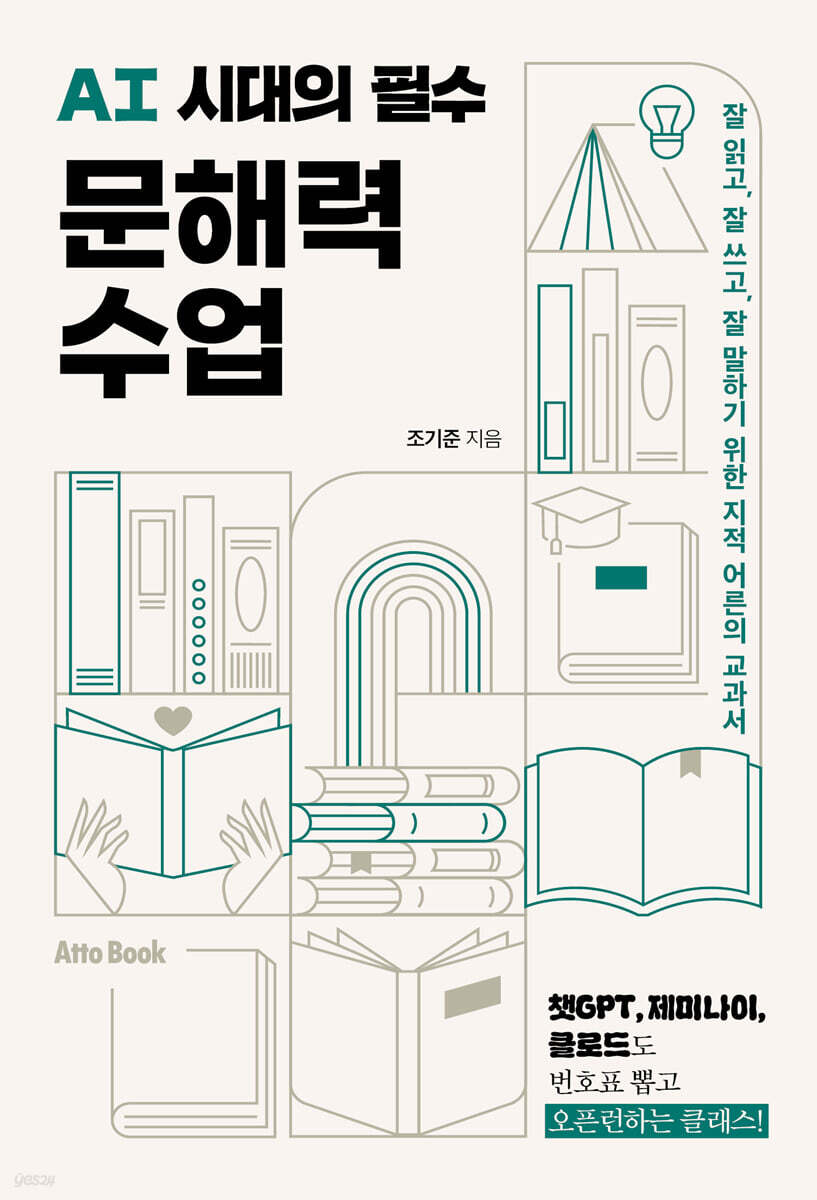
Essential Literacy Classes in the AI Era
 |
Description
Book Introduction
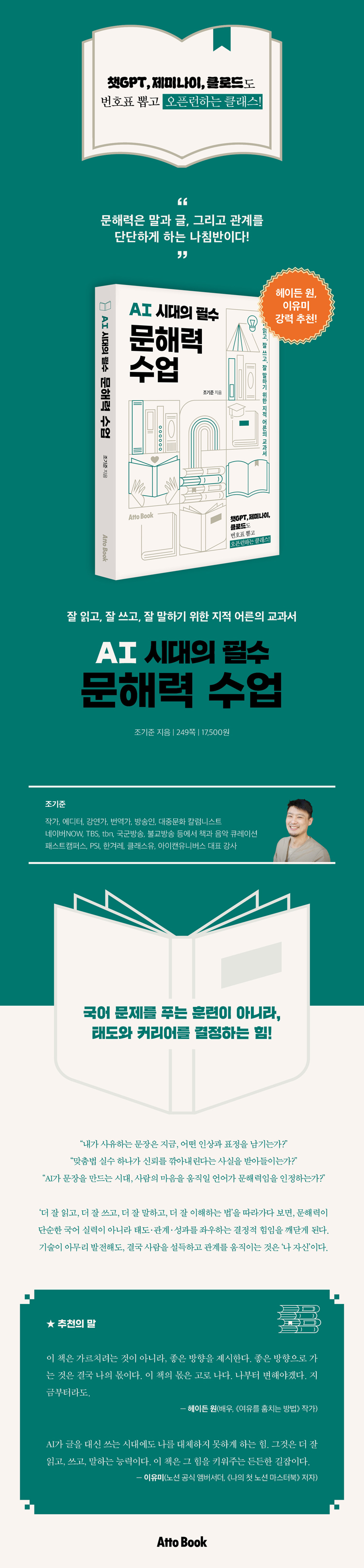
It is not a training to solve Korean language problems,
The power that determines your attitude and career!
“In the AI era, your ultimate competitive edge is literacy!”
An era where AI summarizes texts and even automatically organizes meeting minutes.
But a single tone of voice, a single spelling, a single line of expression in a report still serves as a criterion for gauging a person's attitude and trustworthiness.
《Essential Literacy Classes in the AI Age》 focuses on this very point.
Based on 20 episodes of new employee Seunghoon and vivid workplace experiences, it reveals that literacy is both attitude and career competitiveness.
The power that determines your attitude and career!
“In the AI era, your ultimate competitive edge is literacy!”
An era where AI summarizes texts and even automatically organizes meeting minutes.
But a single tone of voice, a single spelling, a single line of expression in a report still serves as a criterion for gauging a person's attitude and trustworthiness.
《Essential Literacy Classes in the AI Age》 focuses on this very point.
Based on 20 episodes of new employee Seunghoon and vivid workplace experiences, it reveals that literacy is both attitude and career competitiveness.
- You can preview some of the book's contents.
Preview
index
Prologue: The AI Era: Where Speech and Writing Become Competitive
PART Ⅰ.
Read better
1.
First impressions are determined by a sentence.
- The tone of a sentence is as important as “Hello!”
2.
One spelling mistake can ruin your credibility.
- Check “do” and “do”, “not” and “an” first
3.
Acronyms and Neologisms: Convenient but Dangerous
- “ㅇㅇ” and “ㄱㄱ” are taboo words in the workplace
4.
Instead of “Huh?” or “Eh?”, say “Could you say that again?”
- The attitude of listening is literacy.
5.
Why you should shorten “~in seems”
- Even the words show 'confidence'
PART Ⅱ.
Write better
6.
Business emails don't just have to be polite.
- Differences between written and spoken language
7.
Why Reports and Chats Should Have Different Sentence Tone
- “Did you see the material yesterday?” vs.
“Please review the materials.”
8.
To prevent your boss from asking you again
- How to construct sentences logically
9.
The moment when the difference between “yes” and “yes” is important
- The formality and nuance of words
10.
Easy-to-understand sentences are competitive.
Why literacy is important for new employees
PART Ⅲ.
Speak better
11.
Misunderstandings arise when the subject and predicate are far apart.
- How to shorten long sentences
12.
Minutes are your skills
- Ability to summarize key points quickly
13.
In business, "no" doesn't work.
- Practice reducing ambiguous expressions
14. PPT and reports are tools of persuasion.
- Writing sentences that increase readability and persuasiveness
15.
The Law of Feedback That Makes Me Shine
- “Yes” is not always the correct answer.
PART IV.
Understand better
16.
Refusal must be done with elegance.
- Instead of saying “It’s difficult,” say “How about doing it this way?”
17.
Instead of “I don’t know,” say “I understand it this way. Is that correct?”
- Questioning techniques to improve literacy
18.
Even in group chats, the sentences are my face
- Maintaining friendliness without unnecessary emoticons and “lol”
19.
Why Trust in Words and Writings Fails
- Appropriate communication style in the workplace
20.
The last greeting determines the impression
- The difference between “Thank you for your hard work” and “Thank you for your hard work.”
PART Ⅰ.
Read better
1.
First impressions are determined by a sentence.
- The tone of a sentence is as important as “Hello!”
2.
One spelling mistake can ruin your credibility.
- Check “do” and “do”, “not” and “an” first
3.
Acronyms and Neologisms: Convenient but Dangerous
- “ㅇㅇ” and “ㄱㄱ” are taboo words in the workplace
4.
Instead of “Huh?” or “Eh?”, say “Could you say that again?”
- The attitude of listening is literacy.
5.
Why you should shorten “~in seems”
- Even the words show 'confidence'
PART Ⅱ.
Write better
6.
Business emails don't just have to be polite.
- Differences between written and spoken language
7.
Why Reports and Chats Should Have Different Sentence Tone
- “Did you see the material yesterday?” vs.
“Please review the materials.”
8.
To prevent your boss from asking you again
- How to construct sentences logically
9.
The moment when the difference between “yes” and “yes” is important
- The formality and nuance of words
10.
Easy-to-understand sentences are competitive.
Why literacy is important for new employees
PART Ⅲ.
Speak better
11.
Misunderstandings arise when the subject and predicate are far apart.
- How to shorten long sentences
12.
Minutes are your skills
- Ability to summarize key points quickly
13.
In business, "no" doesn't work.
- Practice reducing ambiguous expressions
14. PPT and reports are tools of persuasion.
- Writing sentences that increase readability and persuasiveness
15.
The Law of Feedback That Makes Me Shine
- “Yes” is not always the correct answer.
PART IV.
Understand better
16.
Refusal must be done with elegance.
- Instead of saying “It’s difficult,” say “How about doing it this way?”
17.
Instead of “I don’t know,” say “I understand it this way. Is that correct?”
- Questioning techniques to improve literacy
18.
Even in group chats, the sentences are my face
- Maintaining friendliness without unnecessary emoticons and “lol”
19.
Why Trust in Words and Writings Fails
- Appropriate communication style in the workplace
20.
The last greeting determines the impression
- The difference between “Thank you for your hard work” and “Thank you for your hard work.”
Detailed image
Into the book
Seunghoon started practicing refining his sentences even after work.
I analyzed the flow of sentences while reading business books, and I developed the habit of organizing the main points first and then constructing sentences whenever I wrote.
And before submitting my report, I took the time to read it over again and check the flow.
These small efforts add up to create more natural and trustworthy documents.
--- p.31
“Today was really great.
I especially liked the courage to say 'I don't know'.
“A professional isn’t someone who is perfect, but someone who says ‘what is certain is certain.’” Seunghoon felt a sense of pride and a bit of emotion at the same time.
A listening attitude, the courage to admit what you don't know, and speaking with respect for the other person.
He was learning all of this firsthand through this experience.
--- p.56
Seunghoon nodded, but his feelings were complicated.
Why should I be so cautious just because of the simple expression "yes"? Yet somehow, I found it understandable.
I wonder if I've been relying too much on 'comfortable-sounding expressions'.
That evening, Seunghoon began to look through the previous conversation records.
I was surprised at how often I had used 'yes' without thinking.
Even in the messenger, not only in the report email, but also in the guidance with external partners, and even at the end of the sentence sent to Manager Heo, expressions like 'yes', 'yes', and 'haha' were carelessly mixed in.
The next day, Seunghoon received another message from Manager Jo on Messenger.
--- p.114
The slide was completed in no time.
But strangely enough, from the moment I finished it, I felt uneasy.
The numbers were correct, and the sentences were correct, but I couldn't even answer the question, "So what's important?"
“Sir, could you please take a look at this?” Seunghoon sent a hesitant email, and the reply was just one line.
“Let’s rewrite it so that it’s persuasive, not just a report.” That night, he learned for the first time.
What's important in a report is not the 'organized information' but the sentences that move the other person.
The next morning, Seunghoon was named as the presenter.
Now I had to prove to myself that the sentences from the first page to the last page could make people nod their heads.
--- p.170
Starting the next week, Seunghoon became a slightly different person in his conversations with his teammates.
Although he still maintained a warm tone, he cut down on useless emoticons and cautiously added “lol” only when he was sure he was joking.
And the question marks that used to end every sentence have now turned into confident periods.
Group chats may seem trivial, but the words exchanged within them are anything but light.
Useless “lol”s and emoticons may cover up the moment, but in the end, the weight of the words and attitude are fully revealed.
Friendliness doesn't have to be frivolous.
Even light words can be enough to warm the heart, and the impression that you are 'saying what you want to say' actually creates more trust.
Just as Seunghoon regained trust with a single sentence, we too can be remembered as 'people with a sense of work' with a single sentence in the small space of a group chat.
I analyzed the flow of sentences while reading business books, and I developed the habit of organizing the main points first and then constructing sentences whenever I wrote.
And before submitting my report, I took the time to read it over again and check the flow.
These small efforts add up to create more natural and trustworthy documents.
--- p.31
“Today was really great.
I especially liked the courage to say 'I don't know'.
“A professional isn’t someone who is perfect, but someone who says ‘what is certain is certain.’” Seunghoon felt a sense of pride and a bit of emotion at the same time.
A listening attitude, the courage to admit what you don't know, and speaking with respect for the other person.
He was learning all of this firsthand through this experience.
--- p.56
Seunghoon nodded, but his feelings were complicated.
Why should I be so cautious just because of the simple expression "yes"? Yet somehow, I found it understandable.
I wonder if I've been relying too much on 'comfortable-sounding expressions'.
That evening, Seunghoon began to look through the previous conversation records.
I was surprised at how often I had used 'yes' without thinking.
Even in the messenger, not only in the report email, but also in the guidance with external partners, and even at the end of the sentence sent to Manager Heo, expressions like 'yes', 'yes', and 'haha' were carelessly mixed in.
The next day, Seunghoon received another message from Manager Jo on Messenger.
--- p.114
The slide was completed in no time.
But strangely enough, from the moment I finished it, I felt uneasy.
The numbers were correct, and the sentences were correct, but I couldn't even answer the question, "So what's important?"
“Sir, could you please take a look at this?” Seunghoon sent a hesitant email, and the reply was just one line.
“Let’s rewrite it so that it’s persuasive, not just a report.” That night, he learned for the first time.
What's important in a report is not the 'organized information' but the sentences that move the other person.
The next morning, Seunghoon was named as the presenter.
Now I had to prove to myself that the sentences from the first page to the last page could make people nod their heads.
--- p.170
Starting the next week, Seunghoon became a slightly different person in his conversations with his teammates.
Although he still maintained a warm tone, he cut down on useless emoticons and cautiously added “lol” only when he was sure he was joking.
And the question marks that used to end every sentence have now turned into confident periods.
Group chats may seem trivial, but the words exchanged within them are anything but light.
Useless “lol”s and emoticons may cover up the moment, but in the end, the weight of the words and attitude are fully revealed.
Friendliness doesn't have to be frivolous.
Even light words can be enough to warm the heart, and the impression that you are 'saying what you want to say' actually creates more trust.
Just as Seunghoon regained trust with a single sentence, we too can be remembered as 'people with a sense of work' with a single sentence in the small space of a group chat.
--- p.223
Publisher's Review
ChatGPT, Gemini, and Claude also draw numbers and open run classes!
“In an age where AI writes for you, why do your sentences still seem so light?”
Even if AI summarizes a report or organizes meeting minutes, it is ultimately 'me' who puts my name on it and sends it out.
A sentence is a face, and a tone of voice is an attitude.
This book explains how to cultivate irreplaceable literacy skills even in the AI era.
Literacy is trust.
Spelling is not a detail, it's an attitude.
Also, one line in a report or email is your skill.
Therefore, one attitude of listening creates a relationship.
If you follow the work life of Seunghoon, a new Generation Z employee, you can vividly see why “ㅇㅇ” and “ㄱㄱ” destroy trust and why “~in-same” obscures responsibility.
When you realize that one abbreviation, one spelling mistake, one line in a report can change the course of your entire career, you realize the importance of literacy.
This book is largely divided into four parts.
'Reading Better' covers first impressions and basic literacy, 'Writing Better' covers sentence tone and structure, 'Speaking Better' covers meetings, presentations, and feedback, and 'Understanding Better' covers questions, rejections, and group chat communication.
"Literacy is competitiveness." This phrase is no longer a slogan. No matter how much AI advances, the responsibility for writing sentences remains with humans.
This book is a literacy survival manual for just those people.
After reading, your sentences will change, and ultimately your reputation will change.
This book is divided into four parts.
Ⅰ.
Reading Better: First Impressions, Spelling, Abbreviations, and the Art of Listening
Ⅱ.
Writing Better: Emails and Reports, Sentence Tone and Structure
Ⅲ.
Speaking Better: Persuading in Meetings, Feedback, and Presentations
Ⅳ.
Understanding Better: How to Ask, How to Reject, and How to Communicate in Group Chats
This is not simply a study of the Korean language, but rather provides communication skills that can be immediately applied in the workplace and society.
Readers who need this book
ㆍOffice workers who spend more than twice as much time writing proposals and emails as others
ㆍA new employee is concerned that the sentences in his report keep getting blurry.
Job seekers and college students who are at a loss when it comes to writing self-introductions and reports.
The smartphone generation, whose conversations have become shallow due to the habit of reading only three-line summaries
"What face does your sentence have right now?" Is it a friendly yet casual expression, or a dignified and trustworthy one? In the age of AI, true competitiveness lies not in technical skills, but in the ability to read context and express it responsibly.
Additionally, we added the fun of testing your literacy skills right away by solving the 'Literacy/Vocabulary/Comprehension Check' problems included at the end of each episode.
This book is sure to be a literacy survival manual that will solidify your sentence structure.
“In an age where AI writes for you, why do your sentences still seem so light?”
Even if AI summarizes a report or organizes meeting minutes, it is ultimately 'me' who puts my name on it and sends it out.
A sentence is a face, and a tone of voice is an attitude.
This book explains how to cultivate irreplaceable literacy skills even in the AI era.
Literacy is trust.
Spelling is not a detail, it's an attitude.
Also, one line in a report or email is your skill.
Therefore, one attitude of listening creates a relationship.
If you follow the work life of Seunghoon, a new Generation Z employee, you can vividly see why “ㅇㅇ” and “ㄱㄱ” destroy trust and why “~in-same” obscures responsibility.
When you realize that one abbreviation, one spelling mistake, one line in a report can change the course of your entire career, you realize the importance of literacy.
This book is largely divided into four parts.
'Reading Better' covers first impressions and basic literacy, 'Writing Better' covers sentence tone and structure, 'Speaking Better' covers meetings, presentations, and feedback, and 'Understanding Better' covers questions, rejections, and group chat communication.
"Literacy is competitiveness." This phrase is no longer a slogan. No matter how much AI advances, the responsibility for writing sentences remains with humans.
This book is a literacy survival manual for just those people.
After reading, your sentences will change, and ultimately your reputation will change.
This book is divided into four parts.
Ⅰ.
Reading Better: First Impressions, Spelling, Abbreviations, and the Art of Listening
Ⅱ.
Writing Better: Emails and Reports, Sentence Tone and Structure
Ⅲ.
Speaking Better: Persuading in Meetings, Feedback, and Presentations
Ⅳ.
Understanding Better: How to Ask, How to Reject, and How to Communicate in Group Chats
This is not simply a study of the Korean language, but rather provides communication skills that can be immediately applied in the workplace and society.
Readers who need this book
ㆍOffice workers who spend more than twice as much time writing proposals and emails as others
ㆍA new employee is concerned that the sentences in his report keep getting blurry.
Job seekers and college students who are at a loss when it comes to writing self-introductions and reports.
The smartphone generation, whose conversations have become shallow due to the habit of reading only three-line summaries
"What face does your sentence have right now?" Is it a friendly yet casual expression, or a dignified and trustworthy one? In the age of AI, true competitiveness lies not in technical skills, but in the ability to read context and express it responsibly.
Additionally, we added the fun of testing your literacy skills right away by solving the 'Literacy/Vocabulary/Comprehension Check' problems included at the end of each episode.
This book is sure to be a literacy survival manual that will solidify your sentence structure.
GOODS SPECIFICS
- Date of issue: September 18, 2025
- Page count, weight, size: 249 pages | 280g | 128*190*16mm
- ISBN13: 9791190194235
- ISBN10: 1190194236
You may also like
카테고리
korean


korean

![ELLE 엘르 A형 (여성월간) : 1월 [2026]](http://librairie.coreenne.fr/cdn/shop/files/3b70e1cf77cf67d6da56e0eb041901e8.jpg?v=1767265322&width=3840)


