

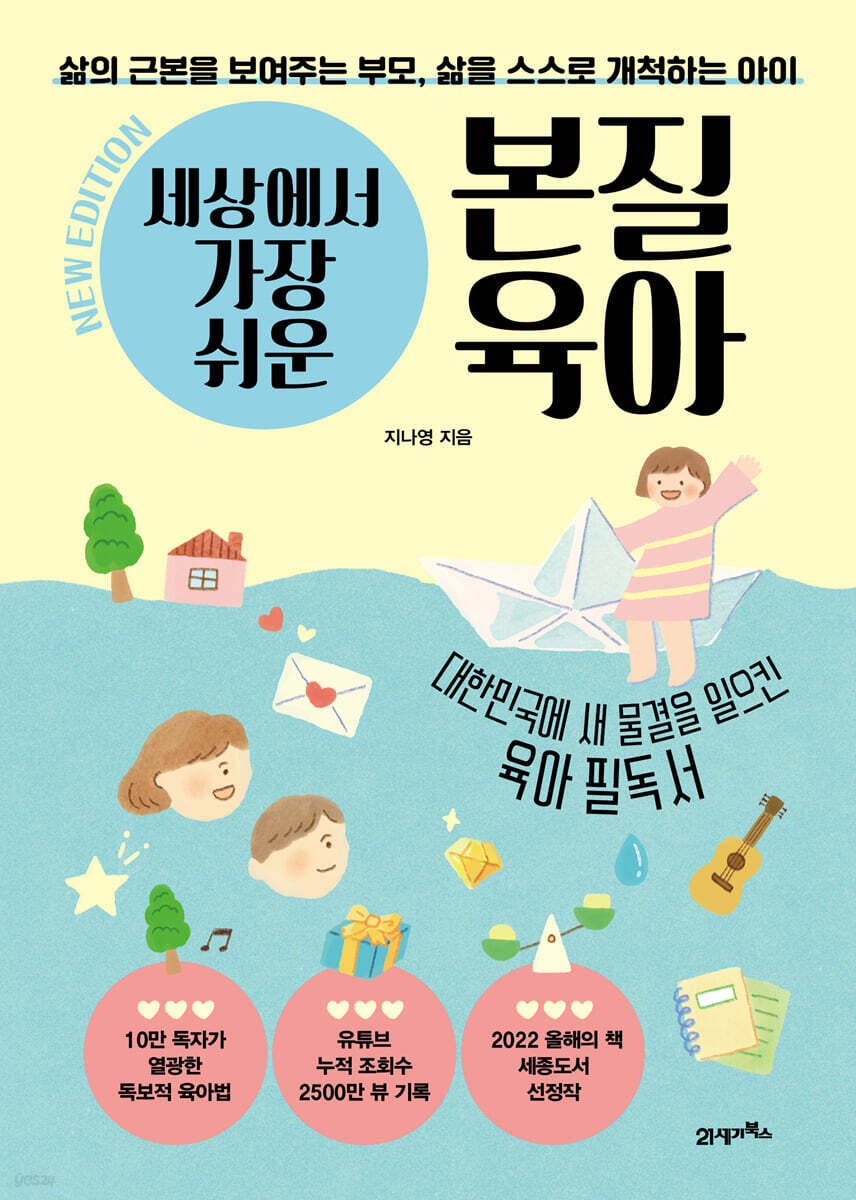
The World's Easiest Parenting Essentials (New Edition to Commemorate 100,000 Copies)
 |
Description
Book Introduction
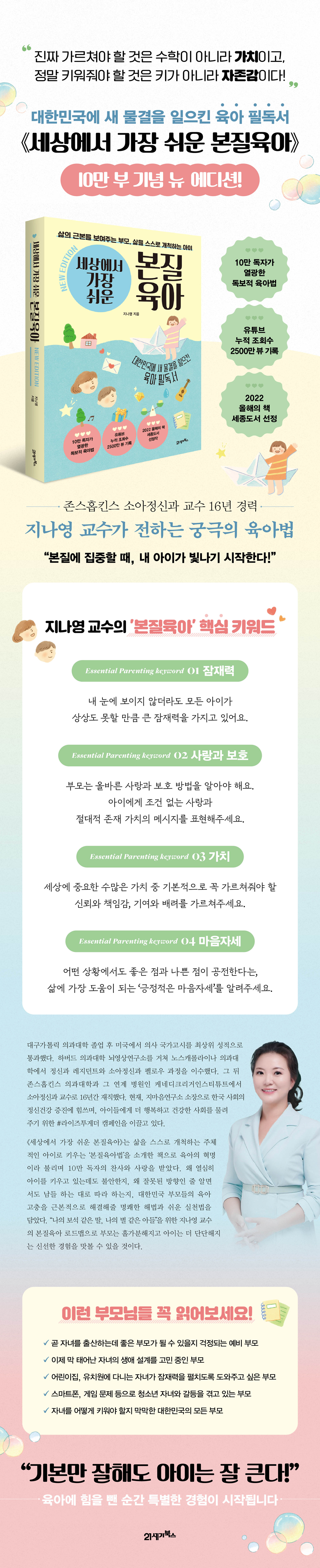
The hot choice of Korean parents, cumulative sales exceed 100,000 copies!
The Ultimate Parenting Principles from Professor Jinah Young
"The World's Easiest Essential Parenting" is back with a new edition to commemorate its 100,000th copy release!
Professor Jinna Young, the first Korean professor of child psychiatry at Johns Hopkins, has met countless children and parents during her 16 years of service.
He realized that there is one principle that parents must adhere to when they are lost in the sea of information.
This is the essence of “parents who show the fundamentals of life, and children who pioneer their own lives.”
This book, which created a sensation upon its publication, was selected as the Book of the Year in 2022 by Sejong Books and has since become Korea's representative parenting book.
Professor Jinah Young answers the most common questions parents ask: "Why do I feel anxious no matter how hard I try to raise my children? Why can't I escape comparison and competition? Why does parenting collapse in an instant?" with clear solutions and easy-to-practice methods.
This new edition commemorating the sale of 100,000 copies will serve as a reminder of the path for parents and children to grow together, and will serve as an opportunity to redefine the standard of "essence" in Korean parenting culture.
The Ultimate Parenting Principles from Professor Jinah Young
"The World's Easiest Essential Parenting" is back with a new edition to commemorate its 100,000th copy release!
Professor Jinna Young, the first Korean professor of child psychiatry at Johns Hopkins, has met countless children and parents during her 16 years of service.
He realized that there is one principle that parents must adhere to when they are lost in the sea of information.
This is the essence of “parents who show the fundamentals of life, and children who pioneer their own lives.”
This book, which created a sensation upon its publication, was selected as the Book of the Year in 2022 by Sejong Books and has since become Korea's representative parenting book.
Professor Jinah Young answers the most common questions parents ask: "Why do I feel anxious no matter how hard I try to raise my children? Why can't I escape comparison and competition? Why does parenting collapse in an instant?" with clear solutions and easy-to-practice methods.
This new edition commemorating the sale of 100,000 copies will serve as a reminder of the path for parents and children to grow together, and will serve as an opportunity to redefine the standard of "essence" in Korean parenting culture.
- You can preview some of the book's contents.
Preview
index
Prologue | Children thrive if they master the basics.
PART 1 Raising a Child Like Cooking Rice
The first question parents should ask: Who am I?
Look back at yourself before the child
What kind of life do I want to live?
Parenting is growing with your child.
Let's become happy adults in the eyes of children.
| Parenting Practice | Looking at Me
The final destination of parenting
Until the child can float his own boat
The child is from the future
Adapting a child who will go out into the world to the Korean reality?
What if I keep going like this because of anxiety?
Is this reality? It's the parents' greed!
| Parenting Practice | Watching Your Child
Basic Principles of Parenting: Cooking Techniques
Are you adhering to the basic principles?
Are you preserving your child's unique taste?
Help your child reach his or her potential.
Parenting Practice | Discovering Your Child's Potential
Rice: How to Discover Your Child's Talent
A world of intelligence more diverse than you might think
Parents who tell fish to climb trees
Let them experience many things
Be a facilitator, not a trainer
Parenting Practice | Understanding Your Child
Water: A Parent's Message to Boost Your Child's Self-Esteem
A message of unconditional love and absolute value
A Message of Love and Acceptance: The 20-Second Hug Therapy
A natural way to empathize with your child
Parenting Practice | Raising Your Child's Self-Esteem
Water: Nutcracker Therapy to Overcome Weaknesses and Boost Self-Esteem
If you confidently expose your shortcomings, they are no longer shortcomings.
My core beliefs change my reality.
The most important thing is your core beliefs about yourself.
Parenting Practice | Overcoming Weaknesses with Your Child
Water: A Body Therapy That Boosts Self-Esteem in Sensitive Children
Every personality has its strengths and weaknesses.
I decide how people treat me.
Parenting Practice | Raising Self-Esteem in Sensitive Children
Fire: If you teach values, your child will stand up straight no matter what.
Four Values You Must Teach Your Children
A child who does his or her job well, trustworthy and responsible
Contributions and consideration that make us greater people
A positive attitude supports a child's entire life.
Parents, be role models
Parenting Practice | Teach the Four Values
PART 2 Know the Force That Moves Your Child
A stronger driving force than competition: intrinsic motivation
What Motivates Children: Intrinsic vs. Extrinsic Motivation
Intrinsic motivation is stronger and longer lasting.
The best driving force according to successful people
The power of 'meaning' in the age of centenarians
Parenting Practice | Finding Intrinsic Motivation
The Trap of Extrinsic Motivation
Extrinsic motivation undermines intrinsic motivation.
If you reward studying, does it become work?
No one can change with external motivation alone.
Parenting Practice | Utilizing Extrinsic and Intrinsic Motivation Together
Are you growing into the talent the future wants?
The 4Cs: The 21st Century's Essential Talents
An educational culture that runs counter to the ideal future talent.
Let them play to their heart's content
Parenting Practice | A child who plays well, a happy child
Play and study should be fun.
PRIDE: How to Get Your Child to Take the Lead in Play
Studying should be fun too
Make reading a game
| Parenting Practice | Practicing PRIDE through Child-Led Interaction
How to Raise a Child Who Isn't Afraid of Failure
Children who say "This life is doomed" even with a little failure
If you don't fall, you won't know how to get up.
Encourage failure
Bite-sized failures
As a child who grows through failure
Parenting Practice | A Child Who Is Not Afraid of Failure
A child who learns gratitude overcomes frustration.
For struggling children, change their thinking.
The difference between positive and negative people
Gratitude Habits of Successful People
Nothing in this world is taken for granted.
Gratitude therapy for the whole family
Practice focusing on the positive
| Parenting Practice | Gratitude Therapy Challenge
PART 3 If you do this when you're young, your child will grow up well.
OT therapy to correct a child's behavior
Children need rules
No child is good at something the first time.
Rules should be established through listening and discussion.
Parenting Practice | Setting Rules with Your Child
How to Protect Your Child from Over-Immersion
Why Children Are Overly Involved in Games and Smartphones
Give them a chance to find something more fun
Let them graze, not neglect them
Developing self-regulation through self-awareness
Boarder Therapy for Communicating with Teenagers
Parenting Practice | Preventing Excessive Gaming and Smartphone Use
Let's develop self-control
You need to feel in control to feel stable.
Do parents have self-control?
The basics of developing self-control
Parenting Practice | Developing Self-Regulation
Practical training methods to develop self-regulation skills
Create a place of peace in your home
Breathing techniques to develop self-control
Hot Potato Therapy for Dealing with Anxious Feelings
Parenting Practice | Breathing with Your Child
Create lifelong habits and routines.
Creating a routine that parents and children can stick to together
Even a free-spirited family needs routine.
Parenting Practice | Creating a Routine Together
PART 4 Parents' Attitudes That Are Immediately Absorbed by Children
Every child is different and special.
It's natural for children to be different.
Everyone has mistakes
Focus on your strengths rather than being good at everything.
Parents' attitude toward special children
Parenting Practice | Understanding Our Family
Parents' attitude toward raising children with inner strength
Patience is essential for parents.
How to Give Feedback to Your Child
| Parenting Practice | A Child with a Strong Inner Self
Happy parents, happy kids
Not everyone can win, but everyone can grow.
What needs to change before the college entrance exam system
| Parenting Practice | Becoming Happy Together
Epilogue | Let's be brave for our children and ourselves.
PART 1 Raising a Child Like Cooking Rice
The first question parents should ask: Who am I?
Look back at yourself before the child
What kind of life do I want to live?
Parenting is growing with your child.
Let's become happy adults in the eyes of children.
| Parenting Practice | Looking at Me
The final destination of parenting
Until the child can float his own boat
The child is from the future
Adapting a child who will go out into the world to the Korean reality?
What if I keep going like this because of anxiety?
Is this reality? It's the parents' greed!
| Parenting Practice | Watching Your Child
Basic Principles of Parenting: Cooking Techniques
Are you adhering to the basic principles?
Are you preserving your child's unique taste?
Help your child reach his or her potential.
Parenting Practice | Discovering Your Child's Potential
Rice: How to Discover Your Child's Talent
A world of intelligence more diverse than you might think
Parents who tell fish to climb trees
Let them experience many things
Be a facilitator, not a trainer
Parenting Practice | Understanding Your Child
Water: A Parent's Message to Boost Your Child's Self-Esteem
A message of unconditional love and absolute value
A Message of Love and Acceptance: The 20-Second Hug Therapy
A natural way to empathize with your child
Parenting Practice | Raising Your Child's Self-Esteem
Water: Nutcracker Therapy to Overcome Weaknesses and Boost Self-Esteem
If you confidently expose your shortcomings, they are no longer shortcomings.
My core beliefs change my reality.
The most important thing is your core beliefs about yourself.
Parenting Practice | Overcoming Weaknesses with Your Child
Water: A Body Therapy That Boosts Self-Esteem in Sensitive Children
Every personality has its strengths and weaknesses.
I decide how people treat me.
Parenting Practice | Raising Self-Esteem in Sensitive Children
Fire: If you teach values, your child will stand up straight no matter what.
Four Values You Must Teach Your Children
A child who does his or her job well, trustworthy and responsible
Contributions and consideration that make us greater people
A positive attitude supports a child's entire life.
Parents, be role models
Parenting Practice | Teach the Four Values
PART 2 Know the Force That Moves Your Child
A stronger driving force than competition: intrinsic motivation
What Motivates Children: Intrinsic vs. Extrinsic Motivation
Intrinsic motivation is stronger and longer lasting.
The best driving force according to successful people
The power of 'meaning' in the age of centenarians
Parenting Practice | Finding Intrinsic Motivation
The Trap of Extrinsic Motivation
Extrinsic motivation undermines intrinsic motivation.
If you reward studying, does it become work?
No one can change with external motivation alone.
Parenting Practice | Utilizing Extrinsic and Intrinsic Motivation Together
Are you growing into the talent the future wants?
The 4Cs: The 21st Century's Essential Talents
An educational culture that runs counter to the ideal future talent.
Let them play to their heart's content
Parenting Practice | A child who plays well, a happy child
Play and study should be fun.
PRIDE: How to Get Your Child to Take the Lead in Play
Studying should be fun too
Make reading a game
| Parenting Practice | Practicing PRIDE through Child-Led Interaction
How to Raise a Child Who Isn't Afraid of Failure
Children who say "This life is doomed" even with a little failure
If you don't fall, you won't know how to get up.
Encourage failure
Bite-sized failures
As a child who grows through failure
Parenting Practice | A Child Who Is Not Afraid of Failure
A child who learns gratitude overcomes frustration.
For struggling children, change their thinking.
The difference between positive and negative people
Gratitude Habits of Successful People
Nothing in this world is taken for granted.
Gratitude therapy for the whole family
Practice focusing on the positive
| Parenting Practice | Gratitude Therapy Challenge
PART 3 If you do this when you're young, your child will grow up well.
OT therapy to correct a child's behavior
Children need rules
No child is good at something the first time.
Rules should be established through listening and discussion.
Parenting Practice | Setting Rules with Your Child
How to Protect Your Child from Over-Immersion
Why Children Are Overly Involved in Games and Smartphones
Give them a chance to find something more fun
Let them graze, not neglect them
Developing self-regulation through self-awareness
Boarder Therapy for Communicating with Teenagers
Parenting Practice | Preventing Excessive Gaming and Smartphone Use
Let's develop self-control
You need to feel in control to feel stable.
Do parents have self-control?
The basics of developing self-control
Parenting Practice | Developing Self-Regulation
Practical training methods to develop self-regulation skills
Create a place of peace in your home
Breathing techniques to develop self-control
Hot Potato Therapy for Dealing with Anxious Feelings
Parenting Practice | Breathing with Your Child
Create lifelong habits and routines.
Creating a routine that parents and children can stick to together
Even a free-spirited family needs routine.
Parenting Practice | Creating a Routine Together
PART 4 Parents' Attitudes That Are Immediately Absorbed by Children
Every child is different and special.
It's natural for children to be different.
Everyone has mistakes
Focus on your strengths rather than being good at everything.
Parents' attitude toward special children
Parenting Practice | Understanding Our Family
Parents' attitude toward raising children with inner strength
Patience is essential for parents.
How to Give Feedback to Your Child
| Parenting Practice | A Child with a Strong Inner Self
Happy parents, happy kids
Not everyone can win, but everyone can grow.
What needs to change before the college entrance exam system
| Parenting Practice | Becoming Happy Together
Epilogue | Let's be brave for our children and ourselves.
Detailed image
Into the book
Those of you who are or will be parents will have these concerns.
'What kind of parent will I be and how will I raise my child?'
Let's keep in mind that the starting point here is 'me', not our child.
The first thing to do is to look back at the parents themselves.
'What kind of person am I? Who am I?'
Why should we ask this question? Because the question, "Who am I?" leads directly to the question, "What kind of parent am I?"
What is especially important here is 'how valuable do I consider myself?'
Simply put, it's self-esteem.
--- p.19
Whatever traits your child has, tell them that they are uniquely yours, and that all of those traits combined make you a valuable and good person.
Parents themselves should also live with this attitude.
Children learn that attitude by watching their parents.
Then, the child's self-esteem will naturally become stronger.
The core belief that I am worthy of love is deeply ingrained in me.
No matter what others say or what situation I face, my belief that I am a good person is not easily shaken.
And people who believe this create an environment where they are respected.
--- p.92
It's always interesting to learn something new.
So studying should be fun.
It has to be interesting.
But if you make studying feel like work, it will lose interest.
A child who once thinks of studying as work will hate studying.
Even if I force myself to study for the exam, I don't even want to look at the book after the exam is over.
It's so annoying.
I hope parents don't destroy their children's interest in learning.
--- pp.152~153
Nothing in this world is taken for granted.
My child is healthy, our family is all together, we had dinner together today, we went to the park together…
When you start to appreciate the ordinary things, they become meaningful.
Children feel it too.
I feel filled with gratitude and blessed.
Then, whether you are a child or a parent, you realize that getting a score of 30 on a test is not such a bad thing.
The fact that our family is happy and loves each other has nothing to do with grades.
Let's practice gratitude together as a family to look at life more positively and live happily.
--- pp.183~184
I desperately wanted a child and had been trying for years to have children, but I was never blessed with one.
Of course, it is true that there are many regrets.
I once confided these feelings to my mother.
“Mom, if I had a child, I would have been confident that I could raise him well…
“I wanted to raise a child who resembles me and live a life to the fullest, making the world their own.”
Then my mother spoke over the phone.
“Oh my, Nayoung, children aren’t born to be raised well.
My child, you can't do what you want.
“Children are not born to be raised the way I want them to be raised.”
"huh?"
“Children are born to be loved.”
'What kind of parent will I be and how will I raise my child?'
Let's keep in mind that the starting point here is 'me', not our child.
The first thing to do is to look back at the parents themselves.
'What kind of person am I? Who am I?'
Why should we ask this question? Because the question, "Who am I?" leads directly to the question, "What kind of parent am I?"
What is especially important here is 'how valuable do I consider myself?'
Simply put, it's self-esteem.
--- p.19
Whatever traits your child has, tell them that they are uniquely yours, and that all of those traits combined make you a valuable and good person.
Parents themselves should also live with this attitude.
Children learn that attitude by watching their parents.
Then, the child's self-esteem will naturally become stronger.
The core belief that I am worthy of love is deeply ingrained in me.
No matter what others say or what situation I face, my belief that I am a good person is not easily shaken.
And people who believe this create an environment where they are respected.
--- p.92
It's always interesting to learn something new.
So studying should be fun.
It has to be interesting.
But if you make studying feel like work, it will lose interest.
A child who once thinks of studying as work will hate studying.
Even if I force myself to study for the exam, I don't even want to look at the book after the exam is over.
It's so annoying.
I hope parents don't destroy their children's interest in learning.
--- pp.152~153
Nothing in this world is taken for granted.
My child is healthy, our family is all together, we had dinner together today, we went to the park together…
When you start to appreciate the ordinary things, they become meaningful.
Children feel it too.
I feel filled with gratitude and blessed.
Then, whether you are a child or a parent, you realize that getting a score of 30 on a test is not such a bad thing.
The fact that our family is happy and loves each other has nothing to do with grades.
Let's practice gratitude together as a family to look at life more positively and live happily.
--- pp.183~184
I desperately wanted a child and had been trying for years to have children, but I was never blessed with one.
Of course, it is true that there are many regrets.
I once confided these feelings to my mother.
“Mom, if I had a child, I would have been confident that I could raise him well…
“I wanted to raise a child who resembles me and live a life to the fullest, making the world their own.”
Then my mother spoke over the phone.
“Oh my, Nayoung, children aren’t born to be raised well.
My child, you can't do what you want.
“Children are not born to be raised the way I want them to be raised.”
"huh?"
“Children are born to be loved.”
--- p.280
Publisher's Review
“What we really need to teach is not math, but values.
“What really needs to be improved is not height, but self-esteem!”
A must-read parenting book that will create a new wave in Korea!
Raising children in Korean society is really difficult.
You have to take care of your child's studies, pursue hobbies every weekend, read all the parenting books that everyone raves about, and figure out what your child's talents are before they enter school so they can find a good job.
The author criticizes that most parents going through this process are preoccupied with an invisible burden, forgetting the essence and ultimate purpose of parenting, and calls for a real change in South Korea's parenting culture.
I urge parents who fall into the trap of parenting mannerism, focusing on irrelevant things instead of providing truly important education, and who feel a sense of inferiority when their children don't follow their desired path, to return to the essence of love and value.
This book focuses on autonomy, which must be protected as a top priority in order to raise children to be proactive and independent individuals, and on self-reliance, which is the ultimate goal of child-rearing.
It contains specific parenting practices and examples, such as the rice cooking technique, the 20-second hug technique, and the nutcracker technique, that can effectively convey the core of parenting that must be taught to children: 'potential, love and protection, value, and attitude', along with a new perspective that calls for parents to first reflect on their own lives as human beings and return to the essence of parenting.
The 'Parent Practice' notebook, which helps children develop their potential to the fullest, provides a variety of questions and space for recording that can be applied directly in everyday life.
This book will completely change the mindset of parents who are anxious about raising their children while sacrificing themselves, and parents who are eager to follow others' lead even though they know it is the wrong direction.
By following the author's roadmap and approaching the essence of parenting, you will not only learn how to raise your child well, but also how to lead a successful life yourself.
If you have experienced high levels of fatigue and anxiety due to parenting that requires you to closely monitor and observe every single action of your child, if you have been worried about even the smallest problems because you are concerned about your child's future, if you have only thought about being the perfect parent rather than loving your child, if you are a parent who has fallen into the trap of realistic parenting, in this book you will discover a true parenting method that will allow you to relax and love your child to your heart's content.
As parents, what we must convey to our children as they live their futures is a message of unconditional love and protection, and the values and attitude that will help them become adults who can live independently.
The author says that we should not overshadow our respect for the child and the child's autonomy in the life he or she wants to live in our desire to raise the child as we wish.
This book conveys the message that “children are not born to be raised well, but to be loved.”
“Parents feel relieved and children become stronger!”
Professor Jinah Young, the Jeanne d'Arc of the child education world, reveals her parenting roadmap!
The author emphasizes to parents who are struggling with the burden and worries of raising children, “If you just get the basics of parenting right, you can relax and your child will grow up well.”
It reminds parents who face various problems such as planning their children's lives, identifying talents and career paths, conflicts with their children, comparing them to other children, and dealing with special needs children like ADHD or autism, that the most important thing to consider is 'how to raise my child happily' and 'how to become happy as a parent myself.'
I tell parents who are hesitating at the crossroads of the road to happiness to help their children grow into people with inner strength and who can move forward even when they hit a rock.
The author explains that the beginning of 'essential parenting' is not the child, but the parents.
Before raising children, parents should reflect on themselves and reflect on the essence and purpose of parenting, and help their children develop their self-esteem through smooth communication, thereby helping them to realize their potential.
If you want your child to grow into an independent and proactive adult without fear of failure, parents must first remain unwavering.
If you examine and practice the author's parenting roadmap, which includes methods for preventing behavioral problems in children that can arise during the parenting process, educational methods that foster self-regulation, routines that parents and children create together, and strengthening internal motivation, not only your beloved child but also your own life will be on the right track.
“What really needs to be improved is not height, but self-esteem!”
A must-read parenting book that will create a new wave in Korea!
Raising children in Korean society is really difficult.
You have to take care of your child's studies, pursue hobbies every weekend, read all the parenting books that everyone raves about, and figure out what your child's talents are before they enter school so they can find a good job.
The author criticizes that most parents going through this process are preoccupied with an invisible burden, forgetting the essence and ultimate purpose of parenting, and calls for a real change in South Korea's parenting culture.
I urge parents who fall into the trap of parenting mannerism, focusing on irrelevant things instead of providing truly important education, and who feel a sense of inferiority when their children don't follow their desired path, to return to the essence of love and value.
This book focuses on autonomy, which must be protected as a top priority in order to raise children to be proactive and independent individuals, and on self-reliance, which is the ultimate goal of child-rearing.
It contains specific parenting practices and examples, such as the rice cooking technique, the 20-second hug technique, and the nutcracker technique, that can effectively convey the core of parenting that must be taught to children: 'potential, love and protection, value, and attitude', along with a new perspective that calls for parents to first reflect on their own lives as human beings and return to the essence of parenting.
The 'Parent Practice' notebook, which helps children develop their potential to the fullest, provides a variety of questions and space for recording that can be applied directly in everyday life.
This book will completely change the mindset of parents who are anxious about raising their children while sacrificing themselves, and parents who are eager to follow others' lead even though they know it is the wrong direction.
By following the author's roadmap and approaching the essence of parenting, you will not only learn how to raise your child well, but also how to lead a successful life yourself.
If you have experienced high levels of fatigue and anxiety due to parenting that requires you to closely monitor and observe every single action of your child, if you have been worried about even the smallest problems because you are concerned about your child's future, if you have only thought about being the perfect parent rather than loving your child, if you are a parent who has fallen into the trap of realistic parenting, in this book you will discover a true parenting method that will allow you to relax and love your child to your heart's content.
As parents, what we must convey to our children as they live their futures is a message of unconditional love and protection, and the values and attitude that will help them become adults who can live independently.
The author says that we should not overshadow our respect for the child and the child's autonomy in the life he or she wants to live in our desire to raise the child as we wish.
This book conveys the message that “children are not born to be raised well, but to be loved.”
“Parents feel relieved and children become stronger!”
Professor Jinah Young, the Jeanne d'Arc of the child education world, reveals her parenting roadmap!
The author emphasizes to parents who are struggling with the burden and worries of raising children, “If you just get the basics of parenting right, you can relax and your child will grow up well.”
It reminds parents who face various problems such as planning their children's lives, identifying talents and career paths, conflicts with their children, comparing them to other children, and dealing with special needs children like ADHD or autism, that the most important thing to consider is 'how to raise my child happily' and 'how to become happy as a parent myself.'
I tell parents who are hesitating at the crossroads of the road to happiness to help their children grow into people with inner strength and who can move forward even when they hit a rock.
The author explains that the beginning of 'essential parenting' is not the child, but the parents.
Before raising children, parents should reflect on themselves and reflect on the essence and purpose of parenting, and help their children develop their self-esteem through smooth communication, thereby helping them to realize their potential.
If you want your child to grow into an independent and proactive adult without fear of failure, parents must first remain unwavering.
If you examine and practice the author's parenting roadmap, which includes methods for preventing behavioral problems in children that can arise during the parenting process, educational methods that foster self-regulation, routines that parents and children create together, and strengthening internal motivation, not only your beloved child but also your own life will be on the right track.
GOODS SPECIFICS
- Date of issue: October 10, 2025
- Page count, weight, size: 284 pages | 406g | 150*210*17mm
- ISBN13: 9791173575303
- ISBN10: 1173575308
You may also like
카테고리
korean


korean

![GQ KOREA Mark (Monthly): December [2025]](http://librairie.coreenne.fr/cdn/shop/files/8ef265dbbfbf186523ed75ba7319009d.jpg?v=1765340328&width=3840)


