

low-consumption lifestyle
 |
Description
Book Introduction
- A word from MD
-
A lifestyle that saves both my wallet and myselfA book for modern people who find it difficult to save money due to stress and the psychology of reward.
It does not teach a life of forced restraint, but a way of life that lightens the mind.
When we focus on life, not money, what emerges is not deprivation, but freedom and leisure.
The sense of happiness that comes back to life in small satisfactions becomes the strength that sustains today.
October 1, 2025. Self-Development PD Oh Da-eun
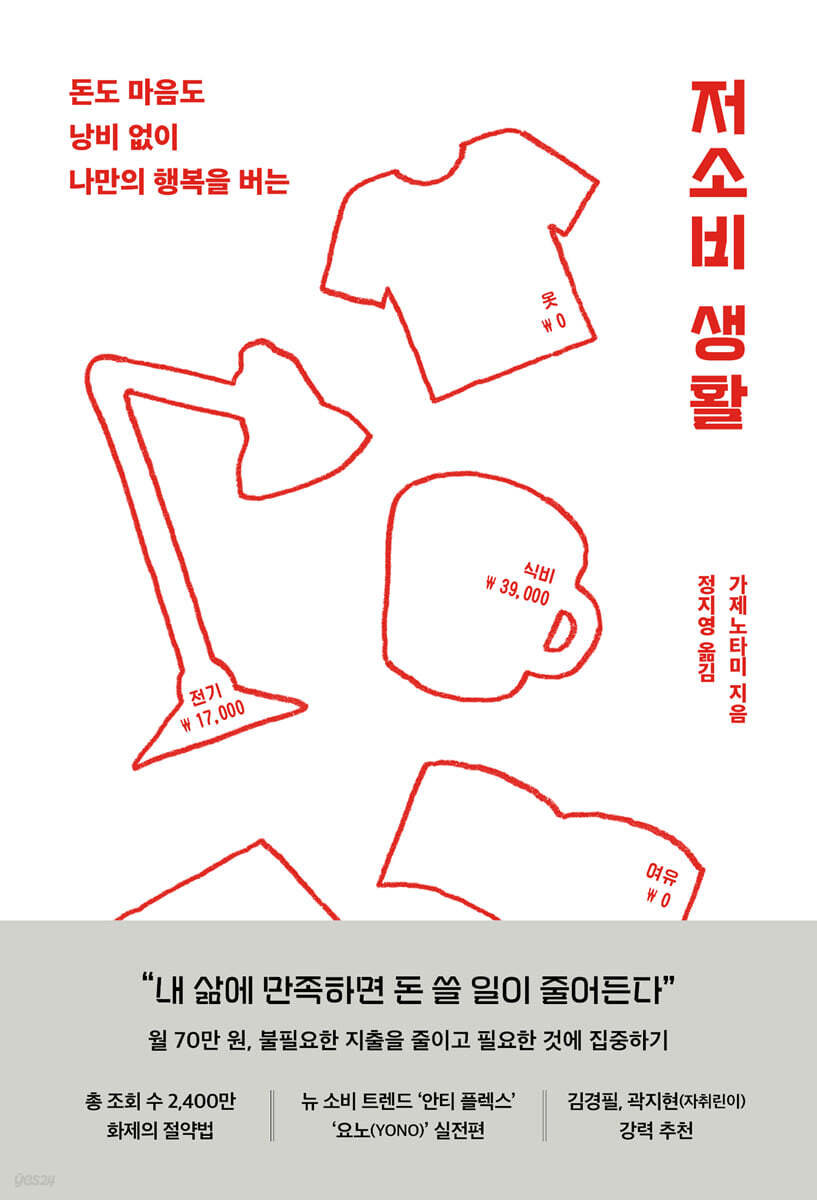
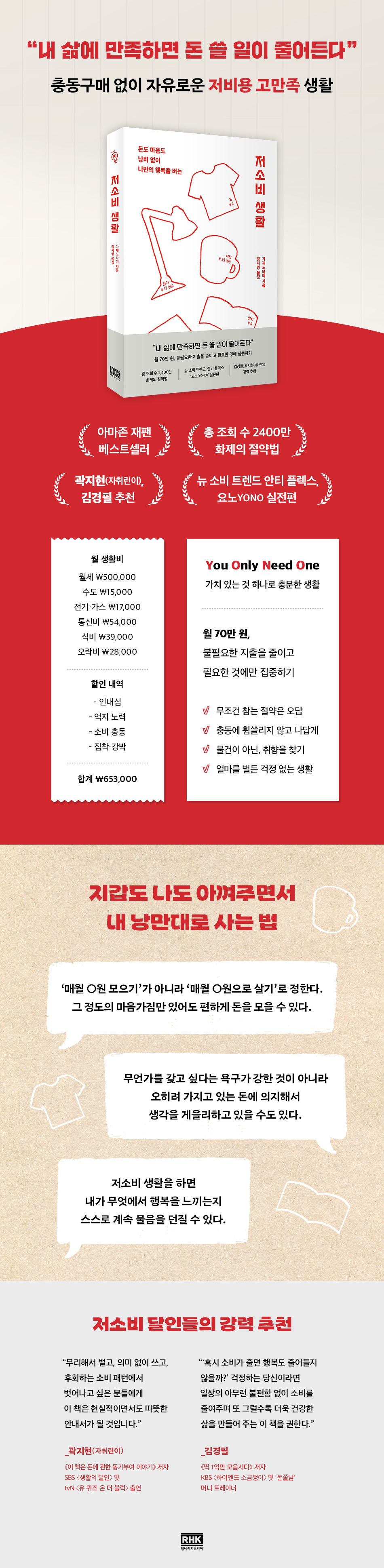
“If I’m satisfied with my life, I’ll spend less.”
700,000 won per month: Reduce unnecessary expenses and focus on what's necessary.
◆ 24 million total views, a trending saving method ◆ Amazon Japan bestseller
◆ New consumer trends: 'Anti-Flex' and 'Yono' in action ◆ Highly recommended by Kim Kyung-pil and Kwak Ji-hyun (Living Alone)
A 'low-consumption lifestyle' is suggested to everyone who needs to make a decision between a stagnant salary and a steady credit card bill.
What the author of "Low Consumption Life" gained from living on 700,000 won including rent for a month was not just 'money'.
Not only was I freed from financial anxiety, but I was also able to regain the small joys and tastes I had lost while spending money so easily.
Let go of the blind belief that spending money makes you happy.
A low-consumption lifestyle is also about protecting one's true self before being swept away by impulses driven by a compensatory psychology.
The key is not to live an extreme frugal life where you endure everything unconditionally, but to live a comfortable life where you are not consumed by the desire to consume.
《Low-Consumption Life》 became a hot topic for its different way of saving money from conventional wisdom and became a bestseller on Amazon Japan after its publication. Money trainer Kim Kyung-pil, a "money savvy man" from KBS's "High-End Salt Struggle," and writer Kwak Ji-hyun, a "savings expert" who appeared on SBS's "Master of Living" and tvN's "You Quiz on the Block," praised the book as "the epitome of saving money."
If you've ever been surprised by your credit card statement, if you want to save but don't know how, or if you find yourself spending money out of habit, let's all start living a low-consumption lifestyle that will give you peace of mind and wallet.
700,000 won per month: Reduce unnecessary expenses and focus on what's necessary.
◆ 24 million total views, a trending saving method ◆ Amazon Japan bestseller
◆ New consumer trends: 'Anti-Flex' and 'Yono' in action ◆ Highly recommended by Kim Kyung-pil and Kwak Ji-hyun (Living Alone)
A 'low-consumption lifestyle' is suggested to everyone who needs to make a decision between a stagnant salary and a steady credit card bill.
What the author of "Low Consumption Life" gained from living on 700,000 won including rent for a month was not just 'money'.
Not only was I freed from financial anxiety, but I was also able to regain the small joys and tastes I had lost while spending money so easily.
Let go of the blind belief that spending money makes you happy.
A low-consumption lifestyle is also about protecting one's true self before being swept away by impulses driven by a compensatory psychology.
The key is not to live an extreme frugal life where you endure everything unconditionally, but to live a comfortable life where you are not consumed by the desire to consume.
《Low-Consumption Life》 became a hot topic for its different way of saving money from conventional wisdom and became a bestseller on Amazon Japan after its publication. Money trainer Kim Kyung-pil, a "money savvy man" from KBS's "High-End Salt Struggle," and writer Kwak Ji-hyun, a "savings expert" who appeared on SBS's "Master of Living" and tvN's "You Quiz on the Block," praised the book as "the epitome of saving money."
If you've ever been surprised by your credit card statement, if you want to save but don't know how, or if you find yourself spending money out of habit, let's all start living a low-consumption lifestyle that will give you peace of mind and wallet.
- You can preview some of the book's contents.
Preview
index
Recommendation
preface
Chapter 0 What is low-cost living?
A life without forced effort
If you try hard, it will get better.
The anxiety that money will decrease just by breathing
be among the successful people
I am neither strong nor cool.
[Additional Story] Living a Life Looking at the Sun
Chapter 1: Organizing Money
I feel anxious because I don't know
The actual cost of living with low consumption
Living expenses come first, not savings.
My fixed and variable costs
My Spending Management Routine
Sparse at the beginning of the month, extravagant at the end
Tools to reduce consumption
I'm glad there's investment.
Think before you spend money
An environment where money is not needed
Exploring the combination of work, hobby, and daily life
Decide your own lifestyle combination
[Additional Story] Ask everything you're curious about
Chapter 2: Organizing Food, Clothing, and Shelter
Not reducing, but increasing
Practice not buying right away
Big changes are bad for the price
What I really want
The age of information overload
Always take a good look at what you use
necessities and luxuries
Criteria for choosing clothes
Establish your taste
Don't buy new
electric kettle and rice cooker
Buy only as much as you can eat and make it
Listen to your body
An environment where there is nothing to find
The space where the main dish is located
Presentation plates and fine plates
Cherish what makes you feel at ease
[Low-Consumption Counseling Center]
Q.
How many clothes do you have?
Q.
What should I do if I can't throw something away because I might need it someday?
Chapter 3: Organizing Your Thoughts and Habits
Gentle incoming pressure
Choose for yourself and decide for yourself
The illusion of belonging to an organization
Compliment yourself skillfully
How to boost your confidence
Check your smartphone and inner self regularly
Stubbornness should be treated with care
First of all, do what you like.
When things don't go well, stop.
Focus on my senses
Things you can see at a glance
Get used to quitting
self-consumption system
A life free from the constraints of money
Don't fix it, undo it
Don't rush and don't be impatient
If I were to compare my current life to a boat,
Looking back on happy times
Happiness and luck are different
[Low-Consumption Counseling Center]
Q.
Do you have your own way of relieving stress or way of thinking when you feel frustrated?
Chapter 4: A Mindset for Protecting Life
Go to a place with calm waters
All that's left is to wait
Practice stopping
Give up cleanly
Turn your eyes to what you already have
Practice letting go
[Low-Consumption Counseling Center]
Q.
What should I do when I don't feel like putting it into practice?
Conclusion: Thinking about happiness
preface
Chapter 0 What is low-cost living?
A life without forced effort
If you try hard, it will get better.
The anxiety that money will decrease just by breathing
be among the successful people
I am neither strong nor cool.
[Additional Story] Living a Life Looking at the Sun
Chapter 1: Organizing Money
I feel anxious because I don't know
The actual cost of living with low consumption
Living expenses come first, not savings.
My fixed and variable costs
My Spending Management Routine
Sparse at the beginning of the month, extravagant at the end
Tools to reduce consumption
I'm glad there's investment.
Think before you spend money
An environment where money is not needed
Exploring the combination of work, hobby, and daily life
Decide your own lifestyle combination
[Additional Story] Ask everything you're curious about
Chapter 2: Organizing Food, Clothing, and Shelter
Not reducing, but increasing
Practice not buying right away
Big changes are bad for the price
What I really want
The age of information overload
Always take a good look at what you use
necessities and luxuries
Criteria for choosing clothes
Establish your taste
Don't buy new
electric kettle and rice cooker
Buy only as much as you can eat and make it
Listen to your body
An environment where there is nothing to find
The space where the main dish is located
Presentation plates and fine plates
Cherish what makes you feel at ease
[Low-Consumption Counseling Center]
Q.
How many clothes do you have?
Q.
What should I do if I can't throw something away because I might need it someday?
Chapter 3: Organizing Your Thoughts and Habits
Gentle incoming pressure
Choose for yourself and decide for yourself
The illusion of belonging to an organization
Compliment yourself skillfully
How to boost your confidence
Check your smartphone and inner self regularly
Stubbornness should be treated with care
First of all, do what you like.
When things don't go well, stop.
Focus on my senses
Things you can see at a glance
Get used to quitting
self-consumption system
A life free from the constraints of money
Don't fix it, undo it
Don't rush and don't be impatient
If I were to compare my current life to a boat,
Looking back on happy times
Happiness and luck are different
[Low-Consumption Counseling Center]
Q.
Do you have your own way of relieving stress or way of thinking when you feel frustrated?
Chapter 4: A Mindset for Protecting Life
Go to a place with calm waters
All that's left is to wait
Practice stopping
Give up cleanly
Turn your eyes to what you already have
Practice letting go
[Low-Consumption Counseling Center]
Q.
What should I do when I don't feel like putting it into practice?
Conclusion: Thinking about happiness
Detailed image
Into the book
If you think about returning your life and consumption patterns to their proper place by carrying unnecessary items rather than holding back on things you want to do, your life will naturally become simpler and you will need less money than before.
In other words, the 'low-consumption lifestyle' is not simply about saving money, but rather the process of returning to one's true self.
--- p.9
If you overuse rewards, your pockets will soon be empty.
If you don't work so hard that you need compensation from the beginning, you won't incur excessive compensation costs.
--- p.26
If you are satisfied with your current appearance, you don't have to spend unnecessary money.
It's similar to when you're full and satisfied, you don't want to eat anything more.
I've learned from experience in the past that if you don't like yourself at all, you feel like you have to do more, that you have to try harder, and that you can't focus on what you have.
--- p.34~35
The way I ultimately arrived at this was to first determine my living expenses and then save everything else.
By switching to this 'living expenses preemption method', the savings rate has increased and living expenses waste has been significantly reduced.
Adopting a preemptive approach to living expenses freed me from the idea that I had to keep earning (indefinitely) to live a better life.
--- p.55
Depending on the other person or situation, think about whether it is 'a social expense that you want to spend yourself on' or 'a social expense that you don't really want to spend yourself on.'
In other words, it changes from a re-examination of social expenses to a re-examination of human relationships.
It may seem dry, but no matter how important social interaction is, there is only one person in the world, and time is limited, so it is impossible to respond to everything.
--- p.58
If you stop pursuing excessive ideals, stop determining your worth by the money you earn, and let go of the desire to live a life of luxury, you will find overall peace in your life.
Instead of ‘saving ○ won every month’, decide to ‘live on ○ won every month’.
If you have that level of mindset, you can save money easily.
--- p.66
I used to think that spending money here and there was freedom, but I realized that in reality, spending money as much as you need on what you need is freedom.
--- p.67
I realized that rather than constantly worrying about the exact amount every time I shop, I could reduce my waste by simply reducing the number of days I spend money.
In other words, you just need to increase the number of days you don't spend money.
For that, records are essential.
--- p.78
The first and most important step is to decide not to bring in new items right away, and the next step is to roll up your sleeves and say, “Let’s throw it away!”
Because you buy things right away, your money decreases, your belongings increase, and your pockets become empty as you rush to organize.
--- p.125
You might think that having less stuff at home would make you want to buy more things, but I think the opposite is true.
Because we have so many things at home, we have less resistance to accepting things, which leads us to gradually bring in things we don't need.
--- p.134
To avoid over-accumulating belongings and unnecessary shopping, it's essential to first understand the characteristics of the items you use on a regular basis.
Rather than worrying about what is the right choice, it's important to understand what features you need and to what extent, and what features you need to have to be satisfied.
--- p.136
What I lacked may not have been consumption, but rather the confidence to believe in myself.
My personality and tastes, as well as my essence, haven't changed much since then.
As a result, I came to truly realize that it is much more important to live in an environment that suits me rather than forcibly chasing after the world's ideals, and that it is better to quickly leave a place that does not suit me.
--- p.174
The reason I prefer a low-consumption lifestyle is because it allows me to constantly ask myself what makes me happy, even if it means experiencing some inconveniences or living a life of moderation in consumption.
I am convinced that happiness is much better when you spend money recklessly.
--- p.252
Happiness is constantly renewed.
Because there is no such thing as ‘complete with this’ in human life.
When it becomes difficult to feel happy, living a low-consumption life may help you regain the feeling of happiness.
In other words, the 'low-consumption lifestyle' is not simply about saving money, but rather the process of returning to one's true self.
--- p.9
If you overuse rewards, your pockets will soon be empty.
If you don't work so hard that you need compensation from the beginning, you won't incur excessive compensation costs.
--- p.26
If you are satisfied with your current appearance, you don't have to spend unnecessary money.
It's similar to when you're full and satisfied, you don't want to eat anything more.
I've learned from experience in the past that if you don't like yourself at all, you feel like you have to do more, that you have to try harder, and that you can't focus on what you have.
--- p.34~35
The way I ultimately arrived at this was to first determine my living expenses and then save everything else.
By switching to this 'living expenses preemption method', the savings rate has increased and living expenses waste has been significantly reduced.
Adopting a preemptive approach to living expenses freed me from the idea that I had to keep earning (indefinitely) to live a better life.
--- p.55
Depending on the other person or situation, think about whether it is 'a social expense that you want to spend yourself on' or 'a social expense that you don't really want to spend yourself on.'
In other words, it changes from a re-examination of social expenses to a re-examination of human relationships.
It may seem dry, but no matter how important social interaction is, there is only one person in the world, and time is limited, so it is impossible to respond to everything.
--- p.58
If you stop pursuing excessive ideals, stop determining your worth by the money you earn, and let go of the desire to live a life of luxury, you will find overall peace in your life.
Instead of ‘saving ○ won every month’, decide to ‘live on ○ won every month’.
If you have that level of mindset, you can save money easily.
--- p.66
I used to think that spending money here and there was freedom, but I realized that in reality, spending money as much as you need on what you need is freedom.
--- p.67
I realized that rather than constantly worrying about the exact amount every time I shop, I could reduce my waste by simply reducing the number of days I spend money.
In other words, you just need to increase the number of days you don't spend money.
For that, records are essential.
--- p.78
The first and most important step is to decide not to bring in new items right away, and the next step is to roll up your sleeves and say, “Let’s throw it away!”
Because you buy things right away, your money decreases, your belongings increase, and your pockets become empty as you rush to organize.
--- p.125
You might think that having less stuff at home would make you want to buy more things, but I think the opposite is true.
Because we have so many things at home, we have less resistance to accepting things, which leads us to gradually bring in things we don't need.
--- p.134
To avoid over-accumulating belongings and unnecessary shopping, it's essential to first understand the characteristics of the items you use on a regular basis.
Rather than worrying about what is the right choice, it's important to understand what features you need and to what extent, and what features you need to have to be satisfied.
--- p.136
What I lacked may not have been consumption, but rather the confidence to believe in myself.
My personality and tastes, as well as my essence, haven't changed much since then.
As a result, I came to truly realize that it is much more important to live in an environment that suits me rather than forcibly chasing after the world's ideals, and that it is better to quickly leave a place that does not suit me.
--- p.174
The reason I prefer a low-consumption lifestyle is because it allows me to constantly ask myself what makes me happy, even if it means experiencing some inconveniences or living a life of moderation in consumption.
I am convinced that happiness is much better when you spend money recklessly.
--- p.252
Happiness is constantly renewed.
Because there is no such thing as ‘complete with this’ in human life.
When it becomes difficult to feel happy, living a low-consumption life may help you regain the feeling of happiness.
--- p.254
Publisher's Review
A low-cost, high-satisfaction life without impulse buying
How to live my romantic life while saving both my wallet and myself
You Only Need One.
So-called 'Yono' consumption is becoming a hot topic.
The era of 'YOLO (You Only Live Once)' and 'flex', which were once trends, has passed, and the era of 'anti-flex', which pursues realistic consumption, has arrived.
There are also various keywords for saving that are attracting attention in the media, such as ‘revenge savings’ and ‘salty water consumption.’
Money management techniques for surviving in a high-inflation, low-growth society are of great interest across all generations.
The problem is that we know we need to save, but putting it into practice is difficult.
Saving money isn't easy for modern people, who constantly succumb to stress and reward psychology and fill their spare time with dopamine through consumption.
But what if there was a way to naturally reduce consumption without having to endure it unconditionally?
Kazenotami, author of "Low-Consumption Life" and a writer who lives on 700,000 won a month, including rent, suggests focusing on a comfortable life that is not consumed by consumerism, rather than extreme moderation.
Rather than thinking, "I'm lacking something," or "I need something," first try to like your life and check what you really want before spending money.
Effective methods to prevent overconsumption are introduced in the following sections: money (Chapter 1), food, clothing, and shelter (Chapter 2), thoughts and habits (Chapter 3), and mindset (Chapter 4).
For readers who don't want to be constrained by money, this book will be an attractive solution.
A life where the amount of stuff piled up at home is reduced and the bank balance increases.
Organizing “Money, Food, Clothing, and Shelter”
A low-consumption lifestyle is a little different from extreme frugality, such as frugality, or minimalism, which involves reducing possessions.
The author says that a low-consumption lifestyle is actually a process of returning to 'my true self'.
“While money is a convenient tool, it also makes us lazy, thinking, ‘Money will solve it,’ even when we can solve it through our own thinking or research.” (p. 88)
If I think carefully about what I really want and my unique tastes, I can live comfortably without necessarily needing money.
For example, if you want to “cut down on coffee,” think about it like this:
“I like cafes” → What do I like specifically?
* It's good to read while listening to music in the store.
→ You might be able to do it at home with music playing.
* I like going out and drinking coffee.
→ It might be nice to just take a tumbler of instant coffee and some snacks from home and spend some leisurely time at a nearby park.
If you discover your true desires in this way, you can discover a new standard for happiness.
In addition, it also teaches basic strategies, such as how to divide your bankbook, in the simplest way.
The author generously reveals all the methods he has discovered through trial and error, such as setting a target spending amount instead of saving in advance, using the "spend sparingly at the beginning of the month, spend lavishly at the end" strategy if you find it difficult to plan your spending every time, and breaking stereotypes about material possessions and living with less.
'If consumption decreases, won't happiness also decrease?'
As consumption decreases, perceived happiness increases.
“Rather than wanting to be happy, aren’t many people spending money to dispel the question, ‘Am I happy now?’?” (p. 253)
This will be a concern for many people.
I want to save money, but I also don't want to give up the happiness that comes from spending.
But the author turns this idea on its head.
According to him, “happiness is something that is constantly renewed.”
Because there is no ‘final completion’ in life.
Rather, if you practice a low-consumption lifestyle when you find it difficult to feel happy, you can revive your subtle sense of happiness.
The way to regain the happiness felt even in small things is definitely through a low-consumption lifestyle.
If consumption guaranteed happiness, we should already be very happy.
But unfortunately, we all know that this is not true.
If you become accustomed to the happiness you find through a low-consumption lifestyle, you can naturally let go of the habitual impulse to overspend when you feel dissatisfied with life, without having to endure it.
In that sense, low-consumption lifestyle is not only a way to save money, but also a philosophy for finding your own happiness.
How to live my romantic life while saving both my wallet and myself
You Only Need One.
So-called 'Yono' consumption is becoming a hot topic.
The era of 'YOLO (You Only Live Once)' and 'flex', which were once trends, has passed, and the era of 'anti-flex', which pursues realistic consumption, has arrived.
There are also various keywords for saving that are attracting attention in the media, such as ‘revenge savings’ and ‘salty water consumption.’
Money management techniques for surviving in a high-inflation, low-growth society are of great interest across all generations.
The problem is that we know we need to save, but putting it into practice is difficult.
Saving money isn't easy for modern people, who constantly succumb to stress and reward psychology and fill their spare time with dopamine through consumption.
But what if there was a way to naturally reduce consumption without having to endure it unconditionally?
Kazenotami, author of "Low-Consumption Life" and a writer who lives on 700,000 won a month, including rent, suggests focusing on a comfortable life that is not consumed by consumerism, rather than extreme moderation.
Rather than thinking, "I'm lacking something," or "I need something," first try to like your life and check what you really want before spending money.
Effective methods to prevent overconsumption are introduced in the following sections: money (Chapter 1), food, clothing, and shelter (Chapter 2), thoughts and habits (Chapter 3), and mindset (Chapter 4).
For readers who don't want to be constrained by money, this book will be an attractive solution.
A life where the amount of stuff piled up at home is reduced and the bank balance increases.
Organizing “Money, Food, Clothing, and Shelter”
A low-consumption lifestyle is a little different from extreme frugality, such as frugality, or minimalism, which involves reducing possessions.
The author says that a low-consumption lifestyle is actually a process of returning to 'my true self'.
“While money is a convenient tool, it also makes us lazy, thinking, ‘Money will solve it,’ even when we can solve it through our own thinking or research.” (p. 88)
If I think carefully about what I really want and my unique tastes, I can live comfortably without necessarily needing money.
For example, if you want to “cut down on coffee,” think about it like this:
“I like cafes” → What do I like specifically?
* It's good to read while listening to music in the store.
→ You might be able to do it at home with music playing.
* I like going out and drinking coffee.
→ It might be nice to just take a tumbler of instant coffee and some snacks from home and spend some leisurely time at a nearby park.
If you discover your true desires in this way, you can discover a new standard for happiness.
In addition, it also teaches basic strategies, such as how to divide your bankbook, in the simplest way.
The author generously reveals all the methods he has discovered through trial and error, such as setting a target spending amount instead of saving in advance, using the "spend sparingly at the beginning of the month, spend lavishly at the end" strategy if you find it difficult to plan your spending every time, and breaking stereotypes about material possessions and living with less.
'If consumption decreases, won't happiness also decrease?'
As consumption decreases, perceived happiness increases.
“Rather than wanting to be happy, aren’t many people spending money to dispel the question, ‘Am I happy now?’?” (p. 253)
This will be a concern for many people.
I want to save money, but I also don't want to give up the happiness that comes from spending.
But the author turns this idea on its head.
According to him, “happiness is something that is constantly renewed.”
Because there is no ‘final completion’ in life.
Rather, if you practice a low-consumption lifestyle when you find it difficult to feel happy, you can revive your subtle sense of happiness.
The way to regain the happiness felt even in small things is definitely through a low-consumption lifestyle.
If consumption guaranteed happiness, we should already be very happy.
But unfortunately, we all know that this is not true.
If you become accustomed to the happiness you find through a low-consumption lifestyle, you can naturally let go of the habitual impulse to overspend when you feel dissatisfied with life, without having to endure it.
In that sense, low-consumption lifestyle is not only a way to save money, but also a philosophy for finding your own happiness.
GOODS SPECIFICS
- Date of issue: September 17, 2025
- Page count, weight, size: 256 pages | 328g | 128*188*17mm
- ISBN13: 9788925573229
- ISBN10: 8925573229
You may also like
카테고리
korean


korean

![ELLE 엘르 스페셜 에디션 A형 : 12월 [2025]](http://librairie.coreenne.fr/cdn/shop/files/b8e27a3de6c9538896439686c6b0e8fb.jpg?v=1766436872&width=3840)


