

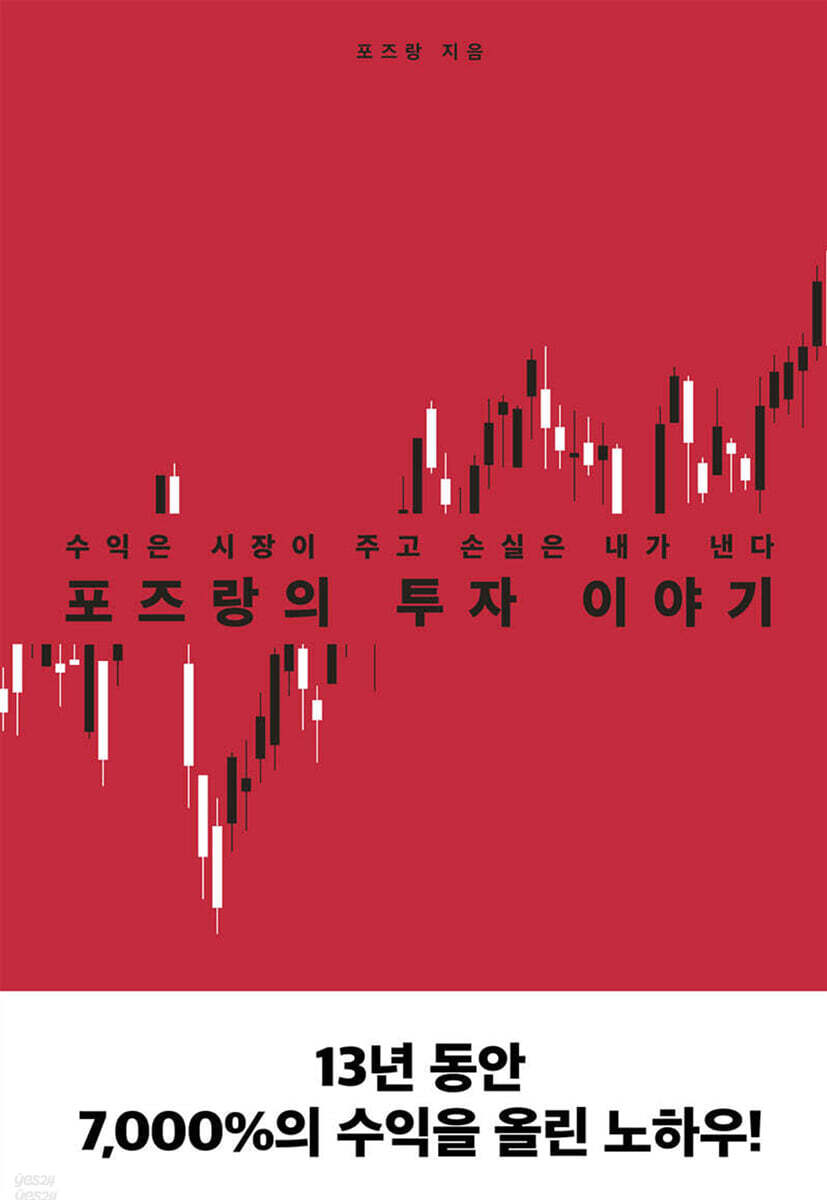
Posrang's Investment Story
 |
Description
Book Introduction
7,000% returns, the hidden investment know-how of a master!
A book that honestly captures the investment process over 13 years!
A book filled with the investment know-how of a hidden master who has achieved an astonishing 7,000% return over the past 13 years.
The author honestly shares his experiences as an investor and the process of developing himself and advising others.
In this book, titled 'Investment Story with Poserang', the author criticizes the fact that there are many people who think investing is too easy and rush into it only to lose money.
“You can lose money in stocks.
That's what investing is.
There are many cases where investment results are not good even after careful decision-making, even in non-stock cases, but in stocks in particular, there are too many cases where a large sum of money is invested and ‘absurdly’ blown without such careful decision-making or due to an unexpected causal relationship.” It is not an easy subject, but it reads like a novel.
It's so comfortable and warm that it feels like a close friend from the neighborhood who's good at stocks is nagging me about investing at a cafe.
A book that honestly captures the investment process over 13 years!
A book filled with the investment know-how of a hidden master who has achieved an astonishing 7,000% return over the past 13 years.
The author honestly shares his experiences as an investor and the process of developing himself and advising others.
In this book, titled 'Investment Story with Poserang', the author criticizes the fact that there are many people who think investing is too easy and rush into it only to lose money.
“You can lose money in stocks.
That's what investing is.
There are many cases where investment results are not good even after careful decision-making, even in non-stock cases, but in stocks in particular, there are too many cases where a large sum of money is invested and ‘absurdly’ blown without such careful decision-making or due to an unexpected causal relationship.” It is not an easy subject, but it reads like a novel.
It's so comfortable and warm that it feels like a close friend from the neighborhood who's good at stocks is nagging me about investing at a cafe.
- You can preview some of the book's contents.
Preview
index
Recommendation/ I hope this book will help you find your way through the maze-like market… …
Starting/ Invest aggressively, operate conservatively
Chapter 1: I Wanted to Make Money
I wanted to make money
Join the Value Investment Research Institute
Accepting the Limitations of Dividend Investing
Experience great success for the first time
Don't close your heart to growing industries.
The romance and investment capabilities of buy-and-hold
Open a full-time office and focus on investing
Begin quarterly performance screening
The Difficulties of Buy and Hold
Correct review, incorrect review
Chapter 2: Investing is inherently difficult.
be delisted
Lessons learned from delisting
Termination of PBR investment
Going through the coronavirus crisis
The basics of studying investment
Investing is inherently difficult
Would you rather ride on fire or on water?
Cases of operation and trading
Investing in 'holding' rather than 'holding'
Chapter 3: If You Teach Someone How to Invest
There are stages to investing.
Create an investment group
Presentation Format - Basics
Presentation Format - Financial Statements and Profit and Loss
Presentation Format - 'Basics, Financial Statements, Profit and Loss' Case Study
Presentation Format - Business Model
Presentation Format - Investment Ideas, Risks, and Conclusions
The meaning of investment meetings and presentation materials
Quarterly Performance Screening Process
It's not a shit company
Chapter 4: The market gives me the profits, and I bear the losses.
Good and Bad Luck in Investing
Recent thoughts on the stock market and attitudes toward stocks
If the stock price falls, can I buy more?
One day, I suddenly reached my target asset.
Change in attitude towards life
The market gives me the profits, and I take the losses.
Chapter 5: Q&A on Questions Investors Have
In conclusion/ If I keep doing this consistently, I hope that at some point I will become rich… …
Acknowledgements
Starting/ Invest aggressively, operate conservatively
Chapter 1: I Wanted to Make Money
I wanted to make money
Join the Value Investment Research Institute
Accepting the Limitations of Dividend Investing
Experience great success for the first time
Don't close your heart to growing industries.
The romance and investment capabilities of buy-and-hold
Open a full-time office and focus on investing
Begin quarterly performance screening
The Difficulties of Buy and Hold
Correct review, incorrect review
Chapter 2: Investing is inherently difficult.
be delisted
Lessons learned from delisting
Termination of PBR investment
Going through the coronavirus crisis
The basics of studying investment
Investing is inherently difficult
Would you rather ride on fire or on water?
Cases of operation and trading
Investing in 'holding' rather than 'holding'
Chapter 3: If You Teach Someone How to Invest
There are stages to investing.
Create an investment group
Presentation Format - Basics
Presentation Format - Financial Statements and Profit and Loss
Presentation Format - 'Basics, Financial Statements, Profit and Loss' Case Study
Presentation Format - Business Model
Presentation Format - Investment Ideas, Risks, and Conclusions
The meaning of investment meetings and presentation materials
Quarterly Performance Screening Process
It's not a shit company
Chapter 4: The market gives me the profits, and I bear the losses.
Good and Bad Luck in Investing
Recent thoughts on the stock market and attitudes toward stocks
If the stock price falls, can I buy more?
One day, I suddenly reached my target asset.
Change in attitude towards life
The market gives me the profits, and I take the losses.
Chapter 5: Q&A on Questions Investors Have
In conclusion/ If I keep doing this consistently, I hope that at some point I will become rich… …
Acknowledgements
Into the book
Investing seems similar to the game of tag we played as children.
It is about protecting one's own land and expanding it little by little.
Expanding your territory while endangering your base is pure foolishness.
Money is like oxygen; when you have it in moderation, you don't realize how precious it is, but when you don't have it, there's nothing more miserable than that.
So, you need to clearly understand the direction and purpose of your investment from the beginning.
There should never be an option that could make my life miserable, and the goal of investing should not be to get rich quickly, but to die rich.
--- From "Starting"
Most investors dream of increasing their assets overnight by using large amounts of leverage, but that is difficult to achieve, and even if things go well and their assets increase, it will only increase their assets.
The investment ability that should have grown together does not grow together, and only one bad investment experience remains, and in many cases, the person wants to repeat that experience and collapses in an instant.
Fundamentally, investing is a journey that takes several decades.
--- From "The Romance of Buy and Hold and Investment Ability"
Many people will look at the past charts that have doubled, tripled, and quadrupled and think, “If I bought it then and held on to it until now, my life would change….”
But that doesn't just happen.
The more stocks you buy that change your life, the worse it becomes.
Because I'm dying to sell it.
And do you know what I'm most afraid of when I'm just holding on? It's when I hold on to a stock with firm faith, holding on to it even after it's gone up over 100%, only to find it's back down to the same level.
It's much more painful than being bitten.
The bigger the amount, the better.
--- From "The Difficulty of Buy and Hold"
Because successful experiences are so important in investing, it is imperative to accumulate them.
Even if you fail repeatedly, you must continue until you experience success.
However, failure must not be fatal so that it can continue until the experience of success is achieved.
Also, even if it is not fatal, if failure is too frequent, you cannot reach the experience of success.
To avoid frequent failures, you need to find the cause of failure and eliminate it. What makes this possible is proper review.
--- From "Correct Reconstruction, Incorrect Reconstruction"
The important thing is that investors themselves should not suffer great losses, no matter how the market flows.
Yes, opportunities are good and being rich is good, but the first thing that comes to mind is not to fail.
Whether you're focusing on or diversifying your investments, investing overseas or domestically, investing in coins or real estate, I think the lesson from the COVID-19 pandemic is that no matter what you're investing in, you should always consider whether you're in a position where you can avoid ruin.
--- From "Experiencing the Coronavirus"
Studying investment is difficult and challenging.
There is no easy way to make money, not in investing, but anywhere in this world.
If it looks easy, it's almost always a scam, and I think that people who say investing is easy in the stock market are either beginners who don't know anything or are scammers.
Investing is never easy.
There are simply 'periods that seem easy for a while' during periods of stock market boom.
--- From "The Meaning of Investment Meetings and Presentation Materials"
Investing seems to be a cumulative outcome of a mixture of good and bad luck.
It is undeniable that luck plays a significant role in investing, and I believe that when people who have been successful in investing for a long time say, “I was lucky,” they are being sincere, not humble.
When I look back, I just think, 'I was lucky.'
In that sense, I often say, "Profits are what the market gives, and losses are what I pay for." This is because I believe that while market sentiment and luck play a large role in profits, luck plays a slightly smaller role in losses.
--- From "Luck and Bad Luck in Investing"
The premise of investment is the performance of the company behind the stock price.
As transactions are made by countless unspecified people and even AI, stock prices overshoot, then plummet, and then crash, but what is clear is that stock prices are like a shadow of the company.
Although there is a time gap, if a company grows well, its stock price will eventually rise, and if it fails to grow, its stock price is likely to fall.
So, we need to focus on finding companies that will grow so that our standards don't waver.
--- From "Recent Thoughts on the Stock Market and Attitudes toward Stocks"
Stocks are the only thing that makes it seem like other people's successes are easily achieved.
Luck and market sentiment have a big influence, and anyone can buy and sell.
But I believe that in investing, you need to focus and work as hard as, or even more than, achieving professional success in other fields, whether it's studying, sports, Go, or gaming.
You absolutely cannot do it with the vague mindset that it will work out if you do it this way.
--- From "Q&A on Things Investors Are Curious About"
To sum up,
─Not repeating the same mistakes through thorough and clear review.
─It is inevitable to blame yourself and regret when the results are not good, but at some point,
The power to cut off emotions and start again.
─Strengthening self-confidence through experiences of success.
─Right direction, consistency, luck.
I hope that by continuing these things for a long time, I will develop into a successful investor.
It is about protecting one's own land and expanding it little by little.
Expanding your territory while endangering your base is pure foolishness.
Money is like oxygen; when you have it in moderation, you don't realize how precious it is, but when you don't have it, there's nothing more miserable than that.
So, you need to clearly understand the direction and purpose of your investment from the beginning.
There should never be an option that could make my life miserable, and the goal of investing should not be to get rich quickly, but to die rich.
--- From "Starting"
Most investors dream of increasing their assets overnight by using large amounts of leverage, but that is difficult to achieve, and even if things go well and their assets increase, it will only increase their assets.
The investment ability that should have grown together does not grow together, and only one bad investment experience remains, and in many cases, the person wants to repeat that experience and collapses in an instant.
Fundamentally, investing is a journey that takes several decades.
--- From "The Romance of Buy and Hold and Investment Ability"
Many people will look at the past charts that have doubled, tripled, and quadrupled and think, “If I bought it then and held on to it until now, my life would change….”
But that doesn't just happen.
The more stocks you buy that change your life, the worse it becomes.
Because I'm dying to sell it.
And do you know what I'm most afraid of when I'm just holding on? It's when I hold on to a stock with firm faith, holding on to it even after it's gone up over 100%, only to find it's back down to the same level.
It's much more painful than being bitten.
The bigger the amount, the better.
--- From "The Difficulty of Buy and Hold"
Because successful experiences are so important in investing, it is imperative to accumulate them.
Even if you fail repeatedly, you must continue until you experience success.
However, failure must not be fatal so that it can continue until the experience of success is achieved.
Also, even if it is not fatal, if failure is too frequent, you cannot reach the experience of success.
To avoid frequent failures, you need to find the cause of failure and eliminate it. What makes this possible is proper review.
--- From "Correct Reconstruction, Incorrect Reconstruction"
The important thing is that investors themselves should not suffer great losses, no matter how the market flows.
Yes, opportunities are good and being rich is good, but the first thing that comes to mind is not to fail.
Whether you're focusing on or diversifying your investments, investing overseas or domestically, investing in coins or real estate, I think the lesson from the COVID-19 pandemic is that no matter what you're investing in, you should always consider whether you're in a position where you can avoid ruin.
--- From "Experiencing the Coronavirus"
Studying investment is difficult and challenging.
There is no easy way to make money, not in investing, but anywhere in this world.
If it looks easy, it's almost always a scam, and I think that people who say investing is easy in the stock market are either beginners who don't know anything or are scammers.
Investing is never easy.
There are simply 'periods that seem easy for a while' during periods of stock market boom.
--- From "The Meaning of Investment Meetings and Presentation Materials"
Investing seems to be a cumulative outcome of a mixture of good and bad luck.
It is undeniable that luck plays a significant role in investing, and I believe that when people who have been successful in investing for a long time say, “I was lucky,” they are being sincere, not humble.
When I look back, I just think, 'I was lucky.'
In that sense, I often say, "Profits are what the market gives, and losses are what I pay for." This is because I believe that while market sentiment and luck play a large role in profits, luck plays a slightly smaller role in losses.
--- From "Luck and Bad Luck in Investing"
The premise of investment is the performance of the company behind the stock price.
As transactions are made by countless unspecified people and even AI, stock prices overshoot, then plummet, and then crash, but what is clear is that stock prices are like a shadow of the company.
Although there is a time gap, if a company grows well, its stock price will eventually rise, and if it fails to grow, its stock price is likely to fall.
So, we need to focus on finding companies that will grow so that our standards don't waver.
--- From "Recent Thoughts on the Stock Market and Attitudes toward Stocks"
Stocks are the only thing that makes it seem like other people's successes are easily achieved.
Luck and market sentiment have a big influence, and anyone can buy and sell.
But I believe that in investing, you need to focus and work as hard as, or even more than, achieving professional success in other fields, whether it's studying, sports, Go, or gaming.
You absolutely cannot do it with the vague mindset that it will work out if you do it this way.
--- From "Q&A on Things Investors Are Curious About"
To sum up,
─Not repeating the same mistakes through thorough and clear review.
─It is inevitable to blame yourself and regret when the results are not good, but at some point,
The power to cut off emotions and start again.
─Strengthening self-confidence through experiences of success.
─Right direction, consistency, luck.
I hope that by continuing these things for a long time, I will develop into a successful investor.
--- From "In Closing"
Publisher's Review
This is the first thing that people who are new to investing should read!
In this book, the author argues that stock investment is not about getting rich quickly.
“The direction of my full-time investment was not to become rich through stock investment and live a luxurious life, but to absolutely not ruin my family’s life.
“The premise was, ‘I would rather miss the opportunity to become very rich than take the risk of ruining my family’s life.’” If there is anyone around me who is new to investing, this is the book I would recommend first.
Know-how that can be applied immediately and practically in the Korean stock market!
The author emphasizes that the most important thing in studying investment is to continuously develop the investment ability to find good investment opportunities, and provides detailed guidance on investment know-how, such as the process of obtaining investment ideas through performance screening and corporate analysis methods.
The author and the investors around him are all making profits, whether large or small, and accumulating results over the long term.
Even though they are not people with investment qualifications or expertise, but rather ordinary office workers you see around you and who dedicate their time to studying investment.
What makes this difference?
It contains what kind of investment studies they do.
The right direction and consistency are the keys to successful investing!
The author emphasizes that the keys to successful investment are the 'right direction', 'consistency', and 'luck'.
Even if you have consistency and luck, it's useless if you're not headed in the right direction. Even if you have the right direction and luck, if you're not consistent, you won't achieve anything. Even if you have the right direction and consistency, if luck isn't on your side, there's no way.
This book, written by an author who had lived a life "unrelated to investment," describes the trial and error he experienced after jumping into investing late in life. It will be of great help to anyone struggling to survive in the stock market.
It's like a book that you keep on a corner of your bookshelf and occasionally open when you feel overwhelmed or lost while investing.
In this book, the author argues that stock investment is not about getting rich quickly.
“The direction of my full-time investment was not to become rich through stock investment and live a luxurious life, but to absolutely not ruin my family’s life.
“The premise was, ‘I would rather miss the opportunity to become very rich than take the risk of ruining my family’s life.’” If there is anyone around me who is new to investing, this is the book I would recommend first.
Know-how that can be applied immediately and practically in the Korean stock market!
The author emphasizes that the most important thing in studying investment is to continuously develop the investment ability to find good investment opportunities, and provides detailed guidance on investment know-how, such as the process of obtaining investment ideas through performance screening and corporate analysis methods.
The author and the investors around him are all making profits, whether large or small, and accumulating results over the long term.
Even though they are not people with investment qualifications or expertise, but rather ordinary office workers you see around you and who dedicate their time to studying investment.
What makes this difference?
It contains what kind of investment studies they do.
The right direction and consistency are the keys to successful investing!
The author emphasizes that the keys to successful investment are the 'right direction', 'consistency', and 'luck'.
Even if you have consistency and luck, it's useless if you're not headed in the right direction. Even if you have the right direction and luck, if you're not consistent, you won't achieve anything. Even if you have the right direction and consistency, if luck isn't on your side, there's no way.
This book, written by an author who had lived a life "unrelated to investment," describes the trial and error he experienced after jumping into investing late in life. It will be of great help to anyone struggling to survive in the stock market.
It's like a book that you keep on a corner of your bookshelf and occasionally open when you feel overwhelmed or lost while investing.
GOODS SPECIFICS
- Date of issue: October 20, 2025
- Page count, weight, size: 344 pages | 572g | 153*224*22mm
- ISBN13: 9788967442996
- ISBN10: 8967442998
You may also like
카테고리
korean


korean

![ELLE 엘르 스페셜 에디션 A형 : 12월 [2025]](http://librairie.coreenne.fr/cdn/shop/files/b8e27a3de6c9538896439686c6b0e8fb.jpg?v=1766436872&width=3840)


