

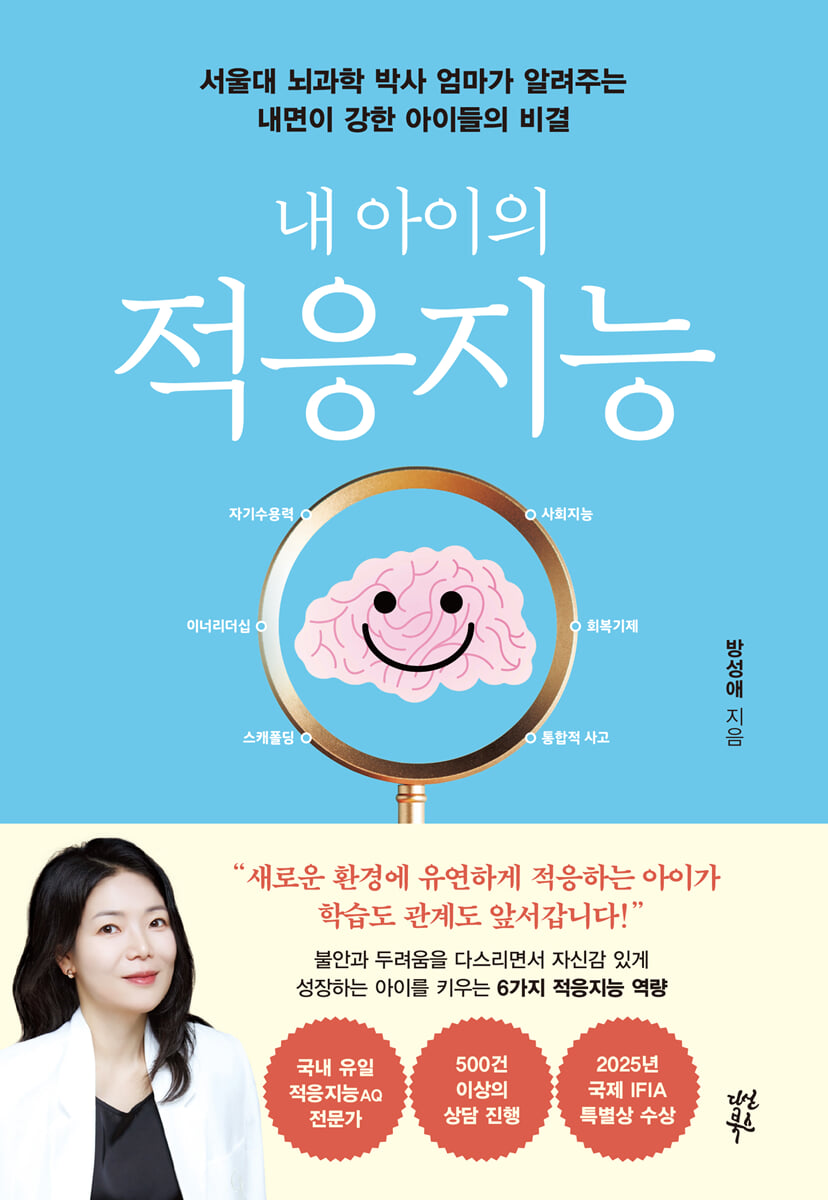
My child's adaptive intelligence
 |
Description
Book Introduction
The first book by Korea's only adaptive intelligence (AQ) expert.
Over 500 counseling sessions to improve learning capacity for children and adolescents
2025 International Federation of Inventors Associations (IFIA) Special Award
“A child who adapts flexibly to new environments
“Learning and relationships are far ahead!”
A mother who raised a daughter with mutism and a doctorate in brain science at Seoul National University shares her thoughts.
Six Adaptive Intelligence Competencies of Children with Inner Strength
Children living in a future that is constantly changing, with educational systems changing every year and job environments changing with the emergence of AI, are bound to easily fall into confusion and anxiety.
In such an unpredictable and uncontrollable environment, what skill do our children absolutely need? It's adaptive intelligence (AQ), the ability to effectively adapt to the environment and flexibly address new challenges.
And this book, "My Child's Adaptive Intelligence," is the first book in Korea to introduce the six core competencies of "adaptive intelligence," written by Bang Seong-ae, a Seoul National University neuroscience doctor who has consulted on over 500 cases of improving the learning abilities of children and adolescents.
Here, CEO Bang Seong-ae generously includes the 'Adaptive Intelligence Activity Sheet for Mothers and Children' and 'My Child's Mental Health Checklist' that she uses in actual counseling sessions, as well as 'Examples of Adaptive Intelligence Conversation Methods' that can be used starting today, providing a friendly guide for parents who are feeling overwhelmed and having a hard time raising children.
Although she has a doctorate in neuroscience, Bang Seong-ae is actually a mother who raised a daughter who suffered from selective mutism and childhood anxiety.
In this book, the author candidly shares the difficulties he faced while raising his child, and offers warm and heartfelt comfort to parents struggling with their children's maladjustment issues.
If your child seems to be lagging behind, if your child seems anxious, if your child seems sensitive, check out this book, "My Child's Adaptive Intelligence."
You will be able to identify the true cause of anxiety hidden behind your child's behavior, 'adaptation,' and learn how to cultivate the inner strength of your child to confidently face the world without fear.
Over 500 counseling sessions to improve learning capacity for children and adolescents
2025 International Federation of Inventors Associations (IFIA) Special Award
“A child who adapts flexibly to new environments
“Learning and relationships are far ahead!”
A mother who raised a daughter with mutism and a doctorate in brain science at Seoul National University shares her thoughts.
Six Adaptive Intelligence Competencies of Children with Inner Strength
Children living in a future that is constantly changing, with educational systems changing every year and job environments changing with the emergence of AI, are bound to easily fall into confusion and anxiety.
In such an unpredictable and uncontrollable environment, what skill do our children absolutely need? It's adaptive intelligence (AQ), the ability to effectively adapt to the environment and flexibly address new challenges.
And this book, "My Child's Adaptive Intelligence," is the first book in Korea to introduce the six core competencies of "adaptive intelligence," written by Bang Seong-ae, a Seoul National University neuroscience doctor who has consulted on over 500 cases of improving the learning abilities of children and adolescents.
Here, CEO Bang Seong-ae generously includes the 'Adaptive Intelligence Activity Sheet for Mothers and Children' and 'My Child's Mental Health Checklist' that she uses in actual counseling sessions, as well as 'Examples of Adaptive Intelligence Conversation Methods' that can be used starting today, providing a friendly guide for parents who are feeling overwhelmed and having a hard time raising children.
Although she has a doctorate in neuroscience, Bang Seong-ae is actually a mother who raised a daughter who suffered from selective mutism and childhood anxiety.
In this book, the author candidly shares the difficulties he faced while raising his child, and offers warm and heartfelt comfort to parents struggling with their children's maladjustment issues.
If your child seems to be lagging behind, if your child seems anxious, if your child seems sensitive, check out this book, "My Child's Adaptive Intelligence."
You will be able to identify the true cause of anxiety hidden behind your child's behavior, 'adaptation,' and learn how to cultivate the inner strength of your child to confidently face the world without fear.
- You can preview some of the book's contents.
Preview
index
Prologue│Time may stop for a child, but a mother cannot.
PART 1
Adaptive Intelligence: The Mental Strength Our Children Need Now
01 Children who are afraid of the world outside
“Mom, my child doesn’t talk to his friends.”
There is no parenting book as perfect as the child himself.
Why You Should Acknowledge Your Child's Anxiety
For a child who stands alone in front of the world
02 The power to believe in yourself and move forward into a new world
What if our child is a little different and adaptation is a problem?
In the new world, adaptive intelligence (AQ) takes precedence over IQ and EQ.
Six Competencies That Connect the World, Us, and Me
Adaptive intelligence is essential at each stage of a child's development.
Why Adaptive Intelligence is Essential for Children Surviving in the AI Era
PART 2
Me: A child who lives true to himself with a strong inner self
03 [Self-acceptance] The ability to healthily accept oneself as is
The ugly four-year-old and the even more ugly seven-year-old, the age when you can stand up for yourself
A child's self-acceptance is more important than self-esteem.
Self-acceptance grows amidst parental expectations and encouragement.
Appendix│Self-Acceptance Activity Sheet for Parents and Children
04 [Inner Leadership] The ability to become a leader and lead yourself
The real reason why you are listless and have no motivation or will
Inner Leadership 1: Initiative: The power to plan and execute on one's own.
Inner Leadership 2: Persistence: The power to not give up easily and try again.
Inner Leadership 3: The Power to Shake Off Big and Small Setbacks and Get Back on Track
Appendix│The 8-Step Formula for Building Strong Inner Leadership
PART 3
Us: A child who lives harmoniously in relationships
05 [Scaffolding] Assistance in providing stability to the child's mind through unwavering faith
Moments when discipline is needed vs.
A moment when comfort is needed
Every parent's first role is to be a safe haven for their child.
Children who grow up eating faith become more self-reliant.
Parents Don't Know Their Child's "Area of Reach"
Appendix│Understanding Your Child's Zone of Proximal Development and the Scaffolding Parents Need to Provide
06 [Social Intelligence] The ability to not be easily hurt in any relationship
If you are forcing fake sociality
A child who understands others and expresses his or her own thoughts
A child who learns respect well does well.
"Crossing this line is trespassing!" Setting standards for children in relationships
Are my child's online friends really okay?
Appendix│Social Intelligence Conversation Techniques to Deepen Various Relationships
PART 4
The World: A Child Who Dreams of the Future Without Fear
07 [Recovery Mechanism] The Ability to View Failure Positively
Hurt is inevitable, but healing is optional.
Automated Process for Caring for Children's Minds B RAVO
Recovery Mechanism Step 1: B Breathe Calmly and Check Your Child's State of Mind
Recovery Mechanism Step 2: R Together: Seeing it as our problem, not the child's.
Recovery Mechanism Step 3: A. Facing the problem: Accepting the problem and taking time for recovery.
Step 4 of the Recovery Mechanism: Finding Worthwhile Goals: Children Examine Their Inner Values
Step 5 of the Recovery Mechanism: O. Building Overcoming Experiences: Overcoming Wounds with 'Small Successes'
Appendix│BRAVO Exercise for Parents and Children to Breathe Together
08 [Integrated Thinking] The ability to enjoy change rather than fear it
Why are our children afraid of even small changes?
The best question a parent can ask is, “Why do you think that?”
Children prepare for the future through failure.
If you want to raise a child who looks forward to tomorrow
Appendix│Finding "Smart Solutions" to Develop Integrative Thinking
PART 5
Parents also need adaptive intelligence.
The fantasy of wanting to be the perfect parent
Parents must grow as their children grow.
Because the present is not everything in a child's life.
“If you loved me today, that’s enough.”
PART 1
Adaptive Intelligence: The Mental Strength Our Children Need Now
01 Children who are afraid of the world outside
“Mom, my child doesn’t talk to his friends.”
There is no parenting book as perfect as the child himself.
Why You Should Acknowledge Your Child's Anxiety
For a child who stands alone in front of the world
02 The power to believe in yourself and move forward into a new world
What if our child is a little different and adaptation is a problem?
In the new world, adaptive intelligence (AQ) takes precedence over IQ and EQ.
Six Competencies That Connect the World, Us, and Me
Adaptive intelligence is essential at each stage of a child's development.
Why Adaptive Intelligence is Essential for Children Surviving in the AI Era
PART 2
Me: A child who lives true to himself with a strong inner self
03 [Self-acceptance] The ability to healthily accept oneself as is
The ugly four-year-old and the even more ugly seven-year-old, the age when you can stand up for yourself
A child's self-acceptance is more important than self-esteem.
Self-acceptance grows amidst parental expectations and encouragement.
Appendix│Self-Acceptance Activity Sheet for Parents and Children
04 [Inner Leadership] The ability to become a leader and lead yourself
The real reason why you are listless and have no motivation or will
Inner Leadership 1: Initiative: The power to plan and execute on one's own.
Inner Leadership 2: Persistence: The power to not give up easily and try again.
Inner Leadership 3: The Power to Shake Off Big and Small Setbacks and Get Back on Track
Appendix│The 8-Step Formula for Building Strong Inner Leadership
PART 3
Us: A child who lives harmoniously in relationships
05 [Scaffolding] Assistance in providing stability to the child's mind through unwavering faith
Moments when discipline is needed vs.
A moment when comfort is needed
Every parent's first role is to be a safe haven for their child.
Children who grow up eating faith become more self-reliant.
Parents Don't Know Their Child's "Area of Reach"
Appendix│Understanding Your Child's Zone of Proximal Development and the Scaffolding Parents Need to Provide
06 [Social Intelligence] The ability to not be easily hurt in any relationship
If you are forcing fake sociality
A child who understands others and expresses his or her own thoughts
A child who learns respect well does well.
"Crossing this line is trespassing!" Setting standards for children in relationships
Are my child's online friends really okay?
Appendix│Social Intelligence Conversation Techniques to Deepen Various Relationships
PART 4
The World: A Child Who Dreams of the Future Without Fear
07 [Recovery Mechanism] The Ability to View Failure Positively
Hurt is inevitable, but healing is optional.
Automated Process for Caring for Children's Minds B RAVO
Recovery Mechanism Step 1: B Breathe Calmly and Check Your Child's State of Mind
Recovery Mechanism Step 2: R Together: Seeing it as our problem, not the child's.
Recovery Mechanism Step 3: A. Facing the problem: Accepting the problem and taking time for recovery.
Step 4 of the Recovery Mechanism: Finding Worthwhile Goals: Children Examine Their Inner Values
Step 5 of the Recovery Mechanism: O. Building Overcoming Experiences: Overcoming Wounds with 'Small Successes'
Appendix│BRAVO Exercise for Parents and Children to Breathe Together
08 [Integrated Thinking] The ability to enjoy change rather than fear it
Why are our children afraid of even small changes?
The best question a parent can ask is, “Why do you think that?”
Children prepare for the future through failure.
If you want to raise a child who looks forward to tomorrow
Appendix│Finding "Smart Solutions" to Develop Integrative Thinking
PART 5
Parents also need adaptive intelligence.
The fantasy of wanting to be the perfect parent
Parents must grow as their children grow.
Because the present is not everything in a child's life.
“If you loved me today, that’s enough.”
Detailed image
.jpg)
Into the book
'Why doesn't this method, which is unanimously recommended in many parenting books, work for my child?' (Omitted) Rather, looking into the child's true nature should be given priority.
Because just observing your child and seeing the situation from their perspective can solve a lot of problems.
The answers to problems such as what makes our child uncomfortable, what situations are particularly difficult for him, and conversely, what situations and elements make him feel secure are already within him.
Parents must read and understand their children's feelings as carefully as if they were reading a parenting book by an expert.
Because there is no parenting book as perfect as the child himself.
---「PART 1.
Adaptive Intelligence: The Mental Strength Our Children Need Now, pp. 28-29
Focusing solely on education or empathy will inevitably lead to problems.
If you focus too much on education, you may end up suppressing your child's emotions without realizing that their minds change as they grow. If you focus only on empathy, your child may prioritize their own emotions, which can cause problems in their relationships with friends.
Ultimately, education and empathy must be achieved in harmony.
However, parents have a difficult time answering the question, “Should we first teach our children about not being able to say hello, or should we first listen to their discomfort?”
You can't ask this question in every situation.
The answer to this difficult question depends on the role of the parents.
---「PART 3.
From "We: Children Living Harmoniously in Relationships" p.131
We generally think of 'intelligence' as something we are born with, but in fact, social intelligence is an acquired ability that we acquire through training.
Many parents believe that their children's social intelligence will develop naturally as they attend daycare, kindergarten, and school, but this is not the case.
There are children like Kitae who have difficulty expressing themselves or forming relationships even though they go to the same daycare and take the same classes.
To improve the social intelligence of these children, it is necessary to provide repetitive training rather than simply solving immediate problems.
---「PART 3.
From "We: Children Living Harmoniously in Relationships" p.162
Children who are anxious about change tend to value stability and predictability.
They are sensitive to even small changes in their daily lives, and it takes them a long time to adjust when things don't go as planned.
So, you develop a strong desire for control over your environment or rules.
For example, if a parent or teacher changes their schedule or a friend suddenly cancels an appointment, they can be very upset and easily feel disappointed.
For these children, it is important to move in a certain pattern, and if that flow is interrupted, they become more anxious.
Because of this, it is not easy to go through experiences during childhood and adolescence when you have to try many things.
But if we just shift our perspective a little, we can teach these kids that change isn't something to be afraid of, but rather an opportunity for growth.
---「PART 4.
From "The World: A Child Who Dreams of the Future Without Fear," pp. 225-226
There are no “perfect parents” in any family.
Even parents who seem great on the outside have probably gone through countless trials and errors before becoming proficient at parenting.
Also, it is not the perfect parents who contribute to the child's adaptive intelligence.
Rather, parents who acknowledge their shortcomings and do their best within them become better role models for their children.
It's not just for parents to check in on themselves and find balance.
So, show your child how to accept themselves rather than hate them, and how to recover from mistakes rather than blame them.
Because just observing your child and seeing the situation from their perspective can solve a lot of problems.
The answers to problems such as what makes our child uncomfortable, what situations are particularly difficult for him, and conversely, what situations and elements make him feel secure are already within him.
Parents must read and understand their children's feelings as carefully as if they were reading a parenting book by an expert.
Because there is no parenting book as perfect as the child himself.
---「PART 1.
Adaptive Intelligence: The Mental Strength Our Children Need Now, pp. 28-29
Focusing solely on education or empathy will inevitably lead to problems.
If you focus too much on education, you may end up suppressing your child's emotions without realizing that their minds change as they grow. If you focus only on empathy, your child may prioritize their own emotions, which can cause problems in their relationships with friends.
Ultimately, education and empathy must be achieved in harmony.
However, parents have a difficult time answering the question, “Should we first teach our children about not being able to say hello, or should we first listen to their discomfort?”
You can't ask this question in every situation.
The answer to this difficult question depends on the role of the parents.
---「PART 3.
From "We: Children Living Harmoniously in Relationships" p.131
We generally think of 'intelligence' as something we are born with, but in fact, social intelligence is an acquired ability that we acquire through training.
Many parents believe that their children's social intelligence will develop naturally as they attend daycare, kindergarten, and school, but this is not the case.
There are children like Kitae who have difficulty expressing themselves or forming relationships even though they go to the same daycare and take the same classes.
To improve the social intelligence of these children, it is necessary to provide repetitive training rather than simply solving immediate problems.
---「PART 3.
From "We: Children Living Harmoniously in Relationships" p.162
Children who are anxious about change tend to value stability and predictability.
They are sensitive to even small changes in their daily lives, and it takes them a long time to adjust when things don't go as planned.
So, you develop a strong desire for control over your environment or rules.
For example, if a parent or teacher changes their schedule or a friend suddenly cancels an appointment, they can be very upset and easily feel disappointed.
For these children, it is important to move in a certain pattern, and if that flow is interrupted, they become more anxious.
Because of this, it is not easy to go through experiences during childhood and adolescence when you have to try many things.
But if we just shift our perspective a little, we can teach these kids that change isn't something to be afraid of, but rather an opportunity for growth.
---「PART 4.
From "The World: A Child Who Dreams of the Future Without Fear," pp. 225-226
There are no “perfect parents” in any family.
Even parents who seem great on the outside have probably gone through countless trials and errors before becoming proficient at parenting.
Also, it is not the perfect parents who contribute to the child's adaptive intelligence.
Rather, parents who acknowledge their shortcomings and do their best within them become better role models for their children.
It's not just for parents to check in on themselves and find balance.
So, show your child how to accept themselves rather than hate them, and how to recover from mistakes rather than blame them.
---「PART 5.
From "Parents Need Adaptive Intelligence Too" p.250
From "Parents Need Adaptive Intelligence Too" p.250
Publisher's Review
“All of a child’s anxiety comes from ‘adaptation.’”
_The secret to children with strong inner strength discovered by a mother with a doctorate in brain science at Seoul National University through over 500 consultations
Children who refuse to go to daycare or school, children who become extremely sensitive and explode with anger as soon as they get home, children who lock themselves in the room and become engrossed in games... ... The author has closely observed and realized the various anxieties that parents and children experience through counseling over 500 cases.
At first glance, children's anxiety may seem like it requires simple behavioral correction, but in fact, it is a problem that arises from difficulty 'adapting'.
The child who refused to go to school had difficulty making new friends.
A child who was particularly irritable at home had high anxiety about what others thought, and a child who seemed to be addicted to games was also avoiding studying because he or she could not keep up with the changed learning progress.
As such, the scope of a child's 'adjustment problems' is broader than parents expect, and it is not easy to pinpoint the cause of the problem by approaching it superficially.
"What mental strength is essential for our anxious children?"
'What can I do to strengthen my child's inner self?'
This book, “My Child’s Adaptive Intelligence,” started from these very concerns.
From the simple task of going to school or kindergarten to forming relationships and learning about the world there, all of these things are bound to be new challenges for children.
If your child seems to be lagging behind, anxious, or overly sensitive at every new stage of growth, it's time to identify the real cause behind their behavior and cultivate their "adaptive intelligence," the invisible mental strength.
“In a world of upheaval,
“Adaptive intelligence (AQ), not IQ or EQ, is essential.”
_6 competencies that help children grow confidently while managing anxiety and fear
"In these times, when IQ and EQ alone aren't enough to solve the challenges we face in life, what is the most essential skill to safeguard our children's happiness? The ability to stand firm against external changes and maintain self-reliance, yet still harmoniously fit into their environment, the ability to navigate challenging relationships in their own way, and the ability to adapt to the future rather than predict it. In other words, adaptive intelligence is essential."
Author Bang Seong-ae, who holds a PhD in brain science from Seoul National University and is the director of the Child and Adolescent Learning Adaptation Research Institute, has garnered attention by introducing the concept of 'adaptive intelligence', which she has been researching for the past 10 years, to Korea for the first time.
Adaptive intelligence, which refers to the core competency that helps people live without losing their individuality even in a rapidly changing external environment, such as an education system that changes every year and a job environment that will change with the emergence of AI, is comprised of a total of six sub-competencies.
And through these six competencies, children who fear change can discover their true selves, find stability within “us,” and learn how to move forward into the “world” without fear.
· [Self-acceptance] The ability to healthily accept oneself as is
· [Inner Leadership] The ability to become a leader and lead yourself.
· [Scaffolding] Assistance that provides stability to the child's mind through unwavering faith
· [Social Intelligence] The ability to not be easily hurt in any relationship
· [Recovery Mechanism] The ability to view failure positively
· [Integrated Thinking] The ability to enjoy change rather than fear it
The world is changing rapidly, and the society our children experience is also changing every day.
The world our children are growing up in may be changing more rapidly, and perhaps more negatively, than the world our parents experienced.
But there is one thing that doesn't change.
That is precisely the fact that 'parenting is a process of believing in the child's strength.'
Even if it's difficult because the results aren't visible, even if negative thoughts make the future seem bleak, even if you're exhausted and want to give up, parents must believe in their children and move forward together toward tomorrow.
And 'adaptive intelligence' will be the best tool and strength that will provide a solid foundation for that process.
“A child’s time may stop, but a mother’s time cannot.”
As a mother who raised a daughter with mutism, I offer my sincere condolences to other mothers who spend time with me.
“Actually, there wasn’t a single test that Ha-eun received that I didn’t know about.
A person who has worked at a university hospital for over a decade, specializing in psychology and neuropsychology, and studying mental issues, can't even understand his own daughter's feelings.
Until then, for me, psychological testing was a tool to objectively and scientifically measure a patient's mind.
I have always believed that the scores and data obtained from that test can provide a reasonable understanding of the patient.
But when those numbers were actually attached to my child's name, they felt different than before.
The numbers on the test paper weren't just numbers; they were the amount of our child's anxiety and fear.
The moment I found out, my heart sank.
“The bar graph that was much higher than the average was my child’s pain that I had not noticed until now.”
What parent wouldn't be fearful and anxious when faced with the various challenges their child faces? Dr. Bang Seong-ae, the author of this book, was an ordinary mother who, heartbroken by her daughter's selective mutism and childhood anxiety, broke down.
However, as a brain science expert and child learning capacity counselor, I believe that children can never find their way when their parents waver, and I offer strong comfort that other parents can do the same just as I silently overcame that time.
If you want your child to live a life true to himself or herself with a strong inner self, to live harmoniously in relationships, and to live a life dreaming of the future without fear, then I urge you to read this book, "My Child's Adaptive Intelligence," right now.
Through this book, you will gain the strength to grow upright and not be broken even in the face of life's adversities, big and small.
_The secret to children with strong inner strength discovered by a mother with a doctorate in brain science at Seoul National University through over 500 consultations
Children who refuse to go to daycare or school, children who become extremely sensitive and explode with anger as soon as they get home, children who lock themselves in the room and become engrossed in games... ... The author has closely observed and realized the various anxieties that parents and children experience through counseling over 500 cases.
At first glance, children's anxiety may seem like it requires simple behavioral correction, but in fact, it is a problem that arises from difficulty 'adapting'.
The child who refused to go to school had difficulty making new friends.
A child who was particularly irritable at home had high anxiety about what others thought, and a child who seemed to be addicted to games was also avoiding studying because he or she could not keep up with the changed learning progress.
As such, the scope of a child's 'adjustment problems' is broader than parents expect, and it is not easy to pinpoint the cause of the problem by approaching it superficially.
"What mental strength is essential for our anxious children?"
'What can I do to strengthen my child's inner self?'
This book, “My Child’s Adaptive Intelligence,” started from these very concerns.
From the simple task of going to school or kindergarten to forming relationships and learning about the world there, all of these things are bound to be new challenges for children.
If your child seems to be lagging behind, anxious, or overly sensitive at every new stage of growth, it's time to identify the real cause behind their behavior and cultivate their "adaptive intelligence," the invisible mental strength.
“In a world of upheaval,
“Adaptive intelligence (AQ), not IQ or EQ, is essential.”
_6 competencies that help children grow confidently while managing anxiety and fear
"In these times, when IQ and EQ alone aren't enough to solve the challenges we face in life, what is the most essential skill to safeguard our children's happiness? The ability to stand firm against external changes and maintain self-reliance, yet still harmoniously fit into their environment, the ability to navigate challenging relationships in their own way, and the ability to adapt to the future rather than predict it. In other words, adaptive intelligence is essential."
Author Bang Seong-ae, who holds a PhD in brain science from Seoul National University and is the director of the Child and Adolescent Learning Adaptation Research Institute, has garnered attention by introducing the concept of 'adaptive intelligence', which she has been researching for the past 10 years, to Korea for the first time.
Adaptive intelligence, which refers to the core competency that helps people live without losing their individuality even in a rapidly changing external environment, such as an education system that changes every year and a job environment that will change with the emergence of AI, is comprised of a total of six sub-competencies.
And through these six competencies, children who fear change can discover their true selves, find stability within “us,” and learn how to move forward into the “world” without fear.
· [Self-acceptance] The ability to healthily accept oneself as is
· [Inner Leadership] The ability to become a leader and lead yourself.
· [Scaffolding] Assistance that provides stability to the child's mind through unwavering faith
· [Social Intelligence] The ability to not be easily hurt in any relationship
· [Recovery Mechanism] The ability to view failure positively
· [Integrated Thinking] The ability to enjoy change rather than fear it
The world is changing rapidly, and the society our children experience is also changing every day.
The world our children are growing up in may be changing more rapidly, and perhaps more negatively, than the world our parents experienced.
But there is one thing that doesn't change.
That is precisely the fact that 'parenting is a process of believing in the child's strength.'
Even if it's difficult because the results aren't visible, even if negative thoughts make the future seem bleak, even if you're exhausted and want to give up, parents must believe in their children and move forward together toward tomorrow.
And 'adaptive intelligence' will be the best tool and strength that will provide a solid foundation for that process.
“A child’s time may stop, but a mother’s time cannot.”
As a mother who raised a daughter with mutism, I offer my sincere condolences to other mothers who spend time with me.
“Actually, there wasn’t a single test that Ha-eun received that I didn’t know about.
A person who has worked at a university hospital for over a decade, specializing in psychology and neuropsychology, and studying mental issues, can't even understand his own daughter's feelings.
Until then, for me, psychological testing was a tool to objectively and scientifically measure a patient's mind.
I have always believed that the scores and data obtained from that test can provide a reasonable understanding of the patient.
But when those numbers were actually attached to my child's name, they felt different than before.
The numbers on the test paper weren't just numbers; they were the amount of our child's anxiety and fear.
The moment I found out, my heart sank.
“The bar graph that was much higher than the average was my child’s pain that I had not noticed until now.”
What parent wouldn't be fearful and anxious when faced with the various challenges their child faces? Dr. Bang Seong-ae, the author of this book, was an ordinary mother who, heartbroken by her daughter's selective mutism and childhood anxiety, broke down.
However, as a brain science expert and child learning capacity counselor, I believe that children can never find their way when their parents waver, and I offer strong comfort that other parents can do the same just as I silently overcame that time.
If you want your child to live a life true to himself or herself with a strong inner self, to live harmoniously in relationships, and to live a life dreaming of the future without fear, then I urge you to read this book, "My Child's Adaptive Intelligence," right now.
Through this book, you will gain the strength to grow upright and not be broken even in the face of life's adversities, big and small.
GOODS SPECIFICS
- Date of issue: September 19, 2025
- Page count, weight, size: 264 pages | 422g | 145*210*20mm
- ISBN13: 9791130670799
- ISBN10: 1130670791
You may also like
카테고리
korean


korean

![GQ KOREA Mark (Monthly): December [2025]](http://librairie.coreenne.fr/cdn/shop/files/8ef265dbbfbf186523ed75ba7319009d.jpg?v=1765340328&width=3840)


