

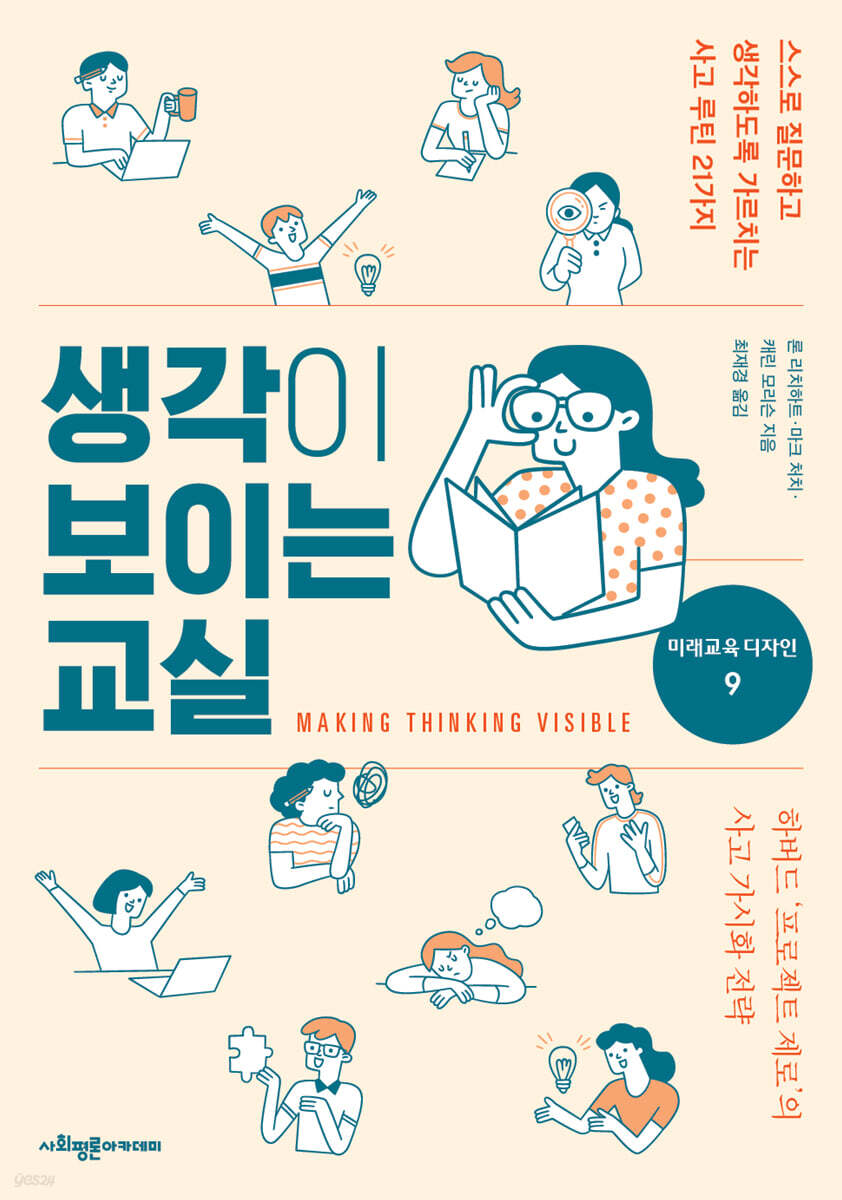
A classroom where thoughts are visible
 |
Description
Book Introduction
“If you can see your thoughts, studying will happen naturally.”
"A Classroom Where Thoughts Are Visible" is a book that presents methods necessary to foster children's thinking skills in everyday life, make their thoughts visible, and create a culture of thinking in schools and classrooms.
This book is based on the work of the Project Zero research team at the Harvard Graduate School of Education.
The authors emphasize that the focus of education should be entirely on thinking.
Mere memorization drills or fun activities alone cannot stimulate children's thinking.
Instead, the authors focus on the strategy of making thinking visible, which introduces 21 thinking routines that make thinking visible in the classroom through a series of steps that express the thought process verbally, in writing, or through drawings.
Children who become accustomed to thinking routines such as 'see-think-wonder', 'zoom in', and 'think-wonder-explore' have more strategies and methods at their disposal to think about things.
You can also develop metacognitive skills that allow you to reflect on and develop your own thoughts beyond thinking more broadly and deeply.
Thinking routines visualize children's thoughts in the classroom, stimulate their thinking and help them communicate effectively.
Children grow into more active human beings when their thoughts are visible.
"A Classroom Where Thoughts Are Visible" is a book that presents methods necessary to foster children's thinking skills in everyday life, make their thoughts visible, and create a culture of thinking in schools and classrooms.
This book is based on the work of the Project Zero research team at the Harvard Graduate School of Education.
The authors emphasize that the focus of education should be entirely on thinking.
Mere memorization drills or fun activities alone cannot stimulate children's thinking.
Instead, the authors focus on the strategy of making thinking visible, which introduces 21 thinking routines that make thinking visible in the classroom through a series of steps that express the thought process verbally, in writing, or through drawings.
Children who become accustomed to thinking routines such as 'see-think-wonder', 'zoom in', and 'think-wonder-explore' have more strategies and methods at their disposal to think about things.
You can also develop metacognitive skills that allow you to reflect on and develop your own thoughts beyond thinking more broadly and deeply.
Thinking routines visualize children's thoughts in the classroom, stimulate their thinking and help them communicate effectively.
Children grow into more active human beings when their thoughts are visible.
- You can preview some of the book's contents.
Preview
index
Recommendation
introduction
Acknowledgements
Some thoughts on Part 1
Chapter 1 What is an accident?
Accidents have no hierarchy and no set order.
Memorization, assignments, and activities are merely training and have nothing to do with thinking.
Eight Thinking Activities to Help You Understand
Other useful types of thinking
What do students think about the accident?
Chapter 2: Putting Thinking at the Center of Education
How would teaching and learning change if students' thinking were visible?
How can we make the invisible visible?
21 Thinking Routines That Reveal Your Thoughts Part 2
Chapter 3: A Classroom Where Thoughts Are Visible: Let's Start with a Thinking Routine
Thought routines are tools, structures, and behavioral patterns.
When should I use which thinking routine?
Chapter 4: Introducing and Exploring New Ideas: Routines for Early Units
See-Think-Wonder
View larger
Think-Puzzle-Exploration
Chalk conversation
3-2-1 bridge
compass needle
Description Game
Chapter 5: Synthesizing and Organizing Information: Routines for Reading, Discussing, and Understanding
Headline
CSI: Color, Symbol, Image
Create-Classify-Connect-Refine: Concept Map
Connect-Expand-Challenge
4Cs: Relevance, Challenge, Concept, Change
Microlab Protocol
Old thoughts, current thoughts
Chapter 6: Thinking Deeply About Issues and Complexities: Routines for Deepening
Why do you say that?
Circle of perspective
Go inside
Red light, yellow light
Claim-Evidence-Question
tug of war
sentence-phrase-word
Part 3: Empowering the Classroom with Visible Thoughts
Chapter 7: Creating a Place That Respects, Visibly Shares, and Encourages Thought
Case Study 1: Creating a Classroom for Reflection
Case Study 2: Making Time for Teachers to Learn
Case Study 3: Creating a Sophisticated Conversation Structure
Seven Forces That Create a Culture of Thought
Chapter 8: A Guide to Reducing Trial and Error
Visualizing Thinking in Math Classes: The Case of the Unstoppable Mark Church
Content + Routine + Students = Thinking Culture: The Case of Sharon Bloom, Who Keeps Trying and Changing
As long as you develop models and languages, the routine will continue on its own.
Evolutionary stages of thinking routines commonly observed in classroom observations and case studies
The traps and struggles ahead of us
In conclusion
References
Search
introduction
Acknowledgements
Some thoughts on Part 1
Chapter 1 What is an accident?
Accidents have no hierarchy and no set order.
Memorization, assignments, and activities are merely training and have nothing to do with thinking.
Eight Thinking Activities to Help You Understand
Other useful types of thinking
What do students think about the accident?
Chapter 2: Putting Thinking at the Center of Education
How would teaching and learning change if students' thinking were visible?
How can we make the invisible visible?
21 Thinking Routines That Reveal Your Thoughts Part 2
Chapter 3: A Classroom Where Thoughts Are Visible: Let's Start with a Thinking Routine
Thought routines are tools, structures, and behavioral patterns.
When should I use which thinking routine?
Chapter 4: Introducing and Exploring New Ideas: Routines for Early Units
See-Think-Wonder
View larger
Think-Puzzle-Exploration
Chalk conversation
3-2-1 bridge
compass needle
Description Game
Chapter 5: Synthesizing and Organizing Information: Routines for Reading, Discussing, and Understanding
Headline
CSI: Color, Symbol, Image
Create-Classify-Connect-Refine: Concept Map
Connect-Expand-Challenge
4Cs: Relevance, Challenge, Concept, Change
Microlab Protocol
Old thoughts, current thoughts
Chapter 6: Thinking Deeply About Issues and Complexities: Routines for Deepening
Why do you say that?
Circle of perspective
Go inside
Red light, yellow light
Claim-Evidence-Question
tug of war
sentence-phrase-word
Part 3: Empowering the Classroom with Visible Thoughts
Chapter 7: Creating a Place That Respects, Visibly Shares, and Encourages Thought
Case Study 1: Creating a Classroom for Reflection
Case Study 2: Making Time for Teachers to Learn
Case Study 3: Creating a Sophisticated Conversation Structure
Seven Forces That Create a Culture of Thought
Chapter 8: A Guide to Reducing Trial and Error
Visualizing Thinking in Math Classes: The Case of the Unstoppable Mark Church
Content + Routine + Students = Thinking Culture: The Case of Sharon Bloom, Who Keeps Trying and Changing
As long as you develop models and languages, the routine will continue on its own.
Evolutionary stages of thinking routines commonly observed in classroom observations and case studies
The traps and struggles ahead of us
In conclusion
References
Search
Into the book
“Learning is the result of thinking.
…it is not that thinking follows knowledge, but that knowledge follows thinking.
“When we think about what we are learning and think with it, we truly learn it.”
Therefore, thinking is at the heart of education, not a mere add-on to be done when one has time.
---p.53
Since thinking routines function as tools for thinking, this means that thinking routines should be useful not only to teachers but also to students.
Rather than simply being activities that help teachers engage students more actively, thinking routines are tools that students use to think for themselves.
---p.73
Julie thought the synthesis activities required for the headline routine would be useful for students who are struggling.
She noticed that when conflicts arose, students would run to their teachers and … recount everything that had happened.
By having students dry their heads and then write down the issues in headline form, Julie encouraged sixth graders to think about what the issues at the heart of a conflict or event are.
---p.155
“For a long time, before I was introduced to thought routines, I was interested in asking questions to my students,” says Mary Kay Archer, an elementary school teacher and math major in the Traverse City Public Schools District in northern Michigan.
“I’ve always wanted to use questions as a key tool to probe the depth of students’ understanding.
So I was immediately drawn to the 'Why do you say that?' routine.
At first glance, it seems like a simple statement, but it has very complex nuances.”
---p.225
Finally, we conclude this chapter by recognizing and naming some common pitfalls and struggles observed in classrooms as teachers use thinking routines as tools to make students' thinking visible.
…as professional developers specializing in education, we've used shorthand terms like "sticky note mania," "the daily special," "kill the mockingbird syndrome," "the death of the progress bar," and "parts-to-whole" to refer to these difficult-to-implement common ground.
Just as early explorers marked potential dangers on maps with the phrase "Here lies a dragon!", we will use this abbreviation to mark your journey as a teacher in the field of incident visualization.
…it is not that thinking follows knowledge, but that knowledge follows thinking.
“When we think about what we are learning and think with it, we truly learn it.”
Therefore, thinking is at the heart of education, not a mere add-on to be done when one has time.
---p.53
Since thinking routines function as tools for thinking, this means that thinking routines should be useful not only to teachers but also to students.
Rather than simply being activities that help teachers engage students more actively, thinking routines are tools that students use to think for themselves.
---p.73
Julie thought the synthesis activities required for the headline routine would be useful for students who are struggling.
She noticed that when conflicts arose, students would run to their teachers and … recount everything that had happened.
By having students dry their heads and then write down the issues in headline form, Julie encouraged sixth graders to think about what the issues at the heart of a conflict or event are.
---p.155
“For a long time, before I was introduced to thought routines, I was interested in asking questions to my students,” says Mary Kay Archer, an elementary school teacher and math major in the Traverse City Public Schools District in northern Michigan.
“I’ve always wanted to use questions as a key tool to probe the depth of students’ understanding.
So I was immediately drawn to the 'Why do you say that?' routine.
At first glance, it seems like a simple statement, but it has very complex nuances.”
---p.225
Finally, we conclude this chapter by recognizing and naming some common pitfalls and struggles observed in classrooms as teachers use thinking routines as tools to make students' thinking visible.
…as professional developers specializing in education, we've used shorthand terms like "sticky note mania," "the daily special," "kill the mockingbird syndrome," "the death of the progress bar," and "parts-to-whole" to refer to these difficult-to-implement common ground.
Just as early explorers marked potential dangers on maps with the phrase "Here lies a dragon!", we will use this abbreviation to mark your journey as a teacher in the field of incident visualization.
---p.289
Publisher's Review
A must-read for any teacher who wants to teach students how to think.
A must-read for education policy makers and education administration experts.
A book worth reading for parents who don't want to tell their children to "think about it."
If there is a child who can barely understand one thing when taught one thing, there is a child who can understand ten things just by looking at one thing.
Is the ability to self-direct heat innate? "The Visible Classroom" uncovers the secrets of that ability.
In a word, ‘the power to think for yourself.’
But if thoughts arise spontaneously, unconsciously, and unplanned, can't we teach them how to think? Should we simply read, write down, and memorize the knowledge provided, and wait for them to naturally think? Or should we sit next to our children and urge them to "think!"? "The Visible Classroom" argues that a classroom focused solely on teaching "thinking" will be different from one that simply repeats memorization.
Let's stop for a moment and think about what we're doing.
What on earth does it mean to 'think'?
To teach how to think, we must first explore what thinking is.
Some thoughts on thinking in Part 1 of this book address that issue.
Authors break down thoughts into smaller pieces and categorize them into different types.
For example, if the ultimate goal of thinking activities in a school classroom is 'understanding,' the thinking activities that naturally accompany the process of understanding something can be subdivided into observing the object in detail, explaining or interpreting it with evidence, inferring new information from known facts, and finding connections between different things.
If you break down and categorize the thought process like this, teaching thinking becomes much easier.
The 'Project Zero' research team listed the types of thinking activities frequently used in the classroom and connected two or three detailed thinking activities to create a 'thinking routine.'
These are 21 tools and means to stimulate and expand students' thinking activities.
The characteristic of the thought routine presented in this way is that it breaks down the thought process and expresses it in words, writing, or pictures, so that the thought process and strategy can be seen by everyone.
Through this thinking routine, the focus of the class becomes more 'thinking'.
What would change if thoughts were visible?
21 thought routines born from countless trials and errors
What changes can occur when thinking is made visible in the classroom through a thinking routine? First, teachers can see what students have understood and what misunderstandings they may be experiencing.
You can determine when children should move on to the next stage and guide them to move forward.
Second, children learn how to think intuitively by watching the teacher's example.
Teachers provide children with models to emulate, and these models not only impart knowledge and information about the subject, but also develop children's thinking habits and tendencies in the long run.
Third, children also acquire the ability to meta-recognize their own thoughts by understanding their thought processes and strategies.
You can objectify your thoughts and see them from other people's perspectives, and even develop the ability to deepen and develop your thoughts.
Part 2 of this book demonstrates how to use and demonstrates the application of twenty-one thought routines, developed through trial and error in children's classrooms.
This book contains a manual and advice you can put into practice right now, from routines for starting and exploring intellectual activities at a very light level, to routines for synthesizing and organizing various thoughts, to routines for further developing and deepening your thoughts.
Part 3 details the authors' mission as educators and the trial and error process they went through to successfully implement the thinking routine.
It is my belief that this trial and error will be a vital resource for teachers who wish to use thinking routines in the classroom.
What changes occurred in children who became accustomed to thought routines? While each chapter introducing the routines includes specific examples, the changes in children's "thinking about thinking" demonstrate the effectiveness of thought routines in another way.
When we first started the study, children's responses to 'thinking' remained emotional or associative.
However, children who had become accustomed to the thought routine began to respond more strategically and systematically to the question of what they thought it meant to "think."
It categorized the goals of thinking, such as “finding meaning, understanding, solving problems, and making decisions,” and provided answers regarding specific strategies and processes for achieving those goals.
This response shows that children have improved their ability to freely manage their intellectual activities.
When thoughts become visible, anywhere becomes a classroom.
The twenty-one thinking routines presented in this book are not necessarily limited to the classroom.
This routine is already being used in art galleries and museums around the world.
Some routines might be done sitting at your desk, while others can be tried in the car on a road trip or around the dinner table with your family.
The authors say that as children become accustomed to a thinking routine, they develop a natural thinking disposition that allows them to develop thinking habits.
The space where children's thoughts become visible does not necessarily have to be limited to the classroom.
A 'culture of thought' that respects and encourages ideas can be created anywhere.
A must-read for education policy makers and education administration experts.
A book worth reading for parents who don't want to tell their children to "think about it."
If there is a child who can barely understand one thing when taught one thing, there is a child who can understand ten things just by looking at one thing.
Is the ability to self-direct heat innate? "The Visible Classroom" uncovers the secrets of that ability.
In a word, ‘the power to think for yourself.’
But if thoughts arise spontaneously, unconsciously, and unplanned, can't we teach them how to think? Should we simply read, write down, and memorize the knowledge provided, and wait for them to naturally think? Or should we sit next to our children and urge them to "think!"? "The Visible Classroom" argues that a classroom focused solely on teaching "thinking" will be different from one that simply repeats memorization.
Let's stop for a moment and think about what we're doing.
What on earth does it mean to 'think'?
To teach how to think, we must first explore what thinking is.
Some thoughts on thinking in Part 1 of this book address that issue.
Authors break down thoughts into smaller pieces and categorize them into different types.
For example, if the ultimate goal of thinking activities in a school classroom is 'understanding,' the thinking activities that naturally accompany the process of understanding something can be subdivided into observing the object in detail, explaining or interpreting it with evidence, inferring new information from known facts, and finding connections between different things.
If you break down and categorize the thought process like this, teaching thinking becomes much easier.
The 'Project Zero' research team listed the types of thinking activities frequently used in the classroom and connected two or three detailed thinking activities to create a 'thinking routine.'
These are 21 tools and means to stimulate and expand students' thinking activities.
The characteristic of the thought routine presented in this way is that it breaks down the thought process and expresses it in words, writing, or pictures, so that the thought process and strategy can be seen by everyone.
Through this thinking routine, the focus of the class becomes more 'thinking'.
What would change if thoughts were visible?
21 thought routines born from countless trials and errors
What changes can occur when thinking is made visible in the classroom through a thinking routine? First, teachers can see what students have understood and what misunderstandings they may be experiencing.
You can determine when children should move on to the next stage and guide them to move forward.
Second, children learn how to think intuitively by watching the teacher's example.
Teachers provide children with models to emulate, and these models not only impart knowledge and information about the subject, but also develop children's thinking habits and tendencies in the long run.
Third, children also acquire the ability to meta-recognize their own thoughts by understanding their thought processes and strategies.
You can objectify your thoughts and see them from other people's perspectives, and even develop the ability to deepen and develop your thoughts.
Part 2 of this book demonstrates how to use and demonstrates the application of twenty-one thought routines, developed through trial and error in children's classrooms.
This book contains a manual and advice you can put into practice right now, from routines for starting and exploring intellectual activities at a very light level, to routines for synthesizing and organizing various thoughts, to routines for further developing and deepening your thoughts.
Part 3 details the authors' mission as educators and the trial and error process they went through to successfully implement the thinking routine.
It is my belief that this trial and error will be a vital resource for teachers who wish to use thinking routines in the classroom.
What changes occurred in children who became accustomed to thought routines? While each chapter introducing the routines includes specific examples, the changes in children's "thinking about thinking" demonstrate the effectiveness of thought routines in another way.
When we first started the study, children's responses to 'thinking' remained emotional or associative.
However, children who had become accustomed to the thought routine began to respond more strategically and systematically to the question of what they thought it meant to "think."
It categorized the goals of thinking, such as “finding meaning, understanding, solving problems, and making decisions,” and provided answers regarding specific strategies and processes for achieving those goals.
This response shows that children have improved their ability to freely manage their intellectual activities.
When thoughts become visible, anywhere becomes a classroom.
The twenty-one thinking routines presented in this book are not necessarily limited to the classroom.
This routine is already being used in art galleries and museums around the world.
Some routines might be done sitting at your desk, while others can be tried in the car on a road trip or around the dinner table with your family.
The authors say that as children become accustomed to a thinking routine, they develop a natural thinking disposition that allows them to develop thinking habits.
The space where children's thoughts become visible does not necessarily have to be limited to the classroom.
A 'culture of thought' that respects and encourages ideas can be created anywhere.
GOODS SPECIFICS
- Date of issue: May 31, 2023
- Page count, weight, size: 376 pages | 165*235*30mm
- ISBN13: 9791167071149
- ISBN10: 116707114X
You may also like
카테고리
korean


korean

![GQ KOREA Mark (Monthly): December [2025]](http://librairie.coreenne.fr/cdn/shop/files/8ef265dbbfbf186523ed75ba7319009d.jpg?v=1765340328&width=3840)


