

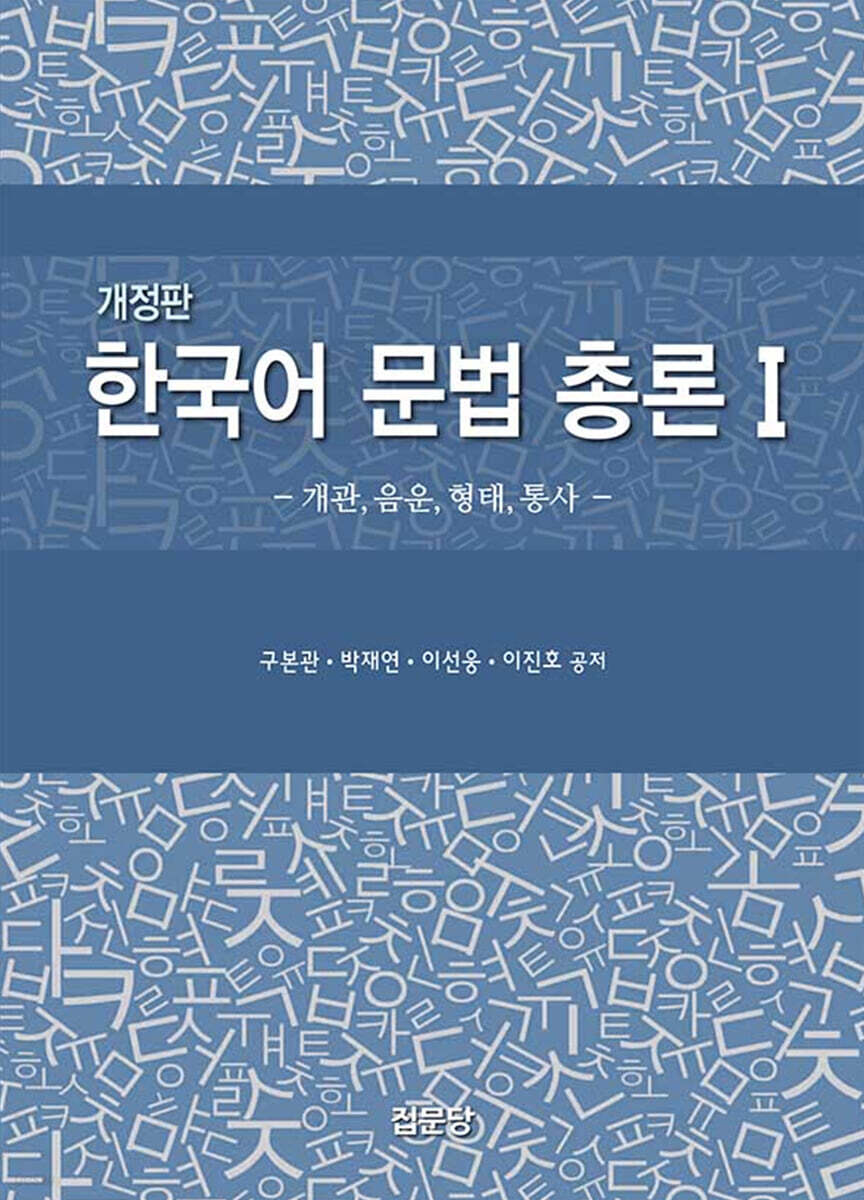
Korean Grammar General 1
 |
Description
Book Introduction
The revised edition has been significantly revised and supplemented compared to the first edition.
In the morphology section of Volume I, the results of research on word formation in new words, which has been actively studied recently, were added, and in the syntax section, a discussion on information structure was added along with syntactic structure.
In the section on the history of the Korean language in Volume II, the discussion on changes in affix derivation and the derivation of consonant changes, vowel changes, and zero changes, commonly referred to as non-affix derivation, has been significantly supplemented, and a modern translation has been added for the convenience of readers regarding the medieval and modern Korean language.
This book is written in as simple a manner as possible, even covering difficult parts such as the history of the Korean language, so that all readers, whether Korean or foreign, who are learning and using the Korean language and deeply concerned about Korean grammar can easily read it.
To ensure that it can be used in Korean language classes at middle and high schools or universities, explanations are provided in the footnotes and reference sections of the wings regarding grammatical facts that may be problematic in learning situations.
This book aims for technical grammar, but also adds a normative grammar perspective.
This book will serve as a practical guide for Korean and international students who are beginning to study Korean language and literature in universities' departments of Korean language and literature, Korean language education, and Korean language education.
Additionally, if you read this book in depth through the reference section, it may be helpful to graduate students and Korean language researchers.
In the morphology section of Volume I, the results of research on word formation in new words, which has been actively studied recently, were added, and in the syntax section, a discussion on information structure was added along with syntactic structure.
In the section on the history of the Korean language in Volume II, the discussion on changes in affix derivation and the derivation of consonant changes, vowel changes, and zero changes, commonly referred to as non-affix derivation, has been significantly supplemented, and a modern translation has been added for the convenience of readers regarding the medieval and modern Korean language.
This book is written in as simple a manner as possible, even covering difficult parts such as the history of the Korean language, so that all readers, whether Korean or foreign, who are learning and using the Korean language and deeply concerned about Korean grammar can easily read it.
To ensure that it can be used in Korean language classes at middle and high schools or universities, explanations are provided in the footnotes and reference sections of the wings regarding grammatical facts that may be problematic in learning situations.
This book aims for technical grammar, but also adds a normative grammar perspective.
This book will serve as a practical guide for Korean and international students who are beginning to study Korean language and literature in universities' departments of Korean language and literature, Korean language education, and Korean language education.
Additionally, if you read this book in depth through the reference section, it may be helpful to graduate students and Korean language researchers.
index
preface
Preface to the First Edition
Chapter 1 Language and Korean
1.1.
The essence of language
1.1.1.
Characteristics of language
1.1.1.1.
Duality and arbitrariness
1.1.1.2.
Creativity and regularity
1.1.1.3.
Sociality and normativity
1.1.1.4.
Abstractness and Transcendence
1.1.1.5.
Segmentation and Systematicity
1.1.1.6.
Historical and cultural significance
1.1.2.
Functions of language
1.1.3.
Language and Humans
1.1.3.1.
Language and Thought
1.1.3.2.
Language and Society
1.1.3.3.
Language and Culture
1.2.
Language and Language Studies
1.2.1.
Trends in language research and Korean grammar research
1.2.2.
Normative and descriptive grammar
1.2.3.
Definition of grammar and the field of language study
1.3.
Korean as a language and its characteristics
1.3.1.
The concept of the Korean language and its distribution
1.3.2.
Characteristics of the Korean language
Chapter 2 Phonology
2.1.
Basic understanding of phonology
2.1.1.
vocal organs
2.1.2.
Voice and phonology
2.1.3.
Phonemes and sounds
2.2.
phonological system
2.2.1.
consonant
2.2.1.1.
Place of articulation of consonants
2.2.1.2.
Consonant articulation method
2.2.2.
monophthong
2.2.3.
Semivowels and diphthongs
2.2.4.
Long and short
2.2.5.
Accent
2.3.
syllable
2.3.1.
Syllable structure
2.3.2.
Types of syllables
2.4.
Phonological phenomena
2.4.1.
Definition and classification criteria for phonological phenomena
2.4.2.
Phonemic substitution
2.4.2.1.
flat rupture
2.4.2.2.
nasalization
2.4.2.3.
Nasalization of 'ㄹ'
2.4.2.4.
Voiced
2.4.2.5.
lenition
2.4.2.6.
palatalization
2.4.2.7.
Initial sound rule
2.4.2.8.
vowel harmony
2.4.2.9.
Semivowelization
2.4.2.10.
Other phonological phenomena
2.4.3.
Dropping of sounds
2.4.3.1.
Simplifying consonant clusters
2.4.3.2.
Dropped back sound
2.4.3.3.
Dropping out of vowels
2.4.3.4.
vowel dropout
2.4.4.
Addition of sounds
2.4.4.1.
Add 'ㄴ'
2.4.4.2.
Addition of semivowels
2.4.5.
Phonetic contraction
2.5.
replacement of morphemes
2.5.1.
Definition and basic form of replacement
2.5.2.
Automatic and non-automatic replacement
2.5.3.
Regular and irregular replacement
2.5.4.
Phonological and non-phonological alternations
Chapter 3 Morphology
3.1.
Basic understanding of word structure
3.1.1.
Morphology and units of morphology
3.1.1.1.
The realm of morphology
3.1.1.2.
Units of word analysis and morphology
3.1.2.
morpheme
3.1.2.1.
Definition and subclassification of morphemes
3.1.2.2.
morpheme, form, allomorph
3.1.3.
word
3.1.3.1.
Definition of the word
3.1.3.2.
Several discussions regarding the scope of words
3.2.
word formation
3.2.1.
Types of word formation
3.2.1.1.
Principles of word formation
3.2.1.2.
Analytical perspective and formative perspective
3.2.1.3.
Types of words according to their formation method
3.2.1.4.
New words and pure Korean words
3.2.2.
compound word
3.2.2.1.
Compound words and phrases
3.2.2.2.
Phonological phenomena appearing in the formation of compound words
3.2.2.3.
Types of compound words
3.2.2.4.
compound noun
3.2.2.5.
Compound nouns and the phenomenon of interjection
3.2.2.6.
Compound adjectives
3.2.2.7.
compound verbs
3.2.2.8.
Compound adverbs
3.2.2.9.
Compound pronouns, compound numerals, and compound determiners
3.2.2.10.
Repeated compound words
3.2.3.
derivatives
3.2.3.1.
Derivatives and Derivative Affixes
3.2.3.2.
Productivity of derivative affixes
3.2.3.3.
Derivative formation and unified word formation
3.2.3.4.
Constraints on derivative formation rules
3.2.3.5.
Prefix derivation
3.2.3.6.
Suffix derivation
3.2.4.
Chinese characters
3.2.4.1.
Scope of Chinese characters
3.2.4.2.
Characteristics of Chinese character word formation
3.2.4.3.
Chinese character compounding method
3.2.4.4.
Chinese character derivation method
3.3.
Parts of speech
3.3.1.
Part of speech classification
3.3.1.1.
The need for part-of-speech classification
3.3.1.2.
Criteria for classifying parts of speech
3.3.1.3.
Korean part-of-speech system
3.3.1.4.
Common use of parts of speech
3.3.2.
nouns, pronouns, numerals
3.3.2.1.
noun
3.3.2.2.
pronoun
3.3.2.3.
investigation
3.3.3.
Verbs, adjectives
3.3.3.1.
verb
3.3.3.2.
adjective
3.3.3.3.
am
3.3.4.
adjectives, adverbs, and exclamations
3.3.4.1.
adjective
3.3.4.2.
adverb
3.3.4.3.
interjection
3.3.5.
Investigation and mother
3.3.5.1.
inspection
3.3.5.2.
ending of a word
Chapter 4 Syntax
4.1.
Basic understanding of syntax
4.1.1.
Syntax and syntactic units
4.1.2.
Two perspectives on sentence structure
4.1.2.1.
syntactic structure of sentences
4.1.2.2.
Information structure of a sentence
4.1.3.
Word order
4.2.
Sentence elements and sentence patterns
4.2.1.
Concept and types of sentence elements
4.2.2.
subject
4.2.3.
direct object
4.2.4.
complement
4.2.5.
predicate
4.2.6.
adjective
4.2.7.
adverb
4.2.8.
Independent language
4.2.9.
Sentence elements and cases
4.2.10.
Argument structure and sentence structure of predicate
4.2.10.1.
Argument structure
4.2.10.2.
sentence patterns
4.3.
Sentence expansion
4.3.1.
Short and complex sentences
4.3.2.
Parallel sentences (connected sentences)
4.3.3.
Mammary gland (embracing sentence)
4.3.3.1.
Sentences containing noun clauses
4.3.3.2.
Sentences containing adjective clauses
4.3.3.3.
Sentences with adverbial clauses
4.3.3.4.
Sentences containing descriptive clauses
4.3.4.
Grammatical characteristics of compound sentences
4.4.
Sentence types
4.4.1.
Plain text
4.4.2.
question
4.4.2.1.
Judgment interrogative sentence
4.4.2.2.
explanatory questions
4.4.2.3.
Choice questions
4.4.2.4.
Echoing interrogative sentences
4.4.2.5.
Self-question
4.4.3.
Command statement
4.4.4.
Cheongyumun
4.4.5.
exclamation
4.4.6.
Sentence types and speech acts
4.5.
Honorific expressions
4.5.1.
The concept and types of honorific expressions
4.5.2.
elevate the subject
4.5.3.
Elevate objects
4.5.4.
Relative honorifics 4.5.5.
expression of humility
4.5.6.
Special vocabulary for honorifics
4.6.
tense and aspect
4.6.1.
The concept of tense
4.6.2.
Absolute and relative tenses
4.6.3.
Types of tenses
4.6.3.1.
present tense
4.6.3.2.
past tense
4.6.3.3.
future
4.6.4.
Concept of top
4.6.5.
Grammatically
4.6.5.1.
Progress
4.6.5.2.
Completion
4.6.6.
Vocabulary-wise
4.6.7.
Grammatical and lexical connections
4.7.
mode
4.7.1.
Basic understanding of modality
4.7.1.1.
The semantic domain of modality
4.7.1.2.
Realization form of the state
4.7.2.
Aspects expressed by the verb ending
4.7.2.1.
'-geu-'
4.7.2.2.
'-more-'
4.7.2.3.
'-(eu)ri-, -ni-, -geot-'
4.7.3.
Aspects expressed by final endings
4.7.3.1.
'-ji'
4.7.3.2.
'-ne', '-guna'
4.7.3.3.
'-(으)ㄹ래', '-(으)ㄹ까'
4.7.4.
Aspects expressed by connective endings
4.7.5.
Aspects expressed in syntactic structure
4.8.
Passive and causative voices
4.8.1.
The concept of passive and causative voice
4.8.2.
Types of passive voice
4.8.2.1.
Passive verb passive
4.8.2.2.
'-아/어지다' passive voice
4.8.3.
Characteristics and limitations of passive voice
4.8.4.
Types of actions
4.8.4.1.
Causative verb
4.8.4.2.
'-ge hada' causative verb
4.8.5.
Characteristics and limitations of the movement
4.8.5.1.
Direct and indirect causation
4.8.5.2.
Restrictions on the use of force
4.9.
negative
4.9.1.
The concept of negation
4.9.2.
Types of negation
4.9.2.1.
Syntactic negation and lexical negation
4.9.2.2.
Short-form negation and long-form negation
4.9.2.3.
Negatives of '안', '못', and '말다'
4.9.2.4.
double negative sentences
4.9.3.
Characteristics of negative sentences
4.9.3.1.
Matching with negative polar words
4.9.3.2.
Ambiguity of negative sentences
4.9.3.3.
Negative and confirmatory sentences
4.9.3.4.
Restrictions on negative sentences
4.10.
Information structure and fragmentation
4.10.1.
Old and new information
4.10.2.
Absolute information structure and relative information structure
4.10.3.
Split Gate
References
Search
Preface to the First Edition
Chapter 1 Language and Korean
1.1.
The essence of language
1.1.1.
Characteristics of language
1.1.1.1.
Duality and arbitrariness
1.1.1.2.
Creativity and regularity
1.1.1.3.
Sociality and normativity
1.1.1.4.
Abstractness and Transcendence
1.1.1.5.
Segmentation and Systematicity
1.1.1.6.
Historical and cultural significance
1.1.2.
Functions of language
1.1.3.
Language and Humans
1.1.3.1.
Language and Thought
1.1.3.2.
Language and Society
1.1.3.3.
Language and Culture
1.2.
Language and Language Studies
1.2.1.
Trends in language research and Korean grammar research
1.2.2.
Normative and descriptive grammar
1.2.3.
Definition of grammar and the field of language study
1.3.
Korean as a language and its characteristics
1.3.1.
The concept of the Korean language and its distribution
1.3.2.
Characteristics of the Korean language
Chapter 2 Phonology
2.1.
Basic understanding of phonology
2.1.1.
vocal organs
2.1.2.
Voice and phonology
2.1.3.
Phonemes and sounds
2.2.
phonological system
2.2.1.
consonant
2.2.1.1.
Place of articulation of consonants
2.2.1.2.
Consonant articulation method
2.2.2.
monophthong
2.2.3.
Semivowels and diphthongs
2.2.4.
Long and short
2.2.5.
Accent
2.3.
syllable
2.3.1.
Syllable structure
2.3.2.
Types of syllables
2.4.
Phonological phenomena
2.4.1.
Definition and classification criteria for phonological phenomena
2.4.2.
Phonemic substitution
2.4.2.1.
flat rupture
2.4.2.2.
nasalization
2.4.2.3.
Nasalization of 'ㄹ'
2.4.2.4.
Voiced
2.4.2.5.
lenition
2.4.2.6.
palatalization
2.4.2.7.
Initial sound rule
2.4.2.8.
vowel harmony
2.4.2.9.
Semivowelization
2.4.2.10.
Other phonological phenomena
2.4.3.
Dropping of sounds
2.4.3.1.
Simplifying consonant clusters
2.4.3.2.
Dropped back sound
2.4.3.3.
Dropping out of vowels
2.4.3.4.
vowel dropout
2.4.4.
Addition of sounds
2.4.4.1.
Add 'ㄴ'
2.4.4.2.
Addition of semivowels
2.4.5.
Phonetic contraction
2.5.
replacement of morphemes
2.5.1.
Definition and basic form of replacement
2.5.2.
Automatic and non-automatic replacement
2.5.3.
Regular and irregular replacement
2.5.4.
Phonological and non-phonological alternations
Chapter 3 Morphology
3.1.
Basic understanding of word structure
3.1.1.
Morphology and units of morphology
3.1.1.1.
The realm of morphology
3.1.1.2.
Units of word analysis and morphology
3.1.2.
morpheme
3.1.2.1.
Definition and subclassification of morphemes
3.1.2.2.
morpheme, form, allomorph
3.1.3.
word
3.1.3.1.
Definition of the word
3.1.3.2.
Several discussions regarding the scope of words
3.2.
word formation
3.2.1.
Types of word formation
3.2.1.1.
Principles of word formation
3.2.1.2.
Analytical perspective and formative perspective
3.2.1.3.
Types of words according to their formation method
3.2.1.4.
New words and pure Korean words
3.2.2.
compound word
3.2.2.1.
Compound words and phrases
3.2.2.2.
Phonological phenomena appearing in the formation of compound words
3.2.2.3.
Types of compound words
3.2.2.4.
compound noun
3.2.2.5.
Compound nouns and the phenomenon of interjection
3.2.2.6.
Compound adjectives
3.2.2.7.
compound verbs
3.2.2.8.
Compound adverbs
3.2.2.9.
Compound pronouns, compound numerals, and compound determiners
3.2.2.10.
Repeated compound words
3.2.3.
derivatives
3.2.3.1.
Derivatives and Derivative Affixes
3.2.3.2.
Productivity of derivative affixes
3.2.3.3.
Derivative formation and unified word formation
3.2.3.4.
Constraints on derivative formation rules
3.2.3.5.
Prefix derivation
3.2.3.6.
Suffix derivation
3.2.4.
Chinese characters
3.2.4.1.
Scope of Chinese characters
3.2.4.2.
Characteristics of Chinese character word formation
3.2.4.3.
Chinese character compounding method
3.2.4.4.
Chinese character derivation method
3.3.
Parts of speech
3.3.1.
Part of speech classification
3.3.1.1.
The need for part-of-speech classification
3.3.1.2.
Criteria for classifying parts of speech
3.3.1.3.
Korean part-of-speech system
3.3.1.4.
Common use of parts of speech
3.3.2.
nouns, pronouns, numerals
3.3.2.1.
noun
3.3.2.2.
pronoun
3.3.2.3.
investigation
3.3.3.
Verbs, adjectives
3.3.3.1.
verb
3.3.3.2.
adjective
3.3.3.3.
am
3.3.4.
adjectives, adverbs, and exclamations
3.3.4.1.
adjective
3.3.4.2.
adverb
3.3.4.3.
interjection
3.3.5.
Investigation and mother
3.3.5.1.
inspection
3.3.5.2.
ending of a word
Chapter 4 Syntax
4.1.
Basic understanding of syntax
4.1.1.
Syntax and syntactic units
4.1.2.
Two perspectives on sentence structure
4.1.2.1.
syntactic structure of sentences
4.1.2.2.
Information structure of a sentence
4.1.3.
Word order
4.2.
Sentence elements and sentence patterns
4.2.1.
Concept and types of sentence elements
4.2.2.
subject
4.2.3.
direct object
4.2.4.
complement
4.2.5.
predicate
4.2.6.
adjective
4.2.7.
adverb
4.2.8.
Independent language
4.2.9.
Sentence elements and cases
4.2.10.
Argument structure and sentence structure of predicate
4.2.10.1.
Argument structure
4.2.10.2.
sentence patterns
4.3.
Sentence expansion
4.3.1.
Short and complex sentences
4.3.2.
Parallel sentences (connected sentences)
4.3.3.
Mammary gland (embracing sentence)
4.3.3.1.
Sentences containing noun clauses
4.3.3.2.
Sentences containing adjective clauses
4.3.3.3.
Sentences with adverbial clauses
4.3.3.4.
Sentences containing descriptive clauses
4.3.4.
Grammatical characteristics of compound sentences
4.4.
Sentence types
4.4.1.
Plain text
4.4.2.
question
4.4.2.1.
Judgment interrogative sentence
4.4.2.2.
explanatory questions
4.4.2.3.
Choice questions
4.4.2.4.
Echoing interrogative sentences
4.4.2.5.
Self-question
4.4.3.
Command statement
4.4.4.
Cheongyumun
4.4.5.
exclamation
4.4.6.
Sentence types and speech acts
4.5.
Honorific expressions
4.5.1.
The concept and types of honorific expressions
4.5.2.
elevate the subject
4.5.3.
Elevate objects
4.5.4.
Relative honorifics 4.5.5.
expression of humility
4.5.6.
Special vocabulary for honorifics
4.6.
tense and aspect
4.6.1.
The concept of tense
4.6.2.
Absolute and relative tenses
4.6.3.
Types of tenses
4.6.3.1.
present tense
4.6.3.2.
past tense
4.6.3.3.
future
4.6.4.
Concept of top
4.6.5.
Grammatically
4.6.5.1.
Progress
4.6.5.2.
Completion
4.6.6.
Vocabulary-wise
4.6.7.
Grammatical and lexical connections
4.7.
mode
4.7.1.
Basic understanding of modality
4.7.1.1.
The semantic domain of modality
4.7.1.2.
Realization form of the state
4.7.2.
Aspects expressed by the verb ending
4.7.2.1.
'-geu-'
4.7.2.2.
'-more-'
4.7.2.3.
'-(eu)ri-, -ni-, -geot-'
4.7.3.
Aspects expressed by final endings
4.7.3.1.
'-ji'
4.7.3.2.
'-ne', '-guna'
4.7.3.3.
'-(으)ㄹ래', '-(으)ㄹ까'
4.7.4.
Aspects expressed by connective endings
4.7.5.
Aspects expressed in syntactic structure
4.8.
Passive and causative voices
4.8.1.
The concept of passive and causative voice
4.8.2.
Types of passive voice
4.8.2.1.
Passive verb passive
4.8.2.2.
'-아/어지다' passive voice
4.8.3.
Characteristics and limitations of passive voice
4.8.4.
Types of actions
4.8.4.1.
Causative verb
4.8.4.2.
'-ge hada' causative verb
4.8.5.
Characteristics and limitations of the movement
4.8.5.1.
Direct and indirect causation
4.8.5.2.
Restrictions on the use of force
4.9.
negative
4.9.1.
The concept of negation
4.9.2.
Types of negation
4.9.2.1.
Syntactic negation and lexical negation
4.9.2.2.
Short-form negation and long-form negation
4.9.2.3.
Negatives of '안', '못', and '말다'
4.9.2.4.
double negative sentences
4.9.3.
Characteristics of negative sentences
4.9.3.1.
Matching with negative polar words
4.9.3.2.
Ambiguity of negative sentences
4.9.3.3.
Negative and confirmatory sentences
4.9.3.4.
Restrictions on negative sentences
4.10.
Information structure and fragmentation
4.10.1.
Old and new information
4.10.2.
Absolute information structure and relative information structure
4.10.3.
Split Gate
References
Search
GOODS SPECIFICS
- Date of issue: August 30, 2025
- Page count, weight, size: 452 pages | 176*248*30mm
- ISBN13: 9788930319768
- ISBN10: 8930319769
You may also like
카테고리
korean


korean

![GQ KOREA Mark (Monthly): December [2025]](http://librairie.coreenne.fr/cdn/shop/files/8ef265dbbfbf186523ed75ba7319009d.jpg?v=1765340328&width=3840)


