

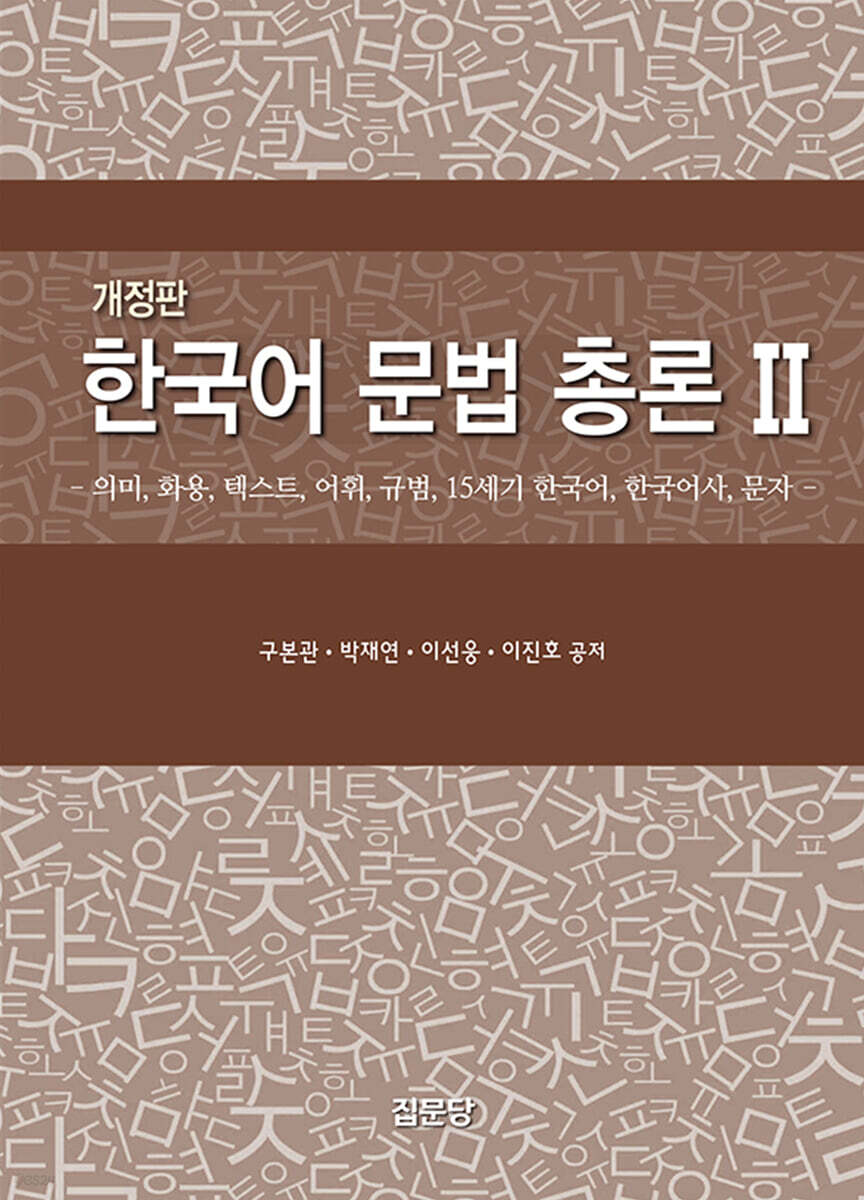
Korean Grammar General 2
 |
Description
Book Introduction
The revised edition has been significantly revised and supplemented compared to the first edition.
In the morphology section of Volume I, the results of research on word formation in new words, which has been actively studied recently, were added, and in the syntax section, a discussion on information structure was added along with syntactic structure.
In the section on the history of the Korean language in Volume II, the discussion on changes in affix derivation and the derivation of consonant changes, vowel changes, and zero changes, commonly referred to as non-affix derivation, has been significantly supplemented, and a modern translation has been added for the convenience of readers regarding the medieval and modern Korean language.
This book is written in as simple a manner as possible, even covering difficult parts such as the history of the Korean language, so that all readers, whether Korean or foreign, who are learning and using the Korean language and deeply concerned about Korean grammar can easily read it.
To ensure that it can be used in Korean language classes at middle and high schools or universities, explanations are provided in the footnotes and reference sections of the wings regarding grammatical facts that may be problematic in learning situations.
This book aims for technical grammar, but also adds a normative grammar perspective.
This book will serve as a practical guide for Korean and international students who are beginning to study Korean language and literature in universities' departments of Korean language and literature, Korean language education, and Korean language education.
Additionally, if you read this book in depth through the reference section, it may be helpful to graduate students and Korean language researchers.
In the morphology section of Volume I, the results of research on word formation in new words, which has been actively studied recently, were added, and in the syntax section, a discussion on information structure was added along with syntactic structure.
In the section on the history of the Korean language in Volume II, the discussion on changes in affix derivation and the derivation of consonant changes, vowel changes, and zero changes, commonly referred to as non-affix derivation, has been significantly supplemented, and a modern translation has been added for the convenience of readers regarding the medieval and modern Korean language.
This book is written in as simple a manner as possible, even covering difficult parts such as the history of the Korean language, so that all readers, whether Korean or foreign, who are learning and using the Korean language and deeply concerned about Korean grammar can easily read it.
To ensure that it can be used in Korean language classes at middle and high schools or universities, explanations are provided in the footnotes and reference sections of the wings regarding grammatical facts that may be problematic in learning situations.
This book aims for technical grammar, but also adds a normative grammar perspective.
This book will serve as a practical guide for Korean and international students who are beginning to study Korean language and literature in universities' departments of Korean language and literature, Korean language education, and Korean language education.
Additionally, if you read this book in depth through the reference section, it may be helpful to graduate students and Korean language researchers.
index
preface
Preface to the First Edition
Citations and Abbreviations
Chapter 5 Semantics
5.1.
Basic understanding of meaning
5.1.1.
The meaning of meaning
5.1.2.
Different views on meaning
5.1.3.
Types of meaning
5.1.4.
Metaphorical conceptualization of meaning
5.1.4.1.
Literal and figurative meanings
5.1.4.2.
conceptual metaphor
5.1.4.3.
conceptual metonymy
5.2.
Meaning of words
5.2.1.
How to figure out word meaning
5.2.1.1.
Ingredient Analysis
5.2.1.2.
Semantic field
5.2.2.
Expansion of multiple meanings of words
5.2.2.1.
Polysemy expansion and polysemy
5.2.2.2.
Polysemy and polysemy
5.2.3.
semantic relationships between words
5.2.3.1.
Consensual relationship
5.2.3.2.
Class relationship
5.2.3.3.
superior-subordinate relationship
5.2.3.4.
Partial relationship
5.2.3.5.
Homonymous relationship
5.3.
Meaning of the sentence
5.3.1.
Principles of sentence interpretation
5.3.2.
Truth value of a sentence
5.3.3.
Ambiguity and ambiguity
5.3.3.1.
Ambiguity
5.3.3.2.
ambiguity
5.3.4.
Implications and Premises
5.3.4.1.
The concept and creation of implication
5.3.4.2.
The concept and creation of premises
Chapter 6 Pragmatics
6.1.
Basic understanding of pragmatics
6.2.
Principles of interpreting utterance meaning
6.3.
Dialogue Implications and Cooperation Principles
6.3.1.
Conversational Implications
6.3.2.
Principles of cooperation and conversational maxims
6.3.3.
Politeness and Conversational Maxims
6.4.
Function of speech
6.4.1.
speech act theory
6.4.2.
Types of speech acts
6.4.3.
Direct and indirect speech acts
6.5.
Face it
6.5.1.
The concept of direct vision
6.5.2.
Center of direct vision
6.5.3.
Type of direct vision
6.5.4.
Direct and substitutive
6.5.5.
Characteristics of the Korean 'this, that, that' direct gaze
Chapter 7 Text Linguistics
7.1.
Basic understanding of text linguistics
7.2.
Requirements for textuality
7.2.1.
bonding structure
7.2.2.
Cohesion
7.2.3.
Intentionality and receptivity
7.2.4.
Informativeness and context
7.2.5.
intertextuality
7.3.
Functions and types of text
7.3.1.
Text features
7.3.2.
Type of text
Chapter 8 Lexicon
8.1.
Basic understanding of vocabulary
8.1.1.
Characteristics of vocabulary and definition of lexicon
8.1.2.
The vocabulary as a subject of study in lexicology
8.1.3.
Lexicology and vocabulary skills
8.1.4.
The field of lexicology and adjacent fields
8.1.5.
Basic concepts of lexicology
8.2.
Lexical system and lexical relationships
8.2.1.
lexical system
8.2.1.1.
Characteristics of the Korean lexical system
8.2.1.2.
Native language
8.2.1.3.
Chinese characters
8.2.1.4.
foreign words
8.2.1.5.
Relationship between native Korean words, Chinese characters, and foreign words
8.2.2.
Lexical relationships
8.2.2.1.
Various lexical relationships
8.2.2.2.
Words that have a family relationship
8.2.2.3.
Vocabulary with a conjunction relationship
8.2.2.4.
Vocabulary with complex relationships
8.3.
Synchronic variation of vocabulary
8.3.1.
Variation and diversity of vocabulary
8.3.2.
Regional variation of vocabulary
8.3.3.
Social variation of vocabulary
8.3.3.1.
Masculine and feminine words
8.3.3.2.
technical terms (or professional terms)
8.3.4.
Situational variation of vocabulary
8.3.4.1.
Engineering and civil engineering
8.3.4.2.
Slang and slang
8.3.4.3.
Taboo words and euphemisms
8.3.4.4.
Idiom
8.4.
Diachronic changes in vocabulary
8.4.1.
Changing vocabulary
8.4.2.
Changes in individual lexical forms
8.4.3.
Changes in the meaning of individual words
8.4.3.1.
Aspects of semantic change
8.4.3.2.
Causes of change in meaning
8.4.4.
Changes in the overall vocabulary system or pattern
8.4.4.1.
Changes resulting from interlingual contact
8.4.4.2.
New and dead words
8.5.
Vocabulary and Dictionary
8.5.1.
Concept and types of dictionaries
8.5.2.
Structure of a dictionary
8.5.3.
Dictionary usage
Chapter 9 Linguistic Norms
9.1.
linguistic norms
9.1.1.
Korean spelling
9.1.1.1.
Understanding the General Rules
9.1.1.2.
Key Contents
9.1.2.
Standard language regulations
9.1.2.1.
Understanding the General Rules
9.1.2.2.
Key Contents
9.1.3.
Foreign word notation
9.1.3.1.
Understanding the basic principles
9.1.3.2.
Key Contents
9.1.4.
Romanization
9.1.4.1.
Understanding the basic principles
9.1.4.2.
Key Contents
9.2.
Standard language etiquette
9.2.1.
Titles and designations
9.2.2.
Honorifics
9.2.3.
greetings
Chapter 10: Grammar of 15th-Century Korean
10.1.
Phonology
10.1.1.
phonological system
10.1.1.1.
consonant system
10.1.1.2.
vowel system
10.1.1.3.
Cloud system
10.1.2.
syllable
10.1.3.
Phonological phenomena
10.1.3.1.
Phonemic substitution
10.1.3.2.
Dropping of sounds
10.1.3.3.
Addition of sounds
10.1.3.4.
Phonetic contraction
10.2.
form
10.2.1.
word formation
10.2.1.1.
Types of word formation
10.2.1.2.
compound word
10.2.1.3.
derivatives
10.2.2.
Parts of speech
10.2.2.1.
Part of speech classification
10.2.2.2.
nouns, pronouns, numerals
10.2.2.3.
Verbs, adjectives
10.2.2.4.
adjectives, adverbs, and exclamations
10.2.2.5.
Investigation and mother
10.3.
Syntax
10.3.1.
sentence elements
10.3.1.1.
subject
10.3.1.2.
direct object
10.3.1.3.
complement
10.3.1.4.
predicate
10.3.1.5.
adjective
10.3.1.6.
adverb
10.3.1.7.
Independent language
10.3.2.
Sentence expansion
10.3.2.1.
Parallel sentences (connected sentences)
10.3.2.2.
Mammary gland (embracing sentence)
10.3.3.
Sentence types
10.3.3.1.
Plain text
10.3.3.2.
question
10.3.3.3.
Command statement
10.3.3.4.
Cheongyumun
10.3.3.5.
exclamation
10.3.4.
Honorific expressions
10.3.4.1.
elevate the subject
10.3.4.2.
Elevate objects
10.3.4.3.
Relative honorifics
10.3.4.4.
Special vocabulary for honorifics
10.3.5.
tense, aspect, and modality
10.3.5.1.
tense
10.3.5.2.
award
10.3.5.3.
mode
10.3.6.
Passive and causative voices
10.3.6.1.
Passive
10.3.6.2.
Sadong
10.3.7.
negative
10.3.7.1.
Syntactic negation and lexical negation
10.3.7.2.
Short-form negation and long-form negation
10.3.7.3.
'No' negation and 'B' negation
10.3.7.4.
Negative noun 'no'
10.4.
vocabulary
10.4.1.
15th-century Korean vocabulary materials
10.4.2.
lexical system
10.4.2.1.
Native language
10.4.2.2.
Chinese characters
10.4.2.3.
foreign words
10.4.3.
Lexical relationships
10.4.3.1.
synonym
10.4.3.2.
Antonym
10.4.3.3.
Homonyms
10.4.4.
Variation of vocabulary
Chapter 11: History of the Korean Language
11.1.
The Scope and Necessity of Korean History Research
11.1.1.
The concept of Korean history
11.1.2.
Genealogy and Formation of the Korean Language
11.1.3.
Periodization of Korean history
11.1.4.
Research methods in Korean history
11.2.
Phonetic history
11.2.1.
Changes in the phonological system
11.2.1.1.
Changes in the consonant system
11.2.1.2.
Changes in the vowel system
11.2.1.3.
Changes in the fortune telling system
11.2.2.
Syllable changes
11.2.3.
Changes in phonological phenomena
11.2.3.1.
Changes in consonant-related phonological phenomena
11.2.3.2.
Changes in vowel-related phonological phenomena
11.3.
Morphological verb
11.3.1.
Changes in word form
11.3.1.1.
Changes in the form of words other than particles and endings
11.3.1.2.
Changes in the form of investigation
11.3.1.3.
Changes in the mother's form
11.3.2.
Changes in word formation
11.3.2.1.
Changes in word formation types
11.3.2.2.
Changes in individual word formation
11.4.
Tongsasa
11.4.1.
Changes in sentence length
11.4.2.
Changes in sentence elements
11.4.3.
Changes in sentence expansion
11.4.4.
Changes in sentence types
11.4.5.
Changes in grammatical categories
11.4.5.1.
Honorifics
11.4.5.2.
Tense and aspect (or writing style)
11.4.5.3.
causative and passive voice
11.4.5.4.
negative
11.4.5.5.
'-o/u-' for speaker subject and object marking
11.5.
Vocabulary
11.5.1.
Etymological and lexical research
11.5.2.
Changes in the vocabulary system
11.5.2.1.
Changes in the lexical system
11.5.2.2.
Changes in the vocabulary system over time
11.5.3.
Changes in individual vocabulary
11.5.3.1.
Changes in the form of individual words
11.5.3.2.
Changes in the meaning and distribution of individual words
11.5.3.3.
Changes in vocabulary differentiation over time
Chapter 12 Characters and Notation
12.1.
Understanding the text
12.1.1.
The concept of letters
12.1.2.
Classification of characters
12.2.
The creation of Hangul
12.2.1.
The principle of the creation of Hangul
12.2.1.1.
The principle of creation of the initial consonant
12.2.1.2.
The principle of creation of neutrons
12.2.2.
Characteristics of Hangul
12.2.3.
Names of Korean letters
12.2.4.
The arrangement order of Korean letters
12.3.
Notation of borrowed characters
12.3.1.
Principles of notation of borrowed characters
12.3.2.
Types of loan notation
12.3.2.1.
Lee Du
12.3.2.2.
Hyangchal
12.3.2.3.
Gugyeol
12.4.
Evolution of Korean notation
References
Search
Preface to the First Edition
Citations and Abbreviations
Chapter 5 Semantics
5.1.
Basic understanding of meaning
5.1.1.
The meaning of meaning
5.1.2.
Different views on meaning
5.1.3.
Types of meaning
5.1.4.
Metaphorical conceptualization of meaning
5.1.4.1.
Literal and figurative meanings
5.1.4.2.
conceptual metaphor
5.1.4.3.
conceptual metonymy
5.2.
Meaning of words
5.2.1.
How to figure out word meaning
5.2.1.1.
Ingredient Analysis
5.2.1.2.
Semantic field
5.2.2.
Expansion of multiple meanings of words
5.2.2.1.
Polysemy expansion and polysemy
5.2.2.2.
Polysemy and polysemy
5.2.3.
semantic relationships between words
5.2.3.1.
Consensual relationship
5.2.3.2.
Class relationship
5.2.3.3.
superior-subordinate relationship
5.2.3.4.
Partial relationship
5.2.3.5.
Homonymous relationship
5.3.
Meaning of the sentence
5.3.1.
Principles of sentence interpretation
5.3.2.
Truth value of a sentence
5.3.3.
Ambiguity and ambiguity
5.3.3.1.
Ambiguity
5.3.3.2.
ambiguity
5.3.4.
Implications and Premises
5.3.4.1.
The concept and creation of implication
5.3.4.2.
The concept and creation of premises
Chapter 6 Pragmatics
6.1.
Basic understanding of pragmatics
6.2.
Principles of interpreting utterance meaning
6.3.
Dialogue Implications and Cooperation Principles
6.3.1.
Conversational Implications
6.3.2.
Principles of cooperation and conversational maxims
6.3.3.
Politeness and Conversational Maxims
6.4.
Function of speech
6.4.1.
speech act theory
6.4.2.
Types of speech acts
6.4.3.
Direct and indirect speech acts
6.5.
Face it
6.5.1.
The concept of direct vision
6.5.2.
Center of direct vision
6.5.3.
Type of direct vision
6.5.4.
Direct and substitutive
6.5.5.
Characteristics of the Korean 'this, that, that' direct gaze
Chapter 7 Text Linguistics
7.1.
Basic understanding of text linguistics
7.2.
Requirements for textuality
7.2.1.
bonding structure
7.2.2.
Cohesion
7.2.3.
Intentionality and receptivity
7.2.4.
Informativeness and context
7.2.5.
intertextuality
7.3.
Functions and types of text
7.3.1.
Text features
7.3.2.
Type of text
Chapter 8 Lexicon
8.1.
Basic understanding of vocabulary
8.1.1.
Characteristics of vocabulary and definition of lexicon
8.1.2.
The vocabulary as a subject of study in lexicology
8.1.3.
Lexicology and vocabulary skills
8.1.4.
The field of lexicology and adjacent fields
8.1.5.
Basic concepts of lexicology
8.2.
Lexical system and lexical relationships
8.2.1.
lexical system
8.2.1.1.
Characteristics of the Korean lexical system
8.2.1.2.
Native language
8.2.1.3.
Chinese characters
8.2.1.4.
foreign words
8.2.1.5.
Relationship between native Korean words, Chinese characters, and foreign words
8.2.2.
Lexical relationships
8.2.2.1.
Various lexical relationships
8.2.2.2.
Words that have a family relationship
8.2.2.3.
Vocabulary with a conjunction relationship
8.2.2.4.
Vocabulary with complex relationships
8.3.
Synchronic variation of vocabulary
8.3.1.
Variation and diversity of vocabulary
8.3.2.
Regional variation of vocabulary
8.3.3.
Social variation of vocabulary
8.3.3.1.
Masculine and feminine words
8.3.3.2.
technical terms (or professional terms)
8.3.4.
Situational variation of vocabulary
8.3.4.1.
Engineering and civil engineering
8.3.4.2.
Slang and slang
8.3.4.3.
Taboo words and euphemisms
8.3.4.4.
Idiom
8.4.
Diachronic changes in vocabulary
8.4.1.
Changing vocabulary
8.4.2.
Changes in individual lexical forms
8.4.3.
Changes in the meaning of individual words
8.4.3.1.
Aspects of semantic change
8.4.3.2.
Causes of change in meaning
8.4.4.
Changes in the overall vocabulary system or pattern
8.4.4.1.
Changes resulting from interlingual contact
8.4.4.2.
New and dead words
8.5.
Vocabulary and Dictionary
8.5.1.
Concept and types of dictionaries
8.5.2.
Structure of a dictionary
8.5.3.
Dictionary usage
Chapter 9 Linguistic Norms
9.1.
linguistic norms
9.1.1.
Korean spelling
9.1.1.1.
Understanding the General Rules
9.1.1.2.
Key Contents
9.1.2.
Standard language regulations
9.1.2.1.
Understanding the General Rules
9.1.2.2.
Key Contents
9.1.3.
Foreign word notation
9.1.3.1.
Understanding the basic principles
9.1.3.2.
Key Contents
9.1.4.
Romanization
9.1.4.1.
Understanding the basic principles
9.1.4.2.
Key Contents
9.2.
Standard language etiquette
9.2.1.
Titles and designations
9.2.2.
Honorifics
9.2.3.
greetings
Chapter 10: Grammar of 15th-Century Korean
10.1.
Phonology
10.1.1.
phonological system
10.1.1.1.
consonant system
10.1.1.2.
vowel system
10.1.1.3.
Cloud system
10.1.2.
syllable
10.1.3.
Phonological phenomena
10.1.3.1.
Phonemic substitution
10.1.3.2.
Dropping of sounds
10.1.3.3.
Addition of sounds
10.1.3.4.
Phonetic contraction
10.2.
form
10.2.1.
word formation
10.2.1.1.
Types of word formation
10.2.1.2.
compound word
10.2.1.3.
derivatives
10.2.2.
Parts of speech
10.2.2.1.
Part of speech classification
10.2.2.2.
nouns, pronouns, numerals
10.2.2.3.
Verbs, adjectives
10.2.2.4.
adjectives, adverbs, and exclamations
10.2.2.5.
Investigation and mother
10.3.
Syntax
10.3.1.
sentence elements
10.3.1.1.
subject
10.3.1.2.
direct object
10.3.1.3.
complement
10.3.1.4.
predicate
10.3.1.5.
adjective
10.3.1.6.
adverb
10.3.1.7.
Independent language
10.3.2.
Sentence expansion
10.3.2.1.
Parallel sentences (connected sentences)
10.3.2.2.
Mammary gland (embracing sentence)
10.3.3.
Sentence types
10.3.3.1.
Plain text
10.3.3.2.
question
10.3.3.3.
Command statement
10.3.3.4.
Cheongyumun
10.3.3.5.
exclamation
10.3.4.
Honorific expressions
10.3.4.1.
elevate the subject
10.3.4.2.
Elevate objects
10.3.4.3.
Relative honorifics
10.3.4.4.
Special vocabulary for honorifics
10.3.5.
tense, aspect, and modality
10.3.5.1.
tense
10.3.5.2.
award
10.3.5.3.
mode
10.3.6.
Passive and causative voices
10.3.6.1.
Passive
10.3.6.2.
Sadong
10.3.7.
negative
10.3.7.1.
Syntactic negation and lexical negation
10.3.7.2.
Short-form negation and long-form negation
10.3.7.3.
'No' negation and 'B' negation
10.3.7.4.
Negative noun 'no'
10.4.
vocabulary
10.4.1.
15th-century Korean vocabulary materials
10.4.2.
lexical system
10.4.2.1.
Native language
10.4.2.2.
Chinese characters
10.4.2.3.
foreign words
10.4.3.
Lexical relationships
10.4.3.1.
synonym
10.4.3.2.
Antonym
10.4.3.3.
Homonyms
10.4.4.
Variation of vocabulary
Chapter 11: History of the Korean Language
11.1.
The Scope and Necessity of Korean History Research
11.1.1.
The concept of Korean history
11.1.2.
Genealogy and Formation of the Korean Language
11.1.3.
Periodization of Korean history
11.1.4.
Research methods in Korean history
11.2.
Phonetic history
11.2.1.
Changes in the phonological system
11.2.1.1.
Changes in the consonant system
11.2.1.2.
Changes in the vowel system
11.2.1.3.
Changes in the fortune telling system
11.2.2.
Syllable changes
11.2.3.
Changes in phonological phenomena
11.2.3.1.
Changes in consonant-related phonological phenomena
11.2.3.2.
Changes in vowel-related phonological phenomena
11.3.
Morphological verb
11.3.1.
Changes in word form
11.3.1.1.
Changes in the form of words other than particles and endings
11.3.1.2.
Changes in the form of investigation
11.3.1.3.
Changes in the mother's form
11.3.2.
Changes in word formation
11.3.2.1.
Changes in word formation types
11.3.2.2.
Changes in individual word formation
11.4.
Tongsasa
11.4.1.
Changes in sentence length
11.4.2.
Changes in sentence elements
11.4.3.
Changes in sentence expansion
11.4.4.
Changes in sentence types
11.4.5.
Changes in grammatical categories
11.4.5.1.
Honorifics
11.4.5.2.
Tense and aspect (or writing style)
11.4.5.3.
causative and passive voice
11.4.5.4.
negative
11.4.5.5.
'-o/u-' for speaker subject and object marking
11.5.
Vocabulary
11.5.1.
Etymological and lexical research
11.5.2.
Changes in the vocabulary system
11.5.2.1.
Changes in the lexical system
11.5.2.2.
Changes in the vocabulary system over time
11.5.3.
Changes in individual vocabulary
11.5.3.1.
Changes in the form of individual words
11.5.3.2.
Changes in the meaning and distribution of individual words
11.5.3.3.
Changes in vocabulary differentiation over time
Chapter 12 Characters and Notation
12.1.
Understanding the text
12.1.1.
The concept of letters
12.1.2.
Classification of characters
12.2.
The creation of Hangul
12.2.1.
The principle of the creation of Hangul
12.2.1.1.
The principle of creation of the initial consonant
12.2.1.2.
The principle of creation of neutrons
12.2.2.
Characteristics of Hangul
12.2.3.
Names of Korean letters
12.2.4.
The arrangement order of Korean letters
12.3.
Notation of borrowed characters
12.3.1.
Principles of notation of borrowed characters
12.3.2.
Types of loan notation
12.3.2.1.
Lee Du
12.3.2.2.
Hyangchal
12.3.2.3.
Gugyeol
12.4.
Evolution of Korean notation
References
Search
GOODS SPECIFICS
- Date of issue: October 20, 2025
- Format: Paperback book binding method guide
- Page count, weight, size: 544 pages | 176*248*35mm
- ISBN13: 9788930319775
- ISBN10: 8930319777
You may also like
카테고리
korean


korean

![ELLE 엘르 스페셜 에디션 A형 : 12월 [2025]](http://librairie.coreenne.fr/cdn/shop/files/b8e27a3de6c9538896439686c6b0e8fb.jpg?v=1766436872&width=3840)


