

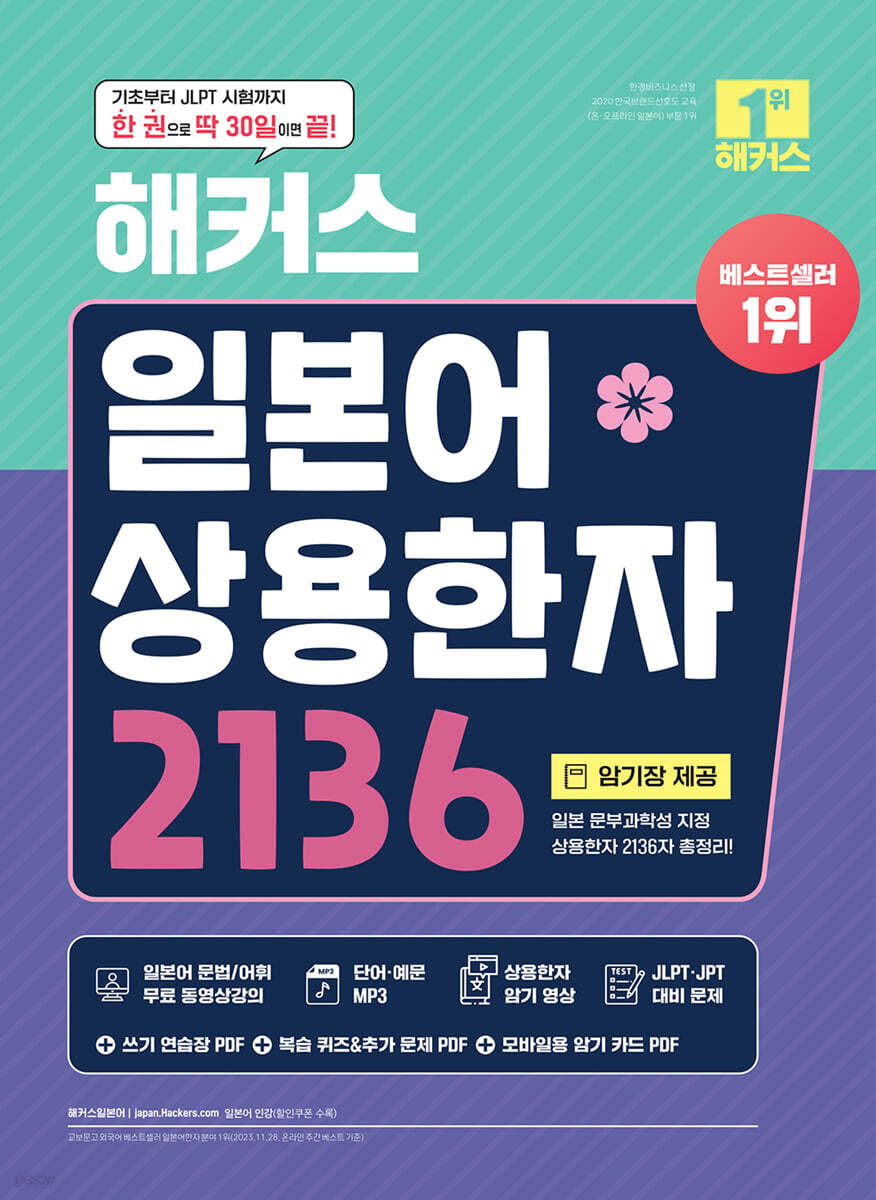
Hackers Japanese Common Kanji 2136
 |
Description
Book Introduction
Master the 2,136 commonly used kanji designated by the Japanese Ministry of Education, Culture, Sports, Science and Technology in just 30 days!
What are Japanese kanji? These are the 2,136 kanji designated by the Japanese Ministry of Education, Culture, Sports, Science and Technology as the standard for kanji used in everyday life, including laws, regulations, official documents, newspapers, magazines, and broadcasts.
You can learn the various pronunciations of a single Japanese kanji with certainty through [word → example → practice problem].
By grouping kanji characters by difficulty level and grouping them by topic or similar shape, you can effectively learn kanji. With vocabulary, example sentences, and questions reflecting JLPT/JPT test trends, you can prepare for various Japanese language exams.
To help you learn Chinese characters more effectively and accurately, we have included the ‘Disciple Principle’ and a ‘Collection of Confusing Words’ corner.
For more convenient and complete learning of Japanese common kanji, we provide an index [2136 common kanji characters in alphabetical order] and a [daily common kanji memorization book (PDF)].
We provide free [textbook MP3] that can be studied anytime, anywhere.
What are Japanese kanji? These are the 2,136 kanji designated by the Japanese Ministry of Education, Culture, Sports, Science and Technology as the standard for kanji used in everyday life, including laws, regulations, official documents, newspapers, magazines, and broadcasts.
You can learn the various pronunciations of a single Japanese kanji with certainty through [word → example → practice problem].
By grouping kanji characters by difficulty level and grouping them by topic or similar shape, you can effectively learn kanji. With vocabulary, example sentences, and questions reflecting JLPT/JPT test trends, you can prepare for various Japanese language exams.
To help you learn Chinese characters more effectively and accurately, we have included the ‘Disciple Principle’ and a ‘Collection of Confusing Words’ corner.
For more convenient and complete learning of Japanese common kanji, we provide an index [2136 common kanji characters in alphabetical order] and a [daily common kanji memorization book (PDF)].
We provide free [textbook MP3] that can be studied anytime, anywhere.
- You can preview some of the book's contents.
Preview
index
Hackers' textbook's unique structure and features
Japanese Kanji, let's start by knowing just this!
30-Day Study Plan to Strengthen Memorization
First Yard Beginner Kanji Kanji that appears in JLPT N5 and N4
Day 1, Number, Time, Location
Day 2 Nature, degree, condition
Day 3 People, Body, Movement
Day 4: Life, Thoughts, and Communication
Day 5: Appearance, objects, places, and transportation
Day 6: Learning, Art, Work
First yard finishing problem
Second Yard Intermediate Kanji Kanji appearing in JLPT N3 and N2
Day 7, Wed, Time, Location
Day 8 Status, Degree
Day 9 People, Body, Health
Day 10: Communication and Exchange
Day 11 Feelings, Thoughts
Day 12 Tendency, Movement
Day 13 Life, Appearance, Flora and Fauna
Day 14: Items, Clothes, Food
Day 15: Nature, Places, and Transportation
Day 16: Faith, Culture, and Learning
Day 17 Business, Industry, and Economy
Day 18 Law and Society
Second yard finishing problem
Third Yard Advanced Kanji Kanji appearing in JLPT N1
Day 19, Wed, Time, Status
Day 20 People, Body, Health
Day 21 Feelings, Emotions, Thoughts
Day 22: Life, Communication, and Exchange
Day 23: Tendency, Appearance
Day 24: Movement, Business, and Industry
Day 25: Clothes, food, and items
Day 26: Location, Environment, and Transportation
Day 27: Faith, Culture, and Performing Arts
Day 28 Nature, Animals, Plants
Day 29: Learning, History, and War
Day 30 Law and Society
Third yard finishing problem
supplement
Yard Finishing Problem Answers and Interpretations
2136 commonly used Chinese characters that can be found in alphabetical order
Japanese Kanji, let's start by knowing just this!
30-Day Study Plan to Strengthen Memorization
First Yard Beginner Kanji Kanji that appears in JLPT N5 and N4
Day 1, Number, Time, Location
Day 2 Nature, degree, condition
Day 3 People, Body, Movement
Day 4: Life, Thoughts, and Communication
Day 5: Appearance, objects, places, and transportation
Day 6: Learning, Art, Work
First yard finishing problem
Second Yard Intermediate Kanji Kanji appearing in JLPT N3 and N2
Day 7, Wed, Time, Location
Day 8 Status, Degree
Day 9 People, Body, Health
Day 10: Communication and Exchange
Day 11 Feelings, Thoughts
Day 12 Tendency, Movement
Day 13 Life, Appearance, Flora and Fauna
Day 14: Items, Clothes, Food
Day 15: Nature, Places, and Transportation
Day 16: Faith, Culture, and Learning
Day 17 Business, Industry, and Economy
Day 18 Law and Society
Second yard finishing problem
Third Yard Advanced Kanji Kanji appearing in JLPT N1
Day 19, Wed, Time, Status
Day 20 People, Body, Health
Day 21 Feelings, Emotions, Thoughts
Day 22: Life, Communication, and Exchange
Day 23: Tendency, Appearance
Day 24: Movement, Business, and Industry
Day 25: Clothes, food, and items
Day 26: Location, Environment, and Transportation
Day 27: Faith, Culture, and Performing Arts
Day 28 Nature, Animals, Plants
Day 29: Learning, History, and War
Day 30 Law and Society
Third yard finishing problem
supplement
Yard Finishing Problem Answers and Interpretations
2136 commonly used Chinese characters that can be found in alphabetical order
Detailed image
.jpg)
Publisher's Review
#1 in Japanese language education
Master the 2,136 commonly used kanji designated by the Japanese Ministry of Education, Culture, Sports, Science and Technology in just 30 days!
What are Japanese kanji? The 2,136 kanji designated by the Japanese Ministry of Education, Culture, Sports, Science and Technology as the standard for kanji used in everyday life, including laws, official documents, newspapers, magazines, and broadcasts.
[Recommended for these people]
1) Those who feel that they need to study kanji when studying Japanese
2) People who have trouble memorizing Japanese kanji or who quickly forget them even after memorizing them.
3) People who have no idea how to read kanji in Japanese words or sentences
4) Those who need to pass the JLPT and get a high score on the JPT
5) Those who want to master Chinese characters efficiently in a short period of time
[Hacker's Textbook's Unique Features]
1.
You can learn the various pronunciations of a single Japanese kanji with confidence through [word → example → practice problem].
1) Japanese kanji is not easy to learn because it is read with multiple pronunciations depending on the word.
Therefore, to learn Japanese kanji reliably and efficiently, you must learn them as words.
2) Also, by learning words through examples, you can naturally learn the usage examples of words that include the corresponding Chinese character, which ultimately allows you to learn the meaning of the Chinese character with certainty.
3) You can check whether you have memorized the pronunciation and meaning of the Chinese characters by solving the 'practice problems' at the end of each day.
2.
You can learn Chinese characters effectively by grouping them by difficulty level and grouping them by theme or similar shape.
1) Chinese characters are divided into beginner/intermediate/advanced levels and included by difficulty level. Beginner level includes N5-N4 level, intermediate level includes N3-N2 level, and advanced level includes N1 level, so you can learn from the level you want according to your ability and purpose.
2) You can memorize Chinese characters by topic, such as Chinese characters related to nature or Chinese characters related to people, so you can learn Chinese characters more effectively through association.
3) By listing Chinese characters with similar shapes, such as 雨/雲/雪 and 心/悲/急, you can quickly and easily learn and distinguish Chinese characters that appear difficult and complicated.
3. You can prepare for various Japanese language exams with vocabulary, examples, and questions that reflect JLPT/JPT test trends.
1) Among the example words of Chinese characters, the JLPT/JPT words from the past exams are marked as ‘Previous Exam’ so that you can learn the JLPT/JPT words from the past exams along with the pronunciation of the Chinese characters.
2) Through example sentences that reflect the test trends of the JLPT/JPT exam, you can learn the meaning of kanji and word usage, and prepare for JLPT N1~N5 and the JPT exam at the same time.
3) Through the 'End-of-the-Yard Problems' that are identical to the JLPT's kanji reading/writing types and JPT Part 5 question types and test trends, you can check whether you have completed your kanji studies well and experience actual test questions in advance.
4.
To help you learn Chinese characters more effectively and accurately, we have included the ‘Disciple Principle’ and a ‘Collection of Confusing Words’ corner.
1) Disciple Principle
Chinese characters were created in various ways, such as a river flowing down (川) meaning "cheon" or a tree flowing down (木) meaning "wood" or a forest (森) meaning "forest." Chinese characters were created by imitating certain shapes or by combining existing Chinese characters to create new characters.
So, if you understand why Chinese characters are shaped that way, you can memorize them more easily.
In the 'Disciple Principle' corner, we explain why each Chinese character is shaped that way, so that you can effectively memorize the shape of the Chinese character.
2) Gather confusing words
We have collected Chinese characters that are easily confused, such as homonyms and synonyms, and explained their exact meaning and usage with example sentences, so that you can more accurately understand the meaning of the word and the Chinese characters within the word.
5.
We provide Hackers' unique supplements to help you learn Japanese kanji more thoroughly.
1) 2136 commonly used Chinese characters that can be found in alphabetical order
- The index is arranged in Korean alphabetical order so that you can quickly find the Chinese character you are curious about even if you only know the Korean pronunciation.
- It is convenient because you can check the Japanese pronunciation of a kanji directly from the index without having to go to the page for the kanji in question.
2) PDF of additional daily common Chinese characters
- You can review your learning more thoroughly by solving additional daily practice problems and additional final problems for each yard.
3) Daily Common Chinese Character Memorization Book PDF
- We provide a PDF memorization book that shows the representative pronunciations and words of 2,136 commonly used Chinese characters at a glance, so you can easily study/review the most important part of learning Chinese characters anytime, anywhere.
4) PDF of mobile-friendly Chinese character memorization cards
- You can study/review the representative pronunciations and words of common Chinese characters in the form of memorization cards anytime, anywhere by putting them on your smartphone.
6.
We provide free [Words, Example MP3] that you can study anytime, anywhere.
By simply scanning the QR code, you can learn Chinese characters anytime, anywhere, while listening to the pronunciation of the characters, as well as vocabulary and example sentences.
(MP3 download and streaming also available)
Hackers' Additional Content for Learning Japanese - Hackers Japanese (japan.Hackers.com)
1.
Words, Example Sentences MP3
2.
Additional Chinese characters for daily use (PDF)
3.
Daily Common Chinese Character Memorization Book (PDF)
4.
Mobile-use Chinese Character Memorization Cards (PDF)
5.
Chinese Character Writing Practice Sheet (PDF)
6.
Common Chinese Character Memorization Video (Hackers Japanese Official YouTube Channel)
7.
Free Japanese Grammar/Vocabulary Video Lectures
Master the 2,136 commonly used kanji designated by the Japanese Ministry of Education, Culture, Sports, Science and Technology in just 30 days!
What are Japanese kanji? The 2,136 kanji designated by the Japanese Ministry of Education, Culture, Sports, Science and Technology as the standard for kanji used in everyday life, including laws, official documents, newspapers, magazines, and broadcasts.
[Recommended for these people]
1) Those who feel that they need to study kanji when studying Japanese
2) People who have trouble memorizing Japanese kanji or who quickly forget them even after memorizing them.
3) People who have no idea how to read kanji in Japanese words or sentences
4) Those who need to pass the JLPT and get a high score on the JPT
5) Those who want to master Chinese characters efficiently in a short period of time
[Hacker's Textbook's Unique Features]
1.
You can learn the various pronunciations of a single Japanese kanji with confidence through [word → example → practice problem].
1) Japanese kanji is not easy to learn because it is read with multiple pronunciations depending on the word.
Therefore, to learn Japanese kanji reliably and efficiently, you must learn them as words.
2) Also, by learning words through examples, you can naturally learn the usage examples of words that include the corresponding Chinese character, which ultimately allows you to learn the meaning of the Chinese character with certainty.
3) You can check whether you have memorized the pronunciation and meaning of the Chinese characters by solving the 'practice problems' at the end of each day.
2.
You can learn Chinese characters effectively by grouping them by difficulty level and grouping them by theme or similar shape.
1) Chinese characters are divided into beginner/intermediate/advanced levels and included by difficulty level. Beginner level includes N5-N4 level, intermediate level includes N3-N2 level, and advanced level includes N1 level, so you can learn from the level you want according to your ability and purpose.
2) You can memorize Chinese characters by topic, such as Chinese characters related to nature or Chinese characters related to people, so you can learn Chinese characters more effectively through association.
3) By listing Chinese characters with similar shapes, such as 雨/雲/雪 and 心/悲/急, you can quickly and easily learn and distinguish Chinese characters that appear difficult and complicated.
3. You can prepare for various Japanese language exams with vocabulary, examples, and questions that reflect JLPT/JPT test trends.
1) Among the example words of Chinese characters, the JLPT/JPT words from the past exams are marked as ‘Previous Exam’ so that you can learn the JLPT/JPT words from the past exams along with the pronunciation of the Chinese characters.
2) Through example sentences that reflect the test trends of the JLPT/JPT exam, you can learn the meaning of kanji and word usage, and prepare for JLPT N1~N5 and the JPT exam at the same time.
3) Through the 'End-of-the-Yard Problems' that are identical to the JLPT's kanji reading/writing types and JPT Part 5 question types and test trends, you can check whether you have completed your kanji studies well and experience actual test questions in advance.
4.
To help you learn Chinese characters more effectively and accurately, we have included the ‘Disciple Principle’ and a ‘Collection of Confusing Words’ corner.
1) Disciple Principle
Chinese characters were created in various ways, such as a river flowing down (川) meaning "cheon" or a tree flowing down (木) meaning "wood" or a forest (森) meaning "forest." Chinese characters were created by imitating certain shapes or by combining existing Chinese characters to create new characters.
So, if you understand why Chinese characters are shaped that way, you can memorize them more easily.
In the 'Disciple Principle' corner, we explain why each Chinese character is shaped that way, so that you can effectively memorize the shape of the Chinese character.
2) Gather confusing words
We have collected Chinese characters that are easily confused, such as homonyms and synonyms, and explained their exact meaning and usage with example sentences, so that you can more accurately understand the meaning of the word and the Chinese characters within the word.
5.
We provide Hackers' unique supplements to help you learn Japanese kanji more thoroughly.
1) 2136 commonly used Chinese characters that can be found in alphabetical order
- The index is arranged in Korean alphabetical order so that you can quickly find the Chinese character you are curious about even if you only know the Korean pronunciation.
- It is convenient because you can check the Japanese pronunciation of a kanji directly from the index without having to go to the page for the kanji in question.
2) PDF of additional daily common Chinese characters
- You can review your learning more thoroughly by solving additional daily practice problems and additional final problems for each yard.
3) Daily Common Chinese Character Memorization Book PDF
- We provide a PDF memorization book that shows the representative pronunciations and words of 2,136 commonly used Chinese characters at a glance, so you can easily study/review the most important part of learning Chinese characters anytime, anywhere.
4) PDF of mobile-friendly Chinese character memorization cards
- You can study/review the representative pronunciations and words of common Chinese characters in the form of memorization cards anytime, anywhere by putting them on your smartphone.
6.
We provide free [Words, Example MP3] that you can study anytime, anywhere.
By simply scanning the QR code, you can learn Chinese characters anytime, anywhere, while listening to the pronunciation of the characters, as well as vocabulary and example sentences.
(MP3 download and streaming also available)
Hackers' Additional Content for Learning Japanese - Hackers Japanese (japan.Hackers.com)
1.
Words, Example Sentences MP3
2.
Additional Chinese characters for daily use (PDF)
3.
Daily Common Chinese Character Memorization Book (PDF)
4.
Mobile-use Chinese Character Memorization Cards (PDF)
5.
Chinese Character Writing Practice Sheet (PDF)
6.
Common Chinese Character Memorization Video (Hackers Japanese Official YouTube Channel)
7.
Free Japanese Grammar/Vocabulary Video Lectures
GOODS SPECIFICS
- Date of issue: March 4, 2024
- Page count, weight, size: 692 pages | 188*257*35mm
- ISBN13: 9788965426516
- ISBN10: 8965426510
You may also like
카테고리
korean


korean

![GQ KOREA Mark (Monthly): December [2025]](http://librairie.coreenne.fr/cdn/shop/files/8ef265dbbfbf186523ed75ba7319009d.jpg?v=1765340328&width=3840)


