

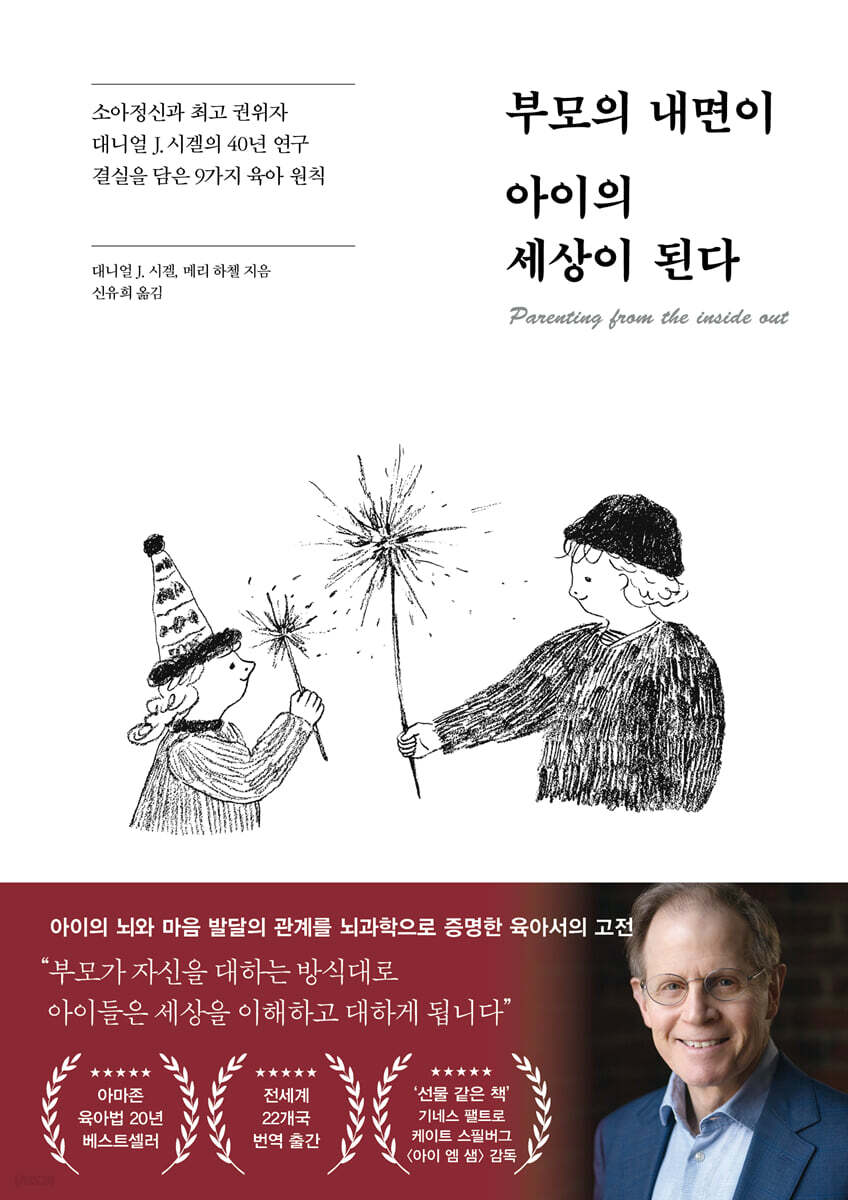
The parent's inner world becomes the child's world.
 |
Description
Book Introduction
“The way your parents treat you
“Children learn to understand and relate to the world.”
A classic parenting book that proves the relationship between a child's brain and mind development through neuroscience.
* Amazon's best-selling parenting book for 20 consecutive years *
* Published in 22 countries worldwide *
* Cumulative sales of 150,000 copies, cumulative YouTube views of over 10 million *
* A parenting book praised by Gwyneth Paltrow, Kate Spielberg, and I Am Sam director Jesse Nelson *
Daniel Siegel, a world-renowned bestselling author, cognitive psychologist, and child psychiatrist with over 1 million copies sold, has published his parenting book, "The Parent's Inner World Becomes the Child's World," in Korea.
The book was co-authored by Daniel Siegel and child development expert Mary Hartzel, whose relationship began when Siegel's daughter attended Mary's preschool.
This book, a collaboration between Siegel, who has studied medicine and science for over 40 years, and Mary, who has personally cared for and observed children in the field for 30 years, explores how parents' childhood experiences influence their parenting, helping them gain a deeper understanding of their own life stories.
The book, based on scientific evidence, explains how close parent-child relationships impact children's brain and emotional development, and presents nine key elements necessary for forming a stable parent-child relationship.
It also examines various factors, such as experiences with children, bonds, attachments, and communication methods, and emphasizes that when parents understand and respect their inner selves, their relationships with their children can become healthier.
“Children learn to understand and relate to the world.”
A classic parenting book that proves the relationship between a child's brain and mind development through neuroscience.
* Amazon's best-selling parenting book for 20 consecutive years *
* Published in 22 countries worldwide *
* Cumulative sales of 150,000 copies, cumulative YouTube views of over 10 million *
* A parenting book praised by Gwyneth Paltrow, Kate Spielberg, and I Am Sam director Jesse Nelson *
Daniel Siegel, a world-renowned bestselling author, cognitive psychologist, and child psychiatrist with over 1 million copies sold, has published his parenting book, "The Parent's Inner World Becomes the Child's World," in Korea.
The book was co-authored by Daniel Siegel and child development expert Mary Hartzel, whose relationship began when Siegel's daughter attended Mary's preschool.
This book, a collaboration between Siegel, who has studied medicine and science for over 40 years, and Mary, who has personally cared for and observed children in the field for 30 years, explores how parents' childhood experiences influence their parenting, helping them gain a deeper understanding of their own life stories.
The book, based on scientific evidence, explains how close parent-child relationships impact children's brain and emotional development, and presents nine key elements necessary for forming a stable parent-child relationship.
It also examines various factors, such as experiences with children, bonds, attachments, and communication methods, and emphasizes that when parents understand and respect their inner selves, their relationships with their children can become healthier.
- You can preview some of the book's contents.
Preview
index
Introduction
Chapter 1: How Do We Remember?: Experience
Inheriting the Shoe Shopping Method | Don't Cry, Baby | Memories Shape Who We Are | Recognizing a Problem Leads to a Solution | Accepting a Problem Leads to Moving Forward
What Parents Need to Know About Our Children's Brain Science
Chapter 2: How Do We Understand the World?: Stories
We perceive the world with both the left and right brains | Narratives are created through the collaboration of left and right processing modes | A coherent story is unified.
What Parents Need to Know About Our Children's Brain Science
Chapter 3: How Do You Feel?: Emotions
Feeling a connection underwater | Emotional connection creates a sense of connection | Crossing the two-legged pine tree | Emotional connection opens the door to communication | Integrative communication fosters connection
What Parents Need to Know About Our Children's Brain Science
Chapter 4: How to Communicate: Bonding
Responsiveness and consistency are key | Denial confuses children | Verbal and nonverbal cues must be aligned | Opening your heart opens channels of communication | Attention to both process and content creates connection
What Parents Need to Know About Our Children's Brain Science
Chapter 5: How Do We Form Attachments?: Relationships
Attachment determines development | Consistent responsiveness leads to secure attachment | Unresponsiveness creates avoidant and ambivalent attachment | Fear leads to disorganized attachment | Communication patterns vary depending on attachment style | As relationships change, so do attachments.
What Parents Need to Know About Our Children's Brain Science
Chapter 6: How Do We Understand Life?: Adult Attachment
Parents need to understand their own lives. Their children are affected differently by their adult attachment styles. They need to reflect on their attachments. They need to move toward secure attachments.
What Parents Need to Know About Our Children's Brain Science
Chapter 7: How to Stay Calm and How to Fall Apart: The High Road and the Low Road
If you take the low road, you must get off it. If you have unresolved problems, you will be stuck on the low road. If you look inside yourself, you will see a way out. You must solve problems through repeated interactions. You must confront and overcome problems.
What Parents Need to Know About Our Children's Brain Science
Chapter 8: How Things Break and Reconnect: Cracks and Repair
Minor cracks occur frequently | Setting vague limits creates cracks | When a destructive crack occurs, it must be repaired | Shameful experiences create defense mechanisms | Relationships can be repaired with effort | It is the parent's role to initiate the repair process | The gas pedal and the brake pedal must be balanced | Fights break out in the toy store
What Parents Need to Know About Our Children's Brain Science
Chapter 9: How to Develop Mindsight: Empathy and Reflective Dialogue
We must cultivate our minds with intention | We can see into the minds of others with our mind-sighting abilities | We must understand the fundamental elements of the mind | Parents are their children's scribes | We must foster a culture of compassion
What Parents Need to Know About Our Children's Brain Science
Looking back
Acknowledgements
Chapter 1: How Do We Remember?: Experience
Inheriting the Shoe Shopping Method | Don't Cry, Baby | Memories Shape Who We Are | Recognizing a Problem Leads to a Solution | Accepting a Problem Leads to Moving Forward
What Parents Need to Know About Our Children's Brain Science
Chapter 2: How Do We Understand the World?: Stories
We perceive the world with both the left and right brains | Narratives are created through the collaboration of left and right processing modes | A coherent story is unified.
What Parents Need to Know About Our Children's Brain Science
Chapter 3: How Do You Feel?: Emotions
Feeling a connection underwater | Emotional connection creates a sense of connection | Crossing the two-legged pine tree | Emotional connection opens the door to communication | Integrative communication fosters connection
What Parents Need to Know About Our Children's Brain Science
Chapter 4: How to Communicate: Bonding
Responsiveness and consistency are key | Denial confuses children | Verbal and nonverbal cues must be aligned | Opening your heart opens channels of communication | Attention to both process and content creates connection
What Parents Need to Know About Our Children's Brain Science
Chapter 5: How Do We Form Attachments?: Relationships
Attachment determines development | Consistent responsiveness leads to secure attachment | Unresponsiveness creates avoidant and ambivalent attachment | Fear leads to disorganized attachment | Communication patterns vary depending on attachment style | As relationships change, so do attachments.
What Parents Need to Know About Our Children's Brain Science
Chapter 6: How Do We Understand Life?: Adult Attachment
Parents need to understand their own lives. Their children are affected differently by their adult attachment styles. They need to reflect on their attachments. They need to move toward secure attachments.
What Parents Need to Know About Our Children's Brain Science
Chapter 7: How to Stay Calm and How to Fall Apart: The High Road and the Low Road
If you take the low road, you must get off it. If you have unresolved problems, you will be stuck on the low road. If you look inside yourself, you will see a way out. You must solve problems through repeated interactions. You must confront and overcome problems.
What Parents Need to Know About Our Children's Brain Science
Chapter 8: How Things Break and Reconnect: Cracks and Repair
Minor cracks occur frequently | Setting vague limits creates cracks | When a destructive crack occurs, it must be repaired | Shameful experiences create defense mechanisms | Relationships can be repaired with effort | It is the parent's role to initiate the repair process | The gas pedal and the brake pedal must be balanced | Fights break out in the toy store
What Parents Need to Know About Our Children's Brain Science
Chapter 9: How to Develop Mindsight: Empathy and Reflective Dialogue
We must cultivate our minds with intention | We can see into the minds of others with our mind-sighting abilities | We must understand the fundamental elements of the mind | Parents are their children's scribes | We must foster a culture of compassion
What Parents Need to Know About Our Children's Brain Science
Looking back
Acknowledgements
Detailed image

Into the book
Parents who understand themselves and develop themselves help their children grow by providing them with a foundation of emotional well-being and stability.
Research on early childhood development shows that children's secure attachment to their parents is closely linked to how well their parents perceive their own childhood experiences.
Contrary to popular belief, childhood experiences do not determine a person's entire life.
No matter how difficult your childhood may be, if you accept those experiences correctly, you can build a healthy relationship with your child without negative interactions.
---From the "Introductory Note"
No matter how much love and good intentions a parent may have, there may be long-standing defense mechanisms that prevent them from accepting their child's behavior.
This is probably the source of ‘parental ambivalence’.
If you fail to consciously recognize and accept when your child's behavior triggers unbearable emotions in you, you risk becoming unable to tolerate their behavior.
This can take the form of ignoring or dismissing children's feelings, which can cause them to become numb to reality and disconnected from their own emotions.
---From "Chapter 1: How Do We Remember?: Experience"
Reflecting on the narrative of your life can help you understand yourself more deeply, integrate your emotions into your daily life, and honor the precious ways of self-understanding that you so deeply value.
As your mind changes through self-reflection, you will find that your experiences with your children will also change.
The mind creates experience, and experience creates the mind.
The personal growth and deeper self-understanding you gain from developing your life story will enhance your mindsight skills and increase your sensitivity to your children.
---From "Chapter 2: How to Understand the World: Stories"
When a child experiences positive emotions such as joy or a sense of accomplishment, parents can share these emotional states and actively reflect on and amplify them with their child.
Likewise, when a child feels negative or uncomfortable emotions, such as disappointment or frustration, parents can empathize with the child's feelings and become a stable presence that comforts them.
Through these moments of bonding, the child feels that the parent is aware of his or her feelings and that he or she exists in the parent's heart.
Children feel good about themselves when they experience connection with adults who respond and empathize with them.
---From "Chapter 3: How Do You Feel?: Emotions"
Expressing emotions directly, simply, and in a comfortable way actually benefits children.
Children want to know not only what their parents think, but also what they feel.
When we express our frustration, anger, disappointment, excitement, pride, or joy, our children learn what is important to them and see a model of healthy emotional expression.
They also learn to empathize by observing how their parents react emotionally.
Only when we respect both our children's experiences and our own can we truly be authentic and passionate beings.
---From "Chapter 4: How to Communicate: Bonding"
Some people worry that attachment research suggests that childhood determines the rest of our lives.
But what the actual research suggests is that relationships with parents can change, and so can children's attachments.
In other words, it is not too late to make positive changes in your child's life.
Research also shows that feeling safe and understood through non-parental care provides nutrients for resilience, the seeds of emotional well-being that will grow with children as they grow.
Relationships with relatives, teachers, childcare workers, counselors, and others are important sources of connection for growing children.
While these relationships cannot replace a secure attachment with a primary caregiver, they certainly play a significant role in a child's emotional development.
---From "Chapter 5: How to Form Attachment: Relationships"
Parents' experiences can be a burden to children.
It is not your child's role to be your emotional support.
If the trauma occurred early, intensely, and repeatedly, you will likely need professional help on your journey toward a coherent story.
Overcoming trauma and hurt is possible and very important for yourself and your children.
Don't be afraid to confront unresolved issues.
I can't let those feelings control me any longer, and I can't let them affect the lives of my children.
Research on early childhood development shows that children's secure attachment to their parents is closely linked to how well their parents perceive their own childhood experiences.
Contrary to popular belief, childhood experiences do not determine a person's entire life.
No matter how difficult your childhood may be, if you accept those experiences correctly, you can build a healthy relationship with your child without negative interactions.
---From the "Introductory Note"
No matter how much love and good intentions a parent may have, there may be long-standing defense mechanisms that prevent them from accepting their child's behavior.
This is probably the source of ‘parental ambivalence’.
If you fail to consciously recognize and accept when your child's behavior triggers unbearable emotions in you, you risk becoming unable to tolerate their behavior.
This can take the form of ignoring or dismissing children's feelings, which can cause them to become numb to reality and disconnected from their own emotions.
---From "Chapter 1: How Do We Remember?: Experience"
Reflecting on the narrative of your life can help you understand yourself more deeply, integrate your emotions into your daily life, and honor the precious ways of self-understanding that you so deeply value.
As your mind changes through self-reflection, you will find that your experiences with your children will also change.
The mind creates experience, and experience creates the mind.
The personal growth and deeper self-understanding you gain from developing your life story will enhance your mindsight skills and increase your sensitivity to your children.
---From "Chapter 2: How to Understand the World: Stories"
When a child experiences positive emotions such as joy or a sense of accomplishment, parents can share these emotional states and actively reflect on and amplify them with their child.
Likewise, when a child feels negative or uncomfortable emotions, such as disappointment or frustration, parents can empathize with the child's feelings and become a stable presence that comforts them.
Through these moments of bonding, the child feels that the parent is aware of his or her feelings and that he or she exists in the parent's heart.
Children feel good about themselves when they experience connection with adults who respond and empathize with them.
---From "Chapter 3: How Do You Feel?: Emotions"
Expressing emotions directly, simply, and in a comfortable way actually benefits children.
Children want to know not only what their parents think, but also what they feel.
When we express our frustration, anger, disappointment, excitement, pride, or joy, our children learn what is important to them and see a model of healthy emotional expression.
They also learn to empathize by observing how their parents react emotionally.
Only when we respect both our children's experiences and our own can we truly be authentic and passionate beings.
---From "Chapter 4: How to Communicate: Bonding"
Some people worry that attachment research suggests that childhood determines the rest of our lives.
But what the actual research suggests is that relationships with parents can change, and so can children's attachments.
In other words, it is not too late to make positive changes in your child's life.
Research also shows that feeling safe and understood through non-parental care provides nutrients for resilience, the seeds of emotional well-being that will grow with children as they grow.
Relationships with relatives, teachers, childcare workers, counselors, and others are important sources of connection for growing children.
While these relationships cannot replace a secure attachment with a primary caregiver, they certainly play a significant role in a child's emotional development.
---From "Chapter 5: How to Form Attachment: Relationships"
Parents' experiences can be a burden to children.
It is not your child's role to be your emotional support.
If the trauma occurred early, intensely, and repeatedly, you will likely need professional help on your journey toward a coherent story.
Overcoming trauma and hurt is possible and very important for yourself and your children.
Don't be afraid to confront unresolved issues.
I can't let those feelings control me any longer, and I can't let them affect the lives of my children.
---From "Chapter 7: How to Stay Calm and How to Fall Apart: The High Road and the Low Road"
Publisher's Review
"Parents' self-healing power becomes their children's self-esteem."
As parents grow, so do children.
Parents' emotional state and inner experiences are important factors that determine the child's growth environment.
The emotional environment provided to a child varies depending on how parents understand and accept their own childhood.
Research shows that when parents are able to positively accept their past and regulate their emotions, they are able to form more secure and warm attachments with their children.
Conversely, if parents have unresolved issues or trauma, they may unconsciously have a negative impact on their interactions with their children.
Therefore, it is essential for a child's healthy growth for parents to first reflect on themselves and maintain a strong inner self.
This book offers practical ways for parents to reflect on themselves and improve their relationships with their children.
One of them is storytelling ability.
Stories play a vital role in helping children understand the world, and parents can leverage them to connect more deeply with their children.
Efforts to connect emotionally through verbal and nonverbal communication are also necessary.
When you form a resonant relationship with each other, you can deeply understand the other person's inner self and feel a sense of security that you are not alone.
Attachment is also a very important factor. Children need to form a secure attachment to their parents to be able to explore the world with peace of mind and form healthy interpersonal relationships.
These attachment patterns persist into adulthood and ultimately influence the next generation.
However, not forming secure attachments in childhood does not necessarily mean that you will be negatively affected.
A secure attachment can be 'acquired' later in life depending on how parents perceive and understand one's life.
Parents should engage in self-reflection and deal with their children without being swayed by emotions.
In everyday life, conflicts and rifts inevitably arise between parents and children, but it is in such times that parents must first reach out and try to restore the relationship.
When parents maintain composure and try to reconnect with their children, their children also find stability.
Parents and children should also engage in regular reflective conversations.
This helps develop the child's ability to empathize, which has a significant impact on how the child understands himself and views the world.
Being a “good enough” parent has a more positive impact on a child’s development than being a perfect parent.
Parents have a responsibility to take care of themselves so they don't get tired, and this book will guide them along the way so that they and their children can grow together.
A child who has learned to love will never fall apart.
Parenting methods that create a treasure trove in a child's heart with parental love
Children learn about emotions and how to navigate the world through their relationships with their parents.
Warm eye contact fosters a child's sense of security, and a gentle hug instills trust.
Empathetic conversations teach us how to regulate our emotions.
A loving look or a word of encouragement from a parent is deeply engraved in a child's brain.
The author explains the importance of parents' roles based on scientific research and suggests specific practical methods of implementation.
It goes beyond simple theoretical explanations and is richly filled with many real-life examples and experiences of parents.
Additionally, at the end of each chapter, we include a section titled 'Brain Science for Children: What Parents Should Know', which introduces research results related to child rearing.
After reading this section, you will gain a variety of scientific perspectives on parenting.
By following the process presented in the book, parents can learn to understand their own emotions and create change in their relationship with their children.
Through this, readers will find specific methods that they can apply to their own parenting styles.
As parents grow, so do children.
Parents' emotional state and inner experiences are important factors that determine the child's growth environment.
The emotional environment provided to a child varies depending on how parents understand and accept their own childhood.
Research shows that when parents are able to positively accept their past and regulate their emotions, they are able to form more secure and warm attachments with their children.
Conversely, if parents have unresolved issues or trauma, they may unconsciously have a negative impact on their interactions with their children.
Therefore, it is essential for a child's healthy growth for parents to first reflect on themselves and maintain a strong inner self.
This book offers practical ways for parents to reflect on themselves and improve their relationships with their children.
One of them is storytelling ability.
Stories play a vital role in helping children understand the world, and parents can leverage them to connect more deeply with their children.
Efforts to connect emotionally through verbal and nonverbal communication are also necessary.
When you form a resonant relationship with each other, you can deeply understand the other person's inner self and feel a sense of security that you are not alone.
Attachment is also a very important factor. Children need to form a secure attachment to their parents to be able to explore the world with peace of mind and form healthy interpersonal relationships.
These attachment patterns persist into adulthood and ultimately influence the next generation.
However, not forming secure attachments in childhood does not necessarily mean that you will be negatively affected.
A secure attachment can be 'acquired' later in life depending on how parents perceive and understand one's life.
Parents should engage in self-reflection and deal with their children without being swayed by emotions.
In everyday life, conflicts and rifts inevitably arise between parents and children, but it is in such times that parents must first reach out and try to restore the relationship.
When parents maintain composure and try to reconnect with their children, their children also find stability.
Parents and children should also engage in regular reflective conversations.
This helps develop the child's ability to empathize, which has a significant impact on how the child understands himself and views the world.
Being a “good enough” parent has a more positive impact on a child’s development than being a perfect parent.
Parents have a responsibility to take care of themselves so they don't get tired, and this book will guide them along the way so that they and their children can grow together.
A child who has learned to love will never fall apart.
Parenting methods that create a treasure trove in a child's heart with parental love
Children learn about emotions and how to navigate the world through their relationships with their parents.
Warm eye contact fosters a child's sense of security, and a gentle hug instills trust.
Empathetic conversations teach us how to regulate our emotions.
A loving look or a word of encouragement from a parent is deeply engraved in a child's brain.
The author explains the importance of parents' roles based on scientific research and suggests specific practical methods of implementation.
It goes beyond simple theoretical explanations and is richly filled with many real-life examples and experiences of parents.
Additionally, at the end of each chapter, we include a section titled 'Brain Science for Children: What Parents Should Know', which introduces research results related to child rearing.
After reading this section, you will gain a variety of scientific perspectives on parenting.
By following the process presented in the book, parents can learn to understand their own emotions and create change in their relationship with their children.
Through this, readers will find specific methods that they can apply to their own parenting styles.
GOODS SPECIFICS
- Date of issue: April 1, 2025
- Page count, weight, size: 372 pages | 606g | 152*215*30mm
- ISBN13: 9791169851305
- ISBN10: 1169851304
You may also like
카테고리
korean


korean

![GQ KOREA Mark (Monthly): December [2025]](http://librairie.coreenne.fr/cdn/shop/files/8ef265dbbfbf186523ed75ba7319009d.jpg?v=1765340328&width=3840)


