

Friedberg linear algebra
 |
Description
Book Introduction
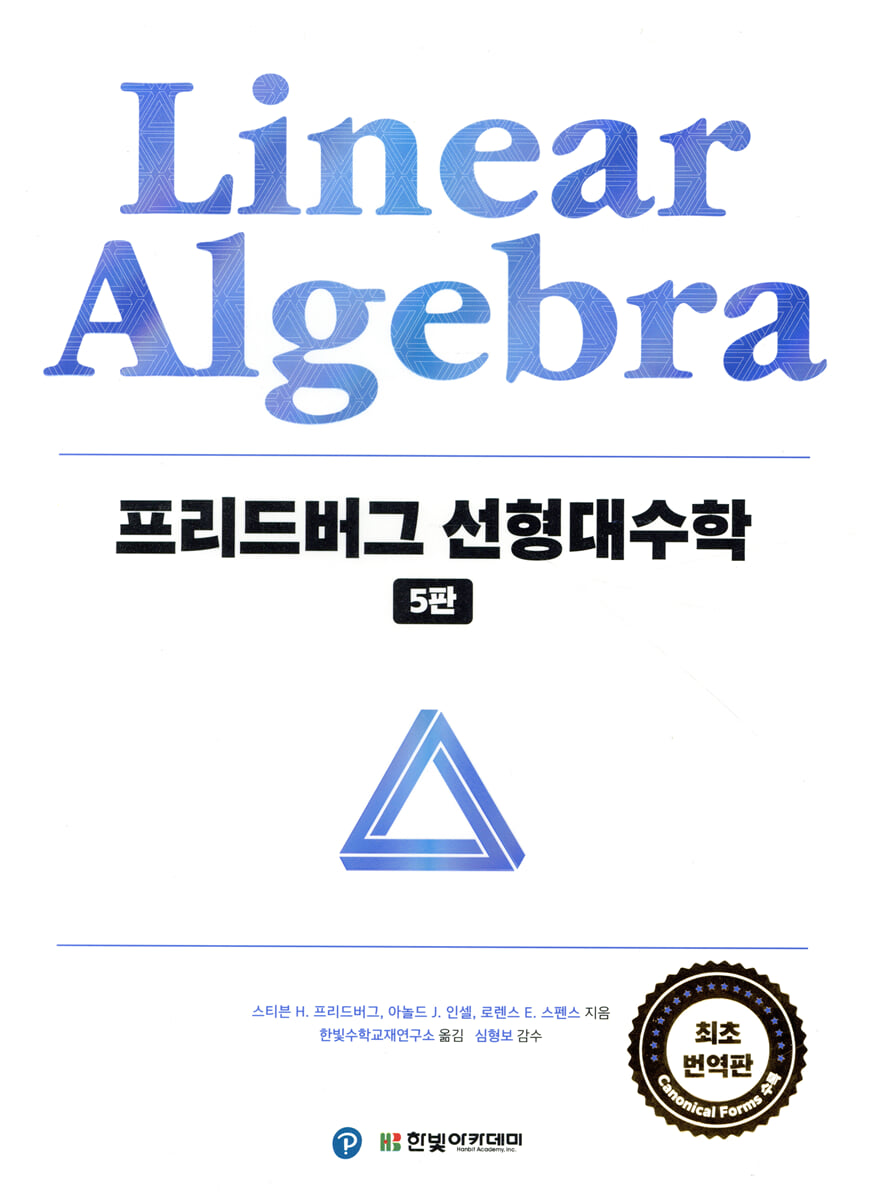
The first translation of Linear Algebra by Friedberg, Insel, and Spence, considered a representative work in linear algebra, has been published.
The standard forms (Chapter 7, Canonical Forms) missing from the 4th edition (International Edition) have been reintroduced, the book's presentation has been simplified, and parts that students may misunderstand have been clarified.
Improved the proofs of some theorems and added examples and practice problems.
The standard forms (Chapter 7, Canonical Forms) missing from the 4th edition (International Edition) have been reintroduced, the book's presentation has been simplified, and parts that students may misunderstand have been clarified.
Improved the proofs of some theorems and added examples and practice problems.
- You can preview some of the book's contents.
Preview
index
Chapter 1 Vector Space
1.1 Introduction
1.2 Vector space
1.3 Subspace
1.4 Linear combinations and simultaneous linear equations
1.5 Primary Dependence and Primary Independence
1.6 Basis and Dimension
1.7 Linearly independent maximal subsets*
Chapter 2 Linear Transformations and Matrices
2.1 Linear transformation, null space, and phase space
2.2 Matrix representation of linear transformations
2.3 Composition of linear transformations and matrix multiplication
2.4 Reversibility and Isomorphism
2.5 Coordinate transformation matrix
2.6 Dual space*
2.7 Homogeneous linear differential equations with constant coefficients*
Chapter 3: Basic Matrix Operations and Systems of Linear Equations
3.1 Basic matrix operations and basic matrices
3.2 Rank and inverse of a matrix
3.3 Systems of Linear Equations: Theoretical Aspects
3.4 Systems of Linear Equations: Computational Aspects
Chapter 4 Determinant
4.1 Determinant of a quadratic square matrix
4.2 Determinant of an nth-order square matrix
4.3 Properties of determinants
4.4 Summary of key points of determinants
4.5 Strict definition of determinant*
Chapter 5 Diagonalization
5.1 Eigenvalues and Eigenvectors
5.2 Diagonalizability
5.3 Matrix Limits and Markov Chains*
5.4 Invariant Subspaces and the Cayley-Hamilton Theorem
Chapter 6 Inner Space
6.1 Inner product and norm
6.2 Gram-Schmidt Orthogonalization and Orthogonal Complement
6.3 Companion operators of linear operators
6.4 Regular operators and self-complementary operators
6.5 Operators and Matrices: Unitary and Orthogonal Operators
6.6 Orthographic projection and spectral theorem
6.7 Singular value decomposition and pseudoinverse*
6.8 Bilinear and Quadratic Forms*
6.9 Einstein's special theory of relativity*
6.10 Conditioning and Rayleigh Quotients*
6.11 Orthogonal Operators and Geometry*
Chapter 7 Standard Type
7.1 Jordan Standard I: Theoretical Aspects
7.2 Jordan Standard II: Computational Aspects
7.3 Minimal polynomial
7.4 Glass Standard*
supplement
Set A
B function
C body
D complex number
E polynomial
List of F symbols
1.1 Introduction
1.2 Vector space
1.3 Subspace
1.4 Linear combinations and simultaneous linear equations
1.5 Primary Dependence and Primary Independence
1.6 Basis and Dimension
1.7 Linearly independent maximal subsets*
Chapter 2 Linear Transformations and Matrices
2.1 Linear transformation, null space, and phase space
2.2 Matrix representation of linear transformations
2.3 Composition of linear transformations and matrix multiplication
2.4 Reversibility and Isomorphism
2.5 Coordinate transformation matrix
2.6 Dual space*
2.7 Homogeneous linear differential equations with constant coefficients*
Chapter 3: Basic Matrix Operations and Systems of Linear Equations
3.1 Basic matrix operations and basic matrices
3.2 Rank and inverse of a matrix
3.3 Systems of Linear Equations: Theoretical Aspects
3.4 Systems of Linear Equations: Computational Aspects
Chapter 4 Determinant
4.1 Determinant of a quadratic square matrix
4.2 Determinant of an nth-order square matrix
4.3 Properties of determinants
4.4 Summary of key points of determinants
4.5 Strict definition of determinant*
Chapter 5 Diagonalization
5.1 Eigenvalues and Eigenvectors
5.2 Diagonalizability
5.3 Matrix Limits and Markov Chains*
5.4 Invariant Subspaces and the Cayley-Hamilton Theorem
Chapter 6 Inner Space
6.1 Inner product and norm
6.2 Gram-Schmidt Orthogonalization and Orthogonal Complement
6.3 Companion operators of linear operators
6.4 Regular operators and self-complementary operators
6.5 Operators and Matrices: Unitary and Orthogonal Operators
6.6 Orthographic projection and spectral theorem
6.7 Singular value decomposition and pseudoinverse*
6.8 Bilinear and Quadratic Forms*
6.9 Einstein's special theory of relativity*
6.10 Conditioning and Rayleigh Quotients*
6.11 Orthogonal Operators and Geometry*
Chapter 7 Standard Type
7.1 Jordan Standard I: Theoretical Aspects
7.2 Jordan Standard II: Computational Aspects
7.3 Minimal polynomial
7.4 Glass Standard*
supplement
Set A
B function
C body
D complex number
E polynomial
List of F symbols
Publisher's Review
It is considered one of the most representative books in linear algebra.
Linear algebra of Friedberg, Insel, and Spence
First publication of the translated work
Master the language of linear algebra through clear definitions, theorems, and examples.
Reading the friendly explanation will help you see linear algebra clearly.
Learn linear algebra systematically with proven practice problems.
You can lay the foundation for applying linear algebra in various fields!
Differences between the 4th and 5th editions
- The standard form (Chapter 7, Canonical Forms) that was missing from the 4th edition (International Edition) has been included again.
- Simplified the book's expressions and clarified parts that students may misunderstand.
- Improved the proofs of some theorems and added examples and practice problems.
Linear algebra of Friedberg, Insel, and Spence
First publication of the translated work
Master the language of linear algebra through clear definitions, theorems, and examples.
Reading the friendly explanation will help you see linear algebra clearly.
Learn linear algebra systematically with proven practice problems.
You can lay the foundation for applying linear algebra in various fields!
Differences between the 4th and 5th editions
- The standard form (Chapter 7, Canonical Forms) that was missing from the 4th edition (International Edition) has been included again.
- Simplified the book's expressions and clarified parts that students may misunderstand.
- Improved the proofs of some theorems and added examples and practice problems.
GOODS SPECIFICS
- Date of issue: June 5, 2020
- Page count, weight, size: 616 pages | 188*257mm
- ISBN13: 9791156644910
- ISBN10: 1156644917
You may also like
카테고리
korean


korean

![ELLE 엘르 스페셜 에디션 A형 : 12월 [2025]](http://librairie.coreenne.fr/cdn/shop/files/b8e27a3de6c9538896439686c6b0e8fb.jpg?v=1766436872&width=3840)


