

Rediscovering Parenting in the AI Era
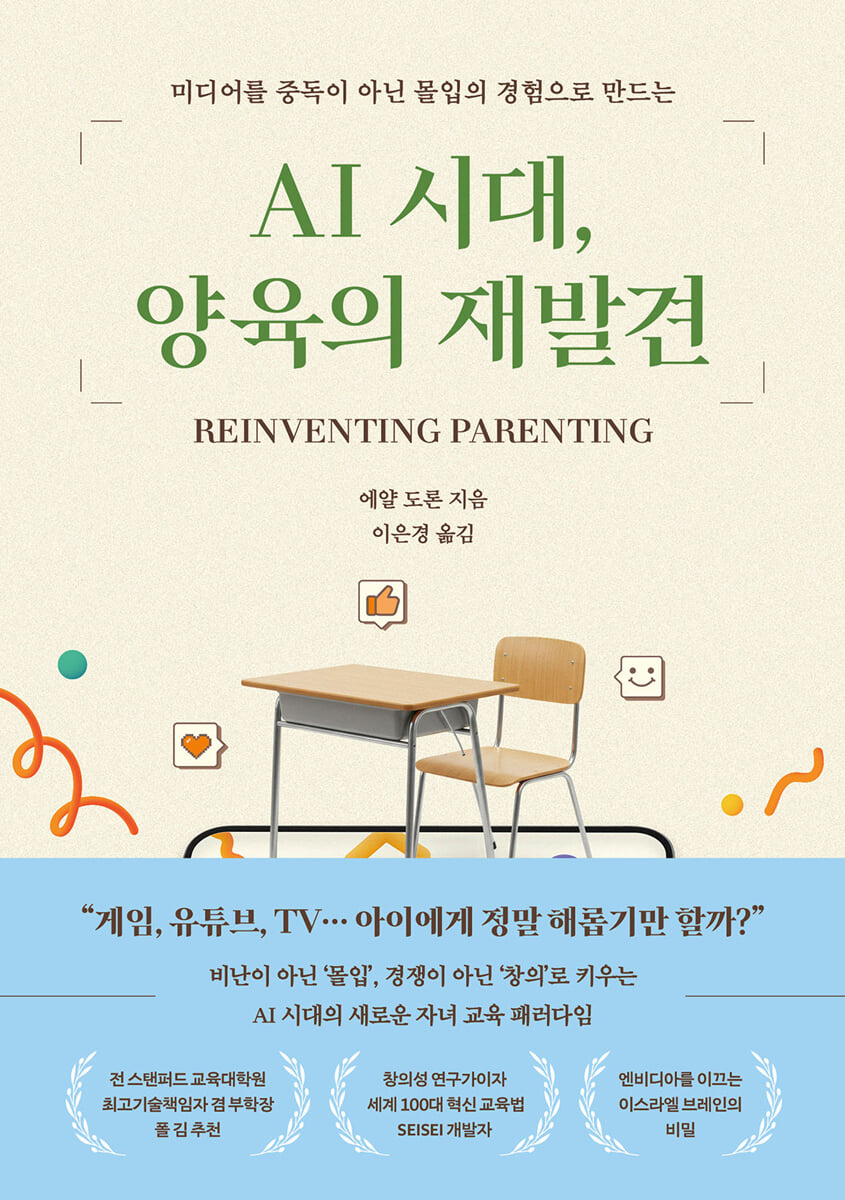 |
Description
Book Introduction
Recommended by Paul Kim, former Chief Technology Officer and Vice Dean of the Stanford Graduate School of Education
A book by a creativity researcher and developer of SEISEI, one of the world's top 100 innovative educational methods.
The Secret to Creativity Behind Nvidia's Israeli Brain
“How should we raise children in a world where ChatGPT can provide answers in just 4 seconds?”
A new paradigm for child education in the AI era: nurturing children through immersion rather than criticism, and creativity rather than competition.
Parents who are exhausted from pouring all their energy into their children's education, and the children who sit quietly beside them.
The current parenting system is stuck in a structure where no one can win.
Dr. Eyal Doron, author of “Rediscovering Parenting in the AI Age,” firmly states, “We must move away from the ‘everyone loses’ parenting approach and shift to a creative and open approach to parenting.”
Rather than simply warning about the harmful effects of media, we should use it as a tool to open new conversations with our children. Rather than criticizing schools, we should find creative parenting methods that work for our children.
YouTube will be reinterpreted as an immersive experience, TV as a time spent together, and games as a teaching aid for practicing failure.
This book sheds new light on previously taboo parenting experiences and proposes a new parenting environment for parents and children to create together.
A book by a creativity researcher and developer of SEISEI, one of the world's top 100 innovative educational methods.
The Secret to Creativity Behind Nvidia's Israeli Brain
“How should we raise children in a world where ChatGPT can provide answers in just 4 seconds?”
A new paradigm for child education in the AI era: nurturing children through immersion rather than criticism, and creativity rather than competition.
Parents who are exhausted from pouring all their energy into their children's education, and the children who sit quietly beside them.
The current parenting system is stuck in a structure where no one can win.
Dr. Eyal Doron, author of “Rediscovering Parenting in the AI Age,” firmly states, “We must move away from the ‘everyone loses’ parenting approach and shift to a creative and open approach to parenting.”
Rather than simply warning about the harmful effects of media, we should use it as a tool to open new conversations with our children. Rather than criticizing schools, we should find creative parenting methods that work for our children.
YouTube will be reinterpreted as an immersive experience, TV as a time spent together, and games as a teaching aid for practicing failure.
This book sheds new light on previously taboo parenting experiences and proposes a new parenting environment for parents and children to create together.
- You can preview some of the book's contents.
Preview
index
Preface to the Korean edition
introduction
Chapter 1: A New World, a Changing Role of Parents
the suffering middle class
Disappearing jobs
When to abandon traditional parenting
The YouTuber is coming
The power of obsession
Depending on the situation at the time
Chapter 2: Unconditional Parental Guilt
Is guilt a parent's destiny?
Parenting and Mask Syndrome
Life without children
Mom Stuck in Perfectionism
Never-ending parental anxiety
Is parenting quality or quantity?
The older generation's perspective on 'kids these days'
Parents are neighborhood book
The Parenting Myth Hidden Behind Guilt
Another face of guilt
Change of thinking
Parenting is a form of self-actualization.
Chapter 3: Homework that Hinders a Child's Growth
Betrayal of Homework
The problem with homework
The importance of intrinsic motivation
The environment determines a child's future.
Carrot and Stick
Parents Need Intrinsic Motivation Too
As homework connected to daily life
The power of intrinsic motivation
Chapter 4 Television is a Window of Opportunity
Television and ADHD
Myths and Truths About Television
Watching television triggers intrinsic motivation.
Television and Violence in Children
The Effects of Violent Scenes on Children
How to Watch Television According to Your Child's Age
12 years old, the age when you become a real viewer
Is violence always bad?
Chapter 5: The Game Changer in Parenting
Children who play games study better.
The game is about learning
Should I stop my child from playing games?
A gaming experience that helps children grow
The appeal of the game
A gaming world where failure isn't a fear
The immersive experience that games provide
School education that disrupts immersion
Game School in New York
The answer to parenting lies in games.
Parents Need Gaming Experience Too
Chapter 6: Helicopter Daddy and Tiger Mom
What type of parent am I?
Parenting that begins with a dilemma and ends with a dilemma
Oriental education attracts attention
A kid who wants a motorcycle
Self-control and emotional maturity
creative parents
What to do when you really don't know
Things you shouldn't say to your child
Value-centered parenting
Chapter 7: Four Tools for Creative Parenting
Tool 1: Finding Things You Don't Need
Tool 2: The Creative Formula of '1+1'
Tool 3: Creating Creative Consciousness
Tool 4 Do it first or last
Chapter 8: Creating Creative Routines
Take an interest in your surroundings
Maximum effect with minimum resources
Examples of 'creative routines'
A chance discovery while traveling
Chapter 9 Curiosity as a Curriculum
References
introduction
Chapter 1: A New World, a Changing Role of Parents
the suffering middle class
Disappearing jobs
When to abandon traditional parenting
The YouTuber is coming
The power of obsession
Depending on the situation at the time
Chapter 2: Unconditional Parental Guilt
Is guilt a parent's destiny?
Parenting and Mask Syndrome
Life without children
Mom Stuck in Perfectionism
Never-ending parental anxiety
Is parenting quality or quantity?
The older generation's perspective on 'kids these days'
Parents are neighborhood book
The Parenting Myth Hidden Behind Guilt
Another face of guilt
Change of thinking
Parenting is a form of self-actualization.
Chapter 3: Homework that Hinders a Child's Growth
Betrayal of Homework
The problem with homework
The importance of intrinsic motivation
The environment determines a child's future.
Carrot and Stick
Parents Need Intrinsic Motivation Too
As homework connected to daily life
The power of intrinsic motivation
Chapter 4 Television is a Window of Opportunity
Television and ADHD
Myths and Truths About Television
Watching television triggers intrinsic motivation.
Television and Violence in Children
The Effects of Violent Scenes on Children
How to Watch Television According to Your Child's Age
12 years old, the age when you become a real viewer
Is violence always bad?
Chapter 5: The Game Changer in Parenting
Children who play games study better.
The game is about learning
Should I stop my child from playing games?
A gaming experience that helps children grow
The appeal of the game
A gaming world where failure isn't a fear
The immersive experience that games provide
School education that disrupts immersion
Game School in New York
The answer to parenting lies in games.
Parents Need Gaming Experience Too
Chapter 6: Helicopter Daddy and Tiger Mom
What type of parent am I?
Parenting that begins with a dilemma and ends with a dilemma
Oriental education attracts attention
A kid who wants a motorcycle
Self-control and emotional maturity
creative parents
What to do when you really don't know
Things you shouldn't say to your child
Value-centered parenting
Chapter 7: Four Tools for Creative Parenting
Tool 1: Finding Things You Don't Need
Tool 2: The Creative Formula of '1+1'
Tool 3: Creating Creative Consciousness
Tool 4 Do it first or last
Chapter 8: Creating Creative Routines
Take an interest in your surroundings
Maximum effect with minimum resources
Examples of 'creative routines'
A chance discovery while traveling
Chapter 9 Curiosity as a Curriculum
References
Detailed image

Into the book
It's interesting to observe how parenting these days resembles the way parents complain about school.
The complaint we are talking about here is an attitude of enforcing rules, asserting authority, and assigning tasks.
Many parents are problem-solvers, energetic, and humorous at work, but when they get home, they become stiff, clock-counting, and homework-dictating parents.
Outside, they are good at taking initiative, coming up with creative ideas, and being playful and fun, but once they get home, all of this disappears.
--- p.11
We grew up in a predictable culture with set rules and traditions.
The standardized life formula of studying hard to pass exams and working hard to secure a secure future has traditionally been taken for granted, and it has been easy to pass this culture on to the next generation.
But the new world rejects this formula.
Futurist and author Martin Ford raises an inconvenient truth:
According to him, the income stability of middle-class jobs, which were considered socially stable and decent, is more threatened than jobs at the extremes.
For example, people with degrees in popular fields like law, economics, and history are at higher risk of unemployment than those in highly skilled professions like doctors, psychologists, and architects, or those in occupations that rely on manual skills like hairdressers and gardeners.
--- p.26
When our parents' generation was young, they emphasized caution, responsibility, and maturity, so acting wisely and thoughtfully was praised.
Of course, these are important and necessary qualities for living.
However, while responsibility and maturity are not without value, they are not absolute.
In particular, parenting styles that emphasize responsibility sometimes turn out to be irresponsible.
Overly strict, rule-based parenting styles struggle to adapt to a dynamically changing world.
Children who don't acquire the skills necessary to respond appropriately to situations will find themselves without a place to stand.
--- p.36
Unfortunately, discourse on desirable parenting emphasizes the importance of mental balance over one-sided immersion.
We've heard it time and time again: "Everything in moderation, balance is key," and the advice that "excessive indulgence in anything is bad, extremes are dangerous" has always been there.
Those who cling to this way of thinking are more likely to miss the true value inherent in mental balance.
Here we are faced with a fundamental question.
Is the true value of life only a restrained approach to balancing conflicting desires? Is the ideal life one in which all areas of life are logically balanced and balanced?
--- p.45
Parents always come home feeling guilty.
Perhaps that is to be expected.
For most of a child's childhood, parents do not spend much time with them.
This is not just an external factor for making a living, but also a result of a personal desire to grow and develop, to realize oneself, to succeed and to be recognized.
Dr. Manshalvi said:
“In effect, we made a very aggressive choice by disappearing from the child’s presence.
“It’s not enough to just see your child briefly at the beginning and end of the day, and even that time is spent in a state of exhaustion.”
--- p.92
Let's go ahead and look into the future 15 years from now.
My adult daughter is an excellent employee with excellent work skills.
She is particularly adept at solving very specific types of problems, such as 'pages 92 through 99', given to her by others.
Later, she is offered a promotion to a position that requires more management skills.
She asks with an excited face on her first day at the office on her new job.
“Where is the guide?” No one understands the intent of the question or what the guide is.
She struggles to explain.
“The guide… tells me exactly what I need to do…” Now she realizes that in reality, no one will tell her what pages to complete, because she is the one who decides what the guide is.
The problem is that she is not ready for this kind of role.
This is part of a major change we are experiencing.
--- p.110
Professor John Hattie, considered by many to be one of the world's most influential educators, points out that 'unfortunately, many parents judge a school's quality by whether or not there is homework, and by how much it is.'
Professor Hattie reviewed studies showing that the correlation between time spent on homework and academic achievement in elementary school students was close to zero.
Furthermore, homework reduces children's motivation to learn and causes them to internalize poor routines and ineffective study habits.
According to him, there is no evidence that homework is effective in developing time management skills, and homework done without active teacher intervention does not help students learn.
What's surprising is how much time we spend doing homework and talking about it.
There are endless other activities your kids could have done during that time: volunteering, playing outside with friends, spending time with their grandparents, making videos, cooking or baking, exercising, helping a neighbor, learning a new language, and so on.
--- p.116
Intrinsic motivation is the energy you naturally pour into a task.
Children with deep intrinsic motivation engage spontaneously in challenges, not for rewards or external goals.
Children with intrinsic motivation become adults who are persistent, goal-focused, and self-satisfied.
They are more likely to be absorbed in their work and earn more money without realizing the passage of time.
This is what every parent wants their child to be like.
Homework is a symbol of the exact opposite.
It is nothing more than repetitive, mechanical study without any personal interest or connection to life, a series of exhausting exercises, and a so-called grade factory that produces results called grades.
--- p.125
Robert Abelman observed second, fifth, and eighth grade students attending 15 elementary schools.
Some of these children had average IQs, while others were gifted.
Although all children had access to video games and television at home, the difference came from their parents' attitudes.
Parents of non-gifted children in the study constantly negotiated with or set limits on their children's television viewing time.
In contrast, parents of gifted children rarely restricted their children's television viewing and instead focused on other aspects of their children's viewing.
They felt it was important to talk to the child about the program and provide tools for the child to interpret the program on their own.
Parents of non-gifted children worried that their children would imitate the violent behavior on screen, but parents of gifted children trusted their children.
Overall, parents of gifted children felt much more comfortable discussing the topic of "screens."
Of course, this doesn't mean that this method will make a child gifted, but it's definitely something to think about.
--- p.159
Over the past two decades, numerous studies have demonstrated the positive effects of games on the way children and adolescents think and make decisions.
For example, some studies have found that video games help develop children's logical, cognitive, and social skills.
What's more, games can improve attention, vigilance, and spatial perception, help children track objects despite distractions, and even improve reading skills in children with dyslexia.
Games also improve overall performance, from the ability to perform multiple complex tasks simultaneously (multitasking) to the mental flexibility to quickly and error-free switch between tasks that require conflicting performance.
Additionally, games have been shown to improve coordination, quick decision-making, and short-term memory.
Gamers flew drones better than non-players and demonstrated skills similar to those of experienced drone pilots.
There is also evidence in the medical community about the effectiveness of gaming.
Younger, less experienced surgeons who were gamers performed better than experienced surgeons.
--- p.195
In recent decades, various parenting models have emerged around the world.
One of them is helicopter parenting.
Helicopter parents hover over their children and constantly watch them closely.
We are ready to intervene, advise, help, and protect even when it is not necessary.
They are overly involved in their children's education, constantly supervising them and frequently contacting teachers.
Another overprotective parenting style is snowplow parenting or lawnmower parenting (the name varies depending on the climate you live in).
They move one step ahead of their children, clearing and leveling the path ahead for them.
Remove everything in advance so that the child does not encounter any obstacles.
For example, they force the child to join a certain team, try to persuade the teacher, or apply pressure behind the scenes without the child's knowledge.
But this overprotection does not restore parental authority.
Rather, the opposite result
Give birth.
Such parents can easily end up becoming their child's dedicated servants.
--- p.259
Creative parents reveal themselves fully.
That is, do not limit yourself to one role as a responsible adult.
These parents verbalize their thoughts to their children, deeply empathize with their children's intuition, and seek new ways to solve problems rather than sticking to established methods.
Children have the opportunity to learn how to solve life's problems as they consider which path to choose next.
Children prepare for life by exploring possibilities, researching information, examining details, thinking for themselves, and facing uncertain situations.
They seek advice but don't let go of their own intuition, they postpone decisions for a while, and sometimes they even think about it for a long time.
The important thing is to approach this entire process with curiosity and without fear.
--- p.288
According to Professor Dacey's research, parents in creative families had an average of one rule regarding their children's behavior, while parents in typical families had an average of six rules.
Professor Daisy said in a telephone interview.
“We used a control group of children who had no outstanding achievements in creativity, and their parents had nine rules.
That's very specific too.
Things like telling people not to smoke or to go to bed at 10 p.m.
In contrast, parents of creative children were perplexed, asking, "Did I ever have rules?"
'Just a moment.
There must be at least one rule…' he said.
But what they all had in common was that they wanted their children to become people who contribute greatly to society.”
--- p.308
Our role as parents is to help our children think more flexibly, be open to new experiences, feel comfortable in a constantly changing world, get along well with diverse people, and boldly dive into unfamiliar environments, becoming learners from the start.
And we too must learn to break away from the traditional rule-based parenting style and instead be present with our children in the moment.
The attitude of shifting all responsibility to the school must stop now.
Don't be afraid to stand on the opposite side of 'right'.
In many cases, what is right is actually not right at all.
In the midst of the chaos of comparisons, figures, studies, and warnings, have faith in your own judgment.
Parents' intuition is, and will always be, their children's greatest asset.
--- p.378
In "Gardener Parents and Carpenter Parents," Professor Alison Gopnik advises parents to stop being "carpenters."
Rather than trying to sculpt a child into a specific type of adult, we should become 'gardeners' who cultivate an environment where each plant can grow on its own.
Parents cannot control how their children grow up, but it is their responsibility to provide a space where they can grow up healthily.
Professor Gopnik says, "Parenting is not a skill or task to be mastered, it's simply being a parent."
I'd like to add one more thing here.
Parenting is not just about raising children.
We ourselves can grow together within it.
Becoming a parent is also an opportunity to revisit issues we didn't fully resolve in childhood—or are still grappling with.
For example, thinking independently, being less conscious of what others think, connecting emotionally, genuinely enjoying and being happy, loving what I do, discovering aspects of myself I never knew existed, and having the courage to get to know new people and the world.
Your journey as a parent can be a time to revisit those challenges and face them differently, this time with your child.
The complaint we are talking about here is an attitude of enforcing rules, asserting authority, and assigning tasks.
Many parents are problem-solvers, energetic, and humorous at work, but when they get home, they become stiff, clock-counting, and homework-dictating parents.
Outside, they are good at taking initiative, coming up with creative ideas, and being playful and fun, but once they get home, all of this disappears.
--- p.11
We grew up in a predictable culture with set rules and traditions.
The standardized life formula of studying hard to pass exams and working hard to secure a secure future has traditionally been taken for granted, and it has been easy to pass this culture on to the next generation.
But the new world rejects this formula.
Futurist and author Martin Ford raises an inconvenient truth:
According to him, the income stability of middle-class jobs, which were considered socially stable and decent, is more threatened than jobs at the extremes.
For example, people with degrees in popular fields like law, economics, and history are at higher risk of unemployment than those in highly skilled professions like doctors, psychologists, and architects, or those in occupations that rely on manual skills like hairdressers and gardeners.
--- p.26
When our parents' generation was young, they emphasized caution, responsibility, and maturity, so acting wisely and thoughtfully was praised.
Of course, these are important and necessary qualities for living.
However, while responsibility and maturity are not without value, they are not absolute.
In particular, parenting styles that emphasize responsibility sometimes turn out to be irresponsible.
Overly strict, rule-based parenting styles struggle to adapt to a dynamically changing world.
Children who don't acquire the skills necessary to respond appropriately to situations will find themselves without a place to stand.
--- p.36
Unfortunately, discourse on desirable parenting emphasizes the importance of mental balance over one-sided immersion.
We've heard it time and time again: "Everything in moderation, balance is key," and the advice that "excessive indulgence in anything is bad, extremes are dangerous" has always been there.
Those who cling to this way of thinking are more likely to miss the true value inherent in mental balance.
Here we are faced with a fundamental question.
Is the true value of life only a restrained approach to balancing conflicting desires? Is the ideal life one in which all areas of life are logically balanced and balanced?
--- p.45
Parents always come home feeling guilty.
Perhaps that is to be expected.
For most of a child's childhood, parents do not spend much time with them.
This is not just an external factor for making a living, but also a result of a personal desire to grow and develop, to realize oneself, to succeed and to be recognized.
Dr. Manshalvi said:
“In effect, we made a very aggressive choice by disappearing from the child’s presence.
“It’s not enough to just see your child briefly at the beginning and end of the day, and even that time is spent in a state of exhaustion.”
--- p.92
Let's go ahead and look into the future 15 years from now.
My adult daughter is an excellent employee with excellent work skills.
She is particularly adept at solving very specific types of problems, such as 'pages 92 through 99', given to her by others.
Later, she is offered a promotion to a position that requires more management skills.
She asks with an excited face on her first day at the office on her new job.
“Where is the guide?” No one understands the intent of the question or what the guide is.
She struggles to explain.
“The guide… tells me exactly what I need to do…” Now she realizes that in reality, no one will tell her what pages to complete, because she is the one who decides what the guide is.
The problem is that she is not ready for this kind of role.
This is part of a major change we are experiencing.
--- p.110
Professor John Hattie, considered by many to be one of the world's most influential educators, points out that 'unfortunately, many parents judge a school's quality by whether or not there is homework, and by how much it is.'
Professor Hattie reviewed studies showing that the correlation between time spent on homework and academic achievement in elementary school students was close to zero.
Furthermore, homework reduces children's motivation to learn and causes them to internalize poor routines and ineffective study habits.
According to him, there is no evidence that homework is effective in developing time management skills, and homework done without active teacher intervention does not help students learn.
What's surprising is how much time we spend doing homework and talking about it.
There are endless other activities your kids could have done during that time: volunteering, playing outside with friends, spending time with their grandparents, making videos, cooking or baking, exercising, helping a neighbor, learning a new language, and so on.
--- p.116
Intrinsic motivation is the energy you naturally pour into a task.
Children with deep intrinsic motivation engage spontaneously in challenges, not for rewards or external goals.
Children with intrinsic motivation become adults who are persistent, goal-focused, and self-satisfied.
They are more likely to be absorbed in their work and earn more money without realizing the passage of time.
This is what every parent wants their child to be like.
Homework is a symbol of the exact opposite.
It is nothing more than repetitive, mechanical study without any personal interest or connection to life, a series of exhausting exercises, and a so-called grade factory that produces results called grades.
--- p.125
Robert Abelman observed second, fifth, and eighth grade students attending 15 elementary schools.
Some of these children had average IQs, while others were gifted.
Although all children had access to video games and television at home, the difference came from their parents' attitudes.
Parents of non-gifted children in the study constantly negotiated with or set limits on their children's television viewing time.
In contrast, parents of gifted children rarely restricted their children's television viewing and instead focused on other aspects of their children's viewing.
They felt it was important to talk to the child about the program and provide tools for the child to interpret the program on their own.
Parents of non-gifted children worried that their children would imitate the violent behavior on screen, but parents of gifted children trusted their children.
Overall, parents of gifted children felt much more comfortable discussing the topic of "screens."
Of course, this doesn't mean that this method will make a child gifted, but it's definitely something to think about.
--- p.159
Over the past two decades, numerous studies have demonstrated the positive effects of games on the way children and adolescents think and make decisions.
For example, some studies have found that video games help develop children's logical, cognitive, and social skills.
What's more, games can improve attention, vigilance, and spatial perception, help children track objects despite distractions, and even improve reading skills in children with dyslexia.
Games also improve overall performance, from the ability to perform multiple complex tasks simultaneously (multitasking) to the mental flexibility to quickly and error-free switch between tasks that require conflicting performance.
Additionally, games have been shown to improve coordination, quick decision-making, and short-term memory.
Gamers flew drones better than non-players and demonstrated skills similar to those of experienced drone pilots.
There is also evidence in the medical community about the effectiveness of gaming.
Younger, less experienced surgeons who were gamers performed better than experienced surgeons.
--- p.195
In recent decades, various parenting models have emerged around the world.
One of them is helicopter parenting.
Helicopter parents hover over their children and constantly watch them closely.
We are ready to intervene, advise, help, and protect even when it is not necessary.
They are overly involved in their children's education, constantly supervising them and frequently contacting teachers.
Another overprotective parenting style is snowplow parenting or lawnmower parenting (the name varies depending on the climate you live in).
They move one step ahead of their children, clearing and leveling the path ahead for them.
Remove everything in advance so that the child does not encounter any obstacles.
For example, they force the child to join a certain team, try to persuade the teacher, or apply pressure behind the scenes without the child's knowledge.
But this overprotection does not restore parental authority.
Rather, the opposite result
Give birth.
Such parents can easily end up becoming their child's dedicated servants.
--- p.259
Creative parents reveal themselves fully.
That is, do not limit yourself to one role as a responsible adult.
These parents verbalize their thoughts to their children, deeply empathize with their children's intuition, and seek new ways to solve problems rather than sticking to established methods.
Children have the opportunity to learn how to solve life's problems as they consider which path to choose next.
Children prepare for life by exploring possibilities, researching information, examining details, thinking for themselves, and facing uncertain situations.
They seek advice but don't let go of their own intuition, they postpone decisions for a while, and sometimes they even think about it for a long time.
The important thing is to approach this entire process with curiosity and without fear.
--- p.288
According to Professor Dacey's research, parents in creative families had an average of one rule regarding their children's behavior, while parents in typical families had an average of six rules.
Professor Daisy said in a telephone interview.
“We used a control group of children who had no outstanding achievements in creativity, and their parents had nine rules.
That's very specific too.
Things like telling people not to smoke or to go to bed at 10 p.m.
In contrast, parents of creative children were perplexed, asking, "Did I ever have rules?"
'Just a moment.
There must be at least one rule…' he said.
But what they all had in common was that they wanted their children to become people who contribute greatly to society.”
--- p.308
Our role as parents is to help our children think more flexibly, be open to new experiences, feel comfortable in a constantly changing world, get along well with diverse people, and boldly dive into unfamiliar environments, becoming learners from the start.
And we too must learn to break away from the traditional rule-based parenting style and instead be present with our children in the moment.
The attitude of shifting all responsibility to the school must stop now.
Don't be afraid to stand on the opposite side of 'right'.
In many cases, what is right is actually not right at all.
In the midst of the chaos of comparisons, figures, studies, and warnings, have faith in your own judgment.
Parents' intuition is, and will always be, their children's greatest asset.
--- p.378
In "Gardener Parents and Carpenter Parents," Professor Alison Gopnik advises parents to stop being "carpenters."
Rather than trying to sculpt a child into a specific type of adult, we should become 'gardeners' who cultivate an environment where each plant can grow on its own.
Parents cannot control how their children grow up, but it is their responsibility to provide a space where they can grow up healthily.
Professor Gopnik says, "Parenting is not a skill or task to be mastered, it's simply being a parent."
I'd like to add one more thing here.
Parenting is not just about raising children.
We ourselves can grow together within it.
Becoming a parent is also an opportunity to revisit issues we didn't fully resolve in childhood—or are still grappling with.
For example, thinking independently, being less conscious of what others think, connecting emotionally, genuinely enjoying and being happy, loving what I do, discovering aspects of myself I never knew existed, and having the courage to get to know new people and the world.
Your journey as a parent can be a time to revisit those challenges and face them differently, this time with your child.
--- p.380
Publisher's Review
“Times are changing, so why don’t parenting methods change?”
A must-read for all parents who want to raise children who are self-directed questioners and learners.
Paul Kim, former Chief Technology Officer and Vice Dean of the Stanford Graduate School of Education
There is a scene that repeats itself every morning.
“Wake up, it’s already 7 o’clock!”, “Did you brush your teeth?”, “Did you pack your bag?” Even in the evening, phrases like “Stop watching TV”, “Play games in moderation”, and “Did you finish your homework?” continue.
Parents repeat the same nagging like programmed machines, and children's individuality and curiosity are pushed to the back burner.
The damage is passed on entirely to the children.
Because they are faced with the changes of the 21st century unprepared and have to deal with parents who are exhausted from raising children.
Moreover, 96% of American parents feel guilty about parenting, and more than 70% of British mothers feel pressure to look perfect.
Korea is no different.
Mothers are shaken by the guilt of not being able to raise their children well, and fathers are shaken by the burden of not being able to fulfill their roles sufficiently.
Eventually, even the children are affected, and the whole family becomes trapped in a cycle of guilt.
Guilt and tension lead to a vicious cycle of blame and blaming.
Parents, teachers, schools, and even the changing world are all targets of blame.
Why do we have to keep repeating this type of parenting?
Dr. Eyal Doron, who developed the creative education model 'SEISEI', which was selected as one of the world's top 100 educational methods by 'HundrED', an educational innovation platform in Helsinki, Finland, presents a solution to this problem in 'Rediscovering Parenting in the AI Age'.
Drawing on his experience working with world-renowned educators, influential teen YouTubers, young entrepreneurs, and thousands of children, he demonstrates a new approach to parenting needed in the AI era.
This book moves beyond simply blocking media from parenting, reinterpreting YouTube as an immersive experience, TV as a space for family conversation and empathy, and games as a teaching tool for practicing failure and growth.
And it proposes a parenting philosophy that is ahead of its time: parents must become creative first for their children to grow up creatively.
This book examines how parental guilt, which has persisted through the ages, impacts children's creativity, emotions, and academics, and explores ways to break this vicious cycle.
“Games, YouTube, TV… Are they really all that harmful to children?”
A new parenting approach that turns media into an immersive experience, not an addiction.
Parents these days are always faced with this dilemma.
Is it okay to let my child watch TV? Should I let them play games? When should I start using a smartphone? Even when I ask experienced parents, their advice varies.
But ultimately, we live in an environment where we cannot avoid exposing our children to media. We also live in an era where we learn alongside AI.
So, isn't there a way to utilize media more positively? When discussing the impact of media like TV, smartphones, and games on children's lives, we often jump to conclusions or settle for unconditional condemnation.
This is especially true when it comes to parenting. Warnings that TV, smartphones, and games secretly threaten children are commonplace.
Media and games cloud children's minds and destroy their souls.
Computers are portrayed as the source of all evil, spreading bad information, and smartphones are portrayed as magicians who lure children into disconnecting from reality.
So, is all parents can do but block everything out and hope nothing happens? Do screens in media truly make children violent, superficial, and unimaginative? "Rediscovering Parenting in the AI Age" answers these questions.
We will challenge our negative perspectives through various experiments on misconceptions and truths about media, the impact of violent scenes on children, media usage by age, and the positive effects of games.
What's important now is not unconditional blocking, but how to use media wisely in parenting.
Moving away from control-oriented parenting,
Creative education where parents and children grow together
Today's parents define themselves within a variety of parenting models: "helicopter parents," "snowplow parents," and "tiger parents."
Helicopter parents hover over their children, constantly intervening, while snowplow parents clear obstacles in their children's path in advance.
Tiger parents emphasize strict training and control.
However, these methods run the risk of turning parents into their children's dedicated servants rather than fostering their children's independence and creativity.
The author of this book says that what is needed now is individualized parenting.
In an era where everything from healthcare to finance to shopping is becoming more personalized, parenting must also shift to a method where parents and children work together to create a system that suits the child's individuality and circumstances.
Recent research results also support this.
Parents of highly creative children had, on average, only one rule to follow, while typical families had six, and families with less creative children had nine or more.
Parents in creative families encouraged their children to experience failure and make their own decisions, and motivated them through conversation and trust.
The power of the relationship was so great that a parent's disappointment alone could change the child's behavior.
When looking at a child's work, asking "What do you think?" rather than praising them with "Good job!" was more helpful in developing their creative self.
In an age where AI and automation threaten even middle-class professionals, the greatest gift parents can give their children is the power of creativity and self-direction, free from the constraints of old conventions.
In "Rediscovering Parenting in the AI Age," Dr. Doron suggests creative tools and routines that parents can practice with their children.
He uses the period leading up to a child's birthday as a space for creative play and learning, and shows creative ways to solve everyday conflicts such as bedtime, sibling conflict, and the daily battles through the simple '1+1' formula he developed.
Parenting must no longer be a shackle of nagging and sacrifice, but a dynamic stage where parents and children can explore a new world together.
A must-read for all parents who want to raise children who are self-directed questioners and learners.
Paul Kim, former Chief Technology Officer and Vice Dean of the Stanford Graduate School of Education
There is a scene that repeats itself every morning.
“Wake up, it’s already 7 o’clock!”, “Did you brush your teeth?”, “Did you pack your bag?” Even in the evening, phrases like “Stop watching TV”, “Play games in moderation”, and “Did you finish your homework?” continue.
Parents repeat the same nagging like programmed machines, and children's individuality and curiosity are pushed to the back burner.
The damage is passed on entirely to the children.
Because they are faced with the changes of the 21st century unprepared and have to deal with parents who are exhausted from raising children.
Moreover, 96% of American parents feel guilty about parenting, and more than 70% of British mothers feel pressure to look perfect.
Korea is no different.
Mothers are shaken by the guilt of not being able to raise their children well, and fathers are shaken by the burden of not being able to fulfill their roles sufficiently.
Eventually, even the children are affected, and the whole family becomes trapped in a cycle of guilt.
Guilt and tension lead to a vicious cycle of blame and blaming.
Parents, teachers, schools, and even the changing world are all targets of blame.
Why do we have to keep repeating this type of parenting?
Dr. Eyal Doron, who developed the creative education model 'SEISEI', which was selected as one of the world's top 100 educational methods by 'HundrED', an educational innovation platform in Helsinki, Finland, presents a solution to this problem in 'Rediscovering Parenting in the AI Age'.
Drawing on his experience working with world-renowned educators, influential teen YouTubers, young entrepreneurs, and thousands of children, he demonstrates a new approach to parenting needed in the AI era.
This book moves beyond simply blocking media from parenting, reinterpreting YouTube as an immersive experience, TV as a space for family conversation and empathy, and games as a teaching tool for practicing failure and growth.
And it proposes a parenting philosophy that is ahead of its time: parents must become creative first for their children to grow up creatively.
This book examines how parental guilt, which has persisted through the ages, impacts children's creativity, emotions, and academics, and explores ways to break this vicious cycle.
“Games, YouTube, TV… Are they really all that harmful to children?”
A new parenting approach that turns media into an immersive experience, not an addiction.
Parents these days are always faced with this dilemma.
Is it okay to let my child watch TV? Should I let them play games? When should I start using a smartphone? Even when I ask experienced parents, their advice varies.
But ultimately, we live in an environment where we cannot avoid exposing our children to media. We also live in an era where we learn alongside AI.
So, isn't there a way to utilize media more positively? When discussing the impact of media like TV, smartphones, and games on children's lives, we often jump to conclusions or settle for unconditional condemnation.
This is especially true when it comes to parenting. Warnings that TV, smartphones, and games secretly threaten children are commonplace.
Media and games cloud children's minds and destroy their souls.
Computers are portrayed as the source of all evil, spreading bad information, and smartphones are portrayed as magicians who lure children into disconnecting from reality.
So, is all parents can do but block everything out and hope nothing happens? Do screens in media truly make children violent, superficial, and unimaginative? "Rediscovering Parenting in the AI Age" answers these questions.
We will challenge our negative perspectives through various experiments on misconceptions and truths about media, the impact of violent scenes on children, media usage by age, and the positive effects of games.
What's important now is not unconditional blocking, but how to use media wisely in parenting.
Moving away from control-oriented parenting,
Creative education where parents and children grow together
Today's parents define themselves within a variety of parenting models: "helicopter parents," "snowplow parents," and "tiger parents."
Helicopter parents hover over their children, constantly intervening, while snowplow parents clear obstacles in their children's path in advance.
Tiger parents emphasize strict training and control.
However, these methods run the risk of turning parents into their children's dedicated servants rather than fostering their children's independence and creativity.
The author of this book says that what is needed now is individualized parenting.
In an era where everything from healthcare to finance to shopping is becoming more personalized, parenting must also shift to a method where parents and children work together to create a system that suits the child's individuality and circumstances.
Recent research results also support this.
Parents of highly creative children had, on average, only one rule to follow, while typical families had six, and families with less creative children had nine or more.
Parents in creative families encouraged their children to experience failure and make their own decisions, and motivated them through conversation and trust.
The power of the relationship was so great that a parent's disappointment alone could change the child's behavior.
When looking at a child's work, asking "What do you think?" rather than praising them with "Good job!" was more helpful in developing their creative self.
In an age where AI and automation threaten even middle-class professionals, the greatest gift parents can give their children is the power of creativity and self-direction, free from the constraints of old conventions.
In "Rediscovering Parenting in the AI Age," Dr. Doron suggests creative tools and routines that parents can practice with their children.
He uses the period leading up to a child's birthday as a space for creative play and learning, and shows creative ways to solve everyday conflicts such as bedtime, sibling conflict, and the daily battles through the simple '1+1' formula he developed.
Parenting must no longer be a shackle of nagging and sacrifice, but a dynamic stage where parents and children can explore a new world together.
GOODS SPECIFICS
- Date of issue: September 24, 2025
- Page count, weight, size: 404 pages | 634g | 148*210*23mm
- ISBN13: 9788925573281
- ISBN10: 8925573288
You may also like
카테고리
korean


korean

![ELLE 엘르 스페셜 에디션 A형 : 12월 [2025]](http://librairie.coreenne.fr/cdn/shop/files/b8e27a3de6c9538896439686c6b0e8fb.jpg?v=1766436872&width=3840)


