

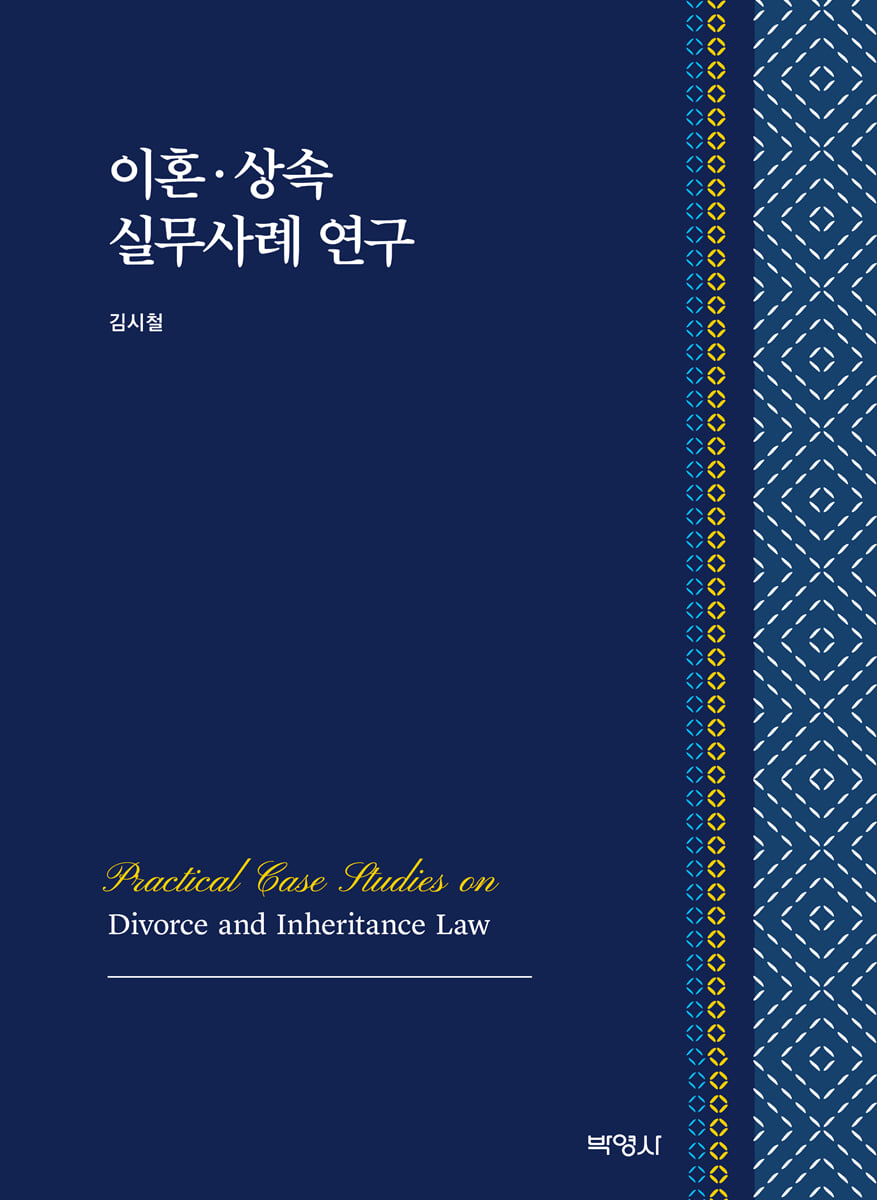
Divorce and Inheritance Practice Case Study
 |
Description
index
I.
Divorce and related cases
[1] Marriage breakdown 3
1.
5 Issues Concerning Property Disputes and Marital Dissolution Between Remarried Couples, Including Nonpayment of Child Support
Seoul High Court 2023.
4. 20.
Verdict 2022r22517
[2] Alimony in divorce 11
1.
13 Constitutional and Legal Issues Concerning the Claim for Damages by the Other Party in Cases Where the At-Fault Spouse's Divorce Petition Is Accepted as an Exception
Seoul High Court 2023.
6. 29.
Sentence 2023r20204
2.
37. The nature and effect of individual agreements regarding alimony and division of property related to previous divorce proceedings
Seoul High Court 2024.
10.
31.
Judgment 2024r21372, 21389
3.
Issue 85: Reflecting the circumstances that arose up to the conclusion of the trial arguments in a divorce suit in the amount of alimony and property division
Seoul High Court 2024.
10.
31.
Sentence 2024r21570, 2024r21587
[3] Division of property following divorce 103
1.
The impact of the unilateral disposition of the wrongdoer on the scope of property subject to division and the division ratio⑴ 105
Seoul High Court 2023.
1. 26.
Sentence 2022r23237, 2022r23244
2.
The impact of the unilateral disposition of the wrongdoer on the scope of property subject to division and the division ratio⑵ 136
Seoul High Court 2023.
2. 9.
Sentence 2022r21002
3.
The impact of the transfer of property rights related to prior wrongful acts on the scope of property subject to division and the division ratio, etc. 143
Seoul High Court 2023.
6. 29.
Verdict 2022r23541
4.
The impact of one spouse's sole acquisition of property, his or her role in the marriage, and concealment of property on the scope of property subject to division and the division ratio 157
Seoul High Court 2023.
11.
2. Judgment Nos. 2023r20891 and 2023r20907
5.
Issues related to the validity of agreements regarding division of property during marriage 189
Seoul High Court 2024.
11.
8. Ja 2024B2034 decision
[4] Child custody disposition 219
1.
Issue 221: Claims for Dissolution of Adoption and Payment of Child Support
Seoul High Court 2023.
5. 4.
Verdict 2022r23305
2.
Issue 226 Concerning Child Abduction Arising During Interview Negotiations
Seoul High Court 2023.
5. 18.
Sentence 2023r20075, 2023r20082
3.
Issues regarding the principle of continuity in prior dispositions regarding child custody and methods of interview negotiations, etc. 234
Seoul High Court 2024.
4. 4. 2024B2029 decision
[5] Other related issues 261
1.
Evidence of files accidentally recorded on a black box device, etc. 263
Seoul High Court 2022.
12.
8. Judgment 2022r22029, 2022r22036
Ⅱ.
Cases requesting division of inherited property and return of reserved portion
[1] Inheritance General 271
1.
Inclusion of attorney fees and procedural costs in the case of a lawsuit filed by a family member of a minor child 273
Seoul High Court 2022.
4. 11. 2022B2061 decision
2.
Case 277: Claim for Division of Inheritance in Case of Multiple Inheritances
Seoul High Court 2022.
7. 27. 2021B2171, 2172, 2173 decisions
3.
Effect of cancellation of inheritance renunciation report, etc. 285
Seoul High Court 2023.
2. 15. 2022B2128, 2129, 2130 decision
4.
Issue 290 regarding the recognition of the death of some parties and waiver of inheritance in inheritance division cases
Seoul High Court 2023.
6. 12. 2022B2090 decision
[2] Inter vivos gift 301
1.
Issues related to gifts made during life in cases seeking the return of a reserved portion 303
Seoul High Court 2022.
10.
27.
Sentence 2022na2006049
[3] Claim for return of reserved portion 311
1.
Issue 313: Starting point of the short-term statute of limitations for claims for the return of a reserved portion
Seoul High Court 2023.
5. 18.
Sentence 2023na2002112
2.
Constitutional and legal issues regarding the selection of the counterparty for the claim for the return of a reserved portion and the calculation of the amount of special profits, etc. 324
Seoul High Court 2023.
9. 21.
Sentence 2023na2026019
3.
Issue 362: Calculation of Special Profits in Claims for Return of Reserved Portion and Legal Principles of Substituted Inheritance
Seoul High Court 2024.
3. 28.
Sentence 2023na2030285
4.
Issues regarding the scope of special income, litigation forms, and methods of returning reserved portions in connection with claims for the return of reserved portions 377
Seoul High Court 2024.
4. 18.
Sentence 2023na2047627
[4] Will Notarized Document 393
1.
Issue 395: The validity of a will and the requirements for claiming compensation for inheritance tax
Seoul High Court 2023.
4. 20.
Sentence 2021na2044594
[5] International Law 413
1.
415 Comparative legal issues in international private law, civil law, and tax law regarding claims for the return of reserved portions
Seoul High Court 2023.
10.
19.
Sentence 2022na2040001
[6] Correlation between inheritance division practice and tax law practice 471
1.
Regarding the correlation between the calculation of special profits in inheritance property division cases and tax investigations and taxation dispositions, etc. 473
Seoul High Court 2023.
7. 25. 2022B2136, 2137 decision
2.
Calculation of Special Income and Contributions for Long-Term Account Transfers and Review of Legal Theories Related to the Inheritance Tax Act 502
Seoul High Court 2023.
8. 28. 2023B2132, 2133 decision
[7] Old Customary Law and Normative Control Regarding Inheritance [Journal of Judicial Studies (76), Judicial Development Foundation (2023), 275-491] 519
1.
A Comparative Legal Review of the Principle of Supreme Law, Parliamentary Sovereignty, and the Constitutional Review System 521
―Focusing on the history and background of the "legislative protection function" of Article 107, Paragraph 1 of the Constitution―
Item Index 717
Case Index 722
Reference 737
Divorce and related cases
[1] Marriage breakdown 3
1.
5 Issues Concerning Property Disputes and Marital Dissolution Between Remarried Couples, Including Nonpayment of Child Support
Seoul High Court 2023.
4. 20.
Verdict 2022r22517
[2] Alimony in divorce 11
1.
13 Constitutional and Legal Issues Concerning the Claim for Damages by the Other Party in Cases Where the At-Fault Spouse's Divorce Petition Is Accepted as an Exception
Seoul High Court 2023.
6. 29.
Sentence 2023r20204
2.
37. The nature and effect of individual agreements regarding alimony and division of property related to previous divorce proceedings
Seoul High Court 2024.
10.
31.
Judgment 2024r21372, 21389
3.
Issue 85: Reflecting the circumstances that arose up to the conclusion of the trial arguments in a divorce suit in the amount of alimony and property division
Seoul High Court 2024.
10.
31.
Sentence 2024r21570, 2024r21587
[3] Division of property following divorce 103
1.
The impact of the unilateral disposition of the wrongdoer on the scope of property subject to division and the division ratio⑴ 105
Seoul High Court 2023.
1. 26.
Sentence 2022r23237, 2022r23244
2.
The impact of the unilateral disposition of the wrongdoer on the scope of property subject to division and the division ratio⑵ 136
Seoul High Court 2023.
2. 9.
Sentence 2022r21002
3.
The impact of the transfer of property rights related to prior wrongful acts on the scope of property subject to division and the division ratio, etc. 143
Seoul High Court 2023.
6. 29.
Verdict 2022r23541
4.
The impact of one spouse's sole acquisition of property, his or her role in the marriage, and concealment of property on the scope of property subject to division and the division ratio 157
Seoul High Court 2023.
11.
2. Judgment Nos. 2023r20891 and 2023r20907
5.
Issues related to the validity of agreements regarding division of property during marriage 189
Seoul High Court 2024.
11.
8. Ja 2024B2034 decision
[4] Child custody disposition 219
1.
Issue 221: Claims for Dissolution of Adoption and Payment of Child Support
Seoul High Court 2023.
5. 4.
Verdict 2022r23305
2.
Issue 226 Concerning Child Abduction Arising During Interview Negotiations
Seoul High Court 2023.
5. 18.
Sentence 2023r20075, 2023r20082
3.
Issues regarding the principle of continuity in prior dispositions regarding child custody and methods of interview negotiations, etc. 234
Seoul High Court 2024.
4. 4. 2024B2029 decision
[5] Other related issues 261
1.
Evidence of files accidentally recorded on a black box device, etc. 263
Seoul High Court 2022.
12.
8. Judgment 2022r22029, 2022r22036
Ⅱ.
Cases requesting division of inherited property and return of reserved portion
[1] Inheritance General 271
1.
Inclusion of attorney fees and procedural costs in the case of a lawsuit filed by a family member of a minor child 273
Seoul High Court 2022.
4. 11. 2022B2061 decision
2.
Case 277: Claim for Division of Inheritance in Case of Multiple Inheritances
Seoul High Court 2022.
7. 27. 2021B2171, 2172, 2173 decisions
3.
Effect of cancellation of inheritance renunciation report, etc. 285
Seoul High Court 2023.
2. 15. 2022B2128, 2129, 2130 decision
4.
Issue 290 regarding the recognition of the death of some parties and waiver of inheritance in inheritance division cases
Seoul High Court 2023.
6. 12. 2022B2090 decision
[2] Inter vivos gift 301
1.
Issues related to gifts made during life in cases seeking the return of a reserved portion 303
Seoul High Court 2022.
10.
27.
Sentence 2022na2006049
[3] Claim for return of reserved portion 311
1.
Issue 313: Starting point of the short-term statute of limitations for claims for the return of a reserved portion
Seoul High Court 2023.
5. 18.
Sentence 2023na2002112
2.
Constitutional and legal issues regarding the selection of the counterparty for the claim for the return of a reserved portion and the calculation of the amount of special profits, etc. 324
Seoul High Court 2023.
9. 21.
Sentence 2023na2026019
3.
Issue 362: Calculation of Special Profits in Claims for Return of Reserved Portion and Legal Principles of Substituted Inheritance
Seoul High Court 2024.
3. 28.
Sentence 2023na2030285
4.
Issues regarding the scope of special income, litigation forms, and methods of returning reserved portions in connection with claims for the return of reserved portions 377
Seoul High Court 2024.
4. 18.
Sentence 2023na2047627
[4] Will Notarized Document 393
1.
Issue 395: The validity of a will and the requirements for claiming compensation for inheritance tax
Seoul High Court 2023.
4. 20.
Sentence 2021na2044594
[5] International Law 413
1.
415 Comparative legal issues in international private law, civil law, and tax law regarding claims for the return of reserved portions
Seoul High Court 2023.
10.
19.
Sentence 2022na2040001
[6] Correlation between inheritance division practice and tax law practice 471
1.
Regarding the correlation between the calculation of special profits in inheritance property division cases and tax investigations and taxation dispositions, etc. 473
Seoul High Court 2023.
7. 25. 2022B2136, 2137 decision
2.
Calculation of Special Income and Contributions for Long-Term Account Transfers and Review of Legal Theories Related to the Inheritance Tax Act 502
Seoul High Court 2023.
8. 28. 2023B2132, 2133 decision
[7] Old Customary Law and Normative Control Regarding Inheritance [Journal of Judicial Studies (76), Judicial Development Foundation (2023), 275-491] 519
1.
A Comparative Legal Review of the Principle of Supreme Law, Parliamentary Sovereignty, and the Constitutional Review System 521
―Focusing on the history and background of the "legislative protection function" of Article 107, Paragraph 1 of the Constitution―
Item Index 717
Case Index 722
Reference 737
Publisher's Review
preface
I am 1999.
9. As a single judge at the Seoul Family Court, I was assigned to handle domestic affairs for the first time.
At the time, the single-judge family law judge handled not only domestic litigation cases centered on divorce and alimony cases, cases confirming the non-existence of parent-child relationships, but also various domestic non-litigation cases, including cases of waiver of inheritance, limited acceptance, declaration of disappearance, and claims for division of property following divorce. While judging unfamiliar fields, I received a lot of help from my colleagues and senior and junior judges.
After that, in accordance with the change in division of labor, in 2001.
9. Since I started handling domestic violence cases, I realized that there is not much reference material on related practices.
Meanwhile, the courts are publishing a judicial practice manual to improve their work and maintain uniformity and continuity in their administrative processes. However, I found it to be inadequate in many ways in 2004.
3. Published Handbook of Domestic Violence Trial Practice (First Edition) and 2008.
2. I participated as a member of the writing team for the first revised edition that was published.
This is because, given the lack of reference materials on related practices, we felt it was necessary to provide materials that could be of some help to the judges in charge.
After that, 2010.
7. Even when I participated in the writing of the published Court Practice Manual (2nd revised edition), this idea remained unchanged.
In the case of divorce cases, not only has the number of cases increased significantly compared to the past, but the types of disputes involved have also become much more diverse.
However, according to our legal system, a structure has been established in which the court exercises a certain degree of discretion in matters such as calculating alimony and dividing property following divorce.
Therefore, the court in charge needs to reasonably exercise its discretion by taking a legal approach based on the overall legal system in the process of determining the amount of compensation, the ratio of property division, and the scope of property subject to division, and the parties must also ensure that the necessary elements are properly reflected by submitting appropriate arguments and evidence regarding the relevant elements.
Meanwhile, as inheritance-related disputes have increased rapidly since 2000, not only has the number of cases for division of inheritance property and cases for return of reserved portions increased significantly, but the types of disputes have also become more diverse.
In other words, as inheritance disputes grow in scale and complexity, both quantitatively and qualitatively, a multi-layered legal review is becoming necessary to properly resolve them.
I am 2020.
2. He has been handling tax litigation at the Seoul High Court since 2022.
2. Due to the change in division of duties, we are now in charge of judicial work related to domestic litigation, non-contentious cases, civil cases such as claims for return of reserved portion, and claims for restoration of inheritance.
However, compared to 20 years ago, although work-related reference materials have increased significantly, I couldn't help but feel that they were still inadequate.
So, I started posting articles that I had organized in my own way, including materials I had referenced and reviewed while actually handling trial work, on the bulletin boards of the 'Supreme Court Juvenile Court Community' and the 'Supreme Court Family Law Research Association Community.'
The purpose of this paper is to provide some helpful information to judges who must constantly consider issues such as balancing legal stability and specific validity.
I shared the content of this post with university professors, lawyers, and others interested in related fields because I believed it would be beneficial to stimulate further research and review on the issue, thereby stimulating discussion.
Afterwards, I felt a sense of accomplishment when I heard from many colleagues and junior and senior judges that they were reading my articles with interest, or when I saw the content of my posts actually reflected in other courts' judgments.
Then, I received a recommendation from people around me: "It would be a good idea to submit the posts I've written in the form of a thesis or to compile them into a book." This led me to give it a lot of thought.
First of all, I am not a scholar specializing in this field, but a practitioner who has handled related cases. The content of the posts is based on the facts of each case, and I reviewed the necessary legal principles and organized related materials in the process of reaching my own appropriate conclusions. Therefore, I needed to first review whether it was appropriate to publish them all together.
The disputes in each case are diverse, and the method of resolving them is bound to vary depending on the specific circumstances. In addition, depending on the individual case, a multifaceted and complex review of civil law, domestic relations law, tax law, and foreign legal systems is conducted, and often only a few lines of brief judgment are recorded in the judgment document.
In the same context, depending on the type of dispute in the individual case being explained, content that was not mentioned at all in the post was sometimes included in the court document, and the gap in content or volume between the posts for each case was also quite large, and there were also cases where the explanations partially overlapped.
If we take the form of organizing the explanatory content by reflecting the specific circumstances of each case in this way, we cannot help but give up on things like the balance of the volume for each case, so we had no choice but to consider whether publishing in this format was even desirable.
Despite recognizing the structural issues mentioned above, I nevertheless accepted the advice of those around me to create a booklet. I believed it was meaningful to compile a resource that scholars and practitioners could use as a reference, even if only for a small amount, on divorce and inheritance-related practices.
This book is based on the content I posted on the Supreme Court community bulletin board. Because examining the basic facts and judgments of individual cases is of considerable significance, I've taken the format of summarizing the specific circumstances of each case and then providing commentary on them.
The paper included in the final section examines the constitutional and legal issues surrounding a case involving the old customary law of inheritance that was likely to be assigned to our court at the time. This is a reprint of an article I previously published in a judicial journal.
Since the Seoul High Court's trial work is handled jointly by the members of the collegiate panel, it goes without saying that without the dedication and hard work of the late Justices Kang Sang-wook, Song Mi-kyung, Lee Dong-hyeon, and Kim Ok-gon, who were members of our panel, reaching the conclusion of the trial or writing the judgment would have been impossible in the first place.
I would like to take this opportunity to once again express my gratitude to the above judges and add that I vividly remember the times we spent together, brainstorming and discussing ways to appropriately resolve these cases.
I would also like to express my gratitude to the judicial researchers Kim Byeong-il, Shin Yeon-seok, Kim Yeo-won, Ahn Jae-ho, Lee Su-jong, Jang Min-a, and Lee Seong-jong, who were responsible for reviewing the issues in each case.
Meanwhile, I would like to make it clear that the commentary portions of this book were written entirely by me, and that any portions not directly related to the judgments of the relevant court documents contain my personal opinions.
I would also like to express my sincere gratitude to Chairman Jong-man Ahn, CEO Sang-jun Ahn, Director Seong-ho Cho, Vice President Seung-hyeon Lee, and all the other staff at Park Young-sa who helped make this book possible.
Lastly, I would like to express my gratitude to my parents, who raised me with all their heart and soul and are now watching over me from heaven; my spouse, Yoo Myung-hyun, who has always supported our family with pride as a descendant of an independence activist; and my son, Jeong-seok, and my daughter, Won-hee, who are now adults and fulfilling their roles as proud members of society.
While this book contains many shortcomings, I hope that other interested lawyers will appropriately fill in these gaps in the future. I also hope that this book will serve as a small foundation for advancing legal theory and appropriate practice in divorce and inheritance-related fields.
2025.
7.
Written by the author
I am 1999.
9. As a single judge at the Seoul Family Court, I was assigned to handle domestic affairs for the first time.
At the time, the single-judge family law judge handled not only domestic litigation cases centered on divorce and alimony cases, cases confirming the non-existence of parent-child relationships, but also various domestic non-litigation cases, including cases of waiver of inheritance, limited acceptance, declaration of disappearance, and claims for division of property following divorce. While judging unfamiliar fields, I received a lot of help from my colleagues and senior and junior judges.
After that, in accordance with the change in division of labor, in 2001.
9. Since I started handling domestic violence cases, I realized that there is not much reference material on related practices.
Meanwhile, the courts are publishing a judicial practice manual to improve their work and maintain uniformity and continuity in their administrative processes. However, I found it to be inadequate in many ways in 2004.
3. Published Handbook of Domestic Violence Trial Practice (First Edition) and 2008.
2. I participated as a member of the writing team for the first revised edition that was published.
This is because, given the lack of reference materials on related practices, we felt it was necessary to provide materials that could be of some help to the judges in charge.
After that, 2010.
7. Even when I participated in the writing of the published Court Practice Manual (2nd revised edition), this idea remained unchanged.
In the case of divorce cases, not only has the number of cases increased significantly compared to the past, but the types of disputes involved have also become much more diverse.
However, according to our legal system, a structure has been established in which the court exercises a certain degree of discretion in matters such as calculating alimony and dividing property following divorce.
Therefore, the court in charge needs to reasonably exercise its discretion by taking a legal approach based on the overall legal system in the process of determining the amount of compensation, the ratio of property division, and the scope of property subject to division, and the parties must also ensure that the necessary elements are properly reflected by submitting appropriate arguments and evidence regarding the relevant elements.
Meanwhile, as inheritance-related disputes have increased rapidly since 2000, not only has the number of cases for division of inheritance property and cases for return of reserved portions increased significantly, but the types of disputes have also become more diverse.
In other words, as inheritance disputes grow in scale and complexity, both quantitatively and qualitatively, a multi-layered legal review is becoming necessary to properly resolve them.
I am 2020.
2. He has been handling tax litigation at the Seoul High Court since 2022.
2. Due to the change in division of duties, we are now in charge of judicial work related to domestic litigation, non-contentious cases, civil cases such as claims for return of reserved portion, and claims for restoration of inheritance.
However, compared to 20 years ago, although work-related reference materials have increased significantly, I couldn't help but feel that they were still inadequate.
So, I started posting articles that I had organized in my own way, including materials I had referenced and reviewed while actually handling trial work, on the bulletin boards of the 'Supreme Court Juvenile Court Community' and the 'Supreme Court Family Law Research Association Community.'
The purpose of this paper is to provide some helpful information to judges who must constantly consider issues such as balancing legal stability and specific validity.
I shared the content of this post with university professors, lawyers, and others interested in related fields because I believed it would be beneficial to stimulate further research and review on the issue, thereby stimulating discussion.
Afterwards, I felt a sense of accomplishment when I heard from many colleagues and junior and senior judges that they were reading my articles with interest, or when I saw the content of my posts actually reflected in other courts' judgments.
Then, I received a recommendation from people around me: "It would be a good idea to submit the posts I've written in the form of a thesis or to compile them into a book." This led me to give it a lot of thought.
First of all, I am not a scholar specializing in this field, but a practitioner who has handled related cases. The content of the posts is based on the facts of each case, and I reviewed the necessary legal principles and organized related materials in the process of reaching my own appropriate conclusions. Therefore, I needed to first review whether it was appropriate to publish them all together.
The disputes in each case are diverse, and the method of resolving them is bound to vary depending on the specific circumstances. In addition, depending on the individual case, a multifaceted and complex review of civil law, domestic relations law, tax law, and foreign legal systems is conducted, and often only a few lines of brief judgment are recorded in the judgment document.
In the same context, depending on the type of dispute in the individual case being explained, content that was not mentioned at all in the post was sometimes included in the court document, and the gap in content or volume between the posts for each case was also quite large, and there were also cases where the explanations partially overlapped.
If we take the form of organizing the explanatory content by reflecting the specific circumstances of each case in this way, we cannot help but give up on things like the balance of the volume for each case, so we had no choice but to consider whether publishing in this format was even desirable.
Despite recognizing the structural issues mentioned above, I nevertheless accepted the advice of those around me to create a booklet. I believed it was meaningful to compile a resource that scholars and practitioners could use as a reference, even if only for a small amount, on divorce and inheritance-related practices.
This book is based on the content I posted on the Supreme Court community bulletin board. Because examining the basic facts and judgments of individual cases is of considerable significance, I've taken the format of summarizing the specific circumstances of each case and then providing commentary on them.
The paper included in the final section examines the constitutional and legal issues surrounding a case involving the old customary law of inheritance that was likely to be assigned to our court at the time. This is a reprint of an article I previously published in a judicial journal.
Since the Seoul High Court's trial work is handled jointly by the members of the collegiate panel, it goes without saying that without the dedication and hard work of the late Justices Kang Sang-wook, Song Mi-kyung, Lee Dong-hyeon, and Kim Ok-gon, who were members of our panel, reaching the conclusion of the trial or writing the judgment would have been impossible in the first place.
I would like to take this opportunity to once again express my gratitude to the above judges and add that I vividly remember the times we spent together, brainstorming and discussing ways to appropriately resolve these cases.
I would also like to express my gratitude to the judicial researchers Kim Byeong-il, Shin Yeon-seok, Kim Yeo-won, Ahn Jae-ho, Lee Su-jong, Jang Min-a, and Lee Seong-jong, who were responsible for reviewing the issues in each case.
Meanwhile, I would like to make it clear that the commentary portions of this book were written entirely by me, and that any portions not directly related to the judgments of the relevant court documents contain my personal opinions.
I would also like to express my sincere gratitude to Chairman Jong-man Ahn, CEO Sang-jun Ahn, Director Seong-ho Cho, Vice President Seung-hyeon Lee, and all the other staff at Park Young-sa who helped make this book possible.
Lastly, I would like to express my gratitude to my parents, who raised me with all their heart and soul and are now watching over me from heaven; my spouse, Yoo Myung-hyun, who has always supported our family with pride as a descendant of an independence activist; and my son, Jeong-seok, and my daughter, Won-hee, who are now adults and fulfilling their roles as proud members of society.
While this book contains many shortcomings, I hope that other interested lawyers will appropriately fill in these gaps in the future. I also hope that this book will serve as a small foundation for advancing legal theory and appropriate practice in divorce and inheritance-related fields.
2025.
7.
Written by the author
GOODS SPECIFICS
- Date of issue: September 30, 2025
- Format: Hardcover book binding method guide
- Page count, weight, size: 760 pages | 188*257*40mm
- ISBN13: 9791130349831
- ISBN10: 1130349837
You may also like
카테고리
korean


korean

![ELLE 엘르 스페셜 에디션 A형 : 12월 [2025]](http://librairie.coreenne.fr/cdn/shop/files/b8e27a3de6c9538896439686c6b0e8fb.jpg?v=1766436872&width=3840)


