

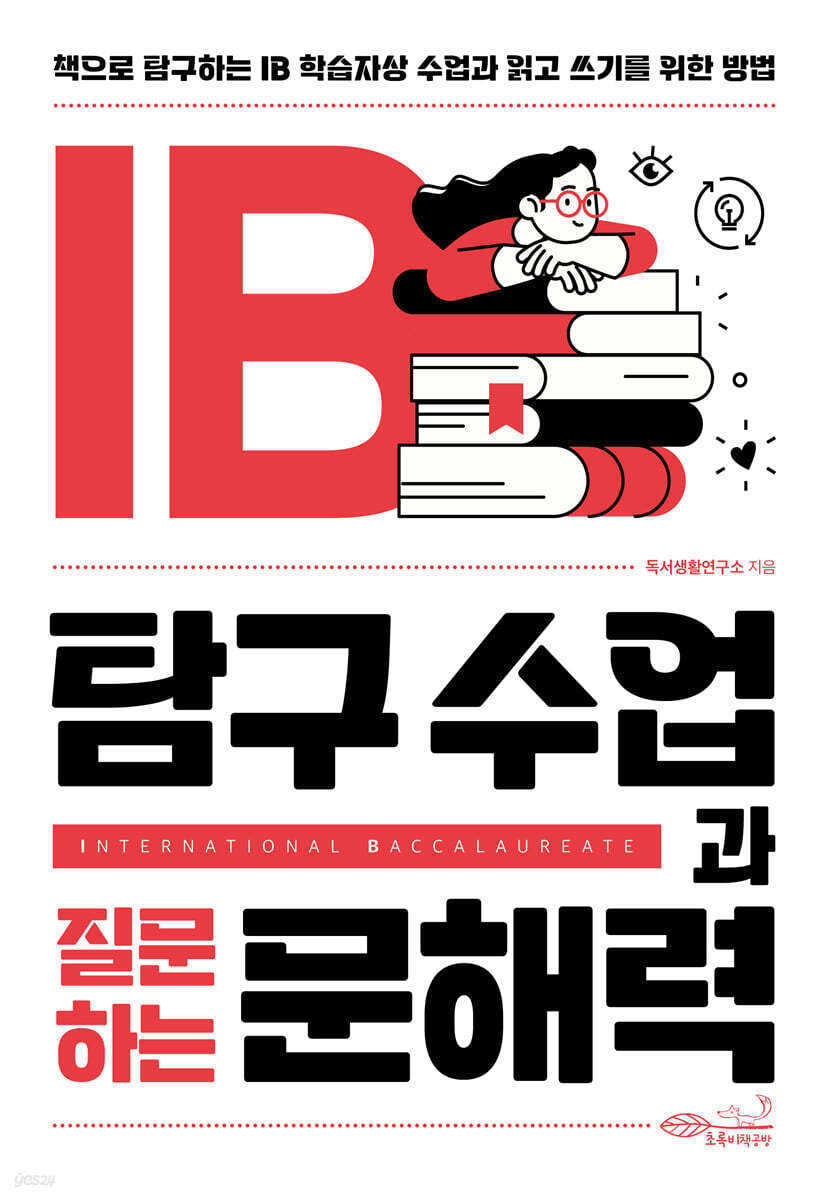
IB Inquiry Classes and Questioning Literacy
 |
Description
Book Introduction
Lifelong learning where students take the initiative, going beyond mere memorization of knowledge.
Finding Solutions for the Successful Implementation of the 2022 Revised Curriculum in the IB
The core of the 2022 revised curriculum, which will be applied to elementary schools starting in 2024 and secondary schools starting in 2025, is 'concept-based inquiry learning.'
It goes beyond simple memorization of knowledge and focuses on developing students' ability to think conceptually and expand their learning on their own.
To realize this kind of education that leads to lifelong learning, ‘literacy’ and ‘thinking skills’ are necessary.
This direction also aligns with the core competencies pursued by the International Baccalaureate (IB), which began 57 years ago to provide a balanced education to the children of diplomats and is now recognized as the most credible educational program for fostering global talent.
The author, who currently serves as the deputy head of the Seoul Metropolitan Office of Education's elementary school IB support team and as a teacher at an IB-focused school, has consistently been interested in international comparative research and has researched the curricula of various countries.
Then, I came across the IB curriculum and, to explore it more in depth, I completed the IBEC, a certification course for IB teachers, and visited IB international schools and observed classes.
In the process, we were able to confirm that IB inquiry classes effectively cultivate the literacy and thinking skills necessary for concept-based inquiry learning.
This book introduces real-world examples of IB-style inquiry classes for current teachers struggling to understand and apply the newly revised curriculum, as well as for educators and parents interested in the IB.
Finding Solutions for the Successful Implementation of the 2022 Revised Curriculum in the IB
The core of the 2022 revised curriculum, which will be applied to elementary schools starting in 2024 and secondary schools starting in 2025, is 'concept-based inquiry learning.'
It goes beyond simple memorization of knowledge and focuses on developing students' ability to think conceptually and expand their learning on their own.
To realize this kind of education that leads to lifelong learning, ‘literacy’ and ‘thinking skills’ are necessary.
This direction also aligns with the core competencies pursued by the International Baccalaureate (IB), which began 57 years ago to provide a balanced education to the children of diplomats and is now recognized as the most credible educational program for fostering global talent.
The author, who currently serves as the deputy head of the Seoul Metropolitan Office of Education's elementary school IB support team and as a teacher at an IB-focused school, has consistently been interested in international comparative research and has researched the curricula of various countries.
Then, I came across the IB curriculum and, to explore it more in depth, I completed the IBEC, a certification course for IB teachers, and visited IB international schools and observed classes.
In the process, we were able to confirm that IB inquiry classes effectively cultivate the literacy and thinking skills necessary for concept-based inquiry learning.
This book introduces real-world examples of IB-style inquiry classes for current teachers struggling to understand and apply the newly revised curriculum, as well as for educators and parents interested in the IB.
- You can preview some of the book's contents.
Preview
index
Entering
Recommendation: Exploratory Classes Leading to Meaningful Learningㆍ7
A Process of Exploration that Develops Thinking Power
Part 1. What is the IB?
# Understanding IB
The Origins of the IB | Educational Theories that Influenced the IB Program | IB Education's Goals and Core Elements
# IB's Inquiry Class
Classes at IB Schools | IB-Style Inquiry Classes
# Exploring the IB Learner Image
Part 2.
IB Learnership Classes Exploring Through Books
IB Learner Profile: Inquiry Class ① Inquirer? Knowledgeable? Thinker
IB Learner Identity Exploration Lesson 2: Communicative? Open-minded? Caring
IB Learner Profile Exploration Lesson 3: Principled? Balanced
IB Learner Profile: Exploration Lesson ④ A Challenger? A Reflector
A class that starts with children's questions
Part 3. Literacy for IB Inquiry Classes
# To be able to ask conceptual questions
Children with low literacy skills | Why general education classes are difficult | If they cannot understand fragmented information or factual knowledge
# How to develop literacy skills appropriate to your child's level
You must read and write a lot | Writing a thought routine based on high literacy | Writing with questions while adding your own thoughts | Writing a 5-step synopsis and asking questions | Writing with the Six Ws and One Ws and asking questions
# The necessity of reading as a basic learning
Reading with Expression | Reading a Book to Build the Foundation of Reading Skills | Listening to Recorded Files | Immersive Reading to Immerse Yourself in the Story
# New classes, we need to try them
supplement.
Recommended books by subject and level for use in class
reference book
Recommendation: Exploratory Classes Leading to Meaningful Learningㆍ7
A Process of Exploration that Develops Thinking Power
Part 1. What is the IB?
# Understanding IB
The Origins of the IB | Educational Theories that Influenced the IB Program | IB Education's Goals and Core Elements
# IB's Inquiry Class
Classes at IB Schools | IB-Style Inquiry Classes
# Exploring the IB Learner Image
Part 2.
IB Learnership Classes Exploring Through Books
IB Learner Profile: Inquiry Class ① Inquirer? Knowledgeable? Thinker
IB Learner Identity Exploration Lesson 2: Communicative? Open-minded? Caring
IB Learner Profile Exploration Lesson 3: Principled? Balanced
IB Learner Profile: Exploration Lesson ④ A Challenger? A Reflector
A class that starts with children's questions
Part 3. Literacy for IB Inquiry Classes
# To be able to ask conceptual questions
Children with low literacy skills | Why general education classes are difficult | If they cannot understand fragmented information or factual knowledge
# How to develop literacy skills appropriate to your child's level
You must read and write a lot | Writing a thought routine based on high literacy | Writing with questions while adding your own thoughts | Writing a 5-step synopsis and asking questions | Writing with the Six Ws and One Ws and asking questions
# The necessity of reading as a basic learning
Reading with Expression | Reading a Book to Build the Foundation of Reading Skills | Listening to Recorded Files | Immersive Reading to Immerse Yourself in the Story
# New classes, we need to try them
supplement.
Recommended books by subject and level for use in class
reference book
Detailed image

Into the book
IB school classes are similar to, yet different from, our country's education.
IB inquiry classes, which generate questions and solve problems based on students' curiosity, are similar to ours, but they differ in that they pursue "conceptual understanding" and systematically implement the curriculum according to the school's own inquiry stages.
Also, the system in which all teachers collaborate to plan an inquiry program that includes all students from grades 1 to 6, and in which teachers of the same grade discuss the program several times and create inquiry units together, was refreshing.
When looking at the stages of the inquiry class, ‘generalizing,’ ‘transferring,’ and ‘reflecting’ were new.
'Generalizing' is the process by which students conceptually organize what they have discovered through research and exploration.
In 'Transferring,' students check whether the generalizations they have made apply to other new situations.
'Reflection' occurs throughout the inquiry process and gives students the opportunity to reflect on what they have learned and how much they have grown from their studies.
The more I learned, the more I wanted to try IB-style inquiry classes with regular school children.
With that in mind, this book contains the process of reading books related to the IB learner profile, creating inquiry questions, finding answers, and planning and conducting classes to derive generalizations.
--- p.4~5
One of the things I struggled with in my inquiry classes was providing students with appropriate materials and books.
I wanted to utilize a variety of meaningful resources that could aid students' exploration, such as picture books, knowledge books, and newspaper articles, in addition to textbooks.
Because when I visited an IB school, the homeroom teacher and librarian emphasized the importance of providing high-quality online resources and books, and I strongly agreed.
I believed that by exploring materials from diverse perspectives and contexts, children's thinking would deepen, and by fully experiencing the world of inquiry, they would be able to benefit when they face problems they must solve on their own outside of school.
--- p.33~34
After completing the IB-style inquiry class, which was a tumultuous process, I realized that it is possible to conduct IB-style inquiry classes even in non-IB schools.
Since each student's situation will be different, I believe that if IB-style inquiry classes are implemented, each classroom will be colorful.
I believe that inquiry classes have a goal rather than a correct answer.
I hope that children will have their own questions, think proactively, and become masters of their own exploration.
--- p.45
Picture books or fairy tales featuring multiple characters can be meaningful teaching materials related to exploring the IB learner profile, as they allow students to explore the characters' personalities and qualities.
In fact, if you just look at the meaning of the word "learner," it's confusing to know exactly what kind of person it is, so I thought that if I brought in stories about people around me or characters from fairy tales, children would be able to understand it much more specifically.
By exploring the IB learner profile one by one through the book, you will be able to form your own concept of the learner profile.
--- p.50
To understand the learner profile described by the IB, it is best to meet someone who shares the characteristics of that learner profile and explore the experience together.
But realistically, it is difficult to meet such a person in person.
So, we decided to explore the IB learner profile through books with children, and selected four books featuring characters who possess the characteristics of an “inquirer,” a “knowledgeable person,” and a “thinker.”
For 'inquirers', we looked for books that portray people who are curious, passionate, and learning; for 'knowledgeable people', we looked for books that portray people who are interested in important issues and explore knowledge from various disciplines; and for 'thinkers', we looked for books that portray people who think critically and creatively and put that thinking into action.
--- p.55
The reason I have taught you the basic framework of writing with a thought routine, writing with questions, writing the plot in five steps and asking questions, and writing with the six principles of W and H is because it helps you write frequently and at length.
Practicing writing requires experience.
I write using the six principles of writing, and once I get used to it, I write by taking into account the characteristics of space and time as well as the characteristics of the characters.
Lynn Erickson said that in the structure of knowledge, concepts are formed based on several facts and generalizations are built on top of them.
Because you can only generalize well if you have clear specific knowledge.
By reading a book and organizing the content by considering time, space, and people, children learn specific knowledge.
--- p.161~162
To develop basic literacy skills, we emphasize the need to 'read a lot and write a lot', and among the many methods, the most basic is focused reading, or immersive reading.
If you secure time for children to focus on reading, either during school free time or during creative experience club time, they will be able to read books without the burden of post-reading activities.
Then you can choose a book that suits your level.
Through this process, children will come to love books, and as they read with concentration, remember and understand the content, not only classes that pursue conceptual understanding but also general subject classes will become much easier.
--- p.184
Learning should not be limited to school knowledge, used only for the college entrance exam, and then forgotten afterward.
Knowledge must be organized in a form that helps analyze and solve various problems in real society.
To achieve this, education is necessary to pursue conceptual understanding through a process of inquiry that involves creating questions, researching and exploring data, creating generalized sentences, and transferring and reflecting.
In this trend, a curriculum that presents a "core idea" is being implemented in Korea, and the IB program is being introduced to public education and operated in various places.
--- p.189~190
In keeping with the trends of the times and educational needs, we explored what IB education is like and planned and conducted classes in regular schools to create 'generalizations' using books based on the IB learner model.
(…) There are many teachers around us who are diligently researching, trying, and working hard on classes such as inquiry-based classes, project-based classes, concept-based inquiry classes, and AI-based classes.
Seeing those people gave me the courage to prepare a generalization class through books.
The method presented in this book may not be the only correct answer.
However, if there are those who want to try IB-style inquiry classes in their own positions, I hope you don't feel sorry that your children have too much difficulty with generalization or that generalization classes are impossible.
Instead, we need to think about what our children need and recognize that classes that pursue conceptual understanding require 'a lot of reading and a lot of writing.'
Now is the time to believe that we can teach such classes to children.
IB inquiry classes, which generate questions and solve problems based on students' curiosity, are similar to ours, but they differ in that they pursue "conceptual understanding" and systematically implement the curriculum according to the school's own inquiry stages.
Also, the system in which all teachers collaborate to plan an inquiry program that includes all students from grades 1 to 6, and in which teachers of the same grade discuss the program several times and create inquiry units together, was refreshing.
When looking at the stages of the inquiry class, ‘generalizing,’ ‘transferring,’ and ‘reflecting’ were new.
'Generalizing' is the process by which students conceptually organize what they have discovered through research and exploration.
In 'Transferring,' students check whether the generalizations they have made apply to other new situations.
'Reflection' occurs throughout the inquiry process and gives students the opportunity to reflect on what they have learned and how much they have grown from their studies.
The more I learned, the more I wanted to try IB-style inquiry classes with regular school children.
With that in mind, this book contains the process of reading books related to the IB learner profile, creating inquiry questions, finding answers, and planning and conducting classes to derive generalizations.
--- p.4~5
One of the things I struggled with in my inquiry classes was providing students with appropriate materials and books.
I wanted to utilize a variety of meaningful resources that could aid students' exploration, such as picture books, knowledge books, and newspaper articles, in addition to textbooks.
Because when I visited an IB school, the homeroom teacher and librarian emphasized the importance of providing high-quality online resources and books, and I strongly agreed.
I believed that by exploring materials from diverse perspectives and contexts, children's thinking would deepen, and by fully experiencing the world of inquiry, they would be able to benefit when they face problems they must solve on their own outside of school.
--- p.33~34
After completing the IB-style inquiry class, which was a tumultuous process, I realized that it is possible to conduct IB-style inquiry classes even in non-IB schools.
Since each student's situation will be different, I believe that if IB-style inquiry classes are implemented, each classroom will be colorful.
I believe that inquiry classes have a goal rather than a correct answer.
I hope that children will have their own questions, think proactively, and become masters of their own exploration.
--- p.45
Picture books or fairy tales featuring multiple characters can be meaningful teaching materials related to exploring the IB learner profile, as they allow students to explore the characters' personalities and qualities.
In fact, if you just look at the meaning of the word "learner," it's confusing to know exactly what kind of person it is, so I thought that if I brought in stories about people around me or characters from fairy tales, children would be able to understand it much more specifically.
By exploring the IB learner profile one by one through the book, you will be able to form your own concept of the learner profile.
--- p.50
To understand the learner profile described by the IB, it is best to meet someone who shares the characteristics of that learner profile and explore the experience together.
But realistically, it is difficult to meet such a person in person.
So, we decided to explore the IB learner profile through books with children, and selected four books featuring characters who possess the characteristics of an “inquirer,” a “knowledgeable person,” and a “thinker.”
For 'inquirers', we looked for books that portray people who are curious, passionate, and learning; for 'knowledgeable people', we looked for books that portray people who are interested in important issues and explore knowledge from various disciplines; and for 'thinkers', we looked for books that portray people who think critically and creatively and put that thinking into action.
--- p.55
The reason I have taught you the basic framework of writing with a thought routine, writing with questions, writing the plot in five steps and asking questions, and writing with the six principles of W and H is because it helps you write frequently and at length.
Practicing writing requires experience.
I write using the six principles of writing, and once I get used to it, I write by taking into account the characteristics of space and time as well as the characteristics of the characters.
Lynn Erickson said that in the structure of knowledge, concepts are formed based on several facts and generalizations are built on top of them.
Because you can only generalize well if you have clear specific knowledge.
By reading a book and organizing the content by considering time, space, and people, children learn specific knowledge.
--- p.161~162
To develop basic literacy skills, we emphasize the need to 'read a lot and write a lot', and among the many methods, the most basic is focused reading, or immersive reading.
If you secure time for children to focus on reading, either during school free time or during creative experience club time, they will be able to read books without the burden of post-reading activities.
Then you can choose a book that suits your level.
Through this process, children will come to love books, and as they read with concentration, remember and understand the content, not only classes that pursue conceptual understanding but also general subject classes will become much easier.
--- p.184
Learning should not be limited to school knowledge, used only for the college entrance exam, and then forgotten afterward.
Knowledge must be organized in a form that helps analyze and solve various problems in real society.
To achieve this, education is necessary to pursue conceptual understanding through a process of inquiry that involves creating questions, researching and exploring data, creating generalized sentences, and transferring and reflecting.
In this trend, a curriculum that presents a "core idea" is being implemented in Korea, and the IB program is being introduced to public education and operated in various places.
--- p.189~190
In keeping with the trends of the times and educational needs, we explored what IB education is like and planned and conducted classes in regular schools to create 'generalizations' using books based on the IB learner model.
(…) There are many teachers around us who are diligently researching, trying, and working hard on classes such as inquiry-based classes, project-based classes, concept-based inquiry classes, and AI-based classes.
Seeing those people gave me the courage to prepare a generalization class through books.
The method presented in this book may not be the only correct answer.
However, if there are those who want to try IB-style inquiry classes in their own positions, I hope you don't feel sorry that your children have too much difficulty with generalization or that generalization classes are impossible.
Instead, we need to think about what our children need and recognize that classes that pursue conceptual understanding require 'a lot of reading and a lot of writing.'
Now is the time to believe that we can teach such classes to children.
--- p.191~192
Publisher's Review
IB education is expanding in Korea as well.
Concept-based inquiry learning based on literacy and thinking skills
Develop practical problem-solving skills
In the past, major changes in education mainly meant reforms to the college entrance exam system.
However, recently, there has been a noticeable shift in the educational paradigm encompassing all elementary, middle, and high school courses, such as the introduction of the high school credit system and the expansion of the IB program.
Among them, the International Baccalaureate (IB) is beginning to attract attention as a new direction to supplement the problems of public education.
In Korea, since the signing of the IB Koreanization Agreement in 2019, some public schools, mainly in Jeju and Daegu, have introduced the IB curriculum and achieved good entrance exam results.
Following the interest shown by approximately 40 schools in the Seoul area from 11 city and provincial offices of education across the country in 2024, 255 schools in the Seoul and Gyeonggi regions alone (82 in Seoul and 173 in Gyeonggi Province) have expressed interest in IB education in 2025.
The IB's emphasis on "concept-based inquiry-based learning" is also aligned with the direction of the 2022 revised curriculum.
This means that even non-IB schools in Korea are gradually embracing the IB curriculum. IB classes emphasize the process by which students engage in inquiry, inquiry, and problem-solving.
It focuses on developing the ability to solve various problems encountered in real society on one's own.
To develop these capabilities, literacy—the ability to understand and interpret fact-based knowledge and the diverse sources containing that knowledge—is essential. The critical thinking skills that underpin this knowledge are also crucial. This is why the IB and our education system prioritize literacy and critical thinking as core elements of education.
Applicable even if not an IB school
A book with real-world examples of book-based inquiry classes
IB classes are similar to traditional Korean classes, but have distinct differences.
While similar in that students generate questions and solve problems based on their curiosity, the IB is different in that it operates a systematic inquiry program that links the entire curriculum from grades 1 to 6, with all teachers collaborating to focus on conceptual understanding.
This book is structured into sections to help readers better understand the IB and demonstrate how actual inquiry classes are conducted.
Part 1 provides a basic introduction to the IB program and presents a practical overview of IB inquiry classes, as observed through IB school visits and class observations. IB inquiry classes are broadly divided into three stages: generalization, transfer, and reflection.
'Generalizing' is the process of conceptually organizing what students have learned through their research, and 'transferring' is the step of examining whether the concept can be applied to new situations.
In the final 'Reflect', you look back on what you learned and how much you grew through your studies.
Part 2 introduces real-life examples of inquiry classes conducted by grouping together the IB's 10 learner profiles (inquirers, knowledgeable learners, thinkers, communicators, open-minded learners, caring learners, principled learners, balanced learners, challengers, and reflective learners) by common theme.
The teaching examples using picture books, fairy tales, and textbooks are practical enough to be used directly in actual educational settings.
Part 3 emphasizes the importance of ‘reading’ and ‘literacy’ as the foundation for IB-style inquiry classes.
It presents four writing methods that can be used at school and at home (writing as a thinking routine, writing with questions, writing with a plot, writing with the six principles of the W and W) and four reading methods (reading while expressing, reading a book, listening, and immersive reading), and provides practical help in improving literacy.
Beyond conventional curriculum reform
Finding better ways to learn is the true role of public education.
This book was written by experts who have long studied and practiced reading education and the IB, and is based on how IB-style inquiry classes have been applied in actual classroom settings.
In particular, it includes a variety of activity sheets and a list of books by subject so that they can be used in general schools, even if they are not IB schools.
The activity sheets and books are designed to be freely modified according to the inquiry classes created with students.
Learning should not be limited to merely acquiring academic knowledge or a means for entrance exams.
By reading books, asking questions, researching and exploring the material, children develop their thinking skills.
Only then will we be able to wisely solve real-world problems as lifelong learners when we go out into society.
This is the true role that public education should play.
Concept-based inquiry learning based on literacy and thinking skills
Develop practical problem-solving skills
In the past, major changes in education mainly meant reforms to the college entrance exam system.
However, recently, there has been a noticeable shift in the educational paradigm encompassing all elementary, middle, and high school courses, such as the introduction of the high school credit system and the expansion of the IB program.
Among them, the International Baccalaureate (IB) is beginning to attract attention as a new direction to supplement the problems of public education.
In Korea, since the signing of the IB Koreanization Agreement in 2019, some public schools, mainly in Jeju and Daegu, have introduced the IB curriculum and achieved good entrance exam results.
Following the interest shown by approximately 40 schools in the Seoul area from 11 city and provincial offices of education across the country in 2024, 255 schools in the Seoul and Gyeonggi regions alone (82 in Seoul and 173 in Gyeonggi Province) have expressed interest in IB education in 2025.
The IB's emphasis on "concept-based inquiry-based learning" is also aligned with the direction of the 2022 revised curriculum.
This means that even non-IB schools in Korea are gradually embracing the IB curriculum. IB classes emphasize the process by which students engage in inquiry, inquiry, and problem-solving.
It focuses on developing the ability to solve various problems encountered in real society on one's own.
To develop these capabilities, literacy—the ability to understand and interpret fact-based knowledge and the diverse sources containing that knowledge—is essential. The critical thinking skills that underpin this knowledge are also crucial. This is why the IB and our education system prioritize literacy and critical thinking as core elements of education.
Applicable even if not an IB school
A book with real-world examples of book-based inquiry classes
IB classes are similar to traditional Korean classes, but have distinct differences.
While similar in that students generate questions and solve problems based on their curiosity, the IB is different in that it operates a systematic inquiry program that links the entire curriculum from grades 1 to 6, with all teachers collaborating to focus on conceptual understanding.
This book is structured into sections to help readers better understand the IB and demonstrate how actual inquiry classes are conducted.
Part 1 provides a basic introduction to the IB program and presents a practical overview of IB inquiry classes, as observed through IB school visits and class observations. IB inquiry classes are broadly divided into three stages: generalization, transfer, and reflection.
'Generalizing' is the process of conceptually organizing what students have learned through their research, and 'transferring' is the step of examining whether the concept can be applied to new situations.
In the final 'Reflect', you look back on what you learned and how much you grew through your studies.
Part 2 introduces real-life examples of inquiry classes conducted by grouping together the IB's 10 learner profiles (inquirers, knowledgeable learners, thinkers, communicators, open-minded learners, caring learners, principled learners, balanced learners, challengers, and reflective learners) by common theme.
The teaching examples using picture books, fairy tales, and textbooks are practical enough to be used directly in actual educational settings.
Part 3 emphasizes the importance of ‘reading’ and ‘literacy’ as the foundation for IB-style inquiry classes.
It presents four writing methods that can be used at school and at home (writing as a thinking routine, writing with questions, writing with a plot, writing with the six principles of the W and W) and four reading methods (reading while expressing, reading a book, listening, and immersive reading), and provides practical help in improving literacy.
Beyond conventional curriculum reform
Finding better ways to learn is the true role of public education.
This book was written by experts who have long studied and practiced reading education and the IB, and is based on how IB-style inquiry classes have been applied in actual classroom settings.
In particular, it includes a variety of activity sheets and a list of books by subject so that they can be used in general schools, even if they are not IB schools.
The activity sheets and books are designed to be freely modified according to the inquiry classes created with students.
Learning should not be limited to merely acquiring academic knowledge or a means for entrance exams.
By reading books, asking questions, researching and exploring the material, children develop their thinking skills.
Only then will we be able to wisely solve real-world problems as lifelong learners when we go out into society.
This is the true role that public education should play.
GOODS SPECIFICS
- Date of issue: April 30, 2025
- Page count, weight, size: 208 pages | 314g | 152*220*20mm
- ISBN13: 9791193296868
- ISBN10: 1193296862
You may also like
카테고리
korean


korean

![GQ KOREA Mark (Monthly): December [2025]](http://librairie.coreenne.fr/cdn/shop/files/8ef265dbbfbf186523ed75ba7319009d.jpg?v=1765340328&width=3840)


