

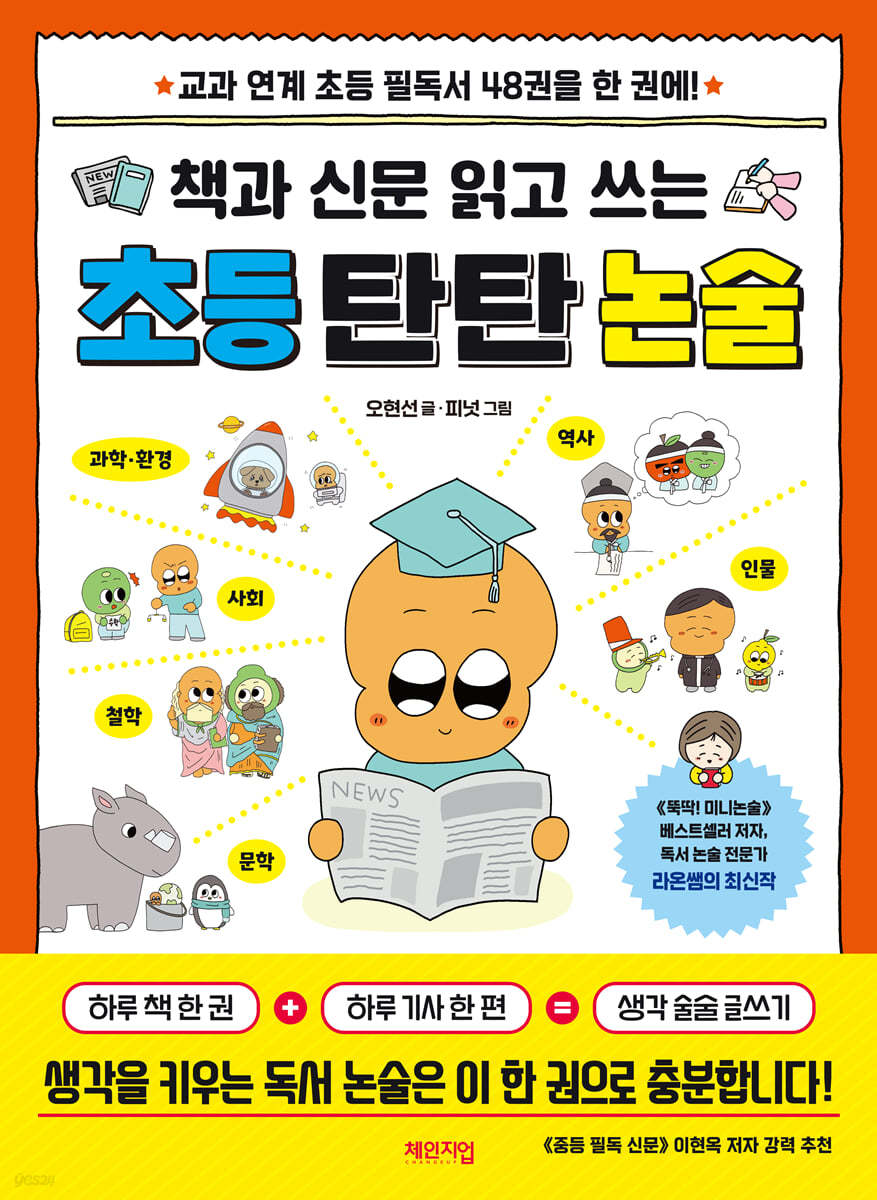
Elementary solid writing skills through reading and writing books and newspapers
 |
Description
Book Introduction
"The core of elementary school writing is the ability to connect books to the world."
An infinite vessel of thought created with textbook-related required reading and newspaper articles
The seeds of 'narrative' thinking that are placed in children's hands in advance,
A complete elementary school essay writing textbook that thoroughly analyzes the revised curriculum!
Teacher Raon, a reading and writing teacher with 24 years of experience, has compiled 48 essential elementary school reading books needed for the curriculum into a single volume.
To help children who dislike reading or lack the time to read easily access books, we've compiled the core content and themes of literature, philosophy, society, science, environment, history, and biographical books that students love in actual educational settings into a single page.
Additionally, easy-to-understand sentences along with friendly and witty illustrations will spark children's curiosity about the book.
After reading “One Page a Day: Elementary School Must-Reads,” let’s read “News with Must-Reads” together.
Articles related to the book's core content are based on actual events and issues that have occurred in our society and are written at a level suitable for children.
By comparing the knowledge gained from books with the social phenomena in articles, you can realize that everything that happens in this world is interconnected.
In this process, you can naturally develop a critical perspective on social problems and phenomena.
The essay questions you solve after reading books and articles are not simply a list of information you already know, but rather a writing process where you apply the knowledge you've acquired to real-world situations and your own life, analyze problems on your own, and logically organize your opinions.
By developing integrated thinking skills and writing essays, you can gain the confidence and insight to master descriptive questions, a key component of future learning.
An infinite vessel of thought created with textbook-related required reading and newspaper articles
The seeds of 'narrative' thinking that are placed in children's hands in advance,
A complete elementary school essay writing textbook that thoroughly analyzes the revised curriculum!
Teacher Raon, a reading and writing teacher with 24 years of experience, has compiled 48 essential elementary school reading books needed for the curriculum into a single volume.
To help children who dislike reading or lack the time to read easily access books, we've compiled the core content and themes of literature, philosophy, society, science, environment, history, and biographical books that students love in actual educational settings into a single page.
Additionally, easy-to-understand sentences along with friendly and witty illustrations will spark children's curiosity about the book.
After reading “One Page a Day: Elementary School Must-Reads,” let’s read “News with Must-Reads” together.
Articles related to the book's core content are based on actual events and issues that have occurred in our society and are written at a level suitable for children.
By comparing the knowledge gained from books with the social phenomena in articles, you can realize that everything that happens in this world is interconnected.
In this process, you can naturally develop a critical perspective on social problems and phenomena.
The essay questions you solve after reading books and articles are not simply a list of information you already know, but rather a writing process where you apply the knowledge you've acquired to real-world situations and your own life, analyze problems on your own, and logically organize your opinions.
By developing integrated thinking skills and writing essays, you can gain the confidence and insight to master descriptive questions, a key component of future learning.
- You can preview some of the book's contents.
Preview
index
To the children who chose this book
Use it like this
Elementary school curriculum linkage & difficulty level
Chapter 1 Literature
1.
Hope for the flowers
2.
Long long night
3.
A hen comes out of the yard
4.
Cucumber King
5.
Aunt's Dream House
6.
Blackout
7.
The Last Children After the Nuclear Explosion
8.
A boy who chews stones
Chapter 2 Philosophy
1.
Atuk
2.
What is freedom?
3.
The easiest philosophy book in the world
4.
What is Justice for Teenagers?
5.
Happy Janitor
6.
Philosophy Glasses
7.
Treegap Spring
8.
Why is thinking important?
Chapter 3 Society
1.
What is good politics?
2.
Black Hoodie Boy
3.
Exciting law study!
4.
Children's World Citizen School
5.
1+1 isn't free?
6.
Those who have abandoned the faith for children
7.
Things Money Can't Buy for Teens
8.
Fair Trade World Tour
Chapter 4 Science and Environment
1.
The man who planted the tree
2.
Life, if you know it, you will love it.
3.
animal rights
4.
The Dark Shadow of the Digital Future: The Story of Electronic Waste
5.
Fabre's Plant Story 1
6.
Teacher, what is the Anthropocene?
7.
If you eat ramen, the forest disappears
8.
Climate Refugee Stories for Children in the Age of Climate Crisis
Chapter 5 History
1.
Sister Mongsil
2.
The Story of Humanity Told by Professor Lee Sang-hee
3.
Seattle Chief's Speech
4.
Baekbeom Ilji: A Record of Passion for Independence
5.
Anne Frank's Diary
6.
Masako's question
7.
Father's letter
8.
Sapiens for Teens
Chapter 6 Characters
1.
The story of Kwon Jeong-saeng, so beautiful
2.
The story of the richest family in Gyeongju
3.
Lee Tae-seok, practicing true sharing from a humble place.
4.
The story of our cultural heritage rediscovered by Professor Gansong
5.
Helen Keller, if only I could see for three days
6.
Martin Luther King, the human rights activist who dreamed of peace
7.
Lindgren, the birth of Pippi Longstocking
8.
How to answer adults' questions about what you want to be
Use it like this
Elementary school curriculum linkage & difficulty level
Chapter 1 Literature
1.
Hope for the flowers
2.
Long long night
3.
A hen comes out of the yard
4.
Cucumber King
5.
Aunt's Dream House
6.
Blackout
7.
The Last Children After the Nuclear Explosion
8.
A boy who chews stones
Chapter 2 Philosophy
1.
Atuk
2.
What is freedom?
3.
The easiest philosophy book in the world
4.
What is Justice for Teenagers?
5.
Happy Janitor
6.
Philosophy Glasses
7.
Treegap Spring
8.
Why is thinking important?
Chapter 3 Society
1.
What is good politics?
2.
Black Hoodie Boy
3.
Exciting law study!
4.
Children's World Citizen School
5.
1+1 isn't free?
6.
Those who have abandoned the faith for children
7.
Things Money Can't Buy for Teens
8.
Fair Trade World Tour
Chapter 4 Science and Environment
1.
The man who planted the tree
2.
Life, if you know it, you will love it.
3.
animal rights
4.
The Dark Shadow of the Digital Future: The Story of Electronic Waste
5.
Fabre's Plant Story 1
6.
Teacher, what is the Anthropocene?
7.
If you eat ramen, the forest disappears
8.
Climate Refugee Stories for Children in the Age of Climate Crisis
Chapter 5 History
1.
Sister Mongsil
2.
The Story of Humanity Told by Professor Lee Sang-hee
3.
Seattle Chief's Speech
4.
Baekbeom Ilji: A Record of Passion for Independence
5.
Anne Frank's Diary
6.
Masako's question
7.
Father's letter
8.
Sapiens for Teens
Chapter 6 Characters
1.
The story of Kwon Jeong-saeng, so beautiful
2.
The story of the richest family in Gyeongju
3.
Lee Tae-seok, practicing true sharing from a humble place.
4.
The story of our cultural heritage rediscovered by Professor Gansong
5.
Helen Keller, if only I could see for three days
6.
Martin Luther King, the human rights activist who dreamed of peace
7.
Lindgren, the birth of Pippi Longstocking
8.
How to answer adults' questions about what you want to be
Detailed image

Into the book
Through “Elementary Solid Argumentation through Reading and Writing Books and Newspapers,” you will learn about a total of 48 books.
Even if you can't read all of these books, you can learn the core content and main points through the 'One-Page Elementary Must-Reads' that are organized into easy-to-read sections.
And through 'News Reading with Must-Read Books,' which covers real-life events and discussions in society, you learn to think more deeply and broadly by linking books and articles.
And if you go through the process of expressing it in your own writing, your thinking will expand infinitely.
---From the "Prologue"
In literature, it shows the process of characters resolving their entangled conflicts.
As we repeat this process, we naturally develop the ability to solve the big and small problems we encounter in life.
This is the biggest reason to read literature.
---From "Why should we read literature?"
We live our lives thinking about it every day.
Simply put, it starts with what to eat, what to choose, and how to behave.
But strictly speaking, it is difficult to call that a thought.
A real 'thought', not a fragmentary thought, has a deeper meaning.
The study of real thinking like that is called 'philosophy'.
---From "Why should we read philosophy books?"
This is also why we read social studies books.
As we learn through books how social phenomena around us are connected and how they influence each other, we begin to see ways to solve problems.
Furthermore, we can understand the world better and think about what values we should uphold in our lives.
The power of social studies is to teach a balanced understanding of the practical knowledge needed to live well in this world and the important values that help us make the right choices.
Even if you can't read all of these books, you can learn the core content and main points through the 'One-Page Elementary Must-Reads' that are organized into easy-to-read sections.
And through 'News Reading with Must-Read Books,' which covers real-life events and discussions in society, you learn to think more deeply and broadly by linking books and articles.
And if you go through the process of expressing it in your own writing, your thinking will expand infinitely.
---From the "Prologue"
In literature, it shows the process of characters resolving their entangled conflicts.
As we repeat this process, we naturally develop the ability to solve the big and small problems we encounter in life.
This is the biggest reason to read literature.
---From "Why should we read literature?"
We live our lives thinking about it every day.
Simply put, it starts with what to eat, what to choose, and how to behave.
But strictly speaking, it is difficult to call that a thought.
A real 'thought', not a fragmentary thought, has a deeper meaning.
The study of real thinking like that is called 'philosophy'.
---From "Why should we read philosophy books?"
This is also why we read social studies books.
As we learn through books how social phenomena around us are connected and how they influence each other, we begin to see ways to solve problems.
Furthermore, we can understand the world better and think about what values we should uphold in our lives.
The power of social studies is to teach a balanced understanding of the practical knowledge needed to live well in this world and the important values that help us make the right choices.
---From "Why should we read social studies books?"
Publisher's Review
A personalized essay prescription for children from Laon, an essay teacher with 24 years of experience.
If you read, think, and connect with the world, even long and difficult problems will be solved easily!
No matter how much knowledge you have, it is of no use if you cannot connect it to real life and the world we live in.
The reason children are not able to write readily is not because they lack study skills.
It's because I don't know how to use the knowledge I have in writing.
This book is a thought-expanding program that teaches you how to connect new information and knowledge gained through books and news articles to world problems.
It is impossible for elementary school students to read all the books in their busy schedules.
The author, who has taught elementary school writing for 24 years, says that children will benefit greatly if they just know that such a book exists in the world.
Just knowing which book contains the information you need allows you to look it up when you need it, and it can also provide clues to spark new interests in areas you previously knew nothing about.
So, even if you are a child who has built a wall around books, let's start reading with this book.
By quickly reading required reading related to the subject, you can confidently raise your hand and participate in discussions during class, and further develop your critical thinking skills by encountering living knowledge connected to the world.
“Is it really true that children’s literacy skills have weakened?”
The problem is that the textbooks are getting more and more difficult by the day!
Build your child's reading and logic skills in just 10 minutes a day.
There is a flood of intellectual and educational books on children's literacy and reading comprehension.
But is the reason really our children? Let's not blame them for reading and solving problems every day.
The real problem is that the textbooks and exam formats are becoming more difficult by the day.
As it becomes increasingly difficult to differentiate between the difficulty levels of questions, it is clear that future education will increasingly focus on descriptive and argumentative questions.
And this is actually something that is being discussed in the revised curriculum.
If children don't practice writing with their own thoughts from elementary school, they won't be able to demonstrate even half of their abilities when they encounter essay-type problems in middle and high school.
Before it's too late, you need to start writing and practice every day how to connect your knowledge and thoughts to social issues and real-life situations.
If you can express your thoughts and opinions well in writing, it is like laying a solid foundation for all studies.
《Elementary Solid Argumentation: Reading and Writing Books and Newspapers》 is a perfect guide for children who are just beginning to learn argumentation and reading comprehension.
Just by following along one page a day, you will soon gain solid writing skills and confidence.
If you read, think, and connect with the world, even long and difficult problems will be solved easily!
No matter how much knowledge you have, it is of no use if you cannot connect it to real life and the world we live in.
The reason children are not able to write readily is not because they lack study skills.
It's because I don't know how to use the knowledge I have in writing.
This book is a thought-expanding program that teaches you how to connect new information and knowledge gained through books and news articles to world problems.
It is impossible for elementary school students to read all the books in their busy schedules.
The author, who has taught elementary school writing for 24 years, says that children will benefit greatly if they just know that such a book exists in the world.
Just knowing which book contains the information you need allows you to look it up when you need it, and it can also provide clues to spark new interests in areas you previously knew nothing about.
So, even if you are a child who has built a wall around books, let's start reading with this book.
By quickly reading required reading related to the subject, you can confidently raise your hand and participate in discussions during class, and further develop your critical thinking skills by encountering living knowledge connected to the world.
“Is it really true that children’s literacy skills have weakened?”
The problem is that the textbooks are getting more and more difficult by the day!
Build your child's reading and logic skills in just 10 minutes a day.
There is a flood of intellectual and educational books on children's literacy and reading comprehension.
But is the reason really our children? Let's not blame them for reading and solving problems every day.
The real problem is that the textbooks and exam formats are becoming more difficult by the day.
As it becomes increasingly difficult to differentiate between the difficulty levels of questions, it is clear that future education will increasingly focus on descriptive and argumentative questions.
And this is actually something that is being discussed in the revised curriculum.
If children don't practice writing with their own thoughts from elementary school, they won't be able to demonstrate even half of their abilities when they encounter essay-type problems in middle and high school.
Before it's too late, you need to start writing and practice every day how to connect your knowledge and thoughts to social issues and real-life situations.
If you can express your thoughts and opinions well in writing, it is like laying a solid foundation for all studies.
《Elementary Solid Argumentation: Reading and Writing Books and Newspapers》 is a perfect guide for children who are just beginning to learn argumentation and reading comprehension.
Just by following along one page a day, you will soon gain solid writing skills and confidence.
GOODS SPECIFICS
- Date of issue: March 31, 2025
- Page count, weight, size: 240 pages | 658g | 188*257*16mm
- ISBN13: 9791191378665
- ISBN10: 1191378667
- KC Certification: Certification Type: Conformity Confirmation
You may also like
카테고리
korean


korean

![GQ KOREA Mark (Monthly): December [2025]](http://librairie.coreenne.fr/cdn/shop/files/8ef265dbbfbf186523ed75ba7319009d.jpg?v=1765340328&width=3840)


