

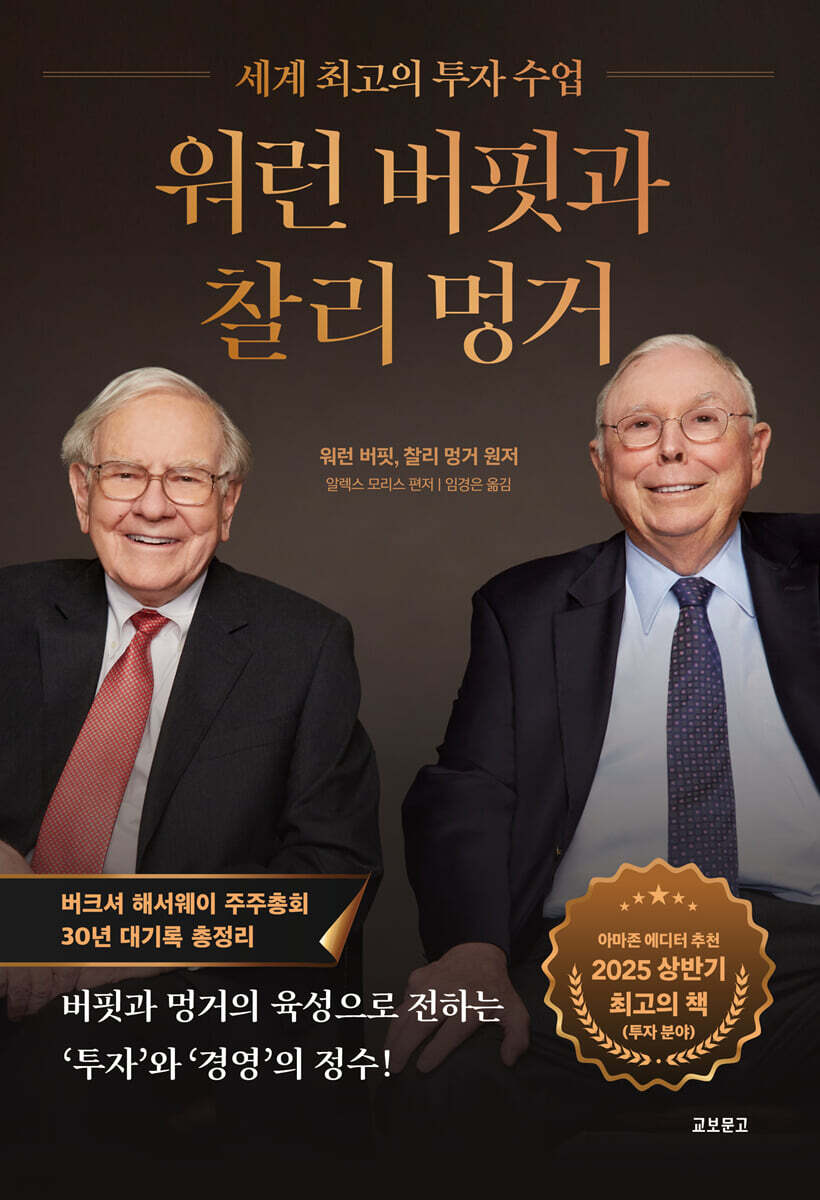
Warren Buffett and Charlie Munger
 |
Description
Book Introduction
★★★Amazon Editors' Picks: "Best Books of the First Half of 2025 (Investing)"★★★
★★★A Complete Summary of 30 Years of Berkshire Hathaway Shareholder Meetings★★★
Warren Buffett and Charlie Munger: Cumulative Returns of 5,500,000%
The unshakable laws of wealth, told directly by an investment legend!
Every May for the past several decades, tens of thousands of investors from around the world have flocked to Omaha, Nebraska.
This is because investment legends Warren Buffett and Charlie Munger generously shared their investment principles, know-how, market observation methods, and information on promising fields at the Berkshire Hathaway shareholders' meeting, held only once a year for five hours.
Buffett and Munger's words were more important than Wall Street reports, and they were "money-making lessons" that went beyond simple investment guidelines and served as a compass at critical crossroads.
In November 2023, Charlie Munger, Warren Buffett's close friend and Berkshire Hathaway's investment strategy architect, passed away at the age of 99.
And at the 60th annual shareholders' meeting held two years later, Buffett announced his retirement, saying he would hand over the CEO position to his successor at the end of the year.
Thus ended the long journey of two of history's greatest investors.
Although we no longer hear the vivid investment advice of Buffett and Munger, the teachings of these two legends, who have since stepped down from their positions of power, remain relevant.
Professional investor Alex Morris listened to both Buffett and Munger's shareholder meetings, a treasure trove of investment and business advice, and distilled their remarks into pieces that still hold true today.
This book is a compilation of the thousands of questions Buffett and Munger have graciously answered at shareholder meetings over the past 30 years, organized by topic.
Buffett and Munger have established themselves as legends in the investment world by achieving an overwhelming return of 20% per year over 60 years and a cumulative return of 5,500,000%.
The secret to their success can be found in their remarks at the Berkshire Hathaway shareholders' meeting.
"Warren Buffett and Charlie Munger: The World's Greatest Investment Lessons" brings together the wisdom and insights gleaned from Buffett and Munger's real-world investment experiences, revealing timeless principles of investment and management.
This book, which contains the 30 years of experience of Buffett and Munger, delivers timeless insights and unwavering principles of wealth on every page, with the vividness of being present at Berkshire Hathaway's annual shareholders' meeting.
Their investment advice, business acumen, and life wisdom will be a welcome gift to investors and entrepreneurs, bringing them wealth and success.
★★★A Complete Summary of 30 Years of Berkshire Hathaway Shareholder Meetings★★★
Warren Buffett and Charlie Munger: Cumulative Returns of 5,500,000%
The unshakable laws of wealth, told directly by an investment legend!
Every May for the past several decades, tens of thousands of investors from around the world have flocked to Omaha, Nebraska.
This is because investment legends Warren Buffett and Charlie Munger generously shared their investment principles, know-how, market observation methods, and information on promising fields at the Berkshire Hathaway shareholders' meeting, held only once a year for five hours.
Buffett and Munger's words were more important than Wall Street reports, and they were "money-making lessons" that went beyond simple investment guidelines and served as a compass at critical crossroads.
In November 2023, Charlie Munger, Warren Buffett's close friend and Berkshire Hathaway's investment strategy architect, passed away at the age of 99.
And at the 60th annual shareholders' meeting held two years later, Buffett announced his retirement, saying he would hand over the CEO position to his successor at the end of the year.
Thus ended the long journey of two of history's greatest investors.
Although we no longer hear the vivid investment advice of Buffett and Munger, the teachings of these two legends, who have since stepped down from their positions of power, remain relevant.
Professional investor Alex Morris listened to both Buffett and Munger's shareholder meetings, a treasure trove of investment and business advice, and distilled their remarks into pieces that still hold true today.
This book is a compilation of the thousands of questions Buffett and Munger have graciously answered at shareholder meetings over the past 30 years, organized by topic.
Buffett and Munger have established themselves as legends in the investment world by achieving an overwhelming return of 20% per year over 60 years and a cumulative return of 5,500,000%.
The secret to their success can be found in their remarks at the Berkshire Hathaway shareholders' meeting.
"Warren Buffett and Charlie Munger: The World's Greatest Investment Lessons" brings together the wisdom and insights gleaned from Buffett and Munger's real-world investment experiences, revealing timeless principles of investment and management.
This book, which contains the 30 years of experience of Buffett and Munger, delivers timeless insights and unwavering principles of wealth on every page, with the vividness of being present at Berkshire Hathaway's annual shareholders' meeting.
Their investment advice, business acumen, and life wisdom will be a welcome gift to investors and entrepreneurs, bringing them wealth and success.
- You can preview some of the book's contents.
Preview
index
Part 1: Value Investing
Value Investing - What's Not Value Investing?
Stock Selection - "The criteria for selecting stocks are the same as the criteria for evaluating the company."
The Ideal Company: "They Become Welfare Wizards"
Success in Investing and Life - "Impatience is the Enemy of Long-Term Performance"
What Makes a Good Annual Report? - "You Don't Need a Typical Annual Report"
Selling Point - 'Competitive Advantage Lost, Trust Lost'
What Makes a Good Investment? - "Making Two Right Decisions"
Avoiding Bad Decisions - "Don't Ask Your Barber If It's Time for a Haircut"
Declining Companies - "The real money is made in growing companies."
A question to ask managers: "Which company would you recommend as your second choice?"
The Basics of Corporate Acquisitions: "Let's buy with our own money, not someone else's."
Investment Period and Risk - "We only move when the odds are favorable."
Volatility and Risk - "Volatility Will Fix Itself"
Irregular Earnings - 'Christmas Still Survives Thousands of Years'
Cash holdings - "Having cash means you don't have any attractive investments."
Buffett's Quest: "How Much Is This Company Worth?"
Investing: "Investing isn't a religion, but it does have some useful doctrines."
Diversification and Concentration - "You Can Invest Successfully with Just Three Great Companies"
Between Growth and Profits - "High Profits Are More Important Than Growth"
Loss Recovery - "Don't try to get back what you've lost."
Recession - 'Recessions come when you least expect them.'
The first question in investing is: "Do I understand this company?"
Benjamin Graham and Philip Fisher - "Value Investing and Growth Investing"
The Role of Math in Investing—"Like a Baseball Scout Comparing Players"
Value Line - "A Look at the Company's Footsteps"
Opportunity Cost - "If the facts change, my mind changes."
Annual Reports - "You have to find and understand the information yourself."
The Key to a Great Company: "A company that can excel for 30 years or more."
Mr. Market: "Volatility is not risk."
Investment Experts vs. Amateurs: "Experts Underperform Index Funds"
5-Minute Test - Develop your own filter to determine your answer in 5 minutes.
Safety Margin - 'Most mistakes are due to negligence rather than misjudgment.'
Leverage and Options - "We don't engage in any flashy techniques."
Cigarette Butt Investing: "A Portfolio Full of Butts Won't Work"
EBITDA - Replace the word EBITDA with "inflated profit."
The Difference Between Good and Bad Companies: The Difference Between Easy and Hard Decisions
Field Survey - 'Who will use the silver bullets on?'
Decision-Making Assessment - "Doctors Who Take Pathology Classes Grow into Masters"
The Wisdom of Investing - "Why Did This Happen?"
Berkshire's Worst Mistake: Sucking Your Thumb
Small-Scale Investing - "Opportunities abound if you understand value and investing."
Part 2 Valuation and Intrinsic Value
Intrinsic Value - "The certainty of the future is better than the uncertainty of a bargain."
Growth and Value Stocks - The Distinction Between Growth and Value Stocks Is Meaningless
Valuation Criteria - "Valuation is not a numerical calculation."
Discounted Cash Flow - "The Margin of Safety Should Be Visible at a Glance"
Earnings Growth and Valuation - "The 15% Number Will Ultimately Be Your Hurdle"
Book Value - "It's not book value, but profits that determine value."
Cash flow discount rate - 'considers the present value of future earnings power'
Berkshire's Insurance Business Valuation: 'Intrinsic Value Far Exceeds Book Value'
Public Opinion and Analysts' Opinion: "Nobody on Wall Street Got Rich from Polls"
Interest Rates and Valuations - 'We're in an Interesting Downturn'
Bank Valuations: "Banks Are No Different from Other Industries"
Price-Earnings Ratio - "PER is not a magic formula."
Discount rate - 'We use the long-term government bond rate as our base discount rate.'
Permanent Hold - 'The best way to buy stocks is to buy them you'll never want to sell.'
Investment Criteria: "Investments should always consider both quality and price."
Part 3: Capital Allocation
Capital Allocation - "The most important requirement for Berkshire's successor is capital allocation skills."
Dividend Payouts - "Is the value of each dollar held by the company greater than the value of each dollar paid in dividends?"
M&A by Large Corporations: Issuing Stock to Acquire Other Companies Usually Fails
Treasury Stock Buybacks - Is the Stock Price Lower Than Its Intrinsic Value?
Berkshire's Share Buybacks: 'Proof That Our Stocks Are Undervalued'
Corporate stock buybacks—"If it's a good company, I support it."
Financial companies' share buybacks: "Intrinsic value must be considered."
Coca-Cola's Share Buyback: "A Company That Uses Capital Smartly"
Part 4 Corporate Management
Management Evaluation - 'How well do you utilize the resources and opportunities provided?'
Berkshire's Subsidiary Management: "Like Baseball Players with Different Hitting Styles"
Maintaining a Great Manager - "You Don't Need to Teach a .400 Hitter How to Swing"
Executive Stock Options - Issuing Stock Without Incurring Costs?
CEO and Capital Allocation - "We are accountable for all capital allocation decisions."
Avoiding Troublemakers - "You can't do good business with bad people."
Dealing with Bad News - "You Can't Lose Even a Bit of Your Reputation"
Management and Employee Compensation: "We Let .400 Hitters Swing Any Way They Want."
Management Contracts - "We Don't Want a Contract-Based Relationship"
Managerial Qualities: "We expect a consistent batting average of .300 or higher."
Stock options - "They should be a reward for generating profits, not a reward for effort."
Corporate Compensation: "American Corporations Are Being Swindled by Damn Consultants"
Good Companies and Incompetent Managers: "If a company is doing useless things, get out."
Self-trap - 'To a man with a hammer, every problem looks like a nail.'
Board of Directors - "The board's role is to select an appropriate CEO and keep him in check."
Corporate Culture - "Follow the corporate culture and you'll be rewarded. If you don't, you'll be punished."
Part 5 Berkshire Hathaway
Buffett's First Berkshire Investment: "Someone Else's Cigarette Butts Are Damp and Unpleasant, But They're Free."
Desirable Shareholders - Those who buy a portion of Berkshire, not Berkshire itself.
Operating Structure: Decentralized Corporate Operations, Centralized Asset Management
Risk Management - "Even if others collapse, we will survive."
Long-Term Corporate Ownership and M&A - "Just Wait for Pat Peach"
Succession Issue: "If Warren dies tonight, Berkshire's way of running won't change."
Strategic Vision: "We will always have ample cash reserves."
Berkshire's Best Investment: "Nothing Returns More on Talent Acquisition"
The Advantage of Selling to Berkshire: Maintaining the Company's Strengths
Accompanying a wholly owned subsidiary: "Not selling off our companies is a long-standing habit."
Berkshire's Intrinsic Value: "What Matters Is Future Capital Allocation"
Stock Turnover - Berkshire shareholders buy stocks to hold.
Berkshire's Strengths: A Culture and Business Model That's Hard to Imitate
McClain: "We want shareholders who are like partners."
Increasing Subsidiary Value - "The Value of Hands-Off Is Tremendous"
Valuation (New B Share Issuance) - "Berkshire cannot sell its shares at a price unfavorable to shareholders."
Stock Price - 'Wealth distribution that allows one group to take the wealth of another group should not be done.'
Subsidiary Capital Allocation - "Sound Business Ideas Always Welcome"
Opportunity Factor - "Berkshire has trained itself to avoid losses."
Limits of scale: "Good companies can't absorb additional capital."
Business Ethics - "Never Lose Your Reputation for Money"
Corporate Structure and Taxes: "The Arithmetic Disadvantage Reduces with Long-Term Investments."
M&A Due Diligence - "Due Diligence Seems Like a Formality to Us"
Acquisitions vs. Stock Investments - "We Prefer Outright Acquisitions"
Long-Term Success - "The Berkshire Way Can't Be Replied"
Energy Sector: "We will invest significantly in the energy business."
Nebraska Furniture Mart - "It wasn't cheap, but it was an opportunity not to be missed."
Netjet - "Mistakes don't change our ways."
Berkshire Hathaway Home Services - "A Very Local Business"
Dividend Policy - "The start of dividends signals the end of Berkshire's compounding efforts."
Borsheim: "For expensive items like jewelry, cost reduction is crucial."
Occidental Petroleum: 'Oil Price Holds the Key'
Precision Cast Parts - "We Will Make Mistakes in the Future"
Dexter Shue: "Investment Banking's Predictions and Reality Are Different"
Lubrizol: "Understanding the industry's economic trends is crucial."
PetroChina: "We Think Like Designers"
BNSF and the railroads—'We're open to adopting other companies' success stories.'
Part 6 Insurance Business
The Role of Insurance and Reinsurance - "There Are Two Reasons to Buy Insurance."
Smart Acquisitions - "The insurance industry can't afford mistakes."
Supercat Pricing - "Earthquakes happen regardless of insurance premiums."
The Reinsurance Business - "Handing over the pen to someone is a huge risk."
Retroactive Insurance - "We set limits on liability in every contract."
Insurance Competition - "If you misprice your insurance, you'll pay the price."
Insurance Floats - "Floats are ultimately a competition."
Float Investment - "Our goal is zero-cost float."
Lloyd's of London - 'Lloyd's' problem helped us'
The Value of Berkshire's Insurance Business: "It Must Be Managed Well to Match Its High Value."
The Strength of Berkshire's Insurance Business: "Float is Like a One-Man Bank"
Unexpected misfortune - 'Unpredictable events can occur, big and late.'
Insurance Underwriting Incentives: "I can tolerate excessive expense ratios, but I can't tolerate bad insurance."
The General Re Acquisition - "It was a major overhaul, but it's done."
Part 7 Accounting
Stock Option Accounting Issues: "Stock options are compensation and should be expensed."
Suspicious Accounting: "Looking into the Accounts Reveals Management"
Rational and Honest Accounting - "Numbers Don't Work"
Earnings Management: "We Can't Meet Expectations Every Year, Every Quarter."
The Value of Goodwill—"It Shouldn't Be Used to Evaluate a Company's Attractiveness"
Stock Split - 'We will not split the stock at $20.'
Accounting - "Shareholders understand the profitability of our transactions."
8th part ability range
Identify Your Strengths - "The Best Strategy Is Specialization"
Anticipating Change - "Find a company that won't be affected by change."
The Impact of Technological Advancement: "We See Change as a Threat"
Competing with the Internet: 'The Internet Will Make Business More Difficult'
Investing in Tech Stocks - "We Don't Invest in Unfamiliar Fields"
Investing in Telecom Stocks - "Telecom is an industry we don't understand."
A difficult prediction: "I'm aiming for a chance to clear the 30cm hurdle rather than a new record for clearing the 2-3m hurdle."
Moats and Sustainable Competitive Advantage: "If your moat widens every year, your business will thrive."
Growth Industries and Investment - "Growth Industries and Money-Making Industries Are Separate"
Part 9 Mr. Market
Mr. Market - "Stocks are the friendliest and most profitable market."
Market Predictions - "No one ever made money by predicting market movements."
Market Efficiency: "Past Knowledge Isn't Enough for Investing"
The Nature of the Market: "The Market Doesn't Follow a Normal Distribution"
Part 10: Economic Environment and Investment
Capitalism - 'Adam Smith Was Right'
Diversification of Investment Countries - "The Nationality of the Investment Target Is Not a Major Variable"
Market Timing - "We're Not Trying to Catch the Bottom"
The Fed and Interest Rates - 'The Fed's Role Is to Stand Against the Wind'
Gold and Inflation: 'Gold is the Bottom of the List'
Fortune 500 Companies' ROEs: "The Average Published ROE Is Overstated"
What's important and what you can know: 'We focus solely on the company's values.'
Macroeconomics and Investment Decisions - "We Don't Pay Attention to Random Variables"
Macroeconomics and External Factors - 'Adopting a deliberate agnosticism'
Economic Correlation - "Investing is about seeing what the asset itself will generate."
Zero Interest Rates - "Interest rates and assets are like gravity and matter."
Inflation and Returns - "Inflation Steals Investors' Money"
Inflation and Purchasing Power - "Your Best Defense Is Your Earnings Power."
Inflation-Resilient Companies - "Inflation is Always Latent"
Commodities - "We invest in companies, not the commodities themselves."
The Global Financial Crisis and the Government's Response: "We took swift and comprehensive measures."
Government Regulation - "Insurance and banking need regulation."
Global living standards are "moving forward, albeit intermittently."
Geopolitical Risks - "Still Looking for Business in the US"
Hiring and Laying Off - 'Capitalism is characterized by creative destruction.'
Part 11: See's Candies, Coca-Cola, and Consumer Goods Brands
Coca-Cola's Dividend Policy: "Evaluated Based on Cash Utilization"
Lessons Learned from See's Candy: "Pond Selection Matters More Than Swimming Skills."
The History of Coca-Cola: 'The Best and Dumbest Contracts'
Coca-Cola Valuation: "Look at Shares Issued and 24-Count Case Sales"
Coca-Cola's Market Share - "There's No Company More Solid Than Coca-Cola"
Walt Disney: "The key is mindshare 10 years from now."
Product Distribution: "If you can survive in the US, you'll have a lot of opportunities to expand globally."
Coca-Cola Bottling: "Bottling profitability is good for Coca-Cola."
Pricing Power and Inflation - "Brand Awareness is Key"
Coca-Cola Stock Price: "We'll Still Be Holding Coca-Cola in 10 Years"
Coca-Cola's Compensation Plan - "Their Compensation Plan Is Excessive"
The Influence of Retailers: "Large Retailers Are Reborn as Independent Brands"
Consumer Goods Brands - "A Brand Is a Promise"
The Kraft-Cadbury Merger: 'American Companies Are Overconfident in Their Strategy'
The Kraft-Heinz Merger: "Even a Good Investment Can Be Bad If It Pays Too Much."
Part 12: Geico and Auto Insurance
Geico Acquisition: 'Geico is a Major Asset for Berkshire'
Expanding the domestic market - "I hope Geico doesn't take a shortcut."
The History of American Auto Insurance: "A Look at It and You'll Learn a Lot"
Geico's Key Variables: "The Keys Are Contracts Held and Contract-Specific Renewal Rates."
Geico's Competitive Advantage: "Long-Term Competitive Advantage: Low Premiums."
Geico's Global Expansion: "Better to Focus the Same Resources on the US"
Progressive and Telematics - 'Look at the expense ratio and loss ratio'
Graham and Geico - 'He made his biggest fortune with growth stock Geico.'
Part 13: Almost Everything About Investing
Buffett's Golden Age: "As money grows, the scope for investment shrinks."
Investment Mistakes: Selling Disney in the 1960s Was a Big Mistake
Derivatives - "The Derivatives Sector is Potential Dynamite"
US Air Investment: "Avoid investing in companies with restructuring issues."
Aviation Industry: "There are many factors hindering profitability in the aviation industry."
Stop Loss - "I don't understand the stop loss order."
Put Options - "Not as Efficient as Buying Stocks"
American Express - "Their history is a wonderful success story."
The Film Industry: "Film companies don't provide much in the way of returns to shareholders."
Newspaper Business - "The Newspaper Business is Better Than the Newspaper Business"
Business Owners - 'They're fickle as hell'
Small Businesses - "Small Investments Offer Wide Opportunities"
Banking - "Good management makes for a good business."
Tobacco Industry: "We decided not to invest because we felt uncomfortable."
The Relationship Between Investing and Mathematics: "It's a Misconception That Math Helps Investing."
The Lesson from LTCM: Don't Price Risk
Pharmaceutical Industry - "Approaching Pharmaceutical Stocks as a Portfolio"
Corporate Social Responsibility - "Find Something Beyond Making and Saving Money"
Insurance company consolidation: "Two poorly performing SMEs merge to create a poorly performing conglomerate."
Costco: "The result of extreme meritocracy and voluntary ethical management."
The declining industry: "We need to squeeze out the money and move elsewhere."
Investment Banks: "Avoid investing in companies you don't know well."
Competition on the Internet: 'Competition is fierce and returns on capital are low.'
Financial Institutions and Banks - "Financial Institutions Are Difficult to Understand Through Financial Statements"
Short Selling - "Usually Ends with a Victory for the Operational Forces"
Index Funds - "We recommend a broad range of index funds."
Chinese Stocks - "Investing in China by Finding Good Companies at Low Prices"
IPOs - "An IPO is more like a negotiated deal than an auction."
Housing Market: 'Home Prices Rise, But Loan Terms Loosen'
BYD - "The company may be small, but their ambitions are big."
Bond Buying - 'All Securities Have Tradeoffs'
Credit rating agencies: "There's no reason to outsource investment decisions."
Lowering Expectations - "I got married because my wife lowered her expectations."
Henry Singleton - 'He issued stock like crazy'
A memorable investment - "Be kind to yourself by looking at us."
Private Equity Funds: 'We Have No Intention to Leverage Berkshire'
Recommended Reading: "It's Harder to Let Go of Old Knowledge Than to Gain New Knowledge."
The Self-Trap - "You Need the Will to Change Direction, Even When It's Painful"
The Right Way to Run an Insurance Company
Value Investing - What's Not Value Investing?
Stock Selection - "The criteria for selecting stocks are the same as the criteria for evaluating the company."
The Ideal Company: "They Become Welfare Wizards"
Success in Investing and Life - "Impatience is the Enemy of Long-Term Performance"
What Makes a Good Annual Report? - "You Don't Need a Typical Annual Report"
Selling Point - 'Competitive Advantage Lost, Trust Lost'
What Makes a Good Investment? - "Making Two Right Decisions"
Avoiding Bad Decisions - "Don't Ask Your Barber If It's Time for a Haircut"
Declining Companies - "The real money is made in growing companies."
A question to ask managers: "Which company would you recommend as your second choice?"
The Basics of Corporate Acquisitions: "Let's buy with our own money, not someone else's."
Investment Period and Risk - "We only move when the odds are favorable."
Volatility and Risk - "Volatility Will Fix Itself"
Irregular Earnings - 'Christmas Still Survives Thousands of Years'
Cash holdings - "Having cash means you don't have any attractive investments."
Buffett's Quest: "How Much Is This Company Worth?"
Investing: "Investing isn't a religion, but it does have some useful doctrines."
Diversification and Concentration - "You Can Invest Successfully with Just Three Great Companies"
Between Growth and Profits - "High Profits Are More Important Than Growth"
Loss Recovery - "Don't try to get back what you've lost."
Recession - 'Recessions come when you least expect them.'
The first question in investing is: "Do I understand this company?"
Benjamin Graham and Philip Fisher - "Value Investing and Growth Investing"
The Role of Math in Investing—"Like a Baseball Scout Comparing Players"
Value Line - "A Look at the Company's Footsteps"
Opportunity Cost - "If the facts change, my mind changes."
Annual Reports - "You have to find and understand the information yourself."
The Key to a Great Company: "A company that can excel for 30 years or more."
Mr. Market: "Volatility is not risk."
Investment Experts vs. Amateurs: "Experts Underperform Index Funds"
5-Minute Test - Develop your own filter to determine your answer in 5 minutes.
Safety Margin - 'Most mistakes are due to negligence rather than misjudgment.'
Leverage and Options - "We don't engage in any flashy techniques."
Cigarette Butt Investing: "A Portfolio Full of Butts Won't Work"
EBITDA - Replace the word EBITDA with "inflated profit."
The Difference Between Good and Bad Companies: The Difference Between Easy and Hard Decisions
Field Survey - 'Who will use the silver bullets on?'
Decision-Making Assessment - "Doctors Who Take Pathology Classes Grow into Masters"
The Wisdom of Investing - "Why Did This Happen?"
Berkshire's Worst Mistake: Sucking Your Thumb
Small-Scale Investing - "Opportunities abound if you understand value and investing."
Part 2 Valuation and Intrinsic Value
Intrinsic Value - "The certainty of the future is better than the uncertainty of a bargain."
Growth and Value Stocks - The Distinction Between Growth and Value Stocks Is Meaningless
Valuation Criteria - "Valuation is not a numerical calculation."
Discounted Cash Flow - "The Margin of Safety Should Be Visible at a Glance"
Earnings Growth and Valuation - "The 15% Number Will Ultimately Be Your Hurdle"
Book Value - "It's not book value, but profits that determine value."
Cash flow discount rate - 'considers the present value of future earnings power'
Berkshire's Insurance Business Valuation: 'Intrinsic Value Far Exceeds Book Value'
Public Opinion and Analysts' Opinion: "Nobody on Wall Street Got Rich from Polls"
Interest Rates and Valuations - 'We're in an Interesting Downturn'
Bank Valuations: "Banks Are No Different from Other Industries"
Price-Earnings Ratio - "PER is not a magic formula."
Discount rate - 'We use the long-term government bond rate as our base discount rate.'
Permanent Hold - 'The best way to buy stocks is to buy them you'll never want to sell.'
Investment Criteria: "Investments should always consider both quality and price."
Part 3: Capital Allocation
Capital Allocation - "The most important requirement for Berkshire's successor is capital allocation skills."
Dividend Payouts - "Is the value of each dollar held by the company greater than the value of each dollar paid in dividends?"
M&A by Large Corporations: Issuing Stock to Acquire Other Companies Usually Fails
Treasury Stock Buybacks - Is the Stock Price Lower Than Its Intrinsic Value?
Berkshire's Share Buybacks: 'Proof That Our Stocks Are Undervalued'
Corporate stock buybacks—"If it's a good company, I support it."
Financial companies' share buybacks: "Intrinsic value must be considered."
Coca-Cola's Share Buyback: "A Company That Uses Capital Smartly"
Part 4 Corporate Management
Management Evaluation - 'How well do you utilize the resources and opportunities provided?'
Berkshire's Subsidiary Management: "Like Baseball Players with Different Hitting Styles"
Maintaining a Great Manager - "You Don't Need to Teach a .400 Hitter How to Swing"
Executive Stock Options - Issuing Stock Without Incurring Costs?
CEO and Capital Allocation - "We are accountable for all capital allocation decisions."
Avoiding Troublemakers - "You can't do good business with bad people."
Dealing with Bad News - "You Can't Lose Even a Bit of Your Reputation"
Management and Employee Compensation: "We Let .400 Hitters Swing Any Way They Want."
Management Contracts - "We Don't Want a Contract-Based Relationship"
Managerial Qualities: "We expect a consistent batting average of .300 or higher."
Stock options - "They should be a reward for generating profits, not a reward for effort."
Corporate Compensation: "American Corporations Are Being Swindled by Damn Consultants"
Good Companies and Incompetent Managers: "If a company is doing useless things, get out."
Self-trap - 'To a man with a hammer, every problem looks like a nail.'
Board of Directors - "The board's role is to select an appropriate CEO and keep him in check."
Corporate Culture - "Follow the corporate culture and you'll be rewarded. If you don't, you'll be punished."
Part 5 Berkshire Hathaway
Buffett's First Berkshire Investment: "Someone Else's Cigarette Butts Are Damp and Unpleasant, But They're Free."
Desirable Shareholders - Those who buy a portion of Berkshire, not Berkshire itself.
Operating Structure: Decentralized Corporate Operations, Centralized Asset Management
Risk Management - "Even if others collapse, we will survive."
Long-Term Corporate Ownership and M&A - "Just Wait for Pat Peach"
Succession Issue: "If Warren dies tonight, Berkshire's way of running won't change."
Strategic Vision: "We will always have ample cash reserves."
Berkshire's Best Investment: "Nothing Returns More on Talent Acquisition"
The Advantage of Selling to Berkshire: Maintaining the Company's Strengths
Accompanying a wholly owned subsidiary: "Not selling off our companies is a long-standing habit."
Berkshire's Intrinsic Value: "What Matters Is Future Capital Allocation"
Stock Turnover - Berkshire shareholders buy stocks to hold.
Berkshire's Strengths: A Culture and Business Model That's Hard to Imitate
McClain: "We want shareholders who are like partners."
Increasing Subsidiary Value - "The Value of Hands-Off Is Tremendous"
Valuation (New B Share Issuance) - "Berkshire cannot sell its shares at a price unfavorable to shareholders."
Stock Price - 'Wealth distribution that allows one group to take the wealth of another group should not be done.'
Subsidiary Capital Allocation - "Sound Business Ideas Always Welcome"
Opportunity Factor - "Berkshire has trained itself to avoid losses."
Limits of scale: "Good companies can't absorb additional capital."
Business Ethics - "Never Lose Your Reputation for Money"
Corporate Structure and Taxes: "The Arithmetic Disadvantage Reduces with Long-Term Investments."
M&A Due Diligence - "Due Diligence Seems Like a Formality to Us"
Acquisitions vs. Stock Investments - "We Prefer Outright Acquisitions"
Long-Term Success - "The Berkshire Way Can't Be Replied"
Energy Sector: "We will invest significantly in the energy business."
Nebraska Furniture Mart - "It wasn't cheap, but it was an opportunity not to be missed."
Netjet - "Mistakes don't change our ways."
Berkshire Hathaway Home Services - "A Very Local Business"
Dividend Policy - "The start of dividends signals the end of Berkshire's compounding efforts."
Borsheim: "For expensive items like jewelry, cost reduction is crucial."
Occidental Petroleum: 'Oil Price Holds the Key'
Precision Cast Parts - "We Will Make Mistakes in the Future"
Dexter Shue: "Investment Banking's Predictions and Reality Are Different"
Lubrizol: "Understanding the industry's economic trends is crucial."
PetroChina: "We Think Like Designers"
BNSF and the railroads—'We're open to adopting other companies' success stories.'
Part 6 Insurance Business
The Role of Insurance and Reinsurance - "There Are Two Reasons to Buy Insurance."
Smart Acquisitions - "The insurance industry can't afford mistakes."
Supercat Pricing - "Earthquakes happen regardless of insurance premiums."
The Reinsurance Business - "Handing over the pen to someone is a huge risk."
Retroactive Insurance - "We set limits on liability in every contract."
Insurance Competition - "If you misprice your insurance, you'll pay the price."
Insurance Floats - "Floats are ultimately a competition."
Float Investment - "Our goal is zero-cost float."
Lloyd's of London - 'Lloyd's' problem helped us'
The Value of Berkshire's Insurance Business: "It Must Be Managed Well to Match Its High Value."
The Strength of Berkshire's Insurance Business: "Float is Like a One-Man Bank"
Unexpected misfortune - 'Unpredictable events can occur, big and late.'
Insurance Underwriting Incentives: "I can tolerate excessive expense ratios, but I can't tolerate bad insurance."
The General Re Acquisition - "It was a major overhaul, but it's done."
Part 7 Accounting
Stock Option Accounting Issues: "Stock options are compensation and should be expensed."
Suspicious Accounting: "Looking into the Accounts Reveals Management"
Rational and Honest Accounting - "Numbers Don't Work"
Earnings Management: "We Can't Meet Expectations Every Year, Every Quarter."
The Value of Goodwill—"It Shouldn't Be Used to Evaluate a Company's Attractiveness"
Stock Split - 'We will not split the stock at $20.'
Accounting - "Shareholders understand the profitability of our transactions."
8th part ability range
Identify Your Strengths - "The Best Strategy Is Specialization"
Anticipating Change - "Find a company that won't be affected by change."
The Impact of Technological Advancement: "We See Change as a Threat"
Competing with the Internet: 'The Internet Will Make Business More Difficult'
Investing in Tech Stocks - "We Don't Invest in Unfamiliar Fields"
Investing in Telecom Stocks - "Telecom is an industry we don't understand."
A difficult prediction: "I'm aiming for a chance to clear the 30cm hurdle rather than a new record for clearing the 2-3m hurdle."
Moats and Sustainable Competitive Advantage: "If your moat widens every year, your business will thrive."
Growth Industries and Investment - "Growth Industries and Money-Making Industries Are Separate"
Part 9 Mr. Market
Mr. Market - "Stocks are the friendliest and most profitable market."
Market Predictions - "No one ever made money by predicting market movements."
Market Efficiency: "Past Knowledge Isn't Enough for Investing"
The Nature of the Market: "The Market Doesn't Follow a Normal Distribution"
Part 10: Economic Environment and Investment
Capitalism - 'Adam Smith Was Right'
Diversification of Investment Countries - "The Nationality of the Investment Target Is Not a Major Variable"
Market Timing - "We're Not Trying to Catch the Bottom"
The Fed and Interest Rates - 'The Fed's Role Is to Stand Against the Wind'
Gold and Inflation: 'Gold is the Bottom of the List'
Fortune 500 Companies' ROEs: "The Average Published ROE Is Overstated"
What's important and what you can know: 'We focus solely on the company's values.'
Macroeconomics and Investment Decisions - "We Don't Pay Attention to Random Variables"
Macroeconomics and External Factors - 'Adopting a deliberate agnosticism'
Economic Correlation - "Investing is about seeing what the asset itself will generate."
Zero Interest Rates - "Interest rates and assets are like gravity and matter."
Inflation and Returns - "Inflation Steals Investors' Money"
Inflation and Purchasing Power - "Your Best Defense Is Your Earnings Power."
Inflation-Resilient Companies - "Inflation is Always Latent"
Commodities - "We invest in companies, not the commodities themselves."
The Global Financial Crisis and the Government's Response: "We took swift and comprehensive measures."
Government Regulation - "Insurance and banking need regulation."
Global living standards are "moving forward, albeit intermittently."
Geopolitical Risks - "Still Looking for Business in the US"
Hiring and Laying Off - 'Capitalism is characterized by creative destruction.'
Part 11: See's Candies, Coca-Cola, and Consumer Goods Brands
Coca-Cola's Dividend Policy: "Evaluated Based on Cash Utilization"
Lessons Learned from See's Candy: "Pond Selection Matters More Than Swimming Skills."
The History of Coca-Cola: 'The Best and Dumbest Contracts'
Coca-Cola Valuation: "Look at Shares Issued and 24-Count Case Sales"
Coca-Cola's Market Share - "There's No Company More Solid Than Coca-Cola"
Walt Disney: "The key is mindshare 10 years from now."
Product Distribution: "If you can survive in the US, you'll have a lot of opportunities to expand globally."
Coca-Cola Bottling: "Bottling profitability is good for Coca-Cola."
Pricing Power and Inflation - "Brand Awareness is Key"
Coca-Cola Stock Price: "We'll Still Be Holding Coca-Cola in 10 Years"
Coca-Cola's Compensation Plan - "Their Compensation Plan Is Excessive"
The Influence of Retailers: "Large Retailers Are Reborn as Independent Brands"
Consumer Goods Brands - "A Brand Is a Promise"
The Kraft-Cadbury Merger: 'American Companies Are Overconfident in Their Strategy'
The Kraft-Heinz Merger: "Even a Good Investment Can Be Bad If It Pays Too Much."
Part 12: Geico and Auto Insurance
Geico Acquisition: 'Geico is a Major Asset for Berkshire'
Expanding the domestic market - "I hope Geico doesn't take a shortcut."
The History of American Auto Insurance: "A Look at It and You'll Learn a Lot"
Geico's Key Variables: "The Keys Are Contracts Held and Contract-Specific Renewal Rates."
Geico's Competitive Advantage: "Long-Term Competitive Advantage: Low Premiums."
Geico's Global Expansion: "Better to Focus the Same Resources on the US"
Progressive and Telematics - 'Look at the expense ratio and loss ratio'
Graham and Geico - 'He made his biggest fortune with growth stock Geico.'
Part 13: Almost Everything About Investing
Buffett's Golden Age: "As money grows, the scope for investment shrinks."
Investment Mistakes: Selling Disney in the 1960s Was a Big Mistake
Derivatives - "The Derivatives Sector is Potential Dynamite"
US Air Investment: "Avoid investing in companies with restructuring issues."
Aviation Industry: "There are many factors hindering profitability in the aviation industry."
Stop Loss - "I don't understand the stop loss order."
Put Options - "Not as Efficient as Buying Stocks"
American Express - "Their history is a wonderful success story."
The Film Industry: "Film companies don't provide much in the way of returns to shareholders."
Newspaper Business - "The Newspaper Business is Better Than the Newspaper Business"
Business Owners - 'They're fickle as hell'
Small Businesses - "Small Investments Offer Wide Opportunities"
Banking - "Good management makes for a good business."
Tobacco Industry: "We decided not to invest because we felt uncomfortable."
The Relationship Between Investing and Mathematics: "It's a Misconception That Math Helps Investing."
The Lesson from LTCM: Don't Price Risk
Pharmaceutical Industry - "Approaching Pharmaceutical Stocks as a Portfolio"
Corporate Social Responsibility - "Find Something Beyond Making and Saving Money"
Insurance company consolidation: "Two poorly performing SMEs merge to create a poorly performing conglomerate."
Costco: "The result of extreme meritocracy and voluntary ethical management."
The declining industry: "We need to squeeze out the money and move elsewhere."
Investment Banks: "Avoid investing in companies you don't know well."
Competition on the Internet: 'Competition is fierce and returns on capital are low.'
Financial Institutions and Banks - "Financial Institutions Are Difficult to Understand Through Financial Statements"
Short Selling - "Usually Ends with a Victory for the Operational Forces"
Index Funds - "We recommend a broad range of index funds."
Chinese Stocks - "Investing in China by Finding Good Companies at Low Prices"
IPOs - "An IPO is more like a negotiated deal than an auction."
Housing Market: 'Home Prices Rise, But Loan Terms Loosen'
BYD - "The company may be small, but their ambitions are big."
Bond Buying - 'All Securities Have Tradeoffs'
Credit rating agencies: "There's no reason to outsource investment decisions."
Lowering Expectations - "I got married because my wife lowered her expectations."
Henry Singleton - 'He issued stock like crazy'
A memorable investment - "Be kind to yourself by looking at us."
Private Equity Funds: 'We Have No Intention to Leverage Berkshire'
Recommended Reading: "It's Harder to Let Go of Old Knowledge Than to Gain New Knowledge."
The Self-Trap - "You Need the Will to Change Direction, Even When It's Painful"
The Right Way to Run an Insurance Company
Detailed image

Into the book
Students at prestigious American business schools and law schools learn corporate finance and investment management the way they do today.
And some of them write articles in newspapers after graduation saying, 'The secret to investing is diversification.'
It turned out to be an order, but it was a completely opposite way of thinking.
The key to investing is finding safe and smart investments that don't require diversification.
It's really simple.
Diversification may be understandable to investment laypeople, but it is not suitable for experts.
---From "Diversified Investment and Concentrated Investment"
Growth is only one part of what makes up value.
Anyone who talks about whether to invest in growth stocks or value stocks doesn't understand investing.
---From "Growth Stocks and Value Stocks"
Companies are issuing massive amounts of stock options and then repurchasing them at much higher prices.
I started reading investing books when I was six, and the first thing I learned was "buy low, sell high."
But companies sell stock options at low prices and buy them at high prices.
It's the opposite of how I was taught.
There are several corporate practices that we find difficult to understand.
---From "Corporate Stock Purchase"
We're not trying to grab the bottom.
I have no idea what the stock market will do tomorrow, next week, or next month.
It is not our way to give up a reasonable opportunity today in the hope that a more attractive one will appear tomorrow.
Whenever a reasonable buying opportunity arises, we execute immediately.
And if there are more reasonable deals and funds the next day, you can invest again.
Buying the dip doesn't seem to be in our direction and doesn't seem feasible.
We value price business valuations, which is not difficult.
People like to buy at the bottom, but in reality, they buy when the stock price starts to rise.
---From "Market Timing"
If we hadn't acquired See's Candies and experienced the lessons that followed, we wouldn't have bought Coca-Cola stock in 1988.
It's no exaggeration to say that a significant portion of the profits we make from Coca-Cola are owed to See's Candies.
Some people might say that they don't even know the true value of Coca-Cola, but I don't know.
It's true that my thinking has broadened thanks to See's Candy.
I saw firsthand the market impact of my decision to acquire See's Candies, and that gave me a clearer perspective on what works and what doesn't.
And we focused on what worked and avoided what didn't.
This led directly to my relationship with Coca-Cola.
Besides that, I was lucky enough to acquire several companies whole, and learned a lot from that.
---From "Lessons Learned from See's Candy"
A friend of mine used to say that the first rule of fishing is to fish where the fish are, and the second rule is to never forget the first rule.
We've become adept at fishing where the fish are.
And some of them write articles in newspapers after graduation saying, 'The secret to investing is diversification.'
It turned out to be an order, but it was a completely opposite way of thinking.
The key to investing is finding safe and smart investments that don't require diversification.
It's really simple.
Diversification may be understandable to investment laypeople, but it is not suitable for experts.
---From "Diversified Investment and Concentrated Investment"
Growth is only one part of what makes up value.
Anyone who talks about whether to invest in growth stocks or value stocks doesn't understand investing.
---From "Growth Stocks and Value Stocks"
Companies are issuing massive amounts of stock options and then repurchasing them at much higher prices.
I started reading investing books when I was six, and the first thing I learned was "buy low, sell high."
But companies sell stock options at low prices and buy them at high prices.
It's the opposite of how I was taught.
There are several corporate practices that we find difficult to understand.
---From "Corporate Stock Purchase"
We're not trying to grab the bottom.
I have no idea what the stock market will do tomorrow, next week, or next month.
It is not our way to give up a reasonable opportunity today in the hope that a more attractive one will appear tomorrow.
Whenever a reasonable buying opportunity arises, we execute immediately.
And if there are more reasonable deals and funds the next day, you can invest again.
Buying the dip doesn't seem to be in our direction and doesn't seem feasible.
We value price business valuations, which is not difficult.
People like to buy at the bottom, but in reality, they buy when the stock price starts to rise.
---From "Market Timing"
If we hadn't acquired See's Candies and experienced the lessons that followed, we wouldn't have bought Coca-Cola stock in 1988.
It's no exaggeration to say that a significant portion of the profits we make from Coca-Cola are owed to See's Candies.
Some people might say that they don't even know the true value of Coca-Cola, but I don't know.
It's true that my thinking has broadened thanks to See's Candy.
I saw firsthand the market impact of my decision to acquire See's Candies, and that gave me a clearer perspective on what works and what doesn't.
And we focused on what worked and avoided what didn't.
This led directly to my relationship with Coca-Cola.
Besides that, I was lucky enough to acquire several companies whole, and learned a lot from that.
---From "Lessons Learned from See's Candy"
A friend of mine used to say that the first rule of fishing is to fish where the fish are, and the second rule is to never forget the first rule.
We've become adept at fishing where the fish are.
---From "Lessons Learned from See's Candy"
Publisher's Review
The one and only reason investors from all over the world head to Omaha every year:
Money-making lessons from an investment legend!
Every May for the past several decades, tens of thousands of investors from around the world have flocked to Omaha, Nebraska.
To attend the Berkshire Hathaway annual shareholders meeting, led by investment legends Warren Buffett and Charlie Munger.
Two of the world's most trusted investors spoke to the public about investing, management, life, mistakes, learning, and philosophy at Berkshire's annual meeting, which lasts only five hours.
The Q&A format of the shareholders' meeting could be considered the largest economic concert in history.
Those who attended the event benefited from Buffett and Munger's investment principles and know-how, market observation techniques, and information on promising fields.
The two investors' answers were more important than any Wall Street report, and they were "money-making lessons" that went beyond simple investment guidance and served as a compass at a critical crossroads.
However, because Berkshire Hathaway's annual shareholders' meeting was held only as an in-person event without video recording, only a small number of people who attended in person for a long time were able to hear investment advice from Buffett and Munger.
Until 2018, when Berkshire Hathaway released video of its annual meetings dating back to 1994, all it had to do was share notes taken by someone attending the meetings.
The world's only capitalist concert,
A Complete Summary of Berkshire Hathaway's 30-Year Record Annual Shareholder Meetings
In November 2023, Charlie Munger, Warren Buffett's close friend and Berkshire Hathaway's investment strategy architect, passed away at the age of 99.
And at the 60th annual shareholders' meeting held two years later, Buffett announced his retirement, saying he would hand over the CEO position to his successor at the end of the year.
The New York Times commented on this, saying, “The era of the most successful entrepreneur and famous investor is over.”
Thus ended the long journey of two of history's greatest investors.
Although we no longer have the vivid investment advice of Buffett and Munger, the lessons learned from these two legends, who have since stepped down from their top positions, still hold true.
Professional investor Alex Morris listened to both Buffett and Munger's shareholder meetings, a treasure trove of investment and business advice, and distilled their remarks into pieces that still hold true today.
This book, "Warren Buffett and Charlie Munger: The World's Greatest Investment Lessons," organizes by topic the thousands of questions Buffett and Munger kindly answered at shareholder meetings over the past 30 years.
We have opened the doors to a treasure trove of information that will be helpful to investors and entrepreneurs.
This book, which contains the 30 years of experience of Buffett and Munger, delivers timeless insights and unwavering principles of wealth on every page, with the vividness of being present at Berkshire Hathaway's annual shareholders' meeting.
Warren Buffett and Charlie Munger,
How did they become legends in the investment world?
From 1964, the year after Buffett acquired Berkshire Hathaway, to 2024, his average annual return was about 20%.
During the same period, the S&P 500's annual average return was about 10%, so Buffett's performance far exceeded the market average return.
This gap has continued for nearly 60 years, resulting in Berkshire Hathaway's cumulative return of over 5,500,000%, significantly outpacing the S&P 500's cumulative return of approximately 40,000%.
Other than Buffett, it's hard to find an investor who has consistently beaten the market for so long.
Berkshire Hathaway, which was a failing textile company when Buffett acquired it, surpassed a market capitalization of $1 trillion in 2024, the first US public company outside of Big Tech to do so.
In this way, Buffett has left a more distinct and significant mark on the investment industry than anyone else.
Munger, who was vice chairman of Berkshire Hathaway, was Buffett's only partner, mentor, and advisor.
Buffett's investment style, which once focused on "cigarette butt investing"—buying poorly performing companies at low prices to make short-term profits—changed after meeting Munger, emphasizing the value of a company and its growth potential.
Moreover, thanks to Munger's insightful approach, which comprehensively applied various fields of study, including economics, psychology, mathematics, and history, to investment decisions, Berkshire Hathaway grew rapidly into a massive corporation with hundreds of subsidiaries.
Munger has been active across boundaries as the architect of Berkshire Hathaway's investment strategy and as a corporate giant.
If there had been no Munger, there would have been no Buffett.
The secret to the two men's long history of achieving overwhelming returns and establishing themselves as legends in the investment world can be found in their remarks at Berkshire Hathaway's annual shareholders' meeting.
"Warren Buffett and Charlie Munger: The World's Greatest Investment Lessons" reveals the principles of investment and management that remain unchanged over the past 30 years, based on the wisdom gleaned from Buffett and Munger's practical investment experiences.
The Unshakable Laws of Wealth, Revealed by Market-Beater Investors
Buffett and Munger were asked questions on the spot at the shareholder meeting, without any preparation.
But their answers always had a clear philosophy, and the two men have remained steadfast in their investment principles, with an unwavering approach for decades.
At the same time, the two men's investment philosophies continued to develop and evolve.
Warren Buffett and Charlie Munger: The World's Greatest Investment Lessons is a journey that follows the trajectory of investment philosophy, the power of words, and wisdom accumulated over 30 years.
The reason why Buffett and Munger's words are so necessary for us now is because, even in turbulent times, we can find answers in unshakable essence.
The first investment rule of Buffett and Munger, who have beaten the market for 60 years, is 'never lose money', and the second rule is 'never forget the first rule'.
To avoid this principle, the two emphasized continuous learning.
Beyond simply analyzing the company to invest in, we invested after comprehensively understanding the market, including the company's business sector, environment, and operating structure.
As a result, Coca-Cola and See's Candies made huge profits.
See's Candies, acquired for $250 billion, quickly generated profits of several dozen times that amount, reaching $1.5 billion, and the Coca-Cola stock purchased with that money brought in enormous returns and large annual dividends.
The two invested in various fields, betting big when opportunities arose.
However, he only invested heavily in companies that he clearly understood and that offered long-term advantages.
And, for the assets held in this way, we adhered to a strategy of holding them for a long time, treating time as our friend, rather than trading them frequently.
If it is a great company that will bring you a clear opportunity, its intrinsic value will grow with compound interest over time, bringing you greater profits.
But Buffett and Munger haven't been successful in every investment.
Even now, when I think about it, I experience failures that I regret so much that I kick off the blanket while I'm sleeping.
Multiple failures have taught them to be less emotionally swayed, to avoid psychological traps, and to face temptation.
In the process, investment decisions were made based on loss minimization and risk management, and as a result, Berkshire Hathaway grew rapidly into a giant corporation with hundreds of subsidiaries.
This book is also filled with unwavering principles of wealth, including capital allocation, corporate valuation techniques, coping with uncertainty and market volatility, calculating opportunity costs, overcoming macroeconomic uncertainty, defining your scope of ability, and the conditions for success as a long-term investor.
Buffett and Munger emphasized that the biggest reason they were able to achieve success over many years was that they “never gave up learning.”
Buffett never stopped improving even after he passed retirement age, and Munger said, “Learning is the very purpose of our existence, so we should go to bed each night wiser than we were the morning after.”
Warren Buffett and Charlie Munger: The World's Greatest Investment Lessons is a book that compiles the essence of the learnings Buffett and Munger have accumulated throughout their lives.
Their investment advice, business acumen, and life wisdom will be a welcome gift to investors and entrepreneurs, bringing them wealth and success.
Money-making lessons from an investment legend!
Every May for the past several decades, tens of thousands of investors from around the world have flocked to Omaha, Nebraska.
To attend the Berkshire Hathaway annual shareholders meeting, led by investment legends Warren Buffett and Charlie Munger.
Two of the world's most trusted investors spoke to the public about investing, management, life, mistakes, learning, and philosophy at Berkshire's annual meeting, which lasts only five hours.
The Q&A format of the shareholders' meeting could be considered the largest economic concert in history.
Those who attended the event benefited from Buffett and Munger's investment principles and know-how, market observation techniques, and information on promising fields.
The two investors' answers were more important than any Wall Street report, and they were "money-making lessons" that went beyond simple investment guidance and served as a compass at a critical crossroads.
However, because Berkshire Hathaway's annual shareholders' meeting was held only as an in-person event without video recording, only a small number of people who attended in person for a long time were able to hear investment advice from Buffett and Munger.
Until 2018, when Berkshire Hathaway released video of its annual meetings dating back to 1994, all it had to do was share notes taken by someone attending the meetings.
The world's only capitalist concert,
A Complete Summary of Berkshire Hathaway's 30-Year Record Annual Shareholder Meetings
In November 2023, Charlie Munger, Warren Buffett's close friend and Berkshire Hathaway's investment strategy architect, passed away at the age of 99.
And at the 60th annual shareholders' meeting held two years later, Buffett announced his retirement, saying he would hand over the CEO position to his successor at the end of the year.
The New York Times commented on this, saying, “The era of the most successful entrepreneur and famous investor is over.”
Thus ended the long journey of two of history's greatest investors.
Although we no longer have the vivid investment advice of Buffett and Munger, the lessons learned from these two legends, who have since stepped down from their top positions, still hold true.
Professional investor Alex Morris listened to both Buffett and Munger's shareholder meetings, a treasure trove of investment and business advice, and distilled their remarks into pieces that still hold true today.
This book, "Warren Buffett and Charlie Munger: The World's Greatest Investment Lessons," organizes by topic the thousands of questions Buffett and Munger kindly answered at shareholder meetings over the past 30 years.
We have opened the doors to a treasure trove of information that will be helpful to investors and entrepreneurs.
This book, which contains the 30 years of experience of Buffett and Munger, delivers timeless insights and unwavering principles of wealth on every page, with the vividness of being present at Berkshire Hathaway's annual shareholders' meeting.
Warren Buffett and Charlie Munger,
How did they become legends in the investment world?
From 1964, the year after Buffett acquired Berkshire Hathaway, to 2024, his average annual return was about 20%.
During the same period, the S&P 500's annual average return was about 10%, so Buffett's performance far exceeded the market average return.
This gap has continued for nearly 60 years, resulting in Berkshire Hathaway's cumulative return of over 5,500,000%, significantly outpacing the S&P 500's cumulative return of approximately 40,000%.
Other than Buffett, it's hard to find an investor who has consistently beaten the market for so long.
Berkshire Hathaway, which was a failing textile company when Buffett acquired it, surpassed a market capitalization of $1 trillion in 2024, the first US public company outside of Big Tech to do so.
In this way, Buffett has left a more distinct and significant mark on the investment industry than anyone else.
Munger, who was vice chairman of Berkshire Hathaway, was Buffett's only partner, mentor, and advisor.
Buffett's investment style, which once focused on "cigarette butt investing"—buying poorly performing companies at low prices to make short-term profits—changed after meeting Munger, emphasizing the value of a company and its growth potential.
Moreover, thanks to Munger's insightful approach, which comprehensively applied various fields of study, including economics, psychology, mathematics, and history, to investment decisions, Berkshire Hathaway grew rapidly into a massive corporation with hundreds of subsidiaries.
Munger has been active across boundaries as the architect of Berkshire Hathaway's investment strategy and as a corporate giant.
If there had been no Munger, there would have been no Buffett.
The secret to the two men's long history of achieving overwhelming returns and establishing themselves as legends in the investment world can be found in their remarks at Berkshire Hathaway's annual shareholders' meeting.
"Warren Buffett and Charlie Munger: The World's Greatest Investment Lessons" reveals the principles of investment and management that remain unchanged over the past 30 years, based on the wisdom gleaned from Buffett and Munger's practical investment experiences.
The Unshakable Laws of Wealth, Revealed by Market-Beater Investors
Buffett and Munger were asked questions on the spot at the shareholder meeting, without any preparation.
But their answers always had a clear philosophy, and the two men have remained steadfast in their investment principles, with an unwavering approach for decades.
At the same time, the two men's investment philosophies continued to develop and evolve.
Warren Buffett and Charlie Munger: The World's Greatest Investment Lessons is a journey that follows the trajectory of investment philosophy, the power of words, and wisdom accumulated over 30 years.
The reason why Buffett and Munger's words are so necessary for us now is because, even in turbulent times, we can find answers in unshakable essence.
The first investment rule of Buffett and Munger, who have beaten the market for 60 years, is 'never lose money', and the second rule is 'never forget the first rule'.
To avoid this principle, the two emphasized continuous learning.
Beyond simply analyzing the company to invest in, we invested after comprehensively understanding the market, including the company's business sector, environment, and operating structure.
As a result, Coca-Cola and See's Candies made huge profits.
See's Candies, acquired for $250 billion, quickly generated profits of several dozen times that amount, reaching $1.5 billion, and the Coca-Cola stock purchased with that money brought in enormous returns and large annual dividends.
The two invested in various fields, betting big when opportunities arose.
However, he only invested heavily in companies that he clearly understood and that offered long-term advantages.
And, for the assets held in this way, we adhered to a strategy of holding them for a long time, treating time as our friend, rather than trading them frequently.
If it is a great company that will bring you a clear opportunity, its intrinsic value will grow with compound interest over time, bringing you greater profits.
But Buffett and Munger haven't been successful in every investment.
Even now, when I think about it, I experience failures that I regret so much that I kick off the blanket while I'm sleeping.
Multiple failures have taught them to be less emotionally swayed, to avoid psychological traps, and to face temptation.
In the process, investment decisions were made based on loss minimization and risk management, and as a result, Berkshire Hathaway grew rapidly into a giant corporation with hundreds of subsidiaries.
This book is also filled with unwavering principles of wealth, including capital allocation, corporate valuation techniques, coping with uncertainty and market volatility, calculating opportunity costs, overcoming macroeconomic uncertainty, defining your scope of ability, and the conditions for success as a long-term investor.
Buffett and Munger emphasized that the biggest reason they were able to achieve success over many years was that they “never gave up learning.”
Buffett never stopped improving even after he passed retirement age, and Munger said, “Learning is the very purpose of our existence, so we should go to bed each night wiser than we were the morning after.”
Warren Buffett and Charlie Munger: The World's Greatest Investment Lessons is a book that compiles the essence of the learnings Buffett and Munger have accumulated throughout their lives.
Their investment advice, business acumen, and life wisdom will be a welcome gift to investors and entrepreneurs, bringing them wealth and success.
GOODS SPECIFICS
- Date of issue: August 25, 2025
- Page count, weight, size: 636 pages | 1,028g | 158*230*43mm
- ISBN13: 9791170612971
- ISBN10: 1170612970
You may also like
카테고리
korean


korean

![GQ KOREA Mark (Monthly): December [2025]](http://librairie.coreenne.fr/cdn/shop/files/8ef265dbbfbf186523ed75ba7319009d.jpg?v=1765340328&width=3840)


