

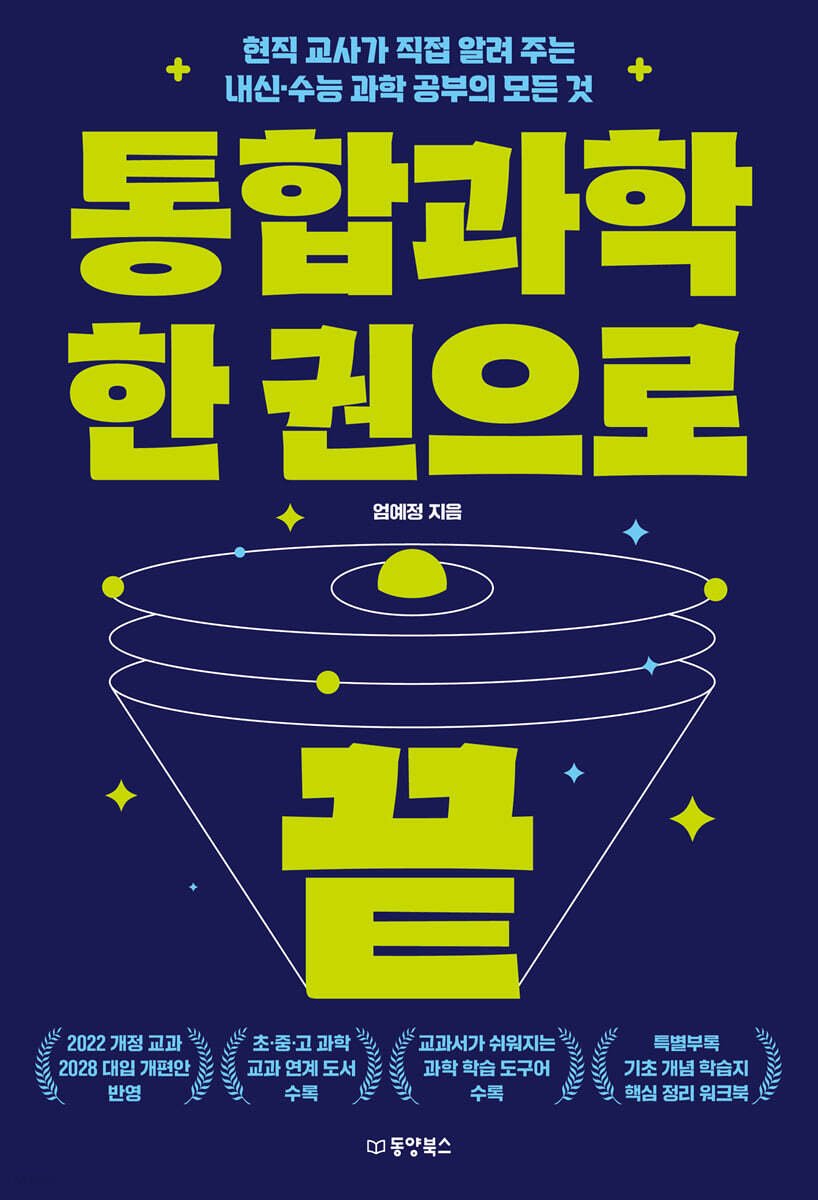
Integrated science in one volume
 |
Description
Book Introduction
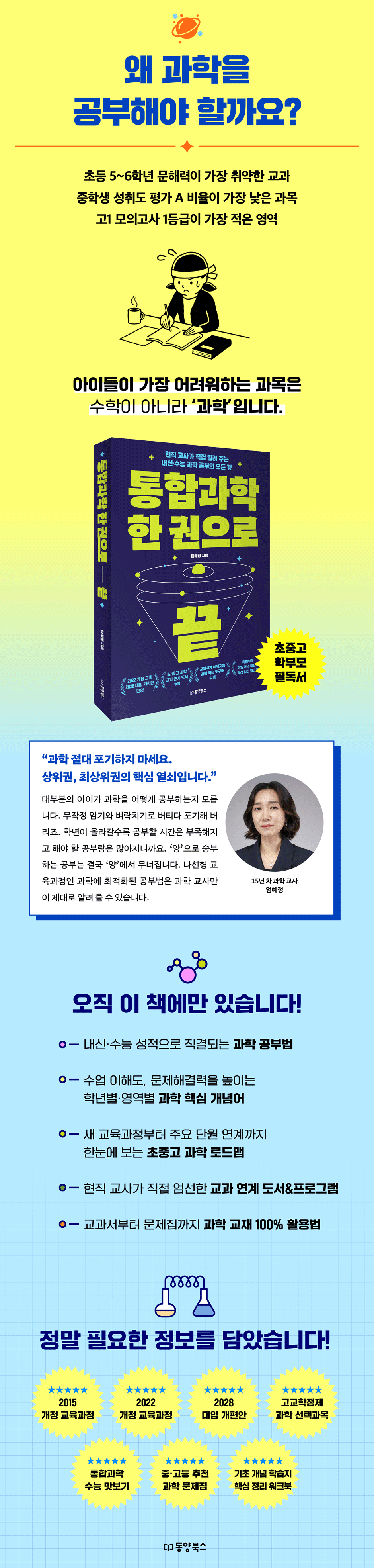
* Science study methods that are directly linked to written and performance assessments and CSAT scores
* Key concepts by grade and area to improve reading comprehension and problem-solving skills
* From the new curriculum to the unit flow! Elementary, middle, and high school curriculum roadmap
* Curriculum-linked books and programs that make science textbooks easier to understand
* How to utilize 100% of essential science materials, from textbooks to workbooks
* Special Appendix: Basic Concepts Workbook & Key Summary Workbook
It is often thought that math is the subject that children find most difficult, but that is a misconception.
In the national middle school achievement test analyzed by Jongro Academy last year, the subject with the lowest A percentage was not math, but science.
The subject with the lowest percentage of first-grade students in mock exams for first-year high school students over the past three years is 'science.'
In other words, even if the school level changes, science is a subject that is easy to get top grades in both school grades and the college entrance exam.
Science is a spiral curriculum where students learn basic concepts repeatedly and gradually delve deeper as they progress through elementary, middle, and high school.
If you study properly, you can get high scores even if you study less rather than more as you advance in grade.
Additionally, subjects that top students find difficult serve as a key factor in differentiating between the top and top-tier students.
This means that if you want to jump to the top or the highest rank, you must study science.
"Complete Integrated Science in One Volume" is a book that will help you completely master "science," which has emerged as a key point in the 2022 revised curriculum and the 2028 College Scholastic Ability Test.
From the elementary level, which firmly establishes the most important fundamental concepts in science studies, to the middle level, which helps to recover learning deficits and improve written and performance assessment scores, to the high school level, which easily solves integrated science and even advanced college entrance exam problems.
Author Yejeong Eom, known as the best in science education and receiving overwhelming support from parents, students, and fellow teachers, shares her 15 years of experience and know-how to teach you the right way to study science.
* Key concepts by grade and area to improve reading comprehension and problem-solving skills
* From the new curriculum to the unit flow! Elementary, middle, and high school curriculum roadmap
* Curriculum-linked books and programs that make science textbooks easier to understand
* How to utilize 100% of essential science materials, from textbooks to workbooks
* Special Appendix: Basic Concepts Workbook & Key Summary Workbook
It is often thought that math is the subject that children find most difficult, but that is a misconception.
In the national middle school achievement test analyzed by Jongro Academy last year, the subject with the lowest A percentage was not math, but science.
The subject with the lowest percentage of first-grade students in mock exams for first-year high school students over the past three years is 'science.'
In other words, even if the school level changes, science is a subject that is easy to get top grades in both school grades and the college entrance exam.
Science is a spiral curriculum where students learn basic concepts repeatedly and gradually delve deeper as they progress through elementary, middle, and high school.
If you study properly, you can get high scores even if you study less rather than more as you advance in grade.
Additionally, subjects that top students find difficult serve as a key factor in differentiating between the top and top-tier students.
This means that if you want to jump to the top or the highest rank, you must study science.
"Complete Integrated Science in One Volume" is a book that will help you completely master "science," which has emerged as a key point in the 2022 revised curriculum and the 2028 College Scholastic Ability Test.
From the elementary level, which firmly establishes the most important fundamental concepts in science studies, to the middle level, which helps to recover learning deficits and improve written and performance assessment scores, to the high school level, which easily solves integrated science and even advanced college entrance exam problems.
Author Yejeong Eom, known as the best in science education and receiving overwhelming support from parents, students, and fellow teachers, shares her 15 years of experience and know-how to teach you the right way to study science.
- You can preview some of the book's contents.
Preview
index
Prologue: No child finds science difficult from the start.
PART1.
Elementary: Integrated Science Buildup
The first help parents should give
Two Ways to Build Science Knowledge | Parents Need to Know What Their Children Are Learning | Parents' Concerns When Building Science Knowledge
Tune in to your study frequency with scientific language.
Learning Science Is Learning the Language of Science | The Characteristic of Scientific Concept Words is 'Sino-Korean Words' | Core Concept Words by Grade Level in Elementary Science
When you need to teach your child how to read a science textbook
Science must understand the grammar specific to non-literature.
Sub-textbooks must be used without fail.
Experimental Observation Books as Review Tools | Digital Textbooks You Can't Use Because You Don't Know About | ★ 'Exploration' in Science Textbooks
Elementary performance assessments should not be neglected either.
Tips for Preparing for Elementary Performance Assessments
Preparation for elementary basic academic ability diagnostic assessment and subject-by-subject unit assessment
How to start writing science?
Writing Using Science Textbooks | Writing Using Cross-Curriculum Topics | Writing Using News and Newspapers | Books Related to Science Textbooks
Small successes build up to create a big sense of accomplishment
The Virtuous Cycle of Self-Efficacy, Academic Achievement, and Growth Mindset | If You Show Interest in Science, Mathematics, Information, and Invention | When Applying to a Gifted Education Institution
PART2.
Middle School: Integrated Science Skills
Secondary Science at a Glance
When you walk into the shackles of testing
1st grade middle school | 2nd grade middle school | 3rd grade middle school
Science requires different study methods for each field.
Motion and Energy (Physics) | Matter (Chemistry) | Life (Life Science) | Earth and Space (Earth Science) | Help Unleash Your Curiosity | ★ Middle School Science Concepts
Science Review Cycle to Win the Test
Step 1: Immediate Review: Focus and Note Taking | Step 2: Immediate Review: Reading | Step 3: Summary Review: Organize Key Points in Words and Pictures | Step 4: Cumulative Review: Organize One Page, Organize into Single Volumes
How to do well on written exams that the private education market doesn't tell you
Principles of Studying for Success | Efficient Written Assessment Planning | Recommended Middle School Science Workbooks
The path to becoming the top always starts with the basics.
Studying with a focus on textbooks | Read at least 3-5 times | Explain aloud | Self-test | Create expected questions as a test-taker | ★Solve even high school Korean non-literature studies with science textbooks
How should science performance assessments be conducted?
As long as you understand the evaluation criteria, you'll be fine. Some tips for giving a good presentation.
Science Reading for Career-Linked Semester and High School Credit System
A Crucial Reason to Focus on Reading | Science Curriculum-Linked Books for Middle and High School Students
PART3.
Advanced: Master of Integrated Science
Advanced Integrated Science at a Glance
Complete Integrated Science Preparation for High School Freshmen
Backwards review using mock exams | Studying key units linked to integrated science | A comprehensive summary of middle school science leading to advanced integrated science
Advanced Key Point 1.
5-grade school grade system and high school credit system
Not All As Are Created the Same | Career Exploration and Self-Directed Learning
Advanced Key Point 2.
Science electives
The more complex the situation, the more realistic the study approach needs to be.|Recommended high school integrated science workbooks
Completing integrated science from school grades to the CSAT
★A sneak peek at the integrated science college entrance exam
Special Appendix 1.
Elementary: Basic Concepts Worksheet
Special Appendix 2.
Middle School: Key Summary Workbook
References
PART1.
Elementary: Integrated Science Buildup
The first help parents should give
Two Ways to Build Science Knowledge | Parents Need to Know What Their Children Are Learning | Parents' Concerns When Building Science Knowledge
Tune in to your study frequency with scientific language.
Learning Science Is Learning the Language of Science | The Characteristic of Scientific Concept Words is 'Sino-Korean Words' | Core Concept Words by Grade Level in Elementary Science
When you need to teach your child how to read a science textbook
Science must understand the grammar specific to non-literature.
Sub-textbooks must be used without fail.
Experimental Observation Books as Review Tools | Digital Textbooks You Can't Use Because You Don't Know About | ★ 'Exploration' in Science Textbooks
Elementary performance assessments should not be neglected either.
Tips for Preparing for Elementary Performance Assessments
Preparation for elementary basic academic ability diagnostic assessment and subject-by-subject unit assessment
How to start writing science?
Writing Using Science Textbooks | Writing Using Cross-Curriculum Topics | Writing Using News and Newspapers | Books Related to Science Textbooks
Small successes build up to create a big sense of accomplishment
The Virtuous Cycle of Self-Efficacy, Academic Achievement, and Growth Mindset | If You Show Interest in Science, Mathematics, Information, and Invention | When Applying to a Gifted Education Institution
PART2.
Middle School: Integrated Science Skills
Secondary Science at a Glance
When you walk into the shackles of testing
1st grade middle school | 2nd grade middle school | 3rd grade middle school
Science requires different study methods for each field.
Motion and Energy (Physics) | Matter (Chemistry) | Life (Life Science) | Earth and Space (Earth Science) | Help Unleash Your Curiosity | ★ Middle School Science Concepts
Science Review Cycle to Win the Test
Step 1: Immediate Review: Focus and Note Taking | Step 2: Immediate Review: Reading | Step 3: Summary Review: Organize Key Points in Words and Pictures | Step 4: Cumulative Review: Organize One Page, Organize into Single Volumes
How to do well on written exams that the private education market doesn't tell you
Principles of Studying for Success | Efficient Written Assessment Planning | Recommended Middle School Science Workbooks
The path to becoming the top always starts with the basics.
Studying with a focus on textbooks | Read at least 3-5 times | Explain aloud | Self-test | Create expected questions as a test-taker | ★Solve even high school Korean non-literature studies with science textbooks
How should science performance assessments be conducted?
As long as you understand the evaluation criteria, you'll be fine. Some tips for giving a good presentation.
Science Reading for Career-Linked Semester and High School Credit System
A Crucial Reason to Focus on Reading | Science Curriculum-Linked Books for Middle and High School Students
PART3.
Advanced: Master of Integrated Science
Advanced Integrated Science at a Glance
Complete Integrated Science Preparation for High School Freshmen
Backwards review using mock exams | Studying key units linked to integrated science | A comprehensive summary of middle school science leading to advanced integrated science
Advanced Key Point 1.
5-grade school grade system and high school credit system
Not All As Are Created the Same | Career Exploration and Self-Directed Learning
Advanced Key Point 2.
Science electives
The more complex the situation, the more realistic the study approach needs to be.|Recommended high school integrated science workbooks
Completing integrated science from school grades to the CSAT
★A sneak peek at the integrated science college entrance exam
Special Appendix 1.
Elementary: Basic Concepts Worksheet
Special Appendix 2.
Middle School: Key Summary Workbook
References
Detailed image
Publisher's Review
Science is said to be easy and fun,
Why does it get harder as you go from elementary to high school?
Science is a subject in which prior learning (review) is more important than prior learning.
Like math, science is a spiral curriculum, with concepts learned in elementary school and then studied in depth in middle and high school.
For example, in the 5th grade [Heat and Our Life] unit, students learn about conduction, convection, and radiation, which are the ways in which heat moves, and in the 7th grade [Heat] unit, students learn about thermal equilibrium and the heat transfer process through models.
In the second year of high school, we go one step further and learn about mechanics and energy, and the relationship between heat and energy.
Much of what we learn in elementary science reappears in secondary science.
The center of advanced integrated science is secondary science, which adds principles to the scientific concepts learned in elementary school.
60% of what you learn in middle school is linked to advanced integrated science.
So, it is important to learn in advance so that what you are learning now becomes completely your own, but many children do not know the importance of learning in advance and only focus on superficial learning.
Lack of prior learning is one of the main reasons why children give up on their studies.
Science classes are conducted on the assumption that students have learned everything previously as they advance in grade and school level.
Elementary school textbooks include concepts and detailed explanations, but middle school textbooks simply list several terms in one sentence without any explanation.
Children who do not study properly will have to study more difficult material without knowing anything.
If this happens repeatedly, you will eventually not be able to keep up with the class progress.
Even if you study hard
Why are science grades plummeting?
It's because I don't know how to study properly.
From elementary school to the first year of middle school, science is assessed only through process-oriented performance assessments without written tests.
There is no opportunity to check whether you have properly understood what you have learned.
So, when I see my first written test and receive a numerical score, I immediately feel frustrated.
Children who study a little develop the habit of blindly memorizing things.
Before the written test, I memorize everything as if I was cramming, but after the test, I completely forget it.
This method works well up to middle school.
Middle school has an absolute evaluation system.
The written test questions are also easy to prepare based on the textbook and worksheets provided in class.
The textbook units are also divided into the following areas: motion and energy (physics), matter (chemistry), life (life science), and earth and space (earth science).
Children who are good at memorization tend to get high scores in areas such as life, earth, and space, where there is a relatively large amount of memorization required.
However, when tested in the material domain, which requires understanding of invisible scientific concepts, you will receive a relatively low score.
From high school onwards, all areas are integrated.
In one unit, the realms of motion, energy, matter, life, Earth and space are mixed.
Textbook units are expanding and texts are becoming longer.
In addition to the textbook, supplementary materials and mock exam questions are also included in the test scope.
Crucially, all internal grades are reflected in the college entrance exam scores, and it is a relative evaluation system.
Difficult and tricky questions are presented to ensure discrimination.
Children who just memorize things blindly end up giving up on science due to the increased workload, increased difficulty, reduced study time, and plummeting grades.
But giving up science is like giving up the easiest path to the top.
Elementary and middle school curriculum changes starting in 2024
Integrated science, which will be mandatory starting from the 2028 CSAT
How should I study science?
There is nothing in elementary, middle, and high school science that is not supported by basic concepts.
Therefore, to do well in elementary, middle, and high school science, you need to know the concepts.
All the important concepts are in the textbook.
This is also why author Yejeong Eom wrote this book.
Because only a science teacher who knows the textbook better than anyone else can teach the proper way to study science.
The period when elementary school students have difficulty studying science begins in the 5th grade.
The textbook becomes more difficult as units related to secondary science are introduced.
So, during elementary school, you need to study key concepts that will improve your reading comprehension and problem-solving skills.
By studying the key concepts for each elementary school grade in this book and expanding your scientific background knowledge with textbooks related to the subject, you can fully acquire the concepts necessary to study science.
Through explanations of grammar specific to science subjects and training in scientific writing, students can develop the literacy and performance assessment skills necessary for middle and high school courses.
The three years of middle school are the most important of all elementary, middle, and high school years.
This is because it is the last line of defense to recover the studies missed in elementary school and the time to lay the cornerstone of integrated science.
You must learn how to study based on textbooks.
This book introduces the textbook-based, advanced learning method used by top-tier and top-tier students.
In fact, children who learned this method from the author never miss getting an A in all subjects and a top grade in their class when they go to high school.
In addition, we provide study methods tailored to the characteristics of each scientific field.
In secondary science, you must master the learning that is divided into each unit to be able to easily master integrated science that combines multiple fields.
Children who have studied middle school science properly will have no difficulty learning advanced integrated science.
High schools are currently experiencing the most drastic changes in their curriculum.
In times like these, accurate and solid teachings are needed rather than unclear and unreliable carder communications.
Author Yejeong Eom, who has poured her know-how and experience as a teacher, shares practical study methods and coping strategies tailored to changing educational trends, such as the five-grade system, high school credit system, science electives, and integrated science for the college entrance exam.
It teaches you important content for improving your grades and college entrance exam scores, from the reverse review method using mock exams to a comprehensive summary of middle school science linked to integrated science.
In addition, this book contains a roadmap for elementary, middle, and high school science curriculum, as well as instructions for utilizing essential science textbooks and workbooks 100%.
A worksheet that helps you review elementary basic concepts and a key summary form that can be used up to middle and high school science are also provided as special appendices.
You can find all of these things only in this book.
Why does it get harder as you go from elementary to high school?
Science is a subject in which prior learning (review) is more important than prior learning.
Like math, science is a spiral curriculum, with concepts learned in elementary school and then studied in depth in middle and high school.
For example, in the 5th grade [Heat and Our Life] unit, students learn about conduction, convection, and radiation, which are the ways in which heat moves, and in the 7th grade [Heat] unit, students learn about thermal equilibrium and the heat transfer process through models.
In the second year of high school, we go one step further and learn about mechanics and energy, and the relationship between heat and energy.
Much of what we learn in elementary science reappears in secondary science.
The center of advanced integrated science is secondary science, which adds principles to the scientific concepts learned in elementary school.
60% of what you learn in middle school is linked to advanced integrated science.
So, it is important to learn in advance so that what you are learning now becomes completely your own, but many children do not know the importance of learning in advance and only focus on superficial learning.
Lack of prior learning is one of the main reasons why children give up on their studies.
Science classes are conducted on the assumption that students have learned everything previously as they advance in grade and school level.
Elementary school textbooks include concepts and detailed explanations, but middle school textbooks simply list several terms in one sentence without any explanation.
Children who do not study properly will have to study more difficult material without knowing anything.
If this happens repeatedly, you will eventually not be able to keep up with the class progress.
Even if you study hard
Why are science grades plummeting?
It's because I don't know how to study properly.
From elementary school to the first year of middle school, science is assessed only through process-oriented performance assessments without written tests.
There is no opportunity to check whether you have properly understood what you have learned.
So, when I see my first written test and receive a numerical score, I immediately feel frustrated.
Children who study a little develop the habit of blindly memorizing things.
Before the written test, I memorize everything as if I was cramming, but after the test, I completely forget it.
This method works well up to middle school.
Middle school has an absolute evaluation system.
The written test questions are also easy to prepare based on the textbook and worksheets provided in class.
The textbook units are also divided into the following areas: motion and energy (physics), matter (chemistry), life (life science), and earth and space (earth science).
Children who are good at memorization tend to get high scores in areas such as life, earth, and space, where there is a relatively large amount of memorization required.
However, when tested in the material domain, which requires understanding of invisible scientific concepts, you will receive a relatively low score.
From high school onwards, all areas are integrated.
In one unit, the realms of motion, energy, matter, life, Earth and space are mixed.
Textbook units are expanding and texts are becoming longer.
In addition to the textbook, supplementary materials and mock exam questions are also included in the test scope.
Crucially, all internal grades are reflected in the college entrance exam scores, and it is a relative evaluation system.
Difficult and tricky questions are presented to ensure discrimination.
Children who just memorize things blindly end up giving up on science due to the increased workload, increased difficulty, reduced study time, and plummeting grades.
But giving up science is like giving up the easiest path to the top.
Elementary and middle school curriculum changes starting in 2024
Integrated science, which will be mandatory starting from the 2028 CSAT
How should I study science?
There is nothing in elementary, middle, and high school science that is not supported by basic concepts.
Therefore, to do well in elementary, middle, and high school science, you need to know the concepts.
All the important concepts are in the textbook.
This is also why author Yejeong Eom wrote this book.
Because only a science teacher who knows the textbook better than anyone else can teach the proper way to study science.
The period when elementary school students have difficulty studying science begins in the 5th grade.
The textbook becomes more difficult as units related to secondary science are introduced.
So, during elementary school, you need to study key concepts that will improve your reading comprehension and problem-solving skills.
By studying the key concepts for each elementary school grade in this book and expanding your scientific background knowledge with textbooks related to the subject, you can fully acquire the concepts necessary to study science.
Through explanations of grammar specific to science subjects and training in scientific writing, students can develop the literacy and performance assessment skills necessary for middle and high school courses.
The three years of middle school are the most important of all elementary, middle, and high school years.
This is because it is the last line of defense to recover the studies missed in elementary school and the time to lay the cornerstone of integrated science.
You must learn how to study based on textbooks.
This book introduces the textbook-based, advanced learning method used by top-tier and top-tier students.
In fact, children who learned this method from the author never miss getting an A in all subjects and a top grade in their class when they go to high school.
In addition, we provide study methods tailored to the characteristics of each scientific field.
In secondary science, you must master the learning that is divided into each unit to be able to easily master integrated science that combines multiple fields.
Children who have studied middle school science properly will have no difficulty learning advanced integrated science.
High schools are currently experiencing the most drastic changes in their curriculum.
In times like these, accurate and solid teachings are needed rather than unclear and unreliable carder communications.
Author Yejeong Eom, who has poured her know-how and experience as a teacher, shares practical study methods and coping strategies tailored to changing educational trends, such as the five-grade system, high school credit system, science electives, and integrated science for the college entrance exam.
It teaches you important content for improving your grades and college entrance exam scores, from the reverse review method using mock exams to a comprehensive summary of middle school science linked to integrated science.
In addition, this book contains a roadmap for elementary, middle, and high school science curriculum, as well as instructions for utilizing essential science textbooks and workbooks 100%.
A worksheet that helps you review elementary basic concepts and a key summary form that can be used up to middle and high school science are also provided as special appendices.
You can find all of these things only in this book.
GOODS SPECIFICS
- Date of issue: March 24, 2025
- Page count, weight, size: 296 pages | 150*220*20mm
- ISBN13: 9791172101015
- ISBN10: 1172101019
You may also like
카테고리
korean


korean

![GQ KOREA Mark (Monthly): December [2025]](http://librairie.coreenne.fr/cdn/shop/files/8ef265dbbfbf186523ed75ba7319009d.jpg?v=1765340328&width=3840)


