

A Good Day to Read Na Min-ae's Poetry
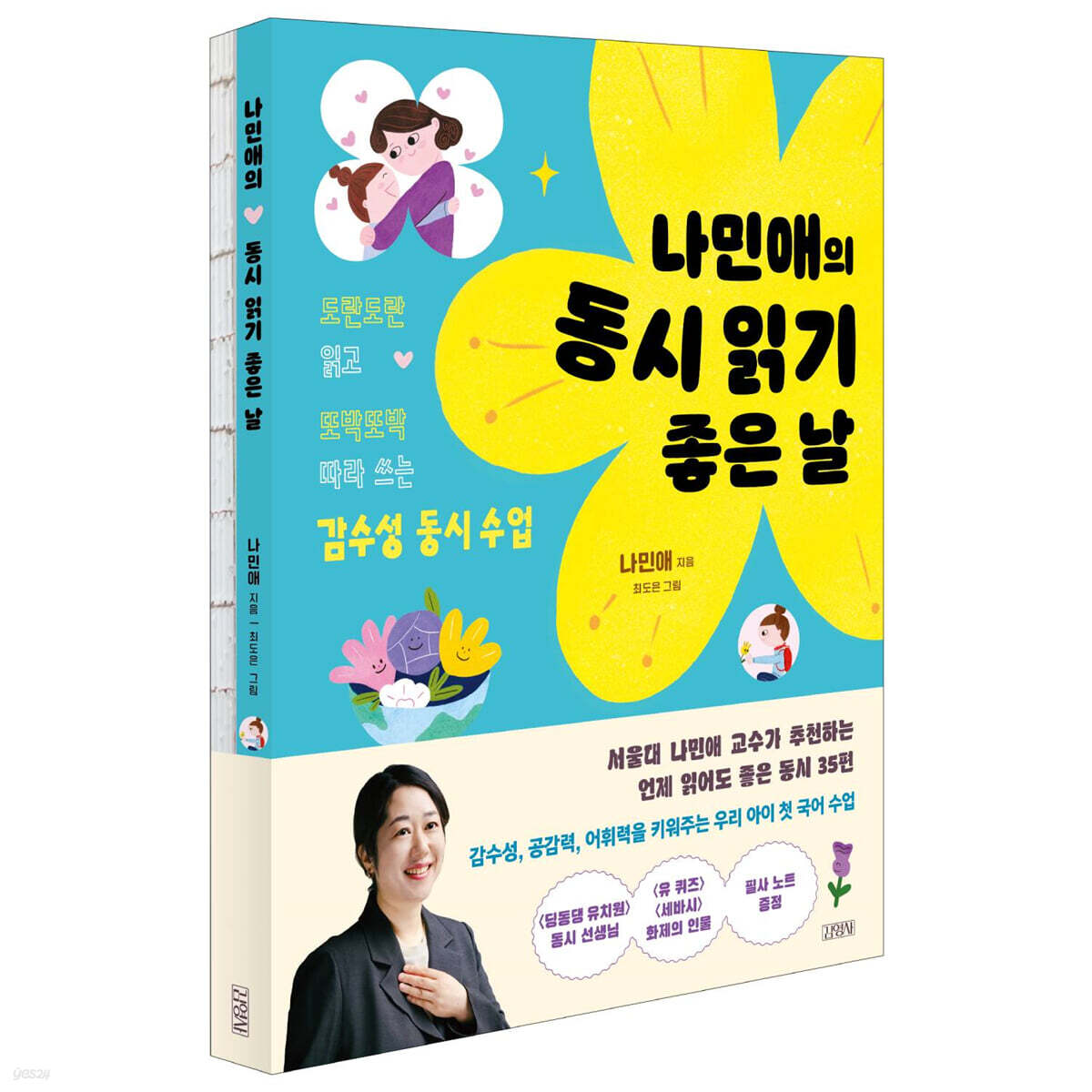 |
Description
Book Introduction
*〈Ding Dong Dang Kindergarten〉 Poetry Teacher*
*〈You Quiz〉 〈Sebashi〉 Hot Topic*
*Free handwritten note*
Bestseller "The Child Who Is Good at Korean Wins" by Professor Na Min-ae!
We invite you to a classroom where you can kill two birds with one stone: study and have fun.
“It would be good for elementary school students to read one or two good poetry collections.”
Professor Na Min-ae, a mentor to elementary school mothers who were struggling with the unanswerable Korean language problem, has once again stepped forward to help children.
We have included 35 of Korea's most beloved poems, including those by Yun Dong-ju, Na Tae-ju, and Kwon Jeong-saeng, divided into six themes, including family, nature, and modern and contemporary culture.
We have not missed anything, from detailed commentary tailored to children's eye level, to activities that children can do together, to even handwritten notes for children.
If you are a mother who is worried because your child only likes videos, a mother who wants to develop her child's sensitivity, or a mother who wants to create beautiful memories with her child, open "Na Min-ae's A Good Day to Read Poetry."
Sensitivity, empathy, and even vocabulary.
If your mother becomes your child's 'home poetry teacher' and you read, write, and play together, not only your Korean language skills but also your heart will grow.
*〈You Quiz〉 〈Sebashi〉 Hot Topic*
*Free handwritten note*
Bestseller "The Child Who Is Good at Korean Wins" by Professor Na Min-ae!
We invite you to a classroom where you can kill two birds with one stone: study and have fun.
“It would be good for elementary school students to read one or two good poetry collections.”
Professor Na Min-ae, a mentor to elementary school mothers who were struggling with the unanswerable Korean language problem, has once again stepped forward to help children.
We have included 35 of Korea's most beloved poems, including those by Yun Dong-ju, Na Tae-ju, and Kwon Jeong-saeng, divided into six themes, including family, nature, and modern and contemporary culture.
We have not missed anything, from detailed commentary tailored to children's eye level, to activities that children can do together, to even handwritten notes for children.
If you are a mother who is worried because your child only likes videos, a mother who wants to develop her child's sensitivity, or a mother who wants to create beautiful memories with her child, open "Na Min-ae's A Good Day to Read Poetry."
Sensitivity, empathy, and even vocabulary.
If your mother becomes your child's 'home poetry teacher' and you read, write, and play together, not only your Korean language skills but also your heart will grow.
- You can preview some of the book's contents.
Preview
index
Chapter 1: Happier Today Than Yesterday: Poems of Precious Everyday Life
Wildflowers | Na Tae-joo
Stream Water | Kwon Jeong-saeng
It's a pity | Jang Se-jeong
Kimchi Song | Kim Yu-jin
Soap Bubbles|Mok Il-shin
Leaf Pear|Park Hong-geun
Potato Flower | Kwon Tae-eung
Chapter 2: A Heart that Grows Through Sharing: A Poem of Empathy and Consideration
What do you eat to live? | Yun Dong-ju
A Pair of Gloves | Na Tae-joo
Sharing | Jang Seo-hu
The tree | Lee Chang-geon
Big Dipper | Kim Yu-jin
Chapter 3 My Family Is the Best: A Poem of Love and Friendship
Just|Moon Sam-seok
Mother's Footsteps | Na Tae-joo
Cricket and Me | Yun Dong-ju
When Mom Was Sick | Jeong Du-ri
Sunflower | Lee Jun-kwan
Belly button | Baek Woo-seon
Under the Umbrella | Moon Sam-seok
Chapter 4: Flowers Bloom and Snow Falls: The Poetry of Our Nature
Mountain Spring Water|Kwon Tae-eung
Eyes | Yun Dong-ju
Everyday is a birthday | Son Dong-yeon
Flower Seeds | Choi Gye-rak
Green Sea | Park Kyung-jong
Chapter 5: A Zoo Written in Poetry: The Poetry of Ecology and Life
Animal Kingdom Clothing Store | Park Seung-woo
Chicken | Kang So-cheon
Deer antlers | Kang So-cheon
Pond Kindergarten | Moon Geun-young
Who's sleeping? | Mok Il-shin
Baby Goat | Lee Hae-byeol
Chapter 6 When Grandma and Grandpa Were Young: Modern and Contemporary Culture
Hide and Seek | Yoon Bok-jin
Okjungi | Shin Hyun-deuk
Asking a Seed | Yoon Bok-jin
Kokkashin|Choi Gye-rak
Magpie Rice | Lee Jeong-rok
Who wrote this poem?
Good nursery rhymes to sing with your child
Wildflowers | Na Tae-joo
Stream Water | Kwon Jeong-saeng
It's a pity | Jang Se-jeong
Kimchi Song | Kim Yu-jin
Soap Bubbles|Mok Il-shin
Leaf Pear|Park Hong-geun
Potato Flower | Kwon Tae-eung
Chapter 2: A Heart that Grows Through Sharing: A Poem of Empathy and Consideration
What do you eat to live? | Yun Dong-ju
A Pair of Gloves | Na Tae-joo
Sharing | Jang Seo-hu
The tree | Lee Chang-geon
Big Dipper | Kim Yu-jin
Chapter 3 My Family Is the Best: A Poem of Love and Friendship
Just|Moon Sam-seok
Mother's Footsteps | Na Tae-joo
Cricket and Me | Yun Dong-ju
When Mom Was Sick | Jeong Du-ri
Sunflower | Lee Jun-kwan
Belly button | Baek Woo-seon
Under the Umbrella | Moon Sam-seok
Chapter 4: Flowers Bloom and Snow Falls: The Poetry of Our Nature
Mountain Spring Water|Kwon Tae-eung
Eyes | Yun Dong-ju
Everyday is a birthday | Son Dong-yeon
Flower Seeds | Choi Gye-rak
Green Sea | Park Kyung-jong
Chapter 5: A Zoo Written in Poetry: The Poetry of Ecology and Life
Animal Kingdom Clothing Store | Park Seung-woo
Chicken | Kang So-cheon
Deer antlers | Kang So-cheon
Pond Kindergarten | Moon Geun-young
Who's sleeping? | Mok Il-shin
Baby Goat | Lee Hae-byeol
Chapter 6 When Grandma and Grandpa Were Young: Modern and Contemporary Culture
Hide and Seek | Yoon Bok-jin
Okjungi | Shin Hyun-deuk
Asking a Seed | Yoon Bok-jin
Kokkashin|Choi Gye-rak
Magpie Rice | Lee Jeong-rok
Who wrote this poem?
Good nursery rhymes to sing with your child
Detailed image

Into the book
“Na Min-ae’s Poetry Reading Day” is a book created with the hope of sending a “poetry teacher” to every home.
Through this book, I want to convey poetry, happiness, and love to children.
May all children and mothers be happy in poetry.
---From the "Preface"
The poet who wrote this poem is my father.
So I can say this with confidence.
This is a poem of children, for children, about children.
But the ones who actually liked this poem first were adults.
Moms know too.
We all deserve to be loved, but as we go through life, we tend to lose sight of ourselves.
This poem is also a message of encouragement that everyone, whether adult or child, is beautiful and lovable.
---From "Wildflowers (Na Tae-ju)"
Many adults stay up late at night looking at their smartphones or worrying.
Could your child be like that? Lie down with your child and sing "Leaf Boat."
The melody is slow and calms the heartbeat.
And I fall asleep thinking about the pond with the leaf boats gently floating by.
---From "Leaf Boat (Park Hong-geun)"
The poet is concerned about the rice bowls of everyone in the world.
The star that resembles a ladle floating in the sky may be the result of someone's wish for everyone to be well fed under the starlight.
Is there separate character education?
Reading this poem is the very act of creating a beautiful personality.
---From "The Big Dipper (Kim Yu-jin)"
The most famous and easiest song about umbrellas in our country is probably the children's song "Umbrella."
It starts with the lyrics, “Three umbrellas walk side by side on an early morning when the drizzle is falling.” Try singing it by changing the lyrics to make it funny, such as a torn umbrella, a holey umbrella, a dirty umbrella, etc.
Be as childish as you want.
You can have fun swapping words while learning the song.
---From "Under the Umbrella (Moon Sam-seok)"
Metaphor will be the most important skill in the future society.
Psychologist Professor Kim Kyung-il chose 'metaphor' as the ability our children must have in the AI era.
The genre where we most often encounter this metaphor is poetry.
Through this book, I want to convey poetry, happiness, and love to children.
May all children and mothers be happy in poetry.
---From the "Preface"
The poet who wrote this poem is my father.
So I can say this with confidence.
This is a poem of children, for children, about children.
But the ones who actually liked this poem first were adults.
Moms know too.
We all deserve to be loved, but as we go through life, we tend to lose sight of ourselves.
This poem is also a message of encouragement that everyone, whether adult or child, is beautiful and lovable.
---From "Wildflowers (Na Tae-ju)"
Many adults stay up late at night looking at their smartphones or worrying.
Could your child be like that? Lie down with your child and sing "Leaf Boat."
The melody is slow and calms the heartbeat.
And I fall asleep thinking about the pond with the leaf boats gently floating by.
---From "Leaf Boat (Park Hong-geun)"
The poet is concerned about the rice bowls of everyone in the world.
The star that resembles a ladle floating in the sky may be the result of someone's wish for everyone to be well fed under the starlight.
Is there separate character education?
Reading this poem is the very act of creating a beautiful personality.
---From "The Big Dipper (Kim Yu-jin)"
The most famous and easiest song about umbrellas in our country is probably the children's song "Umbrella."
It starts with the lyrics, “Three umbrellas walk side by side on an early morning when the drizzle is falling.” Try singing it by changing the lyrics to make it funny, such as a torn umbrella, a holey umbrella, a dirty umbrella, etc.
Be as childish as you want.
You can have fun swapping words while learning the song.
---From "Under the Umbrella (Moon Sam-seok)"
Metaphor will be the most important skill in the future society.
Psychologist Professor Kim Kyung-il chose 'metaphor' as the ability our children must have in the AI era.
The genre where we most often encounter this metaphor is poetry.
---From "Snow (Yoon Dong-ju)"
Publisher's Review
“Mom, please read a poem.”
From Yun Dong-ju to Na Tae-ju, with 35 poems that are good to read at any time.
My child's first Korean class
“It would be good for elementary school students to read one or two good poetry collections.”
Professor Na Min-ae, who emerged as a mentor to elementary school mothers struggling with the intractable Korean language through her best-selling book, “Children Who Are Good at Korean Win,” has once again stepped forward to help children.
《Na Min-ae's A Good Day to Read Poetry》 introduces 35 of Korea's most beloved poems by poets such as Yun Dong-ju, Na Tae-ju, and Kwon Jeong-saeng.
It contains a wide range of poems on six topics, including family, nature, and modern and contemporary culture.
We have not missed anything, from detailed commentary tailored to children's eye level, to activities that children can do together, to even handwritten notes for children.
Simultaneous study that is fun for the child and comforting for the mother.
If you become a ‘children’s teacher at home’ and read, write, and play together, not only your Korean language skills but also your heart will grow.
Elementary Korean language skills start at the same time.
At the same time, it is full of the taste and style of language.
A child who has read poetry since childhood will not be confused when he or she encounters modern and classical poetry in middle school.
This book includes simultaneous commentary for mothers in the '1 Minute Mom School' and 'Tell Me This Story' sections.
Let’s take poet Yun Dong-ju’s poem “Snow” as an example.
Last night
It's snowing heavily
The roof
The road and the field
I'm cold
I think it's a blanket covering me
That's why
It only falls in the cold winter
In this poem, we can encounter the concept of 'metaphor', which sees eyes as a blanket.
Seeing things differently is a vital skill in this age of creativity and imagination.
There is also poet Kwon Jeong-saeng's "Stream Water."
The poet created new words to express the flow of a stream, such as “ttorororong,” “jjororoorong,” and “dinggulreong heopneokjeok,” which are “words that are not in the dictionary but convey a ‘feeling of feeling.’”
You can freely express the appearance of the stream and even learn the concept of 'poetic license'.
Reading poetry also allows for broader study.
Poet Yun Bok-jin's "Hide and Seek" was published 100 years ago and captures the scenery of that time (“I often looked for my head/I hid behind the jar // I looked for a magpie/I hid in the mill // I looked for a gold ribbon/I hid behind the pillar”).
Poetry like this serves as a way to introduce traditional culture to our children.
Poetry develops a child's mind.
Since poetry is written with a child's heart, children who read poetry clearly understand their own feelings and thoughts through indirect experiences.
Poet Jang Se-jeong's "It's a shame" is a poem that expresses the feelings of a child who cannot use new crayons because they are too precious.
Reading this poem, a child may think, 'There are others who think like me' or 'This is such a waste.'
There are also various activities prepared with poetry.
These are things that Professor Na Min-ae did directly with the child.
After reading “Green Sea,” you can have fun singing “If you dip both hands in the green sea water” and playing with paints in the bathroom.
After reading poet Yun Bok-jin's "Burying a Seed," you can collect seeds and try sprouting them yourself.
If reading becomes a good memory of reading and playing in the arms of a mother, the child will love books even when he or she grows up.
《Na Min-ae's Poetry Reading Day》 is also a book for mothers.
I encourage them to read poetry to each other and tell each other that they love each other, and sometimes I even have them look back on their own childhood.
“We are healthy.
“Don’t be sick, Mom.” (From “When Mom is Sick”) I convey Professor Na Min-ae’s warm sympathy and comfort.
Practice correct handwriting and sentences with a notebook.
《Na Min-ae's Good Day to Read Poetry》 comes with a handwritten notebook for children.
We made it large and easy to spread out so that children can easily follow along.
In the early elementary school years, you should focus on dictation, spelling, and writing neatly.
Even in the digital age, there are times when we still take notes by hand and write answers to descriptive questions.
By starting with short, easy poems, you can correct your handwriting and learn the basics of spelling in just 5 or 10 minutes a day.
From Yun Dong-ju to Na Tae-ju, with 35 poems that are good to read at any time.
My child's first Korean class
“It would be good for elementary school students to read one or two good poetry collections.”
Professor Na Min-ae, who emerged as a mentor to elementary school mothers struggling with the intractable Korean language through her best-selling book, “Children Who Are Good at Korean Win,” has once again stepped forward to help children.
《Na Min-ae's A Good Day to Read Poetry》 introduces 35 of Korea's most beloved poems by poets such as Yun Dong-ju, Na Tae-ju, and Kwon Jeong-saeng.
It contains a wide range of poems on six topics, including family, nature, and modern and contemporary culture.
We have not missed anything, from detailed commentary tailored to children's eye level, to activities that children can do together, to even handwritten notes for children.
Simultaneous study that is fun for the child and comforting for the mother.
If you become a ‘children’s teacher at home’ and read, write, and play together, not only your Korean language skills but also your heart will grow.
Elementary Korean language skills start at the same time.
At the same time, it is full of the taste and style of language.
A child who has read poetry since childhood will not be confused when he or she encounters modern and classical poetry in middle school.
This book includes simultaneous commentary for mothers in the '1 Minute Mom School' and 'Tell Me This Story' sections.
Let’s take poet Yun Dong-ju’s poem “Snow” as an example.
Last night
It's snowing heavily
The roof
The road and the field
I'm cold
I think it's a blanket covering me
That's why
It only falls in the cold winter
In this poem, we can encounter the concept of 'metaphor', which sees eyes as a blanket.
Seeing things differently is a vital skill in this age of creativity and imagination.
There is also poet Kwon Jeong-saeng's "Stream Water."
The poet created new words to express the flow of a stream, such as “ttorororong,” “jjororoorong,” and “dinggulreong heopneokjeok,” which are “words that are not in the dictionary but convey a ‘feeling of feeling.’”
You can freely express the appearance of the stream and even learn the concept of 'poetic license'.
Reading poetry also allows for broader study.
Poet Yun Bok-jin's "Hide and Seek" was published 100 years ago and captures the scenery of that time (“I often looked for my head/I hid behind the jar // I looked for a magpie/I hid in the mill // I looked for a gold ribbon/I hid behind the pillar”).
Poetry like this serves as a way to introduce traditional culture to our children.
Poetry develops a child's mind.
Since poetry is written with a child's heart, children who read poetry clearly understand their own feelings and thoughts through indirect experiences.
Poet Jang Se-jeong's "It's a shame" is a poem that expresses the feelings of a child who cannot use new crayons because they are too precious.
Reading this poem, a child may think, 'There are others who think like me' or 'This is such a waste.'
There are also various activities prepared with poetry.
These are things that Professor Na Min-ae did directly with the child.
After reading “Green Sea,” you can have fun singing “If you dip both hands in the green sea water” and playing with paints in the bathroom.
After reading poet Yun Bok-jin's "Burying a Seed," you can collect seeds and try sprouting them yourself.
If reading becomes a good memory of reading and playing in the arms of a mother, the child will love books even when he or she grows up.
《Na Min-ae's Poetry Reading Day》 is also a book for mothers.
I encourage them to read poetry to each other and tell each other that they love each other, and sometimes I even have them look back on their own childhood.
“We are healthy.
“Don’t be sick, Mom.” (From “When Mom is Sick”) I convey Professor Na Min-ae’s warm sympathy and comfort.
Practice correct handwriting and sentences with a notebook.
《Na Min-ae's Good Day to Read Poetry》 comes with a handwritten notebook for children.
We made it large and easy to spread out so that children can easily follow along.
In the early elementary school years, you should focus on dictation, spelling, and writing neatly.
Even in the digital age, there are times when we still take notes by hand and write answers to descriptive questions.
By starting with short, easy poems, you can correct your handwriting and learn the basics of spelling in just 5 or 10 minutes a day.
GOODS SPECIFICS
- Date of issue: March 28, 2025
- Page count, weight, size: 172 pages | 188*250*20mm
- ISBN13: 9791173321221
- ISBN10: 1173321225
You may also like
카테고리
korean


korean

![GQ KOREA Mark (Monthly): December [2025]](http://librairie.coreenne.fr/cdn/shop/files/8ef265dbbfbf186523ed75ba7319009d.jpg?v=1765340328&width=3840)


