

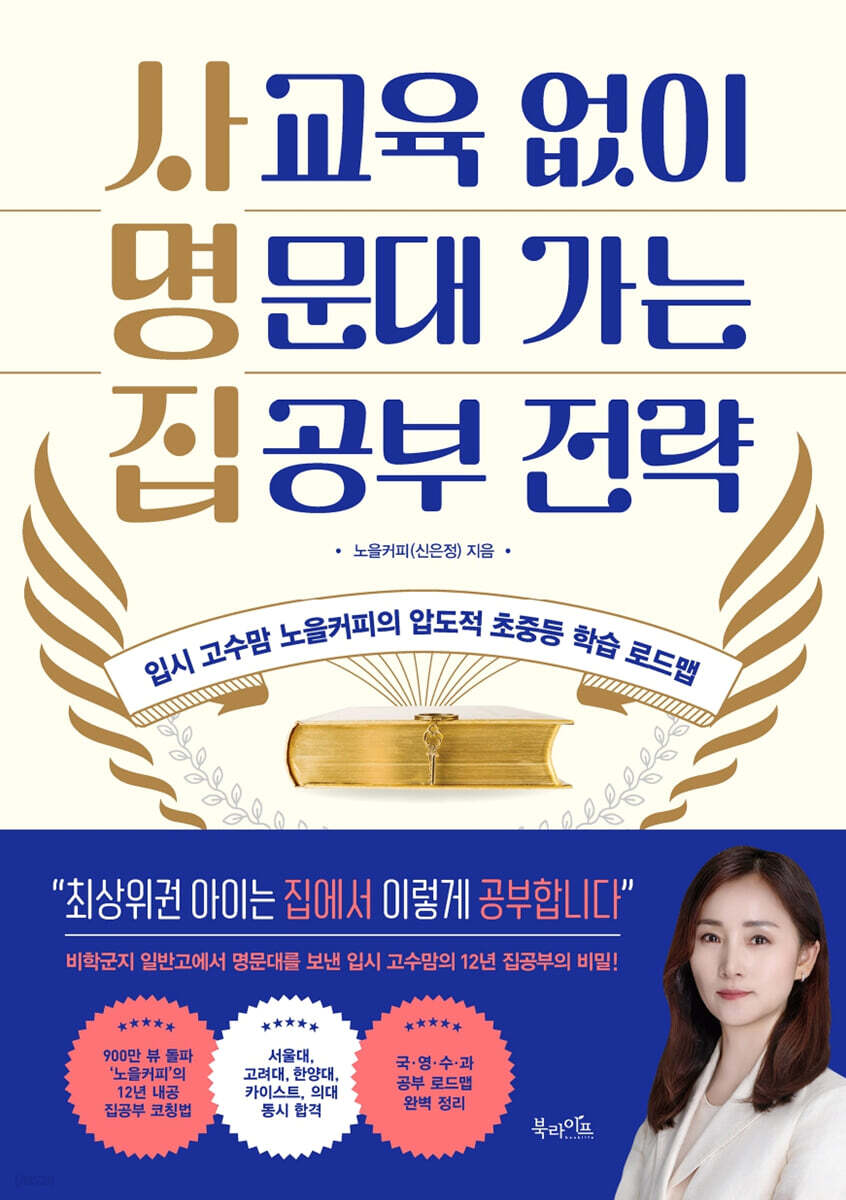
Home study strategy to get into a prestigious university without private tutoring
 |
Description
Book Introduction
|
“Be the most ambitious when it comes to your child’s studies!”
Simultaneous acceptance to Seoul National University, Korea University, Hanyang University, KAIST, and medical school! With over 9 million views, Noeul Coffee, a mom who excels at college entrance exams, has developed her 12-year-old home study secrets. *** I was upset after receiving counseling from the Daechi-dong academy, but I calmed down after watching the video. *** sticks out his tongue. So, the children's entrance exam results were good. *** Algorithm, reflect! You're only recommending it now! How do top-tier students, those who thrive on private education, study? Success stories from college entrance exams and study methods from renowned school districts abound. What matters is whether our child can put it into practice. "Home Study Strategy to Get into a Prestigious University Without Private Education" is a book written by a mom who specializes in entrance exams and runs the YouTube channel "Noeul Coffee's Education and Entrance Exam TV." The author educated his two children at home for 12 years from elementary, middle, and high school, and sent them from a non-academic high school to a prestigious university. In this book, the author reveals all of the practical home study methods and entrance exam strategies he has accumulated through countless trials and errors with his two children. It contains detailed information on elementary and middle school advanced and current learning, Korean, English, Math, and even study routines, and textbooks that will help you jump to the top level, including the secrets of home study for children who have never missed the top ranks, how to create study habits for children in elementary school, and how to secure top grades without fluctuating grades in middle and high school. These are home study strategies that all parents across the country can implement with their children right now, regardless of their financial status or where they live. As a senior mother, I have compiled a column with warm and stinging advice that I would like to give to the younger mothers who will be shaken and broken countless times in the future. It will serve as a solid guide for mothers who are tired of their children's education and college entrance exams. index Prologue_I was just an ordinary housewife, but I was extremely ambitious about my child's education.
Introduction: There are as many study methods as there are children. Chapter 1. To the mothers who have been shaken and collapsed countless times The only thing that can change the outcome is effort. If you value the process, your child will keep trying. Ending the smartphone war will bring my child back. It's ultimately the mother who gets a child who's frustrated with a test back to his desk. Even if your child experiences a period of academic boredom, you shouldn't stop. The more a mother believes in herself, the more the child will love and believe in herself. A mother's tone of voice moves her prickly adolescent child. If you look after my studies and feel like my days are disappearing, [Column] What's Left for Us After the College Entrance Exams Chapter 2. Start studying at home to get into a prestigious university Is it possible to do good deeds without private education? Why private education has been reduced. What are the essential things to check when preparing for home study? Before nagging about studying, mothers should set an example first. How can I make my child study at home for the long term? The earlier a child is admitted to a non-school district, the more preparations he or she must make. How can I make my child's determination to study last? Is it okay for a child who has no interest in studying to study at home? Are you worried because you don't have much to study and it's hard to keep up with your progress? [Column] My eldest son's college entrance exam was like a drama, my second son's college entrance exam was like a sitcom. Chapter 3. Basic learning strategies applicable to elementary, middle, and high school students Securing study time and developing concentration Top-tier children's textbook-centered learning method Creating a Child-Led Study Plan Developing literacy skills to accurately understand text Test preparation memorization techniques and how to organize memorization notes 4-Step Routine to Develop Study Habits with Online Lectures Practice writing and presenting for advanced performance assessments Participate in various activities to gain experience in overcoming failure. Catching Up with the Mindset of Top-Ranking Kids and Expert Moms Chapter 4. Study strategies for each stage of elementary, middle, and high school [Elementary] Strictly follow the planned study schedule and rules. [Elementary] Developing basic Korean, English, and math skills and daily study habits. [Middle School] 4 Steps to Managing Your Grades to Become a Top Student [Middle School] Middle School Grade Management and High School First-Year Pre-Study Methods [Middle School] Thoroughly Preparing for Your First High School Exam [High School] The Meaning of the First Semester Midterm Exam and How to Choose Textbooks for Grade 1 [High School] Studying for Korean, English, Math, and Science Exams to Maintain a Top Grade [High School] Winter Break for Second-Year High School Students: How to Prepare for the CSAT and Your Grades [High School] Winter Break for High School Seniors: What We Did Right and What We Did Wrong [High School] 5 Things Moms Need to Help Their Kids During the All-Out Race [Column] Two Private Educational Activities I'd Definitely Do Again Chapter 5. Top-tier subject-by-subject study roadmap [Common] Drawing the Big Picture of Subject-Specific Goals and Plans [Mathematics] Elementary Roadmap: Current & Advanced, Operations, Thinking, Reading [Math] Middle and High School Roadmap: Current & Advanced, Types, and Grades [Math] 9 Steps to Solving Math Problems While Thinking [Math] N-times pre-study method to get a top grade on the CSAT [Math] Current Study and Exam Strategies for Middle and High School Students [Math] The Crucial Reason for the Difference in Scores Study Methods for 6-7 Year Olds Before Entering Elementary School Elementary Roadmap: Phonics, Reading, Grammar, Writing, Speaking [English] Study listening, vocabulary, and grammar with one reading textbook. [English] Studying for a Grade 1 on the CSAT: Vocabulary, Grammar, and Sentence Reading [English] Studying for a Grade 1 on the CSAT: Reading, Listening, and Writing [Science] Elementary and Middle School College Scholastic Ability Test Roadmap: Reading, Textbooks, and Online Lectures [Science] The Need for Advanced Placement and the Amount of Study [Science] Textbooks for Middle and High School Students by Period [Korean] Middle and High School Preliminary and Current Roadmap: Vocabulary, Reading, Literature, and Grammar [Column] Two Private Educational Activities You'll Regret Not Having Epilogue_Stories Untold After Both Children Completed College Entrance Exams Appendix_Admission Information for Prestigious Universities Detailed image.jpg) Into the book Mothers tend to be the most greedy when it comes to their children's work, but even if they are greedy, it is only meaningful if the child can handle the process.
Progress made quickly and leisurely cannot beat progress made meticulously, even if it is a little slow. It was the same for our children. Since my older child was good at solving math concept textbooks, I pushed him straight into more advanced problems. Since I had heard from people around me that he was different from the start, I naturally thought he would do it easily. However, contrary to my expectations, it took a long time to solve each problem, and there were many problems that I was unable to solve. I was a little embarrassed at that time. This incident engraved in my mind: "Our child is not a genius who will save our country and humanity!" --- p.11~12 Even on the day my older child failed a test, I told him, “You studied so hard for such a short period of time and had such high expectations.” He said that it is shameless to expect your grades to go up just by studying hard during exam period, and that many of his friends seem to have studied hard for a long time. It's not that my child didn't study, but I had to let him know that his better friends definitely worked harder. And he said, “If you worked hard, it’s not that you failed, but that you built up the energy to move up to the next level, so that in itself is a great achievement.” --- p.39 The biggest reason I rarely sent my child to a private academy was because I firmly believed that studying on my own was the best way to learn. The process of studying on your own, making your own plans, and thinking about things on your own is not just for the sake of getting good grades. I think that the habit of thinking things through on your own, making decisions, and executing them is important no matter what you do as time goes by, as you become a senior in school, or even as an independent adult. --- p.68 When you do homeschooling, you're always negotiating with your child. How much to study and what textbook to use. There are things you should not negotiate at this time. The question is whether or not you should study this. When adding new material or starting a new subject, the choice of whether or not to study it should not be an option. It may seem cruel, but the reason you shouldn't negotiate is because of the fundamental idea of studying. The idea is that if you work hard, you can conquer schoolwork. They say that studying is something you just have to do and that you'll get better at it, so is there really any need to worry about whether or not to do it? --- p.89~90 Among the top students, there are many who want to go to an academy but cannot. I can't go to an academy even if I want to because I can't find the time to digest what I've learned on my own. Having raised two children, I feel the importance of doing things on my own even more strongly. College entrance exams aren't the end. As you go through life, you will practice setting goals and achieving them one by one. This is a very important and necessary process. --- p.129 When reading a book or looking at a textbook, the most important part is looking at the table of contents. The table of contents shows you the entire course you need to study and also tells you where you are now. It serves as a guide for children to study any subject, just like a map that shows them the path to take. For some subjects, if the table of contents is not properly remembered, you will be like a blind man feeling an elephant's leg, unable to discern the important and unimportant parts, and will end up studying and memorizing only the important parts. --- p.191 After reading the math concept textbook twice, I will now start solving the application book from the beginning. The application book is also read 2-3 times in the same way as the concept book. The reason why similar words keep being repeated is because we have been studying math in the same way, only changing the textbook. The application workbook also provides solutions, which are written in practice sheets and only graded using the textbook. Likewise, when reading for the second time, solve all the problems from the beginning. Again, look at the questions you got wrong the first and second time through the same method and compare them. I need to make fewer mistakes, but I still make a lot of mistakes in the sections I solve again. --- p.270
Publisher's Review The 'home study' YouTube channel that moms watch over and over again while taking notes!
A must-read for elementary and middle school moms, filled with study methods for the top 1% of children who transcend circumstances and talents!! Is it possible to educate children in South Korea without private education? According to the 2023 "Private Education Expenditure Survey for Elementary, Middle, and High School Students" released by Statistics Korea and the Ministry of Education, 78.5 percent of all students participate in private education, and private education spending increases with higher income levels and in larger cities. There are families who send their children to academies without much thought, but there are also many families who cannot send their children to academies even if they want to. The reason the author decided to study at home was because of his poor financial situation. The author couldn't afford to spend a lot of money on education, but he didn't want to miss out on anything related to his children's education, so he decided to teach them himself. If you want to have your child study at home instead of sending him or her to an academy, the mother's role is very important. The author learned the curriculum ahead of the children, studied directly through online lectures, and diligently selected textbooks based on the children's tendencies and grades. In 2020, after my eldest child was accepted to Seoul National University, I shared my home study tips on YouTube one by one. The YouTube video became a viral hit among mothers as a 'video to watch over and over again while taking notes', quickly gaining 80,000 subscribers and 9 million cumulative views. The author says, “Private education can be used as a supplement to children’s independent studies when absolutely necessary.” You have to study on your own and make plans to get it right. The habit of a child thinking hard, making decisions, and executing them is important even when the child becomes an adult. In this way, the author explains in more detail in the book that relying on academies without working together as a mother and child is not the way to go for the child. How do the top 1% of children who win private education study? How to build basic study skills that apply to elementary, middle, and high school students! Why do parents send their children to private academies? It's difficult for them to keep up with their own progress, and they worry about whether they're being properly supervised. The author did not send his children to academies at all. My older child attended a Korean language academy for one year and a math and essay academy for five months when he was in his third year of high school. My younger child went to an English academy for 5 months in middle school and a math academy in high school, but it was less than a year in total. Even if you go to an academy, there are only one or two subjects that your child cannot study on his or her own. Rather, there is real studying that needs to be done at home. It's about establishing study habits, that is, the basics. Chapters 2 and 3 introduce nine basic study strategies to overcome private education, including creating a self-directed study plan, establishing a lecture routine, and organizing test-preparation memorization techniques and memorization notes. Among them, we highlight two key differences between the top and middle tiers. The first is literacy, which affects all subject grades, and shows how to build background knowledge and expand vocabulary from the early grades. The second is the experience of failure. The most unfortunate situation when a child enters high school is when he or she fails an exam and falls into a state of lethargy. Even if your grades falter for a while, it sincerely conveys the value of true home study that cannot be learned at school or academies, and how to challenge yourself and gain experience of failure to bounce back like a bouncy ball. From pre-tests, internal exams, mock exams, to entrance exam preparation Study techniques for each period and subject to leap to the top! With just this one book, even mothers who were uncertain about where to start their child's education or worried about whether homeschooling would be a good idea can confidently draw up a roadmap for their child's education. If you decide to study at home, the author recommends that you set study standards that match the learning progress and level of children in the national school district. Even if a child is first in class or among the top students in school, he or she may not be among the top students in the country. So the final standard should be based on the amount of study required by the children in the school district. However, you should not raise the standard from the beginning, but rather check the child's level and then raise it step by step. In chapters 4 and 5, the author introduces study techniques in earnest, detailing the numerous trials and errors he experienced with his two children. It tells you specifically when to start studying for each subject in Korean, English, and Math, how much to study, and which textbooks to use. In addition, the current and internal grade management methods that must be followed for each elementary, middle, and high school period, as well as the subject-by-subject roadmap, are organized in an easy-to-understand manner. In particular, the weight of math study is high as the goal of both children's studies was to go to prestigious engineering schools. It systematically teaches problem-solving skills such as pre-math, current, advanced, computational, thinking, and types. Through the home study strategies the author shares, you will be able to discover a study method that is perfect for your child, one that neither school nor academy has taught you. GOODS SPECIFICS
- Date of issue: December 10, 2024
- Page count, weight, size: 384 pages | 524g | 148*210*30mm
- ISBN13: 9791191013801
- ISBN10: 1191013804
|
You may also like
카테고리
korean


korean

![GQ KOREA Mark (Monthly): December [2025]](http://librairie.coreenne.fr/cdn/shop/files/8ef265dbbfbf186523ed75ba7319009d.jpg?v=1765340328&width=3840)


