

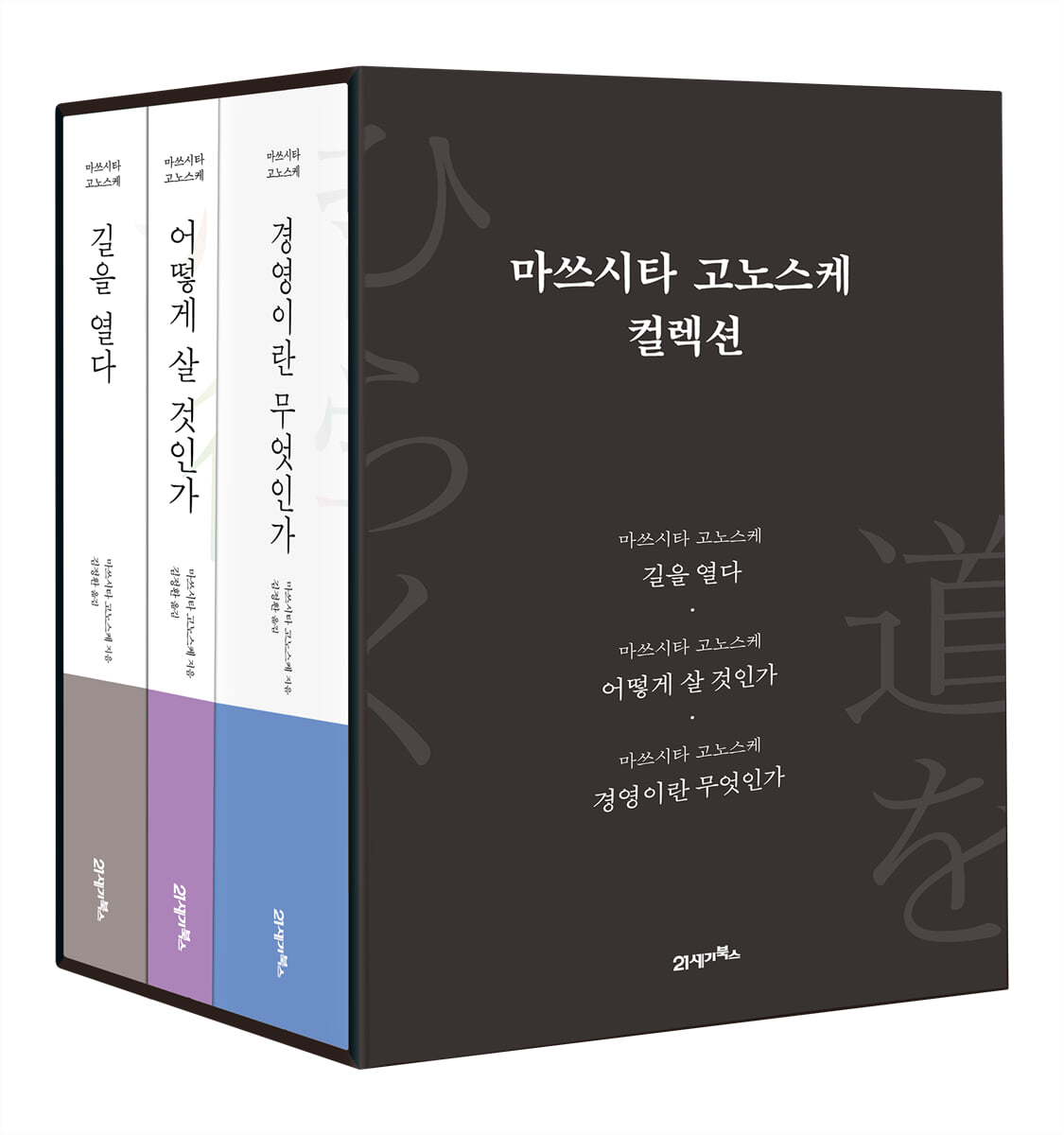
Konosuke Matsushita Collection
 |
Description
Book Introduction
★★★★★ The second-highest-selling single-volume book of all time! A long-running bestseller in Japanese bookstores for 60 years!
★★★★★ The #1 employee-recommended book! A book CEOs devour time and time again!
★★★★★ Highly recommended by domestic and international business leaders such as Son Wook, Son Jeong-ui, and Kazuo Inamori!
“I saw the legend of a man who never stopped growing!”
John Kotter (Professor Emeritus, Harvard Business School, world's leading change management expert)
It has been considered a must-read for businesspeople for over half a century since its publication.
The original text of Matsushita's thought, "Opening the Way," includes the first complete translation in Korea.
Embodied the philosophy that grew a small electric company into a 40 trillion won enterprise.
Konosuke Matsushita is a figure who left an unprecedented mark on Japanese economic history and world management history.
The journey of a poor boy who couldn't even finish elementary school to found an electrical appliance manufacturing company and grow it into the global company Panasonic is not just a success story, but a vivid testimony that reveals the essence of management and life.
His philosophy, which declared that “a company is a place where people are created,” demonstrates a unique perspective that views companies not simply as a place for profit-seeking, but as a community that prospers together with society.
His actions, which overcame numerous crises, including the Great Depression and the oil shock, are a vivid example of the management philosophy that the essence of a business is revealed only in times of crisis.
The 'Matsushita Konosuke Collection' is a three-volume compilation of teachings that are still relevant today, selected from among his extensive works.
"Konosuke Matsushita Opens the Way" reminds us of the strength to rise again even in the face of setbacks and the attitude of forging a path through sincere steps every day.
"Konosuke Matsushita: How to Live" emphasizes the fundamental attitude an individual should have toward life and the ways to live in harmony with society, and encourages us to view work not simply as a means of making a living, but as a training ground for human growth.
"What is Konosuke Matsushita's Management?" systematically organizes the philosophy of coexistence and co-prosperity, human-centered leadership, and the wisdom to overcome crises, based on principles and examples learned in the field of management.
While each volume can be read independently, it connects the three layers of attitude, life, and management, revealing the overall structure of Matsushita's thought.
Even though more than 30 years have passed since his death, it is clear why these books deserve to be read again.
In an era of rapidly changing technological environments and uncertainty becoming the norm, the "power to return to basics" emphasized by Konosuke Matsushita is more urgently needed than ever.
Even amidst the trend toward flashy techniques and short-term results, the unchanging principles of trust, responsibility, integrity, and trust in people remain the backbone that sustains organizations and individuals.
The "Matsushita Konosuke Collection" brings these principles to life in vivid language, offering today's readers a steadfast compass and a practical guidebook they can keep close at hand for reference in the long term.
★★★★★ The #1 employee-recommended book! A book CEOs devour time and time again!
★★★★★ Highly recommended by domestic and international business leaders such as Son Wook, Son Jeong-ui, and Kazuo Inamori!
“I saw the legend of a man who never stopped growing!”
John Kotter (Professor Emeritus, Harvard Business School, world's leading change management expert)
It has been considered a must-read for businesspeople for over half a century since its publication.
The original text of Matsushita's thought, "Opening the Way," includes the first complete translation in Korea.
Embodied the philosophy that grew a small electric company into a 40 trillion won enterprise.
Konosuke Matsushita is a figure who left an unprecedented mark on Japanese economic history and world management history.
The journey of a poor boy who couldn't even finish elementary school to found an electrical appliance manufacturing company and grow it into the global company Panasonic is not just a success story, but a vivid testimony that reveals the essence of management and life.
His philosophy, which declared that “a company is a place where people are created,” demonstrates a unique perspective that views companies not simply as a place for profit-seeking, but as a community that prospers together with society.
His actions, which overcame numerous crises, including the Great Depression and the oil shock, are a vivid example of the management philosophy that the essence of a business is revealed only in times of crisis.
The 'Matsushita Konosuke Collection' is a three-volume compilation of teachings that are still relevant today, selected from among his extensive works.
"Konosuke Matsushita Opens the Way" reminds us of the strength to rise again even in the face of setbacks and the attitude of forging a path through sincere steps every day.
"Konosuke Matsushita: How to Live" emphasizes the fundamental attitude an individual should have toward life and the ways to live in harmony with society, and encourages us to view work not simply as a means of making a living, but as a training ground for human growth.
"What is Konosuke Matsushita's Management?" systematically organizes the philosophy of coexistence and co-prosperity, human-centered leadership, and the wisdom to overcome crises, based on principles and examples learned in the field of management.
While each volume can be read independently, it connects the three layers of attitude, life, and management, revealing the overall structure of Matsushita's thought.
Even though more than 30 years have passed since his death, it is clear why these books deserve to be read again.
In an era of rapidly changing technological environments and uncertainty becoming the norm, the "power to return to basics" emphasized by Konosuke Matsushita is more urgently needed than ever.
Even amidst the trend toward flashy techniques and short-term results, the unchanging principles of trust, responsibility, integrity, and trust in people remain the backbone that sustains organizations and individuals.
The "Matsushita Konosuke Collection" brings these principles to life in vivid language, offering today's readers a steadfast compass and a practical guidebook they can keep close at hand for reference in the long term.
- You can preview some of the book's contents.
Preview
index
Volume 1: "Konosuke Matsushita Opens the Way"
Entering
Chapter 1: To Forge Your Own Destiny
The path given only to you | Accept and live as it is | Set your intentions and move forward | Walk cautiously, as if groping with your hands | Follow the laws of nature | Respect the various forms of life | Life is a battle of wits | When you can't avoid it, just move forward | A matter that transcends right and wrong | Willingly accept illness | Prepare for both life and death
Chapter 2 To start a new day
Greet each day anew | Practice broadening your perspective | Reflect on yourself in your surroundings | Do your best | Remember that rain can fall at any time | Be prepared for three changes a day | Ask, "Why?" | Be like a flower that blooms proudly | Live out your unique characteristics | Fear a life without thinking
Chapter 3: For a Life Together
Remember the power of connection | Greetings are lubricants | Share what you have as much as possible | Embrace both strengths and weaknesses | Why patience and tolerance are important | How to save each other | Recognize your responsibility | Accept sincere rebuke | What only humans can do | What a person is ignorant of the ways of the world | The more we share our hearts, the more strength we gain.
Chapter 4: Standing at the Moment of Decision
Make a decision first | Listen first and then give instructions | Fear not being able to cooperate more than wavering | The power to judge and execute | Do not be obsessed with small immediate gains | Not having a plan is a plan | The power to cut off the breath | The ability to be sensitive | A different perspective is a treasure of the world | Repeatedly ask yourself and answer questions | Push forward persistently | Do not be ashamed of worrying
Chapter 5: Overcoming Difficulties
Welcome worry | A heart that waits for the right time | The thoughts needed when standing at a crossroads of hardship | Don't be troubled even when things are difficult | Understand the light and dark sides of the world | The difference between those who consider work a competition and those who don't | The virtue of patience
Chapter 6: When you want to regain your confidence
Even if you fall, you can't get up without gaining something | Is it failure or success? | Everything is just a sheet of paper apart | The attitude you should have instead of absolute certainty | You must always make up your mind | The mind to do your best | You must not be rigid | You must follow the ways of the world | Don't rely on the wisdom of one person | After winter, spring eventually comes.
Chapter 7 To improve work performance
Where does 'my work' end? | Always consider how you work | Be careful, meticulous, and fast | In the end, finishing is everything | Grasp the flag first | Follow along tenaciously like a child | The power to attract results | What's more important than the success or failure of work | Don't neglect even the smallest details to avoid collapse | Awareness of being a professional
Chapter 8 To Grow Your Business
Change your perspective | The nobility of business | How to achieve success | What it means to have fans | Greet with both hands | The power of small things | Learn from your enemies | Deliberately jump into risky endeavors | Be passionate | Work as if you were running a branch | Same money, different values | Follow through to the end
Chapter 9: To live with an independent attitude
Learn on your own | Break free from self-centered thinking | Do not be content with your natural environment | A fearless life is more dangerous | This is not the time to sit still | Remember the turbulent times, especially in times of prosperity | Cherish your work | Start by knowing yourself | Once again with a sense of urgency | Return to your normal state of mind | It comes back to you in circles | You must teach to grow | You must learn from everything | The path lies in the most ordinary places | Why you must have a respectful heart | Think of other people's business as your own
Chapter 10: To Live a Rewarding Life
Face the truth | People are tempered like washed potatoes | You can get through the end of the year, but you can't get through the end of life | Acknowledge and take responsibility | Virtue comes from diligence | Wisdom also has its limits | Things to know before imitating | Elevate your spirit | The greatness of experience | Break through
Chapter 11: To Create a Better Country
Opening the way for the nation | Are you prepared? | The foundation of all work is belief | To prosper, think of it as your own work | Between peace and war | Can be resolved through conversation | Realize quickly | What is politics? | Aren't you expecting too much? | Serve the public | A mindset like a dam | Thinking of a good nation
Author's chronology
Volume 2: Konosuke Matsushita: How to Live
Before reading this book
Part 1: Reflecting on Daily Wisdom
On my attitude toward life as I approach my nineties
The art of navigating life | My will adds brilliance to destiny | The essence of humanity that shines when polished | What is success in life | Discover your innate talents | Trust first | Don't forget to be grateful | Know fear | Understand the subtleties of the mind | Savor everyday experiences | Both strengths and weaknesses are aspects of one's character | Listen, but don't be swept away | Fate plays a role in work | Passion and sincerity determine success or failure | Use learning, but don't get caught up in it | Become friendly with illness | Humans have no inherent worries | Continue, endure, and persevere | The power of self-objectification | Nothing is useless | Don't make things cry | On age and ageing | Reflect on women's work | What it means to follow the path of parents | Live life to the fullest | Why the meaning of life is important | What is a good life | Live out your life
Part 2: Reflecting on Wisdom at Work
How to work
Chapter 1: To those who have just started working at the company
If you are prepared for fate, it can sometimes be a source of strength. | Trust the company. | The secret to success. | A boss who doesn't understand. | Know the company's history. | Etiquette is the lubricant. | Health care is also part of work. | Be proactive in making suggestions. | Know the joy of work. | Strive to create more value. | The company is a public entity.
Chapter 2: To those who have become leaders
The attitude that I manage my own work | I love what I do enough to dream of working | I am not bound by knowledge | Small considerations are the first step to trust | Regular training is important | Self-improvement is a duty | Let's clearly distinguish between hobbies and main job | Selling skills is also a skill | The hidden meaning of being reprimanded | I stake my life on my work | Overcoming slumps with a beginner's mindset | The company is a place for training and learning | The spirit of cooperation brings about progress | Consideration for superiors
Chapter 3: To those who shoulder the weight of management
Is it the subordinate's fault? | “It's my responsibility” | Developing your skills as a professional | The key to developing people | Do not interfere with subordinates | How to avoid conflict | Your true worth is revealed when you fail | Turn misfortune into blessing | Be honest about your abilities | Become a person who can be of help to others in great matters | There is a realm of life in every worry | There is a better way to solve every problem | Only those who love their work know the true joy of work
Author's chronology
Volume 3: Konosuke Matsushita: What is Management?
Recommendation
Before reading this book
Part 1: The Basics of Business and Management
Chapter 1: The Mind of Doing Business
Always believe in the ways of the world│Competition without cooperation leads to destruction│How helpful has it been to customers│To succeed in sales│What should be put before prizes│You must properly understand your store's capabilities│Service that speaks to you│Put a price on invisible value│The greatest reward in running a business│It is not just my business│General hospitals and neighborhood hospitals│Prices in the new era│The best way to increase regular customers│Build relationships with people in the same industry│Products are like children, regular customers are like relatives│Be in charge of purchasing for regular business partners│The stability of the industry is a shared responsibility│The faces of 20 young employees│Treasure products│How much do you understand the value of service│The relationship between consumers and companies is one of virtue and loyalty│Pay attention to regular customers and where to buy│Gratitude to regular customers│The importance of a recommended sales method│Sellers must also contribute to product improvement│It's more fun during a recession│Raise the quality of a store│Profit comes from cost│Always be sensitive to collection and payment│Couple Being on good terms means that there is no absolute peace of mind. Competition is always fair.
Chapter 2 Attitude toward people
The first step to gathering people is to find strengths. To develop talent, you must be good at what you like. Everything in a company is the responsibility of one person. To create people, start by 'knocking'. Employ people with the belief that they are trustworthy. To utilize the wisdom of many people, be happy with suggestions from subordinates. The attitude of the CEO. An unexpected blessing obtained by a wholesaler.
Chapter 3: The Mind of Management
Are you interested in management?│Working over the phone│Promissory notes are banknotes I made│What is management ability│Work starts when you are convinced│Utilize customer complaints│Why I decided to give up on technology introduction│Wait for the right time during a recession│This store's products are a sure thing│The secret to good purchasing│Sales methods that build trust│Do business within the scope of equity capital│Work is enjoyable│Do business within the scope of service you can provide│Management that does not depend on others is important│Market demand is an intangible contract│Improvements brought about by earthquake damage│Treating business partners with rigorous standards│Recognize profits│Eliminate defects│Contribute in both material and spiritual ways│The necessity of advertising│Value the other party's time│Persuasive power needed for management│Business does not proceed only within the budget│Sincerity that risks one's life
Chapter 4: How to Raise People
Recession and talent development│A sense of mission is needed│How to view subordinates│Personnel management prioritizes the principle of putting the right person in the right position│When faced with a difficult situation│Confidence lacking humility is dangerous│A young CEO's secret to doing a good job│Is there anyone who can point out your mistakes│You shouldn't just do as you're told│Become a practical expert through field work│Put your soul into employee training│Send your son to another company│Ask your boss for help│An attitude of thinking anything is okay│Lessons learned from a hotel CEO│It's best to hire people who are qualified│Is the salary level appropriate│Let's properly resolve personnel complaints│Do you have a sense of being a professional│Living as a manager│Am I the right person for the position of manager│The determination to complete a task determines the success or failure of the task│A flexible and fearless organization
Part 2: About Management Philosophy
Chapter 1: 20 Principles to Know When Running a Business
First, establish a management philosophy. │ Everything in the world is constantly created and developed. │ You must have a good view of humanity. │ You must correctly recognize the mission given to you. │ You must follow the laws of nature. │ The reward for management is that the company makes a profit. │ You must coexist and prosper. │ Always think that the world is right. │ You must think that success is inevitable. │ Keep in mind independent management. │ You must practice 'dam management.' │ It is important to manage appropriately. │ A company's competitiveness comes from specialized capabilities. │ You must cultivate talent. │ You must gather the wisdom of all members. │ You must achieve harmony through conflict. │ Management is creative work. │ You must adapt to the changing times. │ You must be interested in politics. │ You must be pure and honest.
Chapter 2: Talking about In-Depth Management
When it rains, use an umbrella│Leading by example motivates employees│Artificial talent cultivation does not succeed│Do you have a cause that no one can oppose│Second-generation management competes with sincerity and passion│There can be no loss in business│A boom is good, but a recession is even better│How to utilize employees' abilities to more than 100%│Entrust, but do not delegate│Personnel selection requires support│Can you know with intuition alone?│Meetings are usually inefficient│The first buyer is the greatest contributor to technological evolution│True purchasing is only possible when you gain the other party's trust even after lowering the price│A CEO is not a strategist│How much has your management ability improved?│I want to manage a business that opens a new era│Let's practice '80 percent management'!│A society where the right managers can exert their power│If you have the will to save, will and wisdom will gather│The cause lies within yourself│A manager who fails to instill dreams in his employees is disqualified│The value of self-acquired management know-how is worth a million dollars
Chapter 3: Living as a Manager
In the end, the CEO is solely responsible. Even an ordinary day can be a valuable experience. Management is not magic. Employees are always watching the CEO. The determination to never back down paves the way. Can you borrow money from your employees when something happens? Are you prepared to die for your employees? You must constantly encourage yourself. The purpose of a CEO's life is to worry about company affairs. Management is done with the right hand, politics with the left. Business continues. We are the main characters of a living play. Being sick and having a long life are separate things. Youth is the youth of the heart.
Translator's Note | Family and Company Mottos of a Traditionally Excellent Company
Author's chronology
Entering
Chapter 1: To Forge Your Own Destiny
The path given only to you | Accept and live as it is | Set your intentions and move forward | Walk cautiously, as if groping with your hands | Follow the laws of nature | Respect the various forms of life | Life is a battle of wits | When you can't avoid it, just move forward | A matter that transcends right and wrong | Willingly accept illness | Prepare for both life and death
Chapter 2 To start a new day
Greet each day anew | Practice broadening your perspective | Reflect on yourself in your surroundings | Do your best | Remember that rain can fall at any time | Be prepared for three changes a day | Ask, "Why?" | Be like a flower that blooms proudly | Live out your unique characteristics | Fear a life without thinking
Chapter 3: For a Life Together
Remember the power of connection | Greetings are lubricants | Share what you have as much as possible | Embrace both strengths and weaknesses | Why patience and tolerance are important | How to save each other | Recognize your responsibility | Accept sincere rebuke | What only humans can do | What a person is ignorant of the ways of the world | The more we share our hearts, the more strength we gain.
Chapter 4: Standing at the Moment of Decision
Make a decision first | Listen first and then give instructions | Fear not being able to cooperate more than wavering | The power to judge and execute | Do not be obsessed with small immediate gains | Not having a plan is a plan | The power to cut off the breath | The ability to be sensitive | A different perspective is a treasure of the world | Repeatedly ask yourself and answer questions | Push forward persistently | Do not be ashamed of worrying
Chapter 5: Overcoming Difficulties
Welcome worry | A heart that waits for the right time | The thoughts needed when standing at a crossroads of hardship | Don't be troubled even when things are difficult | Understand the light and dark sides of the world | The difference between those who consider work a competition and those who don't | The virtue of patience
Chapter 6: When you want to regain your confidence
Even if you fall, you can't get up without gaining something | Is it failure or success? | Everything is just a sheet of paper apart | The attitude you should have instead of absolute certainty | You must always make up your mind | The mind to do your best | You must not be rigid | You must follow the ways of the world | Don't rely on the wisdom of one person | After winter, spring eventually comes.
Chapter 7 To improve work performance
Where does 'my work' end? | Always consider how you work | Be careful, meticulous, and fast | In the end, finishing is everything | Grasp the flag first | Follow along tenaciously like a child | The power to attract results | What's more important than the success or failure of work | Don't neglect even the smallest details to avoid collapse | Awareness of being a professional
Chapter 8 To Grow Your Business
Change your perspective | The nobility of business | How to achieve success | What it means to have fans | Greet with both hands | The power of small things | Learn from your enemies | Deliberately jump into risky endeavors | Be passionate | Work as if you were running a branch | Same money, different values | Follow through to the end
Chapter 9: To live with an independent attitude
Learn on your own | Break free from self-centered thinking | Do not be content with your natural environment | A fearless life is more dangerous | This is not the time to sit still | Remember the turbulent times, especially in times of prosperity | Cherish your work | Start by knowing yourself | Once again with a sense of urgency | Return to your normal state of mind | It comes back to you in circles | You must teach to grow | You must learn from everything | The path lies in the most ordinary places | Why you must have a respectful heart | Think of other people's business as your own
Chapter 10: To Live a Rewarding Life
Face the truth | People are tempered like washed potatoes | You can get through the end of the year, but you can't get through the end of life | Acknowledge and take responsibility | Virtue comes from diligence | Wisdom also has its limits | Things to know before imitating | Elevate your spirit | The greatness of experience | Break through
Chapter 11: To Create a Better Country
Opening the way for the nation | Are you prepared? | The foundation of all work is belief | To prosper, think of it as your own work | Between peace and war | Can be resolved through conversation | Realize quickly | What is politics? | Aren't you expecting too much? | Serve the public | A mindset like a dam | Thinking of a good nation
Author's chronology
Volume 2: Konosuke Matsushita: How to Live
Before reading this book
Part 1: Reflecting on Daily Wisdom
On my attitude toward life as I approach my nineties
The art of navigating life | My will adds brilliance to destiny | The essence of humanity that shines when polished | What is success in life | Discover your innate talents | Trust first | Don't forget to be grateful | Know fear | Understand the subtleties of the mind | Savor everyday experiences | Both strengths and weaknesses are aspects of one's character | Listen, but don't be swept away | Fate plays a role in work | Passion and sincerity determine success or failure | Use learning, but don't get caught up in it | Become friendly with illness | Humans have no inherent worries | Continue, endure, and persevere | The power of self-objectification | Nothing is useless | Don't make things cry | On age and ageing | Reflect on women's work | What it means to follow the path of parents | Live life to the fullest | Why the meaning of life is important | What is a good life | Live out your life
Part 2: Reflecting on Wisdom at Work
How to work
Chapter 1: To those who have just started working at the company
If you are prepared for fate, it can sometimes be a source of strength. | Trust the company. | The secret to success. | A boss who doesn't understand. | Know the company's history. | Etiquette is the lubricant. | Health care is also part of work. | Be proactive in making suggestions. | Know the joy of work. | Strive to create more value. | The company is a public entity.
Chapter 2: To those who have become leaders
The attitude that I manage my own work | I love what I do enough to dream of working | I am not bound by knowledge | Small considerations are the first step to trust | Regular training is important | Self-improvement is a duty | Let's clearly distinguish between hobbies and main job | Selling skills is also a skill | The hidden meaning of being reprimanded | I stake my life on my work | Overcoming slumps with a beginner's mindset | The company is a place for training and learning | The spirit of cooperation brings about progress | Consideration for superiors
Chapter 3: To those who shoulder the weight of management
Is it the subordinate's fault? | “It's my responsibility” | Developing your skills as a professional | The key to developing people | Do not interfere with subordinates | How to avoid conflict | Your true worth is revealed when you fail | Turn misfortune into blessing | Be honest about your abilities | Become a person who can be of help to others in great matters | There is a realm of life in every worry | There is a better way to solve every problem | Only those who love their work know the true joy of work
Author's chronology
Volume 3: Konosuke Matsushita: What is Management?
Recommendation
Before reading this book
Part 1: The Basics of Business and Management
Chapter 1: The Mind of Doing Business
Always believe in the ways of the world│Competition without cooperation leads to destruction│How helpful has it been to customers│To succeed in sales│What should be put before prizes│You must properly understand your store's capabilities│Service that speaks to you│Put a price on invisible value│The greatest reward in running a business│It is not just my business│General hospitals and neighborhood hospitals│Prices in the new era│The best way to increase regular customers│Build relationships with people in the same industry│Products are like children, regular customers are like relatives│Be in charge of purchasing for regular business partners│The stability of the industry is a shared responsibility│The faces of 20 young employees│Treasure products│How much do you understand the value of service│The relationship between consumers and companies is one of virtue and loyalty│Pay attention to regular customers and where to buy│Gratitude to regular customers│The importance of a recommended sales method│Sellers must also contribute to product improvement│It's more fun during a recession│Raise the quality of a store│Profit comes from cost│Always be sensitive to collection and payment│Couple Being on good terms means that there is no absolute peace of mind. Competition is always fair.
Chapter 2 Attitude toward people
The first step to gathering people is to find strengths. To develop talent, you must be good at what you like. Everything in a company is the responsibility of one person. To create people, start by 'knocking'. Employ people with the belief that they are trustworthy. To utilize the wisdom of many people, be happy with suggestions from subordinates. The attitude of the CEO. An unexpected blessing obtained by a wholesaler.
Chapter 3: The Mind of Management
Are you interested in management?│Working over the phone│Promissory notes are banknotes I made│What is management ability│Work starts when you are convinced│Utilize customer complaints│Why I decided to give up on technology introduction│Wait for the right time during a recession│This store's products are a sure thing│The secret to good purchasing│Sales methods that build trust│Do business within the scope of equity capital│Work is enjoyable│Do business within the scope of service you can provide│Management that does not depend on others is important│Market demand is an intangible contract│Improvements brought about by earthquake damage│Treating business partners with rigorous standards│Recognize profits│Eliminate defects│Contribute in both material and spiritual ways│The necessity of advertising│Value the other party's time│Persuasive power needed for management│Business does not proceed only within the budget│Sincerity that risks one's life
Chapter 4: How to Raise People
Recession and talent development│A sense of mission is needed│How to view subordinates│Personnel management prioritizes the principle of putting the right person in the right position│When faced with a difficult situation│Confidence lacking humility is dangerous│A young CEO's secret to doing a good job│Is there anyone who can point out your mistakes│You shouldn't just do as you're told│Become a practical expert through field work│Put your soul into employee training│Send your son to another company│Ask your boss for help│An attitude of thinking anything is okay│Lessons learned from a hotel CEO│It's best to hire people who are qualified│Is the salary level appropriate│Let's properly resolve personnel complaints│Do you have a sense of being a professional│Living as a manager│Am I the right person for the position of manager│The determination to complete a task determines the success or failure of the task│A flexible and fearless organization
Part 2: About Management Philosophy
Chapter 1: 20 Principles to Know When Running a Business
First, establish a management philosophy. │ Everything in the world is constantly created and developed. │ You must have a good view of humanity. │ You must correctly recognize the mission given to you. │ You must follow the laws of nature. │ The reward for management is that the company makes a profit. │ You must coexist and prosper. │ Always think that the world is right. │ You must think that success is inevitable. │ Keep in mind independent management. │ You must practice 'dam management.' │ It is important to manage appropriately. │ A company's competitiveness comes from specialized capabilities. │ You must cultivate talent. │ You must gather the wisdom of all members. │ You must achieve harmony through conflict. │ Management is creative work. │ You must adapt to the changing times. │ You must be interested in politics. │ You must be pure and honest.
Chapter 2: Talking about In-Depth Management
When it rains, use an umbrella│Leading by example motivates employees│Artificial talent cultivation does not succeed│Do you have a cause that no one can oppose│Second-generation management competes with sincerity and passion│There can be no loss in business│A boom is good, but a recession is even better│How to utilize employees' abilities to more than 100%│Entrust, but do not delegate│Personnel selection requires support│Can you know with intuition alone?│Meetings are usually inefficient│The first buyer is the greatest contributor to technological evolution│True purchasing is only possible when you gain the other party's trust even after lowering the price│A CEO is not a strategist│How much has your management ability improved?│I want to manage a business that opens a new era│Let's practice '80 percent management'!│A society where the right managers can exert their power│If you have the will to save, will and wisdom will gather│The cause lies within yourself│A manager who fails to instill dreams in his employees is disqualified│The value of self-acquired management know-how is worth a million dollars
Chapter 3: Living as a Manager
In the end, the CEO is solely responsible. Even an ordinary day can be a valuable experience. Management is not magic. Employees are always watching the CEO. The determination to never back down paves the way. Can you borrow money from your employees when something happens? Are you prepared to die for your employees? You must constantly encourage yourself. The purpose of a CEO's life is to worry about company affairs. Management is done with the right hand, politics with the left. Business continues. We are the main characters of a living play. Being sick and having a long life are separate things. Youth is the youth of the heart.
Translator's Note | Family and Company Mottos of a Traditionally Excellent Company
Author's chronology
Detailed image

Publisher's Review
Konosuke Matsushita, who opened the way even in the midst of crisis
One man's life proves that even in uncertain times, there is a compass that keeps you on track.
The definitive edition of Matsushita's philosophy, the "Konosuke Matsushita Collection"
Konosuke Matsushita (1894-1989) is called the “God of Management” and is recorded as a living textbook of Japanese economic history and world management history.
He started out with limitations of poverty and illness, having dropped out of elementary school, but he built a small electrical appliance manufacturing plant with just 100 yen and two employees, and turned it into the global company Panasonic.
His life was not simply a success story, but a history of management practices driven by the belief that "a company is a place where people are created" and the philosophy of "coexistence and co-prosperity."
Even in turbulent times like the Great Depression, the post-war defeat, and the oil shock, his choices of trust over layoffs and the basics over clever solutions remain a model that reminds us of the essence of management and life even today.
Professor John Kotter of Harvard Business School described him as “a rare figure in history,” which perfectly illustrates the achievements and ideas he left behind.
“The secret to my success is being born poor, being weak, and not being educated.”
The original text of Matsushita's thought, published in 1968, has sold over 5.7 million copies!
On the attitude of those who open a new path in the face of crisis and uncertainty
The first volume, "Matsushita Konosuke Opens the Way," is an immortal classic that has sold over 5.7 million copies in 287 editions in Japan alone since its first publication in 1968, and has sold over 6 million copies worldwide.
This book, which has been on the bestseller lists of Japanese bookstores for 60 years and still sells 70,000 to 80,000 copies every year, is called the original text of Matsushita's thought rather than simply a self-help book.
He emphasizes that “the essence of life lies not in flashy success, but in the sincere steps taken every day,” and conveys the strength to rise again after setbacks and the spirit of challenge to overcome limitations.
"Konosuke Matsushita Opens the Way" not only contains wisdom from the field of business, but also human attitudes and reflections on daily life, resonating across generations.
Matsushita, before becoming an entrepreneur, recorded the precious truths he realized as a human being in short, concise sentences, and these have been quoted as mottos by countless readers.
In Japan, it is widely used as a training material for new employees and as a required reading for corporate executives, and has earned the nickname of "Introduction to Matsushita's Philosophy."
Even today, this book remains a steadfast guide to life and management in times of crisis.
“Fear an insincere attitude more than failure!”
With over 2 million copies distributed for corporate training purposes alone, this is the most cited book in Japanese business education!
The essence of life philosophy from the god of management to those who find life unstable despite working hard.
The second volume, "Konosuke Matsushita: How to Live," is a combined volume of "Attitudes toward Life" and "Attitudes toward an Employee." It is the result of Matsushita's lifelong reflections and organization on how one should live as an individual and a member of society.
He emphasized that what we should fear more than failure is an 'insincere attitude', and placed the values of gratitude, trust, humility, and responsibility at the center of our lives and organizational activities.
His perspective that work is not simply a means of livelihood but a training ground for human growth suggests a new way of thinking that views work and life as an integrated whole rather than as separate entities.
Since its publication in Japan, "Konosuke Matsushita: How to Live" has been reprinted dozens of times and has become a steady seller.
The book simultaneously addresses personal cultivation and social responsibility, linking the fundamental attitude toward work life to the prosperity of the organization.
In particular, his view of humanity, which sees people as rough diamonds and that anyone can shine if polished, is in line with modern management studies that emphasize talent development and teamwork.
In today's world, where uncertainty and anxiety are the norm, this book goes beyond self-improvement and serves as a philosophy of life, guiding everyone from young people to retirees to organize their lives.
As he said at the age of ninety, “I’m still learning,” the message of continuous growth through lifelong learning and self-cultivation remains relevant to today’s readers.
"Booms are good, busts are better!"
The Timeless Essence of Management by Konosuke Matsushita, the "God of Management."
The one management book you need to reread during a business downturn!
"What is Konosuke Matsushita's Management?" is the definitive compilation of Konosuke Matsushita's management philosophy.
This book is a compilation of four representative works: 『Business Mindset』(1973), 『Management Mindset』(1974), 『Practical Management Philosophy』(1978), and 『The Value of Self-Acquired Management Know-How is Worth a Million Gold』(1980).
Matsushita defined management not as a simple technique or theory, but as “the practice of developing people, building trust, and contributing to society.”
This book embodies core concepts such as "coexistence and co-prosperity," "self-management," and "dam management," and provides vivid examples of overcoming crises such as the Great Depression, the oil shock, and the collapse of sales networks.
Therefore, this book is not simply an entrepreneur's memoir.
It presents specific topics such as customer value, talent development, fair competition, appropriate profits, crisis preparedness, and service spirit, along with abundant anecdotes, making it a guideline applicable to not only managers but also practitioners and employees.
As Konosuke Matsushita said, “A boom is good, but a recession is better!” Positive thinking that turns a crisis into an opportunity for growth is still a textbook for leadership training and organizational innovation.
A standard of life and management that remains unshaken even in chaos
Beyond 30 years, the wisdom we need to overcome the crisis now.
If "Konosuke Matsushita Opens the Way" is an introductory book to Matsushita's thought that can be called a guidebook for the Japanese people, then "What is Konosuke Matsushita Management?" is a masterpiece that shows the roots of his management philosophy from the beginning to how it was completed.
In the middle of this, "Konosuke Matsushita: How to Live" takes its place as a practical book that connects personal life and career, organizations, and society through his enlightenment that nurturing people and cultivating oneself were the top priorities in management and life.
Although more than 30 years have passed since his death, it is clear why the "Matsushita Konosuke Collection" must be read again now.
In an era of artificial intelligence, digital transformation, global upheaval, and uncertainty, what's needed isn't flashy techniques, but the power to return to basics.
Trust, integrity, responsibility, and people-first management are principles that transcend time and borders.
As Professor John Kotter praised, his philosophy is not simply a legacy of the past, but a key to breaking through the chaos of the present, and, as Chairman Son Wook said, a "magic" that opens the way in times of crisis.
This collection will serve as a practical classic for managers, practitioners, young people, and general readers alike, offering a long-term perspective on the direction of their lives and work.
One man's life proves that even in uncertain times, there is a compass that keeps you on track.
The definitive edition of Matsushita's philosophy, the "Konosuke Matsushita Collection"
Konosuke Matsushita (1894-1989) is called the “God of Management” and is recorded as a living textbook of Japanese economic history and world management history.
He started out with limitations of poverty and illness, having dropped out of elementary school, but he built a small electrical appliance manufacturing plant with just 100 yen and two employees, and turned it into the global company Panasonic.
His life was not simply a success story, but a history of management practices driven by the belief that "a company is a place where people are created" and the philosophy of "coexistence and co-prosperity."
Even in turbulent times like the Great Depression, the post-war defeat, and the oil shock, his choices of trust over layoffs and the basics over clever solutions remain a model that reminds us of the essence of management and life even today.
Professor John Kotter of Harvard Business School described him as “a rare figure in history,” which perfectly illustrates the achievements and ideas he left behind.
“The secret to my success is being born poor, being weak, and not being educated.”
The original text of Matsushita's thought, published in 1968, has sold over 5.7 million copies!
On the attitude of those who open a new path in the face of crisis and uncertainty
The first volume, "Matsushita Konosuke Opens the Way," is an immortal classic that has sold over 5.7 million copies in 287 editions in Japan alone since its first publication in 1968, and has sold over 6 million copies worldwide.
This book, which has been on the bestseller lists of Japanese bookstores for 60 years and still sells 70,000 to 80,000 copies every year, is called the original text of Matsushita's thought rather than simply a self-help book.
He emphasizes that “the essence of life lies not in flashy success, but in the sincere steps taken every day,” and conveys the strength to rise again after setbacks and the spirit of challenge to overcome limitations.
"Konosuke Matsushita Opens the Way" not only contains wisdom from the field of business, but also human attitudes and reflections on daily life, resonating across generations.
Matsushita, before becoming an entrepreneur, recorded the precious truths he realized as a human being in short, concise sentences, and these have been quoted as mottos by countless readers.
In Japan, it is widely used as a training material for new employees and as a required reading for corporate executives, and has earned the nickname of "Introduction to Matsushita's Philosophy."
Even today, this book remains a steadfast guide to life and management in times of crisis.
“Fear an insincere attitude more than failure!”
With over 2 million copies distributed for corporate training purposes alone, this is the most cited book in Japanese business education!
The essence of life philosophy from the god of management to those who find life unstable despite working hard.
The second volume, "Konosuke Matsushita: How to Live," is a combined volume of "Attitudes toward Life" and "Attitudes toward an Employee." It is the result of Matsushita's lifelong reflections and organization on how one should live as an individual and a member of society.
He emphasized that what we should fear more than failure is an 'insincere attitude', and placed the values of gratitude, trust, humility, and responsibility at the center of our lives and organizational activities.
His perspective that work is not simply a means of livelihood but a training ground for human growth suggests a new way of thinking that views work and life as an integrated whole rather than as separate entities.
Since its publication in Japan, "Konosuke Matsushita: How to Live" has been reprinted dozens of times and has become a steady seller.
The book simultaneously addresses personal cultivation and social responsibility, linking the fundamental attitude toward work life to the prosperity of the organization.
In particular, his view of humanity, which sees people as rough diamonds and that anyone can shine if polished, is in line with modern management studies that emphasize talent development and teamwork.
In today's world, where uncertainty and anxiety are the norm, this book goes beyond self-improvement and serves as a philosophy of life, guiding everyone from young people to retirees to organize their lives.
As he said at the age of ninety, “I’m still learning,” the message of continuous growth through lifelong learning and self-cultivation remains relevant to today’s readers.
"Booms are good, busts are better!"
The Timeless Essence of Management by Konosuke Matsushita, the "God of Management."
The one management book you need to reread during a business downturn!
"What is Konosuke Matsushita's Management?" is the definitive compilation of Konosuke Matsushita's management philosophy.
This book is a compilation of four representative works: 『Business Mindset』(1973), 『Management Mindset』(1974), 『Practical Management Philosophy』(1978), and 『The Value of Self-Acquired Management Know-How is Worth a Million Gold』(1980).
Matsushita defined management not as a simple technique or theory, but as “the practice of developing people, building trust, and contributing to society.”
This book embodies core concepts such as "coexistence and co-prosperity," "self-management," and "dam management," and provides vivid examples of overcoming crises such as the Great Depression, the oil shock, and the collapse of sales networks.
Therefore, this book is not simply an entrepreneur's memoir.
It presents specific topics such as customer value, talent development, fair competition, appropriate profits, crisis preparedness, and service spirit, along with abundant anecdotes, making it a guideline applicable to not only managers but also practitioners and employees.
As Konosuke Matsushita said, “A boom is good, but a recession is better!” Positive thinking that turns a crisis into an opportunity for growth is still a textbook for leadership training and organizational innovation.
A standard of life and management that remains unshaken even in chaos
Beyond 30 years, the wisdom we need to overcome the crisis now.
If "Konosuke Matsushita Opens the Way" is an introductory book to Matsushita's thought that can be called a guidebook for the Japanese people, then "What is Konosuke Matsushita Management?" is a masterpiece that shows the roots of his management philosophy from the beginning to how it was completed.
In the middle of this, "Konosuke Matsushita: How to Live" takes its place as a practical book that connects personal life and career, organizations, and society through his enlightenment that nurturing people and cultivating oneself were the top priorities in management and life.
Although more than 30 years have passed since his death, it is clear why the "Matsushita Konosuke Collection" must be read again now.
In an era of artificial intelligence, digital transformation, global upheaval, and uncertainty, what's needed isn't flashy techniques, but the power to return to basics.
Trust, integrity, responsibility, and people-first management are principles that transcend time and borders.
As Professor John Kotter praised, his philosophy is not simply a legacy of the past, but a key to breaking through the chaos of the present, and, as Chairman Son Wook said, a "magic" that opens the way in times of crisis.
This collection will serve as a practical classic for managers, practitioners, young people, and general readers alike, offering a long-term perspective on the direction of their lives and work.
GOODS SPECIFICS
- Date of issue: October 29, 2025
- Format: Hardcover book binding method guide
- Page count, weight, size: 1,168 pages | 128*188*60mm
- ISBN13: 9791173575273
- ISBN10: 1173575278
You may also like
카테고리
korean


korean

![GQ KOREA Mark (Monthly): December [2025]](http://librairie.coreenne.fr/cdn/shop/files/8ef265dbbfbf186523ed75ba7319009d.jpg?v=1765340328&width=3840)


