

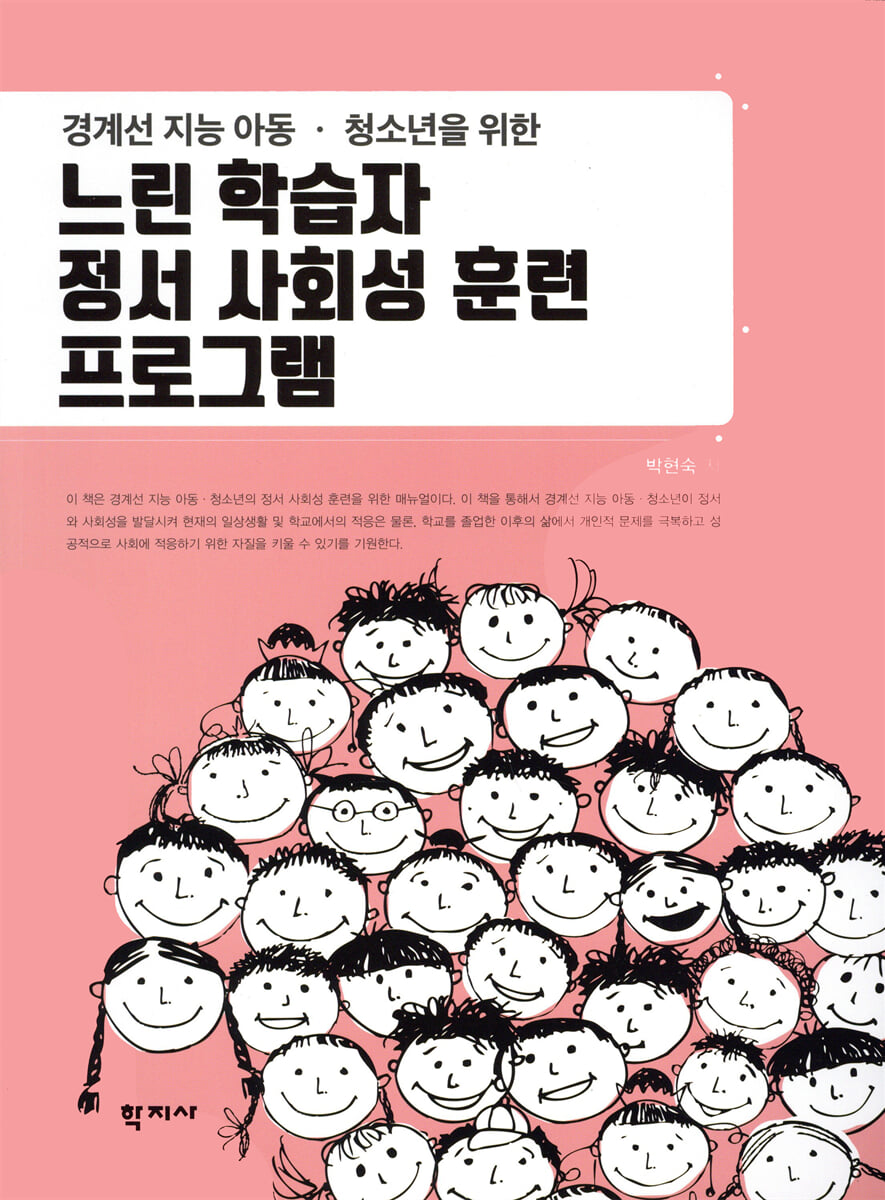
Slow Learner Emotional and Social Skills Training Program
 |
Description
Book Introduction
This is an emotional and social skills training manual specialized for children and adolescents with borderline intelligence.
The "Slow Learner Emotional Social Skills Training Program" is designed to help students develop positive self-concept, recognize their own and others' emotions, regulate their emotions, communicate, make friends and maintain relationships, and demonstrate problem-solving skills in social conflict situations.
It is designed as a program for small groups of 4 to 6 people, and more positive effects can be expected when forming a group with children and adolescents of average intelligence rather than a group consisting solely of children and adolescents with borderline intelligence, so this should be taken into consideration when forming a group.
Additionally, if the play in the introduction is changed to 1:1 play, it can be used for social skills training of children and adolescents with borderline intelligence, not just in groups, so it can be applied in various ways.
The "Slow Learner Emotional Social Skills Training Program" is designed to help students develop positive self-concept, recognize their own and others' emotions, regulate their emotions, communicate, make friends and maintain relationships, and demonstrate problem-solving skills in social conflict situations.
It is designed as a program for small groups of 4 to 6 people, and more positive effects can be expected when forming a group with children and adolescents of average intelligence rather than a group consisting solely of children and adolescents with borderline intelligence, so this should be taken into consideration when forming a group.
Additionally, if the play in the introduction is changed to 1:1 play, it can be used for social skills training of children and adolescents with borderline intelligence, not just in groups, so it can be applied in various ways.
index
preface
introduction
I have a positive self-concept
1.
nice to meet you
2.
Forming a positive self-concept
3.
Acknowledging that we are different and knowing our own unique characteristics
II Making Friends and Maintaining Relationships
4.
Desirable behavior in friendships
5.
Identifying my friends
6.
Become a good friend
7.
Expressing empathy for a friend
8.
Express your favorite emotions
III Communicate Well
9.
The influence of positive and negative words
10.
Knowing how to communicate
11.
Communicating Effectively
12.
Give and receive help
IV Understanding your own and others' needs and feelings
13.
Understanding other people's feelings
14.
Understanding human needs and behavior
15.
Distinguishing Needs from Fulfillment: When You're Happy and When You're Unhappy
16.
Coping When Needs Are Not Met
V Anger Management and Expressing Healthy Anger
17.
I want to fight at times like this
18.
Managing Anger I: Recognizing Anger
19.
Managing Anger II: Anger-Related Behaviors and Alternative Behaviors
20.
Managing Anger III: Healthy Expression of Anger
21.
Managing Anger IV: Identifying the Source of Anger and Solving It
VI Developing Problem-Solving Skills
22.
Coping with fear
23.
Dealing with Teasing
24.
Make your own decisions
25.
Prioritize your work and take action
26.
Accepting my changing self
introduction
I have a positive self-concept
1.
nice to meet you
2.
Forming a positive self-concept
3.
Acknowledging that we are different and knowing our own unique characteristics
II Making Friends and Maintaining Relationships
4.
Desirable behavior in friendships
5.
Identifying my friends
6.
Become a good friend
7.
Expressing empathy for a friend
8.
Express your favorite emotions
III Communicate Well
9.
The influence of positive and negative words
10.
Knowing how to communicate
11.
Communicating Effectively
12.
Give and receive help
IV Understanding your own and others' needs and feelings
13.
Understanding other people's feelings
14.
Understanding human needs and behavior
15.
Distinguishing Needs from Fulfillment: When You're Happy and When You're Unhappy
16.
Coping When Needs Are Not Met
V Anger Management and Expressing Healthy Anger
17.
I want to fight at times like this
18.
Managing Anger I: Recognizing Anger
19.
Managing Anger II: Anger-Related Behaviors and Alternative Behaviors
20.
Managing Anger III: Healthy Expression of Anger
21.
Managing Anger IV: Identifying the Source of Anger and Solving It
VI Developing Problem-Solving Skills
22.
Coping with fear
23.
Dealing with Teasing
24.
Make your own decisions
25.
Prioritize your work and take action
26.
Accepting my changing self
Detailed image
.jpg)
Publisher's Review
Make friends with your child
A Manual for Maintaining Relationships
The novel coronavirus pandemic has made remote learning a necessity rather than an option.
The prolonged remote learning period due to COVID-19 has brought the issue of students failing to meet basic academic standards to the forefront of the education community.
Among these, the children who are having a particularly difficult time are those with borderline intelligence, which lies between disabilities and non-disabilities.
Borderline intelligence is a developmental defect that corresponds to an IQ of 71 to 84 and requires ongoing attention.
For children with borderline intelligence who struggle to keep up with classes even in traditional schools, distance learning is tantamount to a lack of real education.
Even though the normal distribution curve of intelligence shows that borderline intelligence occurs in 13.59% of the population, it is not classified as a disability, so there is very little interest in it.
However, it is easy to see people complaining about the difficulties of raising and educating children and adolescents with borderline intelligence in educational settings, childcare facilities, community children's centers, and even within ordinary families.
Among these challenges, the most pressing concerns are the lack of access to relevant information and the lack of programs tailored to the specific needs of the children, making intervention difficult.
One reason for the difficulty in accessing relevant information is that, despite its high prevalence, borderline intelligence is not classified as a disability, so very few studies have been conducted and very little information is known about it.
Because there is little information available through research or education, it is difficult to develop targeted programs, and despite the large number of people in need, early and appropriate intervention is very difficult.
Accordingly, the author created an emotional and social skills training manual specialized for children and adolescents with borderline intelligence.
The 'Slow Learner Emotional Social Skills Training Program' is designed to help students acquire skills such as positive self-concept, recognizing their own and others' emotions, emotional regulation, communication skills, making and maintaining friends, and problem-solving skills in social conflict situations.
It is designed as a program for small groups of 4 to 6 people, and more positive effects can be expected when forming a group with children and adolescents of average intelligence rather than a group consisting solely of children and adolescents with borderline intelligence, so this should be taken into consideration when forming a group.
Additionally, if the play in the introduction is changed to 1:1 play, it can be used for social skills training of children and adolescents with borderline intelligence, not just in groups, so it can be applied in various ways.
Through this program, we hope that children and adolescents with borderline intelligence will develop their emotions and social skills, enabling them to adapt to their current daily lives and school life, as well as overcome or minimize personal problems that could lead to failure in their lives after graduation, and develop the qualities necessary for successful social adaptation.
A Manual for Maintaining Relationships
The novel coronavirus pandemic has made remote learning a necessity rather than an option.
The prolonged remote learning period due to COVID-19 has brought the issue of students failing to meet basic academic standards to the forefront of the education community.
Among these, the children who are having a particularly difficult time are those with borderline intelligence, which lies between disabilities and non-disabilities.
Borderline intelligence is a developmental defect that corresponds to an IQ of 71 to 84 and requires ongoing attention.
For children with borderline intelligence who struggle to keep up with classes even in traditional schools, distance learning is tantamount to a lack of real education.
Even though the normal distribution curve of intelligence shows that borderline intelligence occurs in 13.59% of the population, it is not classified as a disability, so there is very little interest in it.
However, it is easy to see people complaining about the difficulties of raising and educating children and adolescents with borderline intelligence in educational settings, childcare facilities, community children's centers, and even within ordinary families.
Among these challenges, the most pressing concerns are the lack of access to relevant information and the lack of programs tailored to the specific needs of the children, making intervention difficult.
One reason for the difficulty in accessing relevant information is that, despite its high prevalence, borderline intelligence is not classified as a disability, so very few studies have been conducted and very little information is known about it.
Because there is little information available through research or education, it is difficult to develop targeted programs, and despite the large number of people in need, early and appropriate intervention is very difficult.
Accordingly, the author created an emotional and social skills training manual specialized for children and adolescents with borderline intelligence.
The 'Slow Learner Emotional Social Skills Training Program' is designed to help students acquire skills such as positive self-concept, recognizing their own and others' emotions, emotional regulation, communication skills, making and maintaining friends, and problem-solving skills in social conflict situations.
It is designed as a program for small groups of 4 to 6 people, and more positive effects can be expected when forming a group with children and adolescents of average intelligence rather than a group consisting solely of children and adolescents with borderline intelligence, so this should be taken into consideration when forming a group.
Additionally, if the play in the introduction is changed to 1:1 play, it can be used for social skills training of children and adolescents with borderline intelligence, not just in groups, so it can be applied in various ways.
Through this program, we hope that children and adolescents with borderline intelligence will develop their emotions and social skills, enabling them to adapt to their current daily lives and school life, as well as overcome or minimize personal problems that could lead to failure in their lives after graduation, and develop the qualities necessary for successful social adaptation.
GOODS SPECIFICS
- Publication date: March 15, 2022
- Format: Paperback book binding method guide
- Page count, weight, size: 224 pages | 590g | 188*254*13mm
- ISBN13: 9788999726545
- ISBN10: 8999726541
You may also like
카테고리
korean


korean

![GQ KOREA Mark (Monthly): December [2025]](http://librairie.coreenne.fr/cdn/shop/files/8ef265dbbfbf186523ed75ba7319009d.jpg?v=1765340328&width=3840)


