

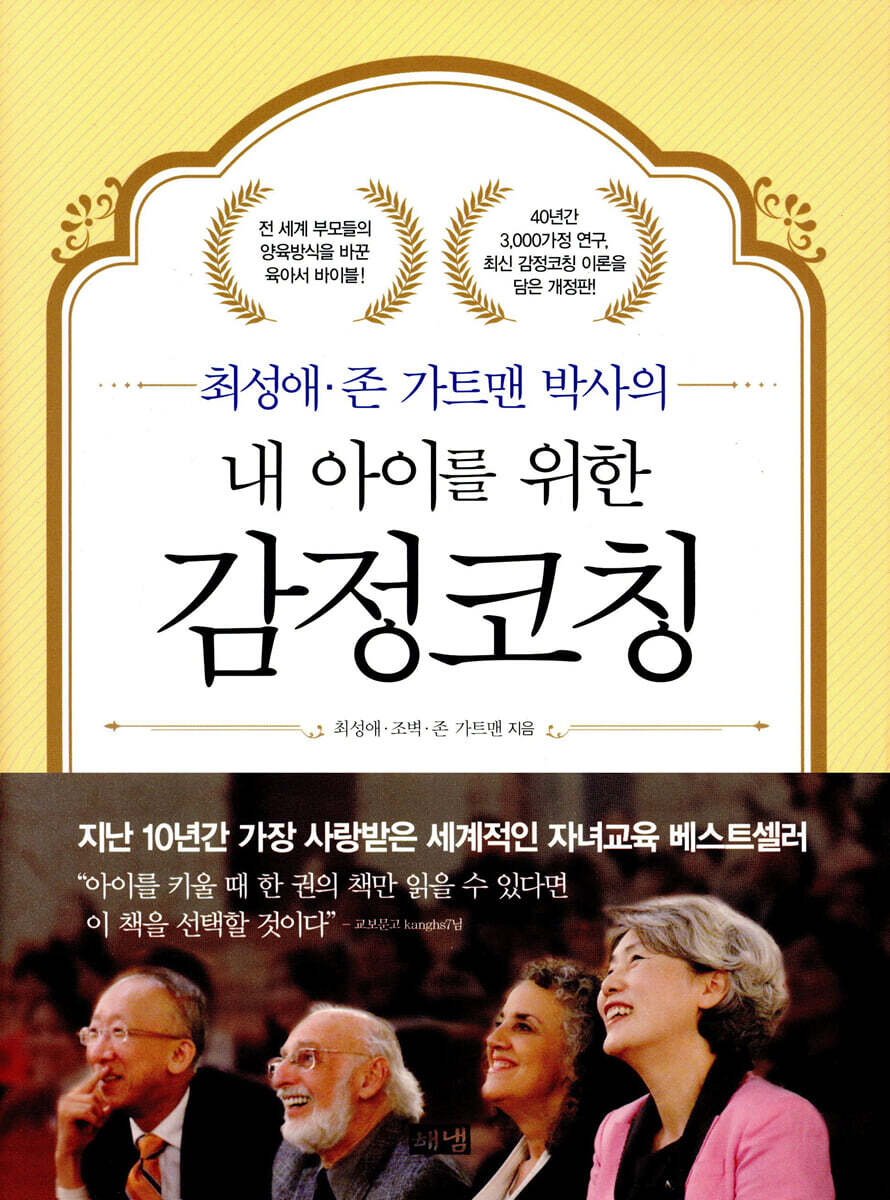
Emotional Coaching for My Child
 |
Description
Book Introduction
A must-read textbook on child education for parents The five stages of emotional coaching discussed in this book are introduced as follows, changing the order of the previous stages 3 and 4. Steps 1 and 2 are to ask the child how he or she is feeling, to capture his or her emotions, and to consider it a good opportunity for emotional coaching when emotions are revealed. Steps 3 and 4 are naming emotions so that the child can recognize his or her own feelings, and empathizing with and listening to the child's feelings through approachable conversation. The final five steps are to ask questions that will help you find your own solutions and guide you toward desirable behavior. Dr. Choi Seong-ae and Professor Cho Byeok have systematized emotional coaching to fit the reality of parenting in Korea and make it easy for parents to follow. Above all, the effectiveness and methods of emotional coaching are supported by the latest theories in human development, brain science, heart science, and positive psychology. We introduce specific methods to enhance the effectiveness of emotional coaching by incorporating clinical experiences such as therapeutic play and relationship therapy. It also demonstrates the practical application of emotional coaching through a wealth of real-life case studies based on the child's developmental stage. This book, consisting of five chapters, covers the reasons why we need to empathize with emotions and the effects of emotional coaching in Chapter 1. Chapter 2 helps parents understand their own emotional states and what type of caregiver they are, and explains the child's innate temperament and family environment. Chapter 3 introduces conversations that reach and distance children's hearts, and explains the negative effects of praise and how to properly scold them. Chapter 4 shows the five stages of emotional coaching. Chapter 5 introduces the characteristics of each developmental stage from before the first birthday to elementary school students and the emotional coaching play methods that can be applied to each stage. With the youth suicide rate unwavering and the fierce competition for college entrance exams, this book offers parents the know-how to rebuild their relationships with their children and raise them to be healthy and happy. It will also provide an opportunity to re-examine the health of your relationship. Furthermore, it will offer wisdom not only to teachers but also to educators on how to foster in children the core qualities of "empathy, communication, and resilience" in the AI era. |
- You can preview some of the book's contents.
Preview
index
Publishing a Revised Edition_ 10 Years with Emotional Coaching and 10 More to Come_ Choi Seong-ae, Jo Byeok
Introduction_ The Magical Art of Sharing Hearts with Children: Emotional Coaching_ John Gottman
Introduction_Emotional Coaching: Getting Started with Very Little Effort_ Choi Seong-ae
Introduction_Why you should choose emotional coaching_Jo Byeok
Chapter 1: Children who control their emotions well are happy.
1.
Child, lost in emotions
2.
Empathizing with a child's feelings is true love.
3.
This is how children who received emotional coaching changed.
Chapter 2: Raising Children to Be Honest About Their Emotions
1.
Parents who are honest about their own feelings also understand their children's emotions well.
2.
How should I respond to my child's emotions?
3.
Anyone can understand a child's emotions if they open their heart.
4.
When parents are happy, their children's happiness doubles.
Chapter 3: Emotional Coaching Conversation Methods to Open a Child's Heart
1.
Conversations that open the mind and conversations that close the mind
2.
Principles are important when praising or scolding.
Chapter 4: 5 Steps to Emotional Coaching for Connecting with Your Child
1.
Step 1 of Emotion Coaching: Recognizing Your Child's Emotions
2.
Step 2 of Emotional Coaching: Turning Emotional Moments into Opportunities
3.
Step 3 of Emotion Coaching: Helping Your Child Express Their Emotions
4.
Step 4 of Emotion Coaching: Empathize with and Listen to Your Child's Emotions
5.
Step 5 of Emotion Coaching: Empowering Children to Solve Problems on Their Own
Chapter 5: How to Treat Your Child Differently Depending on Their Growth Stage
1.
Before their first birthday, children make eye contact and share their emotions.
2.
Toddlers struggle with expressing their emotions, and if left unchecked, they become even more misguided.
3.
For preschool children, relationships with friends are important.
4.
Elementary school students, humiliation and shame are forbidden!
5.
The storm and stress of adolescence requires empathy.
Appendix_ Real-life examples of situational emotional coaching
Appendix 1: When Your Child Throws a Tantrum or Gets Angry
Appendix 2 When a child cries in frustration
Appendix 3 When Your Child Feels Confused
Appendix 4: When You Need to Understand Things You Don't Like
Appendix 5 When a child is stubborn and does not get his/her way
Introduction_ The Magical Art of Sharing Hearts with Children: Emotional Coaching_ John Gottman
Introduction_Emotional Coaching: Getting Started with Very Little Effort_ Choi Seong-ae
Introduction_Why you should choose emotional coaching_Jo Byeok
Chapter 1: Children who control their emotions well are happy.
1.
Child, lost in emotions
2.
Empathizing with a child's feelings is true love.
3.
This is how children who received emotional coaching changed.
Chapter 2: Raising Children to Be Honest About Their Emotions
1.
Parents who are honest about their own feelings also understand their children's emotions well.
2.
How should I respond to my child's emotions?
3.
Anyone can understand a child's emotions if they open their heart.
4.
When parents are happy, their children's happiness doubles.
Chapter 3: Emotional Coaching Conversation Methods to Open a Child's Heart
1.
Conversations that open the mind and conversations that close the mind
2.
Principles are important when praising or scolding.
Chapter 4: 5 Steps to Emotional Coaching for Connecting with Your Child
1.
Step 1 of Emotion Coaching: Recognizing Your Child's Emotions
2.
Step 2 of Emotional Coaching: Turning Emotional Moments into Opportunities
3.
Step 3 of Emotion Coaching: Helping Your Child Express Their Emotions
4.
Step 4 of Emotion Coaching: Empathize with and Listen to Your Child's Emotions
5.
Step 5 of Emotion Coaching: Empowering Children to Solve Problems on Their Own
Chapter 5: How to Treat Your Child Differently Depending on Their Growth Stage
1.
Before their first birthday, children make eye contact and share their emotions.
2.
Toddlers struggle with expressing their emotions, and if left unchecked, they become even more misguided.
3.
For preschool children, relationships with friends are important.
4.
Elementary school students, humiliation and shame are forbidden!
5.
The storm and stress of adolescence requires empathy.
Appendix_ Real-life examples of situational emotional coaching
Appendix 1: When Your Child Throws a Tantrum or Gets Angry
Appendix 2 When a child cries in frustration
Appendix 3 When Your Child Feels Confused
Appendix 4: When You Need to Understand Things You Don't Like
Appendix 5 When a child is stubborn and does not get his/her way
Detailed image

Into the book
10 Years with Emotional Coaching and 10 More to Come - Choi Seong-ae and Jo Byeok
What's the biggest difference between when we first wrote this book and now? I think many children grow up without forming secure attachments with their parents during the crucial early childhood period.
As a human developmentalist who knows all too well the long-term aftereffects of insecure attachment, this is something that concerns me deeply.
However, there is hope in Dr. Gottman's long-term follow-up study that shows that emotion coaching is effective in preventing and treating attachment disorders.
Additionally, abilities acquired through traditional education, such as memorization and arithmetic, are being replaced by artificial intelligence (AI).
In these times, the important role of parents and teachers is no longer to whip their children into studying hard.
Emotional coaching is in line with the assertion of Professor Yuval Harari, a world-renowned scholar, that the most essential survival skills in the era of the Fourth Industrial Revolution are "emotional empathy and communication skills" and "resilience."
Education in advanced countries already places importance on collective intelligence, collective wisdom, and emotionally-based education.
Fortunately, around 2000, behaviorism rapidly declined, and in its place, emotion-based positive psychology emerged rapidly.
At the forefront of this new era are brain science, heart science, and emotional coaching.
Perhaps concepts like creativity, collective intelligence, and resilience will lay the foundation for humanity's more mature survival in the AI era.
Those who learn and practice emotional coaching are pioneers.
--- From "On the Publication of the Revised Edition"
The Magical Art of Sharing Hearts with Children: Emotional Coaching - John Gottman
The most important thing that emotion coaching can do is keep the lines of communication open between parent and child.
Ignoring your emotions doesn't make them go away.
In fact, if you do that, the child will think that the parent doesn't want to know that he or she is sad.
Even if you feel frustrated, angry, hopeless, or afraid, you think your parents don't want to know.
Eventually, the child is left to deal with all these emotions on his own.
The benefits a child gains from emotional coaching last a lifetime.
It's like a child has a GPS that tells them when they're sad, when something is missing, it tells them what it is, and when they're angry, it tells them that they're angry.
When you get angry or your goals are frustrated, it's like a GPS that tells you what your goals are and what caused you to get frustrated.
It acts as a lighthouse that shows the direction of life.
Your inner GPS helps you make choices that are consistent with your thoughts at various moments of choice throughout your life.
This is because your inner GPS guides you morally to make the right choices, allowing you to make choices that align with who you are, leveraging your talents, potential, creativity, and potential.
That's why emotional coaching for children is a lifelong gift.
--- From the "Introductory Note"
From war-like parenting to happy parenting, I raise my child in a safe and prosperous way!
Children express their emotions through actions.
When a child expresses his or her emotions in any way—crying, throwing a tantrum, being irritable, screaming—it is a desperate gesture of wanting to be recognized.
Children encounter the world with emotions at every moment, but they only feel emotions, do not know what those emotions are, and cannot express them in appropriate language.
In these situations, the outcome is completely different whether someone acknowledges the child's feelings or not.
A child who feels understood by someone else quickly learns to control his emotions and finds stability.
You will feel relieved that these feelings are not just yours but that others feel them too, and you will gradually be able to express them in more appropriate words and actions.
In doing so, children learn to respect themselves and others.
On the other hand, a child whose emotions are ignored becomes confused.
'Oh, that's strange.
They wonder, 'Why isn't anyone looking out for me when I'm having such a hard time?' and act more aggressively, such as crying louder or stamping their feet, in hopes that someone will understand how they feel.
The more a child's feelings are rejected or ignored, the lower their self-esteem becomes.
Ultimately, because they do not trust or respect themselves or others, they act recklessly, are overly timid, or speak and act impulsively, which leads to even greater reprimands.
--- From "1-1 Child, Lost in Emotions"
For a reductive parent, the child's feelings are not important.
They take the child's feelings for granted.
Even if the child is startled and scared by the puppy, the child's feelings are ignored and the child is told, "It's nothing."
When a child cries in grief because a pet that was as close as a sibling dies, he or she may say, “That’s why I’m crying.
They simply ignore or minimize the child's feelings by saying, "Do you have to be that sad?"
Then, quickly try to divert the child's attention elsewhere.
Minimizing parents categorize emotions as good or bad.
Emotions such as joy, pleasure, and happiness are considered good emotions.
On the other hand, emotions such as fear, anger, rage, sadness, loneliness, and depression are considered bad emotions.
And I try not to even think about negative emotions.
Because they are reluctant to acknowledge their own negative emotions, they try to quickly get rid of them when their child shows them.
Characteristics of parents with a reduced transition type
① Ignore or underestimate the child’s emotions.
Sometimes they laugh at it or look down on it.
② I think that there are good emotions and bad emotions, and that bad emotions are of no help in living.
③ When a child shows negative emotions, it is uncomfortable and the child's attention is quickly diverted elsewhere.
④ The child's emotions are thought to be irrational and therefore unimportant.
⑤ I think that if you just share your child's feelings, they will disappear on their own over time.
⑥ Fear of things that are emotionally uncontrollable.
--- From "2-2 How should I respond to my child's emotions?"
Many parents, knowingly or unknowingly, verbally abuse their children.
What's even more serious is that parents themselves often don't even realize that such behavior leaves deep scars on their children's hearts and causes them to turn their backs on them.
As a parent, you may think that your child is overly excited about something that is nothing special, or that you are just saying what you should have said.
However, a child will not become unnecessarily angry and distance himself from his parents even if no verbal attacks are made.
If your child starts to avoid talking to you and starts to avoid you, you should examine your own conversation habits.
You may find yourself habitually having conversations that hurt your child's feelings and hurt their emotions.
Dr. Gottman identified four poisons that ruin relationships: blame, contempt, stonewalling, and defensiveness.
--- From “3-1 Conversations that Open the Heart and Conversations that Close the Heart”
Emotional coaching stages 1 and 2 are the stages where parents become aware of their child's emotions and decide whether or not to provide emotional coaching.
This is the stage before you begin having a real conversation with your child.
A full conversation with your child begins at step 3.
Step 3 is about helping the child express his or her feelings.
You shouldn't approach it like, 'I know how you feel even if you don't say anything.'
Even if you can guess what your child is feeling, ask and listen so that your child can look into his or her own feelings and talk about them.
Emotions come in many colors.
It is difficult for a child to distinguish between the infinite colors of emotion on his own.
Even with the same problem, you might get angry because you think you are bad, or you might get angry because you were confident that you could do better than others but the results were not good.
If the former case is anger due to an inferiority complex, the latter case is anger due to pride or competitiveness.
If you try to organize these two things into the same thing, the child will not be able to organize his or her emotions clearly and will feel uncomfortable.
If you don't clearly know your emotions, it's harder to process them.
Therefore, it is necessary to clearly explain to the child the color of the emotion that is confusing him.
--- From "4-3 Emotion Coaching Step 3: Helping Children Express Their Emotions"
Children aged 5 to 7 are still just children in the eyes of adults.
However, children at this age feel a wider range of emotions than adults can imagine, and they know a lot through experience.
Adults and parents just don't know.
To help your child experience and manage a variety of emotions in a healthy way, you should occasionally ask about their feelings and help them express what those feelings are.
However, there are limits to waiting for an emotional situation to arise and then asking naturally.
Therefore, it is recommended to create emotions through play and naturally learn how to deal with those emotions.
At this age, a good game to read a child's emotions and thoughts is 'imaginative play'.
Children are excellent at expressing their feelings and thoughts by imagining situations while playing with dolls or pretending to be children.
What's the biggest difference between when we first wrote this book and now? I think many children grow up without forming secure attachments with their parents during the crucial early childhood period.
As a human developmentalist who knows all too well the long-term aftereffects of insecure attachment, this is something that concerns me deeply.
However, there is hope in Dr. Gottman's long-term follow-up study that shows that emotion coaching is effective in preventing and treating attachment disorders.
Additionally, abilities acquired through traditional education, such as memorization and arithmetic, are being replaced by artificial intelligence (AI).
In these times, the important role of parents and teachers is no longer to whip their children into studying hard.
Emotional coaching is in line with the assertion of Professor Yuval Harari, a world-renowned scholar, that the most essential survival skills in the era of the Fourth Industrial Revolution are "emotional empathy and communication skills" and "resilience."
Education in advanced countries already places importance on collective intelligence, collective wisdom, and emotionally-based education.
Fortunately, around 2000, behaviorism rapidly declined, and in its place, emotion-based positive psychology emerged rapidly.
At the forefront of this new era are brain science, heart science, and emotional coaching.
Perhaps concepts like creativity, collective intelligence, and resilience will lay the foundation for humanity's more mature survival in the AI era.
Those who learn and practice emotional coaching are pioneers.
--- From "On the Publication of the Revised Edition"
The Magical Art of Sharing Hearts with Children: Emotional Coaching - John Gottman
The most important thing that emotion coaching can do is keep the lines of communication open between parent and child.
Ignoring your emotions doesn't make them go away.
In fact, if you do that, the child will think that the parent doesn't want to know that he or she is sad.
Even if you feel frustrated, angry, hopeless, or afraid, you think your parents don't want to know.
Eventually, the child is left to deal with all these emotions on his own.
The benefits a child gains from emotional coaching last a lifetime.
It's like a child has a GPS that tells them when they're sad, when something is missing, it tells them what it is, and when they're angry, it tells them that they're angry.
When you get angry or your goals are frustrated, it's like a GPS that tells you what your goals are and what caused you to get frustrated.
It acts as a lighthouse that shows the direction of life.
Your inner GPS helps you make choices that are consistent with your thoughts at various moments of choice throughout your life.
This is because your inner GPS guides you morally to make the right choices, allowing you to make choices that align with who you are, leveraging your talents, potential, creativity, and potential.
That's why emotional coaching for children is a lifelong gift.
--- From the "Introductory Note"
From war-like parenting to happy parenting, I raise my child in a safe and prosperous way!
Children express their emotions through actions.
When a child expresses his or her emotions in any way—crying, throwing a tantrum, being irritable, screaming—it is a desperate gesture of wanting to be recognized.
Children encounter the world with emotions at every moment, but they only feel emotions, do not know what those emotions are, and cannot express them in appropriate language.
In these situations, the outcome is completely different whether someone acknowledges the child's feelings or not.
A child who feels understood by someone else quickly learns to control his emotions and finds stability.
You will feel relieved that these feelings are not just yours but that others feel them too, and you will gradually be able to express them in more appropriate words and actions.
In doing so, children learn to respect themselves and others.
On the other hand, a child whose emotions are ignored becomes confused.
'Oh, that's strange.
They wonder, 'Why isn't anyone looking out for me when I'm having such a hard time?' and act more aggressively, such as crying louder or stamping their feet, in hopes that someone will understand how they feel.
The more a child's feelings are rejected or ignored, the lower their self-esteem becomes.
Ultimately, because they do not trust or respect themselves or others, they act recklessly, are overly timid, or speak and act impulsively, which leads to even greater reprimands.
--- From "1-1 Child, Lost in Emotions"
For a reductive parent, the child's feelings are not important.
They take the child's feelings for granted.
Even if the child is startled and scared by the puppy, the child's feelings are ignored and the child is told, "It's nothing."
When a child cries in grief because a pet that was as close as a sibling dies, he or she may say, “That’s why I’m crying.
They simply ignore or minimize the child's feelings by saying, "Do you have to be that sad?"
Then, quickly try to divert the child's attention elsewhere.
Minimizing parents categorize emotions as good or bad.
Emotions such as joy, pleasure, and happiness are considered good emotions.
On the other hand, emotions such as fear, anger, rage, sadness, loneliness, and depression are considered bad emotions.
And I try not to even think about negative emotions.
Because they are reluctant to acknowledge their own negative emotions, they try to quickly get rid of them when their child shows them.
Characteristics of parents with a reduced transition type
① Ignore or underestimate the child’s emotions.
Sometimes they laugh at it or look down on it.
② I think that there are good emotions and bad emotions, and that bad emotions are of no help in living.
③ When a child shows negative emotions, it is uncomfortable and the child's attention is quickly diverted elsewhere.
④ The child's emotions are thought to be irrational and therefore unimportant.
⑤ I think that if you just share your child's feelings, they will disappear on their own over time.
⑥ Fear of things that are emotionally uncontrollable.
--- From "2-2 How should I respond to my child's emotions?"
Many parents, knowingly or unknowingly, verbally abuse their children.
What's even more serious is that parents themselves often don't even realize that such behavior leaves deep scars on their children's hearts and causes them to turn their backs on them.
As a parent, you may think that your child is overly excited about something that is nothing special, or that you are just saying what you should have said.
However, a child will not become unnecessarily angry and distance himself from his parents even if no verbal attacks are made.
If your child starts to avoid talking to you and starts to avoid you, you should examine your own conversation habits.
You may find yourself habitually having conversations that hurt your child's feelings and hurt their emotions.
Dr. Gottman identified four poisons that ruin relationships: blame, contempt, stonewalling, and defensiveness.
--- From “3-1 Conversations that Open the Heart and Conversations that Close the Heart”
Emotional coaching stages 1 and 2 are the stages where parents become aware of their child's emotions and decide whether or not to provide emotional coaching.
This is the stage before you begin having a real conversation with your child.
A full conversation with your child begins at step 3.
Step 3 is about helping the child express his or her feelings.
You shouldn't approach it like, 'I know how you feel even if you don't say anything.'
Even if you can guess what your child is feeling, ask and listen so that your child can look into his or her own feelings and talk about them.
Emotions come in many colors.
It is difficult for a child to distinguish between the infinite colors of emotion on his own.
Even with the same problem, you might get angry because you think you are bad, or you might get angry because you were confident that you could do better than others but the results were not good.
If the former case is anger due to an inferiority complex, the latter case is anger due to pride or competitiveness.
If you try to organize these two things into the same thing, the child will not be able to organize his or her emotions clearly and will feel uncomfortable.
If you don't clearly know your emotions, it's harder to process them.
Therefore, it is necessary to clearly explain to the child the color of the emotion that is confusing him.
--- From "4-3 Emotion Coaching Step 3: Helping Children Express Their Emotions"
Children aged 5 to 7 are still just children in the eyes of adults.
However, children at this age feel a wider range of emotions than adults can imagine, and they know a lot through experience.
Adults and parents just don't know.
To help your child experience and manage a variety of emotions in a healthy way, you should occasionally ask about their feelings and help them express what those feelings are.
However, there are limits to waiting for an emotional situation to arise and then asking naturally.
Therefore, it is recommended to create emotions through play and naturally learn how to deal with those emotions.
At this age, a good game to read a child's emotions and thoughts is 'imaginative play'.
Children are excellent at expressing their feelings and thoughts by imagining situations while playing with dolls or pretending to be children.
--- From "5-3 Relationships with friends are important for children before school age"
Publisher's Review
Emotional coaching is the greatest gift you can give your child!
From the characteristics of each child's development to conversation methods that open the mind and play that provides emotional stability.
Everything you need to know about the latest emotional coaching from Dr. Choi Seong-ae, Dr. Jo Byeok, and Dr. John Gottman!
Looking at the trends in parenting books in recent years, books that teach children to respect and understand their emotions and restore relationships with parents through empathetic speech are overwhelmingly popular.
It is undeniable that the foundation of this book trend lies in the "emotional coaching" theory of Dr. John Gottman, who recognized the importance of emotions and relationships and sparked the debate about them over a decade ago.
In fact, many parents and teachers are practicing emotional coaching at home and at school and experiencing the changes it brings.
Since its first publication in 2011, "Emotional Coaching for My Child by Dr. Sung-ae Choi and Dr. John Gottman," which has been a bestseller in child education and much loved by parents and teachers, has been revised and published to reflect the latest emotional coaching theories.
Dr. Choi Seong-ae, Professor Cho Byeok, and world-renowned psychologist Dr. John Gottman, who have spread hope to families, schools, and society in Korea, present the know-how of emotional coaching that parents need to know.
Emotional Coaching was created by child psychologist Dr. Haim Ginert and systematized by Dr. John Gottman, professor emeritus of psychology at Washington State University, through 40 years of relationship research. It is a relationship technique that 'empathizes with the heart but gives clear limits to actions and guides them in a desirable direction.'
Dr. John Gottman's research is still evolving, and in this revised edition, the order of steps 3 and 4 of Emotion Coaching has been changed to reflect recent clinical findings.
This is to apply it more effectively in daily life.
Dr. Choi Seong-ae, Asia's first Gottman Certified Therapist, and Professor Cho Byeok, an educational leadership expert, have been working hard to promote the effectiveness and excellence of emotional coaching as leading authorities on it.
In Korea, we have been providing educational services in the military and in corporations, and have trained hundreds of emotional coaching instructors.
Recognized for its effectiveness, the Chinese version was recently published, and the five-part documentary series "Emotion Coaching," which aired in Vietnam, is also receiving explosive responses.
Why Emotional Coaching Is More Important Than Ever
In a rapidly worsening child-rearing environment due to the recent increase in dual-income families and divorce, many children are growing up without forming a stable attachment with their parents.
The long-term consequences of these insecure attachments are so powerful that they extend beyond the home and classroom, leading to a range of social problems.
Dr. Gottman's long-term follow-up studies have shown that emotion coaching is effective in preventing and treating attachment disorders.
Emotional coaching is also effective in helping parents who are struggling to raise their children in the harsh reality surrounding parenting understand and heal their own emotions.
Above all, relationship building is a core social-emotional competency, an essential skill in the era of the Fourth Industrial Revolution, and this can be cultivated through emotional coaching.
In particular, infants and toddlers who express their emotions through extreme behavior and children who receive emotional coaching during childhood understand and regulate their emotions and reduce stress on their own.
Additionally, children who gain positivity and self-esteem through emotional coaching have better concentration and academic performance, and children who develop patience and self-control are able to build better relationships with their peers and parents.
From the characteristics of each child's development to conversation methods that open the mind and play that provides emotional stability.
Everything you need to know about the latest emotional coaching from Dr. Choi Seong-ae, Dr. Jo Byeok, and Dr. John Gottman!
Looking at the trends in parenting books in recent years, books that teach children to respect and understand their emotions and restore relationships with parents through empathetic speech are overwhelmingly popular.
It is undeniable that the foundation of this book trend lies in the "emotional coaching" theory of Dr. John Gottman, who recognized the importance of emotions and relationships and sparked the debate about them over a decade ago.
In fact, many parents and teachers are practicing emotional coaching at home and at school and experiencing the changes it brings.
Since its first publication in 2011, "Emotional Coaching for My Child by Dr. Sung-ae Choi and Dr. John Gottman," which has been a bestseller in child education and much loved by parents and teachers, has been revised and published to reflect the latest emotional coaching theories.
Dr. Choi Seong-ae, Professor Cho Byeok, and world-renowned psychologist Dr. John Gottman, who have spread hope to families, schools, and society in Korea, present the know-how of emotional coaching that parents need to know.
Emotional Coaching was created by child psychologist Dr. Haim Ginert and systematized by Dr. John Gottman, professor emeritus of psychology at Washington State University, through 40 years of relationship research. It is a relationship technique that 'empathizes with the heart but gives clear limits to actions and guides them in a desirable direction.'
Dr. John Gottman's research is still evolving, and in this revised edition, the order of steps 3 and 4 of Emotion Coaching has been changed to reflect recent clinical findings.
This is to apply it more effectively in daily life.
Dr. Choi Seong-ae, Asia's first Gottman Certified Therapist, and Professor Cho Byeok, an educational leadership expert, have been working hard to promote the effectiveness and excellence of emotional coaching as leading authorities on it.
In Korea, we have been providing educational services in the military and in corporations, and have trained hundreds of emotional coaching instructors.
Recognized for its effectiveness, the Chinese version was recently published, and the five-part documentary series "Emotion Coaching," which aired in Vietnam, is also receiving explosive responses.
Why Emotional Coaching Is More Important Than Ever
In a rapidly worsening child-rearing environment due to the recent increase in dual-income families and divorce, many children are growing up without forming a stable attachment with their parents.
The long-term consequences of these insecure attachments are so powerful that they extend beyond the home and classroom, leading to a range of social problems.
Dr. Gottman's long-term follow-up studies have shown that emotion coaching is effective in preventing and treating attachment disorders.
Emotional coaching is also effective in helping parents who are struggling to raise their children in the harsh reality surrounding parenting understand and heal their own emotions.
Above all, relationship building is a core social-emotional competency, an essential skill in the era of the Fourth Industrial Revolution, and this can be cultivated through emotional coaching.
In particular, infants and toddlers who express their emotions through extreme behavior and children who receive emotional coaching during childhood understand and regulate their emotions and reduce stress on their own.
Additionally, children who gain positivity and self-esteem through emotional coaching have better concentration and academic performance, and children who develop patience and self-control are able to build better relationships with their peers and parents.
GOODS SPECIFICS
- Date of issue: February 15, 2020
- Page count, weight, size: 356 pages | 686g | 176*248*30mm
- ISBN13: 9788965749868
- ISBN10: 8965749867
You may also like
카테고리
korean


korean

![GQ KOREA Mark (Monthly): December [2025]](http://librairie.coreenne.fr/cdn/shop/files/8ef265dbbfbf186523ed75ba7319009d.jpg?v=1765340328&width=3840)


