

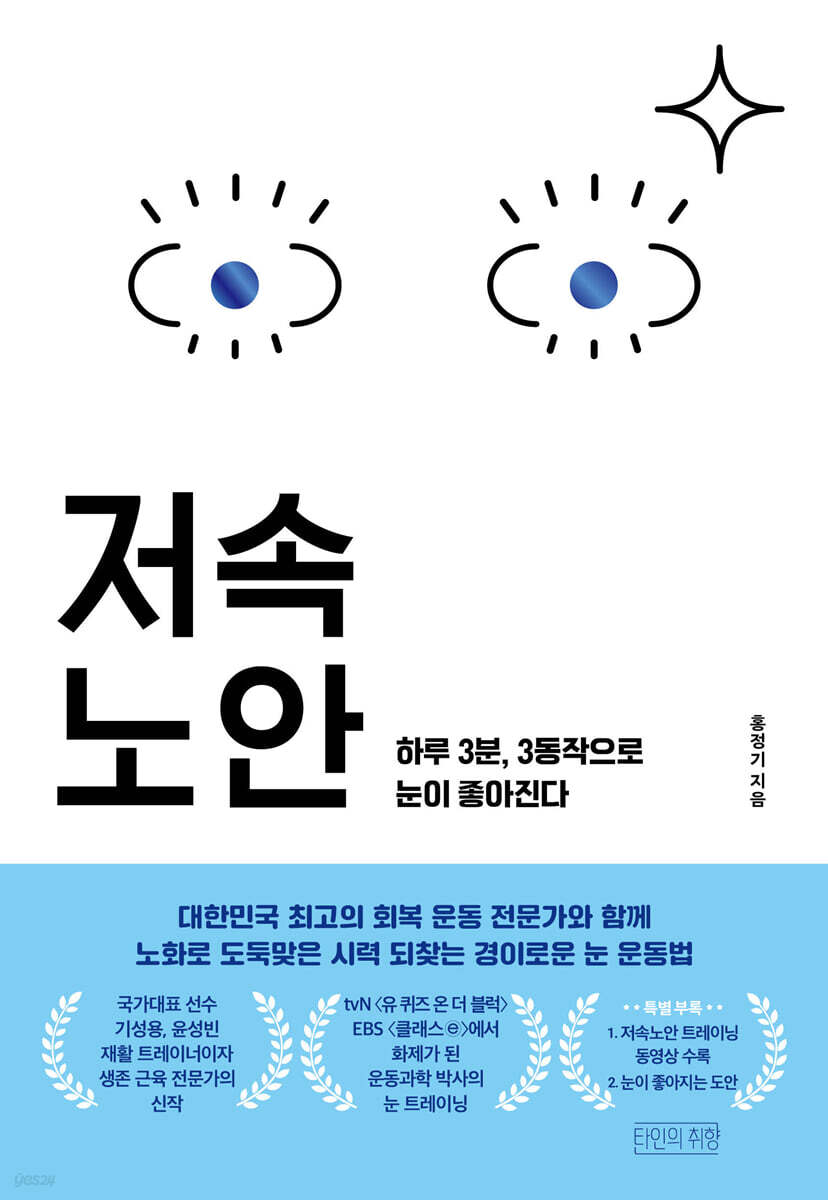
slow presbyopia
 |
Description
Book Introduction
With Korea's top recovery exercise experts
Amazing Eye Exercises to Restore Vision Stolen by Age
“Blurry eyes due to presbyopia will definitely improve if you follow these steps for just 3 minutes a day!”
Miracle Eye Training: 3 Minutes, 3 Movements a Day
“I am embarrassed by the presbyopia that suddenly appeared in my 40s.
The phone that was right in front of my eyes is getting further and further away, and now I have to lower it down to my waist to see the letters, and my heart sinks.
They say we live to be a hundred years old, but how can I survive the rest of my life with these eyes?”
"I'm still in my 30s, but why is the text on my computer shaky and hard to read? And before I know it, my neck is increasingly reaching for my laptop.
As I got older, my posture deteriorated, including forward head posture, rounded shoulders, and a hunched back.
“This is a total mess. Can’t we turn it around with young eyes?”
Presbyopia was thought to be a symptom of aging exclusive to the elderly, but people in their 20s and 30s, as well as those in their 40s, suffer from presbyopia.
Presbyopia, why does it appear so quickly? It's because we're constantly overworked every day.
We carry our smartphones with us on our way to work, on our way home from work, and even right before we go to bed.
If you are an office worker, you have to work on a monitor all day.
Anyone who enjoys playing games will stare at the monitor without even looking away.
Of course, the biggest cause of presbyopia is aging, but the rapid increase in digital device use that involves staring at a single point for long periods of time is causing our eyes to age much faster than previous generations.
Professor Hong Jeong-gi, Korea's leading expert in recovery exercises, points to the 'eye muscles' not functioning properly as the cause of presbyopia.
The eyes are made up of six very delicate muscles that hold the outer surface of the eyeball tightly, and as we age, the muscles atrophy and lose strength, and so do the eye muscles.
Also, when the contractile function of the ciliary muscle (accommodative muscle) inside the eye decreases due to staring at one place, the ability to focus decreases, resulting in presbyopia symptoms.
So, can't deteriorating eyesight be restored? Professor Hong Jeong-gi, a doctor of sports science and mentor to former national team players Ki Sung-yong and Yun Song-bin, asserts, "Aging cannot be prevented, but the rate of presbyopia can be significantly slowed."
Presbyopia, which causes slow focusing, dullness, dryness, and poor vision, can be restored to youthful eyes through eye exercises.
Let's take just three minutes a day and try the eye exercises suggested by Professor Hong Jeong-gi.
Although it lasts a short time, the effect is surprisingly powerful.
This book contains 35 eye stretches and training movements that anyone can follow to see results.
In addition, it contains 16 detailed recovery exercises to correct the turtle neck, dried shoulders, and hunched back caused by presbyopia.
If you want to see the world with clear and vivid eyes, pay attention to this book.
A must-read for health that will help you create eyes that look 10 years younger.
Amazing Eye Exercises to Restore Vision Stolen by Age
“Blurry eyes due to presbyopia will definitely improve if you follow these steps for just 3 minutes a day!”
Miracle Eye Training: 3 Minutes, 3 Movements a Day
“I am embarrassed by the presbyopia that suddenly appeared in my 40s.
The phone that was right in front of my eyes is getting further and further away, and now I have to lower it down to my waist to see the letters, and my heart sinks.
They say we live to be a hundred years old, but how can I survive the rest of my life with these eyes?”
"I'm still in my 30s, but why is the text on my computer shaky and hard to read? And before I know it, my neck is increasingly reaching for my laptop.
As I got older, my posture deteriorated, including forward head posture, rounded shoulders, and a hunched back.
“This is a total mess. Can’t we turn it around with young eyes?”
Presbyopia was thought to be a symptom of aging exclusive to the elderly, but people in their 20s and 30s, as well as those in their 40s, suffer from presbyopia.
Presbyopia, why does it appear so quickly? It's because we're constantly overworked every day.
We carry our smartphones with us on our way to work, on our way home from work, and even right before we go to bed.
If you are an office worker, you have to work on a monitor all day.
Anyone who enjoys playing games will stare at the monitor without even looking away.
Of course, the biggest cause of presbyopia is aging, but the rapid increase in digital device use that involves staring at a single point for long periods of time is causing our eyes to age much faster than previous generations.
Professor Hong Jeong-gi, Korea's leading expert in recovery exercises, points to the 'eye muscles' not functioning properly as the cause of presbyopia.
The eyes are made up of six very delicate muscles that hold the outer surface of the eyeball tightly, and as we age, the muscles atrophy and lose strength, and so do the eye muscles.
Also, when the contractile function of the ciliary muscle (accommodative muscle) inside the eye decreases due to staring at one place, the ability to focus decreases, resulting in presbyopia symptoms.
So, can't deteriorating eyesight be restored? Professor Hong Jeong-gi, a doctor of sports science and mentor to former national team players Ki Sung-yong and Yun Song-bin, asserts, "Aging cannot be prevented, but the rate of presbyopia can be significantly slowed."
Presbyopia, which causes slow focusing, dullness, dryness, and poor vision, can be restored to youthful eyes through eye exercises.
Let's take just three minutes a day and try the eye exercises suggested by Professor Hong Jeong-gi.
Although it lasts a short time, the effect is surprisingly powerful.
This book contains 35 eye stretches and training movements that anyone can follow to see results.
In addition, it contains 16 detailed recovery exercises to correct the turtle neck, dried shoulders, and hunched back caused by presbyopia.
If you want to see the world with clear and vivid eyes, pay attention to this book.
A must-read for health that will help you create eyes that look 10 years younger.
- You can preview some of the book's contents.
Preview
index
Prologue_ The Secret Routine of People Who Manage Even the Speed of Eye Aging
PART 1
Your eyes are aging quickly
The eyes work tirelessly for more than 16 hours a day.
Presbyopia, which will plague the second half of life, has arrived.
SPECIAL PAGE_Presbyopia Self-Diagnosis Checklist: Do You Have Presbyopia?
In the age of young presbyopia, even those in their 20s and 30s cannot avoid presbyopia.
After the age of 60, there is an emergency for farsightedness and cataracts.
The eyes are muscles, too! When these muscles lose strength, presbyopia sets in.
PLUS INFO_ Structure of the eye/ Contraction and relaxation of the accommodative muscles/ Structure of the eye muscles/ Extraocular muscles and their main functions
Prevent eye fatigue that threatens the brain
PLUS INFO_ The structure of the optic nerve/visual pathway connecting the eye and the brain
Training your eye muscles can restore your vision.
Just 3 minutes a day, 3 movements, and your eyes will improve.
PART 2
If your eyesight gets worse, your posture will also deteriorate.
Are you saying that your body aches because of your eyes?
When vision becomes blurred, movements become unsteady.
If your eyesight gets worse, the next thing you'll notice is turtle neck.
If your head is tilted to one side, it's because of your eyes.
As you get older, your ability to concentrate also declines.
Presbyopia can even cause dyslexia
Blurred vision increases the risk of falls.
PART 3
Daily eye care tips to keep your eyes looking younger day by day
The eyes react to habits before age.
What you eat becomes your eyesight
A clear, snowy day perfect for commuting to work
Tea and drinks that open up dull, heavy eyes
A nutritious meal that's refreshing to the eyes for the weekend table
The wrong foods threaten your eyes
If you want to give your eyes a real rest, try a hot compress
Various methods to correct vision
Taking care of your mind is taking care of your eyes.
PART 4
It's amazingly clear and sharp!
Eye Stretching
3-3 Eye Stretching Program for Your Eyes
Nerve stabilization and relaxation program│Concentration recovery program│Near-distance fatigue relief program
Visual Alignment Program | Eye Tracking Improvement Program | Movement Recovery Program
A solid supporter of eye stretching: the visual training chart.
[Stretching 01] Indirect eye pressure
[Stretching 02] Applying direct pressure to the eyes
[Stretching 03] Close your eyes and gently roll your pupils.
[Stretching 04] Blinking quickly
[Stretching 05] Looking up and down
[Stretching 06] Left and right views
[Stretching 07] Moving your eyes diagonally
[Stretch 08] Rolling your eyes in a circular motion
[Stretching 09] Following a radial line
Stretch 10: Follow the Zigzag Line
[Stretch 11] Follow the Spiral
[Stretching 12] Drawing Shapes with Your Eyes
[Stretching 13] Drawing a figure 8
[Stretch 14] Follow the Dots
[Stretch 15] Follow the broken line
[Stretch 16] Follow the four arrows
PART 5
Just follow along for 3 minutes a day and you'll get better in no time!
Eye training
The 3-3 Eye Training Program Your Eyes Need
Eye Muscle Strengthening and Coordination Program│Focus Control and Gaze Concentration Program
Advanced Coordination and Visual-Motor Integration Program│Balance Enhancement Program (Fall Prevention Exercise 1)
Focusing on Movement (Fall Prevention Exercise 2)│Visual Integration and Fusion Control Program
The perfect partner for slow-moving presbyopia exercises: the visual bong
CHAPTER 1: Static Training to Awaken Your Eyes
[Training 01] Thumb Tracking with Spread Arms
[Training 02] Focusing Your Eyes in 8 Directions
[Training 03] Following the Circular Line
[Training 04] Following the spiral line of sight
[Training 05] Focusing at Near and Far Distances 1
[Training 06] Focusing at Near and Far Distances 2
[Training 07] Focusing while pulling the visual stick
[Training 08] Moving your gaze to both visual poles
[Training 09] Shifting Your Eyes Using Brock Strings
[Training 10] Focusing with Barrel Cards
CHAPTER 2: Dynamic Training that Trains the Body and Eyes Simultaneously
[Training 11] Walking in a straight line while looking straight ahead
[Training 12] Walking with your heels raised and your gaze fixed
[Training 13] Moving your head while keeping your gaze fixed
[Training 14] Standing on one foot and moving your head up, down, left, and right
[Training 15] Keeping your gaze fixed while moving your waist
[Training 16] Stepping with your eyes fixed
[Training 17] Throwing and catching the ball
[Training 18] Catching a Falling Ball While Squatting 1
[Training 19] Catching a Falling Ball While Squatting 2
SPECIAL PAGE_ Fall Prevention Exercises: Building a Body and Eyes Free from Fall Anxiety
PART 6
It delays presbyopia and even corrects posture.
Exercises for each body part
CHAPTER 1 Neck Exercises to Restore a C-Shaped Back from a Turtle Neck
The key to neck exercises that slow down presbyopia is alignment and relaxation.
[Neck Exercise 01] Chin Pulling Using a Towel
[Neck Exercise 02] Hold a towel and move your neck in various directions.
[Neck Exercise 03] Stretching the Front and Side Muscles of the Neck
[Neck Exercise 04] Lying Neck Stretch
[Neck Exercise 05] Lying on your side and lifting your head
CHAPTER 2 Shoulder and Arm Exercises to Stretch Shoulders
Smooth shoulder and arm movements stabilize the gaze.
[Shoulder/Arm Exercise 01] Shoulder Rotation
[Shoulder/Arm Exercise 02] Shrugging Shoulders
[Shoulder/Arm Exercise 03] Pushing your palms forward and sideways
[Shoulder/Arm Exercise 04] Draw a circle by making a Y shape with both arms.
[Shoulder/Arm Exercise 05] Pushing your clasped hands back and bending your upper body
[Shoulder/Arm Exercise 06] Raise both arms while holding a towel
CHAPTER 3 Spinal Exercises to Straighten a Hunched Back
Straightening your hunched back improves the flow of visual information.
[Spine Exercise 01] Stretching your arms and stretching your sides
[Spine Exercise 02] Sitting Spinal Curl and Stretch
[Spine Exercise 03] Sitting, Rotating Your Torso and Stretching Your Sides
[Spine Exercise 04] Sitting and Rotating the Torso
[Spine Exercise 05] Drawing a figure 8 with a ball
Appendix_ Weapons that turn back the eye's aging clock
Appendix 1_3-3 Eye Stretching Program at a Glance
Appendix 2_3-3 Eye Training Program at a Glance
Appendix 3_Go directly to the low-speed presbyopia training video presented by Professor Hong Jeong-gi.
Appendix 4_Basic Vision Test Chart
Appendix 5_Near Vision Chart for Presbyopia
Appendix 6_Reading Vision Checklist
Appendix 7_Design for Better Eyes (Barrel Card)
PART 1
Your eyes are aging quickly
The eyes work tirelessly for more than 16 hours a day.
Presbyopia, which will plague the second half of life, has arrived.
SPECIAL PAGE_Presbyopia Self-Diagnosis Checklist: Do You Have Presbyopia?
In the age of young presbyopia, even those in their 20s and 30s cannot avoid presbyopia.
After the age of 60, there is an emergency for farsightedness and cataracts.
The eyes are muscles, too! When these muscles lose strength, presbyopia sets in.
PLUS INFO_ Structure of the eye/ Contraction and relaxation of the accommodative muscles/ Structure of the eye muscles/ Extraocular muscles and their main functions
Prevent eye fatigue that threatens the brain
PLUS INFO_ The structure of the optic nerve/visual pathway connecting the eye and the brain
Training your eye muscles can restore your vision.
Just 3 minutes a day, 3 movements, and your eyes will improve.
PART 2
If your eyesight gets worse, your posture will also deteriorate.
Are you saying that your body aches because of your eyes?
When vision becomes blurred, movements become unsteady.
If your eyesight gets worse, the next thing you'll notice is turtle neck.
If your head is tilted to one side, it's because of your eyes.
As you get older, your ability to concentrate also declines.
Presbyopia can even cause dyslexia
Blurred vision increases the risk of falls.
PART 3
Daily eye care tips to keep your eyes looking younger day by day
The eyes react to habits before age.
What you eat becomes your eyesight
A clear, snowy day perfect for commuting to work
Tea and drinks that open up dull, heavy eyes
A nutritious meal that's refreshing to the eyes for the weekend table
The wrong foods threaten your eyes
If you want to give your eyes a real rest, try a hot compress
Various methods to correct vision
Taking care of your mind is taking care of your eyes.
PART 4
It's amazingly clear and sharp!
Eye Stretching
3-3 Eye Stretching Program for Your Eyes
Nerve stabilization and relaxation program│Concentration recovery program│Near-distance fatigue relief program
Visual Alignment Program | Eye Tracking Improvement Program | Movement Recovery Program
A solid supporter of eye stretching: the visual training chart.
[Stretching 01] Indirect eye pressure
[Stretching 02] Applying direct pressure to the eyes
[Stretching 03] Close your eyes and gently roll your pupils.
[Stretching 04] Blinking quickly
[Stretching 05] Looking up and down
[Stretching 06] Left and right views
[Stretching 07] Moving your eyes diagonally
[Stretch 08] Rolling your eyes in a circular motion
[Stretching 09] Following a radial line
Stretch 10: Follow the Zigzag Line
[Stretch 11] Follow the Spiral
[Stretching 12] Drawing Shapes with Your Eyes
[Stretching 13] Drawing a figure 8
[Stretch 14] Follow the Dots
[Stretch 15] Follow the broken line
[Stretch 16] Follow the four arrows
PART 5
Just follow along for 3 minutes a day and you'll get better in no time!
Eye training
The 3-3 Eye Training Program Your Eyes Need
Eye Muscle Strengthening and Coordination Program│Focus Control and Gaze Concentration Program
Advanced Coordination and Visual-Motor Integration Program│Balance Enhancement Program (Fall Prevention Exercise 1)
Focusing on Movement (Fall Prevention Exercise 2)│Visual Integration and Fusion Control Program
The perfect partner for slow-moving presbyopia exercises: the visual bong
CHAPTER 1: Static Training to Awaken Your Eyes
[Training 01] Thumb Tracking with Spread Arms
[Training 02] Focusing Your Eyes in 8 Directions
[Training 03] Following the Circular Line
[Training 04] Following the spiral line of sight
[Training 05] Focusing at Near and Far Distances 1
[Training 06] Focusing at Near and Far Distances 2
[Training 07] Focusing while pulling the visual stick
[Training 08] Moving your gaze to both visual poles
[Training 09] Shifting Your Eyes Using Brock Strings
[Training 10] Focusing with Barrel Cards
CHAPTER 2: Dynamic Training that Trains the Body and Eyes Simultaneously
[Training 11] Walking in a straight line while looking straight ahead
[Training 12] Walking with your heels raised and your gaze fixed
[Training 13] Moving your head while keeping your gaze fixed
[Training 14] Standing on one foot and moving your head up, down, left, and right
[Training 15] Keeping your gaze fixed while moving your waist
[Training 16] Stepping with your eyes fixed
[Training 17] Throwing and catching the ball
[Training 18] Catching a Falling Ball While Squatting 1
[Training 19] Catching a Falling Ball While Squatting 2
SPECIAL PAGE_ Fall Prevention Exercises: Building a Body and Eyes Free from Fall Anxiety
PART 6
It delays presbyopia and even corrects posture.
Exercises for each body part
CHAPTER 1 Neck Exercises to Restore a C-Shaped Back from a Turtle Neck
The key to neck exercises that slow down presbyopia is alignment and relaxation.
[Neck Exercise 01] Chin Pulling Using a Towel
[Neck Exercise 02] Hold a towel and move your neck in various directions.
[Neck Exercise 03] Stretching the Front and Side Muscles of the Neck
[Neck Exercise 04] Lying Neck Stretch
[Neck Exercise 05] Lying on your side and lifting your head
CHAPTER 2 Shoulder and Arm Exercises to Stretch Shoulders
Smooth shoulder and arm movements stabilize the gaze.
[Shoulder/Arm Exercise 01] Shoulder Rotation
[Shoulder/Arm Exercise 02] Shrugging Shoulders
[Shoulder/Arm Exercise 03] Pushing your palms forward and sideways
[Shoulder/Arm Exercise 04] Draw a circle by making a Y shape with both arms.
[Shoulder/Arm Exercise 05] Pushing your clasped hands back and bending your upper body
[Shoulder/Arm Exercise 06] Raise both arms while holding a towel
CHAPTER 3 Spinal Exercises to Straighten a Hunched Back
Straightening your hunched back improves the flow of visual information.
[Spine Exercise 01] Stretching your arms and stretching your sides
[Spine Exercise 02] Sitting Spinal Curl and Stretch
[Spine Exercise 03] Sitting, Rotating Your Torso and Stretching Your Sides
[Spine Exercise 04] Sitting and Rotating the Torso
[Spine Exercise 05] Drawing a figure 8 with a ball
Appendix_ Weapons that turn back the eye's aging clock
Appendix 1_3-3 Eye Stretching Program at a Glance
Appendix 2_3-3 Eye Training Program at a Glance
Appendix 3_Go directly to the low-speed presbyopia training video presented by Professor Hong Jeong-gi.
Appendix 4_Basic Vision Test Chart
Appendix 5_Near Vision Chart for Presbyopia
Appendix 6_Reading Vision Checklist
Appendix 7_Design for Better Eyes (Barrel Card)
Detailed image

Publisher's Review
Dedicated recovery coach and survival muscle expert for South Korean national team members Ki Sung-yong and Yun Sung-bin
Professor Hong Jeong-gi reveals the secrets of slow presbyopia.
“Presbyopia can’t be avoided, but it can be delayed!”
Everything you need to know about the basic structure of the eye and vision
Eye stretching and training methods to delay presbyopia
The definitive guide to miraculous slow-wave presbyopia treatment, from Korea's leading recovery exercise authority.
Eyes age rapidly, regardless of age, based on habits.
This book contains specific exercises and practical strategies to address such changes in the eyes and aim for 'slow presbyopia'.
We discuss how to correct bad habits and bad posture, and provide gentle stimulation to stiff muscles and nerves to restore the rhythm of the eyes so that aging progresses slowly and as slowly as possible.
“Your eyes are aging quickly!”
Put the brakes on presbyopia in just 3 minutes a day
Includes step-by-step eye training methods to prevent presbyopia and restore vision.
The ciliary muscle, which is the eye's adjusting muscle, can easily become stiff if you continue to look at something close or focus on an object at the same distance for a long time.
Then, the ability to shift focus decreases and the clarity of vision also becomes blurred.
What is needed at this time is stretching and training to restore the eye muscles and nerves.
The eyes should not only be used for writing.
As it is a muscle, it must recover its rhythm of contraction and relaxation to be able to use it healthily for a long time.
Simple movements such as deliberately moving your eyes up, down, left, and right, or switching your focus between near and far, can help relax your muscles and help them regain the strength to contract again.
Let's follow along step by step, from eye stretching (eye mobility exercise), eye training (eye nerve activation exercise), to visual tracking exercise.
You will be greeted with amazingly clear eyes.
If you just move your eyes for 3 minutes a day, your eyes will definitely get better!
Miracle Slow Presbyopia Program, 33 Trainings
Exercises should be short and precise.
Above all, you can expect results only if you can do it consistently.
You should be able to repeat it without any burden in your daily life.
You need a routine you can practice anytime, anywhere: during a quick break, at your desk, on public transportation, or right when you put your smartphone down.
《Slow Presbyopia》 is based on the 3-3 program.
Adhering to the principle that 'exercise without overdoing it' is the key to eye health, we designed a simple and structured routine that is both realistic and scientific that anyone can follow.
The method is simple.
You only need to invest 3 minutes a day, 3 movements at a time.
This short routine gently relaxes your eyes and creates a rhythm that can be easily incorporated into your daily routine.
The most important thing is consistency.
It is the habit of repeating short, simple movements regularly every day that makes a real difference in slowing down presbyopia.
Restores vision and prevents eye aging!
Daily solutions to improve your eyesight
Eye health isn't determined solely by age.
Daily living conditions, including usage, environment, eating habits, psychological stress, and recovery routines, determine the speed at which your eyes age.
Here, Professor Hong Jeong-gi, Korea's leading authority on recovery exercises, introduces a slow-acting presbyopia practice method that slows down the aging process of the eyes.
Provides various tips to protect your eyesight and delay presbyopia in your daily life.
It provides information on eating and living habits that can help prevent presbyopia, mindfulness, and detox methods for children, as well as small and easy daily tips to change bad lifestyle habits.
Includes a self-eye test chart and a cut-out design to improve your eyesight.
We have included three eye test charts and a cut-out design to help you check your improved eyesight through eye training.
It contains the 'Basic Vision Test Chart', which is the Snellen Chart, the most widely used vision test tool in the world, the 'Near Vision Test Chart' for checking presbyopia, and the 'Reading Vision Check Chart' for checking reading vision.
It also includes 'Barrel Cards', which are eye-improving designs that can be cut out and used without opening the book, so you can exercise your eyes anytime, anywhere.
The Barrel Card is a behavioral visual training tool based on Dr. Frederick Brock's convergence and fusion training theory, and has been put into clinical practice by American visual training experts.
Professor Hong Jeong-gi reveals the secrets of slow presbyopia.
“Presbyopia can’t be avoided, but it can be delayed!”
Everything you need to know about the basic structure of the eye and vision
Eye stretching and training methods to delay presbyopia
The definitive guide to miraculous slow-wave presbyopia treatment, from Korea's leading recovery exercise authority.
Eyes age rapidly, regardless of age, based on habits.
This book contains specific exercises and practical strategies to address such changes in the eyes and aim for 'slow presbyopia'.
We discuss how to correct bad habits and bad posture, and provide gentle stimulation to stiff muscles and nerves to restore the rhythm of the eyes so that aging progresses slowly and as slowly as possible.
“Your eyes are aging quickly!”
Put the brakes on presbyopia in just 3 minutes a day
Includes step-by-step eye training methods to prevent presbyopia and restore vision.
The ciliary muscle, which is the eye's adjusting muscle, can easily become stiff if you continue to look at something close or focus on an object at the same distance for a long time.
Then, the ability to shift focus decreases and the clarity of vision also becomes blurred.
What is needed at this time is stretching and training to restore the eye muscles and nerves.
The eyes should not only be used for writing.
As it is a muscle, it must recover its rhythm of contraction and relaxation to be able to use it healthily for a long time.
Simple movements such as deliberately moving your eyes up, down, left, and right, or switching your focus between near and far, can help relax your muscles and help them regain the strength to contract again.
Let's follow along step by step, from eye stretching (eye mobility exercise), eye training (eye nerve activation exercise), to visual tracking exercise.
You will be greeted with amazingly clear eyes.
If you just move your eyes for 3 minutes a day, your eyes will definitely get better!
Miracle Slow Presbyopia Program, 33 Trainings
Exercises should be short and precise.
Above all, you can expect results only if you can do it consistently.
You should be able to repeat it without any burden in your daily life.
You need a routine you can practice anytime, anywhere: during a quick break, at your desk, on public transportation, or right when you put your smartphone down.
《Slow Presbyopia》 is based on the 3-3 program.
Adhering to the principle that 'exercise without overdoing it' is the key to eye health, we designed a simple and structured routine that is both realistic and scientific that anyone can follow.
The method is simple.
You only need to invest 3 minutes a day, 3 movements at a time.
This short routine gently relaxes your eyes and creates a rhythm that can be easily incorporated into your daily routine.
The most important thing is consistency.
It is the habit of repeating short, simple movements regularly every day that makes a real difference in slowing down presbyopia.
Restores vision and prevents eye aging!
Daily solutions to improve your eyesight
Eye health isn't determined solely by age.
Daily living conditions, including usage, environment, eating habits, psychological stress, and recovery routines, determine the speed at which your eyes age.
Here, Professor Hong Jeong-gi, Korea's leading authority on recovery exercises, introduces a slow-acting presbyopia practice method that slows down the aging process of the eyes.
Provides various tips to protect your eyesight and delay presbyopia in your daily life.
It provides information on eating and living habits that can help prevent presbyopia, mindfulness, and detox methods for children, as well as small and easy daily tips to change bad lifestyle habits.
Includes a self-eye test chart and a cut-out design to improve your eyesight.
We have included three eye test charts and a cut-out design to help you check your improved eyesight through eye training.
It contains the 'Basic Vision Test Chart', which is the Snellen Chart, the most widely used vision test tool in the world, the 'Near Vision Test Chart' for checking presbyopia, and the 'Reading Vision Check Chart' for checking reading vision.
It also includes 'Barrel Cards', which are eye-improving designs that can be cut out and used without opening the book, so you can exercise your eyes anytime, anywhere.
The Barrel Card is a behavioral visual training tool based on Dr. Frederick Brock's convergence and fusion training theory, and has been put into clinical practice by American visual training experts.
GOODS SPECIFICS
- Date of issue: July 28, 2025
- Page count, weight, size: 240 pages | 394g | 145*210*15mm
- ISBN13: 9791199359314
- ISBN10: 1199359319
You may also like
카테고리
korean


korean

![GQ KOREA Mark (Monthly): December [2025]](http://librairie.coreenne.fr/cdn/shop/files/8ef265dbbfbf186523ed75ba7319009d.jpg?v=1765340328&width=3840)


