

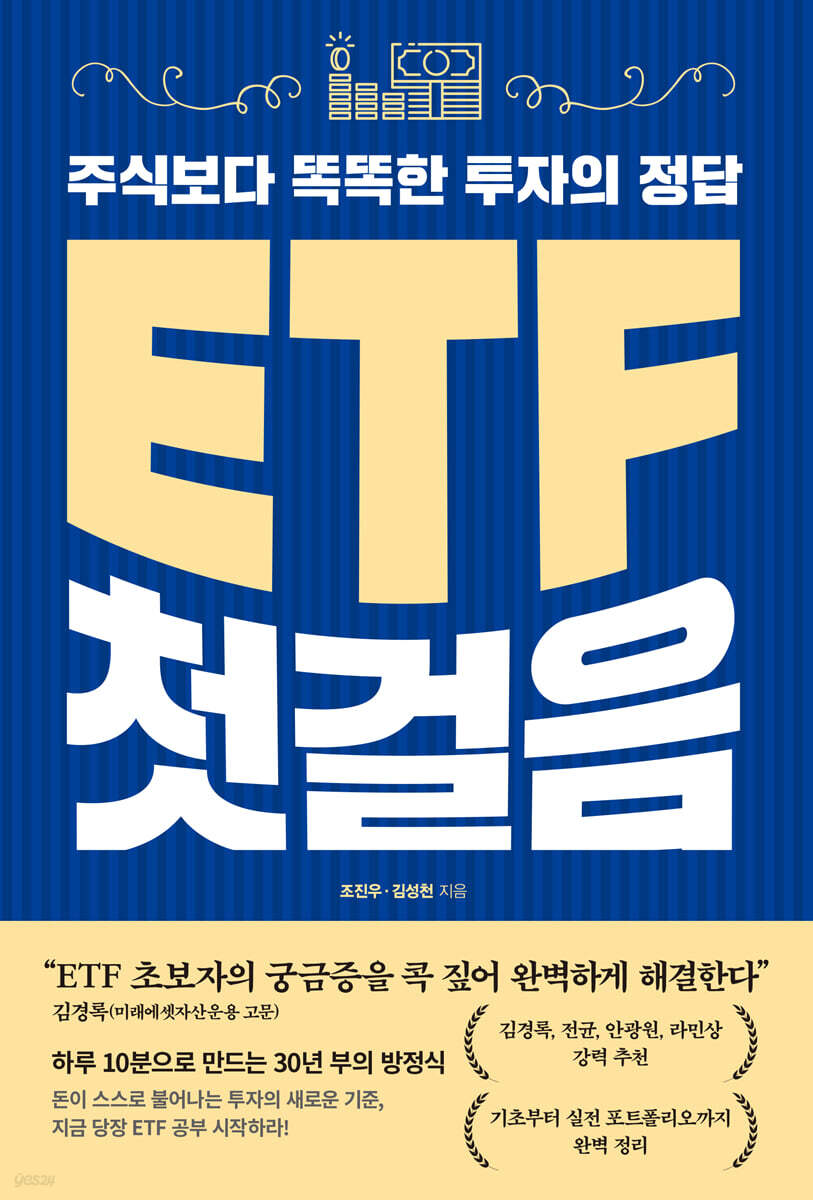
First Steps to ETFs
 |
Description
Book Introduction
The answer to investing smarter than stocks
Get on the magic wheel called ETF!
The influence of ETFs (exchange-traded funds) is rapidly increasing in domestic and international stock markets.
As of September 2025, the domestic ETF market size reached 240 trillion won, and its growth is expected to accelerate further. ETFs have already established themselves as a representative investment vehicle, easily accessible to individual investors.
It is a trend that goes beyond the realm of simple investment and becomes a reliable companion in one's life cycle, including making money, preparing for retirement, and educating children.
However, despite the market's rapid growth, there is still a lack of practical guidance for investors to properly understand the structure and use of ETFs.
To fill this gap, "First Steps in ETFs," written by experts with experience at the Korea Exchange and the forefront of the securities industry, has been published.
This book can be called a "textbook for ETF investment" that helps both beginner and expert investors properly understand and utilize ETFs.
ETFs have expanded beyond simply tracking a specific index to encompass a wide range of areas, including commodities, bonds, foreign stocks, and thematic investments.
Reflecting these changes, "First Steps to ETFs" presents a method for implementing the essence of investment—asset allocation and global diversification—with the efficient tool of ETFs.
This book will serve as a "first guide to ETFs" for readers with little financial investment experience, and as a "practical reference book that broadens strategy and perspective" for experienced investors.
Get on the magic wheel called ETF!
The influence of ETFs (exchange-traded funds) is rapidly increasing in domestic and international stock markets.
As of September 2025, the domestic ETF market size reached 240 trillion won, and its growth is expected to accelerate further. ETFs have already established themselves as a representative investment vehicle, easily accessible to individual investors.
It is a trend that goes beyond the realm of simple investment and becomes a reliable companion in one's life cycle, including making money, preparing for retirement, and educating children.
However, despite the market's rapid growth, there is still a lack of practical guidance for investors to properly understand the structure and use of ETFs.
To fill this gap, "First Steps in ETFs," written by experts with experience at the Korea Exchange and the forefront of the securities industry, has been published.
This book can be called a "textbook for ETF investment" that helps both beginner and expert investors properly understand and utilize ETFs.
ETFs have expanded beyond simply tracking a specific index to encompass a wide range of areas, including commodities, bonds, foreign stocks, and thematic investments.
Reflecting these changes, "First Steps to ETFs" presents a method for implementing the essence of investment—asset allocation and global diversification—with the efficient tool of ETFs.
This book will serve as a "first guide to ETFs" for readers with little financial investment experience, and as a "practical reference book that broadens strategy and perspective" for experienced investors.
- You can preview some of the book's contents.
Preview
index
Prologue?_ Get on the magic wheel called ETF
Part 1: What You Need to Know to Invest Properly in ETFs
Chapter 1: Establishing the Basics of ETF Investment
01 Why ETFs?
02 Understand ETFs in 5 minutes
03 Complete ETF Analysis in 5 Minutes
04 Basic Information You Must Know When Trading ETFs
Chapter 2: Building Practical Knowledge on ETF Investment
05 Understanding ETF Management
06 Understanding ETF Taxes
07 Understanding the Pros and Cons of ETFs
Part 2: 47 Profitable ETF Investment Strategies for Beginners
Chapter 1: ETF Investment Method [Basics]
01 Representative index ETFs that even beginners can easily invest in
02 Bond investment is solved with bond ETFs
03 Dividend ETFs that pay out consistently, rain or shine
04 Finally, I'm a Building Owner, REIT ETF
05 Parking-type ETFs for temporarily depositing spare money
Chapter 2: ETF Investment Methods [Advanced]
06 Thematic ETFs that follow trends
07 Active ETFs Aiming for Excess Returns
08 Covered Call ETFs, a favorite among wealthy Gangnam residents
09 Double the Return, Leveraged and Gopbus ETFs
10 Policy ETFs Riding on the Government's Shoulders
Gold ETFs instead of 11-stone rings
Chapter 3: Investing in Domestically Listed Overseas ETFs [Basics]
12 Synthetic ETFs Different from Physical ETFs
13 S&P 500, representing the U.S. stock market
14 US technology-focused large-cap Nasdaq 100
15 Nikkei ETFs that invest in leading Japanese companies
Nifty 50 invests in 16 leading Indian companies
17 China and Hong Kong ETFs Investing in the Future of the World's Second-Largest Economy
Chapter 4: Investing in Domestically Listed Overseas ETFs [Advanced]
18 ETFs that focus solely on big tech
19 Korean version of SCHD, Midang ETF
20 Chanel and Hermes at a low price, luxury ETFs
21 The Original Covered Call ETF in the US
22 ETFs Investing in Celestial Infrastructure
23 If you're worried about global warming, consider a carbon emissions ETF.
Chapter 5: Direct Investment in Overseas ETFs
24 Preparing for Overseas Direct Purchase Investment
25 Perennial Bestsellers VOO, SPY, IVV
26 Nasdaq Leveraged TQQQ, SQQQ, Loved by Western Ants
27 TLT and TMF invest in the direction of U.S. Treasury yields
28 VIX Betting on Volatility
29 Interesting and Unique ETFs Found Only in the US
30 Ways to Invest in a Variety of Commodities, From Crude Oil to Agricultural Products
How to Invest in Bitcoin with 31 ETFs
Chapter 6: Customized Investment Methods Based on Your Personality
32 Market-Representative Index ETFs for Long-Term Investors
33 Leverage and Gobus Investment Methods for Short-Term Investors
34 How to optimize your portfolio?
Chapter 7: Investment Methods Based on Timing
35 Is the current economic cycle in a downturn?
Short-term and long-term interest rates according to 36 games
37 ETF Investment Methods that Take Advantage of International Situations
Jump on the 38 Megatrends
39 Do you also invest in ETFs by looking at charts?
40 Turtle-type savings investment without timing
Chapter 8 Tax-saving account investment method
41 Pensions will set you free.
42 Essential Tax-Saving Accounts for ETF Management: Pension Savings, IRP, and ISA
43 How to Increase the Risky Asset Allocation in Your Retirement Account
44 TDF, a self-driving investment method that automatically invests for you
Chapter 9: ETF Investing Roadmap for Financial Freedom
45 Everything is determined by asset allocation.
46 Life-Changing ETF Lifetime Asset Management
47 Making a Silver Spoon for Minor Children
Epilogue?_ A solid guide to long-term investment performance
Part 1: What You Need to Know to Invest Properly in ETFs
Chapter 1: Establishing the Basics of ETF Investment
01 Why ETFs?
02 Understand ETFs in 5 minutes
03 Complete ETF Analysis in 5 Minutes
04 Basic Information You Must Know When Trading ETFs
Chapter 2: Building Practical Knowledge on ETF Investment
05 Understanding ETF Management
06 Understanding ETF Taxes
07 Understanding the Pros and Cons of ETFs
Part 2: 47 Profitable ETF Investment Strategies for Beginners
Chapter 1: ETF Investment Method [Basics]
01 Representative index ETFs that even beginners can easily invest in
02 Bond investment is solved with bond ETFs
03 Dividend ETFs that pay out consistently, rain or shine
04 Finally, I'm a Building Owner, REIT ETF
05 Parking-type ETFs for temporarily depositing spare money
Chapter 2: ETF Investment Methods [Advanced]
06 Thematic ETFs that follow trends
07 Active ETFs Aiming for Excess Returns
08 Covered Call ETFs, a favorite among wealthy Gangnam residents
09 Double the Return, Leveraged and Gopbus ETFs
10 Policy ETFs Riding on the Government's Shoulders
Gold ETFs instead of 11-stone rings
Chapter 3: Investing in Domestically Listed Overseas ETFs [Basics]
12 Synthetic ETFs Different from Physical ETFs
13 S&P 500, representing the U.S. stock market
14 US technology-focused large-cap Nasdaq 100
15 Nikkei ETFs that invest in leading Japanese companies
Nifty 50 invests in 16 leading Indian companies
17 China and Hong Kong ETFs Investing in the Future of the World's Second-Largest Economy
Chapter 4: Investing in Domestically Listed Overseas ETFs [Advanced]
18 ETFs that focus solely on big tech
19 Korean version of SCHD, Midang ETF
20 Chanel and Hermes at a low price, luxury ETFs
21 The Original Covered Call ETF in the US
22 ETFs Investing in Celestial Infrastructure
23 If you're worried about global warming, consider a carbon emissions ETF.
Chapter 5: Direct Investment in Overseas ETFs
24 Preparing for Overseas Direct Purchase Investment
25 Perennial Bestsellers VOO, SPY, IVV
26 Nasdaq Leveraged TQQQ, SQQQ, Loved by Western Ants
27 TLT and TMF invest in the direction of U.S. Treasury yields
28 VIX Betting on Volatility
29 Interesting and Unique ETFs Found Only in the US
30 Ways to Invest in a Variety of Commodities, From Crude Oil to Agricultural Products
How to Invest in Bitcoin with 31 ETFs
Chapter 6: Customized Investment Methods Based on Your Personality
32 Market-Representative Index ETFs for Long-Term Investors
33 Leverage and Gobus Investment Methods for Short-Term Investors
34 How to optimize your portfolio?
Chapter 7: Investment Methods Based on Timing
35 Is the current economic cycle in a downturn?
Short-term and long-term interest rates according to 36 games
37 ETF Investment Methods that Take Advantage of International Situations
Jump on the 38 Megatrends
39 Do you also invest in ETFs by looking at charts?
40 Turtle-type savings investment without timing
Chapter 8 Tax-saving account investment method
41 Pensions will set you free.
42 Essential Tax-Saving Accounts for ETF Management: Pension Savings, IRP, and ISA
43 How to Increase the Risky Asset Allocation in Your Retirement Account
44 TDF, a self-driving investment method that automatically invests for you
Chapter 9: ETF Investing Roadmap for Financial Freedom
45 Everything is determined by asset allocation.
46 Life-Changing ETF Lifetime Asset Management
47 Making a Silver Spoon for Minor Children
Epilogue?_ A solid guide to long-term investment performance
Detailed image

Into the book
As of the end of June 2025, the global ETF market size was $17 trillion, an increase of $2 trillion in just half a year compared to the end of 2024.
The U.S. market is worth $12 trillion, over 70% of the global market, and the size of passive ETFs exceeds 90%.
Few mega-funds have outperformed the S&P 500, the largest index in the U.S. market, over the long term.
Among the newly listed ETFs, the active portion is high at a ratio of 3:7. However, as the passive market has matured and competition has become fierce, this should be understood as a natural market movement to seek out new markets.
--- From "Part 1: Things You Must Know to Invest Properly in ETFs: Chapter 1: Building the Basics of ETF Investment"
Dividends received from an ETF are called distributions. They're called distributions because the asset management company distributes dividends from the various stocks held by the ETF to ETF investors.
The date on which investors receiving dividends are determined is called the "distribution payment date," which is the same as the date on which the company determines the shareholders to be included in the shareholder register.
Typically, stock ETFs are based on the last trading day of January, April, July, October, and December each year. Monthly dividend ETFs, which are gaining popularity, are based on the last trading day of each month. Since it takes two days for settlement to be completed after purchasing an ETF, to receive the dividend, you must purchase the ETF at least two days before the dividend payment date.
--- From "Part 1: Things You Must Know to Invest Properly in ETFs: Chapter 2: Building Practical Knowledge in ETF Investment"
The reason KOSPI 200 is important is because it serves as a benchmark for comparing performance across fund products.
When calculating loan interest, we calculate the interest rate by adding a surcharge based on the most credible indicator, such as the CD interest rate.
An indicator that is credible and widely used in the financial market is called a benchmark.
The KOSPI 200 stock index is the oldest index in the Korean stock market and is the basis for the futures and options market. It is called the market representative index and is the benchmark for the Korean stock market.
--- From "Part 2: 47 Profitable ETF Investment Methods for Beginners: Chapter 1: The Basics of ETF Investment"
Have you heard of active ETFs? Since their introduction in 2017, active ETFs have listed 262 stocks across various assets, including stocks and bonds, as of the end of June 2025.
It accounts for a large proportion, more than a quarter of all ETFs.
Simply put, an active ETF is a mutual fund managed by a fund manager that is listed on an exchange like an ETF.
While traditional funds require subscription through a securities firm or bank, active ETFs are much more convenient because they can be freely bought and sold on the stock market.
--- From "Part 2: 47 Profitable ETF Investment Methods for Beginners: Chapter 2: Director ETF Investment Method [In-Depth]"
The Dow 30 and S&P 500 are the indices representing the U.S. stock market, which are most invested in by investors referred to as "ants." The first calculation date for the Dow 30 was May 26, 1896, the year the modern Olympic Games were held in Greece.
The Dow Jones Industrial Average is so famous that it is often mentioned as a proper noun when talking about stock indices, as it has been around for over 100 years.
However, when talking about the representative index of the US market these days, the S&P 500 index is more representative.
--- From "Part 2: 47 Profitable ETF Investment Methods for Beginners: Chapter 3: Domestically Listed Overseas ETF Investment Method [Basics]"
Covered call ETFs are gaining popularity in the United States as they offer higher dividend yields than traditional high-dividend ETFs.
The secret to its popularity is that among the underlying index constituents, stocks with low volatility and high dividend payout ratios are selected and increased in weight, and the strike price is set higher than the current price by selling OTM options, so that some of the increase in the underlying asset can be reflected in the return, which has the effect of widening the range of upside restrictions, which is a weakness of covered calls.
--- From "Part 2: 47 Profitable ETF Investment Methods for Beginners: Chapter 4: Domestically Listed Overseas ETF Investment Method [In-Depth]"
There are various commodity-related ETF products listed on the Korean ETF market.
While the targets include familiar commodities like crude oil and gold, ETFs that invest in less familiar raw materials like soybeans, copper, and silver are also listed and traded.
Unlike securities such as equity securities (stocks) and debt securities (bonds), holding and managing physical raw materials incurs holding costs.
Holding costs include not only simple storage costs, but also insurance against theft and damage, electricity costs, and management personnel costs.
--- From "Part 2: 47 Profitable ETF Investment Methods for Beginners: Chapter 5: Direct Investment Methods for Overseas ETFs"
Have you heard of the "Tax-Savings Accounts Trio"? If you want to reduce taxes while investing in ETFs, it's important to utilize the so-called "Tax-Savings Account Trio": pension savings, IRPs, and ISAs.
These accounts offer various tax benefits and are advantageous for long-term investments.
The three major types of tax-saving accounts are broadly categorized into pension savings accounts, IRPs, and ISAs, which are not pension accounts.
--- From "Part 2: 47 ETF Investment Methods for Beginners to Make a Difference: Chapter 8: Tax-Saving Account Investment Method"
There is no one who has never experienced a loss while investing in stocks.
Even Warren Buffett, the world's greatest investor, has experienced the bitterness of loss.
But surprisingly, the national pension that we pay into every month is a bit different.
The National Pension Service's performance is truly legendary.
From 1988 to 2024, the National Pension Service achieved an average annual return of 6.82%, with only three years of negative returns during that period! The National Pension Service has weathered significant crises like the global financial crisis, the European debt crisis, and the COVID-19 pandemic, consistently generating profits without significant fluctuations.
How was this possible? The secret is asset allocation.
The U.S. market is worth $12 trillion, over 70% of the global market, and the size of passive ETFs exceeds 90%.
Few mega-funds have outperformed the S&P 500, the largest index in the U.S. market, over the long term.
Among the newly listed ETFs, the active portion is high at a ratio of 3:7. However, as the passive market has matured and competition has become fierce, this should be understood as a natural market movement to seek out new markets.
--- From "Part 1: Things You Must Know to Invest Properly in ETFs: Chapter 1: Building the Basics of ETF Investment"
Dividends received from an ETF are called distributions. They're called distributions because the asset management company distributes dividends from the various stocks held by the ETF to ETF investors.
The date on which investors receiving dividends are determined is called the "distribution payment date," which is the same as the date on which the company determines the shareholders to be included in the shareholder register.
Typically, stock ETFs are based on the last trading day of January, April, July, October, and December each year. Monthly dividend ETFs, which are gaining popularity, are based on the last trading day of each month. Since it takes two days for settlement to be completed after purchasing an ETF, to receive the dividend, you must purchase the ETF at least two days before the dividend payment date.
--- From "Part 1: Things You Must Know to Invest Properly in ETFs: Chapter 2: Building Practical Knowledge in ETF Investment"
The reason KOSPI 200 is important is because it serves as a benchmark for comparing performance across fund products.
When calculating loan interest, we calculate the interest rate by adding a surcharge based on the most credible indicator, such as the CD interest rate.
An indicator that is credible and widely used in the financial market is called a benchmark.
The KOSPI 200 stock index is the oldest index in the Korean stock market and is the basis for the futures and options market. It is called the market representative index and is the benchmark for the Korean stock market.
--- From "Part 2: 47 Profitable ETF Investment Methods for Beginners: Chapter 1: The Basics of ETF Investment"
Have you heard of active ETFs? Since their introduction in 2017, active ETFs have listed 262 stocks across various assets, including stocks and bonds, as of the end of June 2025.
It accounts for a large proportion, more than a quarter of all ETFs.
Simply put, an active ETF is a mutual fund managed by a fund manager that is listed on an exchange like an ETF.
While traditional funds require subscription through a securities firm or bank, active ETFs are much more convenient because they can be freely bought and sold on the stock market.
--- From "Part 2: 47 Profitable ETF Investment Methods for Beginners: Chapter 2: Director ETF Investment Method [In-Depth]"
The Dow 30 and S&P 500 are the indices representing the U.S. stock market, which are most invested in by investors referred to as "ants." The first calculation date for the Dow 30 was May 26, 1896, the year the modern Olympic Games were held in Greece.
The Dow Jones Industrial Average is so famous that it is often mentioned as a proper noun when talking about stock indices, as it has been around for over 100 years.
However, when talking about the representative index of the US market these days, the S&P 500 index is more representative.
--- From "Part 2: 47 Profitable ETF Investment Methods for Beginners: Chapter 3: Domestically Listed Overseas ETF Investment Method [Basics]"
Covered call ETFs are gaining popularity in the United States as they offer higher dividend yields than traditional high-dividend ETFs.
The secret to its popularity is that among the underlying index constituents, stocks with low volatility and high dividend payout ratios are selected and increased in weight, and the strike price is set higher than the current price by selling OTM options, so that some of the increase in the underlying asset can be reflected in the return, which has the effect of widening the range of upside restrictions, which is a weakness of covered calls.
--- From "Part 2: 47 Profitable ETF Investment Methods for Beginners: Chapter 4: Domestically Listed Overseas ETF Investment Method [In-Depth]"
There are various commodity-related ETF products listed on the Korean ETF market.
While the targets include familiar commodities like crude oil and gold, ETFs that invest in less familiar raw materials like soybeans, copper, and silver are also listed and traded.
Unlike securities such as equity securities (stocks) and debt securities (bonds), holding and managing physical raw materials incurs holding costs.
Holding costs include not only simple storage costs, but also insurance against theft and damage, electricity costs, and management personnel costs.
--- From "Part 2: 47 Profitable ETF Investment Methods for Beginners: Chapter 5: Direct Investment Methods for Overseas ETFs"
Have you heard of the "Tax-Savings Accounts Trio"? If you want to reduce taxes while investing in ETFs, it's important to utilize the so-called "Tax-Savings Account Trio": pension savings, IRPs, and ISAs.
These accounts offer various tax benefits and are advantageous for long-term investments.
The three major types of tax-saving accounts are broadly categorized into pension savings accounts, IRPs, and ISAs, which are not pension accounts.
--- From "Part 2: 47 ETF Investment Methods for Beginners to Make a Difference: Chapter 8: Tax-Saving Account Investment Method"
There is no one who has never experienced a loss while investing in stocks.
Even Warren Buffett, the world's greatest investor, has experienced the bitterness of loss.
But surprisingly, the national pension that we pay into every month is a bit different.
The National Pension Service's performance is truly legendary.
From 1988 to 2024, the National Pension Service achieved an average annual return of 6.82%, with only three years of negative returns during that period! The National Pension Service has weathered significant crises like the global financial crisis, the European debt crisis, and the COVID-19 pandemic, consistently generating profits without significant fluctuations.
How was this possible? The secret is asset allocation.
--- From "Part 2: 47 Profitable ETF Investment Methods for Beginners: Chapter 9: ETF Investment Roadmap for Financial Freedom"
Publisher's Review
The 30-Year Wealth Equation in 10 Minutes a Day
A new standard for investment where money grows on its own.
Start studying ETFs right now!
The domestic ETF market, which was worth 19 trillion won in October 2015, exceeded 240 trillion won in September 2025, just 10 years later.
Why did an ETF, once an unfamiliar name, become such a "trend among trends"?
The emergence of ETFs is like the invention of the wheel.
Just as the wheel fundamentally changed the way humans moved, ETFs have revolutionized the way we invest.
In the past, investors had to manually select individual stocks or pay high fees to subscribe to funds, making it impossible to escape the high-risk, high-cost structure. However, ETFs are different. ETFs can be bought and sold like stocks, but they also offer the same level of diversification as funds.
Moreover, it offers low costs, transparency, and convenience, making it an ideal asset management tool for long-term investors.
The new book, "First Steps in ETFs," is a comprehensive guide covering everything from the basic concepts of ETFs to global investment strategies, asset allocation, tax savings, and pension utilization.
It was designed to inform the basics of ETFs, an investment vehicle that is smarter than stocks, less burdensome than real estate, and much more powerful than deposits.
Authors with extensive experience at the Korea Exchange and at the forefront of the securities industry participated in the writing, resulting in a practical investment guide that applies not only to theory but also to the actual market.
Most investment books on the market focus on stock recommendations or complex, difficult strategies, making them difficult for novice investors to understand and even more difficult to implement.
Because of this, the most important basics, namely what ETFs are, why they are needed, and how to utilize them, have been neglected.
As the title suggests, "First Steps to ETFs" covers everything from the concept of ETFs to their growth process, representative domestic and international products, tax and pension investment strategies, and even age-specific investment methods from a lifetime asset management perspective, all tailored to readers encountering ETFs for the first time.
Even readers with no prior investment knowledge will gain confidence that ETFs alone can be sufficient for retirement planning and financial freedom.
For beginners starting now
47 Surefire Ways to Profit with ETFs!
《ETF First Steps》 is composed of two parts and 11 chapters.
Part 1 covers the basics of ETFs, including their concept, structure, differences from funds, and considerations for investment, helping you understand the fundamentals of ETFs.
Part 2 presents practical investment methods, including investment methods for US and overseas ETFs, how to utilize various products such as dividend, covered call, bond, and parked ETFs, investment timing through chart analysis, pension and tax strategies, asset allocation by life cycle, and a long-term investment roadmap for financial freedom.
In other words, it has a structure and content that covers the basics and practice, teaching the basic principles of ETFs to beginners and actual investment strategies and application methods to experienced users.
The hardest part of investing isn't choosing stocks, it's waiting.
The patience to endure the long term, to be unswayed by short-term fluctuations and to allow the magic of compound interest to work, is the quality of a true investor.
And ETFs are the best tool to make that waiting possible.
The era of complex and difficult investments has vanished with the advent of ETFs. Thanks to this magical tool, ETFs, the path to financial freedom has become much easier. Climbing onto the wheel of ETFs and steadily rolling it is the most realistic and safe path for the average investor to achieve long-term success.
Now it's your turn to take the first step.
A new standard for investment where money grows on its own.
Start studying ETFs right now!
The domestic ETF market, which was worth 19 trillion won in October 2015, exceeded 240 trillion won in September 2025, just 10 years later.
Why did an ETF, once an unfamiliar name, become such a "trend among trends"?
The emergence of ETFs is like the invention of the wheel.
Just as the wheel fundamentally changed the way humans moved, ETFs have revolutionized the way we invest.
In the past, investors had to manually select individual stocks or pay high fees to subscribe to funds, making it impossible to escape the high-risk, high-cost structure. However, ETFs are different. ETFs can be bought and sold like stocks, but they also offer the same level of diversification as funds.
Moreover, it offers low costs, transparency, and convenience, making it an ideal asset management tool for long-term investors.
The new book, "First Steps in ETFs," is a comprehensive guide covering everything from the basic concepts of ETFs to global investment strategies, asset allocation, tax savings, and pension utilization.
It was designed to inform the basics of ETFs, an investment vehicle that is smarter than stocks, less burdensome than real estate, and much more powerful than deposits.
Authors with extensive experience at the Korea Exchange and at the forefront of the securities industry participated in the writing, resulting in a practical investment guide that applies not only to theory but also to the actual market.
Most investment books on the market focus on stock recommendations or complex, difficult strategies, making them difficult for novice investors to understand and even more difficult to implement.
Because of this, the most important basics, namely what ETFs are, why they are needed, and how to utilize them, have been neglected.
As the title suggests, "First Steps to ETFs" covers everything from the concept of ETFs to their growth process, representative domestic and international products, tax and pension investment strategies, and even age-specific investment methods from a lifetime asset management perspective, all tailored to readers encountering ETFs for the first time.
Even readers with no prior investment knowledge will gain confidence that ETFs alone can be sufficient for retirement planning and financial freedom.
For beginners starting now
47 Surefire Ways to Profit with ETFs!
《ETF First Steps》 is composed of two parts and 11 chapters.
Part 1 covers the basics of ETFs, including their concept, structure, differences from funds, and considerations for investment, helping you understand the fundamentals of ETFs.
Part 2 presents practical investment methods, including investment methods for US and overseas ETFs, how to utilize various products such as dividend, covered call, bond, and parked ETFs, investment timing through chart analysis, pension and tax strategies, asset allocation by life cycle, and a long-term investment roadmap for financial freedom.
In other words, it has a structure and content that covers the basics and practice, teaching the basic principles of ETFs to beginners and actual investment strategies and application methods to experienced users.
The hardest part of investing isn't choosing stocks, it's waiting.
The patience to endure the long term, to be unswayed by short-term fluctuations and to allow the magic of compound interest to work, is the quality of a true investor.
And ETFs are the best tool to make that waiting possible.
The era of complex and difficult investments has vanished with the advent of ETFs. Thanks to this magical tool, ETFs, the path to financial freedom has become much easier. Climbing onto the wheel of ETFs and steadily rolling it is the most realistic and safe path for the average investor to achieve long-term success.
Now it's your turn to take the first step.
GOODS SPECIFICS
- Date of issue: September 30, 2025
- Page count, weight, size: 408 pages | 738g | 152*224*25mm
- ISBN13: 9791194777564
- ISBN10: 1194777562
You may also like
카테고리
korean


korean

![ELLE 엘르 스페셜 에디션 A형 : 12월 [2025]](http://librairie.coreenne.fr/cdn/shop/files/b8e27a3de6c9538896439686c6b0e8fb.jpg?v=1766436872&width=3840)


