

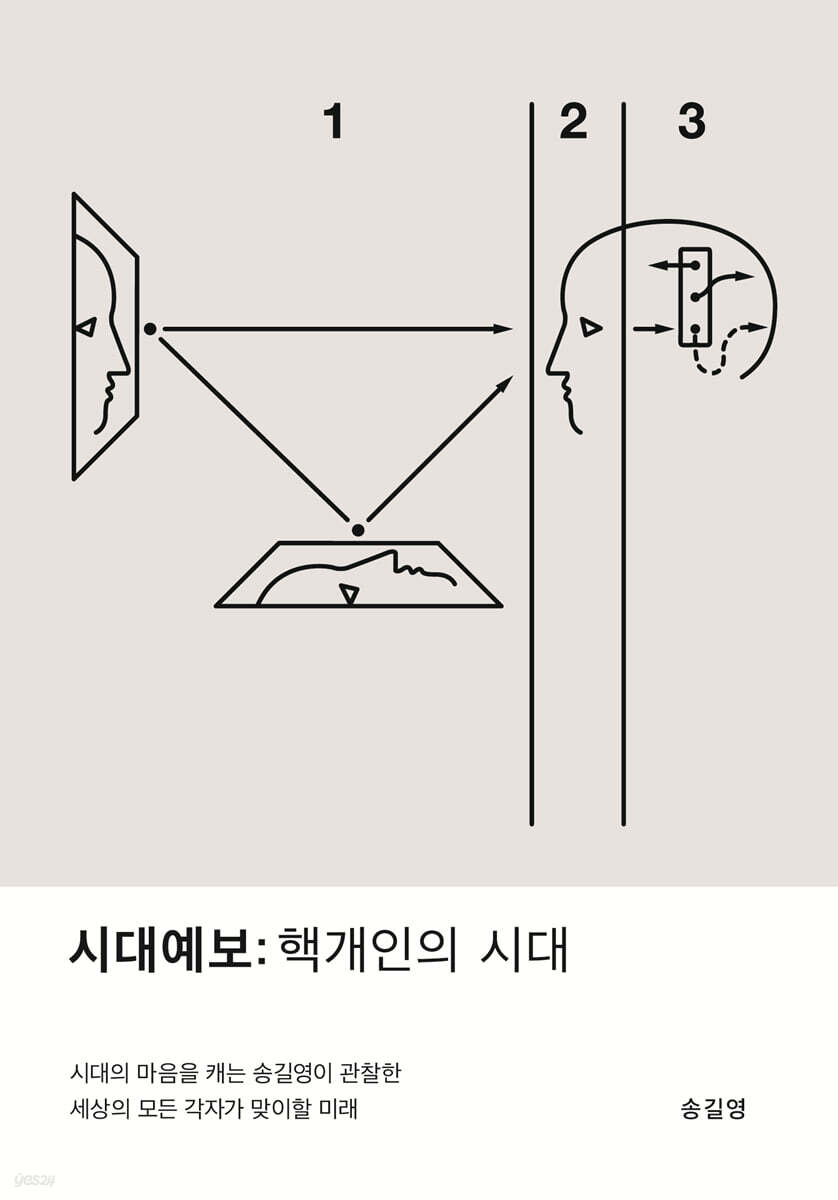
Forecast of the Times: The Age of the Nuclear Individual
 |
Description
Book Introduction
- Books recommended by the Ministry of Culture, Sports and Tourism - Books recommended by librarians at the National Library of Korea - 2nd Park Moo-mirae Foundation Economics and Management Outstanding Book - Selected by SERI CEO Business Book Club The future era predicted by Mind Minor Song Gil-young, How will the world change in the future? It is not a weather forecast that tells you the weather for a season, A bigger breath of 'time forecast' to prepare for life begins! Song Gil-young, a mind miner who reads and interprets the human mind from big data accumulated from the records of countless people, has been able to read social changes faster than anyone else. This time, he offers insights into future trends and flows based on his understanding of the present, based on his observations of the past, from decades ago, through the upheaval of industrialization and the expansion of urbanization. As the system that has maintained society up to now changes, a new entity called the ‘nuclear individual’ is born that did not exist before. Who are these nuclear individuals who are creating new rules at breakneck speed, and what choices must we make to survive in their era? 《Sidaebo: The Age of the Nuclear Individual》 examines the current era, including academic background inflation, the transitional period of caregiving, a transparent society, the oversleeping class, the end of filial piety, and deferred compensation. At the same time, it predicts the era of the nuclear individual that we will face in the future, with Seoulers more than Koreans, a five-minute respect society, global rank badges, AI colleagues, direct transactions with authority figures, micro-communities, and the unsettled generation. Climate change is increasingly breaking away from the weather mechanisms of the past millennium. We live in an age where weather forecasts, a constant presence on the news, change so rapidly that it's difficult to predict what's ahead. Nevertheless, we often listen to the forecasts, even if they're wrong, to prepare and be prepared. To put it metaphorically, this is not simply a preparation to avoid the rain. For some, it is so important that their livelihood and life depend on it. Now, rather than just a weather forecast that tells you what to wear for the season, a bigger-scale 'time forecast' to prepare for my life has begun. |
- You can preview some of the book's contents.
Preview
index
Prologue - Split, Scattered, Standing Alone
Chapter 1: K is not the Republic of Korea
K Premium: Nationality is gone, style remains.
A sense of belonging or distinction as a 'Seouler'
A world that can embrace the 'platypus'
The Empty Echo of the National Education Charter
Language habits change the fate of an organization.
Chapter 2: Co-pilots Don't Leave Work
AI colleagues without commuting
It's not because the machine is good, it's because people find it inconvenient.
Telepathy, Simsim Merchant, AI Secretary
The author disappears, only the genre remains.
Opening a shopping mall in two hours on a weekend afternoon
It may be a blessing for humanity, but it may be a disaster for you.
The Alchemy of Turning Disaster into Blessing
Chapter 3: Recruitment, Not Hiring
College is just about admission, graduation or starting a business is your choice.
Local business owners who graduated from prestigious universities
Individual fluidity, organizational dynamism
Calvin Klein model is a top 1% programmer
How to Survive in a Transparent Society
Are you a recruiting target?
Chapter 4: The End of Filial Piety and the Future of Aging
The era of the daughter who hired her father, the head of the household
I don't want to live like my mom and do ○○
Is Guilt Mine? The Beauty of Give and Take
Aging varies greatly
There is no need for filial piety in the 'Age of Heroes'
The problem isn't 'age', it's 'me'
Chapter 5: The Emergence of the Nuclear Individual
Elegant nuclear individuals exchanging worldviews
It was all debt
Even if natural ties fade, solidarity remains.
The inevitability of the unsettled generation
5-minute respect society
Epilogue - For a Society Without Compulsion and Competition
Chapter 1: K is not the Republic of Korea
K Premium: Nationality is gone, style remains.
A sense of belonging or distinction as a 'Seouler'
A world that can embrace the 'platypus'
The Empty Echo of the National Education Charter
Language habits change the fate of an organization.
Chapter 2: Co-pilots Don't Leave Work
AI colleagues without commuting
It's not because the machine is good, it's because people find it inconvenient.
Telepathy, Simsim Merchant, AI Secretary
The author disappears, only the genre remains.
Opening a shopping mall in two hours on a weekend afternoon
It may be a blessing for humanity, but it may be a disaster for you.
The Alchemy of Turning Disaster into Blessing
Chapter 3: Recruitment, Not Hiring
College is just about admission, graduation or starting a business is your choice.
Local business owners who graduated from prestigious universities
Individual fluidity, organizational dynamism
Calvin Klein model is a top 1% programmer
How to Survive in a Transparent Society
Are you a recruiting target?
Chapter 4: The End of Filial Piety and the Future of Aging
The era of the daughter who hired her father, the head of the household
I don't want to live like my mom and do ○○
Is Guilt Mine? The Beauty of Give and Take
Aging varies greatly
There is no need for filial piety in the 'Age of Heroes'
The problem isn't 'age', it's 'me'
Chapter 5: The Emergence of the Nuclear Individual
Elegant nuclear individuals exchanging worldviews
It was all debt
Even if natural ties fade, solidarity remains.
The inevitability of the unsettled generation
5-minute respect society
Epilogue - For a Society Without Compulsion and Competition
Detailed image
Into the book
We have moved beyond the authoritarian era, which was maintained by a top-down oppressive mechanism, to a new era of the individual, where individuals become self-reliant through the power of mutual networks.
Amidst these changes, we observed, at various levels, the process by which previously powerful authority was naturally fragmented and fused, and the process by which authority was created and preserved through new recognition systems.
We foresee the end of filial piety, the evolution of the cooperative family, and the emergence of new individuals, unprecedented in AI-optimized systems.
In this book, these new individuals are defined as 'nuclear individuals'.
We observe how they are born within the context of social structural change.
And we want to examine how the solidarity of nuclear individuals seeks and agrees on a new way of life.
In this age of the nuclear individual, we want to share with you our vivid observations of life, about the language skills necessary for survival, the embrace of diversity, and how to age wisely.
---From the "Prologue"
If Western individualism emerged as an extension of humanity and humanism, Korean individualism emerged as a counter-dynamic to authoritarianism.
If you look at a newspaper article from 1995, there is a sentence that says, "There are concerns about social collapse due to the spread of individualism."
According to the article, at the time, individualism was another term for villainy.
More than 20 years later, we're now naturally discussing how healthy individualism benefits everyone.
I think all of this ultimately comes down to a change in dynamics.
It's not that things have become more advanced, it's just that individuals have become more powerful.
As the collective system of production groups that operated as a group transformed into an individual-centered platform society, the flow of power suddenly changed before the older generation could even change their thinking.
It's like the smokestack industry transitioning into the IT industry, where the power of each individual has grown.
Therefore, young people feel that anything that limits their prosperity and vitality is 'authoritarian'.
Future nuclear individuals are more likely to perceive the word 'authoritarian' with even greater disgust.
---From Chapter 1, “K is not the Republic of Korea”
In organizations, middle managers are disappearing.
Leading IT service companies are already moving towards eliminating full-time managers.
In the development team, even the team leader codes.
Since collaboration tools manage everything like work progress and schedules, if you take on full-time management, your team members will likely question what you're doing.
“What is your job, Manager?”
“My job is to manage schedules and coordinate work between departments.”
Now, individuals can learn on their own and perform tasks with the help of AI.
And once the organization has normalized the process, it automates it.
That's why the administrator disappears.
So, anyone who defines themselves as a manager is claiming to do something that doesn't exist.
---From Chapter 2, "Co-pilots Don't Leave Work"
There was a time after the 2008 global economic crisis when the entrance exam for a certain large conglomerate was considered a post-CSAT exam.
It was a time when even parents of elementary school students openly said, "I want to raise my children well and send them to work at a large corporation."
Large corporations were the final stage of competition for college graduates and the new educational background.
There was no greater filial piety than having a child enter a large company, and among peers, the phrase, “That friend works at a large company,” was seen as proof of success.
Having experienced two financial crises, we have inevitably been drawn to a stable, one-way future.
Ordinary people, who witnessed their lives fall apart in an instant during the IMF crisis and the global economic crisis, clung to jobs at large corporations that seemed unlikely to go bankrupt even in the face of external shocks.
The moment I got through the fierce tournament and received a business card from a large corporation, I felt like I could have a stable family with a high salary, and live in a protected area for the rest of my life with my employee ID card hanging around my neck like a medal.
But the world changed course in an instant.
The world has changed so that the CSAT is not the final exam, and getting hired at a large company is not the final gateway.
---From Chapter 3, 'Recruitment, Not Recruitment'
In the novel “The Age of the Housemaid,” Korea’s modern and future are marked by repeated conflict and compromise.
The publishing company's staff do not necessarily have to be mothers and fathers.
Perhaps a more experienced and professional colleague would be better.
If a publishing company expands to a larger scale, new employees may be reluctant to join a family-run business.
There are also issues of whether the fairness of hiring has been ensured and whether the compensation for work is appropriate.
But all readers of that novel are relieved and happy.
Because we all know that, as a daughter and not as a CEO, we have no choice but to provide financial support to our mothers and fathers who are not well off financially.
The highlight of this novel is the redefinition of that relationship.
One-sided support for someone who shows no will to become independent makes life difficult for the caregiver.
Parents who take ongoing support for granted create a sense of helplessness in their children.
This fear of helplessness is embodied by Moon Dong-eun's mother in the drama "The Glory," and the social repercussions of this are concretized in the "Amendment to Article 1004 of the Civil Act (Lossession of Inheritance Rights System)" which states that parents who neglect their duty of support should not be able to inherit.
The good custom of mutual aid was a valuable survival method for taking care of one another in times of need.
But even as the economy grows and evolves into a self-sufficient system, a system that still relies on private assistance to care for each person's future creates another problem.
It leaves behind a 'debt of association' that binds us from living our lives fully.
---From Chapter 4, “The End of Filial Piety, the Future of Aging”
The authority of experts in any field is no longer as strong as it once was.
In the past, if you ran to the major leagues, the pinnacle of authority, now it seems you dream of living as a craftsman in an atelier in your own yard.
In his book, To Sell is Human, futurist Daniel Pink declared that all humans must "sell themselves."
So what should we sell? The most competitive product is "narrative."
Each person's narrative is evidence and raw material for authority.
My record, a true accumulation of growth and frustration, is my unique narrative.
Like the rings of a tree, a narrative can never be rushed.
It is made only with time and sincerity.
Amidst these changes, we observed, at various levels, the process by which previously powerful authority was naturally fragmented and fused, and the process by which authority was created and preserved through new recognition systems.
We foresee the end of filial piety, the evolution of the cooperative family, and the emergence of new individuals, unprecedented in AI-optimized systems.
In this book, these new individuals are defined as 'nuclear individuals'.
We observe how they are born within the context of social structural change.
And we want to examine how the solidarity of nuclear individuals seeks and agrees on a new way of life.
In this age of the nuclear individual, we want to share with you our vivid observations of life, about the language skills necessary for survival, the embrace of diversity, and how to age wisely.
---From the "Prologue"
If Western individualism emerged as an extension of humanity and humanism, Korean individualism emerged as a counter-dynamic to authoritarianism.
If you look at a newspaper article from 1995, there is a sentence that says, "There are concerns about social collapse due to the spread of individualism."
According to the article, at the time, individualism was another term for villainy.
More than 20 years later, we're now naturally discussing how healthy individualism benefits everyone.
I think all of this ultimately comes down to a change in dynamics.
It's not that things have become more advanced, it's just that individuals have become more powerful.
As the collective system of production groups that operated as a group transformed into an individual-centered platform society, the flow of power suddenly changed before the older generation could even change their thinking.
It's like the smokestack industry transitioning into the IT industry, where the power of each individual has grown.
Therefore, young people feel that anything that limits their prosperity and vitality is 'authoritarian'.
Future nuclear individuals are more likely to perceive the word 'authoritarian' with even greater disgust.
---From Chapter 1, “K is not the Republic of Korea”
In organizations, middle managers are disappearing.
Leading IT service companies are already moving towards eliminating full-time managers.
In the development team, even the team leader codes.
Since collaboration tools manage everything like work progress and schedules, if you take on full-time management, your team members will likely question what you're doing.
“What is your job, Manager?”
“My job is to manage schedules and coordinate work between departments.”
Now, individuals can learn on their own and perform tasks with the help of AI.
And once the organization has normalized the process, it automates it.
That's why the administrator disappears.
So, anyone who defines themselves as a manager is claiming to do something that doesn't exist.
---From Chapter 2, "Co-pilots Don't Leave Work"
There was a time after the 2008 global economic crisis when the entrance exam for a certain large conglomerate was considered a post-CSAT exam.
It was a time when even parents of elementary school students openly said, "I want to raise my children well and send them to work at a large corporation."
Large corporations were the final stage of competition for college graduates and the new educational background.
There was no greater filial piety than having a child enter a large company, and among peers, the phrase, “That friend works at a large company,” was seen as proof of success.
Having experienced two financial crises, we have inevitably been drawn to a stable, one-way future.
Ordinary people, who witnessed their lives fall apart in an instant during the IMF crisis and the global economic crisis, clung to jobs at large corporations that seemed unlikely to go bankrupt even in the face of external shocks.
The moment I got through the fierce tournament and received a business card from a large corporation, I felt like I could have a stable family with a high salary, and live in a protected area for the rest of my life with my employee ID card hanging around my neck like a medal.
But the world changed course in an instant.
The world has changed so that the CSAT is not the final exam, and getting hired at a large company is not the final gateway.
---From Chapter 3, 'Recruitment, Not Recruitment'
In the novel “The Age of the Housemaid,” Korea’s modern and future are marked by repeated conflict and compromise.
The publishing company's staff do not necessarily have to be mothers and fathers.
Perhaps a more experienced and professional colleague would be better.
If a publishing company expands to a larger scale, new employees may be reluctant to join a family-run business.
There are also issues of whether the fairness of hiring has been ensured and whether the compensation for work is appropriate.
But all readers of that novel are relieved and happy.
Because we all know that, as a daughter and not as a CEO, we have no choice but to provide financial support to our mothers and fathers who are not well off financially.
The highlight of this novel is the redefinition of that relationship.
One-sided support for someone who shows no will to become independent makes life difficult for the caregiver.
Parents who take ongoing support for granted create a sense of helplessness in their children.
This fear of helplessness is embodied by Moon Dong-eun's mother in the drama "The Glory," and the social repercussions of this are concretized in the "Amendment to Article 1004 of the Civil Act (Lossession of Inheritance Rights System)" which states that parents who neglect their duty of support should not be able to inherit.
The good custom of mutual aid was a valuable survival method for taking care of one another in times of need.
But even as the economy grows and evolves into a self-sufficient system, a system that still relies on private assistance to care for each person's future creates another problem.
It leaves behind a 'debt of association' that binds us from living our lives fully.
---From Chapter 4, “The End of Filial Piety, the Future of Aging”
The authority of experts in any field is no longer as strong as it once was.
In the past, if you ran to the major leagues, the pinnacle of authority, now it seems you dream of living as a craftsman in an atelier in your own yard.
In his book, To Sell is Human, futurist Daniel Pink declared that all humans must "sell themselves."
So what should we sell? The most competitive product is "narrative."
Each person's narrative is evidence and raw material for authority.
My record, a true accumulation of growth and frustration, is my unique narrative.
Like the rings of a tree, a narrative can never be rushed.
It is made only with time and sincerity.
---From Chapter 5, “The Emergence of the Nuclear Individual”
Publisher's Review
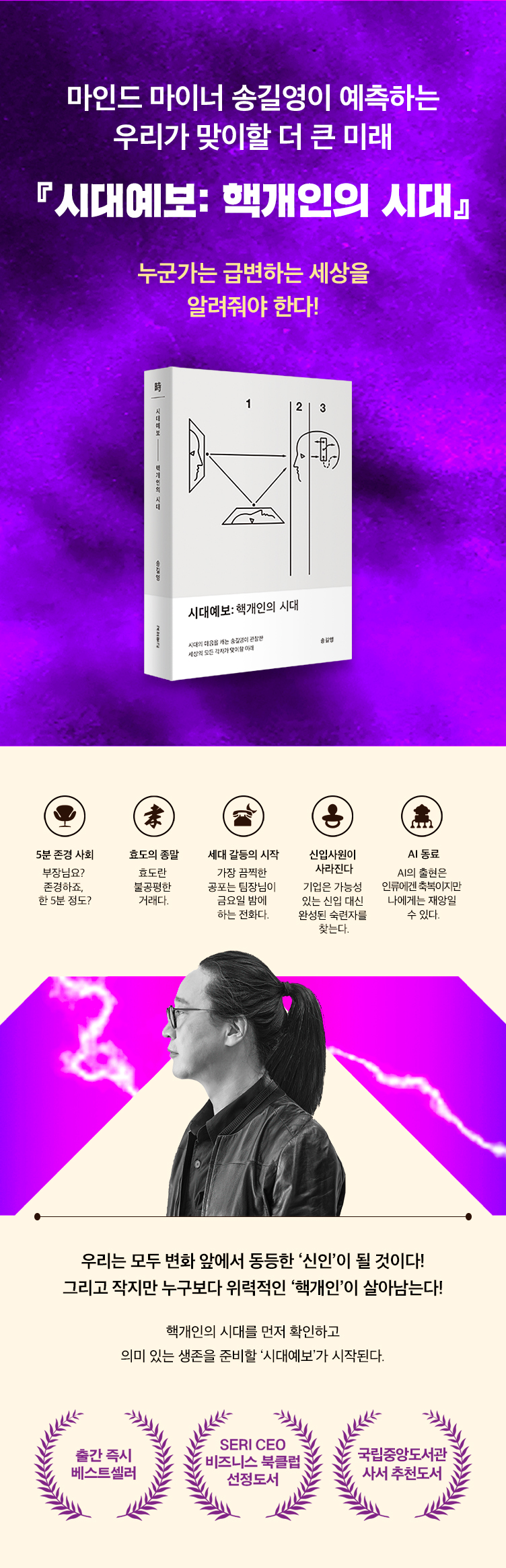
Now, the world of 'nuclear individuals' has arrived!
The future we face, as observed by Song Gil-young, an observer of the times.
We are all split, scattered, and left alone.
It's a time when it's difficult to keep up with trends and fads if you can't react quickly.
The world, which changes every moment, is constantly sending us signals of change.
Signals shot up from all over the place create a new zeitgeist.
This can only be noticed by those who observe and explore.
The extraordinary signal of change observed by Mind Minor's Song Gil-young is the 'era of the nuclear individual', where we are split, scattered, and left to stand alone.
With the advancement of digital tools and artificial intelligence, the authority that once held power will fragment. As life spans past 100 years, the boundaries of organizations and families will crumble and disperse, ultimately ushering in an era where individuals stand alone, each concerned with their own capabilities and survival.
As the power of organizational rank and status weakens and the power that individuals can display grows stronger, each and every person in the world faces a future different from the present.
The greatest change brought about by this social system and zeitgeist is the emergence of a new entity, the ‘nuclear individual.’
It has been over half a century since the no longer new word “nuclear family” arrived in our society.
Now, South Korea is dividing beyond the nuclear family into smaller units called nuclear individuals.
They are beings who have the power to make decisions about their own lives, free from collectivist thinking and established grammar.
In the past, these nuclear individuals were considered mutants, but they are no longer mutants.
This book predicts the emergence of the nuclear individual and the future that will come with it.
First, let's look at the current times, including academic inflation, a transparent society, a class of oversleepers, a transitional period of caregiving, the end of filial piety, and deferred compensation.
At the same time, it predicts the era of the nuclear individual that we will face in the future, with Seoulers being more Korean than Koreans, a five-minute respect society, global class badges, AI colleagues, direct transactions with authority figures, micro-communities, and the unsettled generation.
In this age of the nuclear individual, we can experience vivid discoveries about the weapons we must equip ourselves with, the posture we must maintain, and the self-reliance we must acquire for our own survival.
Five-minute respect society, global rank badges, direct dealings with authority figures, AI colleagues, Seoulites are better than Koreans…
The era of nuclear individuals who create new rules at breakneck speed.
What should we do?
The 'nuclear individual', a being that did not exist before, is armed with the attitude and courage to modify rather than repeat his own life.
Because we know that if we prepare, we will have opportunities, and if we stay still, we will be isolated.
What are the new rules that nuclear individuals, who set their own standards without conforming to the world's standards, have created at an incredible speed?
One, the world view of a nuclear individual.
For nuclear individuals, whose sense of 'the country is the worldview in which I live' has faded, the city in which I live is more important than the country and nationality that are determined regardless of my will.
Instead of living a 'Korean life', we live a 'Seoul-er life', and with a sense of belonging rather than a sense of belonging that adapts to an organization and system.
They also feel that anything that limits their prosperity and vitality is authoritarian.
Second, the competitiveness of the individual.
Is the emergence of AI, which promises to improve work efficiency and expertise, a blessing or a curse? It could be a blessing for humanity, but a disaster for me.
However, the nuclear individual, as an 'AI director' who matches with AI, completes the difficult labor and arms himself with the evolution of his abilities.
It is about reading the great flow of the times and constantly updating yourself within it.
Third, the narrative of the nuclear individual.
Since the 2008 global economic crisis, getting a job at a large corporation has felt like the end of competition.
But the world changed course in an instant.
Since the coronavirus pandemic, "retirement" has become a new trend, and those who have resigned are redefining their identities by chanting the slogan, "From office workers to professionals."
In an era where each person's daily life becomes a portfolio and the entire planet becomes a competitor, nuclear individuals will create their own unique competitive edge by recording a unique narrative of growth and frustration that is truly accumulated.
Fourth, independence of the nuclear individual.
The filial piety system, where adults take care of children, and children grow up to become young adults and take care of adults again, is changing.
As the family is redefined as a relationship that knows how to keep a distance like other people, they are seeking ways for both parents and children to become independent rather than one in which one parent unilaterally sacrifices.
It is evolving into a society where nuclear individuals take care of themselves.
Five, diversity of nuclear individuals.
Even if they are not family, they share the joys and sorrows of daily life with like-minded companions, and break down the mental barriers of 'one nation and one people' and embrace diverse cultures and experiences.
Nuclear individuals are not afraid to become others themselves, and they do not hesitate when they meet new others.
Because when diversity is guaranteed, the life of a true nuclear individual begins.
The future we face, as observed by Song Gil-young, an observer of the times.
We are all split, scattered, and left alone.
It's a time when it's difficult to keep up with trends and fads if you can't react quickly.
The world, which changes every moment, is constantly sending us signals of change.
Signals shot up from all over the place create a new zeitgeist.
This can only be noticed by those who observe and explore.
The extraordinary signal of change observed by Mind Minor's Song Gil-young is the 'era of the nuclear individual', where we are split, scattered, and left to stand alone.
With the advancement of digital tools and artificial intelligence, the authority that once held power will fragment. As life spans past 100 years, the boundaries of organizations and families will crumble and disperse, ultimately ushering in an era where individuals stand alone, each concerned with their own capabilities and survival.
As the power of organizational rank and status weakens and the power that individuals can display grows stronger, each and every person in the world faces a future different from the present.
The greatest change brought about by this social system and zeitgeist is the emergence of a new entity, the ‘nuclear individual.’
It has been over half a century since the no longer new word “nuclear family” arrived in our society.
Now, South Korea is dividing beyond the nuclear family into smaller units called nuclear individuals.
They are beings who have the power to make decisions about their own lives, free from collectivist thinking and established grammar.
In the past, these nuclear individuals were considered mutants, but they are no longer mutants.
This book predicts the emergence of the nuclear individual and the future that will come with it.
First, let's look at the current times, including academic inflation, a transparent society, a class of oversleepers, a transitional period of caregiving, the end of filial piety, and deferred compensation.
At the same time, it predicts the era of the nuclear individual that we will face in the future, with Seoulers being more Korean than Koreans, a five-minute respect society, global class badges, AI colleagues, direct transactions with authority figures, micro-communities, and the unsettled generation.
In this age of the nuclear individual, we can experience vivid discoveries about the weapons we must equip ourselves with, the posture we must maintain, and the self-reliance we must acquire for our own survival.
Five-minute respect society, global rank badges, direct dealings with authority figures, AI colleagues, Seoulites are better than Koreans…
The era of nuclear individuals who create new rules at breakneck speed.
What should we do?
The 'nuclear individual', a being that did not exist before, is armed with the attitude and courage to modify rather than repeat his own life.
Because we know that if we prepare, we will have opportunities, and if we stay still, we will be isolated.
What are the new rules that nuclear individuals, who set their own standards without conforming to the world's standards, have created at an incredible speed?
One, the world view of a nuclear individual.
For nuclear individuals, whose sense of 'the country is the worldview in which I live' has faded, the city in which I live is more important than the country and nationality that are determined regardless of my will.
Instead of living a 'Korean life', we live a 'Seoul-er life', and with a sense of belonging rather than a sense of belonging that adapts to an organization and system.
They also feel that anything that limits their prosperity and vitality is authoritarian.
Second, the competitiveness of the individual.
Is the emergence of AI, which promises to improve work efficiency and expertise, a blessing or a curse? It could be a blessing for humanity, but a disaster for me.
However, the nuclear individual, as an 'AI director' who matches with AI, completes the difficult labor and arms himself with the evolution of his abilities.
It is about reading the great flow of the times and constantly updating yourself within it.
Third, the narrative of the nuclear individual.
Since the 2008 global economic crisis, getting a job at a large corporation has felt like the end of competition.
But the world changed course in an instant.
Since the coronavirus pandemic, "retirement" has become a new trend, and those who have resigned are redefining their identities by chanting the slogan, "From office workers to professionals."
In an era where each person's daily life becomes a portfolio and the entire planet becomes a competitor, nuclear individuals will create their own unique competitive edge by recording a unique narrative of growth and frustration that is truly accumulated.
Fourth, independence of the nuclear individual.
The filial piety system, where adults take care of children, and children grow up to become young adults and take care of adults again, is changing.
As the family is redefined as a relationship that knows how to keep a distance like other people, they are seeking ways for both parents and children to become independent rather than one in which one parent unilaterally sacrifices.
It is evolving into a society where nuclear individuals take care of themselves.
Five, diversity of nuclear individuals.
Even if they are not family, they share the joys and sorrows of daily life with like-minded companions, and break down the mental barriers of 'one nation and one people' and embrace diverse cultures and experiences.
Nuclear individuals are not afraid to become others themselves, and they do not hesitate when they meet new others.
Because when diversity is guaranteed, the life of a true nuclear individual begins.
GOODS SPECIFICS
- Date of issue: September 25, 2023
- Format: Hardcover book binding method guide
- Page count, weight, size: 340 pages | 416g | 130*188*25mm
- ISBN13: 9791170610359
- ISBN10: 1170610358
You may also like
카테고리
korean


korean

![ELLE 엘르 스페셜 에디션 A형 : 12월 [2025]](http://librairie.coreenne.fr/cdn/shop/files/b8e27a3de6c9538896439686c6b0e8fb.jpg?v=1766436872&width=3840)


