

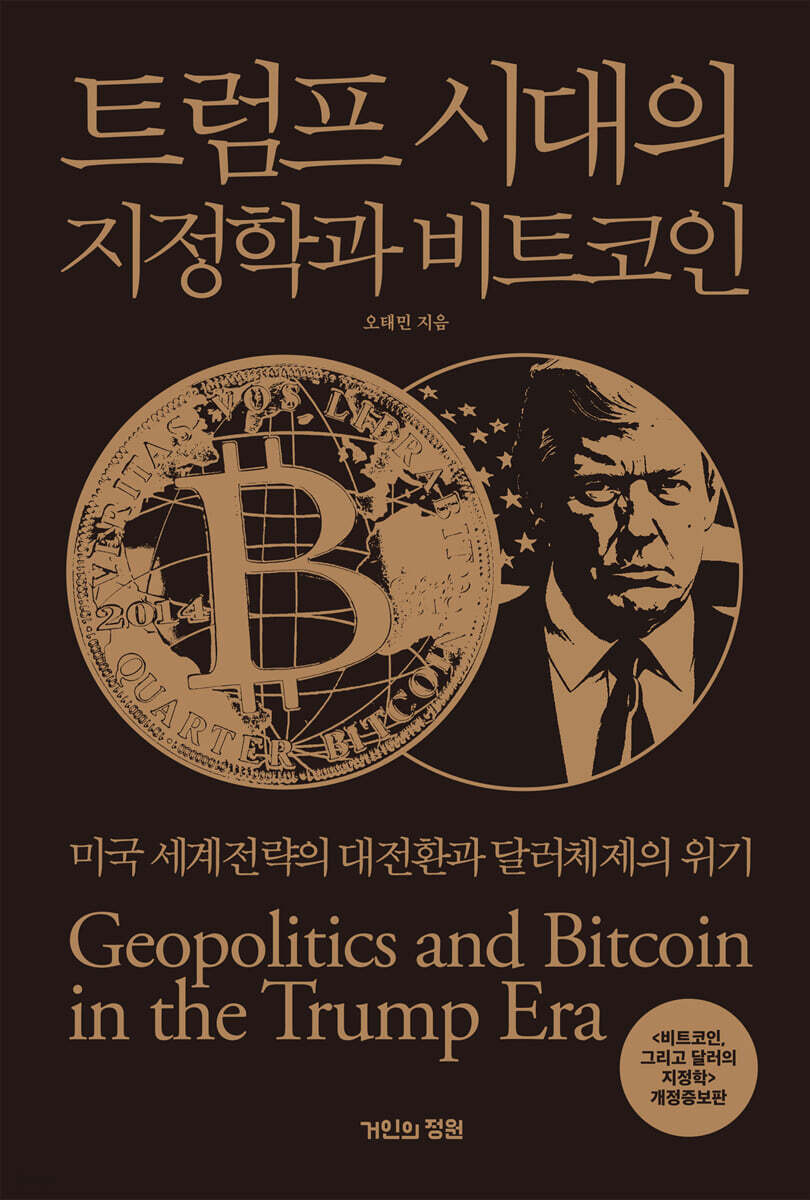
Geopolitics and Bitcoin in the Trump Era
 |
Description
Book Introduction
A new order is coming to the world economy.
The Crisis of the Dollar System and the Rise of Trumpism
The cataclysmic changes brought about by America's shift in global strategy
The Middle East War, the Abraham Accords, the ROK-US-Japan Security Cooperation Declaration, and the US's efforts to tame China
And Trump's declaration of Bitcoin strategy!
South Korea's top cryptocurrency authority, Taemin Oh, predicts a rapidly changing world!
Regarding the claim that “America will block Bitcoin”
The most astonishing counterargument, Bitcoin and the Geopolitics of the Dollar, fully revised and expanded edition.
It is quite an unconventional move.
As soon as Trump returned to the presidency of the United States, he threw the world into chaos by imposing massive tariffs.
Simply stating Trump's America First policy is not enough to grasp his intentions.
All politicians claim to put their country's interests first, but they don't make it their main campaign promise.
Because it is such an obvious thing.
But the slogan has become synonymous with Trump, and has embarrassed many Americans as well as other countries.
To understand why Trump was able to return and the direction he intends to take America, it's necessary to review the path America has taken since World War II.
If the United States is an empire, then the dollar system is the system that existed when the United States was at its most generous.
After World War II, the United States supported its allies through the dollar system, ceded sovereignty to independent nations, managed the Cold War, and ultimately won it.
But in the meantime, the very dollar that had drained America's power had left the country in a state of social division and identity crisis bordering on civil war.
The rise of the political and social phenomenon called 'Trumpism' and Trump's return are not unrelated to this.
And behind Trump's advocacy of Bitcoin as a strategic asset, following his victory in the political civil war, lies the belief that Bitcoin could play a special role in supporting the dollar.
So this book primarily deals not with why the US can't get rid of Bitcoin, but with why it has no intention of doing so.
Under the 'post-1945 system,' the United States has struggled between the imperialist world order and the post-imperialist disorder to maintain the dollar system, but the dollar system has lost its strength due to territorial disputes, economic wars, and hegemonic struggles around the world.
And with Trump's return to Bitcoin, the world has entered a completely new turning point.
While this phenomenon stems from the unique figure of Trump, his choice is also a predictable trend that is in no way detached from the structural context of the historical dynamics of the international order.
This book examines key events of the past and present, from Bretton Woods to the Abraham Accords, the 2023 Korea-US-Japan Agreement, and the US's efforts to tame China. It examines how America's global strategy is evolving and explores its implications for the economy and politics from a geopolitical perspective.
And it proves that Bitcoin is at the center of all these phenomena and the changes to come.
The Crisis of the Dollar System and the Rise of Trumpism
The cataclysmic changes brought about by America's shift in global strategy
The Middle East War, the Abraham Accords, the ROK-US-Japan Security Cooperation Declaration, and the US's efforts to tame China
And Trump's declaration of Bitcoin strategy!
South Korea's top cryptocurrency authority, Taemin Oh, predicts a rapidly changing world!
Regarding the claim that “America will block Bitcoin”
The most astonishing counterargument, Bitcoin and the Geopolitics of the Dollar, fully revised and expanded edition.
It is quite an unconventional move.
As soon as Trump returned to the presidency of the United States, he threw the world into chaos by imposing massive tariffs.
Simply stating Trump's America First policy is not enough to grasp his intentions.
All politicians claim to put their country's interests first, but they don't make it their main campaign promise.
Because it is such an obvious thing.
But the slogan has become synonymous with Trump, and has embarrassed many Americans as well as other countries.
To understand why Trump was able to return and the direction he intends to take America, it's necessary to review the path America has taken since World War II.
If the United States is an empire, then the dollar system is the system that existed when the United States was at its most generous.
After World War II, the United States supported its allies through the dollar system, ceded sovereignty to independent nations, managed the Cold War, and ultimately won it.
But in the meantime, the very dollar that had drained America's power had left the country in a state of social division and identity crisis bordering on civil war.
The rise of the political and social phenomenon called 'Trumpism' and Trump's return are not unrelated to this.
And behind Trump's advocacy of Bitcoin as a strategic asset, following his victory in the political civil war, lies the belief that Bitcoin could play a special role in supporting the dollar.
So this book primarily deals not with why the US can't get rid of Bitcoin, but with why it has no intention of doing so.
Under the 'post-1945 system,' the United States has struggled between the imperialist world order and the post-imperialist disorder to maintain the dollar system, but the dollar system has lost its strength due to territorial disputes, economic wars, and hegemonic struggles around the world.
And with Trump's return to Bitcoin, the world has entered a completely new turning point.
While this phenomenon stems from the unique figure of Trump, his choice is also a predictable trend that is in no way detached from the structural context of the historical dynamics of the international order.
This book examines key events of the past and present, from Bretton Woods to the Abraham Accords, the 2023 Korea-US-Japan Agreement, and the US's efforts to tame China. It examines how America's global strategy is evolving and explores its implications for the economy and politics from a geopolitical perspective.
And it proves that Bitcoin is at the center of all these phenomena and the changes to come.
- You can preview some of the book's contents.
Preview
index
Preface to the Revised Edition
preface
Chapter 1: The Empire's Struggle to Deny the Empire
01 The Age of Geopolitics Returns
02 Geopolitical Humans: Humans are territorial animals that act in groups.
03 Realism vs. Idealism, and the American Temperament
04 Militant Liberalism
05 Two Pillars of the US-led World System
06 Korean War, a calf that couldn't even bear a calf
07 Peace Treaty of Westphalia: Eliminate Morality from the World Order
08 Failure to misapply the lessons of the Vietnam War and the Korean War
09 American idealism accelerates Vietnam's communist transformation
10. Antipathy toward a realistic president who prioritizes national interests
11 Embracing China and Changing the Cold War
12 China blocks the Soviet Union
13 The 1989 Tiananmen Square Incident: The US Deals with China's Incident
14 Breaking with China: When interests change, so do our thoughts.
15 Will China really stay within the Peace of Westphalia?
16 The Rise of the Trump Phenomenon: A Season of Discontent
17 Japan awakens American isolationism
18 Geopolitics of Technology
19 Is the golden age of isolationism finally coming?
20 Abraham Accords, Middle Easternization of the Middle East Issue
Chapter 2: The Costs of the World System
21 Trump Weaponizes Bitcoin
The $22 CBDC and the Yearning for Universal Order
Coexistence of the $23 and the Nation-State
24 Eurodollars, Capital Crosses Borders
25 Karl Polanyi's Capital and the Dual Movement of the Nation-State
26. A world beyond the law, created by sacred borders.
27 Fool, what matters is the world system.
28 Bancor, the dream of neutral rules
29 Is America a bully?
$30 and Neutrality Rules [Neutrality in Bitcoin and Ethereum]
31 The Perpetual Motion Theory of the Dollar Shortage
32 Belt and Road Initiatives, Xi Jinping's Permanent Institution
33 US Treasury Bonds: Paying for the Global System [The Triffin Dilemma and Cryptocurrencies]
34 America's Debt Privilege
35 Managing Japan's Ambition Through the World System
36 Britain and Germany: The Confrontation of the Powers of the Plains and the Balancers of the Outer World
37 Cro Memo, the other person's intentions are not important
The 38th World System Reflects America's Weakness
39 The Shape of a China-led World Order
40 Three Challenges Facing China
41 In Eurasia without the United States
42 The Geopolitics of Bitcoin
preface
Chapter 1: The Empire's Struggle to Deny the Empire
01 The Age of Geopolitics Returns
02 Geopolitical Humans: Humans are territorial animals that act in groups.
03 Realism vs. Idealism, and the American Temperament
04 Militant Liberalism
05 Two Pillars of the US-led World System
06 Korean War, a calf that couldn't even bear a calf
07 Peace Treaty of Westphalia: Eliminate Morality from the World Order
08 Failure to misapply the lessons of the Vietnam War and the Korean War
09 American idealism accelerates Vietnam's communist transformation
10. Antipathy toward a realistic president who prioritizes national interests
11 Embracing China and Changing the Cold War
12 China blocks the Soviet Union
13 The 1989 Tiananmen Square Incident: The US Deals with China's Incident
14 Breaking with China: When interests change, so do our thoughts.
15 Will China really stay within the Peace of Westphalia?
16 The Rise of the Trump Phenomenon: A Season of Discontent
17 Japan awakens American isolationism
18 Geopolitics of Technology
19 Is the golden age of isolationism finally coming?
20 Abraham Accords, Middle Easternization of the Middle East Issue
Chapter 2: The Costs of the World System
21 Trump Weaponizes Bitcoin
The $22 CBDC and the Yearning for Universal Order
Coexistence of the $23 and the Nation-State
24 Eurodollars, Capital Crosses Borders
25 Karl Polanyi's Capital and the Dual Movement of the Nation-State
26. A world beyond the law, created by sacred borders.
27 Fool, what matters is the world system.
28 Bancor, the dream of neutral rules
29 Is America a bully?
$30 and Neutrality Rules [Neutrality in Bitcoin and Ethereum]
31 The Perpetual Motion Theory of the Dollar Shortage
32 Belt and Road Initiatives, Xi Jinping's Permanent Institution
33 US Treasury Bonds: Paying for the Global System [The Triffin Dilemma and Cryptocurrencies]
34 America's Debt Privilege
35 Managing Japan's Ambition Through the World System
36 Britain and Germany: The Confrontation of the Powers of the Plains and the Balancers of the Outer World
37 Cro Memo, the other person's intentions are not important
The 38th World System Reflects America's Weakness
39 The Shape of a China-led World Order
40 Three Challenges Facing China
41 In Eurasia without the United States
42 The Geopolitics of Bitcoin
Detailed image

Into the book
This book primarily addresses not why the United States can't get rid of Bitcoin, but why it has no intention of doing so.
Since discovering Bitcoin, I've primarily focused on explaining why governments can't destroy it.
But the chapter changed when Trump returned to the US presidency, taking a bite out of Bitcoin.
The US is not only unwilling to eliminate Bitcoin, but also intends to foster it.
That's because Bitcoin is so huge.
It can be seen that the United States has decided to keep it close rather than far away.
--- p.8, from the “Preface to the Revised Edition”
The race for technological supremacy is evolving beyond a simple battle for market share into a geopolitical war over survival and dominance among nations.
Japan's frustrations in competing with the United States, and China's current crisis due to US sanctions, remind us that technology is not simply a measure of industrial success, but a tool for reshaping the international order.
--- p.185, from “Geopolitics of Technology”
Although China challenges American hegemony, if you think about it carefully, China's expansion is a problem for Russia, India, South Korea, Taiwan, and Japan, not an immediate problem for the United States.
On the other hand, the United States does not seem to receive the respect and economic rewards it deserves from India, South Korea, and Japan, even though they are doing the work that should be done by those countries.
The fact that this perspective has long been ingrained in the worldview of the American public is precisely what the mainstream media, political, and bureaucratic elites who ignored or downplayed Trump's rise missed.
Trump is an individual, but the Trump phenomenon may be a manifestation of the isolationism that had been dormant under the surface of American politics, rising to the mainstream.
--- p.191, from “Is the Golden Age of Isolationism Finally Coming?”
In conclusion, the Abraham Accords presented a new paradigm for Middle East diplomacy.
This is a significant milestone in strengthening strategic cooperation between Israel and the Gulf states based on shared security and economic interests.
This agreement, a tangled web of Netanyahu's political calculations, Trump's pragmatic diplomacy, and Iran's relentless provocations, is a testing ground for a new Middle East balance, and a microcosm of America's shifting global strategy.
--- p.214, from “Abraham Accords, Middle Easternization of Middle Eastern Issues”
Bitcoin's finality has the potential to seriously undermine countries' ability to manage their currencies.
Currency management is a key element of economic sovereignty, serving as a primary means by which a nation regulates and stabilizes its economy through its currency.
To this end, countries encourage their citizens to use their currency as a store of value, control currency circulation, and implement monetary policy based on this.
Monetary policy is a key tool for stabilizing the economy by stimulating the economy or curbing overheating.
However, the proliferation of Bitcoin could disrupt these policies.
--- p.253, from “Trump Weaponizes Bitcoin”
The post-1945 regime also required violence as much as imperialism, and it had to pay a price.
Even so, there are diagnoses that the universal order is reaching its limit.
As the shale gas revolution has made the United States a net energy exporter, security in the Middle East is becoming a concern for Europe, China, Japan, South Korea, and Taiwan.
In the United States, where militant liberals dominate the media and culture, idealism is reaching a point of denial of reality, while those who know reality are leaning towards isolationism.
For technocratic elites with vested interests in the world system to continue to hold power, several conditions must coincidentally be met.
And that too, continuously.
Since discovering Bitcoin, I've primarily focused on explaining why governments can't destroy it.
But the chapter changed when Trump returned to the US presidency, taking a bite out of Bitcoin.
The US is not only unwilling to eliminate Bitcoin, but also intends to foster it.
That's because Bitcoin is so huge.
It can be seen that the United States has decided to keep it close rather than far away.
--- p.8, from the “Preface to the Revised Edition”
The race for technological supremacy is evolving beyond a simple battle for market share into a geopolitical war over survival and dominance among nations.
Japan's frustrations in competing with the United States, and China's current crisis due to US sanctions, remind us that technology is not simply a measure of industrial success, but a tool for reshaping the international order.
--- p.185, from “Geopolitics of Technology”
Although China challenges American hegemony, if you think about it carefully, China's expansion is a problem for Russia, India, South Korea, Taiwan, and Japan, not an immediate problem for the United States.
On the other hand, the United States does not seem to receive the respect and economic rewards it deserves from India, South Korea, and Japan, even though they are doing the work that should be done by those countries.
The fact that this perspective has long been ingrained in the worldview of the American public is precisely what the mainstream media, political, and bureaucratic elites who ignored or downplayed Trump's rise missed.
Trump is an individual, but the Trump phenomenon may be a manifestation of the isolationism that had been dormant under the surface of American politics, rising to the mainstream.
--- p.191, from “Is the Golden Age of Isolationism Finally Coming?”
In conclusion, the Abraham Accords presented a new paradigm for Middle East diplomacy.
This is a significant milestone in strengthening strategic cooperation between Israel and the Gulf states based on shared security and economic interests.
This agreement, a tangled web of Netanyahu's political calculations, Trump's pragmatic diplomacy, and Iran's relentless provocations, is a testing ground for a new Middle East balance, and a microcosm of America's shifting global strategy.
--- p.214, from “Abraham Accords, Middle Easternization of Middle Eastern Issues”
Bitcoin's finality has the potential to seriously undermine countries' ability to manage their currencies.
Currency management is a key element of economic sovereignty, serving as a primary means by which a nation regulates and stabilizes its economy through its currency.
To this end, countries encourage their citizens to use their currency as a store of value, control currency circulation, and implement monetary policy based on this.
Monetary policy is a key tool for stabilizing the economy by stimulating the economy or curbing overheating.
However, the proliferation of Bitcoin could disrupt these policies.
--- p.253, from “Trump Weaponizes Bitcoin”
The post-1945 regime also required violence as much as imperialism, and it had to pay a price.
Even so, there are diagnoses that the universal order is reaching its limit.
As the shale gas revolution has made the United States a net energy exporter, security in the Middle East is becoming a concern for Europe, China, Japan, South Korea, and Taiwan.
In the United States, where militant liberals dominate the media and culture, idealism is reaching a point of denial of reality, while those who know reality are leaning towards isolationism.
For technocratic elites with vested interests in the world system to continue to hold power, several conditions must coincidentally be met.
And that too, continuously.
--- p.445, from “Eurasia without America”
Publisher's Review
The one book to gain insight into a rapidly changing world.
Hidden in Bitcoin's strategic assetization
America's Purpose and the Future of the International Financial Order
The Biden administration has warned U.S. companies against exposure to or investment in Bitcoin, citing concerns about its potential impact on the financial system.
In particular, there were security concerns raised, saying that cryptocurrencies could help North Korea purchase nuclear materials.
However, Trump, who won the 2024 presidential election, declared that the United States would take a different direction, saying that he would make the United States the "cryptocurrency capital."
Some believe that this is merely an election strategy geared toward cryptocurrency investors and will be difficult to achieve in terms of actual policy change. However, ultimately, the US's stance on Bitcoin is unlikely to be remembered as a Trump-inspired incident.
With the dollar in crisis, Trump and his strategists have identified Bitcoin as a way to shore up the dollar's position, and they see it as a strategic weapon for countries like China that seek to overturn the US-centric global system.
Bitcoin is not a simple phenomenon.
The order we call the dollar system was established after World War II.
But Bitcoin threatens the dollar system.
Bitcoin, with its finality of payment, has the potential to seriously undermine a nation's ability to manage its currency.
Monetary management is one of the core elements of economic sovereignty and is a key means by which a country regulates and stabilizes its economy.
To this end, the state encourages its citizens to use its currency as a store of value and controls currency circulation.
In fact, we can easily see governments attempting to stimulate the economy or manage overheating through monetary policy.
As Bitcoin spreads beyond national boundaries and people embrace it, the effectiveness of national monetary policies inevitably declines, and the United States is no exception.
At a time when the United States, which has claimed to be the world leader since the "post-1945 era," needs to shore up the shaky strength of the dollar, it may seem at first glance contradictory that the US would embrace Bitcoin as a strategic asset.
Bitcoin weakens the power of fiat currencies, but Trump-era America wants to foster Bitcoin.
The world is not a straight line, so if you look closely, you will see many deviations and countercurrents that go against the flow.
These chaotic events can cause us to lose sight of the bigger picture.
However, when viewed from a distance, these tributaries cannot go against the main flow for long.
Bitcoin may seem like a flash in the pan, but that may not be the case.
If so, the fundamental order that governs the world today is changing, and this is the argument this book seeks to make.
This book examines the international financial order from a holistic perspective, examining everything from the "post-1945 system" established by the United States after World War II, which is essential for understanding the essence of the dollar, the medium connecting Trump, Trumpism, and Bitcoin, to the territorial disputes and economic wars taking place around the world today, the Abraham Accords, the security of South Korea, the United States, and Japan, and the conflict between China and the United States.
We also examine the structural reasons for the US's decision to retreat from imperialism, as well as the dollar stablecoin that will mark the final blaze of US imperialism.
Through a history of international finance that encompasses economics, politics, and the humanities, and examines it from a geopolitical perspective, readers will gain insight into the coming era of great upheaval.
Hidden in Bitcoin's strategic assetization
America's Purpose and the Future of the International Financial Order
The Biden administration has warned U.S. companies against exposure to or investment in Bitcoin, citing concerns about its potential impact on the financial system.
In particular, there were security concerns raised, saying that cryptocurrencies could help North Korea purchase nuclear materials.
However, Trump, who won the 2024 presidential election, declared that the United States would take a different direction, saying that he would make the United States the "cryptocurrency capital."
Some believe that this is merely an election strategy geared toward cryptocurrency investors and will be difficult to achieve in terms of actual policy change. However, ultimately, the US's stance on Bitcoin is unlikely to be remembered as a Trump-inspired incident.
With the dollar in crisis, Trump and his strategists have identified Bitcoin as a way to shore up the dollar's position, and they see it as a strategic weapon for countries like China that seek to overturn the US-centric global system.
Bitcoin is not a simple phenomenon.
The order we call the dollar system was established after World War II.
But Bitcoin threatens the dollar system.
Bitcoin, with its finality of payment, has the potential to seriously undermine a nation's ability to manage its currency.
Monetary management is one of the core elements of economic sovereignty and is a key means by which a country regulates and stabilizes its economy.
To this end, the state encourages its citizens to use its currency as a store of value and controls currency circulation.
In fact, we can easily see governments attempting to stimulate the economy or manage overheating through monetary policy.
As Bitcoin spreads beyond national boundaries and people embrace it, the effectiveness of national monetary policies inevitably declines, and the United States is no exception.
At a time when the United States, which has claimed to be the world leader since the "post-1945 era," needs to shore up the shaky strength of the dollar, it may seem at first glance contradictory that the US would embrace Bitcoin as a strategic asset.
Bitcoin weakens the power of fiat currencies, but Trump-era America wants to foster Bitcoin.
The world is not a straight line, so if you look closely, you will see many deviations and countercurrents that go against the flow.
These chaotic events can cause us to lose sight of the bigger picture.
However, when viewed from a distance, these tributaries cannot go against the main flow for long.
Bitcoin may seem like a flash in the pan, but that may not be the case.
If so, the fundamental order that governs the world today is changing, and this is the argument this book seeks to make.
This book examines the international financial order from a holistic perspective, examining everything from the "post-1945 system" established by the United States after World War II, which is essential for understanding the essence of the dollar, the medium connecting Trump, Trumpism, and Bitcoin, to the territorial disputes and economic wars taking place around the world today, the Abraham Accords, the security of South Korea, the United States, and Japan, and the conflict between China and the United States.
We also examine the structural reasons for the US's decision to retreat from imperialism, as well as the dollar stablecoin that will mark the final blaze of US imperialism.
Through a history of international finance that encompasses economics, politics, and the humanities, and examines it from a geopolitical perspective, readers will gain insight into the coming era of great upheaval.
GOODS SPECIFICS
- Date of issue: March 4, 2025
- Page count, weight, size: 536 pages | 950g | 152*225*32mm
- ISBN13: 9791193869215
You may also like
카테고리
korean


korean

![ELLE 엘르 스페셜 에디션 A형 : 12월 [2025]](http://librairie.coreenne.fr/cdn/shop/files/b8e27a3de6c9538896439686c6b0e8fb.jpg?v=1766436872&width=3840)


