

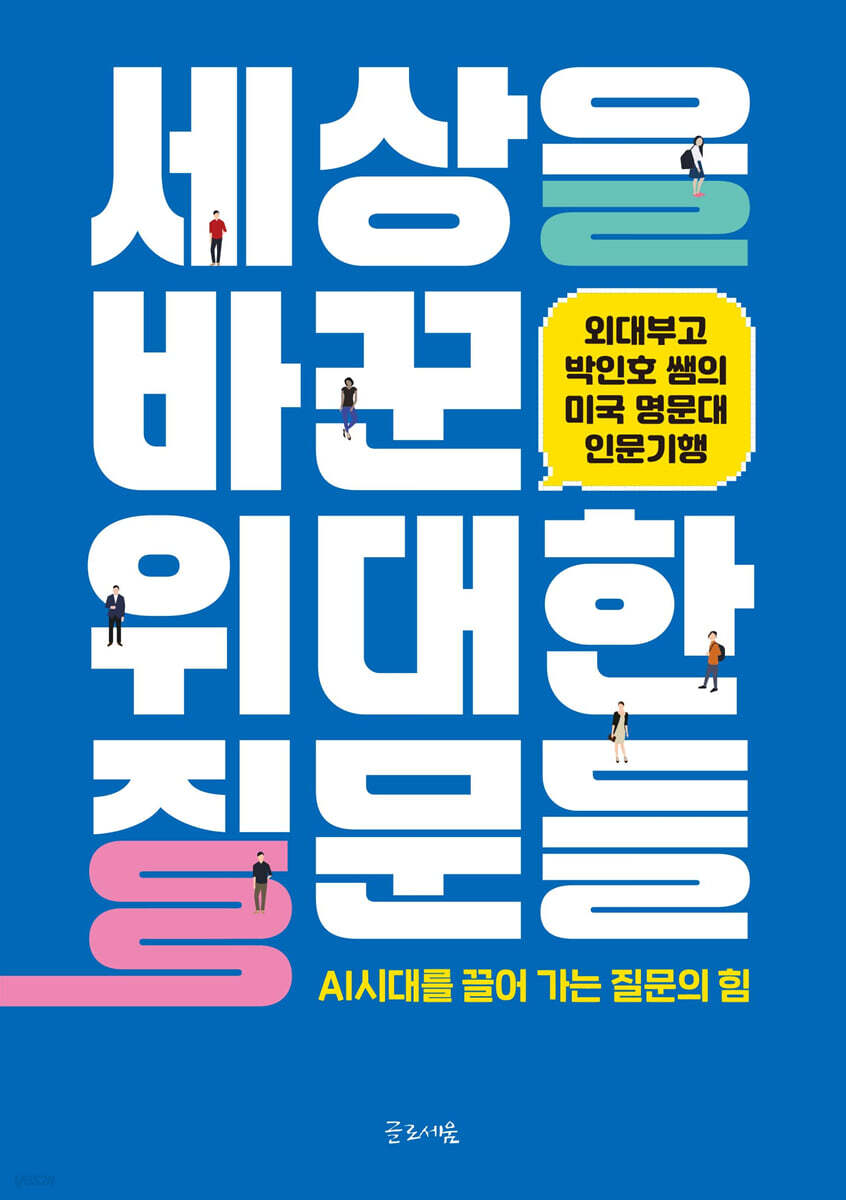
Great Questions That Changed the World
 |
Description
Book Introduction
“AI provides the correct answer.
So what should we do?”
In an age where perfect answers are available in a split second, what kind of talent will our future generations need? In moments when studying feels tedious and directionless, the fundamental questions of "Why do I study?" and "For what purpose, and where am I going?" are rekindled.
"Great Questions That Changed the World" is more than just a tour of prestigious American universities. It is a special humanities travelogue that walks through 20 of the world's best universities, including Harvard, Yale, and MIT, tracing the traces of thought held by these universities and the important questions posed by the people who visited them.
In an age overflowing with "correct answers," this book asks more important "questions" and makes us reflect on the essence of learning.
For students weary of the competition for qualifications, it offers insight into what true learning is, for anxious parents, it offers a new perspective on education, and for educators, it offers insight into how to teach in a rapidly changing era.
In an age where correct answers are commonplace, only those who ask questions can truly continue to learn.
"Great Questions That Changed the World" rediscovers the values of curiosity and imagination that we had forgotten, and ultimately leads us on a journey to find the answer to the question, "Why study?"
So what should we do?”
In an age where perfect answers are available in a split second, what kind of talent will our future generations need? In moments when studying feels tedious and directionless, the fundamental questions of "Why do I study?" and "For what purpose, and where am I going?" are rekindled.
"Great Questions That Changed the World" is more than just a tour of prestigious American universities. It is a special humanities travelogue that walks through 20 of the world's best universities, including Harvard, Yale, and MIT, tracing the traces of thought held by these universities and the important questions posed by the people who visited them.
In an age overflowing with "correct answers," this book asks more important "questions" and makes us reflect on the essence of learning.
For students weary of the competition for qualifications, it offers insight into what true learning is, for anxious parents, it offers a new perspective on education, and for educators, it offers insight into how to teach in a rapidly changing era.
In an age where correct answers are commonplace, only those who ask questions can truly continue to learn.
"Great Questions That Changed the World" rediscovers the values of curiosity and imagination that we had forgotten, and ultimately leads us on a journey to find the answer to the question, "Why study?"
- You can preview some of the book's contents.
Preview
index
Introduction · 04
01 Questions also require practice
01 Questions are study · 15
02 Study like you travel, and travel like you study · 23
03 Awakening Sleeping Curiosity · 29
04 What Are You Curious About?: Asking Questions in Unfamiliar Places · 38
05 Between Strangeness and Familiarity · 48
02 Become the center of the world through discussion and reasoning
01 Nobel Prize Winners in the Humanities at the University of Chicago · 55
02 Pioneer of Progressive Practical Studies, University of Pennsylvania · 69
03 "Little Ivy," the Flower of Discussion and Thought, Swarthmore College · 87
04 Georgetown University, a diplomat's academy with a White House campus · 97
05 Johns Hopkins, the Forefront of Life Sciences and Intelligence · 112
06 NYU: Enjoying New York as a Campus · 128
07 Columbia University, home of the Pulitzer Prize · 136
03 Creative Intelligence Usheres in the AI Era
01 Princeton University, the pinnacle of pure academics · 157
02 Yale University, a prestigious institution for nurturing leaders and seeking truth · 174
03 Brown University: A Cradle of Freedom and Creativity · 188
04 Harvard, the world's leading intellectuals · 198
05 MIT, a study paradise for geniuses · 219
06 Amherst University, a proud university · 230
07 Williams College, the pinnacle of liberal arts · 244
Dartmouth College: A Pioneering Start in AI Research · 254
09 The Crossroads of Practicality, Academics, and Diversity - Cornell University · 267
04 Knocking on the Doors of Space with Freedom and Innovation
01 Stanford University, the Heart of Innovation Embracing Silicon Valley · 279
02 California Dream, UC Berkeley, the most prestigious public university · 292
03 Caltech, the Little Giant Knocking on the Door of the Universe · 304
04 Rice University: A Balance of Science and Humanities · 313
01 Questions also require practice
01 Questions are study · 15
02 Study like you travel, and travel like you study · 23
03 Awakening Sleeping Curiosity · 29
04 What Are You Curious About?: Asking Questions in Unfamiliar Places · 38
05 Between Strangeness and Familiarity · 48
02 Become the center of the world through discussion and reasoning
01 Nobel Prize Winners in the Humanities at the University of Chicago · 55
02 Pioneer of Progressive Practical Studies, University of Pennsylvania · 69
03 "Little Ivy," the Flower of Discussion and Thought, Swarthmore College · 87
04 Georgetown University, a diplomat's academy with a White House campus · 97
05 Johns Hopkins, the Forefront of Life Sciences and Intelligence · 112
06 NYU: Enjoying New York as a Campus · 128
07 Columbia University, home of the Pulitzer Prize · 136
03 Creative Intelligence Usheres in the AI Era
01 Princeton University, the pinnacle of pure academics · 157
02 Yale University, a prestigious institution for nurturing leaders and seeking truth · 174
03 Brown University: A Cradle of Freedom and Creativity · 188
04 Harvard, the world's leading intellectuals · 198
05 MIT, a study paradise for geniuses · 219
06 Amherst University, a proud university · 230
07 Williams College, the pinnacle of liberal arts · 244
Dartmouth College: A Pioneering Start in AI Research · 254
09 The Crossroads of Practicality, Academics, and Diversity - Cornell University · 267
04 Knocking on the Doors of Space with Freedom and Innovation
01 Stanford University, the Heart of Innovation Embracing Silicon Valley · 279
02 California Dream, UC Berkeley, the most prestigious public university · 292
03 Caltech, the Little Giant Knocking on the Door of the Universe · 304
04 Rice University: A Balance of Science and Humanities · 313
Publisher's Review
In the AI era, discovering the unique power of humans to ask questions.
This is an era where ChatGPT provides answers in just one second.
What kind of talents does the world our future generations will live in need?
“Why do I study?”, “For what and where am I going?”
Studying always begins with a question.
What questions are we studying now?
The era of memorizing answers is over.
Now, those who ask questions change the world.
This book, "Great Questions that Changed the World," asks what education should aim for in this changing era.
Based on the question, "Are we really teaching the right questions?", the author visits 20 prestigious universities in the United States, including Harvard, Yale, and Princeton.
Throughout this journey, we examine the philosophy each university has adopted to cultivate talent, and the questions that guide the process.
Author Park In-ho is a teacher at Yongin Hankuk University of Foreign Studies High School who has spent a long time contemplating the meaning of career paths and academics with students.
He visits American universities in person, and calmly explains the direction that education should take today through the educational philosophies and stories of admissions officers there.
University officials the author met said the same thing.
A student who knows how to ask questions that others haven't thought of has greater potential than a student who is good at memorizing answers.
This book makes us re-evaluate studying, not as a painful pursuit of grades, but as a journey to understand the world and ourselves.
In the AI era, questions matter more than specs.
This book encourages students weary of the competition for qualifications to reflect on the essence of studying, and offers anxious parents a new perspective on education.
It provides educators with a calm perspective on the direction in which future education should move.
In an age overflowing with correct answers, only those who ask questions can truly continue to learn.
The various questions introduced in the book serve as a compass in themselves.
Questions like “Does God play dice?” posed by Einstein at Princeton and “Through whose eyes do we see the world?” posed by Noam Chomsky at MIT are traces of the thinking that led the times.
The University of Chicago's liberal arts tradition, Columbia's journalistic spirit, and Dartmouth's early days of AI research are ultimately driven by a common thread.
It is an attitude of questioning that questions existing frameworks and seeks to look at the world in a new way.
This book features a section called 'The Great Question' introduced at the end of each university.
The book introduces questions that graduates who led an era asked the world or questions that they asked themselves during their school days.
These questions give readers the insight that studying ultimately depends on the questions one asks.
“For whom is technology?”, “What makes true freedom possible?”, “Why should we learn?”
These questions help readers find their own direction.
Those who ask questions open the future.
"Great Questions that Changed the World" is not just a tour of American universities.
This book explores the power of questions inherent in the space of university and the essence of education where intellect and philosophy meet.
It asks students the fundamental question, "Why do we need to study?" and makes parents reconsider the question, "What kind of education makes children stronger?"
The author has consistently discussed the essence of questioning and studying through 『The Real #1 Study Method of Foreign Language High School Graduates』 and 『Socrates Reading the Newspaper』.
This book is an extension of that flow.
Encountering the power of the humanities at the University of Chicago, the depth of pure scholarship at Princeton, the spirit of innovation at Stanford, and the gaze of science at Caltech, he asks again:
“Why do I study, what kind of person do I want to become?”
This book emphasizes that no matter where you study or what major you choose, it is important to live with your own questions.
It includes the concerns and advice of actual students accepted to Yale, Cornell, and other universities, as well as the admission essay and interview preparation process, providing practical help and inspiration to students and parents preparing for admission.
“Why are you studying now?”
This book is a record of walking together on the journey of that question.
This is a book that will rekindle your heart on days when you feel bored with studying and when you feel lost.
It will awaken the desire to study in young people and provide an opportunity to dream bigger dreams for the world.
This is an era where ChatGPT provides answers in just one second.
What kind of talents does the world our future generations will live in need?
“Why do I study?”, “For what and where am I going?”
Studying always begins with a question.
What questions are we studying now?
The era of memorizing answers is over.
Now, those who ask questions change the world.
This book, "Great Questions that Changed the World," asks what education should aim for in this changing era.
Based on the question, "Are we really teaching the right questions?", the author visits 20 prestigious universities in the United States, including Harvard, Yale, and Princeton.
Throughout this journey, we examine the philosophy each university has adopted to cultivate talent, and the questions that guide the process.
Author Park In-ho is a teacher at Yongin Hankuk University of Foreign Studies High School who has spent a long time contemplating the meaning of career paths and academics with students.
He visits American universities in person, and calmly explains the direction that education should take today through the educational philosophies and stories of admissions officers there.
University officials the author met said the same thing.
A student who knows how to ask questions that others haven't thought of has greater potential than a student who is good at memorizing answers.
This book makes us re-evaluate studying, not as a painful pursuit of grades, but as a journey to understand the world and ourselves.
In the AI era, questions matter more than specs.
This book encourages students weary of the competition for qualifications to reflect on the essence of studying, and offers anxious parents a new perspective on education.
It provides educators with a calm perspective on the direction in which future education should move.
In an age overflowing with correct answers, only those who ask questions can truly continue to learn.
The various questions introduced in the book serve as a compass in themselves.
Questions like “Does God play dice?” posed by Einstein at Princeton and “Through whose eyes do we see the world?” posed by Noam Chomsky at MIT are traces of the thinking that led the times.
The University of Chicago's liberal arts tradition, Columbia's journalistic spirit, and Dartmouth's early days of AI research are ultimately driven by a common thread.
It is an attitude of questioning that questions existing frameworks and seeks to look at the world in a new way.
This book features a section called 'The Great Question' introduced at the end of each university.
The book introduces questions that graduates who led an era asked the world or questions that they asked themselves during their school days.
These questions give readers the insight that studying ultimately depends on the questions one asks.
“For whom is technology?”, “What makes true freedom possible?”, “Why should we learn?”
These questions help readers find their own direction.
Those who ask questions open the future.
"Great Questions that Changed the World" is not just a tour of American universities.
This book explores the power of questions inherent in the space of university and the essence of education where intellect and philosophy meet.
It asks students the fundamental question, "Why do we need to study?" and makes parents reconsider the question, "What kind of education makes children stronger?"
The author has consistently discussed the essence of questioning and studying through 『The Real #1 Study Method of Foreign Language High School Graduates』 and 『Socrates Reading the Newspaper』.
This book is an extension of that flow.
Encountering the power of the humanities at the University of Chicago, the depth of pure scholarship at Princeton, the spirit of innovation at Stanford, and the gaze of science at Caltech, he asks again:
“Why do I study, what kind of person do I want to become?”
This book emphasizes that no matter where you study or what major you choose, it is important to live with your own questions.
It includes the concerns and advice of actual students accepted to Yale, Cornell, and other universities, as well as the admission essay and interview preparation process, providing practical help and inspiration to students and parents preparing for admission.
“Why are you studying now?”
This book is a record of walking together on the journey of that question.
This is a book that will rekindle your heart on days when you feel bored with studying and when you feel lost.
It will awaken the desire to study in young people and provide an opportunity to dream bigger dreams for the world.
GOODS SPECIFICS
- Date of issue: October 1, 2025
- Page count, weight, size: 328 pages | 508g | 144*205*20mm
- ISBN13: 9791193938034
- ISBN10: 1193938031
You may also like
카테고리
korean


korean

![GQ KOREA Mark (Monthly): December [2025]](http://librairie.coreenne.fr/cdn/shop/files/8ef265dbbfbf186523ed75ba7319009d.jpg?v=1765340328&width=3840)


