

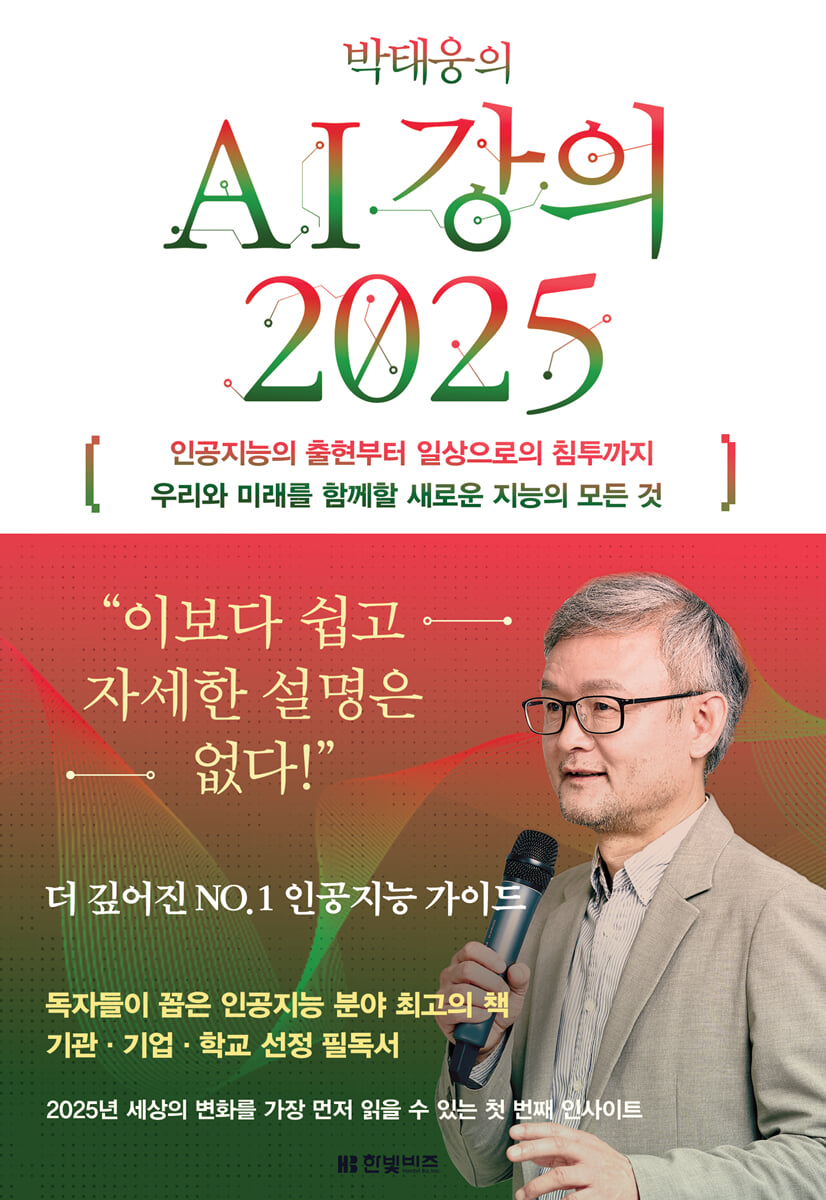
Park Tae-woong's AI Lecture 2025
 |
Description
Book Introduction
Readers' Picks for the Best Books on Artificial Intelligence
The bestseller, "Park Tae-woong's AI Lecture," returns with the latest AI trends! Following the launch of OpenAI's ChatGPT on November 30, 2022, interest in artificial intelligence exploded in 2023, so much so that it could be called the year of the "AI Shock." Shock and amazement have been pouring in since early 2023 over this generative AI that writes like, or even better than, humans. And soon, the bookstores were filled with books about GPT. There are books that explain the identity of ChatGPT and even books co-authored with ChatGPT. Among the flood of AI books pouring out almost daily, there was one book that was overwhelmingly chosen by readers: "AI Lecture by Park Tae-woong," known as the "IT Sage." Deep learning, parameters, tokens, transformers, reinforcement learning, and other concepts that are essential to understanding artificial intelligence but may be unfamiliar and difficult for the general public are easily explained in the author's signature easy-to-understand writing style, helping anyone acquire AI literacy. It was selected as an excellent youth education book in 2023 because it was written at a level that even teenagers could understand, and this year, it was also selected as the best book in the field of artificial intelligence by readers. That very book has returned as "Park Tae-woong's AI Lecture 2025," containing the latest AI trends and deeper insights. While maintaining a simple explanation of the principles of artificial intelligence, the book includes in-depth technical knowledge throughout. It also explores essential AI trends and how AI will shape our future. It also introduces the ideological backgrounds of the super elite leading the AI industry, facilitating a deeper understanding of AI, and offers social insights encompassing AI ethics, risks, and related regulations. This makes the book more than twice as thick. In a word, it has become wider and deeper. If you want "easy yet profound knowledge" about artificial intelligence, I can confidently say that you have no choice but to choose "Park Tae-woong's AI Lecture 2025." |
- You can preview some of the book's contents.
Preview
index
preface
Lecture 1: The Unstoppable Wave of Change: Artificial Intelligence Rapidly Invades Our Work and Lives
The medium is the message
TV is not a 'radio with a monitor attached'
Accelerating change
The evolution of AI
1.
Artificial intelligence as an operating system
2.
Contextual interface
3.
Artificial Intelligence as a Partner
4.
Multimodal
5.
Cheaper, faster, smaller
6.
humanoid robot
The emergence of LLM, a giant language model that surprised everyone in both lectures: The true nature of artificial intelligence revealed through ChatGPT.
Monte Carlo algorithm
Find the cat picture
AI: Finding Potential Patterns
The identity of ChatGPT
I'm good at difficult things, but not good at easy things.
Hallucination, a good lie
unstable artificial intelligence
The emergence of GPT-4
Going deeper
Can AI Become Smarter Than Humans?: The Amazing Power of Generative AI and Recent Technological Trends
Why are we so excited about ChatGPT?
Chain of thought or step-by-step reasoning
Interpretations of ChatGPT's Inference Capabilities
GPT-4 is the beginning of artificial general intelligence.
Does GPT have intelligence?
Why AI is both incredibly smart and shockingly dumb
Speaking and thinking are different
It's a completely different form of intelligence
The Natural Language Interface Revolution: The Changes Created by ChatGPT and LangChain
The AI Trend: Open Source
The strong trend toward miniaturization
The Age of Agents
Welcome to AI Monopoly!
Going deeper
Pandora's Box Opened: The Spread of AI and the Inevitable Impacts
Open AI?
Microsoft Fires AI Ethics Team
Gary Marcus' Five Concerns
Don't Look Up?
The disappearance of the original, the end of the search
natural monopolies
Contaminated data, contaminated results
Faulty learning, reproduction of discrimination
Right to be forgotten and intellectual property rights violations
Lecture 5: How to Build Trustworthy AI: Ethical Principles and Legislation Efforts Around the World
Public Debate: Germany's Green Paper and White Paper
For trustworthy artificial intelligence
Asilomar AI Principles
The Vatican Calls for AI Ethics
European Union's Artificial Intelligence Law
The US Algorithmic Accountability Act of 2022
International movements surrounding AI regulation
unelected super elites
Long-termism, effective altruism, effective accelerationism
Lesson 6: How Should Our Society Respond?: Suggestions for Avoiding Waking Up to Finding Ourself an Underdeveloped Country
How is Korea responding?
A society that does not define justice
What is the Canadian government doing?
National Artificial Intelligence Research Resources Project (NAARRP)
What the South Korean government should and should not do
Conclusion
main
Lecture 1: The Unstoppable Wave of Change: Artificial Intelligence Rapidly Invades Our Work and Lives
The medium is the message
TV is not a 'radio with a monitor attached'
Accelerating change
The evolution of AI
1.
Artificial intelligence as an operating system
2.
Contextual interface
3.
Artificial Intelligence as a Partner
4.
Multimodal
5.
Cheaper, faster, smaller
6.
humanoid robot
The emergence of LLM, a giant language model that surprised everyone in both lectures: The true nature of artificial intelligence revealed through ChatGPT.
Monte Carlo algorithm
Find the cat picture
AI: Finding Potential Patterns
The identity of ChatGPT
I'm good at difficult things, but not good at easy things.
Hallucination, a good lie
unstable artificial intelligence
The emergence of GPT-4
Going deeper
Can AI Become Smarter Than Humans?: The Amazing Power of Generative AI and Recent Technological Trends
Why are we so excited about ChatGPT?
Chain of thought or step-by-step reasoning
Interpretations of ChatGPT's Inference Capabilities
GPT-4 is the beginning of artificial general intelligence.
Does GPT have intelligence?
Why AI is both incredibly smart and shockingly dumb
Speaking and thinking are different
It's a completely different form of intelligence
The Natural Language Interface Revolution: The Changes Created by ChatGPT and LangChain
The AI Trend: Open Source
The strong trend toward miniaturization
The Age of Agents
Welcome to AI Monopoly!
Going deeper
Pandora's Box Opened: The Spread of AI and the Inevitable Impacts
Open AI?
Microsoft Fires AI Ethics Team
Gary Marcus' Five Concerns
Don't Look Up?
The disappearance of the original, the end of the search
natural monopolies
Contaminated data, contaminated results
Faulty learning, reproduction of discrimination
Right to be forgotten and intellectual property rights violations
Lecture 5: How to Build Trustworthy AI: Ethical Principles and Legislation Efforts Around the World
Public Debate: Germany's Green Paper and White Paper
For trustworthy artificial intelligence
Asilomar AI Principles
The Vatican Calls for AI Ethics
European Union's Artificial Intelligence Law
The US Algorithmic Accountability Act of 2022
International movements surrounding AI regulation
unelected super elites
Long-termism, effective altruism, effective accelerationism
Lesson 6: How Should Our Society Respond?: Suggestions for Avoiding Waking Up to Finding Ourself an Underdeveloped Country
How is Korea responding?
A society that does not define justice
What is the Canadian government doing?
National Artificial Intelligence Research Resources Project (NAARRP)
What the South Korean government should and should not do
Conclusion
main
Detailed image

Into the book
In the near future, virtually all software in the world will operate in some form, interfacing with AI. Just as all software running on a PC runs on an operating system, this means that in the future, virtually all software will be integrated with AI.
By the end of 2025, there will likely be more software that integrates with AI than one that doesn't.
--- p.26
There is another special reason for creating humanoids.
This type of humanoid robot is called 'embodied AI'.
What does "having a body" mean? Some AI scientists argue that for AI to truly be "intelligent," it must possess a "body."
That's how you can have a model of the world.
--- p.44
Current large-scale language models cannot eliminate hallucinations.
Because it's like two sides of a coin.
Of course, compared to ChatGPT, hallucination in GPT-4 Turbo is noticeably reduced.
It continues to decrease.
But I don't think it can be eliminated.
--- p.102
This open source culture can be said to be the foundation for the IT industry's ever-accelerating development.
Because once someone writes the code to properly display a chart, everyone on the planet can just use it without having to write it again.
Transformers, Attention, and Rama2, as mentioned earlier, are all open source. In that sense, the IT industry can be considered a melting pot of innovation, where "collective intelligence" operates on a daily basis.
--- p.179
The open source movement is also gaining momentum in AI.
Meta released Rama 3.1 on July 23, 2024 (local time in the US).
Rama3.1 is the largest open-source AI model ever created, with 405 billion parameters.
Meta claimed that this model outperforms OpenAI's GPT-4o and Anthropic's Claude 3.5 Sonnet. GPT-4 is known to have around 1.8 trillion parameters.
It delivers similar performance in less than a third of the size.
--- p.181
The trend toward miniaturization is also gaining momentum.
OpenAI, Microsoft, Google, Meta, Apple, and others are releasing smaller models that rival the performance of larger models that came before.
Miniaturization is inevitable for several reasons.
First of all, current AI uses too many resources.
It is said that it cost 3.7 trillion won to train ChatGPT.
Rama 3.1 ran 16,000 units of the latest GPU H100.
It uses enough electricity to power thousands of households at a time.
It's hard to balance the numbers like this.
--- p.196
OpenAI has not released any specifications or models since GPT-4.
We do not disclose the size of the model, the amount of hardware invested, the dataset used for training, or the training method.
We only exposed the API.
OpenAI cited "corporate confidentiality" as the reason for not revealing this further, but in fact, this attitude seems quite strange considering the founding principles of OpenAI.
“If AI breaks down, something different might need to be done,” said Sam Altman, CEO of OpenAI.
“That’s why no single company should own this type of AI,” he said.
Because of this, OpenAI is being criticized for being essentially a 'closed' AI.
--- p.239
Asilomar becomes the setting for another gathering six years later.
In March 2023, a group of AI and IT experts, including Stuart Russell, Elon Musk (Tesla founder), and Steve Wozniak (Apple co-founder), issued a statement calling for a "stop of large-scale AI experiments."
They said that AI development is spiraling out of control, but without the proper level of planning and management, and that decisions like this should not be left solely to unelected technology leaders.
--- p.283
The debate surrounding AI legislation demonstrates that while the industry sometimes argues for regulation of large models and even announces its own commitments, it is reluctant to actually shoulder the burden.
It is also possible to speculate that, contrary to the claims of the opposition, they are not aware of the possibility of actual danger occurring.
As Professor Hinton and others point out in their letter, “if these risks were truly science fiction, then companies should have no problem taking responsibility for mitigating them.”
--- p.347
The problem is that they are in charge of developing major artificial intelligence projects around the world.
So to speak, we could say that we are being forced to adopt their ideas without even knowing it.
The 'unelected super elite' may not only monopolize the development of artificial intelligence, but also monopolize ideology.
This is another reason why establishing international regulations and norms for the development of artificial intelligence is so urgent and important.
--- p.363
The reason the United States, Germany, and the United Kingdom have become advanced countries and can attract talent from around the world is because they have world-class universities and research institutes.
We now have less than half of our universities with even one basic science department.
It is taken for granted that talented doctoral students do not advance to domestic universities but rather study abroad.
It's sadly shabby compared to how developed countries use their world-class universities to attract talent from around the world like magnets.
If the government fails to change the pace of its science and technology policies and abandons the attitude and strategies of a latecomer, we may soon find ourselves back in the dark as a developing country.
By the end of 2025, there will likely be more software that integrates with AI than one that doesn't.
--- p.26
There is another special reason for creating humanoids.
This type of humanoid robot is called 'embodied AI'.
What does "having a body" mean? Some AI scientists argue that for AI to truly be "intelligent," it must possess a "body."
That's how you can have a model of the world.
--- p.44
Current large-scale language models cannot eliminate hallucinations.
Because it's like two sides of a coin.
Of course, compared to ChatGPT, hallucination in GPT-4 Turbo is noticeably reduced.
It continues to decrease.
But I don't think it can be eliminated.
--- p.102
This open source culture can be said to be the foundation for the IT industry's ever-accelerating development.
Because once someone writes the code to properly display a chart, everyone on the planet can just use it without having to write it again.
Transformers, Attention, and Rama2, as mentioned earlier, are all open source. In that sense, the IT industry can be considered a melting pot of innovation, where "collective intelligence" operates on a daily basis.
--- p.179
The open source movement is also gaining momentum in AI.
Meta released Rama 3.1 on July 23, 2024 (local time in the US).
Rama3.1 is the largest open-source AI model ever created, with 405 billion parameters.
Meta claimed that this model outperforms OpenAI's GPT-4o and Anthropic's Claude 3.5 Sonnet. GPT-4 is known to have around 1.8 trillion parameters.
It delivers similar performance in less than a third of the size.
--- p.181
The trend toward miniaturization is also gaining momentum.
OpenAI, Microsoft, Google, Meta, Apple, and others are releasing smaller models that rival the performance of larger models that came before.
Miniaturization is inevitable for several reasons.
First of all, current AI uses too many resources.
It is said that it cost 3.7 trillion won to train ChatGPT.
Rama 3.1 ran 16,000 units of the latest GPU H100.
It uses enough electricity to power thousands of households at a time.
It's hard to balance the numbers like this.
--- p.196
OpenAI has not released any specifications or models since GPT-4.
We do not disclose the size of the model, the amount of hardware invested, the dataset used for training, or the training method.
We only exposed the API.
OpenAI cited "corporate confidentiality" as the reason for not revealing this further, but in fact, this attitude seems quite strange considering the founding principles of OpenAI.
“If AI breaks down, something different might need to be done,” said Sam Altman, CEO of OpenAI.
“That’s why no single company should own this type of AI,” he said.
Because of this, OpenAI is being criticized for being essentially a 'closed' AI.
--- p.239
Asilomar becomes the setting for another gathering six years later.
In March 2023, a group of AI and IT experts, including Stuart Russell, Elon Musk (Tesla founder), and Steve Wozniak (Apple co-founder), issued a statement calling for a "stop of large-scale AI experiments."
They said that AI development is spiraling out of control, but without the proper level of planning and management, and that decisions like this should not be left solely to unelected technology leaders.
--- p.283
The debate surrounding AI legislation demonstrates that while the industry sometimes argues for regulation of large models and even announces its own commitments, it is reluctant to actually shoulder the burden.
It is also possible to speculate that, contrary to the claims of the opposition, they are not aware of the possibility of actual danger occurring.
As Professor Hinton and others point out in their letter, “if these risks were truly science fiction, then companies should have no problem taking responsibility for mitigating them.”
--- p.347
The problem is that they are in charge of developing major artificial intelligence projects around the world.
So to speak, we could say that we are being forced to adopt their ideas without even knowing it.
The 'unelected super elite' may not only monopolize the development of artificial intelligence, but also monopolize ideology.
This is another reason why establishing international regulations and norms for the development of artificial intelligence is so urgent and important.
--- p.363
The reason the United States, Germany, and the United Kingdom have become advanced countries and can attract talent from around the world is because they have world-class universities and research institutes.
We now have less than half of our universities with even one basic science department.
It is taken for granted that talented doctoral students do not advance to domestic universities but rather study abroad.
It's sadly shabby compared to how developed countries use their world-class universities to attract talent from around the world like magnets.
If the government fails to change the pace of its science and technology policies and abandons the attitude and strategies of a latecomer, we may soon find ourselves back in the dark as a developing country.
--- pp.395-396
Publisher's Review
The first insight to read the changes in the world in 2025.
Six AI Trends That Will Transform Work and Life
After the release of ChatGPT, OpenAI surprised the world again by releasing GPT-4 and GPT-4o this year.
Beyond simple text conversations, multimodal artificial intelligence has emerged that can simultaneously process audio, images, and videos.
And that's not all.
Microsoft has launched 'Copilot+PC' that runs on PCs, Google has 'Project Astra', and Apple has 'Apple Intelligence'.
All three are small artificial intelligence devices that can be used on smartphones and PCs, and are the personal AI secretaries we have seen in movies.
In addition, faster and smarter AI models are being released one after another, such as Meta's Rama 3.1, Anthropic's Claude, and Mistral Raji 2.
That's why the author says that when looking at the AI field, "it feels like several years' worth of time passes in a month."
This book points out the rapidly changing trends in artificial intelligence as follows:
This is a neat summary of how AI is currently developing, what trends are present, and what we should look for in six keywords.
1. AI as OS: AI that takes on the role of an operating system.
All software and services will be linked with artificial intelligence.
2.
Contextual Interface: The emergence of a new interface that understands context.
There will come a time when you no longer have to sort or search for information.
3. AI as a Partner: Artificial intelligence as a partner.
Artificial intelligence will become an indispensable partner in every task humans perform.
4.
Multimodal: AI that processes everything simultaneously, including text, images, videos, and songs.
It can go beyond multimodal to omnimodal.
5.
Cheaper, Faster, Smaller: Becoming smaller, faster, and cheaper.
Artificial intelligence running on smartphones, your own personal agent, will become commonplace.
6.
Humanoid: The emergence of AI with a body.
Humanoids that see, hear, move, and learn like humans will rise to mainstream status.
All six of these are phenomena that are becoming a reality right now, not in the distant future.
We cannot help but pay attention to this because it will only accelerate further.
The world is changing so rapidly.
Things will change even more rapidly in 2025.
That's why we desperately need knowledge about AI and an understanding of the world that AI will transform.
If you want to seize the future before others and don't miss any opportunities, "Park Tae-woong's AI Lecture 2025" will be the No. 1 guide to preparing for the age of artificial intelligence.
Everything about the new intelligence that will accompany us into the future
From the emergence of AI to the resulting risks and countermeasures
"Park Tae-woong's AI Lecture 2025" serves as a comprehensive guide to fostering "AI literacy." Beginning with an examination of the birth and development of AI, as well as its impact, it discusses the role AI plays in our society and daily lives, and how it will evolve in the future.
It also examines the ethical issues and potential risks behind AI technology, helping us wisely prepare for a future that will become increasingly intertwined with artificial intelligence.
In particular, this book devotes a significant portion of its time to pointing out the unethical policies of large AI companies, safety concerns, and the lack of transparency in the AI development process. Reading the author's words, which reflect on the serious problems AI will bring, such as data bias, privacy violations, and deepening social inequality, and emphasize the need for responsible management and control of AI, allows readers to understand what true "AI literacy" truly means.
Also, everyone will nod in agreement in the six lectures that suggest how Korea should respond to the AI era to avoid becoming a "backward country" by waking up.
“AI is a pervasive technology,” the author says.
Because artificial intelligence will have a significant impact on most areas of our lives, and is already having a significant impact.
No one can say for sure what the future holds for us, but one thing is certain: we are witnessing a time of great transformation.
That is why AI literacy is so important.
Only by first understanding what is happening now can we find countermeasures.
In this respect, 『Park Tae-woong's AI Lecture 2025』 will serve as a constant guide for you.
Six AI Trends That Will Transform Work and Life
After the release of ChatGPT, OpenAI surprised the world again by releasing GPT-4 and GPT-4o this year.
Beyond simple text conversations, multimodal artificial intelligence has emerged that can simultaneously process audio, images, and videos.
And that's not all.
Microsoft has launched 'Copilot+PC' that runs on PCs, Google has 'Project Astra', and Apple has 'Apple Intelligence'.
All three are small artificial intelligence devices that can be used on smartphones and PCs, and are the personal AI secretaries we have seen in movies.
In addition, faster and smarter AI models are being released one after another, such as Meta's Rama 3.1, Anthropic's Claude, and Mistral Raji 2.
That's why the author says that when looking at the AI field, "it feels like several years' worth of time passes in a month."
This book points out the rapidly changing trends in artificial intelligence as follows:
This is a neat summary of how AI is currently developing, what trends are present, and what we should look for in six keywords.
1. AI as OS: AI that takes on the role of an operating system.
All software and services will be linked with artificial intelligence.
2.
Contextual Interface: The emergence of a new interface that understands context.
There will come a time when you no longer have to sort or search for information.
3. AI as a Partner: Artificial intelligence as a partner.
Artificial intelligence will become an indispensable partner in every task humans perform.
4.
Multimodal: AI that processes everything simultaneously, including text, images, videos, and songs.
It can go beyond multimodal to omnimodal.
5.
Cheaper, Faster, Smaller: Becoming smaller, faster, and cheaper.
Artificial intelligence running on smartphones, your own personal agent, will become commonplace.
6.
Humanoid: The emergence of AI with a body.
Humanoids that see, hear, move, and learn like humans will rise to mainstream status.
All six of these are phenomena that are becoming a reality right now, not in the distant future.
We cannot help but pay attention to this because it will only accelerate further.
The world is changing so rapidly.
Things will change even more rapidly in 2025.
That's why we desperately need knowledge about AI and an understanding of the world that AI will transform.
If you want to seize the future before others and don't miss any opportunities, "Park Tae-woong's AI Lecture 2025" will be the No. 1 guide to preparing for the age of artificial intelligence.
Everything about the new intelligence that will accompany us into the future
From the emergence of AI to the resulting risks and countermeasures
"Park Tae-woong's AI Lecture 2025" serves as a comprehensive guide to fostering "AI literacy." Beginning with an examination of the birth and development of AI, as well as its impact, it discusses the role AI plays in our society and daily lives, and how it will evolve in the future.
It also examines the ethical issues and potential risks behind AI technology, helping us wisely prepare for a future that will become increasingly intertwined with artificial intelligence.
In particular, this book devotes a significant portion of its time to pointing out the unethical policies of large AI companies, safety concerns, and the lack of transparency in the AI development process. Reading the author's words, which reflect on the serious problems AI will bring, such as data bias, privacy violations, and deepening social inequality, and emphasize the need for responsible management and control of AI, allows readers to understand what true "AI literacy" truly means.
Also, everyone will nod in agreement in the six lectures that suggest how Korea should respond to the AI era to avoid becoming a "backward country" by waking up.
“AI is a pervasive technology,” the author says.
Because artificial intelligence will have a significant impact on most areas of our lives, and is already having a significant impact.
No one can say for sure what the future holds for us, but one thing is certain: we are witnessing a time of great transformation.
That is why AI literacy is so important.
Only by first understanding what is happening now can we find countermeasures.
In this respect, 『Park Tae-woong's AI Lecture 2025』 will serve as a constant guide for you.
GOODS SPECIFICS
- Date of issue: September 30, 2024
- Page count, weight, size: 420 pages | 580g | 140*205*30mm
- ISBN13: 9791157847679
You may also like
카테고리
korean


korean

![GQ KOREA Mark (Monthly): December [2025]](http://librairie.coreenne.fr/cdn/shop/files/8ef265dbbfbf186523ed75ba7319009d.jpg?v=1765340328&width=3840)


