

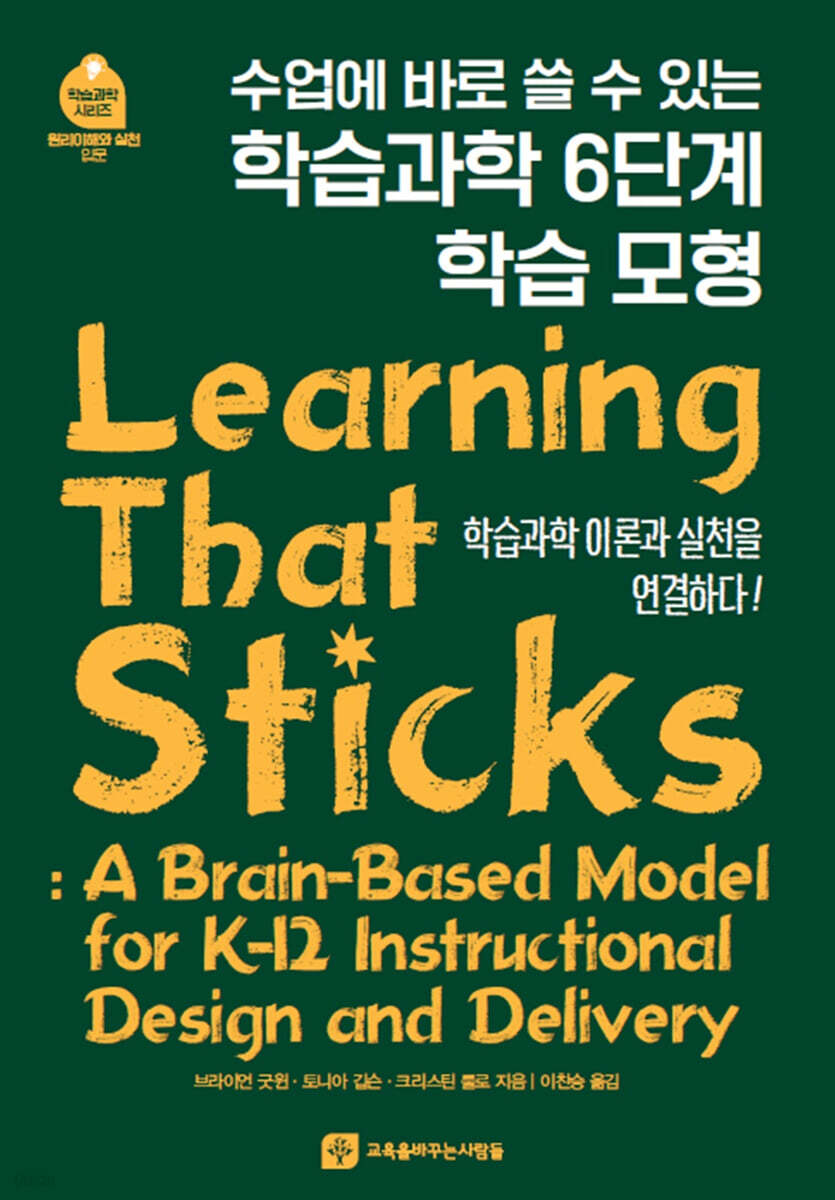
A 6-Step Learning Science Model for Classroom Use
 |
Description
Book Introduction
Learning that Lasts: A 6-Step Learning Model Based on Learning Science
Based on the latest brain science and learning theory, this book divides the learning process into six stages, guiding students to effectively process information and form long-lasting memories.
The most significant feature of this book is that it allows for a close analysis of each stage of the learning process to see what happens in a student's mind while learning.
For teachers, students' minds are like mysterious "black boxes," so when learning isn't going well, they often don't know what's wrong or what to do differently to help students learn.
This book illuminates the inside of that black box, providing concrete help to achieve the most effective learning based on the fundamental principles of learning science.
In other words, it provides a six-stage learning model based on the brain's information processing method, allowing us to view the learning process from beginning to end and see in detail what is happening in students' minds at each stage.
Now, teachers will be able to teach with clearer intention, going beyond just what to teach to understanding when, how, and why.
You will also have a clearer idea of how to respond when problems arise or when students struggle to master new learning.
Packed with practical solutions that will revolutionize teaching and learning through student-centered learning design and a learning science approach, this book will be a great inspiration to both new and veteran teachers.
Based on the latest brain science and learning theory, this book divides the learning process into six stages, guiding students to effectively process information and form long-lasting memories.
The most significant feature of this book is that it allows for a close analysis of each stage of the learning process to see what happens in a student's mind while learning.
For teachers, students' minds are like mysterious "black boxes," so when learning isn't going well, they often don't know what's wrong or what to do differently to help students learn.
This book illuminates the inside of that black box, providing concrete help to achieve the most effective learning based on the fundamental principles of learning science.
In other words, it provides a six-stage learning model based on the brain's information processing method, allowing us to view the learning process from beginning to end and see in detail what is happening in students' minds at each stage.
Now, teachers will be able to teach with clearer intention, going beyond just what to teach to understanding when, how, and why.
You will also have a clearer idea of how to respond when problems arise or when students struggle to master new learning.
Packed with practical solutions that will revolutionize teaching and learning through student-centered learning design and a learning science approach, this book will be a great inspiration to both new and veteran teachers.
- You can preview some of the book's contents.
Preview
index
Introduction Why a Learning Model?
Learn Memorable Teaching and Learning Methods 16
A Look Inside Students' "Black Boxes" 17
19 Reasons You Need This Book
Lesson 21 with Learning in Mind
Bridging the Gap Between Educational Research and Learning Science 22
Learning model provided 24
Learning Model 26, Not Another Framework
Structure of this book 28
It's not a destination, it's a starting point 30
Chapter 1: Understanding Learning Science
Information Processing Model 33
Memory Stage 35
Sensory Register: Finding Signal in Noise 36
-Momentary Memory: First 30 seconds 39
-Short-term working memory: up to 20 minutes 41
Long-term memory: Memories that can last a lifetime 43
Applying the Science of Memory to Learning Models 46
-Sensory register and momentary memory 46
-Working memory 48
-Long-term memory 49
Integrating the entire process 50
Chapter 2: Getting Interested (Step 1)
Living and Learning in an Age of Sensory Overload 62
The Effects of Emotional Disturbance on Attention 63
Brain stimulus processing priority 65
A collection of tools for use in the classroom
- Show interest in students 68
-Connecting learning with positive emotions 72
- Stimulate curiosity 75
Activating prior knowledge and revealing knowledge gaps 80
Structuring Academic Debate 82
-Change the Class 84
Big idea
- Accelerate learning by stimulating natural curiosity 86
Chapter 3: Focus on Learning (Step 2)
Turning Boredom into Immersion 90
- Helping students find meaning and purpose in their learning 91
- Persuade your brain to learn something new by activating it 92
-Balance of extrinsic and intrinsic rewards 94
A collection of tools for use in the classroom
- What does this learning mean to me? (WIIFM) 96
-Frame learning as an exploration of important questions 98
-Provide learning objectives and success criteria 100
-Providing a Path to Mastery 104
- Encourage personal learning goals 106
- Supporting students to strive 108
Big idea
Connecting the "Why" and the "What" to Inspire Motivation to Learn 112
Chapter 4: Focusing on New Learning (Step 3)
The Science of Attention 117
-Using images and text together 120
-Explaining abstract concepts with concrete examples 120
-Problem Solving with Solved Examples 122
The Power of Self-Questioning 123
-Note 124
A collection of tools for use in the classroom
-Using Nonverbal Representations 127
-Show and explain 129
- Demonstration of mastery level through direct guidance 130
- Alternate between solved examples and problems to be solved 131
-Teaching self-questioning and careful reading 133
- Actively taking notes 135
Big idea
-Learn more effectively when organized through pictures, words, and thoughts 138
Chapter 5: Understanding Learning (Step 4)
The Science of Understanding 141
The Mystery of Encoding 143
-Deciphering the Encryption Code 144
- Complex Neural Networks 146
-Magic number 7 (or 4) 147
The brain instinctively seeks out patterns—good or bad. 148
-The brain needs a break sometimes 150
-We only encode what we think 152
-Learning through connection 153
Changing your learning style can keep your brain engaged. 155
A collection of tools for use in the classroom
- Break the content down into short segments for effective learning 157
- Asking Exploratory Questions 158
-Provide time to think after asking a question 161
-Supporting learning through collaborative groups 163
- Identifying Similarities and Differences 166
-Summary of learning content 169
Big idea
- Take time to understand the learning content 174
Chapter 6: Practice and Reflection (Step 5)
The Science of Implanting Memories 179
-Repeat, repeat, repeat 179
-Strengthening memory with spaced repetition 181
Cross-training is difficult, but much more effective. 184
-Place, Place, Place 187
-Roll your head to remember 189
- Find and fix bugs 192
-Summary 195
A collection of tools for use in the classroom
- Observe and guide the initial practice phase 197
-Checking understanding 199
-Providing formative feedback 203
- Cross-practice and spaced independent practice 206
-Teaching Effective Practice Methods 209
Big idea
-Strengthening memory through repeated learning 212
Chapter 7: Expanding and Applying (Step 6)
The Scientific Principles of Deep Learning 219
-Connecting what you're learning to yourself 221
Asking Yourself Deeper Questions 224
The Importance of Self-Description 226
-Building a Cognitive Model 228
- Thinking Critically About Cognitive Models 231
-Meta-approach (thinking about your own thoughts) 234
A collection of tools for use in the classroom
-Providing challenging learning tasks 236
- Supporting inquiry-based learning 239
-Visualizing students' thought processes 244
-Teaching Critical Thinking 245
-Improving Thinking Skills through Writing 248
-Linking learning to performance assessment 251
Big idea
- Helping students develop richer cognitive models 255
Chapter 8: The Way Forward
A 'meta' approach to building expertise 258
- Reflecting on Teaching Methods Using Learning Models 261
-Diagnosing Student Learning Using Learning Models 262
- Supporting professionalism and camaraderie through learning models 263
Frequently Asked Questions 265
Should I help students feel interested in each class? 266
Should students be immersed in learning objectives? 266
-Do all classes require an "Expand and Apply" step? 267
-Does the learning model meet the core question? 267
-The learning model appears sequential.
Is Learning Really That Linear? 268
Can I teach this learning model to students? 270
Instilling Curiosity and Joy in Teaching and Learning 271
The Brain in Its Original State: The Greedy Learner 271
Teaching Methods that Use Curiosity 273
-Making learning easier and more enjoyable 274
Create Your Own Model 275
Search 278
Reference 283
Learn Memorable Teaching and Learning Methods 16
A Look Inside Students' "Black Boxes" 17
19 Reasons You Need This Book
Lesson 21 with Learning in Mind
Bridging the Gap Between Educational Research and Learning Science 22
Learning model provided 24
Learning Model 26, Not Another Framework
Structure of this book 28
It's not a destination, it's a starting point 30
Chapter 1: Understanding Learning Science
Information Processing Model 33
Memory Stage 35
Sensory Register: Finding Signal in Noise 36
-Momentary Memory: First 30 seconds 39
-Short-term working memory: up to 20 minutes 41
Long-term memory: Memories that can last a lifetime 43
Applying the Science of Memory to Learning Models 46
-Sensory register and momentary memory 46
-Working memory 48
-Long-term memory 49
Integrating the entire process 50
Chapter 2: Getting Interested (Step 1)
Living and Learning in an Age of Sensory Overload 62
The Effects of Emotional Disturbance on Attention 63
Brain stimulus processing priority 65
A collection of tools for use in the classroom
- Show interest in students 68
-Connecting learning with positive emotions 72
- Stimulate curiosity 75
Activating prior knowledge and revealing knowledge gaps 80
Structuring Academic Debate 82
-Change the Class 84
Big idea
- Accelerate learning by stimulating natural curiosity 86
Chapter 3: Focus on Learning (Step 2)
Turning Boredom into Immersion 90
- Helping students find meaning and purpose in their learning 91
- Persuade your brain to learn something new by activating it 92
-Balance of extrinsic and intrinsic rewards 94
A collection of tools for use in the classroom
- What does this learning mean to me? (WIIFM) 96
-Frame learning as an exploration of important questions 98
-Provide learning objectives and success criteria 100
-Providing a Path to Mastery 104
- Encourage personal learning goals 106
- Supporting students to strive 108
Big idea
Connecting the "Why" and the "What" to Inspire Motivation to Learn 112
Chapter 4: Focusing on New Learning (Step 3)
The Science of Attention 117
-Using images and text together 120
-Explaining abstract concepts with concrete examples 120
-Problem Solving with Solved Examples 122
The Power of Self-Questioning 123
-Note 124
A collection of tools for use in the classroom
-Using Nonverbal Representations 127
-Show and explain 129
- Demonstration of mastery level through direct guidance 130
- Alternate between solved examples and problems to be solved 131
-Teaching self-questioning and careful reading 133
- Actively taking notes 135
Big idea
-Learn more effectively when organized through pictures, words, and thoughts 138
Chapter 5: Understanding Learning (Step 4)
The Science of Understanding 141
The Mystery of Encoding 143
-Deciphering the Encryption Code 144
- Complex Neural Networks 146
-Magic number 7 (or 4) 147
The brain instinctively seeks out patterns—good or bad. 148
-The brain needs a break sometimes 150
-We only encode what we think 152
-Learning through connection 153
Changing your learning style can keep your brain engaged. 155
A collection of tools for use in the classroom
- Break the content down into short segments for effective learning 157
- Asking Exploratory Questions 158
-Provide time to think after asking a question 161
-Supporting learning through collaborative groups 163
- Identifying Similarities and Differences 166
-Summary of learning content 169
Big idea
- Take time to understand the learning content 174
Chapter 6: Practice and Reflection (Step 5)
The Science of Implanting Memories 179
-Repeat, repeat, repeat 179
-Strengthening memory with spaced repetition 181
Cross-training is difficult, but much more effective. 184
-Place, Place, Place 187
-Roll your head to remember 189
- Find and fix bugs 192
-Summary 195
A collection of tools for use in the classroom
- Observe and guide the initial practice phase 197
-Checking understanding 199
-Providing formative feedback 203
- Cross-practice and spaced independent practice 206
-Teaching Effective Practice Methods 209
Big idea
-Strengthening memory through repeated learning 212
Chapter 7: Expanding and Applying (Step 6)
The Scientific Principles of Deep Learning 219
-Connecting what you're learning to yourself 221
Asking Yourself Deeper Questions 224
The Importance of Self-Description 226
-Building a Cognitive Model 228
- Thinking Critically About Cognitive Models 231
-Meta-approach (thinking about your own thoughts) 234
A collection of tools for use in the classroom
-Providing challenging learning tasks 236
- Supporting inquiry-based learning 239
-Visualizing students' thought processes 244
-Teaching Critical Thinking 245
-Improving Thinking Skills through Writing 248
-Linking learning to performance assessment 251
Big idea
- Helping students develop richer cognitive models 255
Chapter 8: The Way Forward
A 'meta' approach to building expertise 258
- Reflecting on Teaching Methods Using Learning Models 261
-Diagnosing Student Learning Using Learning Models 262
- Supporting professionalism and camaraderie through learning models 263
Frequently Asked Questions 265
Should I help students feel interested in each class? 266
Should students be immersed in learning objectives? 266
-Do all classes require an "Expand and Apply" step? 267
-Does the learning model meet the core question? 267
-The learning model appears sequential.
Is Learning Really That Linear? 268
Can I teach this learning model to students? 270
Instilling Curiosity and Joy in Teaching and Learning 271
The Brain in Its Original State: The Greedy Learner 271
Teaching Methods that Use Curiosity 273
-Making learning easier and more enjoyable 274
Create Your Own Model 275
Search 278
Reference 283
Detailed image
.jpg)
Into the book
Would you undergo brain surgery from a doctor who doesn't understand the anatomy of the brain or how various surgical techniques affect it? Education, while not involving a scalpel, is in some ways like performing brain surgery on students in a classroom all year long.
To do this well, you need to have some understanding of how the brain works and be able to use that understanding to design your students' learning experiences.
--- p.15
It's not necessarily the teachers' fault, but many teachers don't have a good understanding of how learning actually takes place.
For some reason, cognitive science, a representative field of the science of learning, is not sufficiently covered in most teacher training programs despite its long history and importance.
In fact, a study of dozens of textbooks popular in teacher preparation programs revealed that none accurately explained six key teaching strategies based on learning science: distributed practice, crossed practice, retrieval practice, feedback-based improvement, dual encoding, and elaboration (Greenberg, Pomerance, & Walsh, 2016).
New teachers are not learning even the most basic information and skills necessary to effectively perform their roles as teachers.
--- p.16
Meanwhile, we also met with several principals who constantly urged us to use effective teaching strategies.
For example, they persistently demanded that teachers use classroom activities that compare and contrast similarities and differences, but teachers often had no clear idea when or why they should do this.
While in some ways these principals may be pursuing the right direction, their reasons are often superficial or based on misunderstandings.
--- p.19~20
Still, teachers often designed their lessons solely around their lesson plans, rather than what they wanted students to do or think.
Although they follow a lesson plan template, they rarely consider what should happen in the students' minds at each step.
As a result, classes often ended up being a series of activities that failed to engage or challenge students.
In short, the focus of classes was often on the teacher's teaching rather than on the student's learning.
--- p.21
What's most unique about this book is that it provides a learning model based on core learning science ideas that can be applied in the classroom.
Providing such models is a core insight of learning science itself, namely, “the ability to extract key ideas from new data and construct cognitive models (mental models, a cognitive structure or frame used to solve a given problem or understand a situation, refers to an internal representation or structure formed based on previous experience and learning).
This reflects the fact that “we learn best when organized into mental models (often confused with mental models - translator’s note)” (Brown, Roediger, McDaniel, 2014, p.6)
--- p.24
The "six-step learning model based on learning science" introduced in this book is not structured around the steps teachers take to conduct classes (e.g., starting class, checking for understanding, providing practice opportunities).
Rather, it is structured around the steps students must take to engage in deep learning, and this is what makes this model unique.
This book aims to expand thinking and 'flipping' students' minds to consider what's going on in their heads during class.
This allows us to devise instructional approaches that guide and support learning.
In short, the most important thing is not what the teacher teaches, but what the student learns.
--- p.28
It is important to note that this book is not a step-by-step checklist for teachers.
This book is not a manual that teachers must follow step by step in order.
Because the actual learning process is often complex and iterative, you will realize that these learning steps do not always proceed linearly.
In short, this learning model is not intended to be a rigid set of guidelines that teachers must strictly adhere to, but rather a tool to help them develop and apply creative and effective teaching methods.
Understanding and applying learning science goes beyond simple teaching methods.
The key is to help teachers gain a deeper understanding of their teaching methods and students' learning processes, and to reflect on and improve their teaching practices based on this understanding.
--- p.30
The six-step learning model is based on the assumption that intrinsic motivation, not punishment or extrinsic rewards, is the true key to deep learning.
All learning is possible only when the learner participates voluntarily in the process.
We can persuade, bribe, or coerce someone, but we cannot force them to learn something.
Ultimately, learning only happens when learners decide to learn or accept to learn.
--- p.59
Social psychologist Jonathan Haidt described the interaction between these two domains with the metaphor of “elephant and rider” (2006).
The logical, conscious brain would like to think it's in charge, but in reality it's just a rider on a giant elephant of emotions and unconscious reactions.
Sometimes the rider controls the elephant, but most of the time the elephant goes where it wants, and the rider later justifies his actions and feelings.
--- p.72
The essence of curiosity is recognizing that there are gaps in your knowledge and wanting to fill them.
Basically, our brain hates gaps in knowledge and wants to fill them.
However, if the gap feels too large to fill, you are less likely to engage in learning.
--- p.81
When designing learning, it's important to provide opportunities to pause and process what you're learning so you can organize and understand what you're learning.
That means being able to connect with each other, find similarities and differences, and share thoughts about what you're learning with others.
At this time, 5 minutes is appropriate for younger students and up to 10 minutes for older students.
If you're explaining something for more than 10 minutes, it's a good idea to pause and give students time to digest the material.
This process does not stop you from learning, but rather helps you remember what you have learned better.
--- p.157~158
Why do some memories remain and others fade? Why do we store some memories but can't retrieve them, or why do we only recall them after a final exam? As we'll see, many of the ways our brains store new learning for later retrieval are often misunderstood.
...
One important principle is that storing and retrieving memories are different processes, requiring different procedures and conditions.
--- p.178
The important point is that retrieval practice activates neural networks more powerfully than simply rereading or reviewing.
Rereading notes or having a teacher remind you of previously learned material, like focused practice or block practice, only creates the illusion of knowledge and does not actually lead to long-term memory retention (Brown et al., 2014).
--- p.190
On average, teachers spend about 70-80% of their class time speaking (Hattie, 2012).
But the less the teacher talks, the more the student learns, and the more the teacher knows about what the student is thinking and learning.
Breaking up lessons into 5-10 minute chunks that allow students to process information, interact, and share their thoughts can help restore this balance.
--- p.201
To learn something deeply, you need an inner voice that guides you to stop and analyze when you don't understand.
We need a voice that connects what we learn to our personal experiences, and we need an ongoing internal dialogue that summarizes what we learn and derives principles that can be applied to other situations.
Conversely, without metacognitive thinking, learning will likely remain fragmented and discontinuous information, which will likely lose meaning and usefulness and quickly fade from memory.
--- p.235
According to a meta-analysis of critical thinking approaches (Bangert-Drowns & Bankert, 1990), critical thinking does not develop automatically.
Simply exposing students to literature, science, history, or logical arguments will not significantly improve their critical thinking skills.
We need to teach people how to think critically and provide them with opportunities to practice it.
--- p.246
This is precisely the beauty of the human brain.
Especially when we set our minds to learning something, our brains become amazing learning machines.
In fact, that is the very point of this book.
The learning model described here attempts to follow and leverage the way the brain naturally learns.
Learning that occurs through self-motivated inquiry, where you pursue your curiosity and become immersed in a personally meaningful and relevant skill, losing track of time.
To do this well, you need to have some understanding of how the brain works and be able to use that understanding to design your students' learning experiences.
--- p.15
It's not necessarily the teachers' fault, but many teachers don't have a good understanding of how learning actually takes place.
For some reason, cognitive science, a representative field of the science of learning, is not sufficiently covered in most teacher training programs despite its long history and importance.
In fact, a study of dozens of textbooks popular in teacher preparation programs revealed that none accurately explained six key teaching strategies based on learning science: distributed practice, crossed practice, retrieval practice, feedback-based improvement, dual encoding, and elaboration (Greenberg, Pomerance, & Walsh, 2016).
New teachers are not learning even the most basic information and skills necessary to effectively perform their roles as teachers.
--- p.16
Meanwhile, we also met with several principals who constantly urged us to use effective teaching strategies.
For example, they persistently demanded that teachers use classroom activities that compare and contrast similarities and differences, but teachers often had no clear idea when or why they should do this.
While in some ways these principals may be pursuing the right direction, their reasons are often superficial or based on misunderstandings.
--- p.19~20
Still, teachers often designed their lessons solely around their lesson plans, rather than what they wanted students to do or think.
Although they follow a lesson plan template, they rarely consider what should happen in the students' minds at each step.
As a result, classes often ended up being a series of activities that failed to engage or challenge students.
In short, the focus of classes was often on the teacher's teaching rather than on the student's learning.
--- p.21
What's most unique about this book is that it provides a learning model based on core learning science ideas that can be applied in the classroom.
Providing such models is a core insight of learning science itself, namely, “the ability to extract key ideas from new data and construct cognitive models (mental models, a cognitive structure or frame used to solve a given problem or understand a situation, refers to an internal representation or structure formed based on previous experience and learning).
This reflects the fact that “we learn best when organized into mental models (often confused with mental models - translator’s note)” (Brown, Roediger, McDaniel, 2014, p.6)
--- p.24
The "six-step learning model based on learning science" introduced in this book is not structured around the steps teachers take to conduct classes (e.g., starting class, checking for understanding, providing practice opportunities).
Rather, it is structured around the steps students must take to engage in deep learning, and this is what makes this model unique.
This book aims to expand thinking and 'flipping' students' minds to consider what's going on in their heads during class.
This allows us to devise instructional approaches that guide and support learning.
In short, the most important thing is not what the teacher teaches, but what the student learns.
--- p.28
It is important to note that this book is not a step-by-step checklist for teachers.
This book is not a manual that teachers must follow step by step in order.
Because the actual learning process is often complex and iterative, you will realize that these learning steps do not always proceed linearly.
In short, this learning model is not intended to be a rigid set of guidelines that teachers must strictly adhere to, but rather a tool to help them develop and apply creative and effective teaching methods.
Understanding and applying learning science goes beyond simple teaching methods.
The key is to help teachers gain a deeper understanding of their teaching methods and students' learning processes, and to reflect on and improve their teaching practices based on this understanding.
--- p.30
The six-step learning model is based on the assumption that intrinsic motivation, not punishment or extrinsic rewards, is the true key to deep learning.
All learning is possible only when the learner participates voluntarily in the process.
We can persuade, bribe, or coerce someone, but we cannot force them to learn something.
Ultimately, learning only happens when learners decide to learn or accept to learn.
--- p.59
Social psychologist Jonathan Haidt described the interaction between these two domains with the metaphor of “elephant and rider” (2006).
The logical, conscious brain would like to think it's in charge, but in reality it's just a rider on a giant elephant of emotions and unconscious reactions.
Sometimes the rider controls the elephant, but most of the time the elephant goes where it wants, and the rider later justifies his actions and feelings.
--- p.72
The essence of curiosity is recognizing that there are gaps in your knowledge and wanting to fill them.
Basically, our brain hates gaps in knowledge and wants to fill them.
However, if the gap feels too large to fill, you are less likely to engage in learning.
--- p.81
When designing learning, it's important to provide opportunities to pause and process what you're learning so you can organize and understand what you're learning.
That means being able to connect with each other, find similarities and differences, and share thoughts about what you're learning with others.
At this time, 5 minutes is appropriate for younger students and up to 10 minutes for older students.
If you're explaining something for more than 10 minutes, it's a good idea to pause and give students time to digest the material.
This process does not stop you from learning, but rather helps you remember what you have learned better.
--- p.157~158
Why do some memories remain and others fade? Why do we store some memories but can't retrieve them, or why do we only recall them after a final exam? As we'll see, many of the ways our brains store new learning for later retrieval are often misunderstood.
...
One important principle is that storing and retrieving memories are different processes, requiring different procedures and conditions.
--- p.178
The important point is that retrieval practice activates neural networks more powerfully than simply rereading or reviewing.
Rereading notes or having a teacher remind you of previously learned material, like focused practice or block practice, only creates the illusion of knowledge and does not actually lead to long-term memory retention (Brown et al., 2014).
--- p.190
On average, teachers spend about 70-80% of their class time speaking (Hattie, 2012).
But the less the teacher talks, the more the student learns, and the more the teacher knows about what the student is thinking and learning.
Breaking up lessons into 5-10 minute chunks that allow students to process information, interact, and share their thoughts can help restore this balance.
--- p.201
To learn something deeply, you need an inner voice that guides you to stop and analyze when you don't understand.
We need a voice that connects what we learn to our personal experiences, and we need an ongoing internal dialogue that summarizes what we learn and derives principles that can be applied to other situations.
Conversely, without metacognitive thinking, learning will likely remain fragmented and discontinuous information, which will likely lose meaning and usefulness and quickly fade from memory.
--- p.235
According to a meta-analysis of critical thinking approaches (Bangert-Drowns & Bankert, 1990), critical thinking does not develop automatically.
Simply exposing students to literature, science, history, or logical arguments will not significantly improve their critical thinking skills.
We need to teach people how to think critically and provide them with opportunities to practice it.
--- p.246
This is precisely the beauty of the human brain.
Especially when we set our minds to learning something, our brains become amazing learning machines.
In fact, that is the very point of this book.
The learning model described here attempts to follow and leverage the way the brain naturally learns.
Learning that occurs through self-motivated inquiry, where you pursue your curiosity and become immersed in a personally meaningful and relevant skill, losing track of time.
--- p.272
Publisher's Review
How do you know that learning is happening properly?
Opening the black box in students' minds!
In most classrooms, the focus is on the teacher's teaching strategies, while what students should do and think about while learning is overlooked.
Moreover, students' minds are like mysterious black boxes to most teachers, leaving them uncertain about what's going on in their minds while they learn, what problems arise when learning doesn't work, and what needs to be done differently to address them.
This book gives us a clear look inside this black box.
It provides a comprehensive view of the entire learning process: how the brain reacts to new information, stores it in long-term memory, and retrieves and applies that memory to new situations.
Now, teachers will have a deeper understanding of their students' learning and cognitive processes, and will be able to teach more confidently, knowing whether learning is occurring properly, why their teaching strategies are effective, and how they can be improved.
How can we make teaching and learning memorable for a long time?
A 6-step learning model based on learning science!
At the heart of this book is student-centered instructional design, built on the simple premise that learning can be complex, but learning how to learn doesn't have to be.
This book unravels the cognitive science principles underlying learning strategies and, through these, presents a six-step learning model based on learning science (① Take Interest, ② Dedicate Yourself to Learning, ③ Focus on New Learning, ④ Understand Learning, ⑤ Practice and Reflect, ⑥ Extend and Apply), thereby helping you understand the learning process more deeply and design it effectively.
This is what makes this book unique.
In other words, unlike existing models, the six-step learning model based on learning science introduced in this book is not structured around the steps teachers take to conduct classes, but rather around the steps students must take to participate in deep learning.
In other words, it is designed to guide and support deep learning and learning that is memorable by considering what is going on in students' heads during class.
"The most important thing is not what the teacher teaches, but what the student learns." The six-step learning model, based on learning science, faithfully embodies this proposition.
How can we implement learning science into our classrooms?
Connecting learning science theory and practice!
Readers who are aware of the importance and necessity of learning science but have been at a loss as to how to implement it in their classrooms will find this book especially welcome.
This book organizes important concepts from learning science into a six-step learning model that teachers can easily understand and follow.
In other words, rather than simply listing theories or teaching strategies, we present practical and specific strategies and implementation tools for each step so that they can be applied directly to classes.
It perfectly connects learning science theory and practice by providing practical educational tools based on the latest learning science research.
This book will be particularly useful to readers who have been eagerly awaiting effective and specific teaching and learning strategies based on learning science, especially elementary, middle, and high school teachers, instructional designers, and researchers in the field.
Opening the black box in students' minds!
In most classrooms, the focus is on the teacher's teaching strategies, while what students should do and think about while learning is overlooked.
Moreover, students' minds are like mysterious black boxes to most teachers, leaving them uncertain about what's going on in their minds while they learn, what problems arise when learning doesn't work, and what needs to be done differently to address them.
This book gives us a clear look inside this black box.
It provides a comprehensive view of the entire learning process: how the brain reacts to new information, stores it in long-term memory, and retrieves and applies that memory to new situations.
Now, teachers will have a deeper understanding of their students' learning and cognitive processes, and will be able to teach more confidently, knowing whether learning is occurring properly, why their teaching strategies are effective, and how they can be improved.
How can we make teaching and learning memorable for a long time?
A 6-step learning model based on learning science!
At the heart of this book is student-centered instructional design, built on the simple premise that learning can be complex, but learning how to learn doesn't have to be.
This book unravels the cognitive science principles underlying learning strategies and, through these, presents a six-step learning model based on learning science (① Take Interest, ② Dedicate Yourself to Learning, ③ Focus on New Learning, ④ Understand Learning, ⑤ Practice and Reflect, ⑥ Extend and Apply), thereby helping you understand the learning process more deeply and design it effectively.
This is what makes this book unique.
In other words, unlike existing models, the six-step learning model based on learning science introduced in this book is not structured around the steps teachers take to conduct classes, but rather around the steps students must take to participate in deep learning.
In other words, it is designed to guide and support deep learning and learning that is memorable by considering what is going on in students' heads during class.
"The most important thing is not what the teacher teaches, but what the student learns." The six-step learning model, based on learning science, faithfully embodies this proposition.
How can we implement learning science into our classrooms?
Connecting learning science theory and practice!
Readers who are aware of the importance and necessity of learning science but have been at a loss as to how to implement it in their classrooms will find this book especially welcome.
This book organizes important concepts from learning science into a six-step learning model that teachers can easily understand and follow.
In other words, rather than simply listing theories or teaching strategies, we present practical and specific strategies and implementation tools for each step so that they can be applied directly to classes.
It perfectly connects learning science theory and practice by providing practical educational tools based on the latest learning science research.
This book will be particularly useful to readers who have been eagerly awaiting effective and specific teaching and learning strategies based on learning science, especially elementary, middle, and high school teachers, instructional designers, and researchers in the field.
GOODS SPECIFICS
- Date of issue: December 19, 2024
- Page count, weight, size: 304 pages | 152*225*25mm
- ISBN13: 9788997724390
- ISBN10: 8997724398
You may also like
카테고리
korean


korean

![GQ KOREA Mark (Monthly): December [2025]](http://librairie.coreenne.fr/cdn/shop/files/8ef265dbbfbf186523ed75ba7319009d.jpg?v=1765340328&width=3840)


