

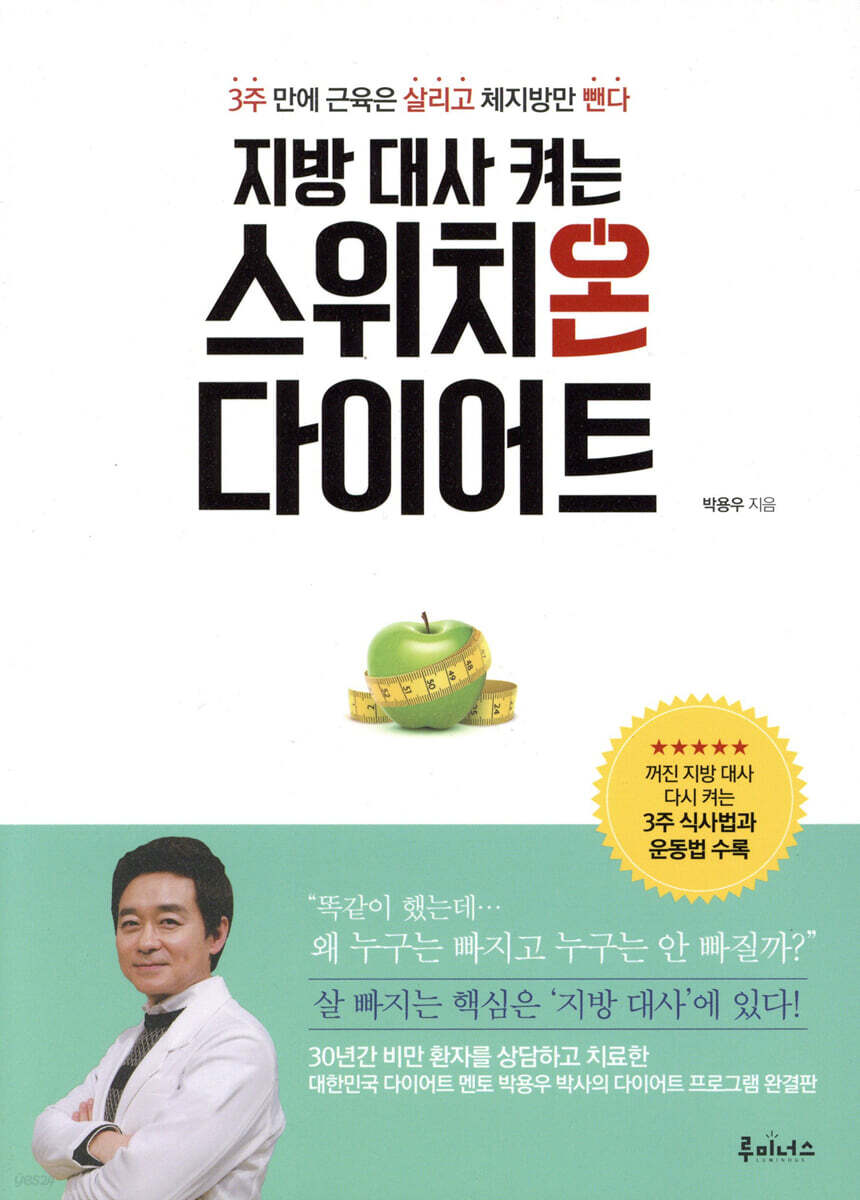
Switch-On Diet to Turn on Fat Metabolism
 |
Description
Book Introduction
Turn on your fat metabolism switch to lose weight!
Dr. Yongwoo Park, Korea's leading obesity specialist who has counseled and treated obese patients for 30 years, has published a new book, "Switch-On Diet to Turn on Fat Metabolism."
The Switch On Diet is a program that was supplemented and refined throughout 2017, and can be considered the 'final version of Dr. Yongwoo Park's diet program.'
As part of a well-known domestic corporation's employee health management efforts, a diet project was conducted with Dr. Yongwoo Park. During this process, he completed an upgraded diet program based on the participants' data and results.
Dr. Park Yong-woo observed the weight loss process of ordinary participants and confirmed that the key to weight loss is 'fat metabolism'. In this book, he explains how fat metabolism affects weight loss through vivid real stories of diet participants.
We reveal the commonalities of people who lose body fat easily, as well as their actual programs.
Dr. Yongwoo Park, Korea's leading obesity specialist who has counseled and treated obese patients for 30 years, has published a new book, "Switch-On Diet to Turn on Fat Metabolism."
The Switch On Diet is a program that was supplemented and refined throughout 2017, and can be considered the 'final version of Dr. Yongwoo Park's diet program.'
As part of a well-known domestic corporation's employee health management efforts, a diet project was conducted with Dr. Yongwoo Park. During this process, he completed an upgraded diet program based on the participants' data and results.
Dr. Park Yong-woo observed the weight loss process of ordinary participants and confirmed that the key to weight loss is 'fat metabolism'. In this book, he explains how fat metabolism affects weight loss through vivid real stories of diet participants.
We reveal the commonalities of people who lose body fat easily, as well as their actual programs.
- You can preview some of the book's contents.
Preview
index
Author's Note
Chapter 1 Why do some people fall and others don't?
: 3-Week Switch-On Diet Progress Report
Diet needs an upgrade too
A new project has begun!
Lose body fat without losing muscle
I'm more surprised by the improved blood test results than the weight loss.
Diet and exercise are both important
The Rediscovered Benefits of Intermittent Fasting
You have to turn back your biological clock to lose weight.
People who fall in love easily have something in common.
Eating less than 2 chapters and exercising will 100% fail.
: Obesity is a disease
The common diet myth that says to eat less and exercise is wrong.
The weight control system is broken
Leptin, the appetite-regulating hormone, is malfunctioning.
The beginning of obesity is chronic stress.
Obese people have a reduced fat metabolism.
When your circadian rhythm is disrupted, leptin resistance develops.
Let's change our bodies from craving carbohydrates to burning fat.
Chapter 3: Restarting the Turned-Off Fat Metabolism
Switch-On Diet Keywords 6
1. Limit carbohydrate intake for a period of time.
2. Eating protein will prevent muscle loss while turning on fat metabolism.
3 Intermittent fasting quickly restores fat metabolism.
4 Fat metabolism is active during deep sleep.
5. Do high-intensity exercise for 30 minutes, 4 times a week.
6 Supplements to Boost Fat Metabolism
(Diet Column) Regrets about the "low-carb, high-fat diet" featured on TV
Chapter 4 Minimum period for body change
: 3-Week Switch-On Diet Program
In 3 weeks, my body adapts to the fat burning system.
Stage 1 Carbohydrate Restriction
Improve leptin resistance and prepare to turn back on fat metabolism.
One-Week Diet Principles / Practices to Restore Your Circadian Rhythm
Phase 2 intermittent fasting
Improves insulin resistance and helps burn stored fat
2-Week Diet Principle / 3-Week Diet Principle / Practices to Restore Your Circadian Rhythm
Chapter 5: Let's keep it fun and comfortable!
: Building a body that won't gain weight again
After 3 weeks, your body is now burning fat
5 Lifestyle Rules for Maintaining the Weight Loss You've Worked Hard to Lose
Get up from your chair every 30 minutes
Chapter 6: Useful Diet Facts You Should Know
Let's use vinegar!
Synbiotics + yogurt in the morning
The older you get, the more you need to eat meat.
You might as well eat!
Is fruit a healthy food?
Eat good fats
Low-fat milk over diet cola
Rice bowl instead of soup
Put expensive items in your shopping cart
Park Yong-woo's Diet Tips
What is an energy source?
Does protein worsen insulin resistance?
Types of whey protein
How much intensity is high?
How much fat should I eat?
The Synergistic Effects of Intermittent Fasting and High-Intensity Exercise
Can I eat coconut oil while dieting?
Should I exercise on intermittent fasting days?
Should I trim off all the fat from the meat?
Park Yong-woo's Healthy Diet Plan
If I eat a lot of meat, won't I get colon cancer?
Is saturated fat worse? Is sugar worse?
Park Yong-woo's Healthy Diet Pyramid
Chapter 1 Why do some people fall and others don't?
: 3-Week Switch-On Diet Progress Report
Diet needs an upgrade too
A new project has begun!
Lose body fat without losing muscle
I'm more surprised by the improved blood test results than the weight loss.
Diet and exercise are both important
The Rediscovered Benefits of Intermittent Fasting
You have to turn back your biological clock to lose weight.
People who fall in love easily have something in common.
Eating less than 2 chapters and exercising will 100% fail.
: Obesity is a disease
The common diet myth that says to eat less and exercise is wrong.
The weight control system is broken
Leptin, the appetite-regulating hormone, is malfunctioning.
The beginning of obesity is chronic stress.
Obese people have a reduced fat metabolism.
When your circadian rhythm is disrupted, leptin resistance develops.
Let's change our bodies from craving carbohydrates to burning fat.
Chapter 3: Restarting the Turned-Off Fat Metabolism
Switch-On Diet Keywords 6
1. Limit carbohydrate intake for a period of time.
2. Eating protein will prevent muscle loss while turning on fat metabolism.
3 Intermittent fasting quickly restores fat metabolism.
4 Fat metabolism is active during deep sleep.
5. Do high-intensity exercise for 30 minutes, 4 times a week.
6 Supplements to Boost Fat Metabolism
(Diet Column) Regrets about the "low-carb, high-fat diet" featured on TV
Chapter 4 Minimum period for body change
: 3-Week Switch-On Diet Program
In 3 weeks, my body adapts to the fat burning system.
Stage 1 Carbohydrate Restriction
Improve leptin resistance and prepare to turn back on fat metabolism.
One-Week Diet Principles / Practices to Restore Your Circadian Rhythm
Phase 2 intermittent fasting
Improves insulin resistance and helps burn stored fat
2-Week Diet Principle / 3-Week Diet Principle / Practices to Restore Your Circadian Rhythm
Chapter 5: Let's keep it fun and comfortable!
: Building a body that won't gain weight again
After 3 weeks, your body is now burning fat
5 Lifestyle Rules for Maintaining the Weight Loss You've Worked Hard to Lose
Get up from your chair every 30 minutes
Chapter 6: Useful Diet Facts You Should Know
Let's use vinegar!
Synbiotics + yogurt in the morning
The older you get, the more you need to eat meat.
You might as well eat!
Is fruit a healthy food?
Eat good fats
Low-fat milk over diet cola
Rice bowl instead of soup
Put expensive items in your shopping cart
Park Yong-woo's Diet Tips
What is an energy source?
Does protein worsen insulin resistance?
Types of whey protein
How much intensity is high?
How much fat should I eat?
The Synergistic Effects of Intermittent Fasting and High-Intensity Exercise
Can I eat coconut oil while dieting?
Should I exercise on intermittent fasting days?
Should I trim off all the fat from the meat?
Park Yong-woo's Healthy Diet Plan
If I eat a lot of meat, won't I get colon cancer?
Is saturated fat worse? Is sugar worse?
Park Yong-woo's Healthy Diet Pyramid
Detailed image

Into the book
As word of mouth spread within the company, more and more people wanted to participate.
The class, which started with 10 people in April 2017, increased to 5 in November at 9:00 AM, 10:00 AM, 11:00 AM, 1:00 PM, and 2:00 PM.
As I progressed through the program, I was able to further develop my diet methods.
Ten participants in one class took the same program, but the results varied.
By listening to the vivid stories of the participants, I was able to infer new reasons for this.
This also allowed me to experience the gap between theory and practice.
Until now, I have explained obesity based on the leptin hormone and set-point theory, but now I have more emphasis on insulin resistance. As I have realized the importance of biological rhythms, I have also confirmed that maintaining a 12-hour fast and at least 6 hours of deep sleep are essential for weight loss.
We also added solutions to the problems that appear to be intertwined with fatty liver, carbohydrate addiction, leptin resistance, and insulin resistance.
That's why intermittent fasting and 14-hour fasting were added to the 3-week program.
--- p.23
But as I looked at the participants' results each week, I realized something new.
If you strictly limit carbohydrates in the first week, the results after one week will vary greatly from person to person.
There were some people who lost a lot of body fat, but there were more people who only lost water and muscle and did not show a significant decrease in body fat.
After two weeks, body fat began to decrease in earnest as the lost muscle mass was restored.
The 'local metabolism' has been activated.
However, if you can't hold out and eat forbidden foods once or twice during the third week, the results after three weeks are not so good.
Again, muscle loss and body fat loss have significantly decreased.
On the other hand, people who held out well for three weeks were much less likely to gain back fat or lose muscle even if they made a few mistakes in the fourth week.
The success or failure of a diet is determined in the '3rd week'.
--- p.24
The bigger problem is that women with lean, obese body types lose more muscle the more they eat less and do aerobic exercise.
As muscle is lost, the body that does not use fat well changes into a body that does not use fat even more.
Muscles are the tissues that consume a lot of energy in our body, so when muscle mass decreases, our basal metabolic rate decreases.
A drop in your basal metabolic rate means your body has switched from energy consumption mode to energy storage mode.
After all, if you eat just a little more, the weight will quickly come back, and if you binge eat due to stress, you will gain more weight than before.
Even if you work hard to lose weight, you can't maintain it.
--- p.26
It's been decades since 'eat less and exercise' became the basic principle of dieting.
I have been treating obesity for nearly 30 years, but I am constantly modifying my treatment.
30 years ago was different, 20 years ago was different.
It's different 10 years ago, it's different 5 years ago.
Our living environment has changed, the food we eat has changed, and our lifestyle habits have changed.
Above all, new research results on obesity and diet are constantly coming out.
Yet, obesity experts still stick to the same treatment methods that have been around for decades.
This is why the obese population increases every year despite the abundance of obesity clinics and the emergence of health clubs in every neighborhood.
--- p.63
When your circadian rhythm is disrupted, not only your fasting-eating cycle but also your sleep-wake cycle becomes disrupted.
When it comes to dieting, sleep is just as important as diet and exercise.
People who are controlling their diet and exercising regularly but still have trouble losing weight need to look back on their sleeping habits.
When sleep time is reduced and the quality of sleep is poor, the sleep-wake cycle becomes disrupted, making you sleepy during the day and feeling unrefreshed even after napping.
Above all, I can't resist the craving for carbohydrates during the day.
In the end, the diet is bound to fail.
The class, which started with 10 people in April 2017, increased to 5 in November at 9:00 AM, 10:00 AM, 11:00 AM, 1:00 PM, and 2:00 PM.
As I progressed through the program, I was able to further develop my diet methods.
Ten participants in one class took the same program, but the results varied.
By listening to the vivid stories of the participants, I was able to infer new reasons for this.
This also allowed me to experience the gap between theory and practice.
Until now, I have explained obesity based on the leptin hormone and set-point theory, but now I have more emphasis on insulin resistance. As I have realized the importance of biological rhythms, I have also confirmed that maintaining a 12-hour fast and at least 6 hours of deep sleep are essential for weight loss.
We also added solutions to the problems that appear to be intertwined with fatty liver, carbohydrate addiction, leptin resistance, and insulin resistance.
That's why intermittent fasting and 14-hour fasting were added to the 3-week program.
--- p.23
But as I looked at the participants' results each week, I realized something new.
If you strictly limit carbohydrates in the first week, the results after one week will vary greatly from person to person.
There were some people who lost a lot of body fat, but there were more people who only lost water and muscle and did not show a significant decrease in body fat.
After two weeks, body fat began to decrease in earnest as the lost muscle mass was restored.
The 'local metabolism' has been activated.
However, if you can't hold out and eat forbidden foods once or twice during the third week, the results after three weeks are not so good.
Again, muscle loss and body fat loss have significantly decreased.
On the other hand, people who held out well for three weeks were much less likely to gain back fat or lose muscle even if they made a few mistakes in the fourth week.
The success or failure of a diet is determined in the '3rd week'.
--- p.24
The bigger problem is that women with lean, obese body types lose more muscle the more they eat less and do aerobic exercise.
As muscle is lost, the body that does not use fat well changes into a body that does not use fat even more.
Muscles are the tissues that consume a lot of energy in our body, so when muscle mass decreases, our basal metabolic rate decreases.
A drop in your basal metabolic rate means your body has switched from energy consumption mode to energy storage mode.
After all, if you eat just a little more, the weight will quickly come back, and if you binge eat due to stress, you will gain more weight than before.
Even if you work hard to lose weight, you can't maintain it.
--- p.26
It's been decades since 'eat less and exercise' became the basic principle of dieting.
I have been treating obesity for nearly 30 years, but I am constantly modifying my treatment.
30 years ago was different, 20 years ago was different.
It's different 10 years ago, it's different 5 years ago.
Our living environment has changed, the food we eat has changed, and our lifestyle habits have changed.
Above all, new research results on obesity and diet are constantly coming out.
Yet, obesity experts still stick to the same treatment methods that have been around for decades.
This is why the obese population increases every year despite the abundance of obesity clinics and the emergence of health clubs in every neighborhood.
--- p.63
When your circadian rhythm is disrupted, not only your fasting-eating cycle but also your sleep-wake cycle becomes disrupted.
When it comes to dieting, sleep is just as important as diet and exercise.
People who are controlling their diet and exercising regularly but still have trouble losing weight need to look back on their sleeping habits.
When sleep time is reduced and the quality of sleep is poor, the sleep-wake cycle becomes disrupted, making you sleepy during the day and feeling unrefreshed even after napping.
Above all, I can't resist the craving for carbohydrates during the day.
In the end, the diet is bound to fail.
--- p.89
Publisher's Review
“I did the same thing...
Why do some people fall out and others don’t?”
The key to losing weight is ‘fat metabolism’!
Dr. Yongwoo Park, the best obesity doctor in Korea
The Complete Diet Program
More upgraded! More effective!
Reviving fat metabolism and losing only body fat
3-Week Switch-On Diet Program
The Switch On Diet is a diet program that has been supplemented and refined throughout 2017.
As part of a well-known domestic corporation's employee health management program, a diet project was conducted with Dr. Yongwoo Park. During this process, Dr. Yongwoo Park completed an upgraded diet program based on the participants' actual data and results.
Participants were ordinary male and female office workers who wanted to lose weight, and ranged in age from their 20s to 50s, with those in their 30s and 40s being the most numerous.
Perhaps because it is the age when belly fat starts to accumulate and health warning signs turn on, the participation rate was very high and the will to lose weight was strong.
After completing the three-week program, participants lost an average of more than 4 kg of body fat without losing any muscle mass, and those who continued the diet continued to lose weight.
However, not all of those who participated in the program were successful in their diet.
Here, Dr. Park Yong-woo had a question.
Why do some people lose weight easily while others struggle when following the same diet program? Even if individual physical conditions and adherence to the program differ, where does this fundamental difference stem from?
Dr. Park Yong-woo confirmed that the key to losing weight is ‘fat metabolism.’
And this book analyzes how fat metabolism affects weight loss and provides solutions.
Along with the vivid real stories of diet participants, we also revealed the commonalities of people who lose body fat easily and their actual programs.
Now, let's hear from people who have rekindled their extinguished fat metabolism.
Let's see how our bodies change when we turn the 'switch' of fat metabolism back on after 3 weeks.
Why don't I lose weight even though I eat less and exercise?
Why does more and more fat accumulate on our bodies as we age?
This is because the metabolism that uses fat as an energy source has degenerated.
In short, the ‘fat metabolism’ has been turned off.
If fat metabolism is not functioning properly, body fat will not be lost no matter how much you control your diet and exercise.
So what should we do? How can we reduce body fat?
Dr. Yongwoo Park, through the 'Switch On Diet Program', teaches a '3-week diet and exercise plan' to turn on the fat metabolism that has been turned off, and lifestyle habits that will prevent weight gain.
If you follow this well, you can lose body fat without losing muscle by becoming a 'body that burns fat well' in just 3 weeks.
Am I a sugar-burning body or a fat-burning body?
What is my biological rhythm?
A healthy person uses both sugar (glucose) and fat as energy sources for the body.
However, people who have gained weight because their weight control system is broken tend to use 'sugar' more than fat.
Even though there is a lot of fat accumulated in the body, the body does not try to use the accumulated fat and instead tries to obtain energy from outside sources by eating food.
If sugar metabolism is prioritized like this, fat metabolism will be pushed back, and body fat will naturally accumulate.
The Switch On Diet is a program that restores degenerated fat metabolism and reduces body fat without losing muscle.
Carbohydrates are temporarily restricted to properly function fat metabolism, and a protein-based diet is emphasized to minimize muscle loss.
In addition, to restore the damaged biological rhythm, sleep for more than 6 hours a day and fast for more than 12 hours, and to quickly restore fat metabolism, intermittent fasting, high-intensity exercise, and nutritional supplements are combined.
Dr. Park Yong-woo particularly emphasizes the ‘biorhythm’ of our body in this book.
He says, “You can lose weight just by keeping track of your sleeping and eating schedule.”
If you follow the Switch On Diet for 3 weeks, your body's regulatory function will be restored, fat metabolism will function properly, and you will have a body that doesn't gain weight.
I feel less tired than before, and my liver function and triglyceride levels have definitely improved.
Because my body changes to a fat-burning body, I don't experience the yo-yo effect after dieting.
After three weeks, you can continue to lose body fat even if you occasionally eat forbidden foods.
Although this book is primarily for people who want to lose weight, the foods and lifestyle habits it introduces, whether prohibited or permitted, are things you can adopt as lifelong habits.
This is especially recommended reading for those in their 30s and 40s who want to maintain their diet and health at the same time.
A word from participants who experienced the 'Switch On Diet Program' in advance.
“I lost a total of 10kg, especially a lot of body fat.” (Seooo, 40 years old)
“When I woke up in the morning, there was no swelling and my body felt really light.” (Park oo, 37 years old)
“All liver function tests have returned to normal.” (Moonoo, 45 years old)
Why do some people fall out and others don’t?”
The key to losing weight is ‘fat metabolism’!
Dr. Yongwoo Park, the best obesity doctor in Korea
The Complete Diet Program
More upgraded! More effective!
Reviving fat metabolism and losing only body fat
3-Week Switch-On Diet Program
The Switch On Diet is a diet program that has been supplemented and refined throughout 2017.
As part of a well-known domestic corporation's employee health management program, a diet project was conducted with Dr. Yongwoo Park. During this process, Dr. Yongwoo Park completed an upgraded diet program based on the participants' actual data and results.
Participants were ordinary male and female office workers who wanted to lose weight, and ranged in age from their 20s to 50s, with those in their 30s and 40s being the most numerous.
Perhaps because it is the age when belly fat starts to accumulate and health warning signs turn on, the participation rate was very high and the will to lose weight was strong.
After completing the three-week program, participants lost an average of more than 4 kg of body fat without losing any muscle mass, and those who continued the diet continued to lose weight.
However, not all of those who participated in the program were successful in their diet.
Here, Dr. Park Yong-woo had a question.
Why do some people lose weight easily while others struggle when following the same diet program? Even if individual physical conditions and adherence to the program differ, where does this fundamental difference stem from?
Dr. Park Yong-woo confirmed that the key to losing weight is ‘fat metabolism.’
And this book analyzes how fat metabolism affects weight loss and provides solutions.
Along with the vivid real stories of diet participants, we also revealed the commonalities of people who lose body fat easily and their actual programs.
Now, let's hear from people who have rekindled their extinguished fat metabolism.
Let's see how our bodies change when we turn the 'switch' of fat metabolism back on after 3 weeks.
Why don't I lose weight even though I eat less and exercise?
Why does more and more fat accumulate on our bodies as we age?
This is because the metabolism that uses fat as an energy source has degenerated.
In short, the ‘fat metabolism’ has been turned off.
If fat metabolism is not functioning properly, body fat will not be lost no matter how much you control your diet and exercise.
So what should we do? How can we reduce body fat?
Dr. Yongwoo Park, through the 'Switch On Diet Program', teaches a '3-week diet and exercise plan' to turn on the fat metabolism that has been turned off, and lifestyle habits that will prevent weight gain.
If you follow this well, you can lose body fat without losing muscle by becoming a 'body that burns fat well' in just 3 weeks.
Am I a sugar-burning body or a fat-burning body?
What is my biological rhythm?
A healthy person uses both sugar (glucose) and fat as energy sources for the body.
However, people who have gained weight because their weight control system is broken tend to use 'sugar' more than fat.
Even though there is a lot of fat accumulated in the body, the body does not try to use the accumulated fat and instead tries to obtain energy from outside sources by eating food.
If sugar metabolism is prioritized like this, fat metabolism will be pushed back, and body fat will naturally accumulate.
The Switch On Diet is a program that restores degenerated fat metabolism and reduces body fat without losing muscle.
Carbohydrates are temporarily restricted to properly function fat metabolism, and a protein-based diet is emphasized to minimize muscle loss.
In addition, to restore the damaged biological rhythm, sleep for more than 6 hours a day and fast for more than 12 hours, and to quickly restore fat metabolism, intermittent fasting, high-intensity exercise, and nutritional supplements are combined.
Dr. Park Yong-woo particularly emphasizes the ‘biorhythm’ of our body in this book.
He says, “You can lose weight just by keeping track of your sleeping and eating schedule.”
If you follow the Switch On Diet for 3 weeks, your body's regulatory function will be restored, fat metabolism will function properly, and you will have a body that doesn't gain weight.
I feel less tired than before, and my liver function and triglyceride levels have definitely improved.
Because my body changes to a fat-burning body, I don't experience the yo-yo effect after dieting.
After three weeks, you can continue to lose body fat even if you occasionally eat forbidden foods.
Although this book is primarily for people who want to lose weight, the foods and lifestyle habits it introduces, whether prohibited or permitted, are things you can adopt as lifelong habits.
This is especially recommended reading for those in their 30s and 40s who want to maintain their diet and health at the same time.
A word from participants who experienced the 'Switch On Diet Program' in advance.
“I lost a total of 10kg, especially a lot of body fat.” (Seooo, 40 years old)
“When I woke up in the morning, there was no swelling and my body felt really light.” (Park oo, 37 years old)
“All liver function tests have returned to normal.” (Moonoo, 45 years old)
GOODS SPECIFICS
- Date of issue: March 25, 2018
- Page count, weight, size: 256 pages | 420g | 152*210*13mm
- ISBN13: 9791196334703
- ISBN10: 1196334706
You may also like
카테고리
korean


korean

![GQ KOREA Mark (Monthly): December [2025]](http://librairie.coreenne.fr/cdn/shop/files/8ef265dbbfbf186523ed75ba7319009d.jpg?v=1765340328&width=3840)


