

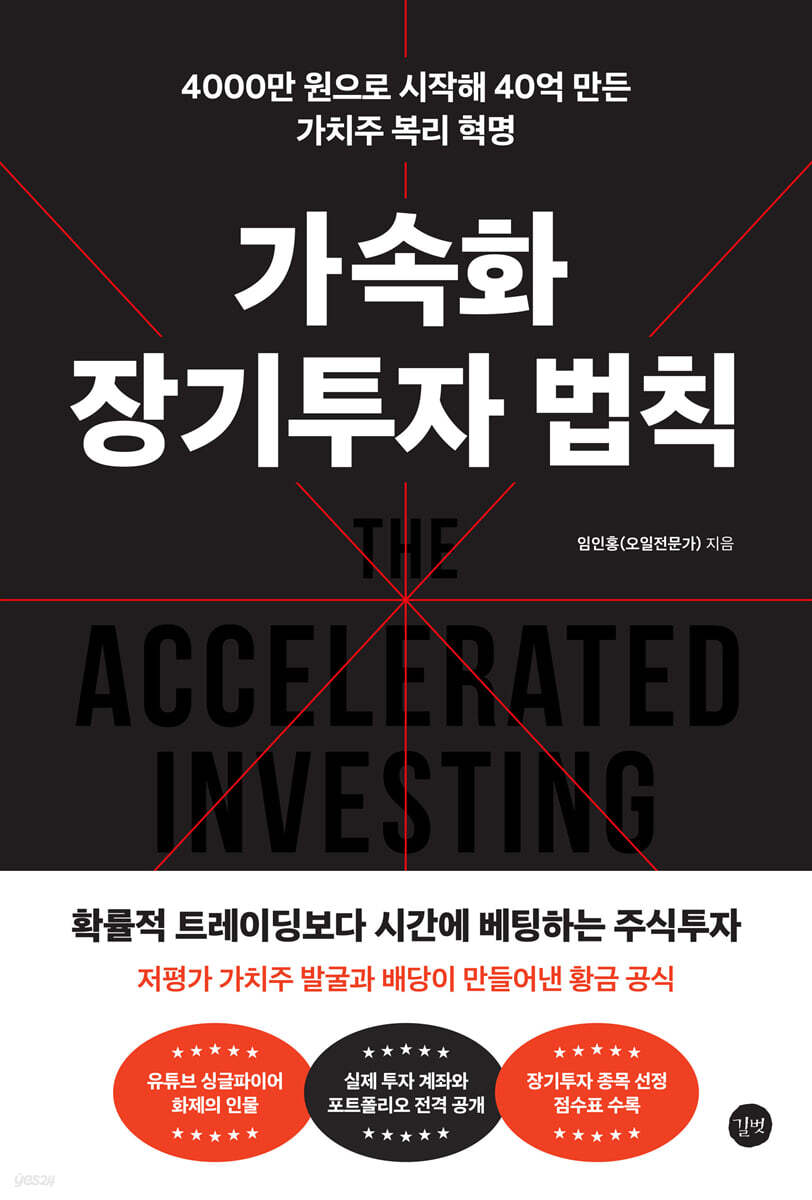
The Law of Accelerated Long-Term Investment
 |
Description
Book Introduction
A long-term investment method that bets on time rather than probability trading, accelerating asset growth through compound interest.
Buy stocks, hold them, and reinvest the dividends!
-A compound investment method that involves buying a goose that lays golden eggs and then using the golden eggs to buy a cheaper goose.
- Investing in stocks with a psychological advantage by securing a safety margin and confirming future growth potential and shareholder returns.
- Suitable for all investors, including office workers, as a long-term investment utilizing undervalued, high-quality dividend stocks.
An ordinary office worker's investment journey, philosophy, portfolio, and actual account details revealed: How he made 4 billion won in 10 years.
How did an ordinary office worker increase his investment assets 100-fold in just 10 years?
A Long-Term Investment Formula for Accelerating Wealth Through Undervalued, High-Quality Dividend Stocks
“Wealth grows with time.”
Investing is inherently difficult.
If investing were easy, anyone could make a lot of money.
This is because the nature of investment is an act that runs counter to human psychology from the very beginning.
It is difficult to endure without selling an asset whose price is rising, and it is also difficult to stop investing when the price is falling sharply, thinking about the principal.
People jump into short-term investments to get rich quickly, but it is very difficult to make a profit.
Maybe you're lucky even if you don't lose a lot of money.
In that sense, 'long-term investment' must overcome the human nature of wanting to realize the profits right in front of us.
So, it may feel like a more difficult investment than short-term trading.
However, it is worth noting that most of the world's leading investors have made money through a strategy of buying good stocks and holding them for a long time.
In particular, ordinary office workers and ordinary investors should know that long-term investment is the only way to significantly increase their assets.
Ordinary people like us can't do the fantastic short-term trading that you see on YouTube, and we have to do our best to make a living every day.
Anyone with a passion for increasing their assets by a factor of 1 through stock investment will find the answer they've been searching for in "The Law of Accelerated Long-Term Investment."
The author of the book, an ordinary office worker, is the person who invested 40 million won in seed money for a long period of time and increased his money by exactly 100 times in 10 years.
This book contains the successful long-term investment journey of an ordinary investor, not very different from us.
In particular, it presents detailed criteria for stock discovery, which investors find most difficult, and allows anyone to create their own 'stock evaluation scorecard' based on those criteria.
This strategy involves finding undervalued, high-quality dividend stocks in the market, directly verifying their safety margins, and then focusing on investing after gaining a psychological advantage through a three-dimensional analysis of dividends and the company.
When dividends are paid, the dividends are reinvested in stocks, increasing the number of shares and the amount of dividends, while also expecting large capital gains through long-term investment, literally ‘accelerating’ asset growth.
Therefore, this book goes beyond a simple investment guide. Its advantage lies in teaching you, like the author, how to select good stocks and, through analysis of publicly available investment portfolios, allowing you to pursue your own way of making money investing in stocks.
If ordinary people like us make good use of the 'time' that is equally given to everyone, we will be able to have the goose that lays the golden eggs of our dreams.
Buy stocks, hold them, and reinvest the dividends!
-A compound investment method that involves buying a goose that lays golden eggs and then using the golden eggs to buy a cheaper goose.
- Investing in stocks with a psychological advantage by securing a safety margin and confirming future growth potential and shareholder returns.
- Suitable for all investors, including office workers, as a long-term investment utilizing undervalued, high-quality dividend stocks.
An ordinary office worker's investment journey, philosophy, portfolio, and actual account details revealed: How he made 4 billion won in 10 years.
How did an ordinary office worker increase his investment assets 100-fold in just 10 years?
A Long-Term Investment Formula for Accelerating Wealth Through Undervalued, High-Quality Dividend Stocks
“Wealth grows with time.”
Investing is inherently difficult.
If investing were easy, anyone could make a lot of money.
This is because the nature of investment is an act that runs counter to human psychology from the very beginning.
It is difficult to endure without selling an asset whose price is rising, and it is also difficult to stop investing when the price is falling sharply, thinking about the principal.
People jump into short-term investments to get rich quickly, but it is very difficult to make a profit.
Maybe you're lucky even if you don't lose a lot of money.
In that sense, 'long-term investment' must overcome the human nature of wanting to realize the profits right in front of us.
So, it may feel like a more difficult investment than short-term trading.
However, it is worth noting that most of the world's leading investors have made money through a strategy of buying good stocks and holding them for a long time.
In particular, ordinary office workers and ordinary investors should know that long-term investment is the only way to significantly increase their assets.
Ordinary people like us can't do the fantastic short-term trading that you see on YouTube, and we have to do our best to make a living every day.
Anyone with a passion for increasing their assets by a factor of 1 through stock investment will find the answer they've been searching for in "The Law of Accelerated Long-Term Investment."
The author of the book, an ordinary office worker, is the person who invested 40 million won in seed money for a long period of time and increased his money by exactly 100 times in 10 years.
This book contains the successful long-term investment journey of an ordinary investor, not very different from us.
In particular, it presents detailed criteria for stock discovery, which investors find most difficult, and allows anyone to create their own 'stock evaluation scorecard' based on those criteria.
This strategy involves finding undervalued, high-quality dividend stocks in the market, directly verifying their safety margins, and then focusing on investing after gaining a psychological advantage through a three-dimensional analysis of dividends and the company.
When dividends are paid, the dividends are reinvested in stocks, increasing the number of shares and the amount of dividends, while also expecting large capital gains through long-term investment, literally ‘accelerating’ asset growth.
Therefore, this book goes beyond a simple investment guide. Its advantage lies in teaching you, like the author, how to select good stocks and, through analysis of publicly available investment portfolios, allowing you to pursue your own way of making money investing in stocks.
If ordinary people like us make good use of the 'time' that is equally given to everyone, we will be able to have the goose that lays the golden eggs of our dreams.
- You can preview some of the book's contents.
Preview
index
preface
Chapter 1.
Make 4 billion won with a 10-year long-term investment
01 You can't get rich on your salary alone.
I am also just an ordinary office worker.
Get into derivatives trading
Marriage and Loans
02 Crisis is an opportunity
Learn from failure
Investing starts with knowledge
Value investing naturally leads to long-term investing.
Drenched in the Corona shower
The crisis repeats itself
03 I am continuing to invest without losing money.
the goose that lays golden eggs
Though the beginning was humble, the latter will be prosperous.
Chapter 2.
Investments that enable sustainable growth
01 Stocks are the best way to build wealth.
Cash is trash
I like stocks better than real estate.
world-class wealthy people
South Korea has the highest elderly poverty rate in the OECD world.
02 Short-term investments cannot beat long-term investments.
The End of a Successful Trader
What stock investment experts have in common
Long-term investing isn't easy either.
Long-term investments that benefit individuals
Anyone can become rich, but not everyone can stay rich.
Chapter 3.
A lifelong investment
01 Lifelong Investor
Investment safety margin
Not all dividends are created equal.
Invest in sustainability
Index-tracking ETF investment
REIT ETF investment
02 Domestic stocks vs.
US stocks
Why Our Country's Stock Market Isn't Rising
The essence of stocks is the same
Chapter 4.
Unwavering investment
01 Don't be swayed by crowd psychology.
The illusion called Tesla
Growth stocks don't necessarily guarantee success.
There's no rule that says value stocks can't grow.
02 Unwavering Investment
My investment philosophy
Investment with a sense of mission
Love passionately and break up coldly
Chapter 5.
Stock selection criteria
undervalued blue chip stocks
Shareholder returns
Future growth potential
Item Selection Score Sheet
Chapter 6.
My Investment Story
Current stock asset portfolio
Investment Case 01: S-OIL (2014-2018)
Investment Case 2: Hana Financial Group (2019-present)
Investment Case 03: Hankook Tire & Technology (2019-2024)
Investment Case 04: POSCO Holdings (2019-2023)
Investment Case 05: Hyundai Motor Company (2020-2021)
Investment Case 06: Daehan Oil & Gas (2020-2021)
Investment Case 07: Lotte Chemical (2020-2022)
Investment Case 8: ExxonMobil (2020-present)
Investment Case 09: Samsung Life Insurance (2020-2024)
Investment Case 10: Meritz Financial Group (2020-2021)
Investment Case 11: Kumho Petrochemical and Kumho Petrochemical Preferred (2021-present)
Investment Case 12: AT&T (2021-present)
Investment Case 13: Petrobras Preferred Stock (2022-Present)
Investment Case 14: Woori Financial Group (2023-present)
Investment Case 15: Hyundai Motor Company 2nd Preferred B (2024-present)
Chapter 7.
Practical Tax Savings for Long-Term Investors
Taxes can't be avoided, but they can be reduced.
Don't be afraid of comprehensive income tax
How to Gift Stocks to Family (National Tax Service Report)
Don't forget the foreign tax credit
Dividend income and health insurance premiums
Let's definitely create an ISA
Acknowledgements
Chapter 1.
Make 4 billion won with a 10-year long-term investment
01 You can't get rich on your salary alone.
I am also just an ordinary office worker.
Get into derivatives trading
Marriage and Loans
02 Crisis is an opportunity
Learn from failure
Investing starts with knowledge
Value investing naturally leads to long-term investing.
Drenched in the Corona shower
The crisis repeats itself
03 I am continuing to invest without losing money.
the goose that lays golden eggs
Though the beginning was humble, the latter will be prosperous.
Chapter 2.
Investments that enable sustainable growth
01 Stocks are the best way to build wealth.
Cash is trash
I like stocks better than real estate.
world-class wealthy people
South Korea has the highest elderly poverty rate in the OECD world.
02 Short-term investments cannot beat long-term investments.
The End of a Successful Trader
What stock investment experts have in common
Long-term investing isn't easy either.
Long-term investments that benefit individuals
Anyone can become rich, but not everyone can stay rich.
Chapter 3.
A lifelong investment
01 Lifelong Investor
Investment safety margin
Not all dividends are created equal.
Invest in sustainability
Index-tracking ETF investment
REIT ETF investment
02 Domestic stocks vs.
US stocks
Why Our Country's Stock Market Isn't Rising
The essence of stocks is the same
Chapter 4.
Unwavering investment
01 Don't be swayed by crowd psychology.
The illusion called Tesla
Growth stocks don't necessarily guarantee success.
There's no rule that says value stocks can't grow.
02 Unwavering Investment
My investment philosophy
Investment with a sense of mission
Love passionately and break up coldly
Chapter 5.
Stock selection criteria
undervalued blue chip stocks
Shareholder returns
Future growth potential
Item Selection Score Sheet
Chapter 6.
My Investment Story
Current stock asset portfolio
Investment Case 01: S-OIL (2014-2018)
Investment Case 2: Hana Financial Group (2019-present)
Investment Case 03: Hankook Tire & Technology (2019-2024)
Investment Case 04: POSCO Holdings (2019-2023)
Investment Case 05: Hyundai Motor Company (2020-2021)
Investment Case 06: Daehan Oil & Gas (2020-2021)
Investment Case 07: Lotte Chemical (2020-2022)
Investment Case 8: ExxonMobil (2020-present)
Investment Case 09: Samsung Life Insurance (2020-2024)
Investment Case 10: Meritz Financial Group (2020-2021)
Investment Case 11: Kumho Petrochemical and Kumho Petrochemical Preferred (2021-present)
Investment Case 12: AT&T (2021-present)
Investment Case 13: Petrobras Preferred Stock (2022-Present)
Investment Case 14: Woori Financial Group (2023-present)
Investment Case 15: Hyundai Motor Company 2nd Preferred B (2024-present)
Chapter 7.
Practical Tax Savings for Long-Term Investors
Taxes can't be avoided, but they can be reduced.
Don't be afraid of comprehensive income tax
How to Gift Stocks to Family (National Tax Service Report)
Don't forget the foreign tax credit
Dividend income and health insurance premiums
Let's definitely create an ISA
Acknowledgements
Detailed image
.jpg)
Into the book
“Wealth grows with time.” This is one of the important truths I've come to realize as I continue to invest in stocks for the long term.
Although I started out as an ordinary office worker, my long-term investments in undervalued, high-quality stocks resulted in me accumulating over 4 billion won in stock assets, which continue to grow over time.
And I am confident that this growth will continue in the future.
--- p.5
Could it be because I've seen so many stock patterns where the chart turns downward when it reaches its all-time high?
I had a strong feeling that the index would fall significantly.
There was no other basis.
It was just a feeling.
Recklessly, I entered into a contract to sell the S&P 500 index.
But the index gradually rose.
I kept paying money to the brokerage because of the margin call.
The valuation loss grew over time.
--- p.29
The first deficit in 34 years was judged to be an opportunity that came after 34 years.
I bought S-OIL stocks with all the funds available.
The stock price continued to fall, but when my salary came in, I bought stocks with all the money I had left over from living expenses.
But it wasn't enough.
It was less than 50 million won.
Most of my wife and I's assets were tied up in the apartment we lived in.
Feeling that I might never have another opportunity like this, I discussed it with my wife and decided to take out a mortgage on our apartment.
Fortunately, my wife listened to my explanation and supported me.
--- p.36
And then, in March 2020, COVID-19 arrived.
Stock markets around the world continued to plummet… (omitted)… As a result, my stock asset value, which was around 1 billion won, plummeted to 600 million won, but I didn’t get discouraged.
There is a stock market adage that says, “Avoid the rain,” but it doesn’t apply to long-term investors like me.
Rather, there were many undervalued, large-cap stocks that had become extremely cheap, and there was an abundance of stocks that people wanted to buy.
But I had no additional cash on hand because I had used all my spare money to continue buying stocks.
I had no choice but to use a stock-backed loan.
--- p.42
Each dividend stock I own is like a goose that lays golden eggs for me.
There is no reason to sell a goose that provides a steady stream of golden eggs on the market.
Rather, they are focusing on selling golden eggs and buying the goose that lays golden eggs that is being sold cheaply in the market.
In particular, if the price of a particular goose that lays golden eggs suddenly skyrockets in the market, you sell that goose and buy another goose that is cheaper but also lays golden eggs well.
As the number of geese increases, the number of golden eggs I receive also increases.
--- p.50
Long-term investing is not a smooth road, but a path filled with numerous trials and tribulations.
The fluctuating stock price order book sways investors' minds.
People around them try to sway the minds of long-term investors with all kinds of ridicule.
So, if you've decided to start investing for the long term, be determined.
And your own solid investment philosophy will be your safety belt.
Long-term investing is not easy.
--- p.101
If you are a long-term investor, you must let go of your impatience.
If a company's business model is sustainable and it strives for steady profits and shareholder returns, it should take sufficient time to wait.
If you consistently reinvest the dividends you earn in stocks, you will achieve much greater results than expected thanks to the compounding effect.
--- p.131
Our country's stock market is changing.
Some are unaware of the changes that have already begun, while others are sensing them.
Those who believe that the nature of stocks varies by region will ultimately miss opportunities on one side, while those who believe that the nature of stocks is the same everywhere will be able to seize opportunities on both sides.
This is why I invest in undervalued, high-quality stocks for the long term, regardless of whether they are domestic or foreign stocks.
--- p.153
It's not that a company's future growth potential isn't important.
However, it is important to be as realistic or critical as possible about the future, in case the story doesn't go as planned.
Is it truly realistic to replace all existing internal combustion engine vehicles with electric vehicles? Can electric vehicle companies generate stable profits without carbon emissions credits and subsidies? How will AI technology be applied in the future, and how will it generate profits? Are these methods realistic? Will humanity continue to rely on oil in the future?
--- p.197
Due to its excellent profit-generating ability, cash continues to accumulate within the company, but it does not engage in any special investment activities or spend a large amount of money on shareholder returns, resulting in a very low debt ratio.
Of course, a low debt ratio isn't necessarily a bad thing when it comes to preparing for an uncertain future.
But as with everything in moderation, an extremely low debt ratio is something to watch out for when selecting long-term investment stocks.
--- p.201
There is something I have heard countless times since the annual dividend exceeded 100 million won.
The opinion was that it is not efficient to continue increasing dividend income because you have to pay comprehensive income tax if it exceeds 20 million won per year.
Because everyone's income situation is different, what may be true for one person may not be true for another.
Although I started out as an ordinary office worker, my long-term investments in undervalued, high-quality stocks resulted in me accumulating over 4 billion won in stock assets, which continue to grow over time.
And I am confident that this growth will continue in the future.
--- p.5
Could it be because I've seen so many stock patterns where the chart turns downward when it reaches its all-time high?
I had a strong feeling that the index would fall significantly.
There was no other basis.
It was just a feeling.
Recklessly, I entered into a contract to sell the S&P 500 index.
But the index gradually rose.
I kept paying money to the brokerage because of the margin call.
The valuation loss grew over time.
--- p.29
The first deficit in 34 years was judged to be an opportunity that came after 34 years.
I bought S-OIL stocks with all the funds available.
The stock price continued to fall, but when my salary came in, I bought stocks with all the money I had left over from living expenses.
But it wasn't enough.
It was less than 50 million won.
Most of my wife and I's assets were tied up in the apartment we lived in.
Feeling that I might never have another opportunity like this, I discussed it with my wife and decided to take out a mortgage on our apartment.
Fortunately, my wife listened to my explanation and supported me.
--- p.36
And then, in March 2020, COVID-19 arrived.
Stock markets around the world continued to plummet… (omitted)… As a result, my stock asset value, which was around 1 billion won, plummeted to 600 million won, but I didn’t get discouraged.
There is a stock market adage that says, “Avoid the rain,” but it doesn’t apply to long-term investors like me.
Rather, there were many undervalued, large-cap stocks that had become extremely cheap, and there was an abundance of stocks that people wanted to buy.
But I had no additional cash on hand because I had used all my spare money to continue buying stocks.
I had no choice but to use a stock-backed loan.
--- p.42
Each dividend stock I own is like a goose that lays golden eggs for me.
There is no reason to sell a goose that provides a steady stream of golden eggs on the market.
Rather, they are focusing on selling golden eggs and buying the goose that lays golden eggs that is being sold cheaply in the market.
In particular, if the price of a particular goose that lays golden eggs suddenly skyrockets in the market, you sell that goose and buy another goose that is cheaper but also lays golden eggs well.
As the number of geese increases, the number of golden eggs I receive also increases.
--- p.50
Long-term investing is not a smooth road, but a path filled with numerous trials and tribulations.
The fluctuating stock price order book sways investors' minds.
People around them try to sway the minds of long-term investors with all kinds of ridicule.
So, if you've decided to start investing for the long term, be determined.
And your own solid investment philosophy will be your safety belt.
Long-term investing is not easy.
--- p.101
If you are a long-term investor, you must let go of your impatience.
If a company's business model is sustainable and it strives for steady profits and shareholder returns, it should take sufficient time to wait.
If you consistently reinvest the dividends you earn in stocks, you will achieve much greater results than expected thanks to the compounding effect.
--- p.131
Our country's stock market is changing.
Some are unaware of the changes that have already begun, while others are sensing them.
Those who believe that the nature of stocks varies by region will ultimately miss opportunities on one side, while those who believe that the nature of stocks is the same everywhere will be able to seize opportunities on both sides.
This is why I invest in undervalued, high-quality stocks for the long term, regardless of whether they are domestic or foreign stocks.
--- p.153
It's not that a company's future growth potential isn't important.
However, it is important to be as realistic or critical as possible about the future, in case the story doesn't go as planned.
Is it truly realistic to replace all existing internal combustion engine vehicles with electric vehicles? Can electric vehicle companies generate stable profits without carbon emissions credits and subsidies? How will AI technology be applied in the future, and how will it generate profits? Are these methods realistic? Will humanity continue to rely on oil in the future?
--- p.197
Due to its excellent profit-generating ability, cash continues to accumulate within the company, but it does not engage in any special investment activities or spend a large amount of money on shareholder returns, resulting in a very low debt ratio.
Of course, a low debt ratio isn't necessarily a bad thing when it comes to preparing for an uncertain future.
But as with everything in moderation, an extremely low debt ratio is something to watch out for when selecting long-term investment stocks.
--- p.201
There is something I have heard countless times since the annual dividend exceeded 100 million won.
The opinion was that it is not efficient to continue increasing dividend income because you have to pay comprehensive income tax if it exceeds 20 million won per year.
Because everyone's income situation is different, what may be true for one person may not be true for another.
--- p.275
Publisher's Review
Stop short-term trading and make time your best ally!
If you can't be a 0.1% trader, then be a long-term investor who never loses.
There are many different investment methods in the world.
Just as there are many different investment methods, there are also many different ways to make a lot of money.
While some investors make jaw-dropping profits in seconds or minutes with dazzling, immediate reactions, others become rich by leisurely, kind-heartedly buying stocks.
If someone has made a fortune through their own investments, their methods are worthy of respect.
However, when you ask yourself, "Can I do that too?", it would be right to choose an investment method that is objectively or probabilistically likely to win.
Especially in the case of short-term trading, it is difficult for ordinary people to follow along and they may end up losing a lot of money.
This doesn't mean that you can't make money through short-term trading, but it's right to calmly assess whether it's an investment method that you can actually achieve.
So, what should someone who has to go to work or their place of residence every morning to make a living do? What investment strategy would be appropriate for someone who can't check the ups and downs of their monitor every minute and second? The answer lies in "long-term investing."
Long-term investment should not be mistaken as simply buying any stock that people around you say is good and holding it for a long time.
You need to know how to pick good stocks and be able to judge for yourself whether you have a sufficient margin of safety.
In that sense, it's contradictory that some people are willing to endure the volatility stress of short-term trading but refuse to learn how to select stocks for long-term investment.
Ordinary people need to study to decide for themselves what to buy, how much to hold, and how to trade a particular stock.
But it is very difficult to learn this on your own.
So we need to pay attention to the "Accelerated Long-Term Investment Law."
This book is not just a simple stock theory book.
It contains the investment process and cases directly experienced by an ordinary office worker.
The biggest advantage is that by learning the criteria for selecting stocks suitable for long-term investment and how to create a numerical evaluation table, readers can establish their own "criteria" for identifying good stocks.
Additionally, the author's portfolio disclosed in the book includes not only stocks in which investments have been 'finished' but also those in which investments are still 'in progress'.
In other words, as a long-term investor, you are transparently disclosing your asset growth, and it provides an opportunity to grow alongside the author on his long-term investment journey, which may never end.
Therefore, if you understand his long-term investment method and apply it to your own investment method, there will be ample opportunity for anyone to "accelerate" their wealth.
The strategy of a real-life office worker investor who multiplied 40 million won by 100 times in 10 years, creating over 4 billion won.
How to find undervalued stocks, secure a margin of safety, and reinvest dividends
The author of "The Accelerated Long-Term Investment Law" experienced failure after actually engaging in short-term trading, which led him to change his investment philosophy.
Rather than focusing on short-term price fluctuations, we chose a strategy of investing time by finding undervalued, high-quality stocks and holding them for the long term.
This strategy has worked very well and is an investment method that other ordinary investors can easily follow.
His strategy, to put it simplistically, is as follows:
Find undervalued, quality stocks.
Check the safety margin and buy.
Holds.
When dividends are paid, I buy more stocks.
Once you've made enough profit, start again.
The concept doesn't seem that difficult.
But even if anyone has an idea that could make money, the actual experience of putting it into practice can be quite different.
Long-term investing may not be easy in reality.
You need to know how to pick good stocks and be able to establish objective evidence, if possible, on how to secure a margin of safety.
However, if you read "The Accelerated Long-Term Investment Law" from the beginning, you can sufficiently learn the basic concepts and strategies of long-term investment.
By following the author's investment journey until the end of the book, you'll naturally develop your own criteria and methodology for stock selection, covering topics like how to determine a stock's margin of safety, what differentiates good and bad dividend stocks, and how to assess a company's earnings growth and future growth potential.
Additionally, by looking at the author's investment portfolio, which he has personally disclosed, you can learn in detail what principles and criteria he used to enter the market, when he liquidated his investments, and what investment results he achieved through these investments.
Buy a good goose that lays golden eggs, and use the golden eggs it lays to buy more geese.
If the price of geese suddenly rises, sell them at the market and buy a cheaper goose that has laid golden eggs.
As the title suggests, "The Law of Accelerated Long-Term Investment" contains information on how to 'accelerate' the growth of assets while making long-term investments.
Beyond the superficial temporal meaning of the term "long-term investment," it's important to recognize that properly executed long-term investment is a key tool for rapidly increasing the invested capital.
At the center of it all are dividend stocks.
This doesn't simply mean stocks that pay dividends, but rather stocks that can generate steady cash flow, which creates an opportunity to buy more proven, good stocks.
It's like the goose that laid the golden eggs in Aesop's fable, and it feels like going out to find the goose that exists in the stock market.
The author recommends that if the market becomes too busy with geese and prices rise sharply, the author should take a sufficient profit and then return to the cheaper geese.
By consistently purchasing dividend stocks and using the dividends to increase the number of shares held, the author is achieving true compound interest. As a result, the author now receives over 200 million won in annual dividends.
The author also argues that long-term investments should be made to turn economic crises into opportunities.
When the stock market crashes, most people think the best thing to do is sell all their stocks and secure cash to limit their losses.
But rather the opposite is true.
When a real crisis strikes, investors who don't know "which stocks to buy" are unlikely to seize the opportunity even if the market plummets.
Economic crises will continue to recur in the future.
By becoming a long-term investor through "The Law of Accelerated Long-Term Investment," you will gain a standard for identifying the goose that lays the golden eggs, and will be able to make truly "accelerated investments" that will allow you to enter with confidence even when a market crisis arises.
If you can't be a 0.1% trader, then be a long-term investor who never loses.
There are many different investment methods in the world.
Just as there are many different investment methods, there are also many different ways to make a lot of money.
While some investors make jaw-dropping profits in seconds or minutes with dazzling, immediate reactions, others become rich by leisurely, kind-heartedly buying stocks.
If someone has made a fortune through their own investments, their methods are worthy of respect.
However, when you ask yourself, "Can I do that too?", it would be right to choose an investment method that is objectively or probabilistically likely to win.
Especially in the case of short-term trading, it is difficult for ordinary people to follow along and they may end up losing a lot of money.
This doesn't mean that you can't make money through short-term trading, but it's right to calmly assess whether it's an investment method that you can actually achieve.
So, what should someone who has to go to work or their place of residence every morning to make a living do? What investment strategy would be appropriate for someone who can't check the ups and downs of their monitor every minute and second? The answer lies in "long-term investing."
Long-term investment should not be mistaken as simply buying any stock that people around you say is good and holding it for a long time.
You need to know how to pick good stocks and be able to judge for yourself whether you have a sufficient margin of safety.
In that sense, it's contradictory that some people are willing to endure the volatility stress of short-term trading but refuse to learn how to select stocks for long-term investment.
Ordinary people need to study to decide for themselves what to buy, how much to hold, and how to trade a particular stock.
But it is very difficult to learn this on your own.
So we need to pay attention to the "Accelerated Long-Term Investment Law."
This book is not just a simple stock theory book.
It contains the investment process and cases directly experienced by an ordinary office worker.
The biggest advantage is that by learning the criteria for selecting stocks suitable for long-term investment and how to create a numerical evaluation table, readers can establish their own "criteria" for identifying good stocks.
Additionally, the author's portfolio disclosed in the book includes not only stocks in which investments have been 'finished' but also those in which investments are still 'in progress'.
In other words, as a long-term investor, you are transparently disclosing your asset growth, and it provides an opportunity to grow alongside the author on his long-term investment journey, which may never end.
Therefore, if you understand his long-term investment method and apply it to your own investment method, there will be ample opportunity for anyone to "accelerate" their wealth.
The strategy of a real-life office worker investor who multiplied 40 million won by 100 times in 10 years, creating over 4 billion won.
How to find undervalued stocks, secure a margin of safety, and reinvest dividends
The author of "The Accelerated Long-Term Investment Law" experienced failure after actually engaging in short-term trading, which led him to change his investment philosophy.
Rather than focusing on short-term price fluctuations, we chose a strategy of investing time by finding undervalued, high-quality stocks and holding them for the long term.
This strategy has worked very well and is an investment method that other ordinary investors can easily follow.
His strategy, to put it simplistically, is as follows:
Find undervalued, quality stocks.
Check the safety margin and buy.
Holds.
When dividends are paid, I buy more stocks.
Once you've made enough profit, start again.
The concept doesn't seem that difficult.
But even if anyone has an idea that could make money, the actual experience of putting it into practice can be quite different.
Long-term investing may not be easy in reality.
You need to know how to pick good stocks and be able to establish objective evidence, if possible, on how to secure a margin of safety.
However, if you read "The Accelerated Long-Term Investment Law" from the beginning, you can sufficiently learn the basic concepts and strategies of long-term investment.
By following the author's investment journey until the end of the book, you'll naturally develop your own criteria and methodology for stock selection, covering topics like how to determine a stock's margin of safety, what differentiates good and bad dividend stocks, and how to assess a company's earnings growth and future growth potential.
Additionally, by looking at the author's investment portfolio, which he has personally disclosed, you can learn in detail what principles and criteria he used to enter the market, when he liquidated his investments, and what investment results he achieved through these investments.
Buy a good goose that lays golden eggs, and use the golden eggs it lays to buy more geese.
If the price of geese suddenly rises, sell them at the market and buy a cheaper goose that has laid golden eggs.
As the title suggests, "The Law of Accelerated Long-Term Investment" contains information on how to 'accelerate' the growth of assets while making long-term investments.
Beyond the superficial temporal meaning of the term "long-term investment," it's important to recognize that properly executed long-term investment is a key tool for rapidly increasing the invested capital.
At the center of it all are dividend stocks.
This doesn't simply mean stocks that pay dividends, but rather stocks that can generate steady cash flow, which creates an opportunity to buy more proven, good stocks.
It's like the goose that laid the golden eggs in Aesop's fable, and it feels like going out to find the goose that exists in the stock market.
The author recommends that if the market becomes too busy with geese and prices rise sharply, the author should take a sufficient profit and then return to the cheaper geese.
By consistently purchasing dividend stocks and using the dividends to increase the number of shares held, the author is achieving true compound interest. As a result, the author now receives over 200 million won in annual dividends.
The author also argues that long-term investments should be made to turn economic crises into opportunities.
When the stock market crashes, most people think the best thing to do is sell all their stocks and secure cash to limit their losses.
But rather the opposite is true.
When a real crisis strikes, investors who don't know "which stocks to buy" are unlikely to seize the opportunity even if the market plummets.
Economic crises will continue to recur in the future.
By becoming a long-term investor through "The Law of Accelerated Long-Term Investment," you will gain a standard for identifying the goose that lays the golden eggs, and will be able to make truly "accelerated investments" that will allow you to enter with confidence even when a market crisis arises.
GOODS SPECIFICS
- Date of issue: March 25, 2025
- Page count, weight, size: 304 pages | 568g | 152*225*19mm
- ISBN13: 9791140712663
- ISBN10: 1140712667
You may also like
카테고리
korean


korean

![ELLE 엘르 스페셜 에디션 A형 : 12월 [2025]](http://librairie.coreenne.fr/cdn/shop/files/b8e27a3de6c9538896439686c6b0e8fb.jpg?v=1766436872&width=3840)


