

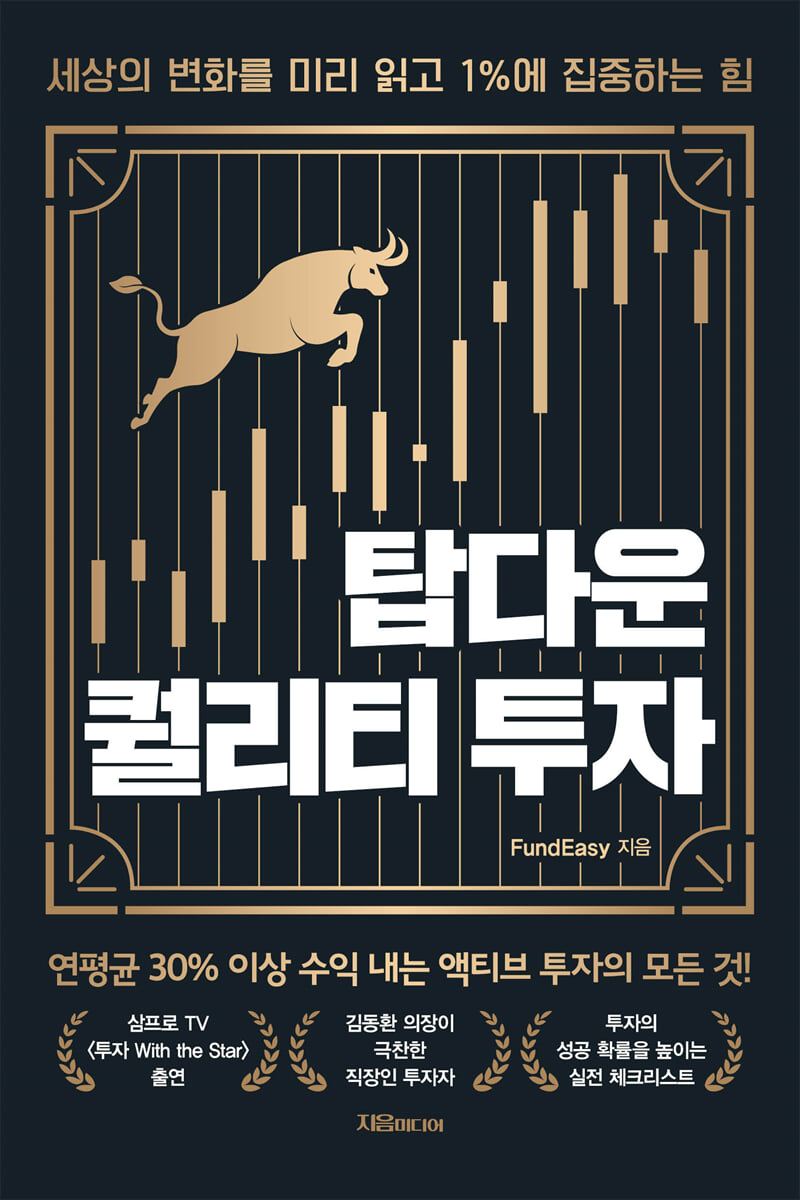
Top-down quality investment
 |
Description
Book Introduction
Sampro TV's "Investment With the Star" Award
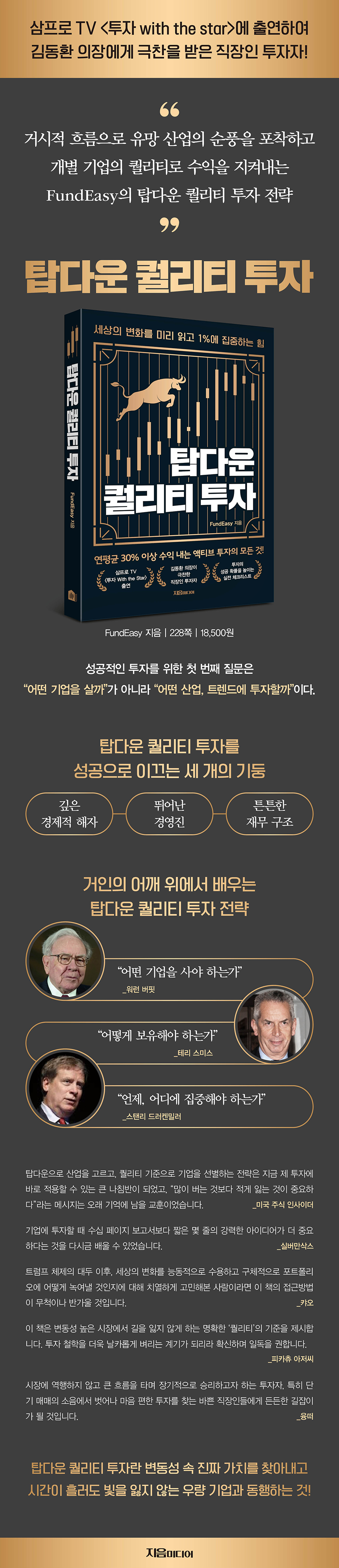
A working investor highly praised by Chairman Kim Dong-hwan
Finding true value in volatility
Accompanying excellent companies that do not lose their shine over time
Everything about top-down quality investing!
“Good companies and long-term investors win, not those who guess stock prices.”
This book contains the philosophy and practical experience of FundEasy, an investor who, after countless trials and errors, discovered the path to "peaceful investment."
The author argues that investing in good companies over the long term, rather than short-term trading or market predictions, is the most realistic and consistent path to profit.
This book presents a specific strategy for reading the major trends of the industry from a top-down perspective and selecting the best companies based on quality.
It reinterprets the philosophies of investment gurus like Warren Buffett, Terry Smith, and Druckenmiller to suit the perspectives of Korean investors, and provides methods for identifying truly excellent companies based on three criteria: "good financials," "strong moat," and "outstanding management."
As with the revival of Microsoft, which was considered a "one-hit wonder" throughout the 2000s, insight into the direction and quality of the market is more important than short-term fluctuations.
This book highlights the power of leading companies that ride the market's major trends and presents an investment compass to help you navigate volatile markets.
Especially for busy working investors, we offer the true power and investment method of "long-term investment that accompanies companies that do not lose their luster over time."
A working investor highly praised by Chairman Kim Dong-hwan
Finding true value in volatility
Accompanying excellent companies that do not lose their shine over time
Everything about top-down quality investing!
“Good companies and long-term investors win, not those who guess stock prices.”
This book contains the philosophy and practical experience of FundEasy, an investor who, after countless trials and errors, discovered the path to "peaceful investment."
The author argues that investing in good companies over the long term, rather than short-term trading or market predictions, is the most realistic and consistent path to profit.
This book presents a specific strategy for reading the major trends of the industry from a top-down perspective and selecting the best companies based on quality.
It reinterprets the philosophies of investment gurus like Warren Buffett, Terry Smith, and Druckenmiller to suit the perspectives of Korean investors, and provides methods for identifying truly excellent companies based on three criteria: "good financials," "strong moat," and "outstanding management."
As with the revival of Microsoft, which was considered a "one-hit wonder" throughout the 2000s, insight into the direction and quality of the market is more important than short-term fluctuations.
This book highlights the power of leading companies that ride the market's major trends and presents an investment compass to help you navigate volatile markets.
Especially for busy working investors, we offer the true power and investment method of "long-term investment that accompanies companies that do not lose their luster over time."
- You can preview some of the book's contents.
Preview
index
Recommendation
Introduction
A Quality Investment Strategy to Win the Market
Chapter 1: Why I Chose Quality Investing
Chapter 2: What is Quality Investing?
Chapter 3: Standing on the Shoulders of Giants
Chapter 4: Top-Down Analysis to Select Promising Industries
Part 2: What Makes a Great Company
Chapter 5: Financial Statements: The "focus" of financial analysis varies depending on the industry being examined.
Chapter 6: Economic Moats: Industry Geometry Determines the Type of Moat
Chapter 7: Good Management: Different Leadership Needs Different Industry Growth Stages
Chapter 8: How to Buy Good Companies at a Good Price: Valuation
My own system for putting the three-part principle into practice
Chapter 9: Portfolio Building and Management: How to Build the Optimal Team
Chapter 10: When to Buy and When to Sell: The Alpha and Omega of Investing
Part 4: Mindset and Risk Management
Chapter 11: The Inner Strength of Great Investors: Flexibility, Discipline, and Humility
Chapter 12: How to Avoid Investment Failure: Managing Risk and Uncertainty
Part 5: FundEasy's Practical Investment Strategies
Case Study 1: Riding the Megatrend of "Electrification"
Case Study 2: The Generation That Chose 'Technology' Over Expensive Degrees
Case Study 3: People Are Leaving Again: The Resurgence of the Cruise Industry
Case Study 4: From Idea Generation to Validation (as of July 2025)
supplement
Appendix 1 FundEasy's Routine and Study Habits
Appendix 2: Key Sites to Increase Investment Efficiency
Appendix 3: How to Make AI Your Investment Assistant
Appendix 4: A Practical Guide to Quality Company Screening for Busy Professionals
Appendix 5: 7 Steps to Building Your Own Investment System
Appendix 6 Recommended Reading
Appendix 7 Reference Websites and Materials
Appendix 8: Explanation of Key Terms
Outgoing post
Introduction
A Quality Investment Strategy to Win the Market
Chapter 1: Why I Chose Quality Investing
Chapter 2: What is Quality Investing?
Chapter 3: Standing on the Shoulders of Giants
Chapter 4: Top-Down Analysis to Select Promising Industries
Part 2: What Makes a Great Company
Chapter 5: Financial Statements: The "focus" of financial analysis varies depending on the industry being examined.
Chapter 6: Economic Moats: Industry Geometry Determines the Type of Moat
Chapter 7: Good Management: Different Leadership Needs Different Industry Growth Stages
Chapter 8: How to Buy Good Companies at a Good Price: Valuation
My own system for putting the three-part principle into practice
Chapter 9: Portfolio Building and Management: How to Build the Optimal Team
Chapter 10: When to Buy and When to Sell: The Alpha and Omega of Investing
Part 4: Mindset and Risk Management
Chapter 11: The Inner Strength of Great Investors: Flexibility, Discipline, and Humility
Chapter 12: How to Avoid Investment Failure: Managing Risk and Uncertainty
Part 5: FundEasy's Practical Investment Strategies
Case Study 1: Riding the Megatrend of "Electrification"
Case Study 2: The Generation That Chose 'Technology' Over Expensive Degrees
Case Study 3: People Are Leaving Again: The Resurgence of the Cruise Industry
Case Study 4: From Idea Generation to Validation (as of July 2025)
supplement
Appendix 1 FundEasy's Routine and Study Habits
Appendix 2: Key Sites to Increase Investment Efficiency
Appendix 3: How to Make AI Your Investment Assistant
Appendix 4: A Practical Guide to Quality Company Screening for Busy Professionals
Appendix 5: 7 Steps to Building Your Own Investment System
Appendix 6 Recommended Reading
Appendix 7 Reference Websites and Materials
Appendix 8: Explanation of Key Terms
Outgoing post
Detailed image
Into the book
Quality investing doesn't require you to waste your emotions by looking at the ever-changing market price window every day.
What investors need to do is dig deep to initially select good companies, and then put great management to work for us.
This is the most ideal and realistic method for office workers who want to invest while staying true to their main job and still be able to sleep soundly at night.
--- p.26
First, we need to clarify the concepts of top-down and bottom-up.
These two indicate the 'direction' of the analysis.
Top-down is an approach that starts from the forest, such as the macroeconomy or industry, and works down to the trees, such as individual companies.
Bottom-up is a method that starts with individual companies (trees) and expands the perspective to the industry (forest) to which the companies belong.
And another key point in this book, quality, is the criterion and methodology I use when conducting bottom-up analysis.
That is, among the numerous bottom-up analysis methods, I adopted the method that focuses on the intrinsic quality of a company.
--- p.28
Among the many gurus, I'd like to introduce three masters who have become my investment compass.
Warren Buffett, who gave us insight into 'what' companies to buy, Terry Smith, who showed us the discipline of 'how' to hold them, and Stanley Druckenmiller, who taught us wisdom on 'when and where' to focus.
Let's explore how their wisdom became the foundation of a "top-down quality investment strategy."
--- p.37
The core of Druckenmiller's investment philosophy lies in "future imagination," which connects present facts to future outcomes.
What matters is not the world we see now, but the world 12 to 18 months from now that the current variables will create.
He constantly simulated how major events, such as changes in central bank monetary policy, the emergence of innovative technologies, and geopolitical risks, would trigger chain reactions that would alter future asset prices.
--- p.46
Now that you understand the megatrends that are changing the world, it's time to gather and discern information to translate it into practical investment ideas.
Great investment ideas aren't born from vague predictions, but from consistently acquiring quality information and processing it according to your own standards.
--- p.61
The most important thing in financial analysis is not to be confined to specific point-in-time numbers, but to understand long-term trends and steadiness over the past five to ten years.
Only when we can understand, through numbers, how robust a company's business model is, how resilient it is to crisis, and how prepared it is for the future, can we truly move forward.
--- p.80
Behind every great company there is always a great management team.
They dig deeper into their economic moats, steer their strategies in a changing environment, and treat shareholders' wealth as if it were their own.
Of course, “greatness” here doesn’t necessarily mean a genius founder.
Even if you're not the founder, if you have a trustworthy, professional manager who treats shareholders' interests as if they were your own and faithfully represents them, the value of your company will steadily grow.
--- p.100
The quality trap refers to a situation where a company's past performance and current moat are undoubtedly excellent, but growth has already stagnated and future expected returns are low. However, investors who invest based on the reputation of a "quality company" end up underperforming the market over the long term or incurring significant opportunity costs.
--- p.111
I constantly check whether my trust in the financial moat and management of the companies I've invested in still holds true today, and I only continue to partner with them as long as that trust holds.
Only when that active partnership continues for 10 or 20 years will the glorious results of what the world calls a "great long-term investment" follow.
Don't let my mistakes go unnoticed in the name of long-term investing.
Long-term investing is not about patience, but about building confidence every day.
What investors need to do is dig deep to initially select good companies, and then put great management to work for us.
This is the most ideal and realistic method for office workers who want to invest while staying true to their main job and still be able to sleep soundly at night.
--- p.26
First, we need to clarify the concepts of top-down and bottom-up.
These two indicate the 'direction' of the analysis.
Top-down is an approach that starts from the forest, such as the macroeconomy or industry, and works down to the trees, such as individual companies.
Bottom-up is a method that starts with individual companies (trees) and expands the perspective to the industry (forest) to which the companies belong.
And another key point in this book, quality, is the criterion and methodology I use when conducting bottom-up analysis.
That is, among the numerous bottom-up analysis methods, I adopted the method that focuses on the intrinsic quality of a company.
--- p.28
Among the many gurus, I'd like to introduce three masters who have become my investment compass.
Warren Buffett, who gave us insight into 'what' companies to buy, Terry Smith, who showed us the discipline of 'how' to hold them, and Stanley Druckenmiller, who taught us wisdom on 'when and where' to focus.
Let's explore how their wisdom became the foundation of a "top-down quality investment strategy."
--- p.37
The core of Druckenmiller's investment philosophy lies in "future imagination," which connects present facts to future outcomes.
What matters is not the world we see now, but the world 12 to 18 months from now that the current variables will create.
He constantly simulated how major events, such as changes in central bank monetary policy, the emergence of innovative technologies, and geopolitical risks, would trigger chain reactions that would alter future asset prices.
--- p.46
Now that you understand the megatrends that are changing the world, it's time to gather and discern information to translate it into practical investment ideas.
Great investment ideas aren't born from vague predictions, but from consistently acquiring quality information and processing it according to your own standards.
--- p.61
The most important thing in financial analysis is not to be confined to specific point-in-time numbers, but to understand long-term trends and steadiness over the past five to ten years.
Only when we can understand, through numbers, how robust a company's business model is, how resilient it is to crisis, and how prepared it is for the future, can we truly move forward.
--- p.80
Behind every great company there is always a great management team.
They dig deeper into their economic moats, steer their strategies in a changing environment, and treat shareholders' wealth as if it were their own.
Of course, “greatness” here doesn’t necessarily mean a genius founder.
Even if you're not the founder, if you have a trustworthy, professional manager who treats shareholders' interests as if they were your own and faithfully represents them, the value of your company will steadily grow.
--- p.100
The quality trap refers to a situation where a company's past performance and current moat are undoubtedly excellent, but growth has already stagnated and future expected returns are low. However, investors who invest based on the reputation of a "quality company" end up underperforming the market over the long term or incurring significant opportunity costs.
--- p.111
I constantly check whether my trust in the financial moat and management of the companies I've invested in still holds true today, and I only continue to partner with them as long as that trust holds.
Only when that active partnership continues for 10 or 20 years will the glorious results of what the world calls a "great long-term investment" follow.
Don't let my mistakes go unnoticed in the name of long-term investing.
Long-term investing is not about patience, but about building confidence every day.
--- p.141
Publisher's Review
"Good companies and long-term investors win, not those who guess stock prices."
FundEasy's first book presents a path to comfortable long-term investment through "Top-Down Quality Investment."
Is it possible to invest with peace of mind in an unpredictable market?
The author, who started investing as an ordinary office worker, found the answer after countless trials and errors.
This is 'top-down quality investing', which focuses on global trends and the intrinsic value of a company rather than short-term stock price predictions.
The author's expertise was recognized in 2022 when he won an award for his innovative monthly dividend ETF product at the "Investment with the Star" program hosted by Sampro TV and KB Asset Management.
Currently, he runs a Naver blog and a Telegram channel called 'FundEasy', where he proposes 'easy and comfortable investment methods' that busy office workers can practice.
FundEasy's investment system
1.
Top-down analysis determines 'which field to play on'.
By anticipating macroeconomic changes and global trends, we proactively identify promising industries that will enjoy strong momentum in the future.
2.
Within that industry, the 'best players' are selected through quality analysis (bottom-up method).
“It is more important to lose less than to earn more.”
This simple principle is very difficult to put into practice in the investment world.
This book starts right at this point.
The author says that after countless trials and errors, he realized that "partnering with good companies" rather than "market predictions" is the surest way to grow assets in the long term.
It shows you specifically how to escape the noise of the market and grow with good companies in the long term.
The author presents realistic investment principles tailored to the needs of Korean investors, drawing on the philosophies of such luminaries as Warren Buffett, Terry Smith, and Stanley Druckenmiller.
It focuses on a strategy of reading the major trends of the industry (top-down) and selecting high-quality companies within them (bottom-up).
“Good companies and long-term investors win, not those who guess stock prices.”
This book contains the experiences and philosophy of FundEasy, an investor who, after countless trials and errors, found the path to "peaceful investment."
Based on insights gained through personally experimenting with various investment methods, including short-term trading, swing trading, thematic stocks, and dividend stocks, the author emphasizes that "partnering with good companies," rather than predicting the market, is the only way to grow assets over the long term.
A solid investment philosophy to overcome volatility.
The author emphasizes, “Don’t buy stocks in companies, but become partners in excellent companies.”
To this end, the following three are presented as the ‘three pillars of a good company.’
1.
Sound finances proven by numbers
2.
An economic moat that blocks competitors
3.
Excellent management team leading this
Here, we add a "top-down perspective" that reads the major trends of the times and present specific criteria for identifying truly "quality companies" in growing industries.
This is called a "top-down quality investment strategy," and it is said that this approach provides the foundation for "peace of mind investing" that remains unshaken even in short-term market volatility.
A Compass for Peaceful Investing for Busy Working Professionals
This book is not simply a book on investment techniques.
Instead of being swayed by market predictions, we present the most realistic investment method: investing in companies that are steadily growing.
In particular, it provides guidance to busy working investors who cannot monitor the market every day, reducing investment stress and growing assets as a "partner of a good company."
Instead of dwelling on the illusion that "you can become rich just by studying," it's time to make real investments that will steadily grow alongside the company.
This book teaches you the principles of investing that will keep you safe and secure in a volatile world, ensuring long-term success.
For investors seeking to build stable returns based on two solid pillars: top-down and quality, this book will serve as a reliable companion on their investment journey.
FundEasy's first book presents a path to comfortable long-term investment through "Top-Down Quality Investment."
Is it possible to invest with peace of mind in an unpredictable market?
The author, who started investing as an ordinary office worker, found the answer after countless trials and errors.
This is 'top-down quality investing', which focuses on global trends and the intrinsic value of a company rather than short-term stock price predictions.
The author's expertise was recognized in 2022 when he won an award for his innovative monthly dividend ETF product at the "Investment with the Star" program hosted by Sampro TV and KB Asset Management.
Currently, he runs a Naver blog and a Telegram channel called 'FundEasy', where he proposes 'easy and comfortable investment methods' that busy office workers can practice.
FundEasy's investment system
1.
Top-down analysis determines 'which field to play on'.
By anticipating macroeconomic changes and global trends, we proactively identify promising industries that will enjoy strong momentum in the future.
2.
Within that industry, the 'best players' are selected through quality analysis (bottom-up method).
“It is more important to lose less than to earn more.”
This simple principle is very difficult to put into practice in the investment world.
This book starts right at this point.
The author says that after countless trials and errors, he realized that "partnering with good companies" rather than "market predictions" is the surest way to grow assets in the long term.
It shows you specifically how to escape the noise of the market and grow with good companies in the long term.
The author presents realistic investment principles tailored to the needs of Korean investors, drawing on the philosophies of such luminaries as Warren Buffett, Terry Smith, and Stanley Druckenmiller.
It focuses on a strategy of reading the major trends of the industry (top-down) and selecting high-quality companies within them (bottom-up).
“Good companies and long-term investors win, not those who guess stock prices.”
This book contains the experiences and philosophy of FundEasy, an investor who, after countless trials and errors, found the path to "peaceful investment."
Based on insights gained through personally experimenting with various investment methods, including short-term trading, swing trading, thematic stocks, and dividend stocks, the author emphasizes that "partnering with good companies," rather than predicting the market, is the only way to grow assets over the long term.
A solid investment philosophy to overcome volatility.
The author emphasizes, “Don’t buy stocks in companies, but become partners in excellent companies.”
To this end, the following three are presented as the ‘three pillars of a good company.’
1.
Sound finances proven by numbers
2.
An economic moat that blocks competitors
3.
Excellent management team leading this
Here, we add a "top-down perspective" that reads the major trends of the times and present specific criteria for identifying truly "quality companies" in growing industries.
This is called a "top-down quality investment strategy," and it is said that this approach provides the foundation for "peace of mind investing" that remains unshaken even in short-term market volatility.
A Compass for Peaceful Investing for Busy Working Professionals
This book is not simply a book on investment techniques.
Instead of being swayed by market predictions, we present the most realistic investment method: investing in companies that are steadily growing.
In particular, it provides guidance to busy working investors who cannot monitor the market every day, reducing investment stress and growing assets as a "partner of a good company."
Instead of dwelling on the illusion that "you can become rich just by studying," it's time to make real investments that will steadily grow alongside the company.
This book teaches you the principles of investing that will keep you safe and secure in a volatile world, ensuring long-term success.
For investors seeking to build stable returns based on two solid pillars: top-down and quality, this book will serve as a reliable companion on their investment journey.
GOODS SPECIFICS
- Date of issue: October 31, 2025
- Page count, weight, size: 228 pages | 306g | 140*210*15mm
- ISBN13: 9791193780190
You may also like
카테고리
korean


korean

![ELLE 엘르 스페셜 에디션 A형 : 12월 [2025]](http://librairie.coreenne.fr/cdn/shop/files/b8e27a3de6c9538896439686c6b0e8fb.jpg?v=1766436872&width=3840)


