

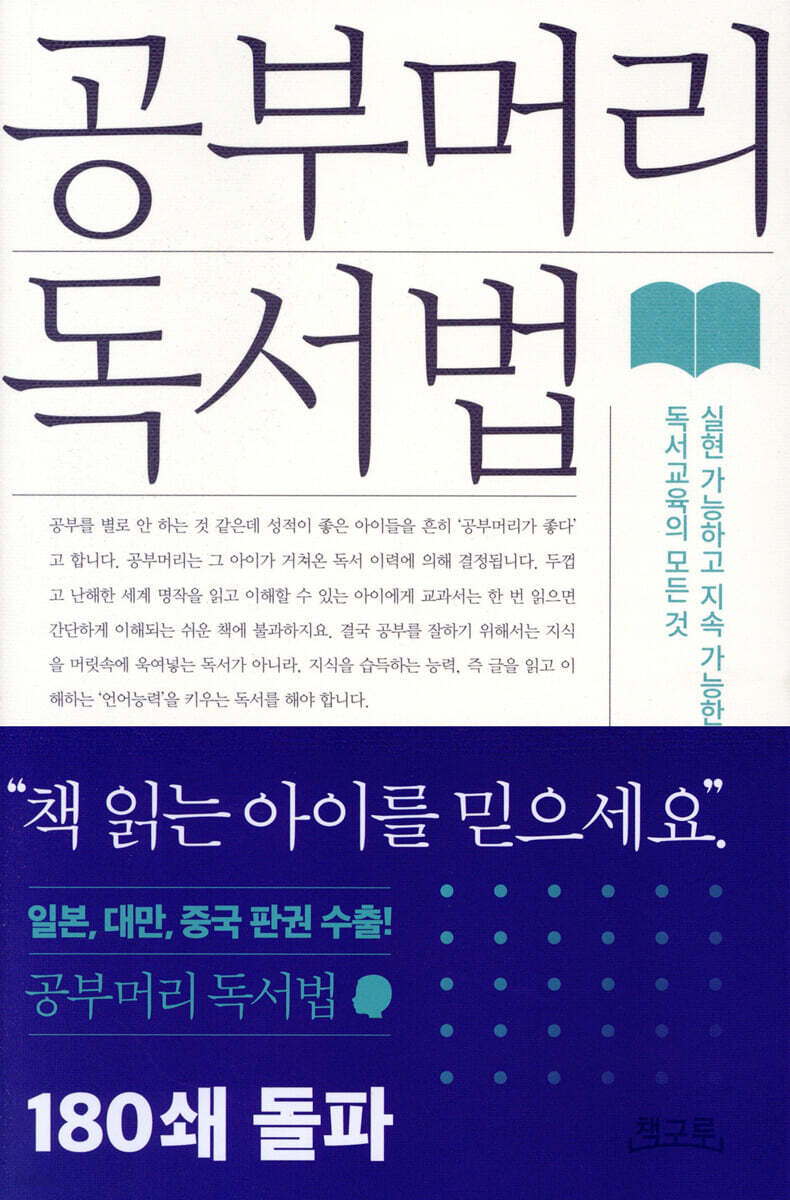
Study Head Reading Method
 |
Description
Book Introduction
“The best way to teach reading is to make it actionable.” Choi Seung-pil, a reading education expert who won the Changbi Good Children's Book Award, A guide to reading education for our children written for parents of elementary and middle school students! "Study Head Reading Method" is a reading education guidebook that condenses the know-how accumulated by author Seungpil Choi over 12 years while teaching reading and writing classes with children. Although he is an expert who travels around the country giving lectures on reading methods, in 『Study Head Reading Method』 he has compiled only reading methods that can be implemented at home. It is filled with reading methods that have been proven effective based on real-life examples and data. What is noteworthy about 『Study Head Reading Method』, as much as its faithful content, is the author's insight into the essence and principles of reading education. As a children's book author and a father who reads to his three children every day, his book "Study Head Reading Method" often contains sentences that look into the hearts of children and parents. Through his sincere writing, the author offers refreshing solutions to various problems encountered in reading education. At the end of each chapter, there is an information page with 14 reading strategies that can be applied to your child's grade and reading level. The reading method page in the form of a schedule includes things to keep in mind and specific reading effects, helping anyone easily create a reading plan. The final chapter, "How to Improve Your Language Skills in a Short Period of Time," is packed with practical tips that even adult readers can apply. After reading this 300-page book, following the sentences as if you were watching the author's lecture right before your eyes, the principles of reading education become clearly organized. "Study Head Reading Method" is a must-read book for parents of elementary and middle school students who want to recharge their motivation by reading whenever they feel tired from reading education. |
- You can preview some of the book's contents.
Preview
index
Preface .
Reading, the real way to study
Part 1: Study Head Reading Method for Beginner Readers
1.
Why do 90% of elementary school honor students fail?
Even a tower built with effort will collapse. / Why do grades drop as soon as middle schoolers start? / Textbooks are difficult. / The problem is 'listening'.
[Information] How to Determine Your Child's Reading Ability
[Study Head Reading Method 1] Basic reading method for upper elementary school students to prevent grade decline when entering middle school.
2.
Language ability determines grades
One day, your grades suddenly improve. / If your foundation is weak, will you really fall behind? / What do smart kids have in common? / The easiest way to develop a smart mind.
[Information] What is language ability?
[Study Head Reading Method 2] A basic reading method for middle school students that helps them develop language skills appropriate to their age.
3.
How do storybooks improve grades?
The key to reading education is not knowledge, but fun. / Reading just one book every two weeks is enough. / The correlation between storybooks and college entrance exam scores. / Storybooks also improve math scores. / I love books, but I'm bad at studying.
[Information] How to Choose Interesting Books
[Study Head Reading Method 3] A Middle School Student's Handwritten Reading Method for Improving Language Skills in a Short Period of Time
4.
My child doesn't even like storybooks. What should I do?
Is it really because their vocabulary is weak that they can't read? / Children who can't read storybooks can't understand textbooks either / Diagnosing reading skills in lower elementary school grades / The answer lies in reading.
[Information] My Child's Reading Habits Checklist
[Study Head Reading Method 4] Elementary School Lower Grade Reading Method to Overcome Reading Inadequateness
5.
Elementary school students and teenagers who are stuck with books need to find a way out.
Children Lost in Books / The Secret to Escape from Last Place in School in Just Four Months / Repeated Reading is Powerful / Motivating with Language Ability Assessments
[Information] How to Use the Step-by-Step Language Proficiency Assessment
[Study Head Reading Method 5] Reading Methods for Elementary School Students and Adolescents to Overcome Reading Inadequately
6.
The first step to becoming a reading talent
The Talents Dreamed of by Advanced Education Countries / Finland, Where Early Childhood Education Is Illegal / Is My Child's Brain Alright? / 15 Minutes to Consider Your Heart
[Information] The Effects of Early Education on the Brain
[Study Head Reading Method 6] Reading Method for Infants and Toddlers to Become Familiar with Books
7.
What's holding back our children from becoming independent readers?
The most common failures in reading instruction / Homework-like collections, learning comics that kill curiosity / Step 1 of independent reading - Reading lots of easy books / Why is speed reading bad? / Step 2 of independent reading - Choosing your own books / What is the worst enemy that ruins independent reading?
[Information] Enemies of Reading Independence
[Study Head Reading Method 7] Reading Methods for 1st and 2nd Graders to Achieve Independent Reading
8.
The college entrance exam system changes frequently. How can we cope without wavering?
High school freshmen who want to escape from studying / Three types of students with poor grades / Why aren't school grades and CSAT scores linked? / The identity of the integrated student record selection process / The most effective way to overcome the college entrance exam
[Information] The Impact of Reading on the Current College Entrance Exam System
[Study Head Reading Method 8] High School Student Training Method to Raise College Scholastic Ability Test Scores
Part 2: The Study-Headed Reading Method for Becoming a Skilled Reader
1.
Knowledge is not something you memorize, it's something you realize.
The ability to ask "Why?" about everything / From "A Dog of Flanders" to "Cosmos" / You can't force a reader to read knowledge books.
[Information] How to Use the Internet Encyclopedia to Internalize Knowledge
[Study Head Reading Method 9] Basic Reading Method for Youth Knowledge Books with an Internet Encyclopedia
2.
The road to knowledge books is closer than you think.
Where did all that curiosity go? / Thank you for being picky. / I'm a middle school student, and you want me to read picture books? / Underlining is essential when reading knowledge books.
[Information] How to Read Knowledge Books
[Study Head Reading Method 10] Achieve Top Grades with One Book in Three Months: A Strengthening Reading Method for Youth
3.
How to improve your language skills in a short period of time
Some tips to avoid side effects
Slow Reading: Look carefully and ask questions constantly.
[Study Head Reading Method 11] One Book a Year, Slow Reading Training Method
Repeated Reading: The Reading Methods of Great People
[Study Head Reading Method 12] Repeated Reading Method: Reading One Book Three Times Over Two Weeks
Transcription: The hand reads more deeply than the eye.
[Study Head Reading Method 13] A reading method that strengthens transcription by copying one book a year.
Abstract: Drawing Your Own Knowledge Map
[Study Head Reading Method 14] The Green Reading Method That Makes You a Knowledge Expert
[Information] Finding the Right Study Reading Method for Your Child
[Information] Setting Up a Reading Plan for Your Child
Conclusion.
When reading isn't 'studying,' your brain grows.
References
Reading, the real way to study
Part 1: Study Head Reading Method for Beginner Readers
1.
Why do 90% of elementary school honor students fail?
Even a tower built with effort will collapse. / Why do grades drop as soon as middle schoolers start? / Textbooks are difficult. / The problem is 'listening'.
[Information] How to Determine Your Child's Reading Ability
[Study Head Reading Method 1] Basic reading method for upper elementary school students to prevent grade decline when entering middle school.
2.
Language ability determines grades
One day, your grades suddenly improve. / If your foundation is weak, will you really fall behind? / What do smart kids have in common? / The easiest way to develop a smart mind.
[Information] What is language ability?
[Study Head Reading Method 2] A basic reading method for middle school students that helps them develop language skills appropriate to their age.
3.
How do storybooks improve grades?
The key to reading education is not knowledge, but fun. / Reading just one book every two weeks is enough. / The correlation between storybooks and college entrance exam scores. / Storybooks also improve math scores. / I love books, but I'm bad at studying.
[Information] How to Choose Interesting Books
[Study Head Reading Method 3] A Middle School Student's Handwritten Reading Method for Improving Language Skills in a Short Period of Time
4.
My child doesn't even like storybooks. What should I do?
Is it really because their vocabulary is weak that they can't read? / Children who can't read storybooks can't understand textbooks either / Diagnosing reading skills in lower elementary school grades / The answer lies in reading.
[Information] My Child's Reading Habits Checklist
[Study Head Reading Method 4] Elementary School Lower Grade Reading Method to Overcome Reading Inadequateness
5.
Elementary school students and teenagers who are stuck with books need to find a way out.
Children Lost in Books / The Secret to Escape from Last Place in School in Just Four Months / Repeated Reading is Powerful / Motivating with Language Ability Assessments
[Information] How to Use the Step-by-Step Language Proficiency Assessment
[Study Head Reading Method 5] Reading Methods for Elementary School Students and Adolescents to Overcome Reading Inadequately
6.
The first step to becoming a reading talent
The Talents Dreamed of by Advanced Education Countries / Finland, Where Early Childhood Education Is Illegal / Is My Child's Brain Alright? / 15 Minutes to Consider Your Heart
[Information] The Effects of Early Education on the Brain
[Study Head Reading Method 6] Reading Method for Infants and Toddlers to Become Familiar with Books
7.
What's holding back our children from becoming independent readers?
The most common failures in reading instruction / Homework-like collections, learning comics that kill curiosity / Step 1 of independent reading - Reading lots of easy books / Why is speed reading bad? / Step 2 of independent reading - Choosing your own books / What is the worst enemy that ruins independent reading?
[Information] Enemies of Reading Independence
[Study Head Reading Method 7] Reading Methods for 1st and 2nd Graders to Achieve Independent Reading
8.
The college entrance exam system changes frequently. How can we cope without wavering?
High school freshmen who want to escape from studying / Three types of students with poor grades / Why aren't school grades and CSAT scores linked? / The identity of the integrated student record selection process / The most effective way to overcome the college entrance exam
[Information] The Impact of Reading on the Current College Entrance Exam System
[Study Head Reading Method 8] High School Student Training Method to Raise College Scholastic Ability Test Scores
Part 2: The Study-Headed Reading Method for Becoming a Skilled Reader
1.
Knowledge is not something you memorize, it's something you realize.
The ability to ask "Why?" about everything / From "A Dog of Flanders" to "Cosmos" / You can't force a reader to read knowledge books.
[Information] How to Use the Internet Encyclopedia to Internalize Knowledge
[Study Head Reading Method 9] Basic Reading Method for Youth Knowledge Books with an Internet Encyclopedia
2.
The road to knowledge books is closer than you think.
Where did all that curiosity go? / Thank you for being picky. / I'm a middle school student, and you want me to read picture books? / Underlining is essential when reading knowledge books.
[Information] How to Read Knowledge Books
[Study Head Reading Method 10] Achieve Top Grades with One Book in Three Months: A Strengthening Reading Method for Youth
3.
How to improve your language skills in a short period of time
Some tips to avoid side effects
Slow Reading: Look carefully and ask questions constantly.
[Study Head Reading Method 11] One Book a Year, Slow Reading Training Method
Repeated Reading: The Reading Methods of Great People
[Study Head Reading Method 12] Repeated Reading Method: Reading One Book Three Times Over Two Weeks
Transcription: The hand reads more deeply than the eye.
[Study Head Reading Method 13] A reading method that strengthens transcription by copying one book a year.
Abstract: Drawing Your Own Knowledge Map
[Study Head Reading Method 14] The Green Reading Method That Makes You a Knowledge Expert
[Information] Finding the Right Study Reading Method for Your Child
[Information] Setting Up a Reading Plan for Your Child
Conclusion.
When reading isn't 'studying,' your brain grows.
References
Into the book
There are kids who don't seem to study much but get good grades.
A child's ability to study is determined by his or her reading history.
For a child who can read and understand thick and difficult world masterpieces, a textbook is nothing more than an easy book that can be easily understood after reading it once.
Ultimately, to study well, you need to read not to cram knowledge into your head, but to develop the ability to acquire knowledge, that is, the 'language ability' to read and understand texts.
--- From the text
Reading a storybook is like living someone else's life.
Because it's about empathizing with someone who is in a completely different time and space and situation than you and experiencing the events they are going through.
It is an act of trying to understand others.
Beyond academic matters, I don't need to tell you how important the ability to understand people is in life.
The basis of a successful school and social life is human relationships.
Oh right, even family life is like that.
--- p.93
Just as there are correct postures and methods for health training, there are also correct postures and methods for reading.
First of all, the general rule is, 'the more you think, the better the reading.'
The reason speed reading is a bad reading method is because it leaves no room for thought.
In fact, children who have a habit of speed reading do not see their language ability test scores improve no matter how many books they read.
It's surprisingly unflappable.
--- p.96
The larger and thicker the mass of thoughts and emotions that arise when reading a book, the greater the effect of reading.
To do that, you need to read actively.
No one can be active while reading a boring book.
It's better to read it all the way through, even if it's a bit long.
The very fact that you find something interesting is a sign that you are reading actively.
--- p.97
Liking a book means that the story itself is interesting, but it also means that the child is comfortable with the author's way of telling the story and the rhythm of the sentences.
There's a good chance you'll like other books by that author too.
--- p.98
Most of the cases of reading instruction failure in our country show similar tendencies.
First, as students advance in grade level, the amount of reading decreases sharply.
We start reading in preschool, read the most in the lower grades of elementary school, and hit rock bottom in the upper grades of elementary school.
As we become teenagers, our reading habits tend to disappear.
Second, many children read quickly.
You sit down and say you're reading a book, but you're actually just skimming through it.
This tendency is strong in upper elementary school students.
Third, parents often choose the books their children will read.
Fourth, the final destination of reading guidance is often educational comics.
A child's ability to study is determined by his or her reading history.
For a child who can read and understand thick and difficult world masterpieces, a textbook is nothing more than an easy book that can be easily understood after reading it once.
Ultimately, to study well, you need to read not to cram knowledge into your head, but to develop the ability to acquire knowledge, that is, the 'language ability' to read and understand texts.
--- From the text
Reading a storybook is like living someone else's life.
Because it's about empathizing with someone who is in a completely different time and space and situation than you and experiencing the events they are going through.
It is an act of trying to understand others.
Beyond academic matters, I don't need to tell you how important the ability to understand people is in life.
The basis of a successful school and social life is human relationships.
Oh right, even family life is like that.
--- p.93
Just as there are correct postures and methods for health training, there are also correct postures and methods for reading.
First of all, the general rule is, 'the more you think, the better the reading.'
The reason speed reading is a bad reading method is because it leaves no room for thought.
In fact, children who have a habit of speed reading do not see their language ability test scores improve no matter how many books they read.
It's surprisingly unflappable.
--- p.96
The larger and thicker the mass of thoughts and emotions that arise when reading a book, the greater the effect of reading.
To do that, you need to read actively.
No one can be active while reading a boring book.
It's better to read it all the way through, even if it's a bit long.
The very fact that you find something interesting is a sign that you are reading actively.
--- p.97
Liking a book means that the story itself is interesting, but it also means that the child is comfortable with the author's way of telling the story and the rhythm of the sentences.
There's a good chance you'll like other books by that author too.
--- p.98
Most of the cases of reading instruction failure in our country show similar tendencies.
First, as students advance in grade level, the amount of reading decreases sharply.
We start reading in preschool, read the most in the lower grades of elementary school, and hit rock bottom in the upper grades of elementary school.
As we become teenagers, our reading habits tend to disappear.
Second, many children read quickly.
You sit down and say you're reading a book, but you're actually just skimming through it.
This tendency is strong in upper elementary school students.
Third, parents often choose the books their children will read.
Fourth, the final destination of reading guidance is often educational comics.
--- p.176
Publisher's Review
“When I was young, I was read a lot of picture books.
But after entering elementary school, he stopped reading books.”
“I’m worried because I don’t read the books I’m told to read and only watch educational comics.”
“I read a lot of books, but my Korean grades aren’t good, and I can’t understand math problems even when I read them.
“What could be the problem?”
This is a complaint that Choi Seung-pil, a children's book author and reading education expert, hears from parents every day.
The question, “How can I raise my child to be a good reader?” is rooted in the formidable difficulty of reading education.
If you try to get your child to read a book, he or she will often make excuses to avoid it, and even if you do manage to get him or her to sit at a desk, he or she will just look at the book and read it quickly.
Besides, our kids are so busy.
From school to cram school to studying, as you advance in grade level, the time you spend on reading inevitably decreases.
Author Choi Seung-pil, who reads books with children every day in the field, knows better than anyone the difficulties of reading education.
Moreover, the reality of our children's reading, as experienced directly by the author, is much more serious than parents think.
Even elementary school students who can solve middle school math problems and converse in English with native speakers often have significantly lower reading and comprehension skills in their grade-level textbooks.
And elementary school students with low language skills inevitably had lower grades when they entered middle school.
Observing the recurring phenomenon of elementary school honor students failing each year, the author studied the correlation between reading and studying for 12 years.
The book that compiles the accumulated real-life cases and data is “Study Head Reading Method.”
The author emphasizes the value and utility of reading a lot.
Why did you focus on 'studying'?
In fact, the amount of reading our children do during their childhood is by no means small.
From infancy, children are exposed to a wide range of books in the fields of science, social studies, and history. In elementary school, there is a list of books called "required reading," and they even receive regular reading supervision from their learning teachers.
But why did these children fall into a state of reading inferiority where they cannot even read and understand textbooks?
The problem is that our children's main way of studying is through listening.
Studying by listening and understanding is clearly effective in the lower grades, but as the amount of subjects increases in the upper grades, limitations arise.
Even if you just read and understand something, you will quickly get through it, but if you listen and understand it, you will have to invest several times more time and energy.
Moreover, the educational reality in Korea is fatal, where children are consumed with 'listening' from a young age and have no time to read and understand.
Considering that studying is an act of reading and understanding a book called a 'textbook', it is urgent to develop 'language skills for reading and understanding'.
In "Study Head Reading Method," the author's regret and desperation as he faced the reality of the educational field are vividly revealed.
This is also the reason why the author, who is also a storybook writer, focused on 'studying' rather than the many values and benefits of reading and explained the principles and methods of reading education.
This is because the most noticeable effect of reading on children in actual school settings is ‘studying.’
“How does reading storybooks help you study?”
The prescription given by the reading teacher to children with low language skills was 'a storybook that you can read while completely absorbed in it.'
At first glance, it might seem like textbook-related books or books that impart knowledge would be helpful for studying, but in reality, reading interesting storybooks was the most effective in improving grades.
Knowledge books are books that are effective for reading, but most children have such low language skills that they cannot read knowledge books.
While children are reading a book with enjoyment, information such as key scenes, plot, and character relationships are built like a house in their heads.
A child who can read age-appropriate storybooks and build a house in his or her head can also understand the content of textbooks and conceptualize it in his or her own way.
“The best reading education method is a practical reading method.”
Ultimately, reading is a habit that should continue into adulthood, but for many, it is often nixed before reaching adolescence.
This is because reading education feels like a long and difficult task, like a full marathon, to both children and parents.
Public lecturer Choi Seung-pil says:
The true reading method is one that can be practiced and sustained at home.
When you get tired of struggling with reading with your child, I recommend keeping “Study Head Reading Method” close by and reading it.
I am confident that this will provide a pacemaker to keep you motivated and supportive during your reading education, which feels like a full-course marathon.
If you do this a few times, it won't take long for your child's reading habits, which used to feel like a marathon, to change into a path they want to walk every day.
But after entering elementary school, he stopped reading books.”
“I’m worried because I don’t read the books I’m told to read and only watch educational comics.”
“I read a lot of books, but my Korean grades aren’t good, and I can’t understand math problems even when I read them.
“What could be the problem?”
This is a complaint that Choi Seung-pil, a children's book author and reading education expert, hears from parents every day.
The question, “How can I raise my child to be a good reader?” is rooted in the formidable difficulty of reading education.
If you try to get your child to read a book, he or she will often make excuses to avoid it, and even if you do manage to get him or her to sit at a desk, he or she will just look at the book and read it quickly.
Besides, our kids are so busy.
From school to cram school to studying, as you advance in grade level, the time you spend on reading inevitably decreases.
Author Choi Seung-pil, who reads books with children every day in the field, knows better than anyone the difficulties of reading education.
Moreover, the reality of our children's reading, as experienced directly by the author, is much more serious than parents think.
Even elementary school students who can solve middle school math problems and converse in English with native speakers often have significantly lower reading and comprehension skills in their grade-level textbooks.
And elementary school students with low language skills inevitably had lower grades when they entered middle school.
Observing the recurring phenomenon of elementary school honor students failing each year, the author studied the correlation between reading and studying for 12 years.
The book that compiles the accumulated real-life cases and data is “Study Head Reading Method.”
The author emphasizes the value and utility of reading a lot.
Why did you focus on 'studying'?
In fact, the amount of reading our children do during their childhood is by no means small.
From infancy, children are exposed to a wide range of books in the fields of science, social studies, and history. In elementary school, there is a list of books called "required reading," and they even receive regular reading supervision from their learning teachers.
But why did these children fall into a state of reading inferiority where they cannot even read and understand textbooks?
The problem is that our children's main way of studying is through listening.
Studying by listening and understanding is clearly effective in the lower grades, but as the amount of subjects increases in the upper grades, limitations arise.
Even if you just read and understand something, you will quickly get through it, but if you listen and understand it, you will have to invest several times more time and energy.
Moreover, the educational reality in Korea is fatal, where children are consumed with 'listening' from a young age and have no time to read and understand.
Considering that studying is an act of reading and understanding a book called a 'textbook', it is urgent to develop 'language skills for reading and understanding'.
In "Study Head Reading Method," the author's regret and desperation as he faced the reality of the educational field are vividly revealed.
This is also the reason why the author, who is also a storybook writer, focused on 'studying' rather than the many values and benefits of reading and explained the principles and methods of reading education.
This is because the most noticeable effect of reading on children in actual school settings is ‘studying.’
“How does reading storybooks help you study?”
The prescription given by the reading teacher to children with low language skills was 'a storybook that you can read while completely absorbed in it.'
At first glance, it might seem like textbook-related books or books that impart knowledge would be helpful for studying, but in reality, reading interesting storybooks was the most effective in improving grades.
Knowledge books are books that are effective for reading, but most children have such low language skills that they cannot read knowledge books.
While children are reading a book with enjoyment, information such as key scenes, plot, and character relationships are built like a house in their heads.
A child who can read age-appropriate storybooks and build a house in his or her head can also understand the content of textbooks and conceptualize it in his or her own way.
“The best reading education method is a practical reading method.”
Ultimately, reading is a habit that should continue into adulthood, but for many, it is often nixed before reaching adolescence.
This is because reading education feels like a long and difficult task, like a full marathon, to both children and parents.
Public lecturer Choi Seung-pil says:
The true reading method is one that can be practiced and sustained at home.
When you get tired of struggling with reading with your child, I recommend keeping “Study Head Reading Method” close by and reading it.
I am confident that this will provide a pacemaker to keep you motivated and supportive during your reading education, which feels like a full-course marathon.
If you do this a few times, it won't take long for your child's reading habits, which used to feel like a marathon, to change into a path they want to walk every day.
GOODS SPECIFICS
- Date of issue: May 3, 2018
- Page count, weight, size: 344 pages | 590g | 147*223*20mm
- ISBN13: 9791196316808
- ISBN10: 1196316805
You may also like
카테고리
korean


korean

![GQ KOREA Mark (Monthly): December [2025]](http://librairie.coreenne.fr/cdn/shop/files/8ef265dbbfbf186523ed75ba7319009d.jpg?v=1765340328&width=3840)


