

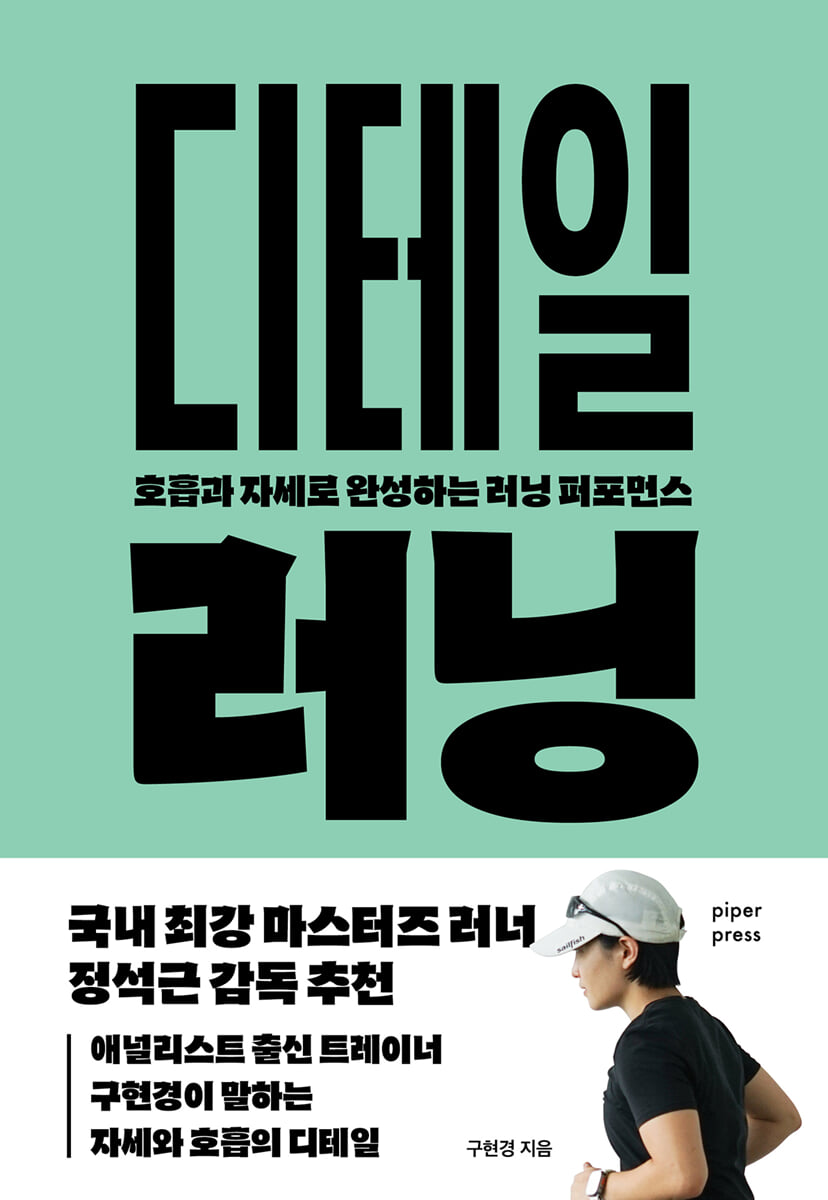
Detail Running
 |
Description
Book Introduction
What a runner needs is not willpower, but detail.
Small differences break records and reduce injuries.
If you're running consistently but your records aren't improving and you're just getting injured again, it's time to check the details.
The author of "Detail Learning," Ku Hyeon-gyeong, is a trainer with a unique background, having previously worked as a private equity analyst.
After becoming a full-time trainer, he runs a fitness studio called 'Timber Modular', which teaches the principles of exercise.
In this book, he closely analyzes the body and movement to point out differences in breathing, posture, and landing that runners often miss.
He emphasizes that each runner must understand their own body and find a training method that suits them.
This book does not talk about willpower and mental strength.
Instead, it scientifically organizes the principles of breathing, posture, running dynamics, and injury prevention.
It is designed with abundant photos and illustrations so that anyone can immediately apply the correct running method.
Small differences break records and reduce injuries.
If you're running consistently but your records aren't improving and you're just getting injured again, it's time to check the details.
The author of "Detail Learning," Ku Hyeon-gyeong, is a trainer with a unique background, having previously worked as a private equity analyst.
After becoming a full-time trainer, he runs a fitness studio called 'Timber Modular', which teaches the principles of exercise.
In this book, he closely analyzes the body and movement to point out differences in breathing, posture, and landing that runners often miss.
He emphasizes that each runner must understand their own body and find a training method that suits them.
This book does not talk about willpower and mental strength.
Instead, it scientifically organizes the principles of breathing, posture, running dynamics, and injury prevention.
It is designed with abundant photos and illustrations so that anyone can immediately apply the correct running method.
- You can preview some of the book's contents.
Preview
index
prolog.
The Challenge of Running
Part 1.
Running and breathing
1.
Running for breath
Why You Need to Change Your Breath
Control your mind with your breathing
Sympathetic and parasympathetic nerves
Running gives you a wide breath
Part 2.
Correct running posture
2.
Incline: The Essence of Running Form
What you need to run injury-free
The mindset to learn running form
Running is a forward movement.
The slope to move forward
3.
Arm Swing: The Movement and Angle That Works for Me
Control your legs with your arms
Postures to avoid
Correct posture
4.
Core: Building a strong core without even thinking about it
All exercise is core exercise
How to Activate Your Core While Running
How to create a core that activates without conscious awareness
5.
Landing Techniques: Three Landing Techniques and Center of Gravity
Who is this advice for?
Three landing methods
Heel Strike
Midfoot strike
If you want to introduce a new landing method
Center of gravity is more important than landing technique
Movement of the knees and feet
Forget everything and run happily
Part 3.
Training Methods and Running Dynamics
6.
Training methods that vary in intensity
Easy training is easy enough, difficult training is hard enough
walking
jogging
Long Distance Training (LSD)
Uphill
Faceju
Tempo Run
Interval
sprint
fartlek
7.
Training method using zone training
The essence of aerobic exercise
Energy currency
Anaerobic and aerobic engines
Training zone and running
Finding Your Training Zones: Maximum Heart Rate and Lactate Threshold Heart Rate
Zone 1: Warm-up and Recovery
Zone 2: The purest form of cardio exercise
Zone 3: Combined interval or race pace
Zone 4: Anaerobic fitness, speed endurance training
Zone 5: Developing anaerobic fitness, maximal power, and speed training.
8.
Training Methods for Beginners
Running like a sloth
Running by time
Two running strategies
A plan to run 5km without injury
9.
Running Dynamics
Until numbers came to language
Cadence vs. Stride
Stride: A Key Factor in Speed Improvement
Cadence
Ground contact time
vertical amplitude
vertical ratio
Part 4.
Strength and breathing training
10.
Strength training for running
Running and Injuries
Common causes of injury
Muscles needed for running
Psoas major: If your front hip muscles hurt after running
Gluteus medius: If your pelvis falls to the side and your left and right landings are not balanced,
Quadriceps and Ankle Muscles: If you want to improve your ability to withstand landing impact
Balancing Leg Development: If you're running with just your front thighs and calves
11.
How to start breathing for real
Modern people trapped in fake breathing
Nasal breathing: inhale and exhale slowly, deeply, and efficiently.
The respiratory pathway requires resistance.
12.
Test and train your breathing ability
Breathing ability test
breathing exercises
Breathing less is breathing better
Part 5.
Runner's spirit
13.
The power to believe in myself
Time alone with me
Freedom to run
Take courage and rest
How to run your daily life well
The Challenge of Running
Part 1.
Running and breathing
1.
Running for breath
Why You Need to Change Your Breath
Control your mind with your breathing
Sympathetic and parasympathetic nerves
Running gives you a wide breath
Part 2.
Correct running posture
2.
Incline: The Essence of Running Form
What you need to run injury-free
The mindset to learn running form
Running is a forward movement.
The slope to move forward
3.
Arm Swing: The Movement and Angle That Works for Me
Control your legs with your arms
Postures to avoid
Correct posture
4.
Core: Building a strong core without even thinking about it
All exercise is core exercise
How to Activate Your Core While Running
How to create a core that activates without conscious awareness
5.
Landing Techniques: Three Landing Techniques and Center of Gravity
Who is this advice for?
Three landing methods
Heel Strike
Midfoot strike
If you want to introduce a new landing method
Center of gravity is more important than landing technique
Movement of the knees and feet
Forget everything and run happily
Part 3.
Training Methods and Running Dynamics
6.
Training methods that vary in intensity
Easy training is easy enough, difficult training is hard enough
walking
jogging
Long Distance Training (LSD)
Uphill
Faceju
Tempo Run
Interval
sprint
fartlek
7.
Training method using zone training
The essence of aerobic exercise
Energy currency
Anaerobic and aerobic engines
Training zone and running
Finding Your Training Zones: Maximum Heart Rate and Lactate Threshold Heart Rate
Zone 1: Warm-up and Recovery
Zone 2: The purest form of cardio exercise
Zone 3: Combined interval or race pace
Zone 4: Anaerobic fitness, speed endurance training
Zone 5: Developing anaerobic fitness, maximal power, and speed training.
8.
Training Methods for Beginners
Running like a sloth
Running by time
Two running strategies
A plan to run 5km without injury
9.
Running Dynamics
Until numbers came to language
Cadence vs. Stride
Stride: A Key Factor in Speed Improvement
Cadence
Ground contact time
vertical amplitude
vertical ratio
Part 4.
Strength and breathing training
10.
Strength training for running
Running and Injuries
Common causes of injury
Muscles needed for running
Psoas major: If your front hip muscles hurt after running
Gluteus medius: If your pelvis falls to the side and your left and right landings are not balanced,
Quadriceps and Ankle Muscles: If you want to improve your ability to withstand landing impact
Balancing Leg Development: If you're running with just your front thighs and calves
11.
How to start breathing for real
Modern people trapped in fake breathing
Nasal breathing: inhale and exhale slowly, deeply, and efficiently.
The respiratory pathway requires resistance.
12.
Test and train your breathing ability
Breathing ability test
breathing exercises
Breathing less is breathing better
Part 5.
Runner's spirit
13.
The power to believe in myself
Time alone with me
Freedom to run
Take courage and rest
How to run your daily life well
Detailed image

Into the book
For those who are easily anxious and tense, it is of great comfort to know that one can improve one's personality by changing one's physical and physiological conditions.
Breathing, and running which improves breathing ability, essentially improves both mental and physical constitution.
--- p.18
To exaggerate a bit, the only body tilt that health people know is the hip hinge.
(…) When people who have worked out a lot start running for the first time, they often see themselves running with their pelvis excessively bent.
Unlike weight lifting, running is an event that can last for 3 or 4 hours.
Is it possible to maintain a hip hinge and core lock throughout the entire exercise? If you experience lower back pain while running, check to see if you're using the wrong incline—that is, using a hip hinge—or creating excessive anterior pelvic tilt or lumbar extension.
--- p.36
A common cause of shoulder discomfort is the 11-figure arm swing.
When viewed from above the crown of the head, the human shoulder blades have a wide V-shaped angle that hugs the back inward.
This is called the scapular plane.
However, if you set your arms to 11, your shoulder blades will be brought back (posterior) and your back will become flat.
In particular, the rhomboid muscle, the muscle between the shoulder blades, becomes tense, and an uncomfortable resistance is felt around the neck, chest, and shoulders.
The discomfort is especially severe in people with short and tight pectoral muscles, front shoulder muscles, or upper trapezius muscles.
--- pp.45~46
In running, the core muscles stabilize by being flexible rather than stiff and stabilizing through abdominal pressure, as if you were squeezing your torso in the weight room.
Similar to core stabilization in sports that allow spinal movement, such as golf, tennis, and boxing.
Keep your front abs flat, focusing especially on your lower abs.
If you need more stability, hold it with a slightly bulging feeling to the side.
--- p.56
Before you blindly switch to a midfoot strike, I want you to first think about why you want to change your landing technique.
After suffering from a minor injury, I often feel like I want to change my landing technique when I easily conclude that it's my landing technique that's the problem.
However, there are many other variables involved in running that are related to injury.
Locally, these include stride length, cadence, speed, vertical oscillation, landing below the center of gravity, and even running rhythm, while larger-scale factors include training frequency and intensity, as well as external factors such as the runner's body weight, strength level, and flexibility.
--- pp.73~74
From resting to zone 2, the body relies primarily on fat for energy.
Fat is an efficient source of energy, but it requires oxygen to be metabolized.
Zone 2 can be seen as the area where you exert your maximum effort without going over the energy source crossover point (VT1, LT1) where you transition from an aerobic to an anaerobic state.
By exercising just below threshold like this, your body becomes more effective at using fat as a source of energy, increases the number and function of mitochondria in your muscle fibers (especially slow-twitch fibers), and improves their ability to process lactate.
--- p.124~125
Beginners who do not have a good sense of what their own pace is, whether fast, normal, or slow, will have uneven paces if they set their goals based on distance, and they are especially prone to overpacing in the latter half of the race in the hopes of covering the distance quickly.
If you are a beginner, I recommend using time rather than distance as your standard.
This will increase the likelihood of setting realistic goals from the outset, increasing your achievement rate and making your pace more relaxed and consistent.
--- p.142~143
Most good runners have short ground contact times, high cadences, high take-off power, and increased stride length.
Beginners should be wary of the chicken-and-egg problem.
This means that you should not misunderstand and think, 'People who run well have long strides, so if I want to run well, I have to run comfortably.'
A wide stride is the result of the effort a runner puts into building strength, rhythm, and speed as they move past their beginner stage.
If you follow along rashly, you might get hurt.
--- p.152
A common postural problem that occurs in the pelvis when landing from running is the pelvis falling to one side.
In this case, the energy of the lower body leaks out to the side, and the rigidity of the lower body required for landing cannot be created, but the bigger problem is that the muscles cannot elastically absorb the shock of hitting the ground with the body weight, so the stimulus is transmitted to the joints.
In particular, the muscles on the outside of the leg become shortened, making them vulnerable to injuries such as iliotibial band syndrome, which causes pain on the outside of the knee when going down stairs.
The chain of compensatory forces can cause the ankle to roll inward, which can cause discomfort around the ankle.
--- p.187
This breathing technique, called cyclic sigh or physiological sigh, is effective in improving mood and reducing stress, and is also useful during exercise.
It is one of the most effective breathing techniques for activating the parasympathetic nervous system of the body.
When you feel out of breath or have pain in your side during exercise, it immediately lowers your heart rate, stabilizes your breathing, and relieves pain.
(…) The breathing method is to take two deep breaths through the nose and then exhale once long through the mouth. Take one deep breath, then take a short, strong breath for the second time and then exhale all the air through the mouth.
Breathing, and running which improves breathing ability, essentially improves both mental and physical constitution.
--- p.18
To exaggerate a bit, the only body tilt that health people know is the hip hinge.
(…) When people who have worked out a lot start running for the first time, they often see themselves running with their pelvis excessively bent.
Unlike weight lifting, running is an event that can last for 3 or 4 hours.
Is it possible to maintain a hip hinge and core lock throughout the entire exercise? If you experience lower back pain while running, check to see if you're using the wrong incline—that is, using a hip hinge—or creating excessive anterior pelvic tilt or lumbar extension.
--- p.36
A common cause of shoulder discomfort is the 11-figure arm swing.
When viewed from above the crown of the head, the human shoulder blades have a wide V-shaped angle that hugs the back inward.
This is called the scapular plane.
However, if you set your arms to 11, your shoulder blades will be brought back (posterior) and your back will become flat.
In particular, the rhomboid muscle, the muscle between the shoulder blades, becomes tense, and an uncomfortable resistance is felt around the neck, chest, and shoulders.
The discomfort is especially severe in people with short and tight pectoral muscles, front shoulder muscles, or upper trapezius muscles.
--- pp.45~46
In running, the core muscles stabilize by being flexible rather than stiff and stabilizing through abdominal pressure, as if you were squeezing your torso in the weight room.
Similar to core stabilization in sports that allow spinal movement, such as golf, tennis, and boxing.
Keep your front abs flat, focusing especially on your lower abs.
If you need more stability, hold it with a slightly bulging feeling to the side.
--- p.56
Before you blindly switch to a midfoot strike, I want you to first think about why you want to change your landing technique.
After suffering from a minor injury, I often feel like I want to change my landing technique when I easily conclude that it's my landing technique that's the problem.
However, there are many other variables involved in running that are related to injury.
Locally, these include stride length, cadence, speed, vertical oscillation, landing below the center of gravity, and even running rhythm, while larger-scale factors include training frequency and intensity, as well as external factors such as the runner's body weight, strength level, and flexibility.
--- pp.73~74
From resting to zone 2, the body relies primarily on fat for energy.
Fat is an efficient source of energy, but it requires oxygen to be metabolized.
Zone 2 can be seen as the area where you exert your maximum effort without going over the energy source crossover point (VT1, LT1) where you transition from an aerobic to an anaerobic state.
By exercising just below threshold like this, your body becomes more effective at using fat as a source of energy, increases the number and function of mitochondria in your muscle fibers (especially slow-twitch fibers), and improves their ability to process lactate.
--- p.124~125
Beginners who do not have a good sense of what their own pace is, whether fast, normal, or slow, will have uneven paces if they set their goals based on distance, and they are especially prone to overpacing in the latter half of the race in the hopes of covering the distance quickly.
If you are a beginner, I recommend using time rather than distance as your standard.
This will increase the likelihood of setting realistic goals from the outset, increasing your achievement rate and making your pace more relaxed and consistent.
--- p.142~143
Most good runners have short ground contact times, high cadences, high take-off power, and increased stride length.
Beginners should be wary of the chicken-and-egg problem.
This means that you should not misunderstand and think, 'People who run well have long strides, so if I want to run well, I have to run comfortably.'
A wide stride is the result of the effort a runner puts into building strength, rhythm, and speed as they move past their beginner stage.
If you follow along rashly, you might get hurt.
--- p.152
A common postural problem that occurs in the pelvis when landing from running is the pelvis falling to one side.
In this case, the energy of the lower body leaks out to the side, and the rigidity of the lower body required for landing cannot be created, but the bigger problem is that the muscles cannot elastically absorb the shock of hitting the ground with the body weight, so the stimulus is transmitted to the joints.
In particular, the muscles on the outside of the leg become shortened, making them vulnerable to injuries such as iliotibial band syndrome, which causes pain on the outside of the knee when going down stairs.
The chain of compensatory forces can cause the ankle to roll inward, which can cause discomfort around the ankle.
--- p.187
This breathing technique, called cyclic sigh or physiological sigh, is effective in improving mood and reducing stress, and is also useful during exercise.
It is one of the most effective breathing techniques for activating the parasympathetic nervous system of the body.
When you feel out of breath or have pain in your side during exercise, it immediately lowers your heart rate, stabilizes your breathing, and relieves pain.
(…) The breathing method is to take two deep breaths through the nose and then exhale once long through the mouth. Take one deep breath, then take a short, strong breath for the second time and then exhale all the air through the mouth.
--- pp.222~223
Publisher's Review
Running is easy for anyone to start, but difficult to do properly.
"Detailed Running" dissects the essence of running.
Running is the simplest exercise, yet at the same time the most complex.
Anyone can get started with just a pair of shoes, but the more you delve into it, the more you realize there are so many elements involved, like breathing, posture, landing, and training methods.
"Detailed Running" is a book that presents the essence of running, both easy and difficult.
Author Ku Hyeon-gyeong, a trainer who teaches the principles of exercise, talked about how to understand your own body and exercise in her previous work, “Exercise Independence.”
This book analyzes each posture that runners often overlook, explaining how these details interact with other body functions.
His philosophy that each runner must understand their own body and find the method that suits them is the most persuasive message for runners who want to improve their performance while continuing to run for a long time.
This book systematically covers breathing, landing, running dynamics, and injury prevention principles from the basics, and is designed with abundant photos and illustrations so that anyone can immediately apply them.
It not only teaches you how to run, but also provides clear reasons why you should do it, which increases both your understanding and your ability to execute the training.
Running is a basic movement that any living, breathing being can do.
But look deeper and you'll discover a sophisticated science of movement where a single breath or landing can make or break a record.
"Detail Running" speaks to runners.
If you want to run farther and faster, first understand your body and read the details.
Small differences prevent injury, increase enjoyment, and make achievement possible.
At that very moment, running becomes the most powerful exercise that can change your life.
"Detailed Running" dissects the essence of running.
Running is the simplest exercise, yet at the same time the most complex.
Anyone can get started with just a pair of shoes, but the more you delve into it, the more you realize there are so many elements involved, like breathing, posture, landing, and training methods.
"Detailed Running" is a book that presents the essence of running, both easy and difficult.
Author Ku Hyeon-gyeong, a trainer who teaches the principles of exercise, talked about how to understand your own body and exercise in her previous work, “Exercise Independence.”
This book analyzes each posture that runners often overlook, explaining how these details interact with other body functions.
His philosophy that each runner must understand their own body and find the method that suits them is the most persuasive message for runners who want to improve their performance while continuing to run for a long time.
This book systematically covers breathing, landing, running dynamics, and injury prevention principles from the basics, and is designed with abundant photos and illustrations so that anyone can immediately apply them.
It not only teaches you how to run, but also provides clear reasons why you should do it, which increases both your understanding and your ability to execute the training.
Running is a basic movement that any living, breathing being can do.
But look deeper and you'll discover a sophisticated science of movement where a single breath or landing can make or break a record.
"Detail Running" speaks to runners.
If you want to run farther and faster, first understand your body and read the details.
Small differences prevent injury, increase enjoyment, and make achievement possible.
At that very moment, running becomes the most powerful exercise that can change your life.
GOODS SPECIFICS
- Date of issue: October 10, 2025
- Page count, weight, size: 250 pages | 426g | 145*210*15mm
- ISBN13: 9791194278139
- ISBN10: 1194278132
You may also like
카테고리
korean


korean

![ELLE 엘르 스페셜 에디션 A형 : 12월 [2025]](http://librairie.coreenne.fr/cdn/shop/files/b8e27a3de6c9538896439686c6b0e8fb.jpg?v=1766436872&width=3840)


