

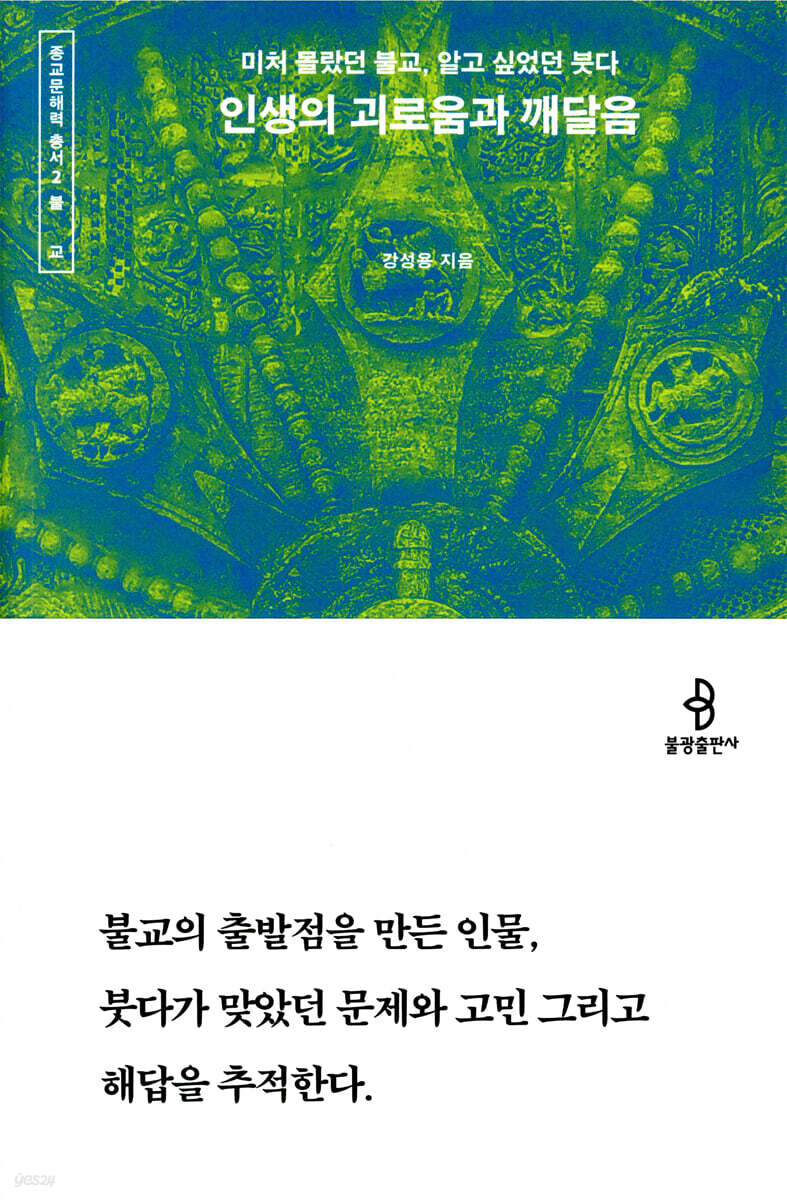
The suffering and enlightenment of life
 |
Description
Book Introduction
The most beloved in the history of human intelligence Core messages of world religions! The second book in the Religious Literacy Series The Suffering and Enlightenment of Life “If hardship disappears through hardship, there will be no more hardship!” A Different Interpretation of Karma, the Four Noble Truths, the Noble Eightfold Path, the Twelve Links of Dependent Origination, and Reincarnation A refreshing overturning of the 'Buddhism' you've believed in so far. The religion we've long believed to be "Buddhism" has been radically overturned! It strips away the embellishments that have been applied to core Buddhist concepts like the Four Noble Truths, the Eightfold Path, the Law of Dependent Origination, karma, and reincarnation, and approaches the true voice of the Buddha. So, this book is also a tracker that explores the suffering and enlightenment of life faced by the historically existing 'Buddha'. This is the second book in the "Religious Literacy Series," which looks at religion from the perspective of "understanding" rather than "belief" and increases religious sensitivity, titled "The Sufferings of Life and Enlightenment." The author, who majored in Indian philosophy and is the director of the South Asia Center at Seoul National University's Asia Research Institute, is a leading Indian expert in Korea who has shared information on ancient Indian history as well as current politics, economy, society, and culture on the economic YouTube channel Sampro TV. In this book, the author traces the voice of the Buddha hidden behind the story of the Buddha, organized and reconstructed within the context of ancient Indian tradition, language, culture, religion, and intellectual history. In the process, we explore what concerns Buddha, the figure who laid the starting point for Buddhism, had in his time and what kind of change in thinking he used to find answers, unlike the thinkers of his time. And it concisely summarizes the message that Buddha's worries and answers give us. This book is new and amazing. The author's interpretation is novel. It offers the refreshing feeling that the teachings of Buddha, which everyone has likely heard at least once, were not entirely theories devised by the Buddha himself. It logically reveals that karma, which is translated as karma (work), dharma, which is translated as law (law), and reincarnation, which are deeply engraved in the minds of Koreans, are concepts that originated from ancient Indian ritual and practice traditions. On the other hand, it emphasizes that Buddha was the person who innovatively transformed the 'Shiramana (?rama?a, 沙門) tradition', which was the dominant ideological or religious trend at the time. "The Suffering of Life and Enlightenment" makes us realize that the Buddha's concern 2,500 years ago—"How can we eliminate suffering in life, a continuous series of suffering?"—is not so different from our own. What enlightenment did Buddha use to find the answer to his unavoidable suffering? If you're seeking to unravel the simple proposition that "life is suffering," this book will serve as the most reliable stepping stone toward that answer. |
- You can preview some of the book's contents.
Preview
index
Publisher's Note: Now is Religious Literacy
Introduction
Chapter 1: Questions about the Buddha
We ask the ancient Indian ascetics
Stories before becoming Buddha
Understanding Shramana in the Jain Tradition
Dharma and Karma
Dualism and Liberation
Chapter 2: Asking about the Buddha's time
Buddha's era and ideological tradition
Sacrificial rites and academic systems
Indo-Aryan and the cakra
Aryan migration and changes in social systems
Chapter 3: Asking About the Buddha's Origins: Enlightenment
The starting point of that worry
Thoughts on suffering (duhkha, 苦)
Face a paradigm shift
The birth and enlightenment of Buddha
Chapter 4: Asking the Buddha's Thoughts: Teachings
A framework containing teachings
The path presented by Buddha
The path of a monk
Born from dependence
Chapter 5: The Origins of Buddhism
Who wanted to hear it?
A middle path without any bias
Many teachings?
Community and Doctrine
Chapter 6: The Buddha and Buddhism Given to Us
Buddhist tradition
The Limits and Potentials of Transmission: The Example of Pali
Issues in Buddhist Philosophy
Outgoing Words: Buddha's Answer and Our Remaining Questions
Search
Introduction
Chapter 1: Questions about the Buddha
We ask the ancient Indian ascetics
Stories before becoming Buddha
Understanding Shramana in the Jain Tradition
Dharma and Karma
Dualism and Liberation
Chapter 2: Asking about the Buddha's time
Buddha's era and ideological tradition
Sacrificial rites and academic systems
Indo-Aryan and the cakra
Aryan migration and changes in social systems
Chapter 3: Asking About the Buddha's Origins: Enlightenment
The starting point of that worry
Thoughts on suffering (duhkha, 苦)
Face a paradigm shift
The birth and enlightenment of Buddha
Chapter 4: Asking the Buddha's Thoughts: Teachings
A framework containing teachings
The path presented by Buddha
The path of a monk
Born from dependence
Chapter 5: The Origins of Buddhism
Who wanted to hear it?
A middle path without any bias
Many teachings?
Community and Doctrine
Chapter 6: The Buddha and Buddhism Given to Us
Buddhist tradition
The Limits and Potentials of Transmission: The Example of Pali
Issues in Buddhist Philosophy
Outgoing Words: Buddha's Answer and Our Remaining Questions
Search
Detailed image

Into the book
Before he experienced liberation, the Buddha was not a Buddha, but merely an ascetic, and little is known about his personal circumstances, actions, or experiences.
The narratives we encounter as the life of the Buddha within the Buddhist tradition are stories inserted to lend persuasiveness and necessity to the teachings of the person who became the Buddha, and to add epic emotion.
It is unlikely that these stories actually reflect historical facts.
--- p.37
Rather than looking into the legends about his personal life, it would be more appropriate to look at the concerns and questions shared by people at the time to find out why he became Buddha.
I would like to begin by explaining the Jaina tradition in the most effective and understandable way possible.
We call the dominant ideological or religious current that emerged in northeastern India during the time of the Buddha the 'Shramana (?rama?a, 沙門) tradition.'
The word 'Shramana' means 'to strive, to make an effort, to suffer', and can be understood to mean to suffer on purpose.
In other words, it is a tradition that can be called an 'ascetic tradition'.
--- p.48
The rules that Jains must follow are called 'dharma'.
This word 'dharma' seems to be the concept with the most possible translations in the Indian tradition.
'Dharma' was a word that referred to the religious and social norms that the Aryans of the Vedic period had to observe within Aryan society.
In other words, it was closer to a word that corresponds to 'morality', which is much more specific than law.
--- p.63
One thing to be careful about is the misunderstanding that often arises when explaining the ancient Indian concept of karma using the metaphor of a negative bank account.
Karma should not be misunderstood as a process whereby you deposit a positive amount corresponding to a negative amount to bring your total balance to '0'.
Once bad karma has become attached to the jiva, it is removed only after it has caused suffering corresponding to that karma.
In other words, good karma does not counteract bad karma, but rather brings happiness or favorable circumstances to the jiva until the jiva attains complete liberation.
--- p.72~73
Soma is the juice of a plant offered as an offering to heaven in sacrificial ceremonies.
In other words, the moisture of heaven is the soma that was sent to heaven during the sacrifice, and therefore, it is the soma that is the source of life, the product of semen, and what makes up humans.
Therefore, it is an important wisdom of the Vedic period that humans must answer with Soma to be correct and pass the test of the afterlife.
So, what does it mean that humans are Soma? It means that although they take the form of rain, water, plants, animals, semen, and humans, they are all Soma that circulates endlessly.
This is the logic upon which the worldview of reincarnation, which we now understand as the logic of an infinite cycle, is built.
--- p.145
In a situation where the concepts of reincarnation and karma are combined, and the concern about the inevitable suffering that bad karma will bring about is added, the weight of the concerns shared by the Sri Ramanas traditions in the Buddha's time would not have been light.
The Buddha himself had a firm belief in reincarnation and karma, and his will to escape from them was as strong as his firm belief.
--- p.146
The fundamental reason we struggle in life is that there are things we like (r?ga) and things we dislike (dve?a), and because of these, we are sometimes distracted (moha).
This is the Buddha's fundamental diagnosis of life.
--- p.152
For the Buddha, the fact that all elements of life are suffering and that suffering will continue throughout reincarnation was a matter of utmost urgency.
And it was common sense at the time that to solve that problem, all karma had to be deleted.
So, Buddha became a monk and continued his practice of overcoming great suffering according to the Sri Ramayana tradition of the time.
--- p.162
In the traditions that describe the life of the Buddha, there is one scene that always appears: the Buddha's personal experience, commonly called the 'first meditation'.
The word 'chosun' means 'the first stage of meditation practice'.
It is a word that takes only the first letters of the Chinese character word 'Seonna (禪那)', which is a transliteration of the original Indian word 'Dhyana (dhy?na, jh?na)', meaning the first stage of 'Seon (禪)'.
In the double suttaraja, it is said as 'prathama? dhy?nam'.
It is important to understand the meaning of the word 'Dyan' here.
The reason is that the method by which the Buddha attained enlightenment and liberation, and the core of the path to liberation that he taught to his disciples, is Dhyana.
--- p.165
The Buddha teaches us that even if we have a huge debt balance, we can still use the personal bankruptcy system to close our accounts without being tied down by it.
This is the core of the logical consequence of the innovation that the Buddha brought into the landscape of ancient Indian religion: the shift toward liberation that does not presuppose suffering.
--- p.196~197
The first thing Buddha presents in his teachings is the middle path without deviation.
The Buddha says that there are two extremes that a monastic practitioner must not fall into.
It is a low attitude that longs for objects that provide sensual satisfaction and a meaningless attitude that aims at self-torment itself.
These two things should be avoided, and the Buddha himself says that he realized the way to avoid these two things, that is, the middle way without deviation.
And it is explained that this middle path without any bias leads to wisdom, enlightenment and nirvana (nirv??a, nibb??na, 涅槃).
--- p.216
The Buddha declares to the five ascetics, “Deathlessness has been achieved!” (amatam adhigatam).
It is suggested that the expression 'no death (am?ta, amata, 不死)' was first used to refer to the state that the Buddha himself reached, the state that we later call 'nirvana'.
Interestingly, this concept has almost disappeared from Buddhist history.
But what is noteworthy is that 'no death' is used to refer to a state that the Buddha himself 'achieved'.
The narratives we encounter as the life of the Buddha within the Buddhist tradition are stories inserted to lend persuasiveness and necessity to the teachings of the person who became the Buddha, and to add epic emotion.
It is unlikely that these stories actually reflect historical facts.
--- p.37
Rather than looking into the legends about his personal life, it would be more appropriate to look at the concerns and questions shared by people at the time to find out why he became Buddha.
I would like to begin by explaining the Jaina tradition in the most effective and understandable way possible.
We call the dominant ideological or religious current that emerged in northeastern India during the time of the Buddha the 'Shramana (?rama?a, 沙門) tradition.'
The word 'Shramana' means 'to strive, to make an effort, to suffer', and can be understood to mean to suffer on purpose.
In other words, it is a tradition that can be called an 'ascetic tradition'.
--- p.48
The rules that Jains must follow are called 'dharma'.
This word 'dharma' seems to be the concept with the most possible translations in the Indian tradition.
'Dharma' was a word that referred to the religious and social norms that the Aryans of the Vedic period had to observe within Aryan society.
In other words, it was closer to a word that corresponds to 'morality', which is much more specific than law.
--- p.63
One thing to be careful about is the misunderstanding that often arises when explaining the ancient Indian concept of karma using the metaphor of a negative bank account.
Karma should not be misunderstood as a process whereby you deposit a positive amount corresponding to a negative amount to bring your total balance to '0'.
Once bad karma has become attached to the jiva, it is removed only after it has caused suffering corresponding to that karma.
In other words, good karma does not counteract bad karma, but rather brings happiness or favorable circumstances to the jiva until the jiva attains complete liberation.
--- p.72~73
Soma is the juice of a plant offered as an offering to heaven in sacrificial ceremonies.
In other words, the moisture of heaven is the soma that was sent to heaven during the sacrifice, and therefore, it is the soma that is the source of life, the product of semen, and what makes up humans.
Therefore, it is an important wisdom of the Vedic period that humans must answer with Soma to be correct and pass the test of the afterlife.
So, what does it mean that humans are Soma? It means that although they take the form of rain, water, plants, animals, semen, and humans, they are all Soma that circulates endlessly.
This is the logic upon which the worldview of reincarnation, which we now understand as the logic of an infinite cycle, is built.
--- p.145
In a situation where the concepts of reincarnation and karma are combined, and the concern about the inevitable suffering that bad karma will bring about is added, the weight of the concerns shared by the Sri Ramanas traditions in the Buddha's time would not have been light.
The Buddha himself had a firm belief in reincarnation and karma, and his will to escape from them was as strong as his firm belief.
--- p.146
The fundamental reason we struggle in life is that there are things we like (r?ga) and things we dislike (dve?a), and because of these, we are sometimes distracted (moha).
This is the Buddha's fundamental diagnosis of life.
--- p.152
For the Buddha, the fact that all elements of life are suffering and that suffering will continue throughout reincarnation was a matter of utmost urgency.
And it was common sense at the time that to solve that problem, all karma had to be deleted.
So, Buddha became a monk and continued his practice of overcoming great suffering according to the Sri Ramayana tradition of the time.
--- p.162
In the traditions that describe the life of the Buddha, there is one scene that always appears: the Buddha's personal experience, commonly called the 'first meditation'.
The word 'chosun' means 'the first stage of meditation practice'.
It is a word that takes only the first letters of the Chinese character word 'Seonna (禪那)', which is a transliteration of the original Indian word 'Dhyana (dhy?na, jh?na)', meaning the first stage of 'Seon (禪)'.
In the double suttaraja, it is said as 'prathama? dhy?nam'.
It is important to understand the meaning of the word 'Dyan' here.
The reason is that the method by which the Buddha attained enlightenment and liberation, and the core of the path to liberation that he taught to his disciples, is Dhyana.
--- p.165
The Buddha teaches us that even if we have a huge debt balance, we can still use the personal bankruptcy system to close our accounts without being tied down by it.
This is the core of the logical consequence of the innovation that the Buddha brought into the landscape of ancient Indian religion: the shift toward liberation that does not presuppose suffering.
--- p.196~197
The first thing Buddha presents in his teachings is the middle path without deviation.
The Buddha says that there are two extremes that a monastic practitioner must not fall into.
It is a low attitude that longs for objects that provide sensual satisfaction and a meaningless attitude that aims at self-torment itself.
These two things should be avoided, and the Buddha himself says that he realized the way to avoid these two things, that is, the middle way without deviation.
And it is explained that this middle path without any bias leads to wisdom, enlightenment and nirvana (nirv??a, nibb??na, 涅槃).
--- p.216
The Buddha declares to the five ascetics, “Deathlessness has been achieved!” (amatam adhigatam).
It is suggested that the expression 'no death (am?ta, amata, 不死)' was first used to refer to the state that the Buddha himself reached, the state that we later call 'nirvana'.
Interestingly, this concept has almost disappeared from Buddhist history.
But what is noteworthy is that 'no death' is used to refer to a state that the Buddha himself 'achieved'.
--- p.
265
265
Publisher's Review
◆ A perspective that empathizes with others: 'Religious Literacy Series' ◆
Literacy, which is used in many areas of society, is the ability to understand and utilize the meaning of words beyond the ability to know them.
Religious literacy is the ability to reinterpret and communicate religion from the perspective of "rational understanding" rather than "blind faith." The power of critical reflection and exploration in religious literacy provides a direction for choosing the right religion and practicing righteous faith.
Especially for us who live in a multi-religious and multi-cultural society, it is a force that increases ‘religious sensitivity’ to understand other religions and worldviews.
The 'Religious Literacy Series', published by Mind Lab with support from the Plato Academy Foundation, is an introductory series that fosters religious sensitivity through religious literacy.
In five books, including 『In Search of Ecstasy Within Me』(Religion), 『The Sufferings and Enlightenment of Life』(Buddhism), 『Who Is Jesus to Us Now?』(Christianity), 『An Apology for Islam』(Islam), and 『The Path to Mental Enlightenment Revealed by Sotaesan』(Won Buddhism), the core messages of the world's religions, which have been loved for the longest time in human intellectual history, are approached from a humanities perspective.
The 'Religious Literacy Series' focuses on the lives of the founders of each religion, including Buddha, Jesus, Muhammad, and Sotaesan, and provides a fresh interpretation of the fundamental questions of life they pondered and the answers to them.
And for us living in an era of post-religionism, climate change, pandemics, and the AI revolution, it shows us the meaning and value of religion, and the direction of a perspective that empathizes with differences.
The story of worshipping him as a deity was kicked out
Buddha's life, worries, and answers!
"The Suffering and Enlightenment of Life" is the second book in the "Religious Literacy Series," which cultivates religious sensitivity by looking at religion from the perspective of "understanding" rather than "faith."
It would be a problem if Buddha, who is the starting point of Buddhism, one of the world's religions and a religion believed in by many people, was mistaken for a god.
Again, if you misunderstand that the cause of suffering, the cessation of suffering, and enlightenment that Buddha revealed to the world were entirely his own ideas, you are mistaken.
This book traces the authentic voice of the Buddha within various contexts, including ancient Indian ritual and ascetic traditions, as well as linguistics and archaeology.
Debt accumulated in overdraft account
An innovative idea that saved people from personal bankruptcy!
“What sin did I commit in my past life…”, “I saved the country in my past life…”, etc. We live our lives talking about our past lives, whether we know it or not.
Many other-worldly fantasy pop culture works, such as “The Youngest Son of a Chaebol Family,” “Please Take Care of Me in This Life Too,” and “Lee Jae, I Will Die Soon,” in which a person is reborn and begins a new life, also have reincarnation (samsara) as a motif based on a previous life.
When we think of reincarnation, the first religion that comes to mind is Buddhism, and we have no great disagreement that it is the Buddha and his teachings that are the starting point of Buddhism.
However, the author emphasizes that the logical system of reincarnation, which operates in relation to karma, has existed for a long time, such as in the sacrificial traditions of ancient India, and that Buddha was the one who brought about a change in this system.
“Soma is the juice of a plant offered as an offering to heaven in sacrificial rites.
In other words, the moisture of heaven is the soma that was sent to heaven during the sacrifice, and therefore, it is the soma that is the source of life, the product of semen, and what makes up humans.
Therefore, it is an important wisdom of the Vedic period that humans must answer with Soma to be correct and pass the test of the afterlife.
So, what does it mean that humans are Soma? It means that although they take the form of rain, water, plants, animals, semen, and humans, they are all Soma that circulates endlessly.
This is the logic upon which the worldview of reincarnation, which we now understand as the logic of an infinite cycle, is built.”
The author's interpretation of karma, which is often compared to 'sins committed in a past life', is also interesting.
The Buddha overturned the then-current idea that karma affects the next life.
The explanation that compares a bank account with accumulated bad karma to a negative account cracks our fixed idea about karma as the cause of reincarnation.
“A person is given pleasure equal to the amount of good karma he has accumulated, and he must suffer pain equal to the amount of bad karma he has accumulated, and then the bad karma is erased.
In this situation, if one thinks that humans can survive, the principled position that all debt balances must be faithfully erased can be said to be the Jain position.
(…omitted…) However, even if one has a huge amount of debt, Buddha teaches that one can close one’s account by utilizing the personal bankruptcy system without being bound by it.
This is the core of the logical conclusion of the innovation that the Buddha brought into the landscape of ancient Indian religion: the shift toward liberation that does not presuppose suffering.”
If life is a burning bonfire,
Stop adding firewood and put out the fire!
So, what did the Buddha diagnose as the fundamental problem of life, and what did he ponder? In this book, the author states that the Buddha pondered the fact that everything that constitutes life is suffering (dissatisfaction), and that this suffering is constantly repeated throughout the cycle of reincarnation.
Buddha practiced overcoming suffering in accordance with the common sense of the time that all karma (good and bad deeds) must be eliminated, and discovered a better path beyond asceticism.
“If we consider the context in which the Buddha said that everything is suffering, we can see that pleasure and comfort without any special cause or reason may be pleasures of a completely different nature.
It was in this experience of his childhood that the Buddha discovered objectless joy.
And in a structure where everything is inevitably suffering, he saw the possibility of free joy, and this became the starting point for the Buddha's transformation and innovation in the history of thought.”
Buddha believed that there are three reasons why life is difficult: ‘things we like (r?ga),’ ‘being unable to come to our senses (moha),’ and ‘things we dislike (dve?a).’
If you like something 'too' much, hate it 'too' much, or become 'too' obsessed, you'll suffer.
The explanation is that Buddha's diagnosis is that 'all satisfaction is inevitably accompanied by all dissatisfaction.'
So, he proposed a very differentiated 'middle way' that is neither asceticism nor pleasure, but right in the middle, and he developed his teachings within the framework of the Four Noble Truths of suffering and the cessation of suffering.
In this passage, the author conveys the voice of Buddha, who provides a simple and clear answer to our difficult lives.
This is the theory of firewood, which compares life to a firewood fire.
“The Buddha presents a clear answer through the metaphor of a fire maintained by firewood to explain the three reasons why life is difficult: there are things we like (r?ga) and things we dislike (dve?a), and because of these, we are unable to come to our senses (moha).
Don't add fuel to the fire by doing stupid things you think are ways to put it out.
The Buddha's answer is that to simply put out a fire, you must stop adding wood to the fire.”
Literacy, which is used in many areas of society, is the ability to understand and utilize the meaning of words beyond the ability to know them.
Religious literacy is the ability to reinterpret and communicate religion from the perspective of "rational understanding" rather than "blind faith." The power of critical reflection and exploration in religious literacy provides a direction for choosing the right religion and practicing righteous faith.
Especially for us who live in a multi-religious and multi-cultural society, it is a force that increases ‘religious sensitivity’ to understand other religions and worldviews.
The 'Religious Literacy Series', published by Mind Lab with support from the Plato Academy Foundation, is an introductory series that fosters religious sensitivity through religious literacy.
In five books, including 『In Search of Ecstasy Within Me』(Religion), 『The Sufferings and Enlightenment of Life』(Buddhism), 『Who Is Jesus to Us Now?』(Christianity), 『An Apology for Islam』(Islam), and 『The Path to Mental Enlightenment Revealed by Sotaesan』(Won Buddhism), the core messages of the world's religions, which have been loved for the longest time in human intellectual history, are approached from a humanities perspective.
The 'Religious Literacy Series' focuses on the lives of the founders of each religion, including Buddha, Jesus, Muhammad, and Sotaesan, and provides a fresh interpretation of the fundamental questions of life they pondered and the answers to them.
And for us living in an era of post-religionism, climate change, pandemics, and the AI revolution, it shows us the meaning and value of religion, and the direction of a perspective that empathizes with differences.
The story of worshipping him as a deity was kicked out
Buddha's life, worries, and answers!
"The Suffering and Enlightenment of Life" is the second book in the "Religious Literacy Series," which cultivates religious sensitivity by looking at religion from the perspective of "understanding" rather than "faith."
It would be a problem if Buddha, who is the starting point of Buddhism, one of the world's religions and a religion believed in by many people, was mistaken for a god.
Again, if you misunderstand that the cause of suffering, the cessation of suffering, and enlightenment that Buddha revealed to the world were entirely his own ideas, you are mistaken.
This book traces the authentic voice of the Buddha within various contexts, including ancient Indian ritual and ascetic traditions, as well as linguistics and archaeology.
Debt accumulated in overdraft account
An innovative idea that saved people from personal bankruptcy!
“What sin did I commit in my past life…”, “I saved the country in my past life…”, etc. We live our lives talking about our past lives, whether we know it or not.
Many other-worldly fantasy pop culture works, such as “The Youngest Son of a Chaebol Family,” “Please Take Care of Me in This Life Too,” and “Lee Jae, I Will Die Soon,” in which a person is reborn and begins a new life, also have reincarnation (samsara) as a motif based on a previous life.
When we think of reincarnation, the first religion that comes to mind is Buddhism, and we have no great disagreement that it is the Buddha and his teachings that are the starting point of Buddhism.
However, the author emphasizes that the logical system of reincarnation, which operates in relation to karma, has existed for a long time, such as in the sacrificial traditions of ancient India, and that Buddha was the one who brought about a change in this system.
“Soma is the juice of a plant offered as an offering to heaven in sacrificial rites.
In other words, the moisture of heaven is the soma that was sent to heaven during the sacrifice, and therefore, it is the soma that is the source of life, the product of semen, and what makes up humans.
Therefore, it is an important wisdom of the Vedic period that humans must answer with Soma to be correct and pass the test of the afterlife.
So, what does it mean that humans are Soma? It means that although they take the form of rain, water, plants, animals, semen, and humans, they are all Soma that circulates endlessly.
This is the logic upon which the worldview of reincarnation, which we now understand as the logic of an infinite cycle, is built.”
The author's interpretation of karma, which is often compared to 'sins committed in a past life', is also interesting.
The Buddha overturned the then-current idea that karma affects the next life.
The explanation that compares a bank account with accumulated bad karma to a negative account cracks our fixed idea about karma as the cause of reincarnation.
“A person is given pleasure equal to the amount of good karma he has accumulated, and he must suffer pain equal to the amount of bad karma he has accumulated, and then the bad karma is erased.
In this situation, if one thinks that humans can survive, the principled position that all debt balances must be faithfully erased can be said to be the Jain position.
(…omitted…) However, even if one has a huge amount of debt, Buddha teaches that one can close one’s account by utilizing the personal bankruptcy system without being bound by it.
This is the core of the logical conclusion of the innovation that the Buddha brought into the landscape of ancient Indian religion: the shift toward liberation that does not presuppose suffering.”
If life is a burning bonfire,
Stop adding firewood and put out the fire!
So, what did the Buddha diagnose as the fundamental problem of life, and what did he ponder? In this book, the author states that the Buddha pondered the fact that everything that constitutes life is suffering (dissatisfaction), and that this suffering is constantly repeated throughout the cycle of reincarnation.
Buddha practiced overcoming suffering in accordance with the common sense of the time that all karma (good and bad deeds) must be eliminated, and discovered a better path beyond asceticism.
“If we consider the context in which the Buddha said that everything is suffering, we can see that pleasure and comfort without any special cause or reason may be pleasures of a completely different nature.
It was in this experience of his childhood that the Buddha discovered objectless joy.
And in a structure where everything is inevitably suffering, he saw the possibility of free joy, and this became the starting point for the Buddha's transformation and innovation in the history of thought.”
Buddha believed that there are three reasons why life is difficult: ‘things we like (r?ga),’ ‘being unable to come to our senses (moha),’ and ‘things we dislike (dve?a).’
If you like something 'too' much, hate it 'too' much, or become 'too' obsessed, you'll suffer.
The explanation is that Buddha's diagnosis is that 'all satisfaction is inevitably accompanied by all dissatisfaction.'
So, he proposed a very differentiated 'middle way' that is neither asceticism nor pleasure, but right in the middle, and he developed his teachings within the framework of the Four Noble Truths of suffering and the cessation of suffering.
In this passage, the author conveys the voice of Buddha, who provides a simple and clear answer to our difficult lives.
This is the theory of firewood, which compares life to a firewood fire.
“The Buddha presents a clear answer through the metaphor of a fire maintained by firewood to explain the three reasons why life is difficult: there are things we like (r?ga) and things we dislike (dve?a), and because of these, we are unable to come to our senses (moha).
Don't add fuel to the fire by doing stupid things you think are ways to put it out.
The Buddha's answer is that to simply put out a fire, you must stop adding wood to the fire.”
GOODS SPECIFICS
- Date of issue: March 8, 2024
- Page count, weight, size: 344 pages | 4,002g | 130*200*20mm
- ISBN13: 9791193454596
- ISBN10: 119345459X
You may also like
카테고리
korean


korean

![GQ KOREA Mark (Monthly): December [2025]](http://librairie.coreenne.fr/cdn/shop/files/8ef265dbbfbf186523ed75ba7319009d.jpg?v=1765340328&width=3840)


