

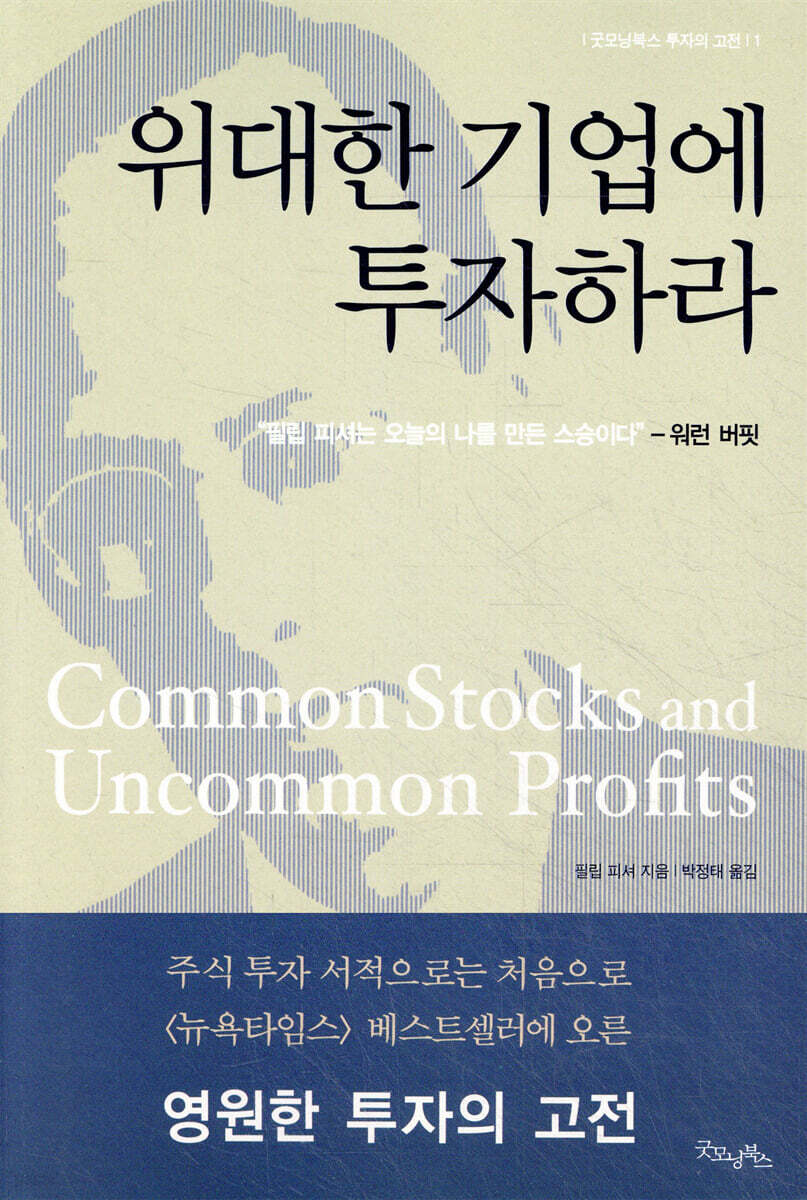
Invest in great companies
 |
Description
Book Introduction
“What are you doing that your competitors aren’t?” This is the question Philip Fisher, the author of this book, poses to the top management of companies he invests in.
The great companies that Fisher speaks of are those that can answer this question clearly.
This book is a "timeless investment classic" and the first stock investment book to reach the New York Times bestseller list. Its publication has been praised for elevating the field of stock investment to a new level.
In particular, when the first edition was published, it introduced for the first time several concepts that even the most renowned experts on Wall Street found unfamiliar. For example, it presented the concept of “growth stocks” and emphasized qualitative analysis of companies above all else.
It brought about a revolution in stock investment techniques that had relied on conventional technical and quantitative analysis.
Fisher is also famous for his "ultra-long" investing in great companies that meet 15 criteria, based on his fact-gathering approach, as described in this book.
It is surprising that he discovered Texas Instruments and Motorola, which grew into global semiconductor and telecommunications companies, in the 1950s when transistors were just beginning to be produced, but it is even more surprising that he held the stocks of these two companies for 30 to 50 years.
The strength of this book lies not in simply describing investment theories, but in the fact that it supports those theories and provides detailed and honest examples of investment experiences based on the author's own experience.
The great companies that Fisher speaks of are those that can answer this question clearly.
This book is a "timeless investment classic" and the first stock investment book to reach the New York Times bestseller list. Its publication has been praised for elevating the field of stock investment to a new level.
In particular, when the first edition was published, it introduced for the first time several concepts that even the most renowned experts on Wall Street found unfamiliar. For example, it presented the concept of “growth stocks” and emphasized qualitative analysis of companies above all else.
It brought about a revolution in stock investment techniques that had relied on conventional technical and quantitative analysis.
Fisher is also famous for his "ultra-long" investing in great companies that meet 15 criteria, based on his fact-gathering approach, as described in this book.
It is surprising that he discovered Texas Instruments and Motorola, which grew into global semiconductor and telecommunications companies, in the 1950s when transistors were just beginning to be produced, but it is even more surprising that he held the stocks of these two companies for 30 to 50 years.
The strength of this book lies not in simply describing investment theories, but in the fact that it supports those theories and provides detailed and honest examples of investment experiences based on the author's own experience.
index
What I Learned from This Book / Kenneth Fisher
introduction
Chapter 1: Clues from the Past
Chapter 2: Use Fact Gathering
Chapter 3: Which Stocks to Buy: 15 Tips for Finding Companies to Invest in
Chapter 4: Which Stocks to Buy: How to Use Investments That Work for Me
Chapter 5: When to Live
Chapter 6: When to Sell, and When Not to Sell
Chapter 7: The Uproar Over Dividends
Chapter 8 Five Mistakes Investors Should Avoid
Chapter 9: Five Mistakes Investors Should Avoid - Additional
Chapter 10: How to Find My Growth Stocks
Chapter 11 Summary and Conclusion
My Father Philip Fisher / Kenneth Fisher
introduction
Chapter 1: Clues from the Past
Chapter 2: Use Fact Gathering
Chapter 3: Which Stocks to Buy: 15 Tips for Finding Companies to Invest in
Chapter 4: Which Stocks to Buy: How to Use Investments That Work for Me
Chapter 5: When to Live
Chapter 6: When to Sell, and When Not to Sell
Chapter 7: The Uproar Over Dividends
Chapter 8 Five Mistakes Investors Should Avoid
Chapter 9: Five Mistakes Investors Should Avoid - Additional
Chapter 10: How to Find My Growth Stocks
Chapter 11 Summary and Conclusion
My Father Philip Fisher / Kenneth Fisher
Into the book
Asking, "What are you doing that your competitors aren't?" means increasing your product's market share, leading others to follow suit, and delivering better outcomes for customers, employees, and shareholders.
This is greatness itself.
--- p.24
Successful stock buying does not depend on information about the company already known at the time of purchase.
Rather, it is influenced by corporate information that becomes known after the stock is purchased.
Therefore, what is fundamentally important to investors is not past operating profit margins, but future operating profit margins.
--- p.89
What's the common denominator in each of the cases discussed so far? While significant improvements in net income have been achieved at leading companies, these increases have not yet been reflected in the stock market, preventing share prices from rising.
Whenever this happens in a company I believe is a good investment, I'm always confident that I've reached a buy point.
--- p.153
The principles that small investors who want to buy a few hundred shares of stock should follow are quite simple.
If the stock you want to buy is the right company and the current stock price is attractive at a reasonable level, then buy it at “market price.”
A price difference of 25 to 50 cents, or even a few cents, is nothing compared to the amount of profit you would miss out on if you didn't buy the stock.
--- p.205
Investors are so obsessed with the principle of diversification that they are overly fearful of putting too many eggs in one basket.
This causes them to pay too much attention to companies they know nothing about, while barely paying attention to companies they know well.
They seem to be unaware that buying stocks without in-depth knowledge of the company is riskier than not diversifying properly.
--- p.209
Any investor should focus on the best stocks, not on a large number of stocks.
When investing in stocks, it's important to remember that even if you make small profits from a large number of stocks, the combined returns will far outweigh the returns from a few of the best stocks.
--- p.224
The fact that a stock has or hasn't risen in the past few years is completely irrelevant when deciding whether to buy it now.
What really matters is whether there is, or is likely to be, a clear improvement that could significantly raise the stock price above what the market currently estimates.
--- p.232
In the world of investing, fleeting fads or misinterpretations of facts can persist for months, even years.
However, when the reality is revealed in the long run, not only is the illusion shattered, but we often find that the stocks that were caught up in the illusion go to the opposite extreme.
If you have the ability to see through the crowd and find out what the current truth is, you can achieve remarkable results in the field of stock investing.
This is greatness itself.
--- p.24
Successful stock buying does not depend on information about the company already known at the time of purchase.
Rather, it is influenced by corporate information that becomes known after the stock is purchased.
Therefore, what is fundamentally important to investors is not past operating profit margins, but future operating profit margins.
--- p.89
What's the common denominator in each of the cases discussed so far? While significant improvements in net income have been achieved at leading companies, these increases have not yet been reflected in the stock market, preventing share prices from rising.
Whenever this happens in a company I believe is a good investment, I'm always confident that I've reached a buy point.
--- p.153
The principles that small investors who want to buy a few hundred shares of stock should follow are quite simple.
If the stock you want to buy is the right company and the current stock price is attractive at a reasonable level, then buy it at “market price.”
A price difference of 25 to 50 cents, or even a few cents, is nothing compared to the amount of profit you would miss out on if you didn't buy the stock.
--- p.205
Investors are so obsessed with the principle of diversification that they are overly fearful of putting too many eggs in one basket.
This causes them to pay too much attention to companies they know nothing about, while barely paying attention to companies they know well.
They seem to be unaware that buying stocks without in-depth knowledge of the company is riskier than not diversifying properly.
--- p.209
Any investor should focus on the best stocks, not on a large number of stocks.
When investing in stocks, it's important to remember that even if you make small profits from a large number of stocks, the combined returns will far outweigh the returns from a few of the best stocks.
--- p.224
The fact that a stock has or hasn't risen in the past few years is completely irrelevant when deciding whether to buy it now.
What really matters is whether there is, or is likely to be, a clear improvement that could significantly raise the stock price above what the market currently estimates.
--- p.232
In the world of investing, fleeting fads or misinterpretations of facts can persist for months, even years.
However, when the reality is revealed in the long run, not only is the illusion shattered, but we often find that the stocks that were caught up in the illusion go to the opposite extreme.
If you have the ability to see through the crowd and find out what the current truth is, you can achieve remarkable results in the field of stock investing.
--- p.254
Publisher's Review
“What are you doing that your competitors aren’t?” This is the question Philip Fisher, the author of this book, poses to the top management of companies he invests in.
The great companies that Fisher speaks of are those that can answer this question clearly.
This book is a "timeless investment classic" and the first stock investment book to reach the New York Times bestseller list. Its publication has been praised for elevating the field of stock investment to a new level.
In particular, when the first edition was published, it introduced for the first time several concepts that even the most renowned experts on Wall Street found unfamiliar. For example, it presented the concept of “growth stocks” and emphasized qualitative analysis of companies above all else.
It brought about a revolution in stock investment techniques that had relied on conventional technical and quantitative analysis.
"The Father of Growth Stock Investing"… Warren Buffett's mentor
Warren Buffett, known as the Sage of Omaha, cited Benjamin Graham and Fisher as the two mentors who shaped him.
Graham was Buffett's graduate school mentor, and Buffett also worked at Graham's company.
However, Fisher had never met Buffett before he read his book, "The Greatest Investors."
Buffett was so moved by this book that he traveled to San Francisco to meet Fisher in person, and from then on he called Fisher his mentor.
If I learned quantitative analysis from Graham, I learned qualitative analysis from Fisher.
If it weren't for this book, Buffett's investment approach might never have seen the light of day.
In Search of Great Companies… Gathering Facts and 15 Points
The first goal of stock investment is to achieve high returns.
Fisher states that to achieve this goal, you must invest in companies that are expected to have stock price increases of hundreds or thousands of percent over the long term.
In short, it means investing in companies with great growth potential.
Such great companies should be discovered not based on past stock prices or financial statements, but on "fact-gathering," which involves directly visiting competitors, suppliers, customers, and former employees to learn about the realities of the target company.
In this book, Fisher points out 15 virtues that a great company should possess, including long-term vision and integrity of top management, outstanding research and development capabilities, an excellent sales organization, and outstanding labor-management relations.
This simply means that you should not invest in companies whose stock price is lower than their book value or whose sales and net income are growing rapidly.
The 10 Mistakes Investors Should Avoid is a vivid testament to Fisher's rich experience and keen insight.
The widely accepted warnings against the benefits of diversification, the warnings against ignoring irrelevant statistics, the warnings against fearing war, and the warnings against following the crowd are as useful today as they were when they were published.
Fisher is also famous for his "ultra-long" investing in great companies that meet 15 criteria, based on his fact-gathering approach, as described in this book.
It is surprising that he discovered Texas Instruments and Motorola, which grew into global semiconductor and telecommunications companies, in the 1950s when transistors were just beginning to be produced, but it is even more surprising that he held the stocks of these two companies for 30 to 50 years.
The strength of this book lies not in simply describing investment theories, but in the fact that it supports those theories and provides detailed and honest examples of investment experiences based on the author's own experience.
"The Timeless Investing Classic," the first stock investment book to reach the New York Times bestseller list.
This book is the first in the investment classic series planned and published by Good Morning Books.
The reason I chose this book as the first classic investment book is because it is the most influential investment book of all time and opened up new horizons in stock investment.
This is probably why this book is used as an investment theory textbook in leading MBA programs in the United States, including Stanford University Business School.
This book is fundamentally different from other stock investment theory books on the market.
This book does not contain a single instance of terms commonly found in other stock investment books, such as “reporting price” or “stop loss.”
Rather, he says that if you properly select a company to invest in and buy its stocks, you will “never” have the opportunity to sell.
He points out that even if a stock of a great company falls 30-40% during a stock market correction, it will rise more than any other stock in the next bull market, and there is no reason to sell it as the stock price is expected to rise at least several times in the long term.
The reason this book has become a classic is because it doesn't simply list investment techniques, but delves into the roots and essence of investment.
Fisher's investment targets are not stocks that fluctuate from moment to moment, but companies that grow over the long term.
Fisher was “the first to link the concept of a company’s superior competitiveness to a model of sustainable growth.”
The author's insight is the foundation of "Invest in Great Companies."
This is a completely revised edition with a new translation.
Good Morning Books first introduced Philip Fisher's growth stock investment theory to Korea with the publication of "Invest in Great Companies" in 2005. Now, to mark the 20th anniversary of its publication, we are releasing a revised edition with a new translation.
The great companies that Fisher speaks of are those that can answer this question clearly.
This book is a "timeless investment classic" and the first stock investment book to reach the New York Times bestseller list. Its publication has been praised for elevating the field of stock investment to a new level.
In particular, when the first edition was published, it introduced for the first time several concepts that even the most renowned experts on Wall Street found unfamiliar. For example, it presented the concept of “growth stocks” and emphasized qualitative analysis of companies above all else.
It brought about a revolution in stock investment techniques that had relied on conventional technical and quantitative analysis.
"The Father of Growth Stock Investing"… Warren Buffett's mentor
Warren Buffett, known as the Sage of Omaha, cited Benjamin Graham and Fisher as the two mentors who shaped him.
Graham was Buffett's graduate school mentor, and Buffett also worked at Graham's company.
However, Fisher had never met Buffett before he read his book, "The Greatest Investors."
Buffett was so moved by this book that he traveled to San Francisco to meet Fisher in person, and from then on he called Fisher his mentor.
If I learned quantitative analysis from Graham, I learned qualitative analysis from Fisher.
If it weren't for this book, Buffett's investment approach might never have seen the light of day.
In Search of Great Companies… Gathering Facts and 15 Points
The first goal of stock investment is to achieve high returns.
Fisher states that to achieve this goal, you must invest in companies that are expected to have stock price increases of hundreds or thousands of percent over the long term.
In short, it means investing in companies with great growth potential.
Such great companies should be discovered not based on past stock prices or financial statements, but on "fact-gathering," which involves directly visiting competitors, suppliers, customers, and former employees to learn about the realities of the target company.
In this book, Fisher points out 15 virtues that a great company should possess, including long-term vision and integrity of top management, outstanding research and development capabilities, an excellent sales organization, and outstanding labor-management relations.
This simply means that you should not invest in companies whose stock price is lower than their book value or whose sales and net income are growing rapidly.
The 10 Mistakes Investors Should Avoid is a vivid testament to Fisher's rich experience and keen insight.
The widely accepted warnings against the benefits of diversification, the warnings against ignoring irrelevant statistics, the warnings against fearing war, and the warnings against following the crowd are as useful today as they were when they were published.
Fisher is also famous for his "ultra-long" investing in great companies that meet 15 criteria, based on his fact-gathering approach, as described in this book.
It is surprising that he discovered Texas Instruments and Motorola, which grew into global semiconductor and telecommunications companies, in the 1950s when transistors were just beginning to be produced, but it is even more surprising that he held the stocks of these two companies for 30 to 50 years.
The strength of this book lies not in simply describing investment theories, but in the fact that it supports those theories and provides detailed and honest examples of investment experiences based on the author's own experience.
"The Timeless Investing Classic," the first stock investment book to reach the New York Times bestseller list.
This book is the first in the investment classic series planned and published by Good Morning Books.
The reason I chose this book as the first classic investment book is because it is the most influential investment book of all time and opened up new horizons in stock investment.
This is probably why this book is used as an investment theory textbook in leading MBA programs in the United States, including Stanford University Business School.
This book is fundamentally different from other stock investment theory books on the market.
This book does not contain a single instance of terms commonly found in other stock investment books, such as “reporting price” or “stop loss.”
Rather, he says that if you properly select a company to invest in and buy its stocks, you will “never” have the opportunity to sell.
He points out that even if a stock of a great company falls 30-40% during a stock market correction, it will rise more than any other stock in the next bull market, and there is no reason to sell it as the stock price is expected to rise at least several times in the long term.
The reason this book has become a classic is because it doesn't simply list investment techniques, but delves into the roots and essence of investment.
Fisher's investment targets are not stocks that fluctuate from moment to moment, but companies that grow over the long term.
Fisher was “the first to link the concept of a company’s superior competitiveness to a model of sustainable growth.”
The author's insight is the foundation of "Invest in Great Companies."
This is a completely revised edition with a new translation.
Good Morning Books first introduced Philip Fisher's growth stock investment theory to Korea with the publication of "Invest in Great Companies" in 2005. Now, to mark the 20th anniversary of its publication, we are releasing a revised edition with a new translation.
GOODS SPECIFICS
- Date of issue: July 15, 2025
- Page count, weight, size: 334 pages | 188*257*30mm
- ISBN13: 9788991378391
- ISBN10: 8991378390
You may also like
카테고리
korean


korean

![ELLE 엘르 스페셜 에디션 A형 : 12월 [2025]](http://librairie.coreenne.fr/cdn/shop/files/b8e27a3de6c9538896439686c6b0e8fb.jpg?v=1766436872&width=3840)


