

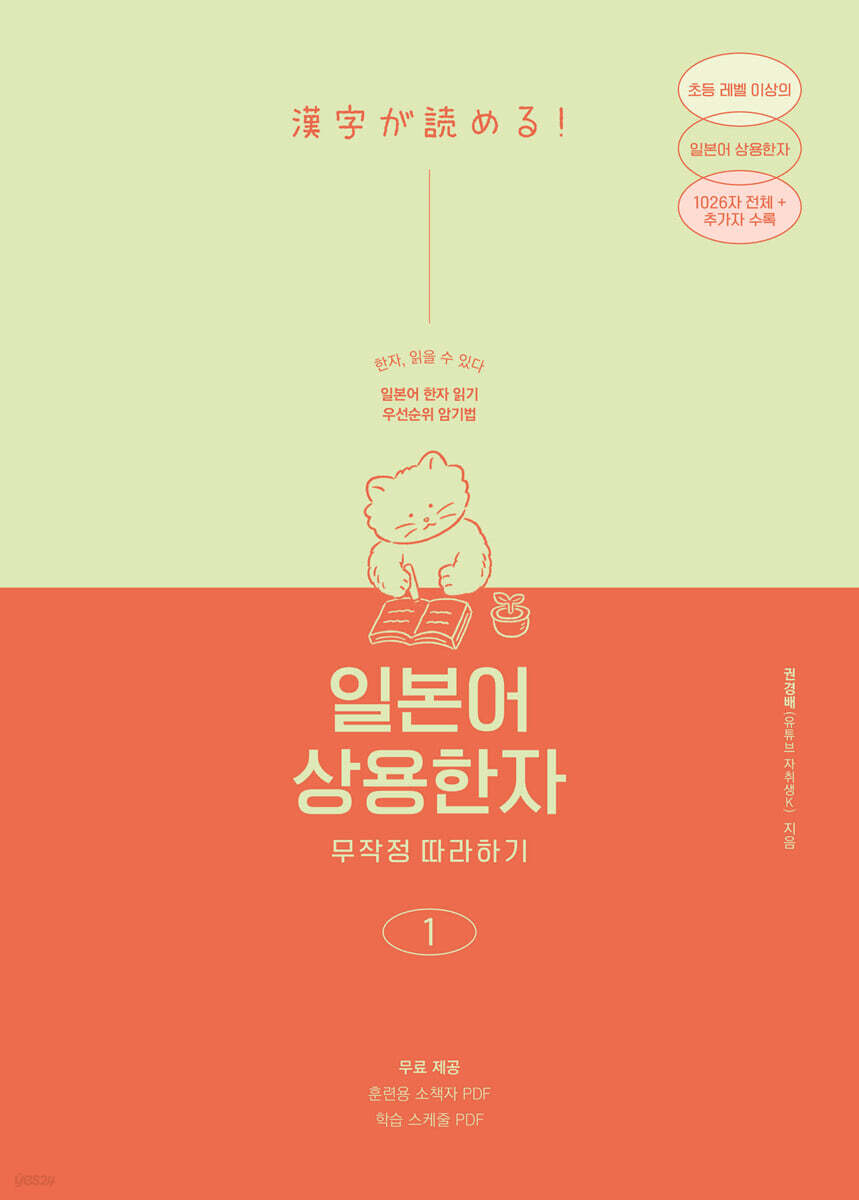
Japanese Common Kanji: Just Follow It 1
 |
Description
Book Introduction
Reading Japanese Kanji, Memorization also has priorities! Volume 1, the first volume of 2,136 common Japanese kanji characters, is a book that will help you completely master basic common kanji characters. It contains 1,026 essential kanji characters for elementary school education in Japan and 197 additional characters. It contains all the Chinese character information that helps with memorization as well as understanding in one book. It provides a variety of information to help you learn Chinese characters with certainty, including explanations of principles, reference pictures, and hidden rules explained in a storytelling format. Additionally, for the first time in Korea, all pronunciations are prioritized, allowing you to efficiently study the content you need to focus on. The author (Ryu-Sensei, YouTube channel '자취생K'), a linguistics expert and YouTuber, has gathered all of his Chinese character memorization know-how and put it into a study method, and has summarized only the points that beginners are curious about and explained them with detailed tips and explanations. The key summary booklet PDF and study plan PDF are provided free of charge on the website (www.gilbut.co.kr). |
- You can preview some of the book's contents.
Preview
index
How should I study Japanese kanji?
Two things to know before you start preparing
01 Japanese Kanji's Onyō and Kunyō
02 10 Basic Principles of Chinese Character Stroke Order
First, let's learn the basic radicals and pictographs without asking questions!
01 number
02 Nature
03 Animals
04 Body
05 Action
06 Tools
07 Society
08 Status
Let's learn about the seven major derivative relationships in the second yard! Derived Chinese characters by topic
First Word ㆍ Nature II
09 Derivation of Sun and Evening
Derivative of 10 ?
11 Derivation of Wood and Clan
12 Derivation of 禾·米
Derivation of 13 田
14 Derivation of Earth, Metal, ?, and Fire
15 Derivation of water, rain, ?, and spring
Second Phrase: Animals II
16 Derivation of 牛·羊
17 Derivation of 兎·巴·也
18 Derivation of ?·Wing·Bird·?
19 Derivation of Shell
Third Phrase: Body and Senses II
20 Derivation of ?·Page·Head
Derivation of 21
22 Derivation of words and phrases
23 Derivatives of 手·?
24 Derivation of 又·皮
25 Derivation of 爪[?·?
26 Derivation of inches and talents
27 Derivation of 尸·骨·?·心
Fourth verse: Weapon II
28 Derivation of 力·刀
29 Derivation of Bow and Arrow
Derivative of 30 ?
Derivative of 31 乂
32 Derivation of 干, 矛, and 斤
Fifth verse: Life II
Derivative of 33 ?
34 Derivation of Gate, House, and Piece
35 Derivation of ?·酉·皿·匕·臼
36 ?·Derivation of clothing
37 Derivation of 丁·工·尺
38 Derivation of Well and Use
39 Derivation of 車·方·占
Sixth verse: Society II
Derivation of 40 people
41 Derivation of ?·女·兄·了
42 Derivation of ?·己
43 Derivation of King, Jade, and Lord
44 Derivation of 士·臣·司·history
45 Derivation of 示·且·比·北·非
Seventh verse, action, state II
46 Derivation of 十·?·其
47 Derivation of large, medium, and small
48 Derivation of high, high, and long
49 Derivation of 止·艮
50 ?·Derivation of 立
51 Derivation of ?·?·?·走
Special Bonus: 24 Rules for Korean-Japanese Character Sound Correspondence
01 The basic framework of Chinese character pronunciation that you must know
02 Seven basic rules for two-consonant correspondence
03 Basic correspondence of vowels 10+1 rule
04 Basic Correspondence of Supporting Consonants: 5+1 Rule
Special Appendix
01 Confirmation question answer
02 Look up Chinese characters
Two things to know before you start preparing
01 Japanese Kanji's Onyō and Kunyō
02 10 Basic Principles of Chinese Character Stroke Order
First, let's learn the basic radicals and pictographs without asking questions!
01 number
02 Nature
03 Animals
04 Body
05 Action
06 Tools
07 Society
08 Status
Let's learn about the seven major derivative relationships in the second yard! Derived Chinese characters by topic
First Word ㆍ Nature II
09 Derivation of Sun and Evening
Derivative of 10 ?
11 Derivation of Wood and Clan
12 Derivation of 禾·米
Derivation of 13 田
14 Derivation of Earth, Metal, ?, and Fire
15 Derivation of water, rain, ?, and spring
Second Phrase: Animals II
16 Derivation of 牛·羊
17 Derivation of 兎·巴·也
18 Derivation of ?·Wing·Bird·?
19 Derivation of Shell
Third Phrase: Body and Senses II
20 Derivation of ?·Page·Head
Derivation of 21
22 Derivation of words and phrases
23 Derivatives of 手·?
24 Derivation of 又·皮
25 Derivation of 爪[?·?
26 Derivation of inches and talents
27 Derivation of 尸·骨·?·心
Fourth verse: Weapon II
28 Derivation of 力·刀
29 Derivation of Bow and Arrow
Derivative of 30 ?
Derivative of 31 乂
32 Derivation of 干, 矛, and 斤
Fifth verse: Life II
Derivative of 33 ?
34 Derivation of Gate, House, and Piece
35 Derivation of ?·酉·皿·匕·臼
36 ?·Derivation of clothing
37 Derivation of 丁·工·尺
38 Derivation of Well and Use
39 Derivation of 車·方·占
Sixth verse: Society II
Derivation of 40 people
41 Derivation of ?·女·兄·了
42 Derivation of ?·己
43 Derivation of King, Jade, and Lord
44 Derivation of 士·臣·司·history
45 Derivation of 示·且·比·北·非
Seventh verse, action, state II
46 Derivation of 十·?·其
47 Derivation of large, medium, and small
48 Derivation of high, high, and long
49 Derivation of 止·艮
50 ?·Derivation of 立
51 Derivation of ?·?·?·走
Special Bonus: 24 Rules for Korean-Japanese Character Sound Correspondence
01 The basic framework of Chinese character pronunciation that you must know
02 Seven basic rules for two-consonant correspondence
03 Basic correspondence of vowels 10+1 rule
04 Basic Correspondence of Supporting Consonants: 5+1 Rule
Special Appendix
01 Confirmation question answer
02 Look up Chinese characters
Detailed image
.jpg)
Publisher's Review
Includes 1026 Japanese educational kanji characters + 197 additional characters!
How to perfectly master basic Japanese kanji!
Korea's first! Priority Chinese character learning!
Japanese pronunciation is always a headache, with its complex and numerous things to memorize! Here, we've listed the priorities you need to know for each pronunciation.
You can immediately check the content you need to focus on and study efficiently.
A comprehensive guide to Chinese character information for 'acquisition'!
It contains all the contents that help with understanding as well as memorization.
From storytelling-based explanations of principles to easy-to-remember reference illustrations and hidden rules, this comprehensive guide provides comprehensive information to ensure a solid grasp of Chinese characters.
Clear learning methods and explanations from a linguistics expert!
For learners who find Chinese characters difficult and burdensome, the author's memorization know-how is fully disclosed (lecture QR code provided).
It also helps beginners learn on their own by providing detailed tips and explanations, collecting only the points they are curious about.
Are you struggling with Chinese characters and want to give up on Japanese?
From specific learning methods suggested by linguistic experts
A comprehensive overview of Chinese character information that can be 'acquired' through understanding!
1.
A comprehensive guide to Chinese character information to help you memorize and understand!
This book covers a total of 1,223 kanji characters, including all 1,026 kanji characters required for elementary school education in Japan and 197 kanji characters and radicals for middle school students to learn basic radicals.
From educational kanji levels, JLPT levels, actual usage frequency rankings, explanations of principles, Kun-yin, total stroke count, stroke order, reference illustrations, on-yomi (pronunciation), kun-yomi (pronunciation), and even a "Just a Minute" corner for additional explanations! This isn't just a list of information; it's a comprehensive guide to all kanji information to aid understanding and memorization.
In particular, the explanation of the principles uses a storytelling method that connects the shape and meaning of Chinese characters, making it easy to remember Chinese characters.
2.
A structure that makes it easy to learn Chinese characters!
In the first yard, the most basic of the basics, pictographs and radicals, are organized by topic, and in the second yard, thematically derived Chinese characters derived from the previously learned basic characters are learned.
It is structured so that you can learn step by step, starting from simple Chinese characters and moving on to complex Chinese characters.
3.
Japanese pronunciation should be your top priority!
The large number and complexity of Japanese pronunciations are the main culprits that make studying Japanese kanji difficult.
Usually, most people just put all the pronunciations on the same line and memorize them.
However, there is a frequently used priority in the pronunciation and meaning of Chinese characters.
This book is the first in Korea to rank words from 1 to 4 according to their productivity when read aloud.
This is the only book that allows you to study efficiently, starting with the important pronunciation that you need to focus on and memorize first.
4.
Detailed study tips and commentary from a linguistics expert!
Detailed and clear explanations and tips are included throughout the book to help you understand Japanese kanji.
The author, a linguistics expert and YouTuber, has compiled his know-how on memorizing Chinese characters into a "study method," and the "Chinese character reading rules" are included to help readers infer how to read Japanese Chinese characters through Korean, adding to the uniqueness of this book.
In addition to the abundant study tips based on the learning content of the author's channel, "Living Alone K - All About Japanese -," the book provides QR codes for direct access to related learning videos.
Through corners like 'Just a moment' and 'I have a question,' you can not only resolve your curiosity about Chinese characters but also study them in depth.
- A word from our beta testers
A book that allows for both understanding and memorization!
This seems like the perfect book for me.
Unlike books that force you to memorize words, this book explains the principles of creating Chinese characters one by one, so you can understand and memorize them naturally without having to try to memorize them.
It contains all the components that a Japanese kanji textbook can include, including principles, phonetic/reading, stroke order, kanji level and frequency of use, and additional information through 'Just a minute'.
I think this is a book that anyone can easily study as long as they have the ability to understand Hiragana and its pronunciation.
I definitely want to buy it and study it!
Park Won-do | 20s, college student
It's perfect for an autodidact!
It helps you remember Chinese characters because it includes pictures of the formation principles.
There's a "Just a Minute" section for areas that require additional explanation, pointing out potentially confusing or overlooked points! Sometimes it can be hard to grasp the level of knowledge you need to have about Chinese characters, but even that is clearly explained.
I think it will be of great help to self-study.
The 'Questions' corner covered in detail even parts that are not well covered in other books, so there was a lot to refer to when studying Chinese characters.
Kim Min | 30s, freelancer
A structure that makes it easy to learn Chinese characters!
The table of contents was well organized.
In the first yard, you can learn the basic words that are frequently used in real life, and then in the second yard, you can study the derivative words that use the basic words.
It seems like a structure that makes it easier to learn difficult and confusing derivatives.
Also, since each unit is categorized by topic, it will be easy to find any Chinese characters that you are confused about or have forgotten later.
When learning on-reading and kun-reading, it was easy to learn the Korean pronunciation of the Chinese character first, as mentioned on the YouTube channel of student K, and then study in the order of representative on-reading, kun-reading, and exceptional pronunciation, as the priority of on-reading was marked.
Lee Jun-young | 20s, college student
A book like a compass for learning Japanese kanji!
This is a friendly book that accurately identifies and explains the parts that are likely to be confusing when studying on your own.
While studying, I asked my Japanese friend all the questions I had, and most of the answers were in the "Just a minute" corner.
There were many Chinese characters that I memorized because they were in the book, even though I thought, "Do I really have to memorize this?" or "I don't think I'll use it like this?" But I felt like this book gave confidence to people who study on their own.
This book is like a compass for self-studying students who are lost as to how to study Chinese characters, providing appropriate study methods and confusing content!
Ha Geon-woo | 20s, elementary school teacher
- Preview of the main text
First yard/Second yard
I organized the Chinese characters by topic.
In the first yard, you can learn basic radicals and pictographs, and in the second yard, you can learn derived Chinese characters by topic, step by step, by level.
①Serial number: This is a unique number for each Chinese character.
Numbered from 1 to 1223.
② Types of Chinese characters: The number of radicals / radicals are indicated with separate symbols.
③ Title Chinese characters: Chinese characters that are used in various forms or as radicals are also indicated.
④ Grade: Japanese educational kanji level is indicated (elementary school 1st to 6th grade/middle school).
⑤ JLPT Levels: N1 to N4 are indicated, but kanji that is not included in the level is indicated as ‘outside of level.’
⑥ Ranking of actual usage frequency: This shows the actual usage frequency (appearance frequency) of each Chinese character in books/Internet.
⑦ Principle: The principle of formation of Chinese characters is explained and presented.
⑧ Hun-eum: Indicates the meaning of the Chinese character (hun) + how to read it (eum).
⑨ Total strokes/stroke order: The total number of strokes and stroke order are organized.
⑩ Reference pictures: Pictures are provided to help you understand the principles or remember the shapes.
(302 cuts in total)
⑪ Ranking 1~4: The level of “word productivity” of each pronunciation is ranked.
⑫ Word notation order: Words are written in the order of “Chinese character + meaning + (hiragana)”.
You can get used to the process of looking at a Chinese character → thinking of the Korean sound → naturally thinking of the Japanese sound through the Korean sound.
⑬ *: Cases where the Korean pronunciation and Japanese pronunciation do not match are marked with an asterisk (*).
⑭ [ ]: The part of the verb (adjective/verb) that is replaced with a Chinese character
⑮ → : Words derived from basic reading
16.
The order of the words is written in the following order: “Chinese character + (hiragana) + meaning.”
17.
Exceptions: We have compiled a list of exceptional sounds that are unproductive and only used in that vocabulary.
18.
Wait a minute: This is a corner for supplementary explanations needed for learning.
We have compiled meaning explanations, practical usage and learning precautions, distinction between homonyms, and Chinese characters with similar forms.
Verification problem
This is a corner where you can check whether you have learned the Chinese characters for each lesson correctly by asking questions.
The answer is in the Special Appendix.
If there are any mistakes, be sure to go back to the main text and check again.
I have a question
We have compiled questions and answers in a question-and-answer format regarding the content of the main text that students may be curious about.
Your understanding of Japanese kanji will increase and you will be able to study kanji in depth.
Study Methods/Preparation Yard/Special Bonus/Special Appendix
It contains a wide range of information for learning Japanese kanji, including the basic characteristics of kanji, specific learning methods, and reading rules.
Learning method
For learners who find the vast amount of kanji overwhelming, we've compiled a study method for efficiently studying Japanese kanji. Scanning the QR code will take you to the author's YouTube lecture.
Preparation yard
Before you begin learning Japanese kanji in earnest, we have introduced the characteristics of reading Japanese kanji and the stroke order principles that you should know.
Special Bonus
We have presented 24 basic rules for reading Japanese kanji that can be inferred from Korean, divided into three elements: initial consonant, medial vowel, and final consonant.
Special Appendix
We have organized the answers to the verification questions and the 1,223 Chinese characters included in this book in alphabetical order so that you can find them.
Booklet PDF
You can download the key summary booklet for free from our website.
Review easily with this booklet packed with essential information! Each lesson's Chinese characters are collected on a single page, allowing you to grasp what you've learned at a glance.
How to perfectly master basic Japanese kanji!
Korea's first! Priority Chinese character learning!
Japanese pronunciation is always a headache, with its complex and numerous things to memorize! Here, we've listed the priorities you need to know for each pronunciation.
You can immediately check the content you need to focus on and study efficiently.
A comprehensive guide to Chinese character information for 'acquisition'!
It contains all the contents that help with understanding as well as memorization.
From storytelling-based explanations of principles to easy-to-remember reference illustrations and hidden rules, this comprehensive guide provides comprehensive information to ensure a solid grasp of Chinese characters.
Clear learning methods and explanations from a linguistics expert!
For learners who find Chinese characters difficult and burdensome, the author's memorization know-how is fully disclosed (lecture QR code provided).
It also helps beginners learn on their own by providing detailed tips and explanations, collecting only the points they are curious about.
Are you struggling with Chinese characters and want to give up on Japanese?
From specific learning methods suggested by linguistic experts
A comprehensive overview of Chinese character information that can be 'acquired' through understanding!
1.
A comprehensive guide to Chinese character information to help you memorize and understand!
This book covers a total of 1,223 kanji characters, including all 1,026 kanji characters required for elementary school education in Japan and 197 kanji characters and radicals for middle school students to learn basic radicals.
From educational kanji levels, JLPT levels, actual usage frequency rankings, explanations of principles, Kun-yin, total stroke count, stroke order, reference illustrations, on-yomi (pronunciation), kun-yomi (pronunciation), and even a "Just a Minute" corner for additional explanations! This isn't just a list of information; it's a comprehensive guide to all kanji information to aid understanding and memorization.
In particular, the explanation of the principles uses a storytelling method that connects the shape and meaning of Chinese characters, making it easy to remember Chinese characters.
2.
A structure that makes it easy to learn Chinese characters!
In the first yard, the most basic of the basics, pictographs and radicals, are organized by topic, and in the second yard, thematically derived Chinese characters derived from the previously learned basic characters are learned.
It is structured so that you can learn step by step, starting from simple Chinese characters and moving on to complex Chinese characters.
3.
Japanese pronunciation should be your top priority!
The large number and complexity of Japanese pronunciations are the main culprits that make studying Japanese kanji difficult.
Usually, most people just put all the pronunciations on the same line and memorize them.
However, there is a frequently used priority in the pronunciation and meaning of Chinese characters.
This book is the first in Korea to rank words from 1 to 4 according to their productivity when read aloud.
This is the only book that allows you to study efficiently, starting with the important pronunciation that you need to focus on and memorize first.
4.
Detailed study tips and commentary from a linguistics expert!
Detailed and clear explanations and tips are included throughout the book to help you understand Japanese kanji.
The author, a linguistics expert and YouTuber, has compiled his know-how on memorizing Chinese characters into a "study method," and the "Chinese character reading rules" are included to help readers infer how to read Japanese Chinese characters through Korean, adding to the uniqueness of this book.
In addition to the abundant study tips based on the learning content of the author's channel, "Living Alone K - All About Japanese -," the book provides QR codes for direct access to related learning videos.
Through corners like 'Just a moment' and 'I have a question,' you can not only resolve your curiosity about Chinese characters but also study them in depth.
- A word from our beta testers
A book that allows for both understanding and memorization!
This seems like the perfect book for me.
Unlike books that force you to memorize words, this book explains the principles of creating Chinese characters one by one, so you can understand and memorize them naturally without having to try to memorize them.
It contains all the components that a Japanese kanji textbook can include, including principles, phonetic/reading, stroke order, kanji level and frequency of use, and additional information through 'Just a minute'.
I think this is a book that anyone can easily study as long as they have the ability to understand Hiragana and its pronunciation.
I definitely want to buy it and study it!
Park Won-do | 20s, college student
It's perfect for an autodidact!
It helps you remember Chinese characters because it includes pictures of the formation principles.
There's a "Just a Minute" section for areas that require additional explanation, pointing out potentially confusing or overlooked points! Sometimes it can be hard to grasp the level of knowledge you need to have about Chinese characters, but even that is clearly explained.
I think it will be of great help to self-study.
The 'Questions' corner covered in detail even parts that are not well covered in other books, so there was a lot to refer to when studying Chinese characters.
Kim Min | 30s, freelancer
A structure that makes it easy to learn Chinese characters!
The table of contents was well organized.
In the first yard, you can learn the basic words that are frequently used in real life, and then in the second yard, you can study the derivative words that use the basic words.
It seems like a structure that makes it easier to learn difficult and confusing derivatives.
Also, since each unit is categorized by topic, it will be easy to find any Chinese characters that you are confused about or have forgotten later.
When learning on-reading and kun-reading, it was easy to learn the Korean pronunciation of the Chinese character first, as mentioned on the YouTube channel of student K, and then study in the order of representative on-reading, kun-reading, and exceptional pronunciation, as the priority of on-reading was marked.
Lee Jun-young | 20s, college student
A book like a compass for learning Japanese kanji!
This is a friendly book that accurately identifies and explains the parts that are likely to be confusing when studying on your own.
While studying, I asked my Japanese friend all the questions I had, and most of the answers were in the "Just a minute" corner.
There were many Chinese characters that I memorized because they were in the book, even though I thought, "Do I really have to memorize this?" or "I don't think I'll use it like this?" But I felt like this book gave confidence to people who study on their own.
This book is like a compass for self-studying students who are lost as to how to study Chinese characters, providing appropriate study methods and confusing content!
Ha Geon-woo | 20s, elementary school teacher
- Preview of the main text
First yard/Second yard
I organized the Chinese characters by topic.
In the first yard, you can learn basic radicals and pictographs, and in the second yard, you can learn derived Chinese characters by topic, step by step, by level.
①Serial number: This is a unique number for each Chinese character.
Numbered from 1 to 1223.
② Types of Chinese characters: The number of radicals / radicals are indicated with separate symbols.
③ Title Chinese characters: Chinese characters that are used in various forms or as radicals are also indicated.
④ Grade: Japanese educational kanji level is indicated (elementary school 1st to 6th grade/middle school).
⑤ JLPT Levels: N1 to N4 are indicated, but kanji that is not included in the level is indicated as ‘outside of level.’
⑥ Ranking of actual usage frequency: This shows the actual usage frequency (appearance frequency) of each Chinese character in books/Internet.
⑦ Principle: The principle of formation of Chinese characters is explained and presented.
⑧ Hun-eum: Indicates the meaning of the Chinese character (hun) + how to read it (eum).
⑨ Total strokes/stroke order: The total number of strokes and stroke order are organized.
⑩ Reference pictures: Pictures are provided to help you understand the principles or remember the shapes.
(302 cuts in total)
⑪ Ranking 1~4: The level of “word productivity” of each pronunciation is ranked.
⑫ Word notation order: Words are written in the order of “Chinese character + meaning + (hiragana)”.
You can get used to the process of looking at a Chinese character → thinking of the Korean sound → naturally thinking of the Japanese sound through the Korean sound.
⑬ *: Cases where the Korean pronunciation and Japanese pronunciation do not match are marked with an asterisk (*).
⑭ [ ]: The part of the verb (adjective/verb) that is replaced with a Chinese character
⑮ → : Words derived from basic reading
16.
The order of the words is written in the following order: “Chinese character + (hiragana) + meaning.”
17.
Exceptions: We have compiled a list of exceptional sounds that are unproductive and only used in that vocabulary.
18.
Wait a minute: This is a corner for supplementary explanations needed for learning.
We have compiled meaning explanations, practical usage and learning precautions, distinction between homonyms, and Chinese characters with similar forms.
Verification problem
This is a corner where you can check whether you have learned the Chinese characters for each lesson correctly by asking questions.
The answer is in the Special Appendix.
If there are any mistakes, be sure to go back to the main text and check again.
I have a question
We have compiled questions and answers in a question-and-answer format regarding the content of the main text that students may be curious about.
Your understanding of Japanese kanji will increase and you will be able to study kanji in depth.
Study Methods/Preparation Yard/Special Bonus/Special Appendix
It contains a wide range of information for learning Japanese kanji, including the basic characteristics of kanji, specific learning methods, and reading rules.
Learning method
For learners who find the vast amount of kanji overwhelming, we've compiled a study method for efficiently studying Japanese kanji. Scanning the QR code will take you to the author's YouTube lecture.
Preparation yard
Before you begin learning Japanese kanji in earnest, we have introduced the characteristics of reading Japanese kanji and the stroke order principles that you should know.
Special Bonus
We have presented 24 basic rules for reading Japanese kanji that can be inferred from Korean, divided into three elements: initial consonant, medial vowel, and final consonant.
Special Appendix
We have organized the answers to the verification questions and the 1,223 Chinese characters included in this book in alphabetical order so that you can find them.
Booklet PDF
You can download the key summary booklet for free from our website.
Review easily with this booklet packed with essential information! Each lesson's Chinese characters are collected on a single page, allowing you to grasp what you've learned at a glance.
GOODS SPECIFICS
- Date of issue: January 30, 2023
- Page count, weight, size: 520 pages | 928g | 174*243*20mm
- ISBN13: 9791140703050
You may also like
카테고리
korean


korean

![GQ KOREA Mark (Monthly): December [2025]](http://librairie.coreenne.fr/cdn/shop/files/8ef265dbbfbf186523ed75ba7319009d.jpg?v=1765340328&width=3840)


