

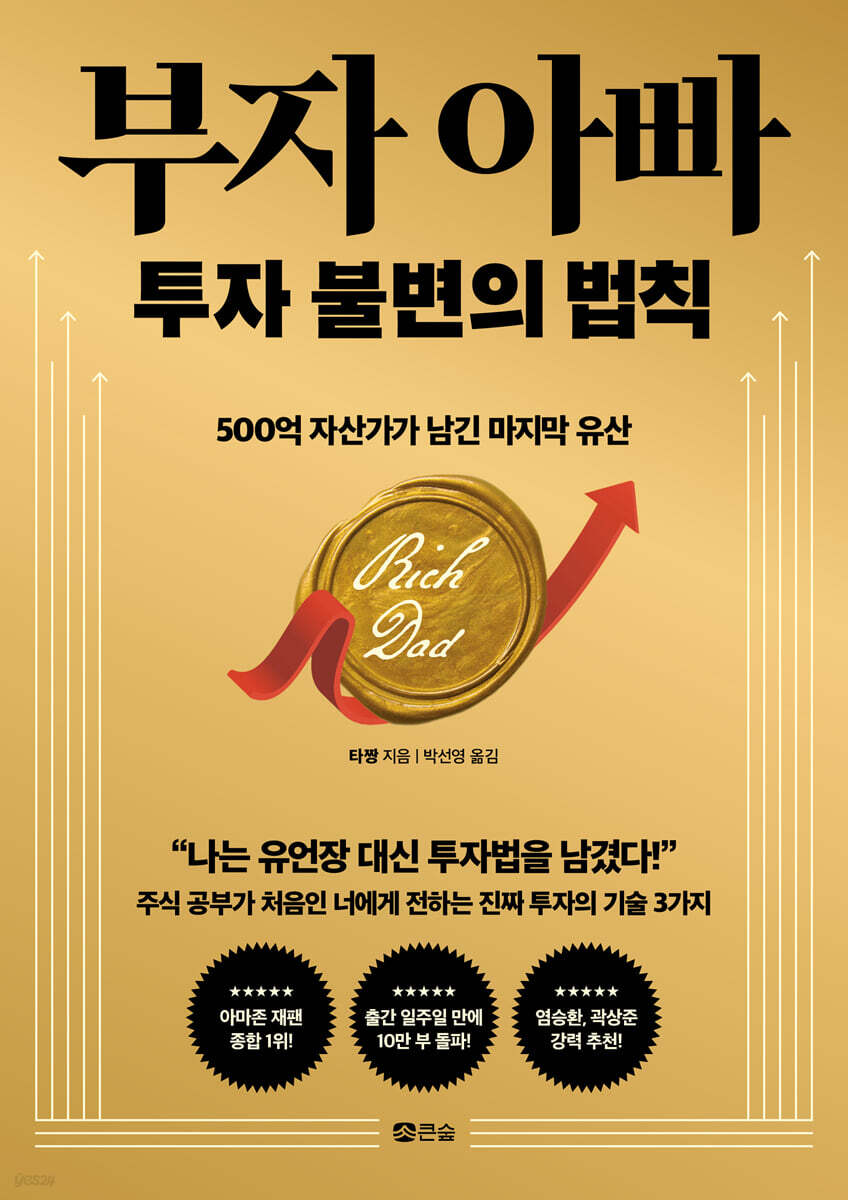
Rich Dad's Timeless Laws of Investing
 |
Description
Book Introduction
- A word from MD
-
Rich Dad's Last LegacyA terminally ill doctor and a man with assets worth 50 billion won.
What he left to his two daughters was not wealth, but the principles of value investing that yield steady returns in a minimal amount of time.
Rich Dad's final lesson, sharing his wisdom on money and his attitude towards life.
November 11, 2025. Economics and Management PD Oh Da-eun
“I left behind an investment method instead of a will!”
My father, a wealthy man who turned 5 million won into 50 billion won over 30 years
The one thing I wanted to convey at the end of my life: the wisdom of money.
★ Amazon Japan Overall #1
★ A sensational bestseller, selling 100,000 copies in just one week of publication.
★ Strongly recommended by Yeom Seung-hwan and Kwak Sang-jun
If you had financial freedom, a happy family, a stable job—everything in your possession—and were sentenced to the end of your life, what would be the first thing you would do? Here's one man's answer to that question.
This is "Rich Dad's Immutable Laws of Investment."
The author, an anesthesiologist and successful individual investor, was given a terminal diagnosis and decided to write this book.
This is because I wanted to leave behind the investment wisdom I wanted to impart to my daughters, who are still in middle and high school, when they grow up, in the form of a book so they can read it for a long time even when I am no longer around.
This book, which contains the 30-year investment record of one person who turned a mere 5 million won (in Korean Won) into 50 billion won, became a hot topic throughout Japan as soon as it was published, setting unusual records for an economics and management book, such as “#1 on Amazon Japan,” “100,000 copies sold in just one week,” and “1 million views on a video featuring the author.”
The reason the author was able to consistently invest for 30 years and consistently generate massive profits while maintaining the busiest job of any doctor was because he focused on just three investment methods that maximized returns with minimal investment time.
This book shows his investment history, which has consistently drawn an upward curve over a not-so-short period of 30 years, through actual investment stocks and company analysis cases.
Furthermore, the author has increased practicality by including tips for writing investment reports and analyzing companies so that children can study and practice investing on their own even after he is gone.
This book, born from the author's earnest desire for his daughters, will provide useful advice to those just starting out in investing, those seeking a more analytical approach to investing, and those seeking to pass on financial wisdom to their children.
My father, a wealthy man who turned 5 million won into 50 billion won over 30 years
The one thing I wanted to convey at the end of my life: the wisdom of money.
★ Amazon Japan Overall #1
★ A sensational bestseller, selling 100,000 copies in just one week of publication.
★ Strongly recommended by Yeom Seung-hwan and Kwak Sang-jun
If you had financial freedom, a happy family, a stable job—everything in your possession—and were sentenced to the end of your life, what would be the first thing you would do? Here's one man's answer to that question.
This is "Rich Dad's Immutable Laws of Investment."
The author, an anesthesiologist and successful individual investor, was given a terminal diagnosis and decided to write this book.
This is because I wanted to leave behind the investment wisdom I wanted to impart to my daughters, who are still in middle and high school, when they grow up, in the form of a book so they can read it for a long time even when I am no longer around.
This book, which contains the 30-year investment record of one person who turned a mere 5 million won (in Korean Won) into 50 billion won, became a hot topic throughout Japan as soon as it was published, setting unusual records for an economics and management book, such as “#1 on Amazon Japan,” “100,000 copies sold in just one week,” and “1 million views on a video featuring the author.”
The reason the author was able to consistently invest for 30 years and consistently generate massive profits while maintaining the busiest job of any doctor was because he focused on just three investment methods that maximized returns with minimal investment time.
This book shows his investment history, which has consistently drawn an upward curve over a not-so-short period of 30 years, through actual investment stocks and company analysis cases.
Furthermore, the author has increased practicality by including tips for writing investment reports and analyzing companies so that children can study and practice investing on their own even after he is gone.
This book, born from the author's earnest desire for his daughters, will provide useful advice to those just starting out in investing, those seeking a more analytical approach to investing, and those seeking to pass on financial wisdom to their children.
- You can preview some of the book's contents.
Preview
index
[Prologue] A story I really want to tell my beloved daughters.
[PART 0] Dad's Investment Journal: How He Turned 5 Million Won into 50 Billion Won
How did 'stocks' come into being? | Becoming a 'shareholder' is like becoming a 'king'? | Vegetables at the vegetable store, stocks in the stock market | A story I always wanted to tell | I wanted to be rich | Make money through stock investment while working moderately | Invest in my favorite game company and hit the jackpot | I failed the national medical licensing exam! | Became a multi-millionaire at 29 | Hit hard by the Lehman Brothers crisis, my assets decreased by 30% | My assets exceeded 6 billion won in my 30s | A 10-year investment gap | The FIRE tribe wasn't for me | Tried to kill three birds with one stone | Diagnosed with terminal rectal cancer, underwent four surgeries
[PART 1] Buy Low, Sell High: Mastering Value Stocks
First, let's understand value investing.
Four Types of Stocks and Their Strategy
Growth stocks have lower overall returns than value stocks.
The Truth About Risky Growth Stock Investments
What is the value of a company?
[PART 2] Don't Buy Because It's Cheap, Buy Because It Has Assets: Investing in Asset Value Stocks
① Characteristics of asset value stocks
② How to find asset value stocks
③ Specific methods for finding asset value stocks
④ When selling asset value stocks
[PART 3] Don't Buy Because It's Cheap, Buy Because It Has the Power to Make Money: Investing in Value Stocks
① Characteristics of income value stocks
② How to find value stocks
③ Specific methods for finding profitable value stocks
④ When selling value stocks
[PART 4] Losing-Finance Companies Are Treasure Troves: Investing in Cyclical Value Stocks
① Characteristics of cyclical value investing
② How to find cyclical value stocks
③ Specific methods for finding cyclical value stocks
④ When selling cyclical value stocks
[PART 5] Don't Miss the Signals Your Stocks Send: How to Write a Corporate Analysis Report
Corporate analysis reports to understand investment opportunities
Let's write our own corporate analysis report.
Learn more about our corporate analysis reports.
If there is a stock that you think is 'this is it', then invest heavily in it.
[PART 6] Small Differences Lead to Big Gains: The '+α' Know-How to Maximize Profits
How to effectively utilize ad hoc disclosures | Email your IR representative | Build a network to bridge the information gap in investing | How to think about capitalizing on inflation | The only good time to trade on margin | Stay unfazed by falling stock prices | When prices drop, it's time to buy.
[Epilogue] What You See After Earning 50 Billion Won
[Appendix] Corporate Analysis Report Sheet
[PART 0] Dad's Investment Journal: How He Turned 5 Million Won into 50 Billion Won
How did 'stocks' come into being? | Becoming a 'shareholder' is like becoming a 'king'? | Vegetables at the vegetable store, stocks in the stock market | A story I always wanted to tell | I wanted to be rich | Make money through stock investment while working moderately | Invest in my favorite game company and hit the jackpot | I failed the national medical licensing exam! | Became a multi-millionaire at 29 | Hit hard by the Lehman Brothers crisis, my assets decreased by 30% | My assets exceeded 6 billion won in my 30s | A 10-year investment gap | The FIRE tribe wasn't for me | Tried to kill three birds with one stone | Diagnosed with terminal rectal cancer, underwent four surgeries
[PART 1] Buy Low, Sell High: Mastering Value Stocks
First, let's understand value investing.
Four Types of Stocks and Their Strategy
Growth stocks have lower overall returns than value stocks.
The Truth About Risky Growth Stock Investments
What is the value of a company?
[PART 2] Don't Buy Because It's Cheap, Buy Because It Has Assets: Investing in Asset Value Stocks
① Characteristics of asset value stocks
② How to find asset value stocks
③ Specific methods for finding asset value stocks
④ When selling asset value stocks
[PART 3] Don't Buy Because It's Cheap, Buy Because It Has the Power to Make Money: Investing in Value Stocks
① Characteristics of income value stocks
② How to find value stocks
③ Specific methods for finding profitable value stocks
④ When selling value stocks
[PART 4] Losing-Finance Companies Are Treasure Troves: Investing in Cyclical Value Stocks
① Characteristics of cyclical value investing
② How to find cyclical value stocks
③ Specific methods for finding cyclical value stocks
④ When selling cyclical value stocks
[PART 5] Don't Miss the Signals Your Stocks Send: How to Write a Corporate Analysis Report
Corporate analysis reports to understand investment opportunities
Let's write our own corporate analysis report.
Learn more about our corporate analysis reports.
If there is a stock that you think is 'this is it', then invest heavily in it.
[PART 6] Small Differences Lead to Big Gains: The '+α' Know-How to Maximize Profits
How to effectively utilize ad hoc disclosures | Email your IR representative | Build a network to bridge the information gap in investing | How to think about capitalizing on inflation | The only good time to trade on margin | Stay unfazed by falling stock prices | When prices drop, it's time to buy.
[Epilogue] What You See After Earning 50 Billion Won
[Appendix] Corporate Analysis Report Sheet
Detailed image

Into the book
I myself have come to believe that the royal road to investing is to buy stocks when they are cheap, hold them for a long time, and then sell them when the price rises.
When I realized that, I had no doubt that I would succeed in life.
Buying stock means owning a part of that company.
Also, the 'market capitalization', which is calculated by multiplying the total number of shares issued by the company by the stock price, must be equal to the value of the company.
But don't stock prices change every day?
If you think about it, this is actually a strange thing.
The fact that stock prices fluctuate ultimately means that they do not necessarily accurately reflect the company's value.
There are stocks that are valued higher than their actual price, while there are also undervalued stocks that do not properly reflect their value.
If you buy an undervalued stock that is valued lower than its intrinsic value, people will realize its value over time and the stock price will rise.
And the essence of value investing is that you make money by selling when the stock price rises.
--- p.59~60
There are many so-called "money-losing companies" among asset value stocks that are unable to generate sufficient profits from their main business.
Because if you are making money from your main business, you are not classified as an asset value stock.
Therefore, in the case of asset value stocks, PER, which is an indicator of profit-generating ability, is not important.
A high PER value is generally considered 'expensive'.
However, it doesn't matter if asset value stocks are expensive. The PER isn't displayed when earnings are in the red, but that's still acceptable.
(Omitted) Investors tend to place importance on the ‘company’s ability to generate profits.’
That's why, no matter how many assets you have, if your earnings performance is not good, your stock price won't rise much.
Therefore, the PBR of asset value stocks tends to be low.
--- p.88
The fundamental principles for selling value stocks remain unchanged: "when the scenario collapses," "when a better stock is found," or "when the stock price has risen excessively in a short period of time."
In value stock investing, the principle is to establish a scenario where a company possesses products and services that are unrivaled in the industry and operates nationwide.
Conversely, when a stronger competitor appears, it is time to sell because the 'scenario collapses'.
In value stock investing, the right time to sell is when performance starts to show signs of weakness, contrary to expectations.
When performance starts to show signs of weakness, it means that the stock price will decline in the future.
To be blunt, it may be too late to conclude that 'the performance is starting to show its shadow' in terms of the closing timing.
Since the financial information is accessible to anyone, the stock price may have already fallen.
Therefore, it is important to somehow get information ahead of other investors.
Even if you miss the opportunity and the stock price has already fallen, if you cannot find evidence that 'performance will definitely recover', it is better to sell even then.
--- p.148~149
It is often said, 'Concentrated investment is risky, so let's diversify our investments.'
That's right.
However, diversification is not always a good idea.
When you find a stock that you really like, you should invest heavily.
I am where I am today because I actually took on that challenge.
For example, let's say you are currently investing 20% equally in 5 stocks: A, B, C, D, and E.
Let's say you find a promising stock F but you no longer have the cash to buy more.
To buy this new stock, you must sell one of the five stocks A through E.
What should I think about this?
First, let's compare the expected stock price increase rate one year later.
Of course, it is impossible to predict accurately, so it is sufficient to have your own expectations based on the progress of the scenario or the quarterly achievement rate when purchasing each stock.
If the results of comparing the expected stock price increase rates are A: 50%, B: 40%, C: 30%, D: 20%, E: 10%, and F: 60%, then you can swap E, which has the lowest increase rate, and F, which has the highest increase rate.
--- p.253~254
Okay, now this is really the last one.
Even when your father is gone, your life will go on.
People need money to live anyway.
Investing in stocks will definitely help you.
Investing in stocks can lead to making great friends and gaining economic knowledge that can change your perspective on society.
Since you are your father's daughter, you must have a sense for stocks.
You will definitely like investing in stocks.
Thank you so much for reading to the end.
I'm glad I can leave you a little bit of what I've built up over my life.
I will remain in this book forever.
I hope you can come see me anytime.
When I realized that, I had no doubt that I would succeed in life.
Buying stock means owning a part of that company.
Also, the 'market capitalization', which is calculated by multiplying the total number of shares issued by the company by the stock price, must be equal to the value of the company.
But don't stock prices change every day?
If you think about it, this is actually a strange thing.
The fact that stock prices fluctuate ultimately means that they do not necessarily accurately reflect the company's value.
There are stocks that are valued higher than their actual price, while there are also undervalued stocks that do not properly reflect their value.
If you buy an undervalued stock that is valued lower than its intrinsic value, people will realize its value over time and the stock price will rise.
And the essence of value investing is that you make money by selling when the stock price rises.
--- p.59~60
There are many so-called "money-losing companies" among asset value stocks that are unable to generate sufficient profits from their main business.
Because if you are making money from your main business, you are not classified as an asset value stock.
Therefore, in the case of asset value stocks, PER, which is an indicator of profit-generating ability, is not important.
A high PER value is generally considered 'expensive'.
However, it doesn't matter if asset value stocks are expensive. The PER isn't displayed when earnings are in the red, but that's still acceptable.
(Omitted) Investors tend to place importance on the ‘company’s ability to generate profits.’
That's why, no matter how many assets you have, if your earnings performance is not good, your stock price won't rise much.
Therefore, the PBR of asset value stocks tends to be low.
--- p.88
The fundamental principles for selling value stocks remain unchanged: "when the scenario collapses," "when a better stock is found," or "when the stock price has risen excessively in a short period of time."
In value stock investing, the principle is to establish a scenario where a company possesses products and services that are unrivaled in the industry and operates nationwide.
Conversely, when a stronger competitor appears, it is time to sell because the 'scenario collapses'.
In value stock investing, the right time to sell is when performance starts to show signs of weakness, contrary to expectations.
When performance starts to show signs of weakness, it means that the stock price will decline in the future.
To be blunt, it may be too late to conclude that 'the performance is starting to show its shadow' in terms of the closing timing.
Since the financial information is accessible to anyone, the stock price may have already fallen.
Therefore, it is important to somehow get information ahead of other investors.
Even if you miss the opportunity and the stock price has already fallen, if you cannot find evidence that 'performance will definitely recover', it is better to sell even then.
--- p.148~149
It is often said, 'Concentrated investment is risky, so let's diversify our investments.'
That's right.
However, diversification is not always a good idea.
When you find a stock that you really like, you should invest heavily.
I am where I am today because I actually took on that challenge.
For example, let's say you are currently investing 20% equally in 5 stocks: A, B, C, D, and E.
Let's say you find a promising stock F but you no longer have the cash to buy more.
To buy this new stock, you must sell one of the five stocks A through E.
What should I think about this?
First, let's compare the expected stock price increase rate one year later.
Of course, it is impossible to predict accurately, so it is sufficient to have your own expectations based on the progress of the scenario or the quarterly achievement rate when purchasing each stock.
If the results of comparing the expected stock price increase rates are A: 50%, B: 40%, C: 30%, D: 20%, E: 10%, and F: 60%, then you can swap E, which has the lowest increase rate, and F, which has the highest increase rate.
--- p.253~254
Okay, now this is really the last one.
Even when your father is gone, your life will go on.
People need money to live anyway.
Investing in stocks will definitely help you.
Investing in stocks can lead to making great friends and gaining economic knowledge that can change your perspective on society.
Since you are your father's daughter, you must have a sense for stocks.
You will definitely like investing in stocks.
Thank you so much for reading to the end.
I'm glad I can leave you a little bit of what I've built up over my life.
I will remain in this book forever.
I hope you can come see me anytime.
--- p.278~279
Publisher's Review
“Life isn’t all about money,
“Money increases your choices in life.”
I wanted to teach you how to make money on your own.
The final legacy of a father with assets worth 50 billion won
"Highly recommended to any investor who wants to learn the fundamental principles of investing that will stand the test of time."
Yeom Seung-hwan (Director, LS Securities)
“I don’t know about next year, but I don’t think I can say for sure about the year after next.” The faces of my two daughters came to mind in 2024, when I was given a terminal diagnosis.
The author, who had been living a successful life as a doctor and investor, reached his final moment.
While he was happy that he would be able to leave behind enough money to support his family even if something happened to him, he didn't want to give up until the very end.
And the author decided to share the investment wisdom he had experienced and accumulated throughout his life with his beloved children in the form of a book.
The message of this book is clear.
Money is very important for living freely in the world, and the easiest way to become rich is through stock investment.
The author wanted to be rich since he was young.
So, I decided to become a doctor, making use of my talent for studying.
However, life as a medical student did not suit him, and during those days of wandering, he happened to come across a book.
It was Robert Kiyosaki's "Rich Dad Poor Dad."
In this book, he discovered a new way to become rich through stock investment, and he started investing by saving 5 million won as seed money through tutoring.
And this investment returned a profit of 50 million won.
This was the beginning of my full-fledged investment journey.
After that, he invested heavily in Australian gold mining stocks that had crashed in 2003, and achieved assets of 1 billion won in 2005 when he was in his 20s. In 2013, thanks to the tailwind of Abenomics, the consumer finance stock iPool, which he had purchased at the bottom, increased by about 7 times in half a year, and the restaurant company Arkland stock he held also achieved a tenbagger (10 times stock) in the same year, and he continued to generate profits and increased his assets to 10 billion won.
Since then, his investments have been consistently successful, and at present, the value has exceeded 50 billion won.
Even when he was immersed in his investments for 30 years, and even when he was focused on raising his child and not looking at the charts for months on end, stocks were always on his mind, and before he knew it, stock investing had become a part of his life.
I experienced both joy and sorrow through stock investment, and the people around me also changed.
With financial freedom, I also had more time to spend with my family.
The author's desire to share with children the positive changes in life brought about by stocks is fully expressed in this book.
“Even if Dad leaves, your life will go on.
People need money to live anyway.
Investing in stocks will definitely help you.
If you invest in stocks, you may make great friends.
Gaining economic knowledge may change your perspective on society.
I will remain in this book forever.
“I hope you can come see me anytime.”
_From the epilogue
There are only three ways to invest: 'asset value stocks', 'income value stocks', and 'cyclical value stocks'.
Earn 50 billion won by investing in stocks while working!
"Rich Dad's Stock Lessons" captures real-life investment cases that have consistently followed an upward curve for 30 years.
The author began investing in stocks while he was a medical student, and continued to invest even after becoming a doctor. Starting with a principal of 5 million won, he built up assets of 1 billion won in his 20s and 50 billion won in his 40s.
What makes this book special is that it summarizes the secrets of his overwhelming success, which has only been on an upward curve for 30 years, in the form of a 'stock lesson' for his daughters.
The author first explains the concept of stocks and value stock investing, which he focuses on, from the perspective of someone just starting out in stock investing.
Afterwards, we will introduce three investment methods that have actually achieved profits through our own investment cases.
The first is 'asset value investment', which selects undervalued stocks based on the value of a company's assets such as real estate, land, and facilities; the second is 'earnings value investment', which seeks out undervalued stocks based on the company's profit-generating ability; and the third is 'cyclical value investment', which identifies stock candidates with a 10x return in line with changes in the economic cycle.
The author focuses on cyclical value stocks, which account for 85% of his portfolio.
Cyclical value stocks are 'old-established industries' such as 'steel, non-ferrous metals, mining, glass, oil, coal, rubber, chemicals, textiles, and paper pulp', and are difficult to differentiate because their products and services do not change significantly depending on the company.
Therefore, since stock prices fluctuate greatly depending on economic fluctuations, it is crucial to seize this opportunity to buy at a low price.
The author achieved significant success, particularly in the Namura Shipyard and HD Korea Shipbuilding & Offshore Engineering sectors, and was able to increase his assets to 50 billion won by investing 10 billion won starting in 2022.
The power of corporate analysis, which the author emphasizes, was great here.
Ships are both essential and consumable goods, so there comes a time when they must be purchased new. However, the shipbuilding industry has suffered losses for a long time as the manufacturing cost continues to be 105 for every 100 the ship price.
The author continued to invest, confident that this distorted pricing would eventually be corrected. As expected, ship prices soared, leading to improved performance and a surge in stock prices, resulting in significant profits.
In addition to the author's own case studies, this book also contains a wealth of practical know-how, including "How to Write a Corporate Analysis Report," which helps you develop your investment judgment to purchase stocks and generate profits on your own, and "Extra Tips for Maximizing Profits," which helps you gather and analyze stock-related information.
This book, written with a fervent desire for daughters, will provide useful advice to anyone just starting out in investing, anyone seeking a more analytical approach to investing, and anyone seeking to pass on financial wisdom to their children.
“Money increases your choices in life.”
I wanted to teach you how to make money on your own.
The final legacy of a father with assets worth 50 billion won
"Highly recommended to any investor who wants to learn the fundamental principles of investing that will stand the test of time."
Yeom Seung-hwan (Director, LS Securities)
“I don’t know about next year, but I don’t think I can say for sure about the year after next.” The faces of my two daughters came to mind in 2024, when I was given a terminal diagnosis.
The author, who had been living a successful life as a doctor and investor, reached his final moment.
While he was happy that he would be able to leave behind enough money to support his family even if something happened to him, he didn't want to give up until the very end.
And the author decided to share the investment wisdom he had experienced and accumulated throughout his life with his beloved children in the form of a book.
The message of this book is clear.
Money is very important for living freely in the world, and the easiest way to become rich is through stock investment.
The author wanted to be rich since he was young.
So, I decided to become a doctor, making use of my talent for studying.
However, life as a medical student did not suit him, and during those days of wandering, he happened to come across a book.
It was Robert Kiyosaki's "Rich Dad Poor Dad."
In this book, he discovered a new way to become rich through stock investment, and he started investing by saving 5 million won as seed money through tutoring.
And this investment returned a profit of 50 million won.
This was the beginning of my full-fledged investment journey.
After that, he invested heavily in Australian gold mining stocks that had crashed in 2003, and achieved assets of 1 billion won in 2005 when he was in his 20s. In 2013, thanks to the tailwind of Abenomics, the consumer finance stock iPool, which he had purchased at the bottom, increased by about 7 times in half a year, and the restaurant company Arkland stock he held also achieved a tenbagger (10 times stock) in the same year, and he continued to generate profits and increased his assets to 10 billion won.
Since then, his investments have been consistently successful, and at present, the value has exceeded 50 billion won.
Even when he was immersed in his investments for 30 years, and even when he was focused on raising his child and not looking at the charts for months on end, stocks were always on his mind, and before he knew it, stock investing had become a part of his life.
I experienced both joy and sorrow through stock investment, and the people around me also changed.
With financial freedom, I also had more time to spend with my family.
The author's desire to share with children the positive changes in life brought about by stocks is fully expressed in this book.
“Even if Dad leaves, your life will go on.
People need money to live anyway.
Investing in stocks will definitely help you.
If you invest in stocks, you may make great friends.
Gaining economic knowledge may change your perspective on society.
I will remain in this book forever.
“I hope you can come see me anytime.”
_From the epilogue
There are only three ways to invest: 'asset value stocks', 'income value stocks', and 'cyclical value stocks'.
Earn 50 billion won by investing in stocks while working!
"Rich Dad's Stock Lessons" captures real-life investment cases that have consistently followed an upward curve for 30 years.
The author began investing in stocks while he was a medical student, and continued to invest even after becoming a doctor. Starting with a principal of 5 million won, he built up assets of 1 billion won in his 20s and 50 billion won in his 40s.
What makes this book special is that it summarizes the secrets of his overwhelming success, which has only been on an upward curve for 30 years, in the form of a 'stock lesson' for his daughters.
The author first explains the concept of stocks and value stock investing, which he focuses on, from the perspective of someone just starting out in stock investing.
Afterwards, we will introduce three investment methods that have actually achieved profits through our own investment cases.
The first is 'asset value investment', which selects undervalued stocks based on the value of a company's assets such as real estate, land, and facilities; the second is 'earnings value investment', which seeks out undervalued stocks based on the company's profit-generating ability; and the third is 'cyclical value investment', which identifies stock candidates with a 10x return in line with changes in the economic cycle.
The author focuses on cyclical value stocks, which account for 85% of his portfolio.
Cyclical value stocks are 'old-established industries' such as 'steel, non-ferrous metals, mining, glass, oil, coal, rubber, chemicals, textiles, and paper pulp', and are difficult to differentiate because their products and services do not change significantly depending on the company.
Therefore, since stock prices fluctuate greatly depending on economic fluctuations, it is crucial to seize this opportunity to buy at a low price.
The author achieved significant success, particularly in the Namura Shipyard and HD Korea Shipbuilding & Offshore Engineering sectors, and was able to increase his assets to 50 billion won by investing 10 billion won starting in 2022.
The power of corporate analysis, which the author emphasizes, was great here.
Ships are both essential and consumable goods, so there comes a time when they must be purchased new. However, the shipbuilding industry has suffered losses for a long time as the manufacturing cost continues to be 105 for every 100 the ship price.
The author continued to invest, confident that this distorted pricing would eventually be corrected. As expected, ship prices soared, leading to improved performance and a surge in stock prices, resulting in significant profits.
In addition to the author's own case studies, this book also contains a wealth of practical know-how, including "How to Write a Corporate Analysis Report," which helps you develop your investment judgment to purchase stocks and generate profits on your own, and "Extra Tips for Maximizing Profits," which helps you gather and analyze stock-related information.
This book, written with a fervent desire for daughters, will provide useful advice to anyone just starting out in investing, anyone seeking a more analytical approach to investing, and anyone seeking to pass on financial wisdom to their children.
GOODS SPECIFICS
- Date of issue: October 31, 2025
- Page count, weight, size: 280 pages | 430g | 152*215*20mm
- ISBN13: 9791194979791
- ISBN10: 1194979793
You may also like
카테고리
korean


korean

![ELLE 엘르 스페셜 에디션 A형 : 12월 [2025]](http://librairie.coreenne.fr/cdn/shop/files/b8e27a3de6c9538896439686c6b0e8fb.jpg?v=1766436872&width=3840)


