

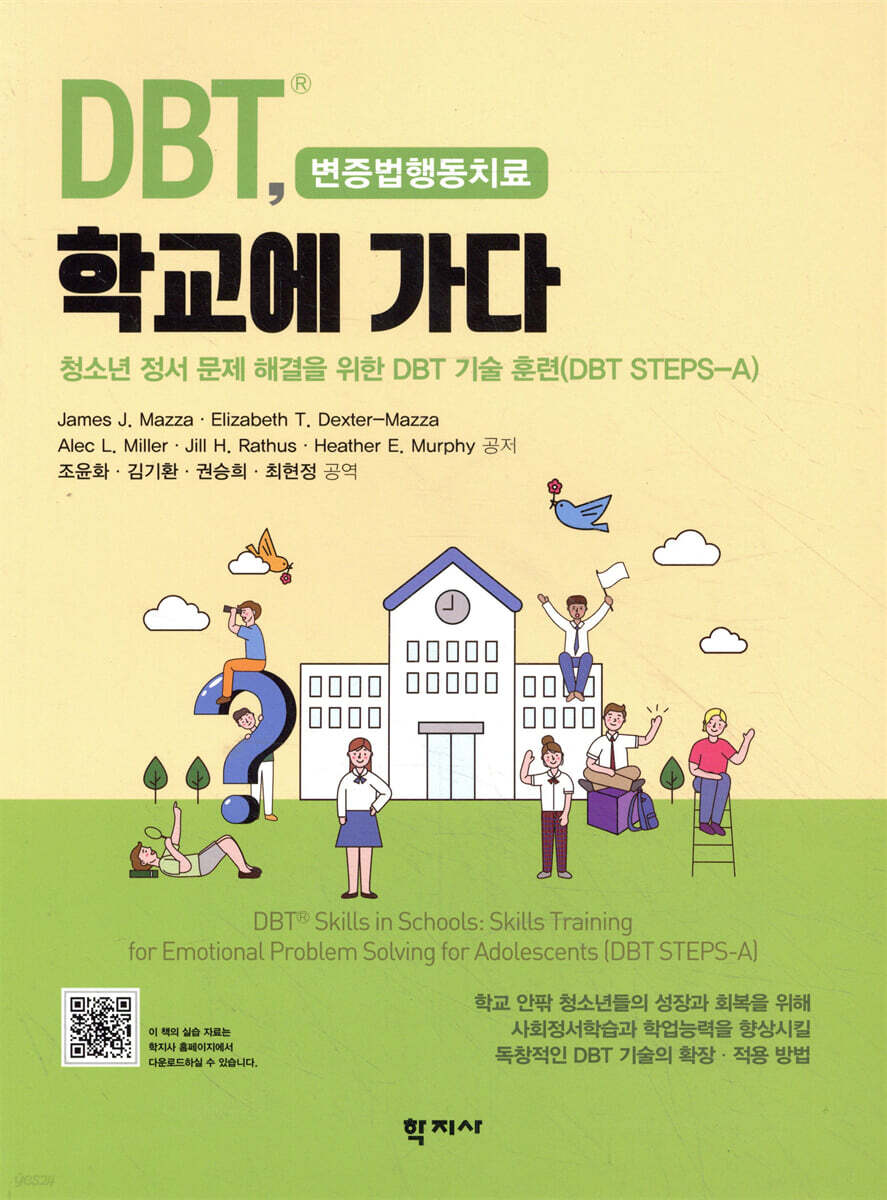
DBT, Go to School
 |
Description
Book Introduction
James, a school-based intervention specialist, and Elizabeth, a DBT specialist, each drew on their respective expertise to develop the solutions clearly outlined in this book.
The curriculum they developed is a unique Social Emotional Learning (SEL) curriculum that helps young people learn and develop emotional regulation skills, effective interpersonal strategies, and decision-making skills.
The skills taught in this course are identical to those found effective with high-risk adolescents (Mehlum et al., 2014; Miller, Rathus, & Linehan, 2007) and adults (Linehan, 1993, 2015a). Consistent with DBT and dialectical perspectives, the authors have developed a unique method for extending and applying DBT skills to all adolescents in school settings. The DBT STEPS-A curriculum is an excellent preventative approach to help all adolescents utilize DBT skills and reduce their emotional regulation difficulties.
The curriculum they developed is a unique Social Emotional Learning (SEL) curriculum that helps young people learn and develop emotional regulation skills, effective interpersonal strategies, and decision-making skills.
The skills taught in this course are identical to those found effective with high-risk adolescents (Mehlum et al., 2014; Miller, Rathus, & Linehan, 2007) and adults (Linehan, 1993, 2015a). Consistent with DBT and dialectical perspectives, the authors have developed a unique method for extending and applying DBT skills to all adolescents in school settings. The DBT STEPS-A curriculum is an excellent preventative approach to help all adolescents utilize DBT skills and reduce their emotional regulation difficulties.
index
Translator's Preface
Recommendation
Introduction
Part 1: DBT STEPS-A Overview
Chapter 1: Introduction to DBT STEPS-A
Welcome to DBT STEPS-A
Book structure
The Need for Social and Emotional Learning Curriculum for Adolescents
Existing social emotional learning curriculum
Why DBT STEPS-A?
DBT STEPS-A Curriculum Overview: Skill Modules and Subskills
conclusion
Chapter 2: Practical Issues in Schools
How to implement
Training Schedule
Curriculum Objectives
Class size and class structure
DBT STEPS-A Teacher Qualifications and Training
Unit structure
Teaching materials for students
Administrative matters
Special Rules for DBT STEPS-A Skills Classes
DBT STEPS-A Special Issues Teachers Must Address
Chapter 3: DBT STEPS-A for Struggling Students
Mediation response model
After the third stage of special education support
DBT STEPS-A within a multi-layered support system
Strategies for Students in Levels 2 and 3 of General Education
School-based mental health services at levels 1-3
DBT services that schools cannot provide
Part 2: Study Guide and Exam
Unit 1 DBT STEPS-A Course Guide
Unit 2 Dialectics
Unit 3 Mindfulness: The Wise Mind
Unit 4 Mindfulness: The "What" Skill
Unit 5 Mindfulness: How Skills
Unit 6: Embracing Pain: An Introduction to Crisis Survival Skills and the Secrets of a New Vitality
Unit 7: Wrapping Up Pain: A Box of Self-Comfort and Magical Rest
Unit 8: Wrapping Up Pain: Body Stabilization and Cryotherapy Techniques for Dealing with Extreme Emotions
Unit 9: Embracing Pain: Identifying Strengths and Weaknesses
Unit 10: Embracing Pain: Introduction to Reality Acceptance Skills and Full Acceptance
Unit 11: Embracing Pain: Turning the Mind and Being Willing
Unit 12: Embracing Suffering: Mindfulness Now (and the Embracing Suffering Test)
Unit 13 Mindfulness: The Wise Mind
Unit 14 Mindfulness: What and How Skills
Unit 15: Emotion Regulation: Goals of Emotion Regulation and the Functions of Emotions
Unit 16: Emotion Regulation: Describing Emotions
Unit 17: Emotional Regulation: Fact-Checking and Doing the Opposite
Unit 18: Emotion Regulation: Problem Solving
Unit 19: Emotional Regulation: Pride Practice - "Positive"
Unit 20: Emotional Regulation: Pride Practice - The Remaining Skills
Unit 21: Emotion Regulation: Surfing Skills - Mindful Emotions Now
Unit 22 Emotion Regulation: Emotion Regulation Test
Unit 23 Mindfulness: Review of the Wise Mind
Unit 24 Mindfulness: Reviewing the "What" and "How" Skills
Unit 25: Effective Interpersonal Relationships: Objectives and Overview
Unit 26: Effective Interpersonal Relationships: Group Negotiation Skills
Unit 27: Effective Interpersonal Relationships: Skills for Understanding and Appealing
Unit 28: Effective Interpersonal Relationships: The Golden Pendulum Technique
Unit 29: Effective Interpersonal Relationships: Examining the Conditions for Determining the Intensity of Requests and Refusals
Unit 30: Effective Interpersonal Relationships Test
Pain Wrapping Test
Pain Wrapping Test Commentary
Emotion Regulation Test
Emotion Regulation Test Commentary
Effective Interpersonal Test
Effective Interpersonal Relations Test Guide
Part 3 Student Handouts
References
Recommendation
Introduction
Part 1: DBT STEPS-A Overview
Chapter 1: Introduction to DBT STEPS-A
Welcome to DBT STEPS-A
Book structure
The Need for Social and Emotional Learning Curriculum for Adolescents
Existing social emotional learning curriculum
Why DBT STEPS-A?
DBT STEPS-A Curriculum Overview: Skill Modules and Subskills
conclusion
Chapter 2: Practical Issues in Schools
How to implement
Training Schedule
Curriculum Objectives
Class size and class structure
DBT STEPS-A Teacher Qualifications and Training
Unit structure
Teaching materials for students
Administrative matters
Special Rules for DBT STEPS-A Skills Classes
DBT STEPS-A Special Issues Teachers Must Address
Chapter 3: DBT STEPS-A for Struggling Students
Mediation response model
After the third stage of special education support
DBT STEPS-A within a multi-layered support system
Strategies for Students in Levels 2 and 3 of General Education
School-based mental health services at levels 1-3
DBT services that schools cannot provide
Part 2: Study Guide and Exam
Unit 1 DBT STEPS-A Course Guide
Unit 2 Dialectics
Unit 3 Mindfulness: The Wise Mind
Unit 4 Mindfulness: The "What" Skill
Unit 5 Mindfulness: How Skills
Unit 6: Embracing Pain: An Introduction to Crisis Survival Skills and the Secrets of a New Vitality
Unit 7: Wrapping Up Pain: A Box of Self-Comfort and Magical Rest
Unit 8: Wrapping Up Pain: Body Stabilization and Cryotherapy Techniques for Dealing with Extreme Emotions
Unit 9: Embracing Pain: Identifying Strengths and Weaknesses
Unit 10: Embracing Pain: Introduction to Reality Acceptance Skills and Full Acceptance
Unit 11: Embracing Pain: Turning the Mind and Being Willing
Unit 12: Embracing Suffering: Mindfulness Now (and the Embracing Suffering Test)
Unit 13 Mindfulness: The Wise Mind
Unit 14 Mindfulness: What and How Skills
Unit 15: Emotion Regulation: Goals of Emotion Regulation and the Functions of Emotions
Unit 16: Emotion Regulation: Describing Emotions
Unit 17: Emotional Regulation: Fact-Checking and Doing the Opposite
Unit 18: Emotion Regulation: Problem Solving
Unit 19: Emotional Regulation: Pride Practice - "Positive"
Unit 20: Emotional Regulation: Pride Practice - The Remaining Skills
Unit 21: Emotion Regulation: Surfing Skills - Mindful Emotions Now
Unit 22 Emotion Regulation: Emotion Regulation Test
Unit 23 Mindfulness: Review of the Wise Mind
Unit 24 Mindfulness: Reviewing the "What" and "How" Skills
Unit 25: Effective Interpersonal Relationships: Objectives and Overview
Unit 26: Effective Interpersonal Relationships: Group Negotiation Skills
Unit 27: Effective Interpersonal Relationships: Skills for Understanding and Appealing
Unit 28: Effective Interpersonal Relationships: The Golden Pendulum Technique
Unit 29: Effective Interpersonal Relationships: Examining the Conditions for Determining the Intensity of Requests and Refusals
Unit 30: Effective Interpersonal Relationships Test
Pain Wrapping Test
Pain Wrapping Test Commentary
Emotion Regulation Test
Emotion Regulation Test Commentary
Effective Interpersonal Test
Effective Interpersonal Relations Test Guide
Part 3 Student Handouts
References
Publisher's Review
Strategies to improve your life,
Welcome to DBT STEPS-A!
DBT techniques were first published in book form in 1993. They were originally developed for high-risk individuals with complex disorders that made it difficult for them to function effectively and manage their emotions.
For years, these techniques were widely used with adults, and later with adolescents experiencing similar difficulties. It took a long time for DBT techniques to be recognized as useful for everyone.
When I began conducting DBT skills training for friends and family members of patients who struggle with emotional regulation and general functioning, and for parents of children who struggle with similar challenges, I discovered that DBT skills have a wide range of applicability.
Later, we learned that companies were also interested in DBT techniques, and that parents wanted DBT techniques taught in schools.
In summary, although it took a long time, it is becoming increasingly clear that DBT techniques can be helpful to the general public.
But at the same time, an important problem arose.
The question was, 'How can we teach these skills to the public?'
Teaching this skill to adults wasn't difficult.
When training opportunities were created, many adults participated.
Even adolescents experiencing psychological difficulties did not find it difficult to participate.
Once they found out about our program, they also came to us often.
Many parents and students said they would like to learn the technology at their schools as well.
However, deciding whether to involve children who do not struggle emotionally and children who struggle emotionally at the same time has been a difficult problem and one we have been working to solve.
James, a school-based intervention specialist, and Elizabeth, a DBT specialist, each drew on their respective expertise to develop the solutions clearly outlined in this book.
The curriculum they developed is a unique Social Emotional Learning (SEL) curriculum that helps young people learn and develop emotional regulation skills, effective interpersonal strategies, and decision-making skills.
The skills taught in this course are identical to those found effective with high-risk adolescents (Mehlum et al., 2014; Miller, Rathus, & Linehan, 2007) and adults (Linehan, 1993, 2015a). Consistent with DBT and dialectical perspectives, the authors have developed a unique method for extending and applying DBT skills to all adolescents in school settings. The DBT STEPS-A curriculum is an excellent preventative approach to help all adolescents utilize DBT skills and reduce their emotional regulation difficulties.
One of the primary goals of developing DBT STEPS-A was to help adolescents develop effective behavioral strategies, or “life-enhancing” strategies.
We use the term "life-enhancing" because the skills taught in this course, when used in the right way and at the right time, can have a profound impact on the individual student beyond simply solving their current problem.
Adolescents will be able to utilize these skills to address important life challenges ahead, such as staying in school, applying to college, managing romantic relationships, and maintaining a good job. DBT STEPS-A helps adolescents learn and practice these skills before making decisions that have significant consequences in their lives.
We hope that DBT STEPS-A will provide adolescents with the tools and strategies to manage difficult emotional situations and make better decisions in challenging situations.
The translation is as faithful to the original English text as possible, but three changes have been made to accommodate Korean readers.
First, the names of the main characters in the examples in the learning guide were changed to Korean names.
Second, we changed class activities that would be difficult to do if you are not familiar with American culture into activities that our youth can easily do.
For example, in the mindfulness practice in Unit 20, the original book had students singing “Take Me Out to the Ball Game,” the national anthem of American baseball stadiums. However, this song was changed to “Cotton Candy,” which most Korean youth can easily sing.
Third, the names of skills created with abbreviations were changed to Korean abbreviations to make them easier to remember (e.g., the name of the effective interpersonal skills ‘DEAR MAN’ was translated to ‘Gipyojubo Collective Negotiation’).
If the English names of the technologies were used as they are, it would be difficult to acquire the technologies because each alphabet would also have to be memorized in English. Therefore, in 2017, Yunhwa Jo, Hyunjeong Choi, Seunghee Kwon, and Suhyeon Jo came up with Korean names for the technologies, and most of the names created at that time were used in the translation of this book.
Welcome to DBT STEPS-A!
DBT techniques were first published in book form in 1993. They were originally developed for high-risk individuals with complex disorders that made it difficult for them to function effectively and manage their emotions.
For years, these techniques were widely used with adults, and later with adolescents experiencing similar difficulties. It took a long time for DBT techniques to be recognized as useful for everyone.
When I began conducting DBT skills training for friends and family members of patients who struggle with emotional regulation and general functioning, and for parents of children who struggle with similar challenges, I discovered that DBT skills have a wide range of applicability.
Later, we learned that companies were also interested in DBT techniques, and that parents wanted DBT techniques taught in schools.
In summary, although it took a long time, it is becoming increasingly clear that DBT techniques can be helpful to the general public.
But at the same time, an important problem arose.
The question was, 'How can we teach these skills to the public?'
Teaching this skill to adults wasn't difficult.
When training opportunities were created, many adults participated.
Even adolescents experiencing psychological difficulties did not find it difficult to participate.
Once they found out about our program, they also came to us often.
Many parents and students said they would like to learn the technology at their schools as well.
However, deciding whether to involve children who do not struggle emotionally and children who struggle emotionally at the same time has been a difficult problem and one we have been working to solve.
James, a school-based intervention specialist, and Elizabeth, a DBT specialist, each drew on their respective expertise to develop the solutions clearly outlined in this book.
The curriculum they developed is a unique Social Emotional Learning (SEL) curriculum that helps young people learn and develop emotional regulation skills, effective interpersonal strategies, and decision-making skills.
The skills taught in this course are identical to those found effective with high-risk adolescents (Mehlum et al., 2014; Miller, Rathus, & Linehan, 2007) and adults (Linehan, 1993, 2015a). Consistent with DBT and dialectical perspectives, the authors have developed a unique method for extending and applying DBT skills to all adolescents in school settings. The DBT STEPS-A curriculum is an excellent preventative approach to help all adolescents utilize DBT skills and reduce their emotional regulation difficulties.
One of the primary goals of developing DBT STEPS-A was to help adolescents develop effective behavioral strategies, or “life-enhancing” strategies.
We use the term "life-enhancing" because the skills taught in this course, when used in the right way and at the right time, can have a profound impact on the individual student beyond simply solving their current problem.
Adolescents will be able to utilize these skills to address important life challenges ahead, such as staying in school, applying to college, managing romantic relationships, and maintaining a good job. DBT STEPS-A helps adolescents learn and practice these skills before making decisions that have significant consequences in their lives.
We hope that DBT STEPS-A will provide adolescents with the tools and strategies to manage difficult emotional situations and make better decisions in challenging situations.
The translation is as faithful to the original English text as possible, but three changes have been made to accommodate Korean readers.
First, the names of the main characters in the examples in the learning guide were changed to Korean names.
Second, we changed class activities that would be difficult to do if you are not familiar with American culture into activities that our youth can easily do.
For example, in the mindfulness practice in Unit 20, the original book had students singing “Take Me Out to the Ball Game,” the national anthem of American baseball stadiums. However, this song was changed to “Cotton Candy,” which most Korean youth can easily sing.
Third, the names of skills created with abbreviations were changed to Korean abbreviations to make them easier to remember (e.g., the name of the effective interpersonal skills ‘DEAR MAN’ was translated to ‘Gipyojubo Collective Negotiation’).
If the English names of the technologies were used as they are, it would be difficult to acquire the technologies because each alphabet would also have to be memorized in English. Therefore, in 2017, Yunhwa Jo, Hyunjeong Choi, Seunghee Kwon, and Suhyeon Jo came up with Korean names for the technologies, and most of the names created at that time were used in the translation of this book.
GOODS SPECIFICS
- Publication date: February 10, 2022
- Page count, weight, size: 632 pages | 1,236g | 188*255*30mm
- ISBN13: 9788999725807
- ISBN10: 8999725804
You may also like
카테고리
korean


korean

![GQ KOREA Mark (Monthly): December [2025]](http://librairie.coreenne.fr/cdn/shop/files/8ef265dbbfbf186523ed75ba7319009d.jpg?v=1765340328&width=3840)


